
Tu cuerpo produce GHK-Cu, y luego reduce su producción. Entre los 20 y los 60 años, los niveles plasmáticos de péptidos de cobre disminuyen aproximadamente un 60% ; de unos 200 ng/mL a 80 ng/mL. La piel pierde firmeza. Los folículos comienzan a encogerse. Las heridas cicatrizan más lentamente. El GHK-Cu es la señal de reparación que tu cuerpo consume silenciosamente. Los péptidos de cobre son cadenas cortas de aminoácidos unidas a un ion de cobre (Cu²⁺) que indican a las células que remodelen, reparen y protejan los tejidos. El GHK-Cu es la forma más estudiada. Es una señal biológica que reactiva las vías de reparación que ya tienes. En el programa Longevity del Dr. Terziler, mapeamos aproximadamente 750 000 variantes en el panel estándar y el genoma completo de 3 000 millones de letras en el plan Ultimate Longevity; rastreamos tres generaciones del árbol genealógico y construimos un plan de reinicio de un año a partir de ahí.
RESUMEN
- GHK-Cu es un tripéptido unido al cobre compuesto por los aminoácidos glicina, histidina y lisina.
- Los péptidos de cobre reestructuran el colágeno, alivian la inflamación, producen nuevos capilares, activan enzimas antioxidantes y regulan más de 4.000 genes.
- Péptidos de cobre para la piel: firmeza, mejora de las cicatrices, unificación del tono de la piel.
- Péptido de cobre para el cabello: favorece el entorno del folículo, especialmente después de la microaguja, el plasma rico en plaquetas (PRP) o el trasplante capilar.
- El GHK-Cu afecta al menos a 4 de los 12 signos de envejecimiento identificados por López-Otín et al. (Cell, 2013 y 2023).
- El péptido de cobre no es un bloqueador de DHT.
- El péptido de cobre de uso tópico debe utilizarse a una concentración del 1% al 3%, con un rango de pH de 5,0 a 6,0.
¿Qué es el péptido de cobre?
Los péptidos de cobre son cadenas cortas de aminoácidos unidas a un ion de cobre (Cu²⁺) que envían señales a las células para la reparación, remodelación y protección de los tejidos.
GHK-Cu es un tripéptido compuesto por los aminoácidos glicina, histidina y lisina, unidos al cobre (Cu²⁺), y presente de forma natural en el plasma, la saliva y la orina humanas. Fue identificado en 1973 por el bioquímico Loren Pickart al observar que el plasma joven favorecía la regeneración del tejido hepático envejecido. Esta molécula es la responsable de este efecto. También se la conoce como tripéptido de cobre-1, Cu-GHK y péptido de cobre GHK-Cu. Número CAS: 49557-75-7.
Los niveles plasmáticos de GHK-Cu disminuyen de aproximadamente 200 ng/mL a los 20 años a aproximadamente 80 ng/mL a los 60 años (una disminución del 60%) . La menor síntesis hepática, la reducción de la biodisponibilidad del cobre y la ralentización del ciclo de péptidos contribuyen a este descenso. Esta disminución se manifiesta como piel más fina, cicatrización de heridas más lenta y atrofia folicular. La reevaluación tópica es la clave de la solución cosmética.
¿Son todos los péptidos de cobre la misma molécula?
No. El GHK-Cu es el más estudiado, pero esta categoría también incluye variedades como el AHK-Cu (alanina-histidina-lisina, un tipo comercializado para el cabello) y mezclas más grandes de péptidos de cobre azul. Consulte la sección INCI en la etiqueta del suero: el tripéptido de cobre-1 es el ingrediente que ha sido validado clínicamente.
¿Cómo funciona el péptido de cobre?
Los péptidos de cobre actúan a través de cinco mecanismos interrelacionados, cada uno de los cuales corresponde a un resultado clínico específico.
GHK-Cu estimula la producción de colágeno, elastina y glicosaminoglicanos (GAG), reconstruyendo la matriz dérmica que tensa la piel y mantiene los folículos en su lugar. La salud de un folículo depende de la salud del tejido que lo rodea. Cuando la matriz se daña, la piel se cae y el cabello se debilita.
Los péptidos de cobre reducen los niveles de las citocinas inflamatorias IL-6 y TNF-α e incrementan la actividad de la superóxido dismutasa (SOD), una enzima clave de la defensa antioxidante. La inflamación crónica de bajo grado, denominada “inflamación asociada al envejecimiento”, es responsable de gran parte del envejecimiento visible. Menos radicales libres significan menos daño al ADN y al colágeno con el tiempo.
Los péptidos de cobre aumentan el VEGF (Factor de Crecimiento Endotelial Vascular), principal factor de crecimiento para la formación de nuevos capilares en la dermis y el cuero cabelludo. Un mayor número de capilares transporta más oxígeno y nutrientes a las células desnutridas. Los folículos debilitados y la piel apagada responden no solo a la hidratación superficial, sino también a una mayor circulación sanguínea.
¿Realmente el péptido de cobre regula más de 4.000 genes?
Un análisis de expresión génica realizado en 2010 por el Broad Institute demostró que el GHK regula más de 4000 genes humanos, incluyendo genes de señalización Wnt, factores de crecimiento y colágeno. Aproximadamente 2000 genes se activaron, mientras que otros 2000 se reprimieron; la mayoría estaban asociados con la inflamación y la fibrosis. Por lo tanto, el GHK-Cu tiene efectos sobre la piel, el cabello, la cicatrización de heridas y la reparación de tejidos.
El estudio original de Pickart demostró que el GHK-Cu acelera la reepitelización y reduce las cicatrices. Su efecto cicatrizante explica por qué se utiliza en el tratamiento de cicatrices de acné, estrías y en la recuperación postoperatoria. Los departamentos de dermatología emplean esta sustancia con el mismo fin tras tratamientos como la microaguja, el rejuvenecimiento con láser y el trasplante capilar.
¿Cómo se relaciona el péptido de cobre con 12 signos de envejecimiento?
En 2013, Carlos López-Otín y sus colegas publicaron un estudio en la revista Cell titulado « Características distintivas del envejecimiento», en el que identificaron nueve vías celulares que rigen el envejecimiento. Una actualización de 2023 («Características distintivas del envejecimiento: un universo en expansión» ) amplió esta lista a doce. El programa Longevity del Dr. Terziler actúa contra estas doce vías. El GHK-Cu afecta al menos a cuatro de ellas, posiblemente a más.
| Síntoma | Significado | El papel del GHK-Cu |
| Inflamación crónica (inflamación asociada al envejecimiento) | Inflamación persistente de bajo grado que daña los tejidos. | Reduce los niveles de IL-6 y TNF-α. Tiene un efecto antiinflamatorio directo. |
| Cambios epigenéticos | Trastornos de la expresión génica relacionados con la edad | Regula más de 4.000 genes, incluidas las vías de señalización Wnt y del colágeno. |
| Disfunción mitocondrial | Los radicales libres aumentan y la energía celular disminuye. | La SOD activa las defensas antioxidantes y reduce los radicales libres. |
| trastorno de la comunicación intercelular | Las células dejan de comunicarse eficazmente entre sí. | Restablece la señalización del VEGF y la cascada de citoquinas para la cicatrización de heridas. |
| Pérdida de la proteostasis | Las proteínas dañadas se acumulan. | Favorece el equilibrio de las metaloproteinasas de matriz (MMP). Limpia el colágeno dañado y genera colágeno nuevo. |
Ninguna molécula por sí sola corregirá los doce síntomas. Los paquetes de suplementos generales no son adecuados para todos los pacientes. El programa Longevity del Dr. Terziler comienza con un panel genético de aproximadamente 750 000 variantes en el plan estándar y el genoma completo de 3 000 millones de letras en el plan Ultimate, rastreando el árbol genealógico hasta tres generaciones atrás. Basándose en este mapa, el tratamiento de cada paciente se personaliza: GHK-Cu tópico para la matriz y el envejecimiento inflamatorio, microagujas o PRP para la administración, antioxidantes orales específicos y moléculas senolíticas para síntomas que el tratamiento tópico no puede alcanzar (disfunción mitocondrial, envejecimiento celular, acortamiento de los telómeros), nutrición a cargo de un dietista especializado en genética y un plan de entrenamiento a cargo de un entrenador deportivo que le informa sobre su perfil poligénico. Cada componente actúa de manera diferente y el plan se reconstruye según su genoma.
¿Qué efectos tiene el péptido de cobre en la piel?
Los péptidos de cobre favorecen el proceso de cuidado antienvejecimiento de la piel; su uso tópico regular durante 8 a 16 semanas mejora la firmeza, la textura, el tono y la calidad de la barrera cutánea.
Líneas de expresión, arrugas y firmeza de la piel: Los péptidos de cobre estimulan la producción de colágeno y elastina en la dermis, mejorando la firmeza, las líneas de expresión y la textura de la piel. Los cambios son sutiles y progresivos, no se observan resultados inmediatos. La mayoría de los usuarios notan una mejoría significativa alrededor de la semana 12.
Bolsas, hinchazón y papada bajo los ojos: Los péptidos de cobre fortalecen la delicada zona periorbital, donde el colágeno se adelgaza con mayor rapidez. Las cremas para el contorno de ojos y las mascarillas de hidrogel con péptidos que contienen GHK-Cu reafirman esta zona y suavizan las líneas de expresión. No drenan las bolsas debajo de los ojos llenas de líquido estructural.
Cicatrices de acné, estrías y queloides: Los péptidos de cobre favorecen la cicatrización y pueden reducir la apariencia de las cicatrices de acné, las estrías y las cicatrices quirúrgicas. El efecto es más pronunciado en cicatrices recientes que aún se están remodelando, generalmente durante los primeros 12 meses. Las cicatrices queloides responden con menor frecuencia y requieren atención dermatológica.
Hiperpigmentación, melasma y tono de piel irregular: Los péptidos de cobre actúan indirectamente sobre la hiperpigmentación postinflamatoria al calmar la inflamación y acelerar la renovación celular. No son inhibidores de la tirosinasa. Para el melasma activo, úselo en combinación con ácido azelaico o ácido tranexámico bajo la supervisión de un dermatólogo.
Rosácea, piel sensible y reactiva: Los péptidos de cobre se toleran bien en pieles con tendencia a la rosácea, ya que no desencadenan, sino que reducen, las vías inflamatorias. Comience con una concentración del 1 %. Realice una prueba de parche después de una semana. Suspenda su uso si aumenta el enrojecimiento.
¿Qué efectos tiene el péptido de cobre en el cabello?
Los péptidos de cobre por sí solos no promueven el crecimiento del cabello. Favorecen el entorno folicular y pueden potenciar los resultados de tratamientos probados como minoxidil, finasterida, microagujas, plasma rico en plaquetas (PRP) o trasplante capilar. GHK-Cu no estimula el crecimiento del cabello, sino que optimiza el entorno del cuero cabelludo.
Los péptidos de cobre no son bloqueadores significativos de la DHT. Si bien algunos datos in vitro sugieren una leve modulación de la 5-alfa reductasa, ningún estudio clínico ha demostrado la supresión de la DHT a niveles similares a los de la finasterida. GHK-Cu es un tratamiento de apoyo, no un sustituto, para la alopecia genética inducida por la DHT.
Uso de péptidos de cobre después de microagujas, PRP o trasplante capilar.
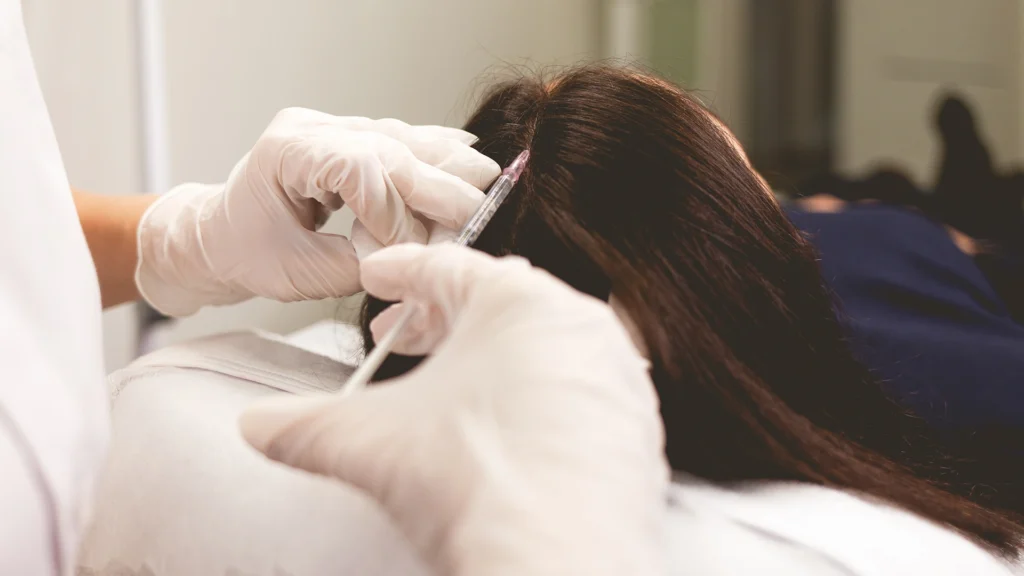
Según una investigación de 2023 sobre microemulsiones de líquidos iónicos, la aplicación tópica de GHK-Cu tras la microaguja penetra aproximadamente tres veces más profundamente en el folículo que la aplicación sola. Espere 48 horas después del PRP y, a continuación, aplique GHK-Cu tópico durante todo el periodo de regeneración. Su uso está contraindicado entre los días 0 y 10 posteriores al trasplante capilar. Entre los días 10 y 14 , cuando los injertos se han estabilizado y la formación de costras ha desaparecido, el GHK-Cu puede favorecer la reparación de la matriz y aliviar cualquier inflamación residual. Siga el protocolo de su cirujano.
¿El péptido de cobre estimula el crecimiento de la barba o las pestañas?
La evidencia es anecdótica. En teoría, cabría esperar que la lógica de la matriz y la angiogénesis que funciona en el cuero cabelludo también funcionara en los folículos faciales y de las pestañas; sin embargo, ningún estudio controlado ha demostrado ningún beneficio específico para los folículos de la barba o las pestañas.
¿Pueden los péptidos de cobre revertir las canas?
No existe evidencia clínica sólida de que los péptidos de cobre por sí solos reviertan las canas. Existen informes anecdóticos. Los estudios controlados no confirman la repigmentación. Considere esta afirmación como no comprobada.
¿Cómo deben utilizarse los péptidos de cobre?
Al usar péptidos de cobre, elija productos que contengan entre un 1 % y un 3 % de GHK-Cu (tripéptido de cobre-1) en un frasco opaco y hermético con un pH entre 5,0 y 6,0. Las concentraciones inferiores al 1 % son ineficaces. Las concentraciones superiores al 3 % no ofrecen beneficios adicionales comprobados y pueden ser irritantes . Es más importante una formulación estable que buscar porcentajes más altos.
¿Deben aplicarse los péptidos de cobre por la mañana o por la noche?
Una vez al día es suficiente. La mayoría de los usuarios lo aplican por la noche para evitar que se solape con la vitamina C o los protectores solares activos. Aplique una o dos pulsaciones sobre la piel o el cuero cabelludo limpios y ligeramente húmedos, no enjuague y aplique crema hidratante después.
¿Cuándo se verán los resultados?
Los cambios en el tono de la piel, la hidratación y las líneas de expresión suelen aparecer entre las 8 y las 12 semanas de uso regular . La firmeza y la mejora de las cicatrices se acumulan a lo largo de 3 a 6 meses . Los cambios en el ciclo capilar tardan más porque los folículos rotan por fases; por lo tanto, evalúe su estado a partir de los 6 meses.
Péptidos de cobre tópicos, inyectables u orales: ¿Qué método funciona mejor?
La vía tópica es la clínicamente validada. El GHK-Cu inyectado se usa fuera de indicación en la mayoría de los países y no está en la categoría de productos de consumo. Los péptidos orales se degradan en el intestino, por lo que la biodisponibilidad de la señalización completa del GHK-Cu es muy baja. Se recomienda la vía tópica.
¿Con qué no se debe mezclar el péptido de cobre?
El cobre se adhiere con fuerza. Esa es su esencia. Se vuelve inestable cuando se aplica con ciertos principios activos en la misma rutina. Úselos de forma alternada en lugar de abandonarlos.
| Contenido | ¿La misma rutina? | Cómo superponer capas |
| Ácido hialurónico, niacinamida, bakuchiol, matrixyl | Sí | El orden no importa, se pueden superponer libremente. |
| protector solar | Sí (mañana) | Aplicar al final, FPS 30+ |
| Vitamina C (ácido L-ascórbico) | De | Vitamina C por la mañana, GHK-Cu por la noche. |
| Retinol, retinal, tretinoína | De | Noches alternas o distinción entre mañana y tarde |
| AHA (glicólico, láctico) / BHA (salicílico) | De | Exfolia dos veces por semana, pero omite el GHK-Cu esa noche. |
| peróxido de benzoilo | No lo uses el mismo día. | Óxidos de cobre, divididos en días separados. |
| ácido azelaico | Con cuidado | En días alternos |
| Microneedling, PRP, mesoterapia | Se recomienda hacerlo después. | Solicite de inmediato o después de 48 horas. |
| Minoxidil (para el cabello) | Sí | Primero minoxidil, y 20 minutos después GHK-Cu. |
¿Es seguro el péptido de cobre?
Los péptidos de cobre de aplicación tópica suelen ser bien tolerados. La mayoría de los efectos secundarios son leves y transitorios.
¿Qué son los “Copper Uglies”?
La fase de limpieza de 2 a 4 semanas después de comenzar a usar péptidos de cobre puede presentar opacidad, descamación o tendencia al acné, ya que la renovación celular se acelera y las metaloproteinasas de la matriz eliminan el tejido dañado . Esto suele resolverse con el uso regular. El acné que persiste después de 6 semanas no es típico de una limpieza. Suspenda su uso y revise su rutina.
¿Por qué el péptido de cobre a veces “arruina” la piel?
Los péptidos de cobre rara vez dañan la piel por sí solos. Generalmente, hay tres causas: altas concentraciones (superiores al 3%) , combinarlos con ácido L-ascórbico, vitamina C o retinoides potentes en la misma rutina, o aplicarlos sobre una barrera cutánea dañada. Vuelva a la concentración del 1%, alterne los ingredientes activos y repare primero la barrera cutánea.
¿Es seguro el péptido de cobre durante el embarazo o la lactancia?
Los péptidos de cobre de uso cosmético tópico generalmente se consideran de bajo riesgo durante el embarazo debido a su mínima absorción cutánea; sin embargo, la información sobre su seguridad es limitada. No se recomienda la inyección de GHK-Cu durante el embarazo ni la lactancia. Consulte con su obstetra antes de comenzar a usar cualquier ingrediente activo nuevo.
¿Quiénes deberían evitar por completo el GHK-Cu?
No lo use si padece la enfermedad de Wilson u otro trastorno del metabolismo del cobre, una infección activa en el cuero cabelludo o la piel, o una alergia conocida al cobre. En la mayoría de los países, su uso inyectable no está autorizado. Los péptidos de cobre no están aprobados por la FDA como fármacos.
¿Qué se ha demostrado y qué no se ha demostrado con respecto al péptido de cobre?
Se ha demostrado que ayuda en la cicatrización de heridas, la remodelación de la matriz dérmica, la defensa antioxidante mediante la activación de la SOD, la angiogénesis, la supresión de citocinas antiinflamatorias y la modulación genética extensa. Se basa en gran medida en décadas de investigación de Pickart et al.
Aún en investigación. Entre sus aplicaciones se incluyen el crecimiento del cabello, la reversión de arrugas, la modulación de la DHT, la penetración profunda del folículo sin agujas y la repigmentación de las canas. Se han observado señales prometedoras en estudios pequeños, pero no se han realizado ensayos controlados aleatorizados a gran escala. Un estudio piloto abierto realizado en 2025 reportó un crecimiento del cabello del 26,5 % tras cinco meses de sesiones con péptido de cobre y microagujas. El número de participantes fue reducido. Es necesario repetirlo.
¿Cómo encaja el péptido de cobre en el Protocolo Longevity del Dr. Terziler?
El programa Longevity no comienza con un suero. Empieza con una muestra de saliva y análisis de sangre. La secuenciación se realiza antes de recetar cualquier producto tópico.
- Paso 1: Mapeo genético. Muestra de saliva y análisis de sangre. El programa estándar analiza aproximadamente 750 000 variantes, mientras que el programa Ultimate Longevity analiza el genoma completo, que contiene 3000 millones de letras. Mapeamos el árbol genealógico hasta tres generaciones atrás, ya que el riesgo hereditario rara vez reside en un solo gen.
- Paso: Interpretación clínica en lugar de resultados algorítmicos. El Prof. Dr. Hakan Cangül revisa personalmente el panel. No publicamos informes generados por máquinas que pretendan resumir once órganos con 131 parámetros. La biología no funciona así. Ningún médico honesto le diría a un paciente: “Tiene un 65 % de riesgo de cáncer cerebral”, basándose en datos brutos de SNP. El riesgo relativo genético realista suele rondar el 15 % y solo tiene sentido si existe un fuerte historial familiar. En biología, nada se basa en una sola variante.
- Paso: Un reinicio de un año, seguido de un seguimiento de por vida. Los resultados iniciales están disponibles al mes, los ajustes se realizan al mes y los valores de referencia cambian durante el primer año. Los pacientes permanecen en el programa de por vida.
¿Qué lugar ocupa GHK-Cu en este protocolo?
GHK-Cu es un agente tópico, no el tratamiento en sí. Aplique suero de GHK-Cu al 1% o 3% diariamente para reducir la inflamación, reparar la matriz y modular la expresión génica. Aplíquelo inmediatamente después de la microaguja para beneficiarse de una penetración aproximadamente 3 veces más profunda gracias a los nuevos microcanales. Aplique en capas entre 24 y 48 horas después de la mesoterapia o el PRP para extender la ventana regenerativa. Después del trasplante capilar robótico DHI, comience entre los días 10 y 14 con la aprobación del cirujano para promover la integración de los injertos y aliviar la inflamación restante.
GHK-Cu no es para todos los síntomas. Para la disfunción mitocondrial, la senescencia celular y el acortamiento de los telómeros, añade antioxidantes orales y moléculas senolíticas (NMN, trans-resveratrol, quercetina, fisetina, astragalósido IV, cicloastragenol, NAC, CoQ10, vitaminas suplementarias) seleccionadas según el perfil de variante de su programa.
El programa se desarrolla con grupos definidos: uno masculino, uno femenino, uno centrado en la piel (dirigido por el Dr. Kürşat Yalvaç) y un subprograma de reinicio basado en aproximadamente 700 variaciones relacionadas con la edad biológica, el cabello, la piel y la nutrición. La orientación nutricional la proporciona una dietista especializada en genética. El entrenamiento lo imparte un entrenador deportivo que te informa sobre tu perfil poligénico.
¿Por qué es importante? El trasplante capilar puede hacer que una persona de 50 años parezca de 40. La genética es clave para que el resto del cuerpo funcione como el de una persona de 40 años: energía, sueño, recuperación, calidad de la piel, función sexual. La medicina tradicional se centra en mantener a las personas con vida. Longevity se centra en mantenerlas dinámicas a lo largo de toda su vida.
Preguntas frecuentes
¿Para qué se utiliza el péptido de cobre?
Los péptidos de cobre estimulan la producción de colágeno, elastina y GAG en la dermis, reafirmando la piel, suavizando las líneas de expresión y mejorando el equilibrio de hidratación. Además, reducen la inflamación y favorecen la cicatrización de heridas, lo cual resulta beneficioso para las cicatrices del acné, las estrías y la recuperación tras tratamientos estéticos.
¿El péptido de cobre causa acné?
Algunos usuarios experimentan una fase de “limpieza con cobre” que dura de 2 a 4 semanas; pueden aparecer opacidad o pequeños granitos en la piel a medida que se acelera la renovación celular. Esto suele desaparecer con el uso regular. Los granitos que persisten después de 6 semanas no son normales.
¿Se puede utilizar el péptido de cobre junto con la vitamina C?
Algunos usuarios experimentan una fase de “limpieza con cobre” que dura de 2 a 4 semanas; pueden aparecer opacidad o pequeños granitos en la piel a medida que se acelera la renovación celular. Esto suele desaparecer con el uso regular. Los granitos que persisten después de 6 semanas no son normales.
¿Se puede utilizar el péptido de cobre junto con la niacinamida?
Sí. La niacinamida y el péptido de cobre son compatibles. Aplique primero la niacinamida, espere 30 segundos y luego aplique el suero de péptido de cobre.
¿El péptido de cobre favorece el crecimiento del cabello?
El péptido de cobre por sí solo no promueve de forma fiable el crecimiento del cabello. Favorece el entorno folicular y mejora los resultados de tratamientos probados como el minoxidil, la finasterida, la microaguja, el plasma rico en plaquetas (PRP) o el trasplante capilar.