

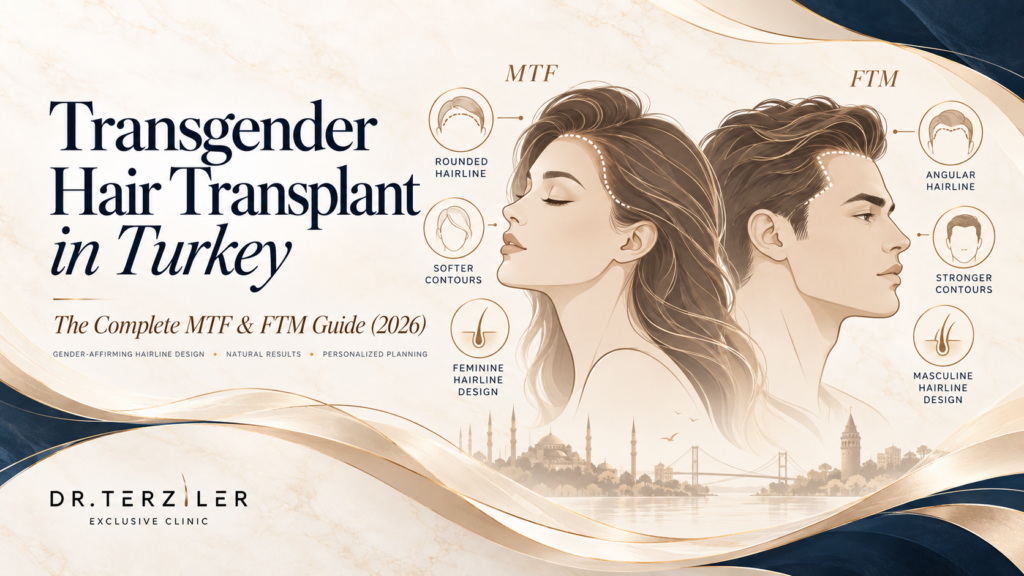
A transgender hair transplant is a gender-affirming surgical procedure that moves a person’s own permanent donor follicles to reshape the hairline and restore density so the result aligns with their gender identity. For trans women (MTF) this usually means feminizing the hairline: lowering it, rounding the corners, and erasing male-pattern temple recession. For trans men (FTM) it means masculinizing the hairline and building facial hair such as a beard, moustache or sideburns. At Dr. Terziler Exclusive Clinic in Istanbul the procedure is doctor-led, AACI-accredited and LGBTQ+ inclusive, with 90 to 97% graft survival (general) and 98.1% for Picasso Robotic DHI (n=120, 12-month photography), starting from €4,000 all-inclusive (about $4,300), against $25,000 to $40,000 charged by specialized gender-affirming hair clinics in the United States.

ПРЕГЛЕДАНО ОТ МЕДИЦИНСКИ СПЕЦИАЛИСТ
Д-р Сервет Терзилер
AACI Accredited Surgeon, ISHRS Member and Inventor of Robotic DHI
Last medically reviewed: October 2026
TL;DR: Transgender Hair Transplant at a Glance
| What is it? | A permanent, same-day surgery that relocates your own follicles to feminize (MTF) or masculinize (FTM) the hairline, or to build beard and body hair. |
| Is it gender-affirming care? | Yes. WPATH Standards of Care 8 recognises hair restoration for androgenic alopecia and facial-hair goals as part of gender-affirming treatment. |
| MTF goal | A lower, rounded, oval hairline with no temple recession and a soft, natural density. |
| FTM goal | A stronger, more angular hairline plus beard, moustache and sideburn density using scalp-donor hair. |
| Does HRT regrow hair? | HRT can slow or stop loss and thicken active follicles, but it cannot regrow fully lost hair or move the hairline. A transplant does that. |
| Cost (2026) | From €4,000 to €10,000 all-inclusive in Turkey (about $4,300 to $10,800) vs $25,000 to $40,000 for MTF feminization in the US. |
| Техника | DHI / unshaven DHI / Robotic DHI with a Choi pen for precise angle control, essential for a natural feminine or facial hairline. |
| Краен резултат | 12 to 14 months, documented with standardised before-and-after photography. |
What Is a Transgender (Gender-Affirming) Hair Transplant?
A transgender hair transplant is a hair restoration procedure that uses a patient’s own follicles to bring the hairline, density and facial hair into alignment with their gender identity. Across the field, the gender-affirming hair procedures most often requested are female hairline feminization, beard and eyebrow transplantation, surgical hairline lowering, and body-hair transplantation (Gender-affirming hair procedures, Operative Techniques in Otolaryngology-HNS, 2023). It is not a single operation but a toolkit matched to each person’s anatomy and goals.
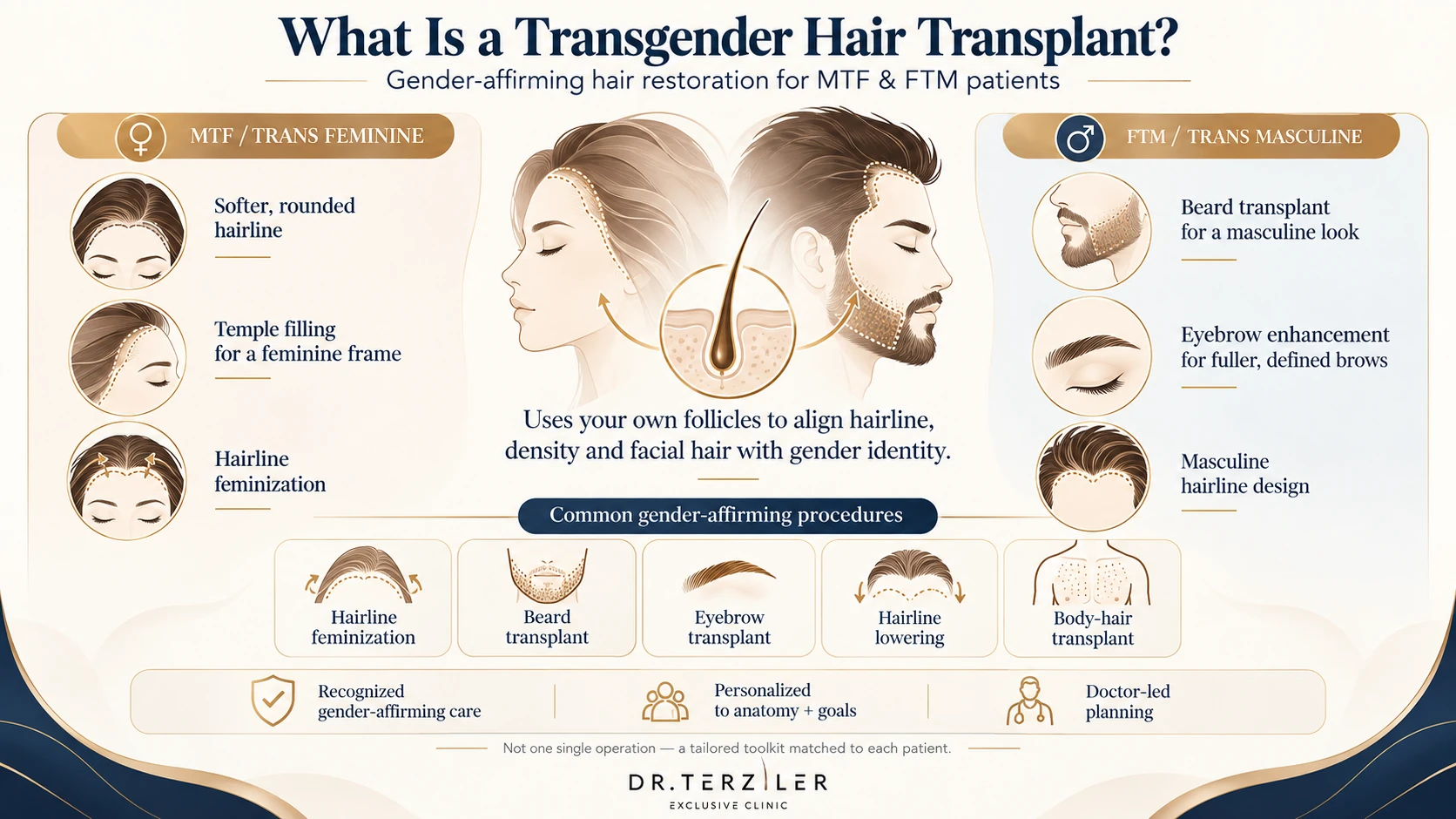
It is also a recognised part of gender-affirming care rather than a purely cosmetic add-on. The WPATH Standards of Care, Version 8 include hair transplantation for androgenic alopecia in people assigned male at birth, alongside facial-hair goals, within the broader framework of gender-affirming treatment.
This guide covers both pathways, MTF (trans feminine) and FTM (trans masculine), the role of hormones, the right techniques, realistic cost, recovery, and how to choose a trans-competent, doctor-led clinic. Patients with afro-textured hair are welcome across both pathways; curly follicles curve under the skin and need a curved punch and angle-matched implantation.
Is a Hair Transplant Gender-Affirming Care?
Yes, a hair transplant can be gender-affirming care. When a transplant is used to feminize or masculinize the hairline or to create facial hair that matches a person’s gender identity, it fits squarely within the gender-affirming framework described by WPATH SOC-8, which lists hair restoration for androgenic alopecia in AMAB patients and facial-hair procedures among affirming treatments.
Insurance is a separate question from clinical classification. In the US, coverage for hair transplantation as gender-affirming care is inconsistent and often excluded as “cosmetic”, which is why many patients pay out of pocket, and why specialized US feminization transplants run $25,000 to $40,000. A doctor-led clinic in Turkey delivers the same clinical standard from €4,000 all-inclusive, making the procedure accessible without insurance approval. Ask any clinic for an itemised written quote before booking.
MTF Hair Transplant: Hairline Feminization for Trans Women
An MTF hair transplant feminizes the hairline by lowering it, rounding the temporal corners, and removing the receding, angular shape of male-pattern hair loss. A typically feminine hairline sits lower on the forehead and is more rounded or bell-shaped, framing the face softly. Surgeons place single-hair grafts along the leading edge and transition to multi-follicular units behind it for density (Operative Techniques in Otolaryngology-HNS, 2023).
Because trans women often still have usable donor hair at the back and sides, the transplant can both redraw the shape and add density in one plan. The design is the hard part: a feminine hairline is not just lower, it has a different geometry (central peak softened, temples filled, a gentle convex curve). This is where doctor-led planning matters most. See our dedicated трансплантация на коса при жени page for women-specific hairline design and Ludwig-pattern density work.
No-Shave (Unshaven) DHI for Privacy
Many trans women want results without an obvious recovery. Небръснат DHI lets the surgeon implant into the new hairline without shaving your existing hair, so the procedure stays discreet and you can return to daily life and work sooner. It is clinically equivalent to standard DHI and especially suited to hairline feminization where existing length hides the recipient area.
Hair Transplant vs Hairline-Lowering Surgery
Two procedures feminize the hairline, and they are not the same. A hair transplant moves follicles and can reshape any pattern, including temple recession, ideal when there is recession or thinning. Hairline-lowering (scalp advancement) surgery physically pulls the whole scalp forward in one operation, best only when density is good and the hairline is simply too high, and it leaves a fine incision line. In the US, hairline lowering runs $8,000 to $20,000; many trans women choose transplantation for its flexibility and lack of a linear scar. The two can also be combined.
FTM Hair Transplant: Masculine Hairline, Beard & Facial Hair for Trans Men
An FTM hair transplant masculinizes the hairline and builds facial hair. Testosterone often triggers male-pattern changes, so some trans men want a stronger, more angular hairline or temple definition; others want to fill a beard, moustache or sideburns that hormones alone did not complete. All of these use the patient’s own occipital scalp follicles as donor, implanted with a Choi pen for precise angle and direction.
- Трансплантация на брада: 1,500 to 3,000 grafts build a full beard; occipital donor matches beard calibre closely.
- Мустаци & sideburns: 100 to 600 grafts per area at precise 10 to 20 degree angles.
- Hairline masculinization: straightening the border and rebuilding angular temples; DHI control is essential for a natural facial result where a 2 degree error is visible.
Facial-hair work is the most angle-sensitive hair surgery there is, so technique and surgeon experience outweigh graft count. Body- and beard-donor hair can also supplement a limited scalp donor in larger cases.
HRT and Timing: Does Hormone Therapy Regrow Hair?
Hormone therapy can slow or stop hair loss and thicken follicles that are still active, but it cannot regrow hair that is already gone or move the hairline to a new position. For trans women, estrogen plus an anti-androgen reduces testosterone and DHT and can stabilise the lateral hairline. A peer-reviewed study found estrogen therapy stabilises the transfeminine lateral hairline, and a documented case recorded partial scalp regrowth after about six months of estradiol and spironolactone. But stabilising is not the same as rebuilding a lost hairline; that is what a transplant does.
When Should You Transplant, Before or After Starting HRT?
Surgeons generally recommend being on a stable hormone regimen for 6 to 12 months before a transplant, so hormone-driven changes settle and the surgeon can design around your true, stabilised pattern. You do not usually need to stop HRT for the procedure. Transplanting onto an unstable, still-changing scalp risks a design that looks mismatched later.
Is It Safe for a Trans Man to Take Finasteride?
Finasteride lowers DHT, so for some trans men it can conflict with masculinization goals and is usually approached cautiously and only with the prescribing clinician’s guidance; a transplant does not depend on it. For trans women, finasteride-type DHT control is often already covered by anti-androgen therapy. Any medication decision should be made with your hormone provider. This guide is educational, not medical advice.
Which Technique Is Best for a Transgender Hair Transplant?
DHI (and unshaven DHI), ideally Роботизирана DHI, is the best technique for most transgender hair transplants because the Choi implanter places each graft at a controlled angle and depth, exactly what a natural feminine hairline or a facial-hair line needs. FUE is a reliable extraction method but gives the surgeon less implantation control for these precision cases.
| Техника | Why it suits trans patients |
|---|---|
| DHI (Choi pen) | Direct, channel-free implantation; precise angle for feminine hairlines and facial hair; 90 to 97% graft survival (general). |
| Небръснат DHI | No head shave, discreet MTF recovery, keeps existing length. |
| Роботизирана DHI | AI-assisted extraction plus manual Choi implantation; sub-1% transection. |
| Picasso Robotic DHI | Premium protocol: 0.75mm pen, UV plus GF 9-hour viability, 98.1% survival (n=120). |
| Sapphire FUE | Smoother channels for broad coverage at lower cost. |
For afro-textured hair, the same angle-controlled DHI applies, with a curved punch matched to the follicle’s subcutaneous curl. See the afro hair transplant page for details that apply equally to MTF and FTM patients.
How Much Does a Transgender Hair Transplant Cost in Turkey?
A transgender hair transplant in Turkey costs from €4,000 to €10,000 all-inclusive in 2026 (about $4,300 to $10,800), depending on graft count, technique and whether the plan includes facial hair. That compares with $25,000 to $40,000 for specialized MTF hairline feminization in the US, $6,000 to $15,000 for a general US transplant, and $8,000 to $20,000 for hairline-lowering surgery. The all-inclusive Turkey package typically covers the procedure, anaesthesia, hotel, VIP transfers, aftercare kit and documented follow-up.
| Country / option | Typical cost (2026) | Бележки |
|---|---|---|
| Turkey (Dr. Terziler) | From €4,000 to €10,000 (about $4,300 to $10,800) | All-inclusive, doctor-led, AACI-accredited |
| US, MTF feminization | $25,000 to $40,000 | Specialized gender-affirming hair clinics |
| US, general transplant | $6,000 to $15,000+ | Varies by graft count / city |
| US, hairline lowering surgery | $8,000 to $20,000 | Scalp advancement, leaves an incision line |
See the full Norwood-by-graft breakdown and per-graft pricing on our Цена на трансплантацията на коса в Турция page.
Does a Transgender Hair Transplant Hurt?
No, the procedure itself does not hurt. It is performed under local anaesthesia, which numbs the scalp within about five minutes; patients rate the surgery 0 to 1 out of 10 on the pain scale, and the brief anaesthetic injection is the only uncomfortable moment. A vibrating, needle-free delivery device reduces even that. Full clinical detail is on our does a hair transplant hurt guide.
Recovery and Results Timeline
Transgender transplants follow the same healing curve as any transplant. Transplanted hairs shed first (shock loss), this is normal, then regrow permanently.
| Хронология | What happens |
|---|---|
| Week 1 | Tiny scabs form at graft sites; keep the area clean and untouched. |
| Weeks 2 to 4 | Shock loss: transplanted hairs shed. Expected and temporary. |
| Months 2 to 4 | New growth begins, fine at first. |
| 6-и месец | 50 to 60% density; the new shape becomes visible. |
| Months 12 to 14 | Full, permanent result; documented with standardised photography. |
How to Choose a Trans-Competent, Doctor-Led Clinic
The right clinic is both clinically excellent and genuinely inclusive. Before booking, confirm:
- Accreditation: AACI or JCI, verifiable in a public registry, not self-reported.
- Named, responsible surgeon: a doctor designs the hairline and performs implantation; not a technician-led line.
- Trans-specific experience: ask to see MTF feminization and FTM facial-hair before-and-after cases at 12 months.
- Feminine/masculine hairline design: the surgeon should explain geometry, not just graft numbers.
- Published graft-survival data: with sample size and photography method.
- Respectful, confidential care: correct name and pronouns, privacy, and a written aftercare plus guarantee.
Accreditation and named-surgeon accountability are the strongest safety filters: the ISHRS warns patients to avoid unlicensed, technician-only operators, and the NHS and AAD publish what to check before any hair-loss procedure.
Why Choose Dr. Terziler Clinic in Turkey for Gender-Affirming Hair
Ексклузивна клиника „Д-р Терзилер“ is an AACI-accredited, doctor-led hair restoration centre in Istanbul treating patients from 40+ countries with 35+ years of experience. Gender-affirming cases are planned by a named surgeon around feminine or masculine hairline geometry, performed with precise DHI / unshaven DHI / Robotic DHI, and documented with 90 to 97% graft survival (general) and 98.1% for Picasso Robotic DHI (n=120). Care is confidential and inclusive, the package is all-inclusive from €4,000, and every plan ends with a written guarantee and 12-month photographic follow-up. Start with a free, judgment-free WhatsApp assessment for a personalised graft count, technique and quote.
Transgender Hair Transplant FAQ
Does MTF HRT regrow hair?
Estrogen with an anti-androgen can slow or stop further loss and thicken follicles that are still active, and some patients see partial regrowth in the first months. But HRT cannot regrow hair that is fully lost or move the hairline. A transplant is what rebuilds a feminine hairline.
Is it safe for a transgender man to take finasteride?
Finasteride lowers DHT, which can work against masculinization goals, so trans men usually approach it cautiously and only with their prescribing clinician. A hair transplant does not require it. Always decide medication with your hormone provider.
How much does an MTF hair transplant typically cost?
In the US, specialized MTF hairline feminization runs $25,000 to $40,000. In Turkey at a doctor-led, AACI-accredited clinic it starts from €4,000 and ranges to about €10,000 all-inclusive (about $4,300 to $10,800), depending on graft count and technique.
What is a male-to-female (MTF) hair transplant?
It is a surgical procedure that feminizes the hairline by lowering it, rounding the temples and removing male-pattern recession, and adds density, using the patient’s own donor follicles implanted with a Choi pen for a soft, natural edge.
Is a hair transplant gender-affirming care?
Yes. When it aligns the hairline or facial hair with a person’s gender identity, it falls within the gender-affirming framework of WPATH SOC-8. Insurance coverage, however, varies and is often excluded as cosmetic in the US.
Can trans women get a no-shave hair transplant?
Yes. Unshaven DHI implants into the new hairline without shaving your existing hair, so recovery is discreet and you keep your length, a popular choice for MTF feminization.
How long after starting HRT should I wait?
Most surgeons recommend 6 to 12 months on a stable hormone regimen so your pattern settles before the hairline is designed. You usually do not need to stop HRT for the procedure.
Will a transgender hair transplant look natural?
At a doctor-led clinic that designs feminine or masculine geometry and controls every follicle angle (15 to 45 degrees), results at 12 months look natural. Unnatural results come from technician-only, template implantation, not from the procedure itself.
Is a transgender hair transplant permanent?
Yes. Transplanted follicles are DHT-resistant and keep growing for life. HRT and, where appropriate, medication protect your remaining native hair around the transplanted zone.
Transgender hair transplant: Turkey vs the USA?
Clinical standards at an AACI-accredited Turkish clinic match top Western centres, at 65 to 90 percent lower total cost after flights and hotel. The deciding factor is accreditation, named-surgeon accountability and trans-specific experience, not the country.
Sources & Clinical References
- WPATH Standards of Care for the Health of Transgender and Gender Diverse People, Version 8 (2022)
- Gender-affirming hair procedures, Operative Techniques in Otolaryngology-Head and Neck Surgery (2023)
- Estrogen hormone therapy stabilizes the lateral hairline in transfeminine patients, ScienceDirect (2024)
- Scalp hair regrowth in a hormone-treated transgender woman, PMC
- American Academy of Dermatology, hair loss diagnosis and treatment
- ISHRS, consumer alert on unlicensed personnel and false advertising
- NHS, hair transplant patient guidance
Graft-survival figures (90 to 97% general; 98.1% for Picasso Robotic DHI, n=120, 12-month standardised photography) are Dr. Terziler Exclusive Clinic reported outcome data. Reviewed by Д-р Сервет Терзилер, доктор по медицина, AACI Accredited Surgeon, ISHRS Member, Inventor of Robotic DHI. Last updated: October 2026.
Dr. Terziler Exclusive Clinic in Istanbul is an AACI-accredited, doctor-led hair transplant and medical aesthetics centre. Dr. Servet Terziler, known as the Picasso of Hair, developed the proprietary Robotic DHI method in-house to deliver high-density, natural and gender-affirming hair restoration with confidential, inclusive care for international patients.