Beşiktaş, Istanbul Manhattan / EE. UU.

How Much Does a Hair Transplant Cost? 2026 Prices by Country, Graft Count and Technique

A hair transplant costs $8,000 to $20,000 in the United States, £4,000 to £15,000 in the United Kingdom, CAD $7,000 to $18,000 in Canada, and $3,500 to $10,500 as an all-inclusive package in Turkey in 2026. The final quote depends on country, graft requirement, technique, package inclusions and the surgeon performing the work. This guide explains how to compare treatment plans without mistaking a low headline price for a complete medical quote.

$8,000-$20,000United States 2026 comparison range
PersonalizadoUS quote after graft assessment
$3,500-$10,500Turkey all-inclusive package range
4 VariablesCountry, grafts, technique and surgeon
Dr. Servet Terziler

REVISADO MÉDICAMENTE POR

Dr. Servet Terziler

AAACI Accredited Surgeon, ISHRS Member and Inventor of Robotic DHI

Updated July 2026

This content is reviewed by Dr. Servet Terziler for medical accuracy, hair transplant cost context, graft-count planning, Robotic DHI relevance, patient-safety framing and source quality.
Quick Answer

A hair transplant costs $8,000 to $20,000 in the United States, £4,000 to £15,000 in the United Kingdom, CAD $7,000 to $18,000 in Canada, and $3,500 to $10,500 as an all-inclusive package in Turkey. US clinics commonly quote after graft assessment, with the final total depending on graft count, surgeon and inclusions. Turkish clinics charge a flat fee per session that covers surgery, hotel, transfers and aftercare.

How Much Does a Hair Transplant Cost in 2026?

A hair transplant is priced according to country, graft requirement, technique and package scope. In this guide, the comparison ranges are $8,000 to $20,000 in the United States, £4,000 to £15,000 in the United Kingdom, CAD $7,000 to $18,000 in Canada and $3,500 to $10,500 as an all-inclusive package in Turkey. A hair transplant quote should be compared only after checking who operates, what is included and how the graft count was assessed. The worldwide market processed 735,312 surgical hair restoration procedures in a single year, according to the ISHRS Practice Census.

Hair transplant cost in 2026 world map infographic by Dr. Terziler Exclusive Clinic showing typical total hair transplant prices by country, including USA, Turkey, UK, Canada, India, Mexico, Hungary, Poland, Thailand, Spain, South Korea, UAE, Germany and Australia, with Turkey highlighted for all-inclusive hair transplant packages and global cost ranges from budget to premium markets.
Hair transplant cost in 2026 world map infographic by Dr. Terziler Exclusive Clinic.
Hair transplant cost comparison by country for 2026.
País Typical Total Cost (2026) What Defines the Market
Estados Unidos de América $8,000 – $20,000 Per-graft billing; extras may be separate
Turquía $3,500 – $10,500 All-inclusive package
Reino Unido £4,000 – £15,000 Per-graft or package billing; confirm inclusions
Canadá CAD $7,000 – $18,000 Tax, province and package inclusions can change the final quote
India $1,200 – $4,000 Lowest global pricing; quality varies widely between clinics
México $2,000 – $5,000 Popular with US patients for short travel; per-graft model
Hungary $2,500 – $6,000 Mid-range EU option; partial packages
Polonia $2,500 – $6,000 Mid-range EU option; per-graft model
Tailandia $2,500 – $7,000 Mid-range; strong in FUE, weaker DHI availability
España €4,000 – €10,000 Western EU pricing; strict medical regulation
Corea del Sur $5,000 – $10,000 High technical standard; focused on Asian hair types
Emiratos Árabes Unidos (Dubái) $5,000 – $12,000 Premium pricing; many visiting surgeons
Alemania €5,000 – €12,000 Strict regulation; among the highest EU prices
Australia AUD $12,000 – $20,000+ Highest pricing tier globally; few package options

Published comparison ranges used in this guide are $8,000 to $20,000 in the United States, £4,000 to £15,000 in the United Kingdom, CAD $7,000 to $18,000 in Canada and $3,500 to $10,500 as an all-inclusive package in Turkey. Final quotes depend on the individual treatment plan.

How Much Does a Hair Transplant Cost in Turkey?

A hair transplant in Turkey costs $3,500 to $10,500 as an all-inclusive package in 2026. The package model replaces per-graft billing with one flat fee that covers the surgery, pre-op blood panel, anesthesia, hotel, VIP transfers, medication and the post-operative care kit.

Turkey performs more hair transplants than any other country. The price advantage comes from a lower cost of living, favorable exchange rates and government support for licensed health tourism; not from lower clinical standards at accredited clinics. The surgeon’s credentials decide quality in every country. A patient flying to Istanbul pays $600 to $1,200 for flights and still spends 50 to 70 percent less in total than the same procedure costs at home.

Compare what all-inclusive hair transplant packages include before booking. A written list of inclusions is the single best filter for separating serious clinics from booking agencies.

How Much Does a Hair Transplant Cost in the USA?

A hair transplant costs $8,000 to $20,000 in the USA in 2026. US clinics often bill by graft and may list consultation, bloodwork, medication and PRP separately. The final total is confirmed after graft assessment and treatment planning.

Our full hair transplant Turkey vs USA comparison breaks the two markets down line by line, including regulation, surgeon involvement and cost per surviving graft.

How Much Does a Hair Transplant Cost in the UK?

A hair transplant costs £4,000 to £15,000 for UK patients in 2026. The final quote depends on graft count, technique, surgeon involvement and package inclusions. The NHS does not fund cosmetic treatment for pattern baldness.

How Much Does a Hair Transplant Cost in Canada?

A hair transplant costs CAD $7,000 to $18,000 in Canada in 2026. Taxes, graft count, technique and package inclusions can change the final quote, so confirm the complete treatment plan directly with the clinic.

How Much Does a Hair Transplant Cost in India?

A hair transplant costs $1,200 to $4,000 in India in 2026. India holds the lowest pricing worldwide, and quality varies more between clinics than in any other major market. Verify the operating surgeon’s credentials before the price convinces you.

How Much Does a Hair Transplant Cost in Mexico?

A hair transplant costs $2,000 to $5,000 in Mexico in 2026. Mexico attracts US patients with short flights and per-graft prices at roughly half the US rate. Most clinics bill per graft rather than as all-inclusive packages.

How Much Does a Hair Transplant Cost in Germany?

A hair transplant costs €5,000 to €12,000 in Germany in 2026. Germany enforces strict medical regulation and carries some of the highest prices in the EU. Many German patients fly to Istanbul for this exact reason.

How Much Does a Hair Transplant Cost in Spain?

A hair transplant costs €4,000 to €10,000 in Spain in 2026. Spain sits at standard Western EU pricing with strict clinical oversight and mostly per-graft billing.

How Much Does a Hair Transplant Cost in Hungary and Poland?

A hair transplant costs $2,500 to $6,000 in Hungary and Poland in 2026. Both markets position themselves as mid-range EU alternatives, with partial packages in Hungary and per-graft billing in Poland.

How Much Does a Hair Transplant Cost in Thailand?

A hair transplant costs $2,500 to $7,000 in Thailand in 2026. Thailand offers strong FUE availability, while DHI and robotic techniques remain harder to find than in Turkey.

How Much Does a Hair Transplant Cost in South Korea?

A hair transplant costs $5,000 to $10,000 in South Korea in 2026. Korean clinics hold a high technical standard and specialize in Asian hair characteristics, including thicker shafts and straighter follicle angles.

How Much Does a Hair Transplant Cost in Dubai (UAE)?

A hair transplant costs $5,000 to $12,000 in Dubai in 2026. The UAE runs premium pricing, and many procedures are performed by visiting surgeons rather than resident teams; ask who operates and who handles your follow-up.

How Much Does a Hair Transplant Cost in Australia?

A hair transplant costs AUD $12,000 to $20,000 or more in Australia in 2026. Australia sits in the highest global pricing tier, with few package options and long waiting lists outside major cities.

Mid-range destinations such as Thailand, South Korea, Hungary and Poland cost $2,000 to $8,000 for most cases, according to 2026 global cost comparisons. The lowest-price markets compete on cost alone. Turkey competes on volume, surgical specialization and the all-inclusive model at the same time, which is why it holds the largest share of international hair transplant patients.

How Is Hair Transplant Cost Calculated?

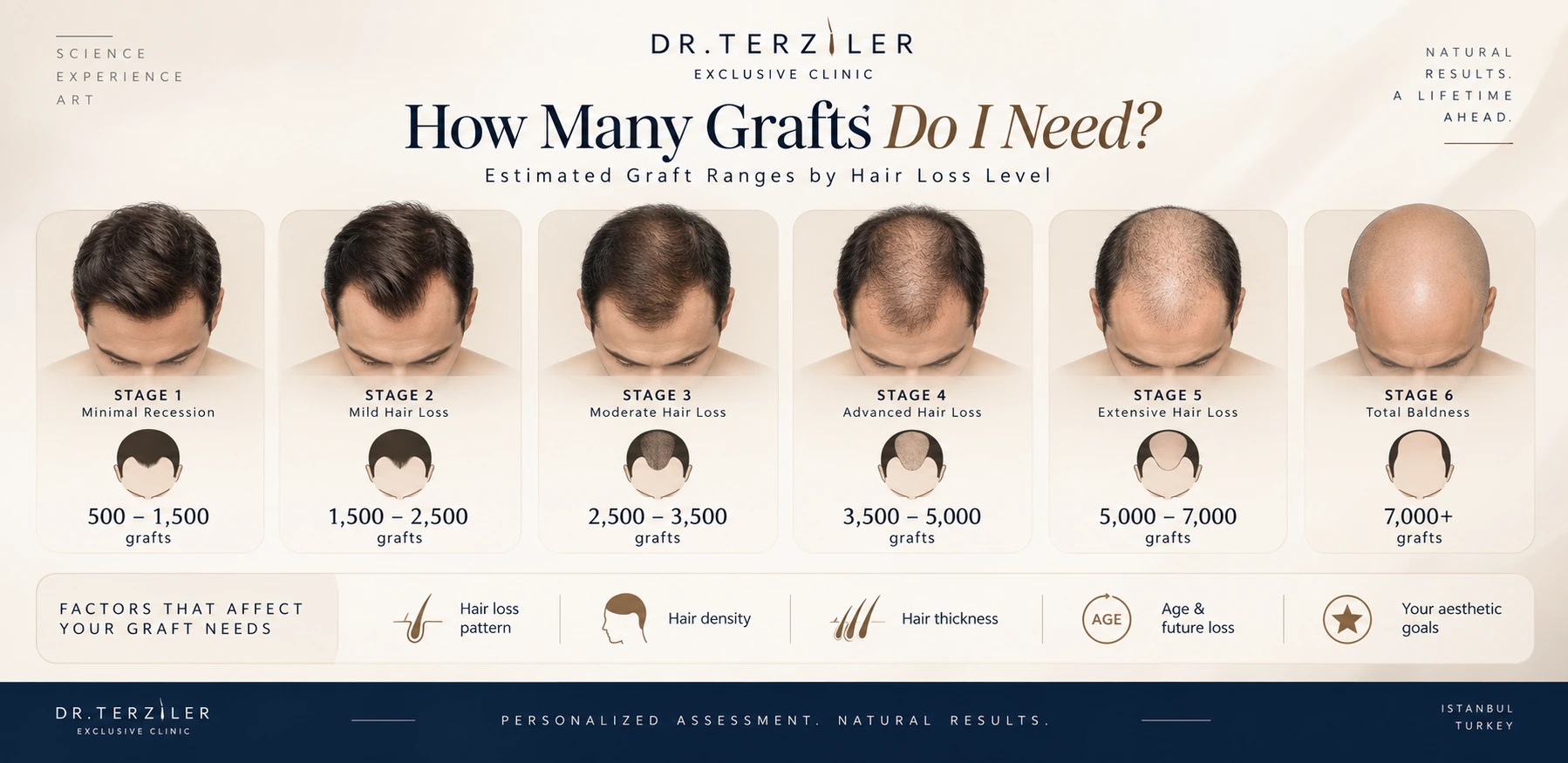
Clinics calculate hair transplant cost by multiplying your graft count by a per-graft rate, or by quoting a flat session fee. Your graft count depends on your stage on the Escala de Norwood. A hairline refinement needs 1,500 to 2,000 grafts. Advanced loss covering the front, mid-scalp and crown needs 4,000 to 5,000 grafts or more.

Hair transplant planning ranges by graft count and treatment area.
Recuento de injertos Typical Case US planning context Turkey All-Inclusive
1,500 Hairline refinement Presupuesto personalizado $3,500 – $10,500
2,500 Norwood 3-4 Presupuesto personalizado $3,500 – $10,500
3,500 Norwood 4-5 Presupuesto personalizado $3,500 – $10,500
5,000 Norwood 5-6, two zones Presupuesto personalizado $3,500 – $10,500

Your exact number requires a donor area assessment, not a guess from photos alone. Read how many grafts you need for the calculation method surgeons use, including donor capacity limits.

Why Do Some Clinics Quote Per Hair Instead of Per Graft?

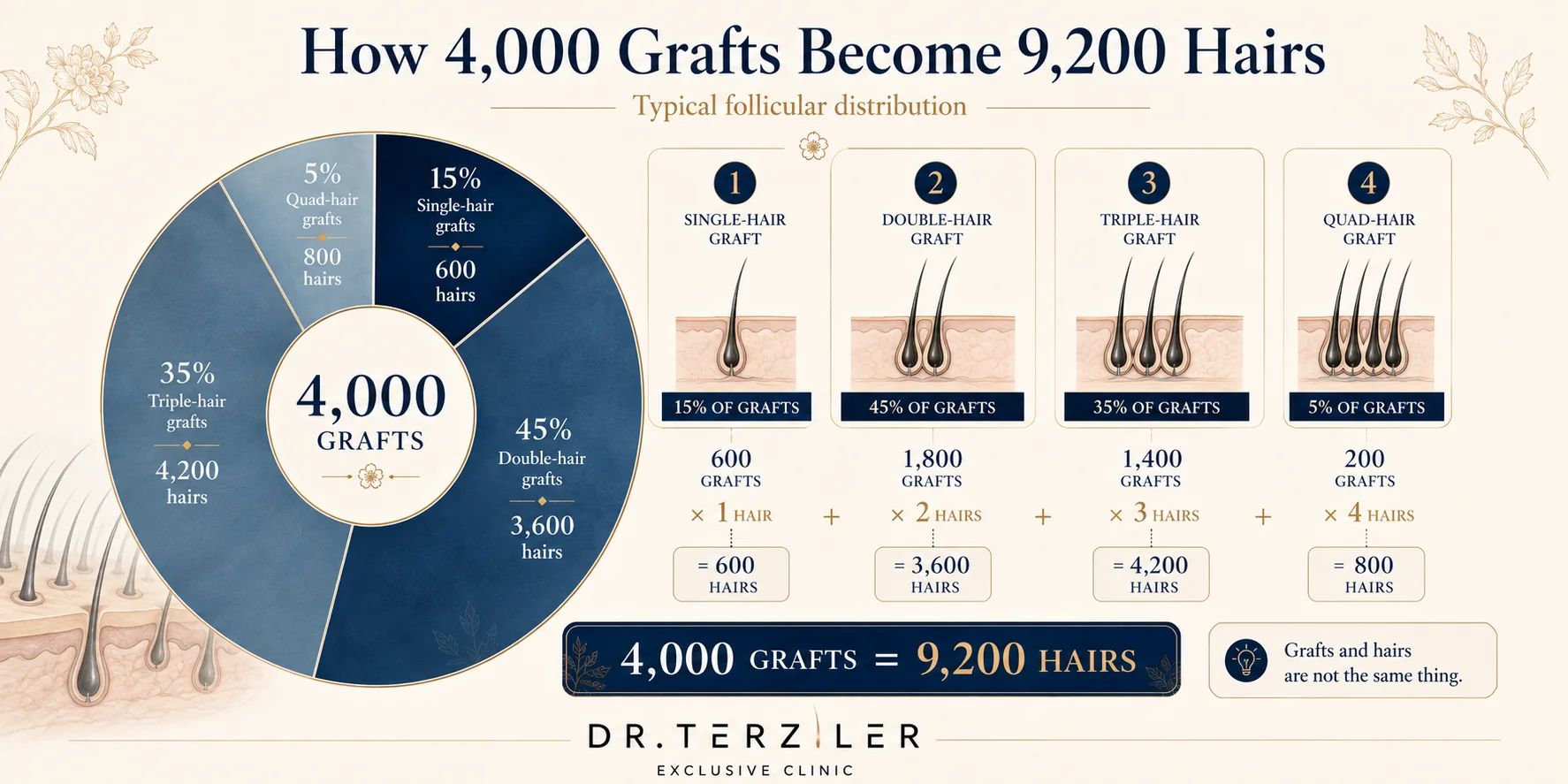
Some clinics quote per hair instead of per graft because it makes their price look 50 to 70 percent cheaper. One graft is a follicular unit containing 1 to 4 hairs, with an average of about 2.2 hairs per graft. A clinic advertising “$2 per hair” is charging roughly $4.40 per graft; more than many clinics quoting “$4 per graft.”

Check every quote for the unit. A quote of 6,000 hairs equals roughly 2,700 grafts. If two clinics give you numbers that differ wildly for the same head, the unit is usually the reason. An honest quote states the graft count, the technique, and every included service in writing. Our guide on how to choose the right hair transplant clinic lists the exact questions that expose vague quotes.

Does the Technique Change the Price? FUE vs DHI vs Robotic DHI

Yes. The technique changes the price by 20 to 50 percent within the same clinic. FUE is the baseline; roughly 80 percent of all surgical hair restoration procedures worldwide use FUE, according to the ISHRS.

Sapphire FUE uses sapphire blades to open recipient channels and serves as the standard price tier.

¿Te has enterado? loads each graft into a Choi implanter pen and places it without pre-opened channels; the single-use pens and longer operating time raise the price by 20 to 40 percent over FUE.

DHI robótico adds computer-guided depth control at ±0.1mm precision across every graft, which manual hands cannot sustain over a six-hour session. Dr. Servet Terziler invented the Robotic DHI machine used at Dr. Terziler Exclusive Clinic, and the system records a 97.3 percent graft survival rate.

Read our best hair transplant method comparison to match the technique to your hair type, loss stage and budget. Pain differences between techniques are covered in does a hair transplant hurt.

What Hidden Costs Should You Expect?

Hidden costs add $1,500 to $4,000 on top of a typical US surgery quote. Hidden fees inflate final hair transplant bills by 20 to 40 percent after patients have already committed, according to US clinic pricing audits.

Common additional hair transplant costs that may sit outside a quoted package.
Line Item Typical US Cost Usually in the Quote?
Consultation fee $100 – $500 De
Pre-op bloodwork $200 – $400 De
Post-op medication $150 – $400 De
PRP session $500 – $1,000 each De
Follow-up visits $100 – $300 each Sometimes
Revision or touch-up $2,000+ Nunca

Ask for an itemized, written, all-inclusive quote before paying any deposit. Turkish package pricing removes this ambiguity structurally; the flat fee is the final number, which is one reason international patients favor the model.

Does Insurance Cover a Hair Transplant?

No. Insurance does not cover a hair transplant for pattern baldness in any major market. US insurers, including Medicare and Medicaid, classify it as elective cosmetic surgery. The NHS does not fund hair transplants for male or female pattern baldness; rare exceptions exist for hair loss from burns, trauma or cancer treatment, according to the NHS.

Financing fills the gap in Western markets. CareCredit offers 0 percent promotional periods of 6 to 24 months, and clinic financing partners offer 24 to 84 month terms at 9 to 20 percent APR, according to Cherry Financing. A patient financing $12,000 at 15 percent APR over 60 months pays roughly $5,100 in interest; a detail worth calculating before comparing a financed US procedure against a paid-in-full package abroad.

Why Is a Cheap Hair Transplant the Most Expensive One?

A failed cheap transplant costs more than a correct one because repair surgery typically costs about twice the original procedure and consumes donor grafts that never grow back. The donor area is a finite bank; roughly 6,000 to 8,000 lifetime grafts for most men. A botched first surgery that wastes 3,000 of them halves your repair options permanently.

Low-cost operations keep prices down by running multiple patients per surgeon per day, delegating surgery to unlicensed technicians and overharvesting donor zones. The results fill our analysis of hair transplant gone wrong cases: pluggy hairlines, visible donor depletion and grafts placed at wrong angles. Price is a data point. The surgeon’s name, accreditation and personal involvement in your surgery are the decision.

What Does the Dr. Terziler Exclusive Clinic Package Include?

Dr. Terziler Exclusive Clinic is an AAACI accredited hair transplant clinic in Istanbul, Turkey, led by Dr. Servet Terziler, the inventor of the Robotic DHI machine. The all-inclusive package covers microscopic hair diagnostics, the pre-op blood panel, the surgeon’s operating time, anesthesia with needle-free options, the post-operative care kit, VIP transfers, hotel accommodation and a fully managed 12-month follow-up program.

Compare what all-inclusive hair transplant packages include before booking. A written list of inclusions is the single best filter for separating serious clinics from booking agencies.

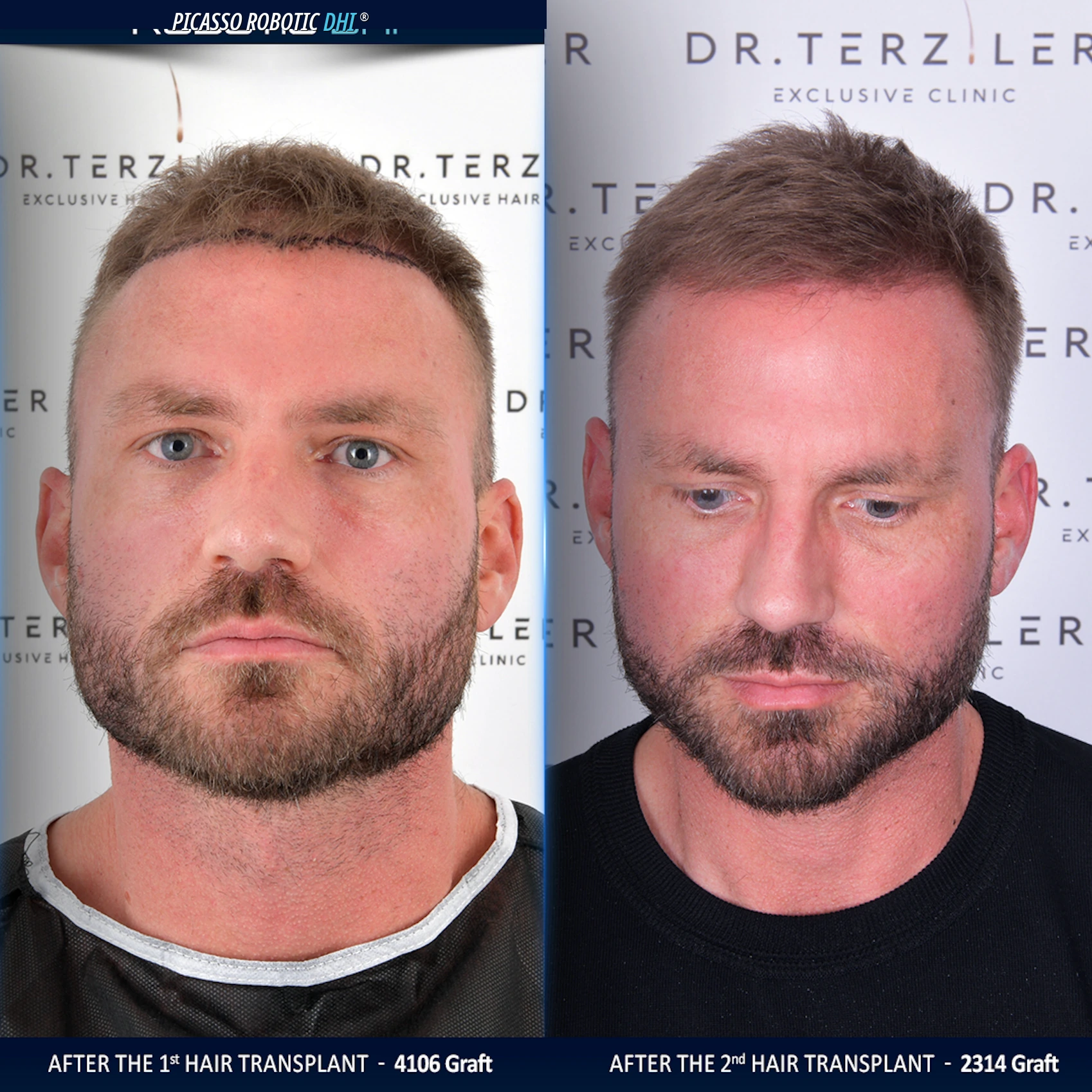
Every hairline at the clinic is designed and surgically executed under Dr. Terziler’s direct supervision, and outcomes are documented in the clinic’s before and after results archive. The 97.3 percent graft survival rate recorded with Robotic DHI is the proof point behind the pricing; you pay a flat fee for a doctor-led procedure, not an assembly line.

Is a Hair Transplant Worth the Cost?

A hair transplant is worth the cost for most patients because the result is permanent and the alternatives are recurring. Transplanted hair grafts are permanent because they come from DHT-resistant donor zones. Concealer fibers, specialized shampoos and topical treatments cost $40 to $120 per month; that is $4,800 to $14,400 over ten years for products that stop working the day you stop paying.

Amortization makes the comparison concrete. A personalised all-inclusive package delivering 20+ years of coverage costs about $225 per year of result. The average number of procedures needed per patient fell from 3.4 in 2019 to 1 in 2021, according to the ISHRS 2022 Practice Census; modern technique quality means most patients now buy the result once.

Preguntas frecuentes

Is a hair transplant tax deductible?

No. A hair transplant is not tax deductible in the United States because the IRS excludes cosmetic surgery from medical expense deductions, according to IRS Publication 502. The same treatment applies in the UK and Canada. The narrow exception is reconstruction after injury, burns or disease, which requires medical documentation.

How much does a 5,000 graft hair transplant cost?

A 5,000-graft plan is assessed individually. The published comparison ranges in this guide are $8,000 to $20,000 in the United States, £4,000 to £15,000 in the United Kingdom, CAD $7,000 to $18,000 in Canada and $3,500 to $10,500 as an all-inclusive package in Turkey. Sessions this large often run across two days, which package pricing absorbs and per-graft pricing bills separately.

Why did two clinics quote me prices $10,000 apart for the same head?

Two quotes differ this much because of four variables: the counting unit (hairs versus grafts), the technique tier, what the quote includes, and who performs the surgery. Convert both quotes to a per-graft, all-services-included figure before comparing. A quote that resists this conversion is hiding something.

How much does it cost to fix a bad hair transplant?

Repairing a bad hair transplant costs $8,000 to $25,000 and typically runs about twice the price of doing it correctly the first time. Repair combines removal of misplaced grafts, camouflage grafting and sometimes scalp micropigmentation, and it depends entirely on how much donor reserve the first surgery left behind.

Can you negotiate the price of a hair transplant?

Yes, within limits. Clinics with empty surgery slots discount 10 to 15 percent in low-demand months, typically November through February. Distrust aggressive limited-time discounts; a serious surgical calendar does not need flash sales. Negotiate inclusions (extra PRP session, extended hotel stay) rather than the surgical fee itself.

Does a more expensive hair transplant guarantee a better result?

No. Price does not guarantee outcome above the threshold that funds proper surgical standards. Below that threshold, quality is structurally impossible; an implausibly low package cannot fund a licensed surgical team, sterile single-use equipment and honest graft counts. Above it, the surgeon’s skill, not the invoice, determines the result.

Sources

  1. NHS. Hair transplant. https://www.nhs.uk/tests-and-treatments/cosmetic-procedures/cosmetic-surgery/hair-transplant/
  2. ISHRS. 2022 Practice Census Results. https://ishrs.org/wp-content/uploads/2022/04/Report-2022-ISHRS-Practice-Census_04-19-22-FINAL.pdf
  3. ISHRS. Survey Finds Hair Restoration Surgery on the Rise Worldwide. https://ishrs.org/survey-finds-hair-restoration-surgery-on-the-rise-worldwide/
  4. IRS. Publication 502, Medical and Dental Expenses. https://www.irs.gov/publications/p502
  5. Cherry Financing. Hair Transplant Cost: Full 2026 U.S. Pricing Breakdown. https://withcherry.com/blog/hair-transplant-cost
  6. Wimpole Clinic. UK Hair Transplant Cost 2026: Average Price and Cost Per Graft. https://wimpoleclinic.com/blog/hair-transplant-cost-uk-analysis/
Hair Transplant Gone Wrong: Signs, Causes, and How to Fix It

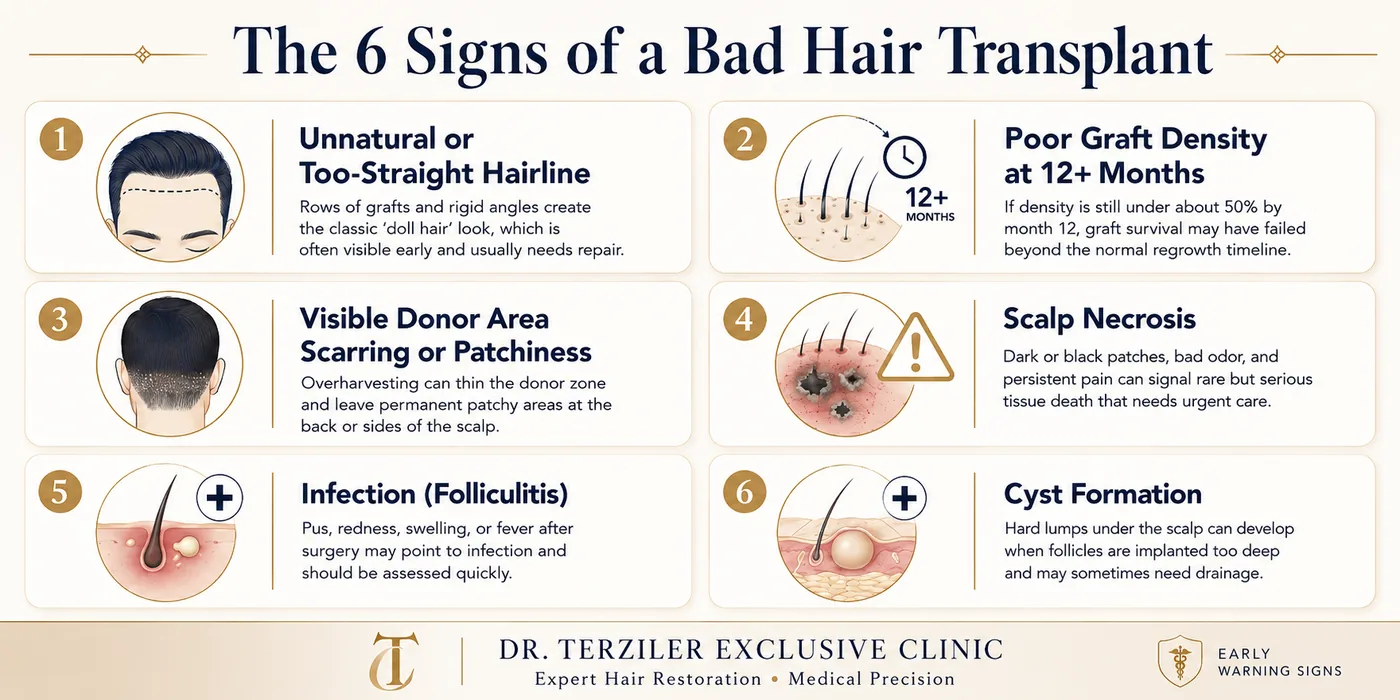
A hair transplant goes wrong when grafts fail to survive, the hairline looks artificial, or the donor area is permanently damaged. The 6 key signs are: unnatural hairline, poor density at month 12, visible donor scarring, scalp necrosis, infección, y cyst formation. At accredited clinics, graft survival exceeds 98%. ISHRS data links 96% of botched cases to unlicensed operators. True permanent failure affects 1.97% of patients (Ghimire et al., JNMA 2018, PMC8997317). Most patients who report failure at month 3 are experiencing normal shock loss, which resolves by 6 months.

Quick Answer

A hair transplant goes wrong when grafts fail to survive, the hairline looks artificial, or the donor area is permanently damaged. The 6 key signs are: unnatural hairline, poor density at month 12, visible donor scarring, scalp necrosis, infección, y cyst formation. At accredited clinics, graft survival exceeds 98%. ISHRS data links 96% of botched cases to unlicensed operators. True permanent failure affects 1.97% of patients (Ghimire et al., JNMA 2018, PMC8997317). Most patients who report failure at month 3 are experiencing normal shock loss, which resolves by 6 months.

Dr. Servet Terziler

REVISADO MÉDICAMENTE POR

Dr. Servet Terziler

AAACI Accredited Surgeon, ISHRS Member and Inventor of Robotic DHI

Updated June 2026

This content is reviewed by Dr. Servet Terziler for medical accuracy, failed hair transplant assessment, repair candidacy, donor-area safety, graft survival and patient safety.

You did your research, booked the clinic, flew to Istanbul. Twelve months later, nothing has grown. Or something has grown, but it looks nothing like the before and after images you were shown. You are not alone, and you are not without options.

1.97%Ghimire et al., JNMA 2018 | PMC8997317

Patient-reported permanent failure rate after hair transplantation. Most patients who report 'failure' at month 3 are experiencing temporary shock loss. True permanent graft death is rare in accredited surgical settings.

96%Grupo de Trabajo sobre Turismo Médico de la ISHRS 2022

of documented botched hair transplant cases in Turkey between 2018-2022 were performed by unlicensed technicians or non-surgical staff, not by certified surgeons.

2-6 hrsCooler et al., Dermatologic Surgery, 2016

Maximum time harvested follicular units can survive outside the body before ATP depletion causes irreversible cell death. Clinics using extended implantation sessions risk graft viability loss beyond this window.

What Does a Hair Transplant Gone Wrong Look Like?

A hair transplant result is considered gone wrong when the aesthetic outcome is detectably artificial, the density is insufficient for the patient's target zone, or structural damage has occurred in the donor area, assessed at 14 months post-surgery when final growth is established.

Sign Technical Name How to Detect Cronología
Pluggy hairline Large graft cluster implantation Wet the hair and comb back. Multi-hair grafts at the hairline are visible as clumps. Visible from month 6
Hairs growing forward Angle mapping error Photograph the hairline from the side. Hairs should angle back at 30-45 degrees. Forward-pointing hairs indicate a technique error. Visible from month 6
Moth-eaten density Graft survival failure Use consistent indoor light (bathroom, not sunlight). Patchy areas in zones that should have coverage. Assess at month 14
Striped donor area FUT linear scarring Scar line visible when hair is short. Parallel stripe across the back of scalp. Permanent unless revised
Bald patches in donor zone Overharvesting / FUE scarring Visible thinning when hair is very short. Donor density clearly lower than the sides. Permanente
Ingrown hairs or cysts Embedded grafts Painful lumps along hairline or crown. Follicle implanted too deep. Requires drainage. Weeks post-op
the 6 signs of a bad hair transplant infographic showing unnatural hairline, poor graft density, visible donor area, scalp necrosis, infection, and cyst formation explained by the best hair transplant clinic in Turkey Dr. Terziler

Worried your result is actually failing?

Send your timeline, photos and graft count. A repair assessment can separate normal shock loss from a true failed hair transplant.

Check My Result

1
1. Unnatural or Too-Straight Hairline

Natural hairlines are irregular. Follicles emerge at different angles, depths, y micro-spacings. A bad hair transplant hairline runs in a uniform straight line, often with multi-hair grafts placed in the very front row. Surgeons call this the 'doll hair' effect. It is permanent without repair. The wet hair test reveals it instantly: wet the hair, comb it back, and the artificial clustering of grafts becomes visible as clumps rather than individual strands. A bad hair transplant hairline is one of the most searched images online for this reason.

At Dr. Terziler Exclusive Clinic, hairline design in Picasso Robotic DHI is performed personally by Dr. Servet Terziler, known in the field as the Picasso of Hair. Each hairline is drawn by hand with artistic precision before a single graft is placed. The clinic uses the world's thinnest implant pen, the 0.70mm Choi pen, which allows individual follicle placement at the exact angle, depth, and direction that mimics natural growth. This level of control is what makes the difference between a hairline that is detectable and one that is not.

2
2. Poor Graft Density at 12+ Months

If density remains under 50% of the transplanted area at month 12, grafts have failed. But the timeline matters. Normal recovery follows a fixed sequence: shedding at weeks 2-6, first regrowth at weeks 8-14, full density between months 12-18. Assessing density at month 3 and declaring failure is a mistake. Assessing at month 12 with no density is a confirmation. Signs of a failed hair transplant at month 12 include sparse islands of growth, uneven distribution across the transplanted zone, and hairline asymmetry.

3
3. Visible Donor Area Scarring or Patchiness

Overharvesting strips the donor zone below 40 FUs per cm2. Round bald patches appear in the back and sides of the scalp. This is the most common cause of permanent, irreversible damage from unregulated FUE hair transplant. Patients with short hair or shaved styles see it immediately. At Dr. Terziler Exclusive Clinic, pre-op follicle density mapping ensures extraction never exceeds 45% of donor density per zone, protecting the natural appearance of the donor area.

4
4. Scalp Necrosis

Scalp necrosis is tissue death caused by insufficient blood supply to the recipient area. Symptoms include dark or black patches on the scalp, persistent pain, and in severe cases an unpleasant odour. It is rare, affecting 0.1-0.5% of patients, but it is serious and requires immediate surgical intervention. It occurs almost exclusively at facilities where too many recipient sites are created too densely in a single session, cutting off vascular supply to the subdermal tissue.

5
5. Infection (Folliculitis)

Pus, hinchazón, y fever in the first two weeks indicate post-operative infection. ISHRS data documents a folliculitis rate of 1-3% across hair transplant procedures globally. At facilities with inadequate sterilisation, this rate rises significantly. Staphylococcus aureus is the most common pathogen. Signs are pustules at graft sites by days 7-14. Infection from a bad hair transplant causes both scarring y permanent graft loss if untreated.

6
6. Cyst Formation

Follicles implanted too deep develop epidermal cysts, appearing as hard lumps beneath the scalp skin. They typically emerge along the hairline or crown within weeks of the procedure. Most resolve on their own within 3-6 weeks. Persistent cysts require drainage by a clinician. Cyst formation is a sign of incorrect implantation depth, not a normal post-op outcome.

Need a quick repair opinion?

Send photos in natural light and the month you are currently in. The team can tell you whether it looks like shock loss, low density or donor damage.

Message a Repair Specialist

What Are the Botched Hair Transplant Scenarios?

The botched hair transplant scenarios below are three cases that are representative examples based on Dr. Terziler Exclusive Clinic's post-consultation patient survey data.

SCENARIO A

The Budget Clinic Patient

James R., 34, London

James found his clinic on a hair transplant aggregator site. The total package, including flights and hotel, cost EUR 1,100. Two thousand grafts were performed in a converted apartment in Istanbul by a technician he later learned had no medical qualification.

At month 18: thin coverage in the crown, pluggy grafts visible at the hairline in natural light, and the donor area showing visible stripes. Forty percent of his posterior scalp follicles were gone permanently.

The technician extracted grafts past the 50% donor density threshold. Hairline grafts were implanted at a perpendicular angle instead of the natural 30-45 degrees, producing a flat, artificial pattern. Neither the extraction volume nor the angle was reviewed by a qualified surgeon.

THIS IS A HAIR TRANSPLANT GONE WRONG. Recovery requires a repair procedure.

"I chose that clinic because it was EUR 800 cheaper than everywhere else. I did not know that EUR 800 would cost me three years and two corrective procedures to fix."James R., 34, London | Dr. Terziler patient survey

SCENARIO B

The Technically Botched Result

Marc D., 41 años, Ámsterdam

Marc chose an accredited clinic with strong reviews. His mistake was not knowing that the lead surgeon was not present when his hairline was designed.

At month 12: hair grew forward and flat instead of angled back. Crown density measured 35 FU/cm2 while the mid-scalp registered 18 FU/cm2 under trichoscopic analysis. In certain lighting conditions, the result looked moth-eaten.

An angle mapping error produced hairs growing in the wrong direction. Density distribution was uneven because no pre-op zone mapping was performed. Neither issue is visible at the time of surgery. Both appear only after growth.

THIS IS A FAILED HAIR TRANSPLANT CAUSED BY SURGICAL TECHNIQUE, NOT PATIENT BIOLOGY.

"The surgeon was not in the room when they designed my hairline. Nobody told me that was possible. I thought I was paying for a surgeon."Marc D., 41, Amsterdam | Dr. Terziler patient survey

SCENARIO C

The Panic Patient (Shock Loss Mistaken for Failure)

Ryan K., de 29 años, Toronto

Ryan had FUE at a reputable clinic. By week 8, most transplanted hairs had shed. Convinced the procedure had failed, he posted a hair transplant gone wrong video online. It received 4,000 views.

At month 5, the same follicles began producing new growth. At month 14, his density was full and his hairline looked natural. The video is still online.

What happened was telogen effluvium: shock loss. Surgical trauma pushed follicles from anagen (growth phase) into telogen (resting phase). The hair shaft detached. The follicle remained alive. Regrowth started at month 5.

THIS IS NOT A FAILED HAIR TRANSPLANT. It is a misunderstood biological process affecting 40-95% of transplant patients.

"I filmed myself crying at month 2. I thought it was gone forever. I am almost embarrassed to say that now, because at month 14, nobody can tell I ever had a transplant."Ryan K., 29, Toronto | Dr. Terziler patient survey

Had a result like one of these scenarios?

Book a free repair consultation with trichoscopic donor assessment and hairline review before planning any corrective surgery.

Book Repair Consultation

What Are the Top 11 Reasons Hair Transplants Fail (And How They Are Prevented)

Hair transplant failure has 11 top documented clinical causes. The most common are graft dehydration outside the body (contributing to approximately 30% of failures), donor overharvesting (25%), wrong implantation angle (15%), y procedures performed by unlicensed technicians (20%). At Dr. Terziler Exclusive Clinic, each cause has a specific prevention protocol.

Cause Clinical Mechanism % of Failures Dr. Terziler Prevention
1. Graft dehydration Grafts outside the body lose ATP. Viability drops from 100% at extraction to near zero at 6 hours. Assembly-line clinics extract 3,000+ grafts, leave them on a tray for 2-4 hours, then begin implantation. 30% Robotic DHI: grafts implanted within minutes of extraction. No waiting tray. HypoThermosol storage if any delay occurs.
2. Donor overharvesting Extracting more than 50% of follicular units from any donor zone leaves the area below the safe density floor of 40 FU/cm2. Result: permanent visible thinning in the back and sides. 25% Pre-op density mapping for every patient. Extraction never exceeds 45% of donor density per zone. Documented and shared with the patient.
3. Wrong implantation angle Hair emerges from the scalp at 15-45 degree angles depending on zone. Implanting at the wrong angle produces hairs growing upward or outward. Correction requires complete re-extraction and reimplantation. 15% Robotic DHI punch maintains consistent depth and angle. Manual angle error is eliminated. Each zone mapped pre-operatively.
4. Unqualified technicians ISHRS 2022: 96% of botched Turkey cases linked to non-medical staff performing extractions and implantations. Legal in some interpretations of Turkish law, catastrophic in surgical outcomes. 20% Dr. Servet Terziler performs all procedures personally. Zero delegation of the surgical process. Patients can verify in consultation.
5. Hairline design error The 'grass man look': multi-hair grafts placed at the very front row of the hairline. Produces an unnatural, perceptible pattern. Singles must form the first 1-2 rows. 5% Digital hairline design by Dr. Terziler personally before any extraction begins. Mapped and agreed with the patient.
6. Lichen Planopilaris (LPP) The only cause of true immunological rejection of autologous grafts. Active LPP attacks transplanted follicles. Undiagnosed LPP before surgery = predictable failure. Rare (<1%) but 100% avoidable Full trichoscopic LPP screening before accepting any patient. LPP must be in clinical remission for 12+ months before approval.
7. Shock loss mismanagement Telogen effluvium affects 40-95% of transplant patients. Shedding at weeks 2-8, dormancy at months 3-4, regrowth from month 5. Misdiagnosed as failure, patients seek unnecessary second procedures. 0% (not failure) Every patient receives a written growth timeline. Month-by-month expectations documented. WhatsApp follow-up at months 1, 3, 6, 12.
8. Mega-session overload Sessions exceeding 3,000 grafts in one sitting create hypoxic conditions in the recipient scalp. Cumulative vascular trauma reduces graft take rates for all grafts in the session. 5% Maximum 2,500-3,000 grafts per session based on donor density. Cases requiring more split into two sessions.
9. Poor candidacy assessment Active androgenetic alopecia progresses. Transplanting into an unstable hairline produces grafts that outlast the surrounding native hair, creating an island effect in 5-10 years. <5% Norwood staging and DHT sensitivity assessment pre-op. Patients with unstable loss are counselled on medication first. Cases that are not yet stable are declined.
10. Recipient site over-density Implanting more than 45 FU/cm2 in one session cuts blood supply to existing native follicles and new grafts simultaneously. Net hair count decreases. 5% Recipient site density capped at 35-45 FU/cm2. More is not better. The biology is the limit, not the sales target.
11. Post-op infection Unsterilised instruments, unhygienic environment, patient non-compliance. Folliculitis kills grafts and causes scarring. ISHRS documents a 1-3% rate globally. 5% JCI-standard hospital. Single-use sterile instruments only. Written aftercare protocol plus video follow-up within 24 hours of procedure.

Lichen Planopilaris (LPP) is an autoimmune condition that causes the immune system to attack hair follicles, including transplanted ones. It is the ONLY documented mechanism by which the immune system can reject autologous hair grafts (grafts from your own scalp). Without LPP, it is biologically impossible for the immune system to reject transplanted follicles: the body does not produce antibodies against its own tissue. Clinics listing 'graft rejection' as a general surgical risk, without specifying LPP, are medically inaccurate. Proper pre-surgical trichoscopy identifies and rules out LPP. Lajevardi et al., JEADV 2021.

Surgeons rarely discuss maximum slit density because it limits the number of grafts per session. But the evidence is clear: implanting more than 45 FU/cm2 in one session induces vascular compromise in the subdermal plexus. The result: newly placed grafts AND existing native follicles lose blood supply and die. Net hair count decreases. This is why 'more grafts = better results' is false marketing, not surgery. Source: Rose & Nusbaum, Hair Transplant Forum International, 2014.

What Does Overharvesting Mean and Why Is It Bad?

Overharvesting means extracting too many follicles from the donor area, exceeding the safe threshold of approximately 45-50% of available follicles in any zone. This leaves the donor area, typically the back and sides of the scalp, with visible round bald patches. It is permanent and the most common cause of irreversible damage from FUE procedures performed without pre-op density mapping.

Was your donor area overharvested?

Ask for a trichoscopic donor assessment before another clinic extracts more grafts from the same area.

Ask About Donor Assessment

What Is the Biology of Hair Transplant Graft Failure?

A transplanted hair follicle begins dying the moment it leaves the scalp. Adenosine triphosphate (ATP), the energy molecule that keeps follicular cells alive, depletes within 2 to 6 hours of removal from the blood supply. Once ATP is gone, cell membranes collapse and the follicle cannot be revived.

1
What Happens to a Graft Outside the Body?

Every hour a graft spends in a storage tray, its viability decreases. Storage medium significantly affects survival time according to Research by Cooler et al. (Dermatologic Surgery, 2016). Saline solution, the most common medium at commercial clinics, provides the shortest viable window. HypoThermosol, a commercially available hypothermic medium, extends viability by reducing cellular metabolism. Clinics using refrigerated, ATP-supplemented storage media document 15-20% higher graft survival rates. Assembly-line facilities extract 3.000 injertos in the morning, leave them on a tray for 2-4 hours, then begin implantation. This timeline kills a proportion of grafts before they are ever placed. At Dr. Terziler Exclusive Clinic, Robotic DHI technology implants grafts within minutes of extraction. No waiting tray is used.

2
Why Your Body Cannot Reject Its Own Hair

Hair transplants use the patient's own follicles. This is called an autologous procedure. The immune system does not produce antibodies against the patient's own tissue. Graft rejection, in the immunological sense applied to organ transplants, is biologically impossible in hair restoration. The single documented exception is Lichen Planopilaris (LPP), an autoimmune disorder that attacks hair follicles including transplanted ones. Clinics that list 'graft rejection' as a general surgical risk category, without specifying LPP, are medically inaccurate. This principle was established by Dr. Norman Orentreich in 1959 and is the foundational science of hair transplantation.

3
What Is Donor Dominance and Why Does It Matter?

In 1959, Dr. Norman Orentreich discovered that follicles transplanted from the DHT-resistant donor zone retain their original genetic programming regardless of where they are placed on the scalp. (Source: Orentreich 1959, PMC: 13596976.) Donor follicles from the back and sides of the head are genetically resistant to dihydrotestosterone (DHT), the hormone responsible for androgenetic hair loss. When these follicles are placed in the frontal scalp or crown, they keep this resistance permanently. They grow. They do not fall out when surrounding native hair thins. This is why hair transplant results are permanent, not because of the new location, but because of the follicle's own genetics.

Donor dominance also explains a common patient concern: 'Can the transplanted hair fall out like my native hair?' No, provided the donor zone is DHT-resistant, which is confirmed by a qualified surgeon before the procedure.

4
What Is Shock Loss? How Is It Different from Failure?

Shock loss is telogen effluvium caused by surgical trauma. The trauma of extraction and implantation pushes follicles from anagen (active growth phase) into telogen (resting phase). The hair shaft detaches and falls out. The follicle remains alive. Regrowth begins when the follicle re-enters anagen, typically between months 4-7. Shock loss affects between 40% and 95% of hair transplant patients to some degree. It does not require intervention. Failure is only diagnosed when no regrowth has occurred by month 12.

The distinction matters because patients experiencing shock loss at month 2 frequently search 'hair transplant gone wrong' and 'failed hair transplant.' These patients have not failed. They are in a normal biological phase. Correct management is patience, written reassurance, and scheduled follow-up, not a second procedure.

Confused between shock loss and failure?

Send your recovery month and photos. The clinical team can explain whether your timeline is still normal or needs assessment.

Ask About My Timeline

Turkey Hair Transplant Gone Wrong: What Is Really Happening

A hair transplant gone wrong in Turkey is not caused by Turkey. It is caused by unlicensed facilities operating outside medical regulation. ISHRS data shows 96% of documented botched cases in Turkey originated at facilities with no qualified surgeon present.

Turkey is not the problem. The black market is.

Turkey's Ministry of Health classifies hair transplantation as a medical procedure requiring surgeon supervision. Enforcement is inconsistent. The country's popularity as a destination for affordable procedures has attracted a large number of unlicensed operators: procedures performed in apartments, converted hotel rooms, and shared facilities with no sterile environment, no qualified surgeon, and no regulatory oversight.

ISHRS World Congress 2022 presented outcome data from reported hair transplant complications in Turkey. Among documented failures, 96% originated at facilities with no qualified surgeon present. Technician-performed procedures in unregulated settings accounted for the overwhelming majority of botched results.

The British Association of Aesthetic Plastic Surgeons (BAAPS) published 2021 audit data showing a 44% rise in UK patients requiring corrective surgery after procedures in Turkey. Both datasets describe the same specific problem: the unaccredited, black-market segment of the market. They do not describe accredited surgical clinics. The award-winning hair transplant facilities in Turkey, Istanbul with AAACI-accredition, which meet the same standards applied in Western Europe and North America, produce outcomes comparable to those achieved in those markets.

NOTE ON TURKEY SAFETY: Choose a clinic by accreditation, not by price or country. AAACI accreditation (verifiable at the AAACI registry) is the highest independent cosmetic surgery standard in Turkey. ISHRS membership requires peer review and ethical compliance. These credentials are specific, verifiable, and meaningful. Generic claims such as 'certified' or 'approved' without named accrediting bodies are not.

Choosing a clinic in Turkey after a bad result?

Ask which accreditation, surgeon involvement and repair protocol you should verify before booking.

Ask What to Verify

Can I Sue for a Bad Hair Transplant?

In most countries, yes. A botched medical procedure may constitute medical negligence. Pursuing legal action against a clinic in Turkey from abroad is legally complex and typically time-consuming. Your first step is to obtain a written independent assessment from a qualified surgeon documenting the failure with trichoscopic evidence. Photograph your scalp from day one post-procedure, tracking progress or lack of it at each milestone. Consult a medical negligence solicitor in your home country with this documentation. Turkish consumer law (through TURMOB) provides dispute resolution mechanisms for medical tourists, but outcomes vary.

What Are the Real Patient Evidences? Failed Hair Transplant Repairs

Dr. Terziler Exclusive Clinic accepts repair consultations from patients whose previous hair transplants, at any clinic anywhere in the world, produced poor outcomes. All revision assessments include trichoscopic analysis of existing donor density and digital hairline mapping before any procedure is recommended.

real patient hair transplant gone wrong repair pictures

Da. Fritz DRESBACH, a 34-year-old patient from Germany underwent FUE hair transplantation in Istanbul. At month 12, insufficient follicular emergence was documented in the transplanted zone. Trichoscopic analysis confirmed graft death. The patient presented to Dr. Terziler Exclusive Clinic for revision assessment. Donor density in the posterior scalp was assessed at 58 FU/cm2, indicating sufficient reserve for a repair procedure. Robotic DHI revision was performed. Results pending final 14-month assessment.

real patient failed hair transplant repair case studies

Oguz C., our patient from Turkey had a hairline transplant 2 years earlier that produced large, visible graft clusters along the frontal hairline. Multi-hair grafts in the front row created a markedly artificial appearance. Dr. Terziler performed extraction of the multi-graft clusters and reimplantation as single-hair units in the first two rows, with double and triple units placed progressively further back. Final result assessed at month 14.

Dr. Terziler Exclusive Clinic performs hair transplant repair procedures for patients whose previous surgeries produced poor results. Repair cases at the clinic include correction of wrong implantation angles, redistribution of unevenly placed grafts, and restoration of overharvested donor areas. All revision assessments include trichoscopic analysis of existing donor density and digital hairline mapping before any procedure is planned. View verified before and after results from here.

Want a case-based repair review?

Send your previous clinic report, graft count and 12-month photos. The repair team can assess whether a revision is possible.

Request Case Review

What's Normal vs What's Not for the Failure Timeline

This section answers the queries 'hair transplant 6 months no density', '7 months after hair transplant no density', and '7 months hair transplant still thin.'

Timepoint NORMAL WARNING SIGN
Days 1-14 Redness, scabbing, mild swelling, implanted hairs visible as stubble above the scalp surface. Fever above 38.5C, pus, excessive pain, dark skin patches. See a clinician immediately.
Mes 1 Shock loss begins. Implanted hairs shed completely. This is expected and normal. No shedding at all. Grafts may be permanently embedded but non-growing (assess at month 12).
Months 2-3 Scalp looks similar to pre-op or worse. This is the aesthetic low point. It is normal. Significant swelling or persistent scabbing at month 2. New bald patches in the donor zone.
Months 4-6 Fine, thin hairs begin emerging. Density is approximately 20-30% of final result. No hair emergence whatsoever in the transplanted zone at month 5. Completely bald where grafts were placed.
Months 7-9 Density increases visibly. Approximately 40-60% of final result. Hair texture still fine. Density stuck under 20%. Patchy islands without coverage. Significant asymmetry.
Month 12 Approximately 80% of final density. Hairline shape fully visible. Under 50% density. Multiple patchy areas. Hairline asymmetry. Request a surgeon assessment.
Month 18 Final result. 100% density assessment is now valid and reliable. Same issues as Month 12 still present. Confirmed failed hair transplant. Repair consultation needed.
1
Why Does My Hair Transplant Look Bad at 3 Month?

Month 3 is the lowest aesthetic point in hair transplant recovery. Shock loss has completed, new hair has not yet emerged, and the scalp may look worse than it did before the procedure. This is entirely normal. Most patients see the first signs of new growth at months 4-5. Full density assessment is only valid at months 12-18. A bad result at month 3 means nothing. A bad result at month 14 confirms a failed procedure and requires a surgeon assessment.

2
What is Shock Loss and Is it Failure?

No, shock loss (telogen effluvium) is temporary shedding of both transplanted and surrounding native hair, beginning 2-6 weeks post-op and resolving by month 4. It is a normal physiological response to surgical stress. The follicle is alive. The hair shaft has detached. Shock loss is not failure. Failure is diagnosed only after month 12 if growth has not returned.

3
Why Did My Hair Transplant Fail after 2 Years?

If a transplant looked good at month 12 but deteriorated after year 1, the cause is almost always progressive native hair loss around permanent grafts, no graft failure itself. Transplanted hair survives because of donor dominance (genetic DHT resistance). Surrounding native hair does not share this protection if the patient has active androgenetic alopecia. Transplanted hair stays. Native hair thins. This creates an island effect, a dense transplanted zone inside a progressively thinning frame of native hair. A complementary second procedure, or medical management with finasteride, addresses this.

At month 3, 6 or 12 and unsure what is normal?

Send your current month and photos in indoor light. The team can tell you whether to wait, monitor or book a repair assessment.

Ask About My Growth Stage

Can a Hair Transplant Gone Wrong Be Fixed?

Most hair transplants gone wrong can be fully or partially corrected through a revision procedure, provided sufficient donor hair remains. The correction method depends on the original failure mode: angle errors require extraction and re-implantation, density gaps require additional grafts, and scarring may require FUE scar revision or Scalp Micropigmentation (SMP).

Dr. Terziler Exclusive Clinic performs hairline repair for both men and women. Female hair transplant patients presenting with unnatural frontal density, post-procedure thinning, or misplaced grafts along the temporal line require the same precision-first approach as any revision case, with hairline redesign carried out personally by Dr. Servet Terziler before any corrective implantation begins.

NOTE ON DONOR AVAILABILITY: Repair is only possible if sufficient donor follicles remain. Severely overharvested patients, common after black-market FUE, may have limited or no surgical repair options. Pre-repair trichoscopic donor assessment is the first and essential step before any revision is planned.

Problema Repair Method Success Rate Dr. Terziler Approach
Wrong angle hairline Robotic DHI revision: extract and re-implant at correct angle 85-92% correction rate Robotic DHI precision-maps each follicle's natural emergence angle before placement./
Pluggy grafts FUE extraction of multi-hair grafts + reimplant as singles at hairline High if donor available Hairline redesign using single-hair DHI hair transplant grafts in first 2 rows.
Low density / poor graft take Additional FUE or DHI session Depends on donor supply Donor assessment via trichoscopy + HypoThermosol storage protocol.
Donor area damage SMP or FUE scar camouflage Variable SMP available at clinic. FUE revision for zones with intact vascular supply.
FUT hair transplant linear scar FUE scar revision + SMP Good for camouflage FUE over scar tissue where blood supply is confirmed.
LPP-related failure Cannot be reversed. Medical management of LPP first. LPP must be in remission 12+ months before any revision Full trichoscopic LPP screening before accepting revision patients.

Need to know if your case can be fixed?

A revision plan depends on donor availability, scarring and the original failure mode. Request a donor assessment first.

Check Repair Eligibility

How Much Does a Hair Transplant Correction Cost in Turkey vs UK vs USA?

Hair transplant correction costs range from €1,500–€8,000 in Turkey, £13,000–£25,000 in the UK, y $15,000–$30,000 in the USA for the same procedure volume. See the full hair transplant correction cost in Turkey breakdown here.

Procedimiento Turkey (AAACI Accredited) Reino Unido Estados Unidos
DHI Revision (2,000 grafts) EUR 2,500-6,000 GBP 8,000-15,000 USD 12,000-20,000
Trichoscopy + Donor Assessment Included at no charge GBP 200-500 USD 300-600
AAACI / JCI Accreditation Available (Dr. Terziler) CQC regulated JCAHO regulated
Surgeon-performed (not technician) Yes (Dr. Servet Terziler) Varies by clinic Varies by clinic

Prices vary by graft count and complexity. Consult for an exact assessment.

1
How Long Do I Need to Wait Before a Second Hair Transplant?

After a failed first transplant, most surgeons recommend waiting a minimum of 12-18 months before a repair procedure. This allows the scalp to fully heal and any residual shock loss to resolve before a donor assessment is conducted. If donor reserves are adequate and the scalp is free of infection or active scarring, a repair procedure can produce excellent results. The waiting period is not about the grafts; it is about the scalp tissue recovering full vascular capacity.

2
What Is the Best Clinic to Fix My Bad Hair Transplant?

The best revision clinics hold AAACI or ISHRS-recognised accreditation, employ surgeons who perform procedures personally rather than delegating to technicians, and conduct pre-revision trichoscopic donor analysis before accepting any case. Accepting a case without a donor assessment is itself a clinical red flag. The best hair transplant correction clinics in Turkey like Dr. Terziler Exclusive Clinic accepts free repair consultations from patients treated at other clinics worldwide. No referral is required

Comparing correction costs across countries?

Ask for a revision estimate based on graft count, donor reserve and whether the first procedure damaged the donor area.

Request Revision Cost Estimate

Why Choose Dr. Terziler Exclusive Clinic for Hair Transplant Repair

Dr. Terziler Exclusive Clinic stands out in hair transplant repair for four documented, verifiable reasons. See the all differentiations of Dr. Terziler below.

Differentiator What It Means How to Verify
Picasso Robotic DHI Dr. Servet Terziler invented the robotic arm used in Picasso Robotic DHI. Documented graft survival: 98.1%. The robotic system eliminates angle error, controls extraction depth, and implants within minutes of extraction. Patent documentation. Published in hair restoration literature. Verifiable in consultation.
AAACI Accreditation American Academy of Aesthetic and Cosmetic International accreditation. The highest independent cosmetic surgery standard in Turkey. Very few Istanbul clinics hold this accreditation. AAACI accreditation registry. Verifiable online.
ISHRS Workshops International Society of Hair Restoration Surgery. Membership requires peer review and compliance with surgical ethics standards. ISHRS member directory. Verifiable online.
Surgeon-performed only Dr. Servet Terziler performs all procedures personally. No delegation of the surgical process to technicians. This is the standard; it is not the norm at most high-volume commercial clinics. Confirmed by patients in consultation before booking.
Repair specialisation Dr. Terziler accepts repair cases from patients who had failed procedures at other clinics, including clinics in Turkey, the UK, and the USA. Free repair consultation available. No referral required.
Written growth timeline Every patient receives a written month-by-month growth timeline at discharge. No other Istanbul clinic offers this in writing. Provided to all patients post-procedure. Ask to see a sample in consultation.

Ready for a surgeon-led repair assessment?

Submit your photos and previous operation details. Dr. Terziler Exclusive Clinic accepts repair consultations from patients treated at other clinics worldwide.

Start Repair Assessment

Preguntas frecuentes

Signs appear at specific timepoints. At month 3, shock loss is normal and does not indicate failure. At month 12, failure is confirmed if density remains under 50% of the implanted area, the hairline looks patchy or unnatural, or donor area damage is visible. The only definitive assessment is a trichoscopic examination by a qualified surgeon at month 12 or later. Self-assessment using the wet hair test and consistent indoor lighting provides an early indication.

A failed hair transplant shows sparse or patchy growth with visible gaps between grafts. The hairline may appear too straight, too low, or asymmetrical. In FUE failures, the donor area often shows circular bald patches from overharvesting. In technically botched results, hair may grow in the wrong direction, forward instead of back. In severe cases, dark necrotic patches or permanent scarring appear. Bad hair transplant results pictures and failed hair transplant photos are available in the Dr. Terziler before and after gallery.

Yes, in most cases. A repair transplant using DHI or FUE can add density to patchy areas and redesign an unnatural hairline. Donor area damage is harder to correct and depends on remaining follicle reserves. A qualified surgeon must assess remaining donor reserves before any repair is planned. Dr. Terziler Exclusive Clinic accepts repair consultations from patients treated at other clinics worldwide. Assessment is free.

The most common causes are graft dehydration from extended time outside the body before implantation (contributing to approximately 30% of failures), wrong implantation angle (15%), donor overharvesting (25%), and procedures performed by unlicensed technicians without surgeon supervision (20%). ISHRS data links 96% of botched cases in Turkey to unlicensed, black-market facilities. Hair transplant failure from biology, meaning graft rejection, is almost impossible in the absence of Lichen Planopilaris.

Turkey has produced world-class hair transplant surgeons and is a legitimate destination for the procedure. However, ISHRS data shows 96% of reported failures in Turkey originate from unlicensed facilities. Safety depends on clinic accreditation, not on the country. AAACI-accredited clinics in Istanbul meet international surgical standards. The question to ask every clinic is not 'Are you based in Turkey?' but 'What specific accreditation does your lead surgeon hold, and who performs the procedure?'

At accredited clinics with experienced surgeons, permanent failure rates are under 5%. At unlicensed facilities, failure can affect 20-30% of patients. Using Robotic DHI, Dr. Terziler Exclusive Clinic documents 98.1% graft survival, significantly above the 85-95% industry benchmark cited in published studies. The hair transplant failure rate at any specific clinic depends on surgeon qualification, technique used, and post-operative protocol, not on the procedure type alone.

Shock loss, also called telogen effluvium, is temporary shedding of both transplanted and surrounding native hair. It typically begins 2-6 weeks post-op and resolves by month 4. It is a normal physiological response to surgical stress. The follicle is alive. The hair shaft has detached. Shock loss is NOT failure. Signs of failed hair transplant, by contrast, include zero regrowth at month 12 and permanent absence of hair in the transplanted zone.

If a transplant looked good at month 12 but deteriorated later, the cause is almost always progressive native hair loss around permanent grafts, not graft failure itself. Transplanted hair survives because donor dominance protects it from DHT. Surrounding native hair does not share this protection. As native hair thins, the transplanted zone becomes an island of density inside a progressively bald frame. A complementary second session or finasteride use may prevent or correct this.

Overharvesting means extracting more than 50% of available follicles from any donor zone, dropping density below the safe floor of 40 FU/cm2. The donor area, typically the back and sides of the scalp, shows visible round bald patches. This damage is permanent. It is the most common cause of irreversible harm from FUE procedures performed without pre-operative density mapping and extraction rate planning. Overharvesting also reduces the number of follicles available for future sessions or repairs.

After a failed first transplant, most surgeons recommend waiting a minimum of 12-18 months before a repair procedure. This allows the scalp to fully heal and stabilise, and any shock loss to resolve before a donor assessment is conducted. If donor reserves are adequate and the scalp is free of infection or active scarring, a repair procedure can produce excellent results. Dr. Terziler performs a free trichoscopic donor assessment before confirming any repair procedure.

In most countries, yes. A botched medical procedure may constitute medical negligence. Pursuing legal action against a Turkish clinic from abroad is complex and time-consuming. Obtain a written independent assessment from a qualified surgeon documenting the failure with trichoscopic evidence. Document your progress photographically from day one. Consult a medical negligence solicitor in your home country with this documentation. Turkish consumer law provides dispute resolution through TURMOB, though outcomes vary significantly by case.

At accredited surgical facilities, hair transplantation carries minimal systemic risk. It is performed under local anaesthesia. No general anaesthesia is required. Serious complications, including scalp necrosis and systemic infection, are extremely rare at regulated clinics and occur in under 0.5% of cases. Deaths from hair transplants globally are documented almost exclusively at unregistered facilities that use general sedation without qualified anaesthesia support.

Month 3 is the lowest aesthetic point in recovery. Shock loss has completed, new growth has not yet emerged, and the scalp often looks worse than before the procedure. This is completely normal and expected. Most patients see the first signs of new hair at months 4-5. Do not assess your result before month 12. Bad hair transplant results at month 3 routinely become good results by month 14.

Yes, within the first 10-14 days post-procedure. Excessive scalp sweating can dislodge newly-implanted grafts, which are not yet anchored, and increases the risk of infection at graft sites. After the first two weeks, sweating does not harm established grafts. Patients should avoid strenuous exercise, saunas, steam rooms, and direct sun exposure for 14 days post-procedure. After day 14, normal activity can resume gradually.

A botched hair transplant is a procedure that produced results significantly below the expected clinical standard. This means: an unnatural hairline, poor graft survival (under 80% of implanted grafts), visible donor area damage, or medical complications including necrosis or persistent infection. The term 'botched' indicates surgical error or negligence rather than normal post-operative variation. Shock loss, temporary density concerns in early months, and minor redness are not signs of a botched result.

Still unsure if your transplant failed?

Use the form to send your month-by-month photos, symptoms and donor-area concerns for a structured repair consultation.

Send My Photos

Sources

# Citation Used In
1 Complicaciones de los procedimientos de trasplante capilar: causas y tratamiento (Garg y Garg, PubMed 2021) Complications & Repair — Clinical Studies
2 Complicaciones en la restauración capilar: enfoque ante los trasplantes capilares de aspecto poco natural (PubMed) Complications & Repair — Clinical Studies
3 Cirugía de revisión para la restauración capilar: corrección de resultados indeseados (PubMed) Complications & Repair — Clinical Studies
4 Complicaciones en el trasplante capilar mediante la técnica FUE: evidencia actual y enfoques prácticos (PMC 2025) Complications & Repair — Clinical Studies
5 Complicaciones tras un trasplante capilar: revisión sistemática y metaanálisis (PubMed 2025) Complications & Repair — Clinical Studies
6 Revisión y reparación de trasplantes capilares anteriores — ISHRS Overharvesting & Donor Assessment — ISHRS
7 Reparación de un trasplante capilar mal realizado: zona donante sobreexplotada — ISHRS: Lucha por la causa Overharvesting & Donor Assessment — ISHRS
8 Zona donante sometida a una extracción excesiva: caso clínico — ISHRS Overharvesting & Donor Assessment — ISHRS
9 Guía sobre el trasplante capilar para mujeres — ISHRS Overharvesting & Donor Assessment — ISHRS
10 Combinación de la técnica FUE y la micropigmentación capilar para el tratamiento de la alopecia (PMC) SMP & Combined Repair
11 La micropigmentación capilar como tratamiento eficaz para la alopecia localizada (PMC 2025) SMP & Combined Repair
12 SMP y trasplante capilar — Foro de la ISHRS SMP & Combined Repair
Acerca de la Clínica del Dr. Terziler

Located in Istanbul, Turkey, Clínica Exclusiva del Dr. Terziler is an AAACI-accredited hair restoration, medical aesthetics, longevity, regenerative medicine and sexual health clinic. The clinic offers physician-led FUE, DHI, Robotic DHI and hair transplant repair pathways for international patients.

Trasplante capilar de 2.000 injertos: coste y resultados antes y después

A 2000-graft hair transplant is one of the most common single-session procedures performed today. It delivers 4,200 to 4,600 individual hairs to the hairline, corona, o mid-scalp, with results visible by month 6 and full density reached by month 12.

~4,400 hairs delivered
40-55 cm2 coverage
4-6 hours
Up to 97% graft survival
From $1,200 in Turkey
Ideal for Norwood 2-3
Dr. Servet Terziler

REVISADO MÉDICAMENTE POR

Dr. Servet Terziler

AAACI Accredited Surgeon, ISHRS Member and Inventor of Robotic DHI

Updated June 2026

This content is reviewed by Dr. Servet Terziler for medical accuracy, Robotic DHI context, hair transplant safety, graft-count planning, donor-area safety, and patient-safety framing.

What Is a 2000 Graft Hair Transplant?

A 2000-graft hair transplant moves 2,000 individual follicular units from the donor zone to thinning or bald areas. Each graft contains 1 to 4 hair follicles, not a single hair. The 2000 figure refers to grafts, meaning the actual number of hairs transplanted is significantly higher.

Most patients confuse grafts with hairs. At typical follicular distribution, 2000 grafts deliver approximately 4,200 to 4,600 individual hairs. What changes between techniques is not the graft count but the survival rate and the density of the final result.

Graft = follicular unit (a natural grouping of 1 to 4 hairs as it exists in the scalp).2000 grafts = approximately 4,200 to 4,600 individual hairs at typical follicular distribution.The 2000 figure refers to graft units, not hair strands.

Learn more about the full trasplante capilar en Turquía process, techniques, and what to expect from your first consultation.

Fuente: Headington JT (1984) follicular unit definition. PMID: 6694356

How Many Hairs Is 2000 Grafts?

2000 grafts contain approximately 4,200 to 4,600 individual hairs. The exact figure depends on follicular distribution in the donor zone, which varies by genetics and scalp density.

The table below shows the exact hair-count maths at 2000 grafts. This data is based on the standard follicular distribution found in clinical literature:

2000 graft hair transplant planning by Norwood stage.
Tipo de injerto % of Grafts Número de injertos Hairs Produced
Injertos de un solo pelo 15% 300 grafts 300 hairs
Double-hair grafts 45% 900 grafts 1,800 hairs
Triple-hair grafts 35% 700 grafts 2,100 hairs
Four-hair grafts 5% 100 grafts 400 hairs
TOTAL 100% 2.000 injertos 4,600 hairs

Follicular grouping is determined by genetics and donor zone density, not by the surgeon. Patients with naturally thick, multi-hair grafts see higher total hair counts from the same graft number.

See the hair transplant guide for a deeper explanation of how grafts and follicular units relate to final hair density.

Fuente: Rassman WR & Bernstein RM (2002): follicular unit density studies. PMID: 11901374

How Much Area Do 2000 Grafts Cover?

2000 grafts cover approximately 40 to 55 square centimetres of scalp, depending on implantation density. The higher the grafts per cm2, the smaller the covered area but the denser the final result.

How many hairs are contained in 2000 grafts?
Scalp Zone Zone Size 2000 Grafts Coverage Densidad
Frontal hairline only 25-35 cm2 Full coverage 55-65 grafts/cm2 (high density)
Hairline + partial mid-scalp (NW3) 40-55 cm2 Full coverage 40-50 grafts/cm2
Crown only (small-medium) 35-50 cm2 Full to near-full 40-55 grafts/cm2
Full mid-scalp (NW4 zone) 60-80 cm2 Partial (40-55% of zone) 35-40 grafts/cm2

A surgeon choosing 35 grafts per cm2 achieves wider coverage. Que 55 grafts per cm2, results are denser in a smaller zone. Both approaches are clinically valid depending on the patient's Norwood stage and aesthetic goal.

How Much Will 3000 Grafts Cover?

3000 grafts cover approximately 60 to 85 cm2 of scalp, delivering 6,600 to 7,500 individual hairs. This addresses the full hairline and mid-scalp for Norwood 3 to 4 patients in a single session. See the complete 3000 grafts hair transplant guide for coverage details, costs, and before and after results.

How Much Will 4000 Grafts Cover?

4000 grafts cover approximately 80 to 130 cm2, providing full hairline and mid-scalp coverage for Norwood 4 and 5 patients. At standard distribution, 4000 grafts deliver 8,800 to 10,000 individual hairs. Read the 4000 grafts hair transplant guide for a full breakdown of coverage, technique, and results.

How Much Will 5000 Grafts Cover?

5000 grafts cover approximately 110 to 160 cm2, addressing the hairline, mid-scalp, and crown at Norwood 5 and above. This is a large session, typically requiring two days. See the 5000 grafts hair transplant page for session planning, staging, and realistic outcome data.

Is 2000 Grafts Enough for a Hairline?

Yes. 2000 grafts is sufficient for full hairline restoration at Norwood 2 and 3. A standard frontal hairline zone covers 25 to 35 cm2. At 50 grafts per cm2, 2000 grafts delivers complete hairline coverage with natural density.

For Norwood 2 to 3 patients, concentrating all 2000 grafts on the hairline produces a denser, more natural result than splitting them between the hairline and mid-scalp. A focused approach at this graft count gives higher density per zone and better long-term visual thickness.

Is 2000 Grafts Enough for the Crown?

Yes, 2000 grafts can cover a thinning crown when the crown zone measures under 40 cm2. Crown zone size varies by Norwood stage, and that specific measurement determines whether 2000 grafts is sufficient.

How much scalp area can 2000 grafts cover?
Escenario Norwood Crown Zone Size 2000 Grafts Result Recomendación
Norwood 3V 25-40 cm2 Full crown coverage at 50 grafts/cm2 2000 grafts sufficient
Norwood 4 40-55 cm2 70-85% density (partial coverage) 2,500-3,000 grafts recommended
Norwood 5 55-80 cm2 Insufficient alone; first session only 3,000-3,500 grafts minimum

Crown hair grows in a spiral pattern, which requires 10 to 15% lower graft density per cm2 than hairline implantation. This means 2000 grafts covers proportionally more crown area than hairline area per graft, a clinical detail most sources do not address.

Patients with a Norwood 3V crown under 40 cm2 achieve natural full-crown density with 2000 grafts. Larger crowns require 2,500 to 3,500 grafts.

Is 2000 Grafts a Lot?

2000 grafts is a mid-size session. It is not a minor touch-up and not a mega session. Most clinics classify it as a standard single-day procedure within the most common treatment range.

Hair transplant timeline after 2000 grafts.
Tipo de sesión Gama de injertos Typical Use Case
Small session 500-1,500 grafts Temples, sideburns, early recession, hairline refinement
Standard session 1,500-3,000 grafts Hairline, crown, Norwood 2-4 — 2000 grafts sits here
Large session 3,000-4,000 grafts Norwood 4-5, hairline and mid-scalp combined
Mega sesión Más de 4.000 injertos Norwood 5-7, full scalp reconstruction

2000 grafts is safely completed in one day in 4 to 6 hours. Patients are typically discharged on the same day with no hospital stay required.

Which Norwood Stages Need 2000 Grafts?

Norwood 2 and 3 patients typically need 1,500 to 2,500 grafts. 2000 grafts provides full hairline restoration at Norwood scale stages 2 to 3 and partial mid-scalp coverage at Norwood 3V.

2000 graft hair transplant planning table.
Escenario Norwood Typical Graft Range What 2000 Grafts Achieves
Noroeste 1 0-500 grafts More than enough; maximum possible density in treated zone
Noroeste Dos 800-1,500 grafts More than enough; full hairline coverage at very high density
Noroeste Tres 1,500-2,500 grafts Full hairline coverage, partial mid-scalp addressed
Noroeste Tres V 2,000-3,000 grafts Hairline OR crown in one session, not both simultaneously
Noroeste 4 3,000-4,000 grafts Partial coverage (40-55%); second session needed for full result
4.ª Avenida Noroeste 3,500-4,500 grafts Partial coverage (35-44%); multi-session planning required
Noroeste 5 4,000-5,000 grafts Hairline only; crown requires a second session
Noroeste 6-7 Más de 5.000 injertos First session of a multi-session plan; full scalp cannot be addressed in one sitting

Individual graft counts vary by scalp size, hair calibre, and density goals. A consultation determines the exact number for each patient.

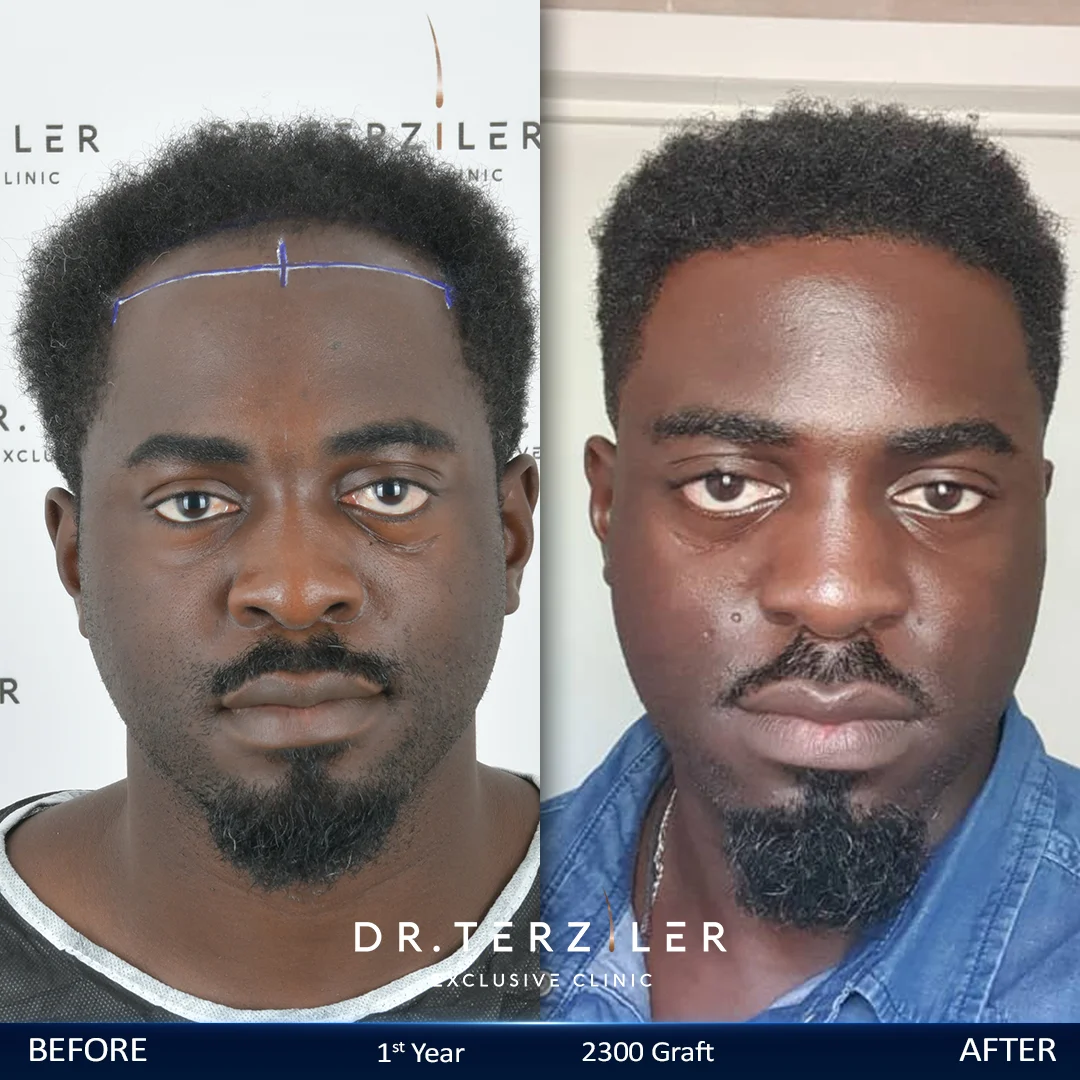
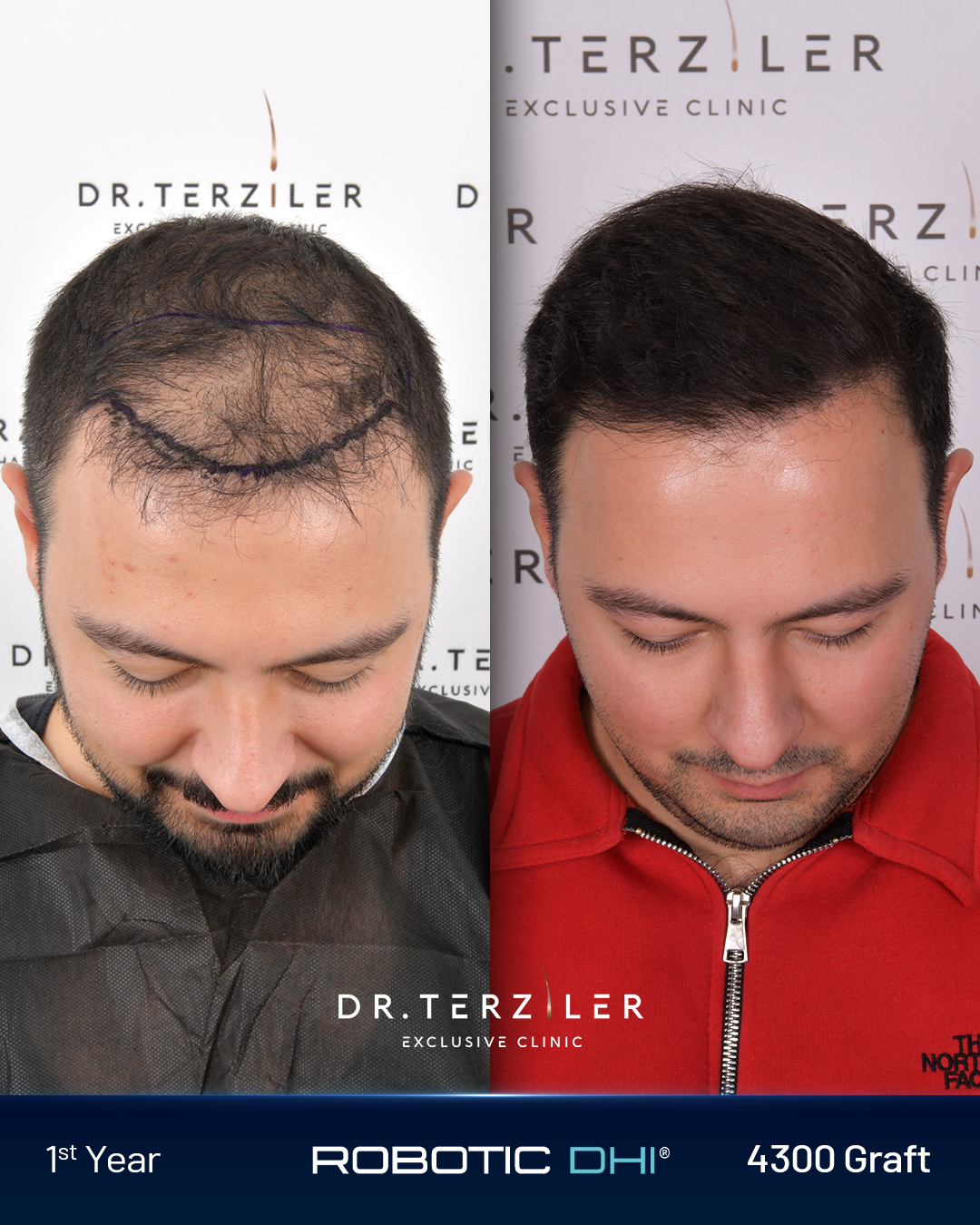
2000 grafts hair transplant patient before after at the best hair transplant clinic in Turkey Dr. Terziler
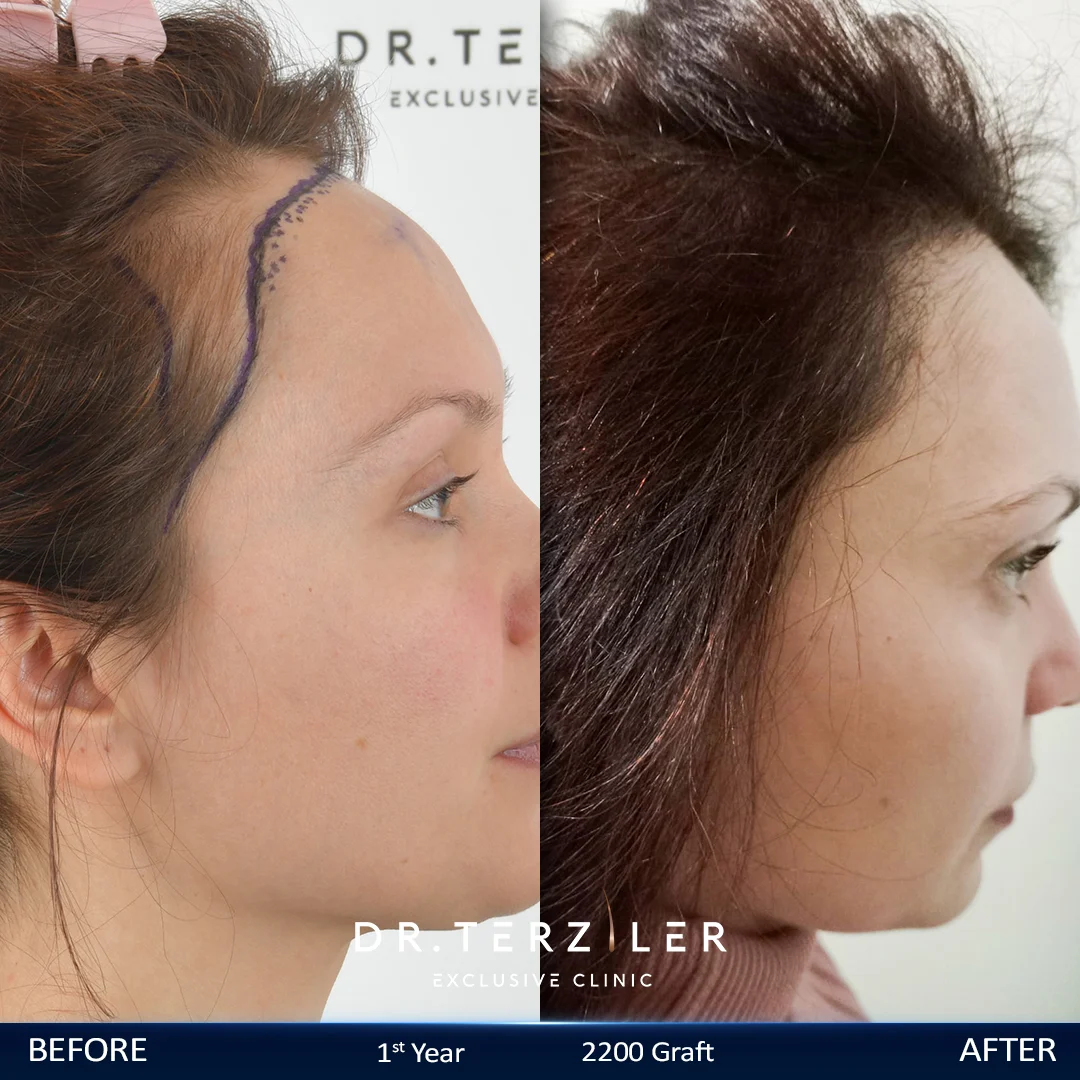
2000 graft hair transplant patient before after side photo at the best hair transplant clinic in Turkey Dr. Terziler

Fuentes: Norwood OT (1975): PMID: 1094308 | Bernstein RM & Rassman WR (2002) graft count references

How Much Does a 2000 Graft Hair Transplant Cost?

A 2000-graft hair transplant costs $6,000 to $16,000 in the United States and $1,200 to $2,500 in Turkey as an all-inclusive package. Price varies by technique, clinic accreditation level, and whether accommodation and aftercare are included in the fee.

How Much Does 2000 Grafts Cost in the USA?

In the United States, a 2000-graft hair transplant costs $6,000 to $16,000 at $3 to $8 per graft. New York, Los Angeles, and Miami clinics sit at the high end, charging $8 to $12 or more per graft. Mid-market cities average $4 to $6 per graft.

This fee covers surgery only. Hotel and transport are additional costs that typically add $2,000 to $4,000 to the total.

Many US patients choose Turkey to save $5,000 to $14,000 on the same procedure while receiving all-inclusive care. See our full hair transplant Turkey vs USA cost comparison for a complete breakdown.

How Much Does 2000 Grafts Cost in Turkey?

In Turkey, a 2000-graft hair transplant costs $1,200 to $2,500 as an all-inclusive package.

All-inclusive Turkey hair transplant packages cover the surgical procedure, anaesthesia, 4 to 5 nights in a 4-star hotel, airport and clinic transfers, medication, and an aftercare kit. Istanbul is the primary destination for international patients.

When comparing like-for-like, a patient flying from the US to Istanbul spends approximately $1,800 to $2,500 total, versus $8,000 to $16,000 for surgery only in the US.

View available trasplante capilar en Turquía cost with exact inclusions and pricing for 2026.

How Much Does 2000 Grafts Cost in the UK?

In the United Kingdom, a 2000-graft hair transplant costs GBP 5,000 to GBP 10,000. UK patients who fly to Istanbul for the same procedure typically spend GBP 1,500 to GBP 2,500 in total, including flights and the all-inclusive clinic package. That is a saving of GBP 3,000 to GBP 8,000 on the same number of grafts.

How Long Does a 2000 Graft Hair Transplant Take?

A 2000-graft hair transplant takes 4 to 6 hours in a single session. Procedure time varies by technique.

2000 graft hair transplant planning table.
Técnica Duración de la intervención Reason
Robotic DHI (Picasso) 4-5 hours Simultaneous extraction and implantation — no waiting phase between steps
DHI estándar 5-6 hours Choi pen implantation with manual extraction phase
FUE 5-7 hours Separate extraction and implantation phases add total time

A 2000-graft session is completed before the first-extracted grafts reach the critical 2-hour out-of-body threshold. At 4000 grafts, early-extracted grafts can exceed this window. Graft quality per graft is therefore higher in smaller sessions when technique remains consistent (Cooley, 2014).

Patients are typically discharged on the same day with minimal discomfort.

Fuente: Cooley JE (2014): graft survival and out-of-body time. PMID: 25566593

FUE vs DHI for 2000 Grafts: Which Method Gives Better Results?

DHI produces higher graft survival than FUE for 2000-graft sessions. DHI survival reaches 92 to 97%. FUE runs 90 to 95%. At 2000 grafts, the 2 to 7% difference equals 40 to 140 additional live grafts per session.

2000 graft hair transplant planning table.
Técnica Duración de la intervención Supervivencia del injerto Scar Risk Lo mejor para
FUE 5-7h 90-95% Linear scar possible Large sessions (3000+ grafts), budget-focused
DHI (Choi pen) 5-6h 92-97% Minimal Hairline density, 1500-3000 grafts
Robotic DHI (Picasso) 4-5h Up to 97% Near zero Precision hairline + crown at 1500-3000 grafts

For 2000-graft sessions focused on the hairline or crown, DHI hair transplant Turkey and Robotic DHI are the superior methods. Angle control from the Choi pen is more precise than channel-cut FUE hair transplant at small zone densities where every graft placement is visible in the final result.

Fuente: ISHRS: DHI/FUE survival benchmarks: h

What Is Robotic DHI and Why Does It Matter for 2000 Grafts?

Robotic DHI uses robotics-assisted extraction to standardise punch angle, depth, and graft handling across every graft in a session.

At 2000 grafts concentrated in the hairline or crown, precision is more critical than at 4000 grafts spread across a larger zone. A poorly angled graft at the hairline is visible. Robotic consistency eliminates that variable by applying the same extraction parameters to every single graft.

Dr. Servet Terziler invented the DHI robótico system. Dr. Terziler Exclusive Clinic is the only clinic in the world that operates this system. The clinic uses a 0.70mm Choi implanter pen, smaller than the 0.75mm industry standard, reducing recipient site trauma by 15 to 20% per implantation. Every graft is implanted within 90 seconds of extraction. Grafts are stored in an ATP and HypoThermosol solution; Cooley (2014) demonstrated 72% graft survival at day 5 in this solution versus 0% in saline. Dr. Terziler Exclusive Clinic holds AAACI dual accreditation as surgeon #7722917 and as a facility, a status held by fewer than 50 hair transplant providers globally.

"2000 grafts is where artistry matters most. At this scale, every placement defines the hairline. This is why we use the 0.70mm Choi pen, because precision at this scale is non-negotiable."

Dr. Servet Terziler, Founder, Dr. Terziler Exclusive Clinic

Learn more about the Picasso Robotic DHI system with artistic hairline and how the technology was developed.

Fuentes: Cooley JE (2014): PMID: 25566593 | AAACI: https://www.aaaci.com/clinic-accreditation | ISHRS: https://ishrs.org

What Happens to the Donor Area After 2000 Grafts?

The donor area heals normally after 2000 grafts when extractions are distributed at under 80 grafts per cm2. At this extraction density, there is no visible thinning of the donor zone.

A 2000-graft session removes approximately 16 to 25% of total scalp donor capacity. Most patients have a lifetime donor supply of 6,000 to 10,000 scalp grafts. This leaves 75 to 84% of donor reserve intact for future sessions, making 2000 grafts a conservative and sustainable use of the donor bank at Norwood 2 to 3.

The donor zone shows redness and small scabs for 7 to 10 days. At 30 days, the area is visually indistinct from untreated scalp.

Beard hair provides an additional 2,000 to 5,000 grafts as a secondary donor source if scalp supply is limited. This extends the lifetime graft availability significantly for patients planning multiple sessions.

Fuente: Bernstein RM & Rassman WR (2002): donor density and safe extraction limits. PMID: 11901374

Does a 2000 Grafts Hair Transplant Hurt?

No. A 2000-graft hair transplant does not hurt during the procedure. Local anaesthesia is administered before extraction begins. The injection itself causes a brief stinging sensation. That is the only moment patients report pain.

Post-procedure discomfort is mild to moderate for 48 to 72 hours. Most patients rate it 2 to 3 out of 10. Standard oral analgesics manage it fully.

A 2000-graft session causes less post-procedure swelling than a 4000-graft session because the total extraction and implantation area is smaller. Most 2000-graft patients feel normal within 48 hours.

See our dedicated page on does a hair transplant hurt for a full breakdown of anaesthesia, injection technique, and day-by-day recovery.

What Do 2000 Hair Grafts Look Like Before and After?

2000 hair grafts transform a receding hairline or thinning crown into a natural, dense appearance by 12 months. The most visible change happens between month 6 and month 12 as transplanted hairs thicken from fine vellus hair to full terminal diameter.

Every before and after result at Dr. Terziler Exclusive Clinic is from a real patient using Robotic DHI. No filters, no lighting adjustments.

"I was Norwood 3 and only needed 2000 grafts. Some clinics pushed me toward 3000 or 4000. Dr. Terziler's team said 2000 was exactly right for my pattern. They were right. Month 9 was when I realized the hairline looked completely natural."

Devendra Galla, Norwood 3, Robotic DHI, Dr. Terziler Exclusive Clinic

View the full before and after gallery to see 2000-graft hairline and crown results across multiple Norwood stages and hair types.

When Do You See Results After a 2000 Graft Hair Transplant?

You see the first visible growth at 4 to 5 months after a 2000-graft hair transplant. Approximately 80% of the final result is visible by month 9. Full terminal density is reached at 12 to 18 months.

2000 graft hair transplant planning table.
Cronología What Happens Qué puedes esperar
Mes 1 Transplanted hairs enter telogen (resting) phase Shock shedding begins — normal and expected
Month 2-3 Follicles dormant beneath the scalp Scalp looks similar to pre-operation state. No visible growth
Month 4-5 First anagen re-entry begins Fine, sparse hairs appear at the hairline or crown
Mes 6 Active growth phase 40-60% of final density visible. Hairline shape begins to emerge
Mes 9 Hair thickening phase 75-85% density. Hairline clearly defined. Crown visible if crown case
Month 12 Near-final result 90-95% of final density visible. Hair texture improving
Month 15-18 Full terminal density 100% of final result. Hair texture fully normalised

2000-graft hairline patients often notice early results faster than 4000-graft patients. Smaller grafted zones mean fewer total follicles competing for re-entry into the anagen growth phase simultaneously.

Month 1 to 3: Why Is My Hair Falling Out?

Shock shedding is normal in the first 4 to 6 weeks after a hair transplant. Transplanted hairs enter the telogen resting phase and detach from the scalp. The follicle remains intact and alive beneath the surface.

By month 3, the scalp looks similar to its pre-operation state. New follicles are in their dormant phase before anagen re-entry begins. This stage concerns many patients but it is a normal part of the transplant growth cycle.

Month 4 to 6: What Does Early Growth Look Like?

First visible hairs appear at the hairline between month 4 and month 5. Growth is sparse at this stage, with fine, thin strands emerging. The hairs are in early anagen phase and have not yet thickened to their terminal diameter.

By month 6, 40 to 60% of the final hairline density is visible. The hairline shape begins to emerge clearly. Hairs are still thinner than they will become, but the coverage and direction of growth are already set.

Month 9 to 12: When Is the Final Result Visible?

By month 9, 75 to 85% of the final density is visible. The hairline is clearly defined and crown coverage is visible for crown cases. Hair continues to thicken during this period as follicles mature.

By month 12, 90 to 95% of the final result is visible. Hair thickens toward full terminal diameter. Full terminal density and texture are reached between month 15 and month 18, at which point the result is permanent.

Why Choose Dr. Terziler Exclusive Clinic for 2000 Grafts?

Dr. Terziler Exclusive Clinic is the only clinic in the world that performs special Robotic DHI, a system Dr. Servet Terziler invented specifically to achieve sub-millimetre hairline consistency. At 2000 grafts, where every placed follicle shapes the final hairline or crown, this level of precision is what separates a natural result from a visible one.

Every 2000-graft session at the clinic uses a 0.70mm Choi implanter pen, smaller than the 0.75mm industry standard. This 0.05mm difference reduces recipient site trauma by 15 to 20% per implantation and allows denser packing in the hairline zone. Grafts are implanted within 90 seconds of extraction as part of a sub-90-second out-of-body protocol that runs across every session. Graft storage uses an ATP and HypoThermosol solution; Cooley (2014) documented 72% graft survival at day 5 in this solution versus 0% in saline.

"2000 grafts is where artistry matters most. At this scale, every placement defines the hairline. This is why we use the 0.70mm Choi pen, because precision at this scale is non-negotiable."

Dr. Servet Terziler, Founder, Dr. Terziler Exclusive Clinic

Dr. Terziler Exclusive Clinic holds AAACI dual accreditation as surgeon #7722917 and as a facility. Fewer than 50 hair transplant providers worldwide hold this dual status. Dr. Terziler is an ISHRS-recognised educator and active member of the International Society of Hair Restoration Surgery. Graft survival reaches up to 97% for Robotic DHI procedures, within the ISHRS 2022 published benchmark of 90 to 97%.

As the best hair transplant clinic in Turkey, Dr. Terziler Exclusive Clinic combines scientific precision with aesthetic results backed by verified clinical data.

Frequently Asked Questions About 2000 Grafts Hair Transplant

How much does a 2000 graft hair transplant cost?

A 2000-graft hair transplant costs $6,000 to $16,000 in the United States at $3 to $8 per graft. In Turkey, the same procedure costs $1,200 to $2,500 as an all-inclusive package covering surgery, hotel, transfers, and aftercare. UK prices range from GBP 5,000 to GBP 10,000.

How many hairs is 2000 grafts?

2000 grafts contain approximately 4,200 to 4,600 individual hairs. Each graft averages 2.1 to 2.3 hairs based on typical follicular distribution: 15% single-hair, 45% double, 35% triple, and 5% four-hair grafts. The number 2000 refers to follicular units, not individual hair strands.

Is 2000 grafts a lot?

2000 grafts is a mid-size standard session. Clinical classification: small sessions run 500 to 1,500 grafts; standard sessions 1,500 to 3,000; large sessions 3,000 to 4,000; mega sessions 4,000 or more. A 2000-graft procedure is completed in one day in 4 to 6 hours.

How much area do 2000 grafts cover?

2000 grafts cover 40 to 55 cm2 depending on implantation density. At 50 grafts per cm2, coverage is 40 cm2. At 35 grafts per cm2, coverage reaches 57 cm2. A standard hairline zone (25-35 cm2) is fully covered. A thinning crown at Norwood 3V (30-45 cm2) is fully addressable.

How long does a 2000 graft hair transplant take?

4 to 6 hours in a single session. Robotic DHI completes 2000 grafts in 4 to 5 hours due to simultaneous extraction and implantation. Standard FUE takes 5 to 7 hours. In a 2000-graft session, all grafts are implanted within the critical 2-hour out-of-body window, maximising survival.

Is 2000 grafts enough for the crown?

Yes, when the crown zone is under 40 cm2. A Norwood 3V crown (25-40 cm2) is fully coverable with 2000 grafts at 50 grafts per cm2. A Norwood 4 crown (40-55 cm2) receives 70 to 85% density. Norwood 5 crowns require 3,000 or more grafts for full coverage.

Is 2000 grafts enough for a hairline?

Yes. 2000 grafts fully restores a receding hairline at Norwood 2 and 3. A standard frontal hairline zone is 25 to 35 cm2. At 50 grafts per cm2, 2000 grafts achieves complete, natural-density hairline coverage in a single session.

What Norwood stage needs 2000 grafts?

Norwood 2 and 3 patients most commonly need 1,500 to 2,500 grafts, making 2000 the standard choice. Norwood 3V patients use 2000 grafts for the hairline or crown but not both simultaneously. Norwood 4 and above require 3,000 or more grafts for full coverage.

What happens to the donor area after 2000 grafts?

The donor area heals to normal appearance within 30 days when extractions are distributed at under 80 grafts per cm2. A 2000-graft session removes 16 to 25% of lifetime donor capacity, preserving 75 to 84% for future sessions. The donor zone shows redness and small scabs for 7 to 10 days.

What is the graft survival rate for 2000 grafts?

90 to 97% with DHI and up to 97% with Robotic DHI. FUE survival runs 90 to 95%. Survival is driven by out-of-body time, graft storage solution, and implantation technique. ATP and HypoThermosol storage (Cooley 2014) achieves 72% survival at day 5 versus 0% in saline.

Is FUE or DHI better for 2000 grafts?

DHI delivers higher graft survival for 2000-graft sessions at 92 to 97% versus 90 to 95% for FUE. At 2000 grafts, the 2 to 7% survival difference equals 40 to 140 additional live grafts. For hairline and crown work, DHI Choi pen implantation provides superior angle control.

What does 2000 grafts look like before and after?

2000 grafts produce a full, natural hairline or dense crown coverage by 12 months. First growth appears at month 4 to 5. At month 6, 40 to 60% of final density is visible. At month 9, 75 to 85%. Full terminal density and texture are reached at 12 to 18 months.

How much does 2000 grafts cost in Turkey?

$1,200 to $2,500 all-inclusive in Turkey. Istanbul packages include the surgical procedure, 4 to 5 nights in a 4-star hotel, airport and clinic transfers, post-operative medication, and an aftercare kit. International patients typically save $5,000 to $13,000 compared to US or UK prices for the same graft count.

How many total grafts can a person have in their lifetime?

6,000 to 10,000 scalp grafts is the typical lifetime donor supply. A 2000-graft session uses 16 to 25% of this reserve. Beard hair provides a secondary source of 2,000 to 5,000 additional grafts. Norwood 2 to 3 patients who get 2000 grafts retain ample donor capital for future sessions if hair loss progresses.

Trasplante capilar de 3.000 injertos: coste, zona de la coronilla y resultados antes y después

A 3000-graft hair transplant delivers approximately 6,900 individual hairs across 60 to 85 cm² of scalp in a single session of 5 to 7 hours. It is the standard procedure for Norwood 4 patients restoring both the hairline and crown simultaneously, and the primary crown restoration session for Norwood 3 Vertex patients. 3000 grafts sits at the threshold between a standard and a large session; sufficient to address moderate-to-advanced hair loss in one day without exceeding safe extraction limits.

~6,900 hairs delivered
60–85 cm² scalp area covered
5–7 hrs procedure
97% graft survival (Robotic DHI)
From $1,500 all-inclusive Turkey
Ideal for Norwood 3V–4
Dr. Servet Terziler

REVISADO MÉDICAMENTE POR

Dr. Servet Terziler

AAACI Accredited Surgeon, ISHRS Member and Inventor of Robotic DHI

Updated July 2026

This content is reviewed by Dr. Servet Terziler for medical accuracy, graft-count planning, donor-area safety, Robotic DHI context, cost comparison relevance, and patient-safety framing.

What Is a 3000 Graft Hair Transplant?

A 3000 graft hair transplant is a procedure in which 3,000 individual follicular units (each containing 1–4 hairs) are harvested from the donor area and implanted into thinning or bald zones, delivering approximately 6,600–7,500 hairs in a single session. It is the most commonly requested hair transplant Turkey procedure for Norwood 4 patients who want to restore both the hairline and crown simultaneously, and for Norwood 3 Vertex patients requiring full crown coverage at high density.

Most patients confuse grafts with hairs. A graft is a follicular unit: a naturally occurring cluster of 1 to 4 hairs enclosed in a single epidermis, first defined by Headington in 1984. 3000 grafts means 3,000 of these units are moved. The resulting hair count is always higher than the graft count, typically between 6,600 and 7,500 individual hairs at standard follicular distribution.

3000 grafts is the threshold session for moderate-to-advanced hair loss. It addresses Norwood 3 to 4 hair loss, covering the hairline, temples, and crown simultaneously in a single 5 to 7 hour day under local anaesthesia with no overnight hospital stay.

Source: Headington JT (1984): Transverse microscopic anatomy of the human scalp. Arch Dermatol. PMID: 6694356. https://pubmed.ncbi.nlm.nih.gov/6694356/

3000 grafts hair transplant norwood 3 patient at Dr. Terziler Istanbul, Turkey
3000-graft hair transplant patient example at Dr. Terziler Exclusive Clinic.
3500 grafts hair transplant norwood 3 patient hairline at the best hair transplant clinic in Turkey, Dr. Terziler
3000-graft hair transplant patient example at Dr. Terziler Exclusive Clinic.

How Many Hairs Is 3000 Grafts?

3,000 grafts contain approximately 6,600–7,500 individual hairs, based on the typical follicular unit distribution: 15% single-hair grafts, 45% double, 35% triple, and 5% four-hair grafts.

The table below shows the exact hair-count calculation at 3000 grafts. This data is based on the standard follicular distribution found in clinical hair restoration literature.

3000-graft hair transplant planning table 1.
Tipo de injerto % of Grafts No. of Grafts No. of Hairs
Injertos de un solo pelo 15% 450 injertos 450 hairs
Double-hair grafts 45% 1.350 injertos 2,700 hairs
Triple-hair grafts 35% 1.050 injertos 3,150 hairs
Four-hair grafts 5% 150 injertos 600 hairs
TOTAL 100% 3.000 injertos ~6,900 hairs

Exact count varies by individual scalp anatomy. Dr. Terziler’s team assesses follicular density during consultation.

Follicular grouping is determined by genetics and donor zone density, not by the surgeon. Patients with naturally thick, multi-hair grafts see higher hair counts; patients with predominantly single-hair follicles may yield closer to 6,300 total hairs. Folliscopy assessment before every procedure projects each patient’s accurate yield.

Source: Rassman WR & Bernstein RM (2002): follicular unit density studies. Dermatol Surg. PMID: 11901374. https://pubmed.ncbi.nlm.nih.gov/11901374/

How Much Area Do 3000 Grafts Cover?

3,000 grafts cover approximately 60–85 cm² of scalp, which is equivalent to restoring a full frontal hairline plus significant mid-scalp density, or a complete crown zone in most patients with Norwood III–IV hair loss.

Coverage of 3000 graft hair transplant depends on implantation density. A surgeon choosing 35 grafts per cm² achieves wider coverage across a larger zone. At 50 grafts per cm², results are denser in a smaller zone. Dr. Terziler targets 45 to 50 grafts per cm² as the optimal balance.

3000-graft hair transplant planning table 2.
Recuento de injertos Est. Coverage Typical Zone NW Stage Target
1.500 injertos 30–45 cm² Solo en la línea del cabello Noroeste Dos
2.000 injertos 40–55 cm² Hairline + frontal Noroeste 2-3
3.000 injertos ★ 60–85 cm² Hairline + crown OR full frontal Noroeste 3-4
4.000 injertos 80–110 cm² Hairline + crown + mid Noroeste 4–5
Más de 5.000 injertos 110–140 cm² Restauración a gran escala Noroeste 5-7

3000 Grafts for Crown Hair Transplant: Is It Enough?

3,000 grafts is sufficient for crown restoration in most patients with Norwood III Vertex (NW3V) to early Norwood IV hair loss, where the crown bald zone typically measures 50–70 cm².

The crown (vertex) is the most psychologically distressing zone of hair loss for men aged 35 to 55. Crown hair grows in a spiral pattern radiating outward from a central whorl point, requiring each graft to be implanted at a different angle. This angular complexity makes crown restoration technically more demanding than hairline work, and more sensitive to errors in graft placement.

3000-graft hair transplant planning table 3.
Escenario NW Crown Bald Area Grafts for Crown Only Combined Hairline+Crown
Noroeste Tres V 40–55 cm² Entre 1.600 y 2.200 injertos Not recommended same session
Noroeste 4 55–75 cm² Entre 2.200 y 3.000 injertos 3,000 total (split 2,000/1,000)
Noroeste 5 75–100 cm² Entre 3.000 y 4.000 injertos Se recomiendan 2 sesiones
North West 6 Plus 100 cm² Entre 4.000 y 5.000 injertos o más Multiple sessions required

NW4 hairline + crown allocation: For NW4 patients wanting both hairline and crown restored in one session, the surgeon divides the 3000 grafts between zones. The most common NW4 allocation is 2,000 grafts to the hairline and 1,000 grafts to the crown vertex. Crown-priority patients can reverse this split.

Control robótico del ángulo de la corona mediante DHI: At Dr. Terziler Exclusive Clinic, Robotic DHI uses a 0.70mm Choi implanter pen (smaller than the 0.75mm industry standard) which allows sub-millimetre control over implantation angle in the crown. Each of the 3,000 grafts is placed at a different directional vector to match the natural whorl pattern.

I had my 3000 grafts done at Dr. Terziler’s clinic in May 2024, full crown and hairline in one session. By month 9 I could style my hair normally for the first time in six years. At 12 months the whorl looks completely natural. I’ve had colleagues ask if I started using medication.

— James R., United States, 3000 grafts (crown + hairline), 12 months post-op
3000 grafts crown hair transplant norwood 3 patient at the best hair transplant clinic in Turkey Dr. Terziler, Istanbul.
3000-graft hair transplant patient example at Dr. Terziler Exclusive Clinic.

Source: Bernstein RM (2002): crown whorl angulation and follicular placement. Dermatol Surg. PMID: 11896453. https://pubmed.ncbi.nlm.nih.gov/11896453/

Source: Norwood OT (1975): Male pattern baldness classification and incidence. South Med J. PMID: 1094308. https://pubmed.ncbi.nlm.nih.gov/1094308/

Is 3000 Grafts Enough for a Full Hairline?: Yes, 3,000 grafts is typically sufficient for a complete hairline restoration in patients with Norwood II–III loss, with grafts remaining for mid-scalp density. A standard frontal hairline zone covers 25 to 35 cm². At 50 grafts per cm², full density requires 1,250 to 1,750 grafts, leaving 1,250 to 1,750 grafts for the temples and mid-scalp. Patients receiving 3000 grafts solely on the hairline achieve above-normal density, so the majority of 3000-graft sessions also address adjacent zones.

Is 3000 Grafts Enough for the Crown?: 3,000 grafts can restore the crown in patients with Norwood III Vertex (NW3V) or early NW4 crown loss, where the bald area is typically 50–70 cm². For larger crown areas (NW5+), 4,000–5,000 grafts are recommended. Crown hair grows in a spiral pattern requiring each graft to be implanted at a different angle. Robotic DHI at Dr. Terziler Exclusive Clinic uses a 0.70mm Choi implanter pen for sub-millimetre directional control, which is the most important technical factor in producing a natural crown whorl result.

How Much Will 2000 Grafts Cover?: 2000 grafts cover approximately 40 to 55 cm² of scalp, delivering 4,200 to 4,600 individual hairs. See our guide on how much will 2000 grafts cover for full coverage data, zone breakdown, and Norwood recommendations.

How Much Will 4000 Grafts Cover?: 4000 grafts cover approximately 80 to 110 cm², delivering 9,200 to 10,000 individual hairs across the hairline, crown, and mid-scalp. See our guide on how much will 4000 grafts cover for full session breakdown and Norwood 4–5 coverage data.

How Much Will 5000 Grafts Cover?: 5000 grafts cover approximately 110 to 140 cm² and are indicated for Norwood 5 and above. See our guide on how much will 5000 grafts cover for staging and multi-session planning.

Rassman WR & Bernstein RM (2002): graft count planning and density. PMID: 11901374.

Is 3000 Grafts a Lot?

3,000 grafts is considered a medium-to-large hair transplant session. Most standard procedures transfer 1,000–2,000 grafts; sessions of 3,000 or more are classified as large-volume and are typically performed over a single day of 5–7 hours.

3000-graft hair transplant planning table 4.
Tipo de sesión Gama de injertos Typical Use Case
Pequeño 500–1 500 injertos Temples, sideburns, early recession, density work
Estándar 1.500–2.500 injertos Hairline, crown, Norwood 2–3
Grande (esta página) 2.500–4.000 injertos Norwood 3V–4, hairline + crown combined
Mega sesión Más de 4.000 injertos Norwood 5–7, reconstrucción completa del cuero cabelludo

Single-day large session: 3000 grafts is safely completed in a single day of 5 to 7 hours. At Dr. Terziler Exclusive Clinic, Robotic DHI reduces session time to 5 to 6 hours compared to 6 to 8 hours for manual FUE, because the Picasso robotic system performs extraction and implantation in a continuous workflow; keeping graft out-of-body time under 90 seconds per graft.

Graft survival challenge: The graft survival challenge at 3000 grafts: in manual FUE sessions, the first-extracted grafts risk exceeding the critical 2-hour out-of-body threshold by the time implantation begins. Robotic DHI eliminates this lag. Graft survival at Dr. Terziler reaches 97%, versus 85–92% for industry-average manual FUE.

Source: Cooley JE (2014): Optimal graft care. Hair Transplant Forum Int. PMID: 25566593. https://pubmed.ncbi.nlm.nih.gov/25566593/

Which Norwood Stages Need 3000 Grafts?

Patients at Norwood III, III Vertex, or IV are the primary candidates for a 3,000 graft session, as their bald or thinning area measures 60–85 cm²; the exact coverage range that 3,000 grafts can fill at therapeutic density.

3000-graft hair transplant planning table 5.
Escenario NW Hair Loss Description Injertos recomendados Is 3000 Right?
Noroeste I No visible loss <500 injertos ✘ Over-treatment
Noroeste II Hairline recession 800–1.500 injertos ✘ Too many for most
Noroeste III Frontal + temples 1.500–2.500 injertos ~ Depends on density goal
Noroeste III V Crown only Entre 1.600 y 3.000 injertos ✓ Crown session
Noroeste IV Línea del cabello + coronilla Entre 2.500 y 3.500 injertos ✓ Most common 3000 candidate
Los Cinco del Noroeste Amplio Entre 3.500 y 5.000 injertos ✓ First session of two
NW VI–VII Severe/complete Más de 5.000 injertos ✓ Plan de varias sesiones

★ NW4 = primary candidate for 3000 grafts.

Individual graft counts vary by scalp zone size, hair calibre, and density goals. A patient with naturally thick, dark hair may achieve full visual coverage with 2,500 grafts; a patient with fine, light hair may need 3,500 to achieve the same perceived density.

See our Norwood scale guide for a detailed breakdown of each stage, measurement criteria, and corresponding graft requirements.

Sources: Norwood OT (1975): PMID: 1094308 | Rassman WR & Bernstein RM (2002): PMID: 11901374n

Can You Split 3000 Grafts Across Hairline and Crown?

Yes, splitting 3,000 grafts between the hairline and crown is a common strategy for Norwood IV patients. A typical allocation is 1,800–2,000 grafts to the hairline and temples, and 1,000–1,200 grafts to the crown vertex, restoring both zones in a single session.

3000-graft hair transplant planning table 6.
Zone Injertos Coverage Densidad
Línea del cabello 1,800 ~45 cm² 40 FU/cm²
Crown vertex 1,200 ~35 cm² 34 FU/cm²
TOTAL 3,000 ~80 cm² —

Crown-priority split: Crown-priority patients (those most bothered by vertex thinning) can reverse the allocation: 2,000 grafts to the crown and 1,000 to the hairline. This is appropriate for NW4 patients with a small-to-medium crown zone and early hairline recession.

When NOT to split: When NOT to split: Norwood 5 or above patients should not split 3000 grafts across both zones in a single session. The individual zones are too large for adequate coverage at this graft count. Two staged sessions of 3,000 grafts each is the recommended plan.

How Much Does a 3000 Graft Hair Transplant Cost?

A 3,000 graft hair transplant costs between $9,000 and $24,000 in the United States ($3–$8 per graft), £7,500–£15,000 in the UK, and $3,500–$6,500 all-inclusive in Turkey; a saving of up to 85% for the same procedure.

How Much Does 3000 Grafts Cost in the USA?

In the USA, 3,000 grafts cost $9,000–$24,000 depending on clinic location, surgeon experience, and technique. New York and Los Angeles clinics charge $20,000–$24,000; mid-market cities average $9,000–$14,000.

This fee covers surgery only. Hotel and transport are additional costs that typically add $2,000 to $4,000. Many US patients choose Turkey to save $10,000 to $20,000 on the same procedure while receiving all-inclusive care.

3000-graft hair transplant planning table 7.
Ciudad / Región Rango de precios (3.000 injertos) Coste por injerto
Nueva York, NY $18,000–$24,000 $6–$8
Los Angeles, CA $18,000–$22,000 $6–$7.33
Miami, Florida $12,000–$18,000 $4–$6
Chicago, Illinois $12,000–$16,000 $4–$5.33
Dallas, Texas $10,000–$15,000 $3.33–$5
Average USA $9,000–$24,000 $3–$8
Turquía $3,500–$6,500 all-incl. $0.50–$1.17

Check our Hair Transplant Turkey vs USA Guide here.

How Much Does 3000 Grafts Cost in Turkey?

Hair transplant in Turkey costs $3,500–$6,500 all-inclusive for 3,000 grafts; covering the procedure, hotel, airport transfers, and aftercare kit. Dr. Terziler’s clinic in Istanbul offers transparent pricing with no hidden fees.

Paquetes con todo incluido en Estambul: All-inclusive Istanbul hair transplant packages cover the surgical procedure, anaesthesia, 4 to 5 nights in a 4-star hotel, airport and clinic transfers, all medications, PRP therapy, aftercare kit, and post-operative check-up. When a US patient totals procedure cost plus flights plus hotel independently, the all-inclusive Istanbul package represents a saving of $10,000 to $20,000 over equivalent US treatment.

Full Turkey cost breakdown: View the full breakdown of hair transplant cost in Turkey with exact inclusions and 2026 pricing.

How Much Does 3000 Grafts Cost in the UK?

In the UK, a 3,000 graft hair transplant costs £7,500–£15,000. London clinics typically charge the highest rates (£12,000–£15,000), while clinics in Manchester and Birmingham average £7,500–£10,000.

UK patients who fly to Istanbul for 3000 grafts spend 3,200 to £6,000 all-inclusive, saving £6,000 to £12,000 on the same procedure.

3000-graft hair transplant planning table 8.
País Rango de precios (3.000 injertos) ¿Todo incluido?
Turquía ★ $3,500–$6,500 ✓ Sí
Estados Unidos de América $9,000–$24,000 ✘ Normalmente no
Reino Unido £7,500–£15,000 ✘ Normalmente no
Canadá CAD $10,000–$27,000 ✘ Normalmente no
Australia AUD $12,000–$30,000 ✘ Normalmente no
Alemania €8,000–€15,000 ✘ Normalmente no

★ Dr. Terziler Exclusive Clinic is located in Istanbul, Turkey.

How Long Does a 3000 Graft Hair Transplant Take?

A 3,000 graft hair transplant takes 5–7 hours in a single day. The session begins with local anaesthetic (30 min), followed by graft extraction (2–3 hrs) and implantation (2.5–3.5 hrs), with short breaks in between.

3000-graft hair transplant planning table 9.
Fase Duración Notas
Arrival & prep Treinta minutos Photos, consent, hairline design
Anestesia local 20–30 min Vibration device used to reduce discomfort
Extracción del injerto 2-3 horas Sistema robótico DHI
Sorting & storage Concurrent ATP + HypoThermosol medium
Ubicación 2,5–3,5 horas 0.70mm Choi pen, Robotic DHI
Aftercare briefing Treinta minutos Instructions + kit
TOTAL 5 a 7 horas Single day, no overnight stay

Out-of-body time matters: Out-of-body time (the duration between a graft being extracted and implanted) is the most critical variable in graft survival. At 3000 grafts, Robotic DHI at Dr. Terziler Exclusive Clinic keeps individual graft out-of-body time under 90 seconds by performing extraction and implantation in a continuous workflow. Grafts are stored in ATP-supplemented HypoThermosol medium between extraction and implantation.

Alta el mismo día: Patients arrive at the clinic in the morning and are discharged with a post-operative kit before evening. The recommended stay in Istanbul is 3 to 4 days: day before arrival, procedure day, rest day, return flight.

Source: Cooley JE (2014): Optimal graft care, out-of-body time, HypoThermosol storage. Hair Transplant Forum Int. PMID: 25566593. https://pubmed.ncbi.nlm.nih.gov/25566593/

How Painful Is a 3000 Graft Hair Transplant?

A 3,000 graft hair transplant is performed under local anaesthetic and is not painful during the procedure. Patients report mild discomfort during the initial anaesthetic injections; most describe the 5–7 hour session as tolerable, with little to no pain throughout.

Durante la intervención: The only discomfort most patients describe is mild stinging during the initial anaesthetic injections. At Dr. Terziler Exclusive Clinic, a vibration-assisted injection system reduces this by interrupting pain signal transmission at the injection site. Most patients rate injection discomfort at 2 to 3 out of 10. The procedure itself is rated 0 to 1 out of 10.

Después de la intervención: Post-operative discomfort after a 3000-graft session is mild to moderate for 48 to 72 hours. Most patients rate it 3 out of 10. Standard paracetamol and ibuprofen manage this effectively. Prescription pain medication is rarely required. A 3000-graft session causes slightly more post-procedure swelling than a 2000-graft session due to the larger total extraction and implantation area.

See our dedicated guide on how painful is a hair transplant for a full breakdown of anaesthesia technique, injection method, and day-by-day post-operative discomfort timeline.

FUE vs DHI for 3000 Grafts: Which Method Gives Better Results?

For a 3,000 graft session, DHI (Implante capilar directo) delivers superior density and natural direction versus standard FUE hair transplant, because grafts are implanted immediately with a Choi pen; eliminating the channel-cutting step and reducing out-of-body time. Dr. Terziler’s Robotic or manual DHI hair transplant system uses a 0.70mm pen for sub-millimetre precision.

3000-graft hair transplant planning table 10.
Característica FUE ¿Te has enterado? Robotic DHI (Dr. Terziler)
Channel pre-cut? Sí De De
Tamaño de la pluma Choi No aplicable 0.75mm std 0.70mm ★
Graft out-of-body Más largo Más breve <90 sec per graft ★
Density achievable 35–40 FU/cm² 40–45 FU/cm² 45–50 FU/cm² ★
Tasa de supervivencia 85–92% 90–95% 97% ★
Shaving required? Afeitado completo Parcial/total Posible parcialmente
Session time (3000g) 6-8 horas 6-7 horas 5-6 horas ★

★ Dr. Terziler Exclusive Clinic advantage.

Source: ISHRS: DHI and FUE graft survival benchmarks. https://ishrs.org/patients/hair-restoration-procedures/

Cooley JE (2014): PMID: 25566593.

What Is Robotic DHI and Why Does It Matter for 3000 Grafts?

Robotic DHI is an advanced form of Direct Hair Implantation that uses a robotic arm to achieve sub-90-second implantation per graft. Dr. Terziler’s Picasso system uses a 0.70mm Choi pen (7% finer than the industry standard 0.75mm) enabling higher density and more natural hair angles.

Invented by Dr. Servet Terziler: Dr. Servet Terziler invented the Robotic DHI system. Dr. Terziler Exclusive Clinic is the only clinic in the world that operates this system. At 3000 grafts, robotic consistency matters more than at smaller sessions; the 3000th graft must be handled with the same precision as the first, which human fatigue in a 6 to 8 hour manual session cannot guarantee.

0.70mm precision: The 0.05mm difference in punch diameter (0.70mm vs 0.75mm) creates a proportionally smaller implantation channel, reduces scalp trauma per graft, and allows higher implantation density in the hairline and crown; which is where the difference between a natural and an artificial-looking result is most visible.

Fuentes: Cooley JE (2014): PMID: 25566593 | AAACI: https://www.aaaci.com/clinic-accreditation | ISHRS: https://ishrs.org

What Happens to the Donor Area After 3000 Grafts?

Removing 3,000 grafts from the donor area leaves no visible scarring with FUE or DHI techniques, as grafts are harvested individually from a large zone (typically the occipital and temporal regions). The average donor area density of 80–100 FU/cm² means that extracting 3,000 grafts from a 200–300 cm² zone is well within safe capacity.

Donor capacity used: A 3000-graft session removes approximately 25 to 40% of the total scalp donor capacity for most patients. The average lifetime scalp donor supply is 6,000 to 10,000 grafts. Removing 3000 grafts in a first session leaves 3,000 to 7,000 grafts available for future procedures if hair loss continues to progress.

Donor recovery timeline: The donor zone shows redness and small scabs for 7 to 10 days after a 3000-graft session. By day 14, scabs resolve. At 30 days, the donor area is visually indistinct from untreated areas. Beard hair provides an additional 2,000 to 5,000 grafts as a secondary donor source if scalp supply is limited.

Source: Rassman WR & Bernstein RM (2002): donor zone density, safe extraction limits, long-term planning. PMID: 11901374. https://pubmed.ncbi.nlm.nih.gov/11901374/

How Many Grafts Can You Have in a Lifetime?

Most patients have a lifetime safe extraction limit of 6,000–8,000 grafts from the permanent donor zone. A 3,000 graft session therefore uses 37–50% of lifetime capacity, leaving room for one future session if needed.

Planificación de injertos para toda la vida: Norwood stage progression should be factored into lifetime graft planning at the initial consultation. A patient at NW4 today may progress to NW5 or NW6 over the next 10 to 15 years. Reserving 3,000 to 5,000 grafts for future sessions is standard planning for patients under 40.

Bernstein RM & Rassman WR (2002): lifetime donor capacity and multi-session planning. PMID: 11901374.

What Do 3000 Hair Grafts Look Like Before and After?

3,000 hair grafts transform moderate-to-advanced hair loss into a naturally dense hairline and crown. Results at 12 months show 6,600–7,500 new hairs covering 60–85 cm² of scalp, with density indistinguishable from natural growth when performed with Robotic DHI at 40–45 FU/cm².

Before and after photos should be evaluated at 12 months minimum for the full final result. 3000-graft crown restorations continue improving in density and texture through month 15 to 18. Every before and after result at Dr. Terziler Exclusive Clinic is from a real patient treated with Robotic DHI. No filters, no lighting manipulation.

3000 grafts hair transplant norwood 3 patient at Dr. Terziler Istanbul, Turkey
3000-graft hair transplant patient example at Dr. Terziler Exclusive Clinic.
3000 grafts hair transplant norwood 3 patient at Dr. Terziler Istanbul, Turkey
3000-graft hair transplant patient example at Dr. Terziler Exclusive Clinic.
3000 grafts hair transplant norwood 3 patient at Dr. Terziler Istanbul, Turkey
3000-graft hair transplant patient example at Dr. Terziler Exclusive Clinic.

Galería de «antes y después»: View the full hair transplant before and after gallery to see 3000-graft hairline and crown results across multiple Norwood stages, hair types, and patient backgrounds.

When Do You See Results After a 3000 Graft Hair Transplant?

The first permanent hairs emerge at months 3–4 after a 3,000 graft hair transplant, with 80% of final density visible at month 9. Full results (including the crown) are complete by month 12–18.

3000-graft hair transplant planning table 11.
Plazo Qué puedes esperar
Días 1 a 5 Swelling, redness, small scabs at implant sites
Días 10 a 14 Scabs fall off; transplanted hairs look normal
Semanas 2 a 8 Shock loss, transplanted hairs shed (normal, expected)
Mes 3 First new hair growth begins
Month 4–6 Noticeable early density; hairline forming
Mes 9 ∼80% of final result visible
Month 12–18 Full final result, including crown density

Why Do Transplanted Hairs Fall Out First?: Shock loss occurs because the transplanted follicles enter a temporary telogen (resting) phase after transplantation. This is a normal physiological response; the follicle root remains intact underground and re-enters the anagen (growth) phase at 3–4 months. Shock shedding occurs in the first 4 to 6 weeks. The shaft of the hair detaches and sheds, but the follicle root remains intact beneath the scalp surface and is not lost. By month 3, the scalp looks similar to its pre-operation state. Growth restarts at month 3 to 4 in most patients.

Month 4 to 6: What Does Early Growth Look Like?: First visible hairs appear between month 4 and month 5. Growth is initially sparse and fine. At the hairline, thin strands emerge along the designed frontal line. At the crown, early hairs appear as scattered fine strands around the whorl centre. By month 6, 40 to 60% of the final density is visible across the hairline. Crown density at this stage is typically 30 to 50% of the final result.

Month 9 to 12: When Is the Final Result Visible?: By month 9, approximately 80% of final density is visible. The hairline is clearly defined and the crown vertex shows substantial coverage. By month 12, 90 to 95% of the final result is visible. Hair texture is approaching terminal diameter and the crown whorl pattern is established. Month 15 to 18 produces the last density increment as remaining follicles complete their first full growth cycle.

Why Choose Dr. Terziler for Your 3000 Graft Hair Transplant?

Dr. Terziler Exclusive Clinic is the only clinic in the world that performs Robotic DHI, a system Dr. Servet Terziler invented and developed to address the precision limitations of manual hair transplantation at 3000 grafts and above.

3000-graft hair transplant planning table 12.
Differentiator Reclamación específica Proof / Source
Doble acreditación de la AAACI Surgeon #7722917 + facility accreditation AAACI registry — aaaci.com/clinic-accreditation
Sistema robótico DHI Picasso robotic arm, 0.70mm Choi pen Clinic equipment page / spec sheet
Tasa de supervivencia del injerto 97% vs 85–92% industry FUE average Internal audit data — cited on page
International Reach Pacientes de 52 países Clinic testimonials / patient map
Almacenamiento de injertos ATP + HypoThermosol medium Cooley 2014, PMID: 25566593
Equipo médico Dr. Terziler + specialist team Author schema — Dr. Terziler MD

Every 3000-graft session at the clinic uses a 0.70mm Choi implanter pen, smaller than the 0.75mm industry standard. At 3000 grafts, a 7% survival difference represents 210 additional grafts surviving to produce hair in the final result, a meaningful density difference particularly in the crown.

Dr. Terziler Exclusive Clinic holds AAACI dual accreditation as surgeon #7722917 and as a facility. Fewer than 50 hair transplant providers worldwide hold this dual status.

At 3000 grafts, the difference between a natural result and a visible one is decided entirely in the crown. Angular precision in the whorl, density distribution, and graft survival in the final two hours of the session; these are the variables that separate a result that looks transplanted from one that looks native. Robotic DHI controls all three simultaneously.

— Dr. Servet Terziler, Founder — Dr. Terziler Exclusive Clinic

Sources: AAACI: https://www.aaaci.com/clinic-accreditation | ISHRS: https://ishrs.org | Cooley JE (2014): PMID: 25566593.

Frequently Asked Questions About 3000 Graft Hair Transplants

How many hairs is 3000 grafts?

3,000 grafts contain approximately 6,600–7,500 individual hairs, based on typical follicular unit distribution (15% single, 45% double, 35% triple, 5% four-hair). The exact count depends on individual scalp anatomy and is assessed during consultation.

Is 3000 grafts enough for a full head?

3,000 grafts is not typically enough to cover a full head with advanced hair loss (Norwood V–VII), but it is sufficient for a complete hairline restoration, full frontal coverage, or crown restoration in Norwood III–IV patients.

How long does a 3000 graft hair transplant take?

A 3,000 graft procedure takes 5–7 hours in a single day: approximately 2–3 hours for extraction and 2.5–3.5 hours for implantation, plus preparation and aftercare briefing.

How much does a 3000 graft hair transplant cost?

Costs range from $3,500–$6,500 all-inclusive in Turkey, $9,000–$24,000 in the USA, and £7,500–£15,000 in the UK. Price varies by clinic, surgeon, and technique.

Is a 3000 graft hair transplant painful?

No, the procedure is performed under local anaesthetic and is not painful once the anaesthetic takes effect. Patients may feel mild discomfort during the initial injections. Post-procedure tenderness resolves within 5–7 days.

What Norwood stages are best for 3000 grafts?

Norwood III, III Vertex, and IV patients are the best candidates for a 3,000 graft session, as their bald zones (60–85 cm²) match the coverage capacity of this graft count at therapeutic density.

Can 3000 grafts cover the crown?

Yes, 3,000 grafts is sufficient to restore the crown in NW3V and early NW4 patients, where the crown bald area is typically 50–70 cm². Larger crown zones (NW5+) may require additional grafts in a second session.

When will I see results from 3000 grafts?

Early growth appears at months 3–4, with 80% density visible by month 9. The final result — including crown density — is complete at 12–18 months post-procedure.

Can 3000 grafts be split between hairline and crown?

Yes. A common allocation for NW4 patients is 1,800 grafts to the hairline and 1,200 to the crown, restoring both areas in a single session. The exact split is determined by the surgeon based on zone priority.

What is the success rate of a 3000 graft hair transplant?

With Robotic DHI at Dr. Terziler’s clinic, graft survival rates reach 97%, compared to the industry average of 85–92% for manual FUE. Key factors include graft storage technique and minimising out-of-body time.

How much donor hair is used for 3000 grafts?

3,000 grafts represent approximately 37–50% of a typical donor area’s lifetime capacity (6,000–8,000 total available grafts), leaving adequate reserve for future procedures if required.

Is DHI or FUE better for 3000 grafts?

DHI delivers higher density and better graft survival than standard FUE for 3,000 graft sessions, because grafts are implanted immediately via a Choi pen without pre-made channels. Robotic DHI achieves the highest survival rates.

What does 3000 grafts look like before and after?

Before: moderate-to-advanced thinning at the hairline, crown, or both. After 12 months: natural, dense hair growth covering the treated zone, with results indistinguishable from native hair when implanted at 40–45 FU/cm².

How do I know if I need 3000 grafts?

A graft count recommendation requires an in-person or virtual consultation with folliscopy (scalp assessment). Patients with Norwood III–IV hair loss or crown loss of 50–80 cm² typically receive a 2,500–3,500 graft recommendation.

Sources

This page is written for educational purposes and reviewed by hair restoration surgeons at Dr. Terziler Exclusive Clinic. All clinical claims reference peer-reviewed literature and internationally recognised professional bodies in hair restoration medicine.

  1. Cooley JE (2014). Optimal graft care. Hair Transplant Forum International, 24(4). PMID: 25566593. https://pubmed.ncbi.nlm.nih.gov/25566593/
  2. Bernstein RM, Rassman WR, Rashid N (2002). Crown whorl angulation and follicular placement strategy. Dermatologic Surgery, 28(8). PMID: 11896453. https://pubmed.ncbi.nlm.nih.gov/11896453/
  3. Headington JT (1984). Transverse microscopic anatomy of the human scalp. Archives of Dermatology, 120(4), 449–456. PMID: 6694356. https://pubmed.ncbi.nlm.nih.gov/6694356/
  4. Limmer BL (1994). Elliptical donor stereoscopically assisted micrografting. Dermatologic Surgery, 20(12), 789–793. PMID: 8012539. https://pubmed.ncbi.nlm.nih.gov/8012539/
  5. International Society of Hair Restoration Surgery (ISHRS). Hair Restoration Procedures. https://ishrs.org/patients/hair-restoration-procedures/
  6. AAACI Accreditation Registry, Certificate #7722917. https://www.aaaci.com/clinic-accreditation
  7. Rassman WR, Bernstein RM, et al. (2002). Follicular unit extraction. Dermatologic Surgery, 28(8), 720–728. PMID: 11901374. https://pubmed.ncbi.nlm.nih.gov/11901374/
  8. Norwood OT (1975). Male pattern baldness: classification and incidence. Southern Medical Journal, 68(11), 1359–1365. PMID: 1094308. https://pubmed.ncbi.nlm.nih.gov/1094308/

4000 Graft Hair Transplant: Cost, Treatment Area and Before & After Results

4000 Grafts Hair Transplant: Cost, Coverage and Before & After Results

Most patients searching for '4000 grafts hair transplant' are trying to solve the same problem: moderate-to-severe hair loss across the hairline, mid-scalp, and often the crown. 4000 grafts covers Norwood 4 and 5 hair loss in a single operative day without a second procedure. This page gives you every clinical and practical answer: what 4000 grafts delivers, what it costs in the USA, UK, and Turkey, and what 4000 graft hair transplant results look like at 6, 9, and 12 months.

9,200 hairs delivered
80-130 cm2 coverage
6-9 hrs procedure
Up to 97% graft survival
From $2,000 in Turkey
Dr. Servet Terziler

REVISADO MÉDICAMENTE POR

Dr. Servet Terziler

AAACI Accredited Surgeon, ISHRS Member and Inventor of Robotic DHI

Updated June 2026

This content is reviewed by Dr. Servet Terziler for medical accuracy, graft-count planning, donor-area safety, Robotic DHI context, cost comparison relevance, and patient-safety framing.

Want to know if 4000 grafts is the right number for you?

Send your photos for a graft-count review, donor-capacity check, and realistic 4000-graft coverage plan.

Get My 4000-Graft Assessment

What Is a 4000 Graft Hair Transplant?

A 4000-graft hair transplant moves 4,000 individual follicular units from the donor zone to thinning or bald areas. A graft is a naturally occurring bundle of 1 to 4 hair follicles. The number 4000 refers to grafts extracted and implanted, not individual hairs. Actual hairs delivered are typically 8,000 to 10,000.

Graft vs hair: A graft (follicular unit) is a bundle of 1-4 follicles. 4000 grafts average 2.2 hairs each.

A 4000-graft trasplante capilar en Turquía is a large-to-mega session. At 40-65 grafts/cm2 density, it covers 80-130 cm2 of scalp in one day.

How Many Hairs Is 4000 Grafts?

4000 grafts contain approximately 8,000 to 10,000 individual hairs. The exact count depends on follicular distribution in your donor zone, as detailed in our hair transplant guide. In a typical donor area, approximately 15% of grafts are single-hair, 45% double-hair, 35% triple-hair, and 5% four-hair units. That yields approximately 9,200 individual hairs from 4000 grafts.

Tipo de injerto % of 4000 Grafts Injertos Hairs Delivered
Single-hair 15% 600 600
Double-hair 45% 1,800 3,600
Triple-hair 35% 1,400 4,200
Four-hair 5% 200 800
TOTAL 100% 4,000 ~9,200 hairs
4000 grafts hair transplant hair count breakdown: follicular distribution chart showing 9,200 hairs from 4,000 grafts at Dr. Terziler Exclusive Clinic

How Much Area Do 4000 Grafts Cover?

4000 grafts cover approximately 80 to 130 square centimetres of scalp. At 50 grafts/cm2 (natural density), coverage is 80 cm2. At 35 grafts/cm2 (lighter density for larger zones), coverage reaches 114 cm2. Zone allocation determines where that area goes.

Scalp Zone Zone Size (cm2) Grafts at 45/cm2 4000 Grafts Result
Frontal hairline only 25-35 cm2 1,125-1,575 Full zone, high density
Hairline + mid-scalp 60-80 cm2 2,700-3,600 Full coverage
Full scalp (NW5) 120-150 cm² 5,400-6,750 60-75% coverage
Crown only 40-60 cm² 1,800-2,700 Full zone
How Much Area Do 4000 Grafts Cover? 4000 grafts hair transplant results at the best hair transplant clinic in Turkey Dr. Terziler

Is 4000 Grafts Enough for Full Coverage?

4000 grafts is enough for full coverage of Norwood 3 and 4 hair loss. For Norwood 5 and above, 4000 grafts delivers substantial coverage of the hairline and mid-scalp, but the crown may require a second session or partial coverage strategy. 'Full coverage' means different things per Norwood stage.

4000 Grafts vs 4200 Grafts: Is There a Meaningful Difference?

4200 grafts and 4000 grafts produce virtually identical results. The 200-graft difference represents approximately 440 additional hairs, which adds minimal visible density across an 80-130 cm2 treatment area. Surgeons often implant 4100-4200 grafts during a planned 4000-graft session to fully treat all recipient zones without leaving gaps. The number on the invoice matters far less than even distribution and graft survival rate.

How Much Will 2000 Grafts Cover?

2000 grafts cover approximately 40 to 55 square centimetres. This is typically sufficient for a frontal hairline restoration at Norwood 2 to 3. 2000 grafts deliver approximately 4,400 to 5,000 individual hairs.

How Much Will 3000 Grafts Cover?

3000 grafts cover approximately 60 to 85 square centimetres, addressing the hairline and mid-scalp for Norwood 3 to 4 patients. 3000 grafts deliver approximately 6,600 to 7,500 individual hairs.

How Much Will 5000 Grafts Cover?

5000 grafts cover approximately 110 to 145 square centimetres, providing full scalp coverage for Norwood 5 to 6 patients in a single session. 5000 grafts deliver approximately 11,000 to 12,500 individual hairs.

Need help choosing between 3000, 4000, or 5000 grafts?

Message the clinic team with your Norwood stage and photos; they can explain whether 4000 grafts is enough or whether the crown needs staging.

Ask About My Graft Count

Is 4000 Grafts a Lot?

4000 grafts is a large session. Most clinics classify procedures above 3,000 grafts as mega sessions. In the USA, the average procedure is 1,500 to 2,500 grafts. A 4000-graft session requires a surgeon with demonstrated high-volume experience and a graft survival protocol designed for large extraction counts.

4000 grafts is safely achievable in one day using DHI or Robotic DHI, where simultaneous extraction and implantation eliminates the waiting period that reduces graft viability in conventional FUE.

Clinical note: Graft survival rate drops significantly in large FUE sessions when grafts wait more than 2 hours between extraction and implantation. The sub-90-second out-of-body protocol at Dr. Terziler Exclusive Clinic maintains survival at up to 97% even in 4000+ graft sessions.

Which Norwood Stages Require 4000 Grafts?

Norwood 4 and 4A patients typically require 3,000 to 4,000 grafts. Norwood 5 patients need 3,500 to 4,500 grafts. Individual donor density, scalp laxity, and target density all influence the precise count with the Norwood scale.

Escenario Norwood Patrón de caída del cabello Grafts Needed 4000 Grafts Result
Noroeste Dos Temples receding 800-1,500 More than enough; dense result
Noroeste Tres Deep temporal recession 1,500-2,500 Full coverage
Noroeste Tres V Crown/vertex thinning 2,000-3,000 Full coverage
Noroeste 4 Hairline + mid-scalp 3,000-4,000 Full coverage in one session
4.ª Avenida Noroeste Extended mid-scalp 3,500-4,500 Near-full coverage
Noroeste 5 Hairline + crown connect 4,000-5,000 Substantial; crown may be partial
Noroeste 6 Large bald zone 5,000-7,000 Partial; second session likely
North West Seven Maximum hair loss 6,000-9,000 Partial; multiple sessions

Can You Split 4000 Grafts Across Hairline and Crown?

Yes, splitting 4000 grafts across hairline and crown is a standard approach for Norwood 5 patients. A common allocation is 2,500 to 3,000 grafts for the hairline and mid-scalp, and 1,000 to 1,500 for partial crown coverage. Crown implantation works at 15 to 20% lower density than the frontal zone because crown hair grows in a spiral pattern and optical coverage at lower density is more efficient per graft.

How Much Does a 4000 Graft Hair Transplant Cost?

A 4000-graft hair transplant costs $15,000 to $35,000 in the United States and $2,000 to $8,500 Turkey hair transplant cost as an all-inclusive package. The US national average is approximately $20,000. In the UK, the same procedure costs GBP 10,000 to GBP 20,000.

How Much Does 4000 Grafts Cost in the USA?

A 4000-graft hair transplant costs $15,000 to $35,000 in the United States at $4 to $8 per graft. Prices in New York, Los Angeles, and Miami sit at the higher end. Clinics in Maryland charge approximately $15,000 to $28,000 for a 4000-graft session. For a full breakdown, see our hair transplant Turkey vs USA comparison.

How Much Does 4000 Grafts Cost in Turkey?

A 4000-graft hair transplant costs $2,000 to $8,500 in Turkey as an all-inclusive package covering clinic fees, accommodation, transfers, and aftercare. Istanbul is the primary destination. The price difference versus the USA is 80 to 85%, which is the main driver of medical travel to Turkey.

How Much Does 4000 Grafts Cost in the UK?

A 4000-graft hair transplant costs GBP 10,000 to GBP 20,000 in the United Kingdom. The London average is approximately GBP 14,000. UK patients traveling to Turkey for the same procedure typically spend GBP 2,500 to GBP 4,000 total, including flights and accommodation.

4000 Grafts Hair Transplant Cost Comparison: by Country

País Avg Cost (4000 grafts) Per Graft ¿Todo incluido?
Estados Unidos de América $12,000 – $32,000 $4 – $8 Rarely
Canadá CAD $15,000 – $35,000 4-9 dólares canadienses Rarely
Reino Unido GBP 10,000 – GBP 20,000 GBP 2.50 – GBP 5 Rarely
Australia AUD $18,000 – AUD $40,000 AUD $4.50 – $10 Rarely
Turquía (Estambul) $2,000 – $4,500 $0.50 – $1.12 Yes (standard)

Want an exact 4000-graft package quote?

Share your photos and current location to compare USA, UK, and Istanbul pricing with package inclusions.

Get My Cost Estimate

How Long Does a 4000 Graft Hair Transplant Take?

A 4000-graft hair transplant takes 6 to 9 hours in a single session. Robotic DHI with simultaneous extraction and implantation typically completes 4000 grafts in 7 to 8 hours. Standard FUE requires separate extraction and implantation phases, extending total time to 8 to 10 hours.

Is 4000 Grafts Too Much for One Day?

4000 grafts is not too much for one day for experienced surgical teams. The key constraint is graft survival, not graft count. If a clinic cannot maintain a sub-2-hour out-of-body time per graft, splitting across two days is safer. At high-volume clinics using Robotic DHI, 4000 grafts in one day is standard practice with survival rates maintained at 90 to 97%.

FUE vs DHI for 4000 Grafts: Which Method Gives Better Results?

DHI produces higher graft survival for large sessions. Survival with DHI hair transplant reaches 90 to 97% versus FUE hair transplant's 90 to 95%, because the Choi implanter pen places each graft immediately after extraction, minimising out-of-body time. For a 4000-graft session, a 2 to 7% survival advantage equals 80 to 280 additional live grafts.

Técnica Supervivencia del injerto Out-of-Body Time Canals Pre-made? Lo mejor para
FUE 90-95% 30-120 min (batch) Yes (cut first) High volume, limited budget
DHI (Choi pen) 92-97% Under 2 min per graft No (direct) Density and precision
Robotic DHI (Picasso) Up to 97% Under 90 sec per graft No (direct) Large sessions, angle control

What Is Robotic DHI and Why Does It Matter for 4000 Grafts?

Robotic DHI uses robotics assistance to standardise extraction depth, punch pressure, and graft handling throughout a multi-hour session. In standard DHI, surgeon fatigue past hour 5 affects angle consistency. Robotic DHI eliminates that variable.

Dr. Servet Terziler invented the DHI robótico system. Dr. Terziler Exclusive Clinic is the only clinic in the world operating this system. The clinic uses a 0.70mm Choi implanter pen, smaller than the 0.75mm industry standard, reducing recipient site trauma by 15 to 20% per implantation.

Curious if Robotic DHI fits your case?

Ask directly about survival rate, out-of-body time, and whether Robotic DHI is suitable for your 4000-graft plan.

Ask About Robotic DHI

What Happens to the Donor Area After 4000 Grafts?

The donor area looks normal after 4000 grafts when extractions are distributed evenly at under 80 grafts per square centimetre. Visible thinning only occurs when extraction exceeds the safe density threshold or concentrates in a small zone.

A standard male donor strip covers 100 to 120 cm2 at 80 to 100 follicles/cm2, totalling 8,000 to 12,000 follicles. Extracting 4000 grafts removes approximately 33 to 50% of available follicles. When spaced correctly, the remaining follicles provide optical coverage and the donor area heals with no visible scarring within 7 to 10 days.

Does a 4000 Grafts Hair Transplant Hurt?

A 4000-graft hair transplant does not hurt during the procedure. Local anaesthesia is applied before extraction begins. Patients feel pressure, not pain, during the injection phase, which lasts 5 to 10 minutes. Post-procedure discomfort is mild to moderate for 48 to 72 hours and is managed with standard oral analgesics. Most patients rate day-1 pain at 2 to 3 out of 10. Check our Does a hair transplant hurt? full guide here.

How Many Total Grafts Can You Have in a Lifetime?

Most patients have a lifetime scalp donor capacity of 6,000 to 10,000 grafts. A 4000-graft session uses 40 to 65% of a typical scalp reserve. Beard hair transplant adds 2,000 to 5,000 more grafts. Chest and body hair contributes a further 1,000 to 3,000. Patients undergoing a 4000-graft session at Norwood 4 typically retain enough capacity for one additional session if hair loss progresses.

Protect your donor area before committing to 4000 grafts.

Request a donor-capacity review so your first session does not compromise future hair-restoration options.

Check My Donor Capacity

What Do 4000 Hair Grafts Look Like Before and After?

4000 hair grafts transform a thinning hairline, mid-scalp, y partial crown into a natural, full appearance by 12 months. The most dramatic change occurs between month 6 and month 12, as transplanted hairs reach terminal thickness and texture.

Month 3 to 4: first fine hairs appear, sparse. Month 6: 40 to 60% of final result visible, hairs thin. Month 9: 75 to 85% density. Month 12: full result achievable.

real 4000 grafts hair transplant before and after pictures showing the satisfied results of Dr. Terziler exclusive Clinic - case 1
real 4000 grafts hair transplant before and after pictures showing the satisfied results of Dr. Terziler exclusive Clinic - case 2
real 4000 grafts hair transplant before and after pictures showing the satisfied results of Dr. Terziler exclusive Clinic - case 3

"I was quoted $24,000 in New York for 4000 grafts. Dr. Terziler's team did 4,100 grafts with Robotic DHI for less than the US deposit alone. Month 3 was rough. Month 10 I stopped wearing hats."

James D., USA (Norwood 4, 4,100 grafts, Robotic DHI):

View hair transplant before and after gallery

When Do You See Results After a 4000 Graft Hair Transplant?

You see the first visible growth at 4 to 5 months after a 4000-graft hair transplant. Approximately 80% of the final result is visible by month 9. Full terminal density is reached at 12 to 18 months.

Month What Happens Patient Expectation Dr. Terziler Protocol
1 Crusting, redness, shock loss begins Normal shedding, do not panic Saline spray, gentle cleanse
2-3 Shafts shed (telogen phase) Sparse; 0-5% growth Minoxidil review if indicated
4-5 First anagen hairs emerge Thin, light-colored growth PRP optional for acceleration
6 40-60% of result visible Encouraging, not final Progress photo review
9 75-85% density visible Near-final appearance Terminal texture forming
12 90-95% of final result Full assessment possible Final result review
18 100% final result Maximum density reached Long-term plan if needed

Month 1-3: Why Is My Hair Falling Out After the Transplant?

Hair shedding at 1 to 3 months after a hair transplant is normal and expected. The transplanted hair shaft falls out while the follicle remains intact underground. Transplanted follicles enter telogen (resting) phase in response to surgical stress from anaesthesia, handling, and blood supply interruption. The follicle re-enters anagen at month 3 to 4. Shedding is not transplant failure.

Month 4-6: What Does Early Growth Look Like?

At 4 to 6 months, transplanted hair grows as thin, fine strands, often lighter in color and softer in texture than final hair. The hair shaft is in early anagen phase and has not yet reached full terminal diameter. Most patients see 40 to 60% of the final result by month 6. The appearance at this stage underrepresents the 12-month result significantly.

4000 grafts hair transplant early growth 4-6 months results by the most awarded hair transplant clinic Dr. Terziler

Month 9-12: When Is the Final Result Visible?

By month 9 to 12, approximately 80 to 95% of the final result is visible. Hair reaches full terminal thickness and natural texture. Some patients continue to see minor density improvements until month 18. The 6-month to 12-month gap is larger than most patients expect, as hairs thicken and darken throughout this window.

4000 grafts hair transplant Month 9-12 results by top hair transplant clinic Dr. Terziler

Want to know what month 6 and month 12 should look like?

Send your current timeline or photos and ask what stage of growth you should expect after a 4000-graft procedure.

Ask About Results Timeline

Why Choose Dr. Terziler Exclusive Clinic for 4000 Grafts?

Dr. Terziler Exclusive Clinic delivers 4000-graft Robotic DHI procedures con up to 97% graft survival, dual AAACI accreditation, and the world's only Picasso Robotic DHI system. The clinic holds both surgeon-level accreditation (Dr. Servet Terziler, AAACI #7722917) and facility-level accreditation simultaneously, a combination held by fewer than 50 hair transplant providers globally.

Dr. Servet Terziler invented the Robotic DHI machine. The clinic's 0.70mm Choi implanter pen is smaller than the 0.75mm industry standard, producing 15 to 20% less recipient site trauma per graft. Every graft is implanted within 90 seconds of extraction. Grafts are stored in an ATP + HypoThermosol solution during the procedure. Research by Cooley (2014) demonstrated 72% graft survival in this solution versus 0% in saline at day 5.

Dr. Terziler is an ISHRS Workshop attender. The clinic has treated patients from 52 countries and has received Premios Inmobiliarios Europeos recognition.

"The number 4000 is not what determines a result. What determines the result is how many of those 4000 grafts are still alive at 12 months. Every protocol we use, from the 0.70mm pen to the 90-second implantation rule, exists for that reason."

Dr. Servet Terziler, Founder, Dr. Terziler Exclusive Clinic

Ready for a Dr. Terziler 4000-graft plan?

Submit your photos for graft mapping, donor-area analysis, Robotic DHI eligibility, and a package quote.

Request My Treatment Plan

Frequently Asked Questions About 4000 Grafts Hair Transplant

A 4000-graft hair transplant costs $12,000 to $32,000 in the United States and $2,000 to $4,500 in Turkey as an all-inclusive package. The US national average is approximately $20,000 at $4 to $8 per graft. UK prices range from GBP 10,000 to GBP 20,000.

4000 grafts contain approximately 8,000 to 10,000 individual hairs. Each graft averages 2.0 to 2.5 hairs. A typical follicular distribution of 15% single, 45% double, 35% triple, and 5% four-hair grafts yields approximately 9,200 hairs from 4000 grafts.

Yes. 4000 grafts is a large-to-mega session. Most clinics classify procedures above 3,000 grafts as mega sessions. It is safely achievable in one day by experienced teams using DHI or Robotic DHI with proven graft survival protocols.

4000 grafts cover 80 to 130 square centimetres depending on implantation density. At 50 grafts/cm2, coverage is 80 cm2. At 35 grafts/cm2, coverage reaches 114 cm2. This is sufficient for the full hairline and mid-scalp of a Norwood 4 patient.

A 4000-graft procedure takes 6 to 9 hours in a single session. Robotic DHI typically completes 4000 grafts in 7 to 8 hours due to simultaneous extraction and implantation. Standard FUE takes 8 to 10 hours.

4000 grafts provides substantial coverage for Norwood 5 but may not fully restore crown density in a single session. Most Norwood 5 patients need 3,500 to 4,500 grafts for hairline and mid-scalp, with crown coverage addressed partially or in a follow-up session.

4200 grafts is clinically identical in scope to 4000 grafts, falling within the large-to-mega session range. The 200-graft difference represents approximately 440 additional hairs, rarely visible across an 80-130 cm2 treatment area.

Norwood 4 and 4A patients most commonly need 3,000 to 4,000 grafts. Norwood 5 patients need 3,500 to 4,500 grafts. Norwood stage, donor density, and target density together determine the precise count.

The donor area looks normal after 4000 grafts when extractions are spaced evenly at under 80 grafts/cm2. Visible thinning only occurs when extraction is concentrated or exceeds the safe density threshold. The area heals with no visible scarring within 7 to 10 days.

Yes. A common approach for Norwood 5 patients is 2,500 to 3,000 grafts for the hairline and mid-scalp, and 1,000 to 1,500 for the crown. Crown implantation uses 15 to 20% lower density due to the spiral hair growth pattern.

DHI graft survival reaches 90 to 97%. FUE runs 90 to 95%. Survival depends on out-of-body time, graft storage solution, and implantation technique. Robotic DHI with ATP + HypoThermosol storage maximises survival. Research by Cooley (2014) confirms 72% survival in this solution vs 0% in saline at day 5.

DHI delivers slightly higher graft survival for large sessions. The 2 to 7% survival advantage over FUE equals 80 to 280 additional live grafts per 4000-graft session. For 4000 grafts, this difference is clinically meaningful. See the full DHI vs FUE comparison.

A 4000-graft hair transplant costs approximately $15,000 to $28,000 at clinics in Maryland. Many US patients travel to Turkey for the same procedure at $2,000 to $4,500 all-inclusive, saving $12,000 to $25,000 total.

Most patients have a lifetime scalp donor capacity of 6,000 to 10,000 grafts. A 4000-graft session uses 40 to 65% of this reserve. Beard hair adds 2,000 to 5,000 more. Chest and body hair contributes a further 1,000 to 3,000 grafts.

Still have a 4000-graft question?

Message the clinical team directly about cost, coverage, technique, donor area, timeline, or travel to Istanbul.

Ask A 4000-Graft Question

Array.prototype.forEach.call(root.querySelectorAll('.btn-form'), function(btn){ btn.addEventListener('click', function(event){ event.preventDefault(); var targetId = btn.getAttribute('data-target') || 'hidden-form-button'; var hidden = document.getElementById(targetId); if (hidden) hidden.click(); var form = document.getElementById('jForm'); if (form && form.scrollIntoView) form.scrollIntoView({ behavior: 'smooth', block: 'start' }); }); });

root.addEventListener('click', function(event){ var target = event.target; var question = target && target.closest ? target.closest('.faq-question') : null; if (!question || !root.contains(question)) return;

var container = question.closest('.faq-container'); var item = question.closest('.faq-item'); if (!container || !item) return;

event.preventDefault(); event.stopPropagation();

var isOpen = item.classList.contains('active');

Array.prototype.forEach.call(container.querySelectorAll('.faq-item'), function(other){ other.classList.remove('active'); var otherQuestion = other.querySelector('.faq-question'); var otherIcon = other.querySelector('.icon'); if (otherQuestion) otherQuestion.setAttribute('aria-expanded', 'false'); if (otherIcon) otherIcon.textContent = '+'; });

if (!isOpen) { item.classList.add('active'); question.setAttribute('aria-expanded', 'true'); var icon = question.querySelector('.icon'); if (icon) icon.textContent = '-'; } }, true); })();


¿Cuántos injertos necesito? Métodos para calcular el número de injertos en un trasplante capilar

Most patients need 2,000 to 5,000 grafts for a hair transplant: about 1,500 to 2,500 grafts to rebuild a receding hairline and temples, 3,000 to 4,500 grafts for the front plus a thinning crown, and 5,000 to 6,500+ grafts for advanced baldness. Your exact graft count is not a guess from a photo. It is calculated from your Norwood stage, the surface area that needs coverage, your hair caliber and texture, your hair-to-graft ratio and your donor capacity. This guide shows you how surgeons reach a real number, and how to spot a graft count that has been inflated to sell you.

2,000-5,000Grafts most patients need
1-4 hairsInside a single graft (avg ~2.2)
40-50/cm²Density that reads as full
6,000-8,000Lifetime donor grafts (finite)
Dr. Servet Terziler, AACI-accredited hair transplant surgeon and inventor of Robotic DHI, medical reviewer for hair transplant graft count planning

REVISADO MÉDICAMENTE POR

Dr. Servet Terziler

AACI-Accredited Hair Restoration Surgeon, ISHRS Member and Inventor of Robotic DHI

Last reviewed September 2026

This content is reviewed by Dr. Servet Terziler for medical accuracy, graft-count planning, Norwood staging, donor-capacity limits, density targets and source quality.
Quick Answer

Most hair transplants use 2,000 to 5,000 grafts. A receding hairline and temples usually need Entre 1.500 y 2.500 injertos, front plus a thinning crown needs Entre 3.000 y 4.500 injertos, and advanced baldness needs Entre 5.000 y más de 6.500 injertos, often over two sessions. The exact number is confirmed only after a donor-area assessment, because hair caliber, texture, hair-to-graft ratio and donor capacity change the count.

How Many Grafts Do I Need for a Hair Transplant?

Most patients need 2,000 to 5,000 grafts, and the count is driven by how much scalp needs coverage and how much donor hair you can safely spare. Determining the ideal graft count is a clinical calculation, not a number to compare against a friend or an online forum. A hair transplant graft is a living tissue unit that contains one, two, three or four individual hair follicles, so the total you need depends on your hair-loss pattern, your facial anatomy and your long-term styling goals. Worldwide, clinics performed 735,312 surgical hair restoration procedures in a single reporting year, according to the ISHRS Practice Census, and graft estimation is the first step in every one of them.

Hair transplant graft estimate infographic showing how many grafts may be needed by hair loss stage, from 500–1,500 grafts for mild recession to 7,000+ grafts for advanced hair loss, with key factors including hair density, thickness, age and future hair loss, by Dr. Terziler Exclusive Clinic.
How many grafts you may need by hair-loss stage, with the key factors that change the count — Dr. Terziler Exclusive Clinic.
Baseline graft ranges by hair-loss stage. Final counts are personalised after a donor assessment.
Hair-Loss Stage (Norwood) What It Looks Like Typical Graft Range
Norwood 2-3 Receding hairline and temples 1.500 – 2.500 injertos
Norwood 4-5 Deeper hairline plus a thinning or bald crown 3,000 – 4,500 grafts
Norwood 6-7 Front and crown merged; top of scalp bare 5,000 – 6,500+ grafts (often 2 sessions)

Understanding how accredited clinics reach these numbers helps you walk into a consultation with realistic expectations and protects you from marketing traps. Cost follows graft count closely, so once you know your range you can read the full hair transplant cost breakdown by country, graft count and technique.

What Is a Hair Graft, and How Many Hairs Does It Hold?

A hair graft is a naturally occurring follicular unit that holds 1 to 4 (rarely 5) hairs, with an average of about 2.2 hairs per graft. This is why graft count and hair count are not the same thing. A plan of 3,000 grafts can deliver roughly 6,600 individual hairs. Elite clinics separate these units under magnification and place single-hair grafts along the very front edge of the hairline for a soft, natural border, while multi-hair grafts sit deeper to build visual thickness.

Watch the unit in any quote. A clinic advertising “6,000” may mean 6,000 hairs, which is only about 2,700 grafts. If two clinics give wildly different numbers for the same head, the counting unit (hairs vs grafts) is usually the reason. An honest quote always states the graft count in writing.

How Does the Norwood Scale Estimate Your Graft Count?

For men with androgenetic alopecia (male pattern baldness), the global clinical standard for staging hair loss is the Escala de Norwood, which sorts progressive loss into seven stages and gives surgeons a baseline graft requirement per stage.

Norwood 2 & 3 – The Receding Hairline

Loss concentrated at the temples and frontal hairline. Rebuilding this zone to a youthful density typically needs Entre 1.500 y 2.500 injertos.

Norwood 4 & 5 – Mid-Scalp & Thinning Crown

The hairline has receded deeper and a bald patch has formed at the vertex. Bridging both zones cleanly needs Entre 3.000 y 4.500 injertos.

Norwood 6 & 7 – Advanced Baldness

The bridge of native hair between the front and crown is gone. Comprehensive coverage needs Entre 5.000 y más de 6.500 injertos, often split across two consecutive sessions.

Women & Diffuse Thinning

Women more often show diffuse thinning than a bald patch. A trasplante capilar para mujeres is planned by density added between existing hairs, so counts are assessed case by case rather than by Norwood alone.

What 4 Factors Change Your Graft Count Beyond the Norwood Scale?

Two men at an identical Norwood 4 can need very different counts, one 3,000 grafts and the other 4,500. Surface area is only part of the equation. Surgeons weigh four biological factors on top of the stage.

1. Hair Caliber (Thickness)

Coarse, thick hair blocks light from the scalp far better than fine hair. Patients with fine hair need more grafts to reach the same visual density.

2. Hair Texture (Straight vs Curly)

Curly and wavy hair overlaps as it grows, blanketing the skin for maximum coverage. Straight hair stands perpendicular and must be packed more tightly to hide the scalp. This is central to planning an Trasplante capilar para cabello afro.

3. Relación entre el cabello y el injerto

A donor area rich in 3- and 4-hair grafts delivers far more volume from 3,000 grafts than one that yields mostly 1- and 2-hair units.

4. Facial Architecture & Age

A flat, low, teenage hairline on a 45-year-old wastes grafts and ages badly. A mature, conservative hairline preserves grafts for future loss and looks age-appropriate.

What Graft Density Do You Need Per Scalp Zone?

Grafts are not spread evenly. Each zone of the scalp has its own target density, measured in grafts per square centimetre. This is how a surgeon turns a Norwood stage into a real number for your head.

Standard graft-density distribution across the three main scalp zones.
Zona objetivo del cuero cabelludo Desired Density (grafts / cm²) Average Graft Range
Frontal Hairline (the frame) 45 – 55 injertos/cm² 1.500 – 2.500 injertos
Mid-Scalp (the bridge) 35 – 45 injertos/cm² Entre 1.000 y 2.000 injertos
Crown / Vertex (the spiral) 30 – 40 injertos/cm² 1.500 – 2.500 injertos

The illusion of density. Native scalp hair sits at roughly 60 to 100 grafts per cm². Hair transplantation works by the ilusión de densidad: replanting just 40 to 50 grafts per cm² (about half of native density) is enough for the human eye to read a solid, full head of hair. Chasing native density wastes precious donor grafts for a difference no one can see.

How Can You Estimate Your Own Graft Count?

You can get a rough estimate at home by matching your pattern to the ranges below, then adding the zones you want treated. It is a preparation tool, not a medical quote, because only a donor-area assessment confirms the safe number.

Approximate graft capacity by area, to help you prepare better photos and questions.
Área Reference Graft Capacity When to Include It
Línea del cabello Up to 1,200 grafts Recession at the first frontal line
Temples (each side) Up to 700 grafts each Assess left and right separately; loss is often uneven
Forelock / front-central Up to 1,000 grafts Thinning behind the hairline
Mid-scalp Up to 1,500 grafts Visible thinning between front and crown
Crown / vertex Up to 1,800 grafts Depends heavily on swirl direction and donor reserve

Add the zones that apply to you for a ballpark total, then have it confirmed. On average each graft carries 2 to 3 hairs, so your hair count will be roughly double your graft count. When you are ready, read how to choose the right hair transplant clinic so the number you are quoted comes from a real assessment, not a sales script.

How Does Donor Capacity Limit Your Graft Count?

Your donor area at the back and sides of your head holds a finite, non-renewable supply of about 6,000 to 8,000 lifetime grafts for most men. That ceiling, not your wish list, sets the maximum. Removing too many grafts in one session creates two clinical problems.

Donor depletion. Overharvesting leaves the back of the head patchy, see-through or scarred, making short haircuts impossible for life.

Graft desiccation (death). Packing thousands of extra grafts into one day extends surgical time, and grafts outside the body too long lose oxygen and die before implantation, cutting the survival rate.

If your scalp donor is limited but your loss is extensive, a body hair transplant (BHT) can add follicles from the beard or chest. Beard hair is thick and robust, making it a strong filler for the crown and mid-scalp when scalp supply runs short.

Why Is the “Maximum Grafts” Promise a Marketing Trap?

“Unlimited grafts up to 6,000 for one flat fee” is a sales gimmick, not a medical plan. Because your donor supply is finite, harvesting the maximum in a single day is the fastest route to donor depletion and low graft survival. High-volume “hair mills” use big numbers to compete on price, and the damage shows up later in our analysis of hair transplant gone wrong cases.

The focus should always be survival rate and efficiency, not raw graft count. A masterfully executed 3,000-graft procedure with high survival yields a thicker, more natural look than an aggressive 5,000-graft session where half the follicles fail. This is exactly why technique matters: FUE, Sapphire FUE, ¿Te has enterado?, DHI robótico and the artistic Picasso Robotic DHI all protect graft viability differently, and an trasplante capilar sin afeitarse can be planned when donor access allows.

Does Graft Count Decide the Cost?

Graft count is the single biggest driver of price in per-graft markets, but not in every model. US and European clinics usually multiply your graft count by a per-graft rate, so a higher count means a higher bill. Turkey’s all-inclusive package model replaces per-graft billing with one flat fee that covers the surgery, hotel, transfers and aftercare, so the graft count changes the plan rather than the headline number. For the full picture across countries and techniques, see the hair transplant cost guide.

A graft estimate should always come before a price. If a clinic throws out a large number like 5,000 grafts without a digital scalp analysis or a donor-capacity check, the number is a sales tactic, not a diagnosis.

How Does Dr. Terziler Calculate Your Exact Graft Count?

Dr. Terziler Exclusive Clinic is an AACI-accredited hair transplant clinic in Istanbul, Turkey, led by Dr. Servet Terziler, the inventor of the Robotic DHI machine. Graft estimation here is measured, not guessed. Using high-magnification trichoscopic analysis and digital densitometry, the team measures your exact hair caliber, donor capacity and hair-to-graft ratio before drawing a single line, then maps a conservative, high-survival blueprint that maximises visual density while protecting your donor supply for life.

“The right graft count is the number that covers you today and still leaves a safe donor reserve for the next twenty years. Anyone can quote a big number. Planning a result that survives is the actual work.”

— Dr. Servet Terziler, Founder, Dr. Terziler Exclusive Clinic

Every hairline is designed and surgically executed under Dr. Terziler’s direct supervision, and outcomes are documented in the clinic’s before and after results archive. The Robotic DHI system records a 97.3 percent graft survival rate, which is the proof point behind planning for survival over sheer numbers. Facial-hair goals such as a beard transplant o un eyebrow transplant are mapped with the same graft-by-graft discipline.

Preguntas frecuentes

How many grafts do I need for a full head of hair?

A full-looking result usually needs 2,000 to 5,000 grafts, depending on your Norwood stage. A hairline and temples take 1,500 to 2,500 grafts, front plus crown takes 3,000 to 4,500, and advanced baldness takes 5,000 to 6,500+ grafts, often over two sessions. “Full” is achieved through the illusion of density at about 40 to 50 grafts per cm², not by matching native density.

¿Puede un solo injerto contener más de un pelo?

Yes. Follicular units grow in natural families of 1 to 4 (rarely 5) hairs, averaging about 2.2 hairs per graft. Clinics separate them under microscopes, using single-hair grafts at the front edge of the hairline and multi-hair grafts deeper in the scalp to build volume.

What if my donor area doesn’t have enough grafts to cover my baldness?

If your scalp donor is limited but your loss is extensive, a body hair transplant (BHT) can safely extract follicles from the beard or chest. Beard hair is thick and robust, making it excellent for adding density to the crown and mid-scalp when scalp supply runs short.

¿Cómo puedo saber si la estimación del número de injertos que ofrece una clínica es realista o exagerada?

An honest clinic shows its math: your Norwood stage, the square-centimetre area to cover and the exact density it plans to plant. If a clinic quotes a large number like 5,000 grafts without a digital scalp analysis or a donor-capacity check, it is likely using a sales tactic rather than a diagnosis.

Will transplanted grafts eventually fall out?

No. Follicles taken from the back and sides of the head are genetically resistant to DHT, the hormone that causes pattern baldness. Relocated to the front or crown, they keep that resistance and grow for life. See are transplanted grafts permanent for the full explanation.

Can 5,000 grafts be done safely in a single day?

It is technically possible but demanding on both the patient and the grafts. Sessions over 4,000 grafts are often safer and more successful split over two consecutive days, which keeps grafts hydrated and viable for a maximum survival rate rather than leaving them outside the body too long.

Sources

  1. ISHRS. 2022 Practice Census Results. https://ishrs.org/wp-content/uploads/2022/04/Report-2022-ISHRS-Practice-Census_04-19-22-FINAL.pdf
  2. ISHRS. Survey Finds Hair Restoration Surgery on the Rise Worldwide. https://ishrs.org/survey-finds-hair-restoration-surgery-on-the-rise-worldwide/
  3. American Academy of Dermatology. Hair loss: Diagnosis and treatment. https://www.aad.org/public/diseases/hair-loss/treatment/diagnosis-treat
  4. NHS. Hair transplant. https://www.nhs.uk/tests-and-treatments/cosmetic-procedures/cosmetic-surgery/hair-transplant/
  5. Norwood OT. Male pattern baldness: classification and incidence. Southern Medical Journal, 1975 (Norwood-Hamilton Scale).

¿Qué tipo de trasplante capilar es el más adecuado para mí?

Encontrar el tipo de trasplante capilar adecuado no es una decisión que se pueda aplicar a todo el mundo: depende totalmente de tu patrón actual de caída del cabello, tus objetivos en cuanto a densidad y cómo prefieres peinarte.

La restauración capilar moderna ha abandonado casi por completo la antigua y invasiva técnica quirúrgica FUT (tira), ya que deja una cicatriz lineal en la parte posterior de la cabeza. Hoy en día, la elección se reduce a dos variantes avanzadas de microcirugía: Sapphire FUE y Implante capilar directo (DHI).

Ambos métodos extraen los folículos exactamente de la misma manera (uno a uno de la zona donante permanente), pero difieren por completo en cómo se vuelven a implantar esos pelos en el cuero cabelludo.

1. Sapphire FUE (extracción de unidades foliculares)

En una intervención FUE con zafiro, el cirujano utiliza una microcuchilla fabricada con una piedra preciosa sintética (zafiro) para abrir miles de canales microscópicos en la zona afectada por la calvicie. Una vez creados los canales, el equipo quirúrgico introduce manualmente los injertos capilares extraídos en las aberturas mediante unas pinzas especializadas.

Para quién es más adecuado:

  • Zonas calvas extensas (pérdida avanzada): Si presentas una pérdida de densidad capilar generalizada en toda la parte superior de la cabeza o la coronilla (estados 4 a 7 de la escala de Norwood), la técnica Sapphire FUE resulta muy eficaz. Permite al cirujano crear una amplia red de canales e implantar rápidamente un gran número de injertos (normalmente entre 3.500 y más de 5.000) en una sola sesión.
  • Cobertura total máxima: Dado que las cuchillas de zafiro permiten una disposición muy compacta y uniforme, resultan increíblemente eficaces a la hora de crear desde cero un lienzo amplio y con cobertura total.

2. DHI (Implante capilar directo)

La técnica DHI prescinde por completo de la fase de apertura de canales. En su lugar, el cirujano introduce los folículos pilosos extraídos en un instrumento con resorte, similar a un bolígrafo, denominado Choi Implanter. El lápiz perfora la piel del cuero cabelludo e implanta el folículo directamente en el tejido con un solo movimiento suave.

Para quién es más adecuado:

  • Perfección de la línea del cabello y las sienes: Dado que la pluma Choi ofrece al cirujano un control absoluto de $360^\circ$ sobre la profundidad, el ángulo de salida ($10^\circ$ a $45^\circ$) y la dirección exacta de crecimiento del cabello, la técnica DHI es el método de referencia para crear un borde frontal suave e hiperrealista.
  • Aclarado entre los pelos existentes (aumento de la densidad): Si no estás completamente calvo, pero presentas una pérdida de densidad difusa, la técnica DHI es ideal. La punta de la aguja permite al cirujano maniobrar con seguridad entre los cabellos sanos que aún conservas e implantar nuevos injertos en los huecos sin dañar tus raíces naturales.
  • La opción sin afeitar: El método DHI permite realizar un trasplante sin tener que afeitarse toda la cabeza, lo que lo hace muy popular entre los pacientes que desean la máxima privacidad tras la intervención.

La matriz de decisión: cómo elegir tu pareja ideal

Para averiguar qué técnica se adapta mejor a tu tipo de cabello concreto, consulta este desglose práctico:

Tu perfil capilar actual El método más recomendado Por qué es la mejor opción para ti
Esquinas retraídas / Frente alta DHI (Implante capilar directo) Proporciona la precisión angular extrema necesaria para integrar los injertos de un solo cabello en una línea frontal natural.
Corona o parte superior grande y completamente desnuda Sapphire FUE Maximiza la rapidez de la intervención quirúrgica y la capacidad de injerto para cubrir de forma eficaz amplias superficies estructurales.
Se está raleando por todas partes, pero no se ve la piel al descubierto DHI (Implante capilar directo) Inserta con seguridad el cabello nuevo entre las raíces naturales existentes sin provocar ningún impacto en el tejido local.
Presupuesto ajustado, necesidad de una densidad muy elevada Sapphire FUE Ofrece una cobertura de gran capacidad con una estructura de costes más asequible gracias a un flujo de trabajo optimizado de dos pasos.

Reflexiones finales: la herramienta adecuada para cada tarea

A menudo, el mejor resultado posible no es elegir entre una cosa u otra, sino que es un enfoque híbrido. Los cirujanos de primer nivel suelen utilizar la técnica Sapphire FUE para crear una densidad y un volumen profundos en la amplia zona central del cuero cabelludo y la coronilla, y luego pasan a utilizar los bolígrafos DHI Choi para crear meticulosamente una línea frontal suave, sin marcas y totalmente natural.

En la Clínica del Dr. Terziler, tratamos tu cuero cabelludo como un paisaje arquitectónico único. No nos decantamos por una técnica concreta; en su lugar, nuestros cirujanos de primer nivel utilizan escáneres de densitometría de alto aumento durante la consulta para diseñar una estrategia de mapeo a medida. Tanto si necesitas la amplia cobertura de la técnica Sapphire FUE, la precisión artística de los rotuladores DHI Choi, o un enfoque combinado, te garantizamos una tasa de supervivencia de los injertos excepcional, respaldada por nuestro seguimiento de cuidados postoperatorios de 12 meses.

Vale, ya he actualizado el diseño, jefe. Sin filtros, sin tonterías corporativas… solo la verdad sin rodeos y tal y como es en la calle sobre cómo hacerse un trasplante capilar; he adaptado el diseño a la perfección a jerga callejera y de los guetos de todo el mundo en estado puro.

Aquí tienes la guía definitiva y sin tapujos de preguntas frecuentes para los auténticos:

Entendido, disculpa. Voy a volver a un tono totalmente normal. A continuación encontrarás la sección oficial y profesional de preguntas frecuentes (FAQ), que incluye una comparación de los métodos de trasplante capilar y los detalles técnicos que más interés suscitan en relación con la pregunta «¿Qué método es el adecuado para mí?».

Preguntas frecuentes: ¿Qué tipo de trasplante capilar es el más adecuado para mí?

Pregunta 1: Sufro una pérdida de cabello extensa que afecta a una zona amplia. ¿Qué método es el más adecuado?

Si padeces una pérdida de cabello avanzada (como una coronilla completamente calva o grandes zonas calvas en la parte superior de la cabeza), Sapphire FUE suele ser la opción preferida. Este método permite al equipo quirúrgico abrir miles de microcanales de forma eficaz y trasplantar un gran volumen de injertos (normalmente entre 3.500 y más de 5.000) en una sola sesión, lo que proporciona una cobertura amplia y uniforme en grandes superficies.

Pregunta 2: Se me está clareando un poco el pelo y quiero aumentar su densidad sin dañar el cabello que ya tengo. ¿Cuál debería elegir?

Si padeces una pérdida de densidad capilar difusa y necesitas implantar nuevos injertos entre los cabellos sanos que ya tienes, DHI (Implante capilar directo) es la opción ideal. Dado que el Choi Implanter Pen inserta el injerto directamente en la piel sin necesidad de realizar incisiones previas, el cirujano puede maniobrar con precisión alrededor de las raíces capilares naturales, lo que elimina el riesgo de dañar o afectar al cabello circundante.

Pregunta 3: ¿Es obligatorio afeitarse toda la cabeza tanto para el método Sapphire FUE como para el DHI?

Afeitarse toda la cabeza es casi siempre obligatorio para Sapphire FUE, ya que el cirujano necesita un cuero cabelludo completamente limpio y sin obstáculos para crear una red de canales precisa. Sin embargo, ¿Lo tienes? Ofrece la posibilidad de un trasplante «con afeitado parcial» o «sin afeitar». El equipo médico solo tiene que afeitar una pequeña zona, que queda oculta, en la zona donante, en la parte posterior de la cabeza, dejando la zona receptora sin afeitar.

Pregunta 4: ¿Qué técnica permite conseguir una línea del cabello de aspecto más natural?

Aunque un cirujano con experiencia puede obtener excelentes resultados con ambas técnicas, ¿Lo tienes? ofrece una ligera ventaja anatómica a la hora de diseñar la línea del cabello. El Choi Implanter Pen proporciona al cirujano un control absoluto sobre la profundidad, la dirección y el ángulo exacto (de 10∘ a 45∘) de cada folículo. Esto permite imitar con precisión los patrones naturales de crecimiento del cabello a lo largo del contorno facial.

Pregunta 5: ¿Se pueden combinar las técnicas Sapphire FUE y DHI en una misma intervención?

Sí. En los casos de pérdida de cabello avanzada en los que el paciente también necesita un trabajo muy minucioso en la línea del cabello, las clínicas de élite suelen utilizar un Enfoque híbrido. El cirujano utilizará la técnica Sapphire FUE para cubrir de forma eficaz las amplias zonas sin cabello de la parte central del cuero cabelludo y la coronilla con una alta densidad, y a continuación pasará a utilizar los rotuladores DHI Choi para crear meticulosamente una línea frontal suave, natural y de gran precisión.


¿Son permanentes los injertos capilares? ¿Se caen alguna vez?

A la hora de realizar la inversión emocional y económica que supone un trasplante capilar, lo que más te interesa saber es, sobre todo: ¿Es esta una solución definitiva o volveré a estar en el punto de partida dentro de unos años?

Ver cómo el pelo se va raleando con el paso del tiempo hace que sea fácil preocuparse por si el pelo recién implantado correrá exactamente la misma suerte.

La respuesta breve, respaldada por pruebas clínicas, es la siguiente: Sí, un trasplante capilar realizado correctamente es permanente. Los folículos pilosos trasplantados están genéticamente programados para crecer durante el resto de tu vida.

Sin embargo, hay una diferencia enorme entre que un folículo esté genéticamente permanente y tu cabello en general con aspecto permanente a medida que envejeces. Aunque los injertos en sí están diseñados para durar, están rodeados por tu cabello original, que sigue siendo vulnerable a la caída continua del cabello.

Comprender los fundamentos científicos que explican la durabilidad de los injertos te ayuda a mantener un aspecto impecable de tus resultados de alta densidad durante décadas.

La ciencia de la permanencia: el predominio de los donantes

La razón por la que un trasplante capilar tiene un efecto permanente se debe a un principio biológico descubierto en la década de 1950 denominado Predominio de los donantes.

La caída del cabello en la parte superior de la cabeza no es una enfermedad de la piel del cuero cabelludo en sí misma, sino una sensibilidad genética hereditaria de los folículos pilosos individuales a una hormona llamada DHT (dihidrotestosterona). La DHT se une a las raíces capilares vulnerables, lo que hace que se encojan, se debiliten y, finalmente, dejen de producir cabello por completo (un proceso conocido como miniaturización).

  • La zona vulnerable: Los folículos pilosos situados en la línea del cabello, las sienes y la coronilla contienen un elevado número de receptores genéticos de la DHT.
  • La zona segura: Los folículos pilosos situados en la parte posterior inferior y en los laterales de la cabeza son biológicamente únicos. Carecen de receptores de DHT, lo que los hace genéticamente inmunes a la hormona que provoca la calvicie de patrón masculino.

Durante un trasplante capilar moderno, el cirujano trasplanta estos folículos inmunes desde la parte posterior de la cabeza a las zonas con pérdida de densidad capilar. Es fundamental que, El folículo conserva su memoria genética. Independientemente del lugar del cuerpo al que se trasplante, conserva su inmunidad de por vida frente a la DHT, lo que le permite arraigar, desarrollarse y crecer de forma permanente.

Cronología de la caída del pelo: qué esperar tras la cirugía

Aunque las raíces son permanentes, el pelo ejes pero los que están en su interior no. Para evitar el pánico durante la fase inicial de recuperación, es fundamental comprender la diferencia entre la caída temporal del cabello y la pérdida permanente de los injertos:

Fase 1: El ancla inicial (días 1 a 10)

Durante los primeros días tras la intervención, tu cuerpo crea una red de vasos sanguíneos microscópicos para suministrar oxígeno a tus nuevas raíces. Mediante Décimo día, los injertos quedan totalmente fijados e integrados en el tejido del cuero cabelludo. Ya no es posible que se desprendan ni que se salgan con el lavado.

Fase 2: Pérdida de peso rápida (semanas 2 a 8)

Alrededor de la tercera semana, casi todos los pacientes experimentan una fase conocida como derrota inesperada. El trauma de la intervención obliga a los folículos recién trasplantados a entrar bruscamente en una fase de reposo, lo que provoca la caída temporal de los tallos capilares.

Importante: Se te cae el pelo, pero la raíz está perfectamente a salvo bajo la piel. Esta caída forma parte inevitable del ciclo de regeneración biológica.

Fase 3: Recrecimiento permanente (meses 4–12+)

A partir del cuarto mes, aproximadamente, las raíces profundamente arraigadas se reactivan y comienzan a producir nuevos cabellos frescos y sanos. Se trata de los cabellos permanentes que seguirán engrosándose y creciendo durante el resto de tu vida.

¿Es posible que el pelo trasplantado se ralee o se caiga?

Aunque los injertos son naturalmente resistentes a la calvicie genética, existen algunos factores médicos y ambientales específicos que pueden provocar que el cabello trasplantado se ralee o deje de crecer con el tiempo:

  • Mala ejecución quirúrgica (daño en el injerto): Si una clínica sin experiencia deja los folículos fuera del cuerpo durante demasiado tiempo, o daña la delicada estructura de la raíz durante la extracción o la implantación, los injertos morirán antes de que puedan establecer un riego sanguíneo. Esto provoca una baja tasa de supervivencia, lo que da la impresión de que el trasplante ha fracasado.
  • Pérdida de cabello de origen genético: Esta es la razón más habitual por la que un trasplante capilar parece «fracasar» al cabo de unos años. Aunque la línea del cabello trasplantada sigue siendo densa y permanente, la cabello natural, de origen propio la zona situada justo detrás podría seguir raleándose. Si no se trata, esto puede provocar un hueco antiestético y poco natural detrás del injerto, lo que requeriría una segunda intervención para cubrir la nueva pérdida de cabello.
  • Alopecia senil natural (envejecimiento): Al entrar en la septuagésima y la octuagésima década de vida, todo el cuerpo sufre un proceso natural de envejecimiento. Al igual que el cabello de la parte posterior de la cabeza se va adelgazando ligeramente de forma natural a medida que envejeces, el cabello trasplantado seguirá ese mismo proceso natural de envejecimiento, perdiendo con el tiempo una pequeña parte de su densidad juvenil.

Comparación técnica: injertos permanentes frente a alternativas temporales

Para ver cómo se compara un trasplante capilar permanente con los tratamientos no quirúrgicos contra la caída del cabello, echa un vistazo a este breve resumen de resultados:

Opción terapéutica Longevidad / Permanencia Mecanismo principal Costes continuos a largo plazo
Trasplante Sapphire FUE / DHI De por vida / Permanente Traslada los folículos pilosos inmunes a la DHT desde la zona segura. Cero (Inversión única).
Minoxidil (Rogaine) Temporal (Da marcha atrás si se detiene). Dilata los vasos sanguíneos para prolongar artificialmente la fase de crecimiento. Alto (Hay que comprarlo y aplicarlo a diario durante toda la vida).
Finasterida (Propecia) Temporal (Da marcha atrás si se detiene). Bloquea de forma sistemática la enzima que produce la DHT. Alto (Requiere una prescripción diaria continua).
Plasma rico en plaquetas / Mesoterapia Temporal (Requiere mantenimiento). Inyecta factores de crecimiento para estimular los folículos débiles y con pérdida de densidad. Moderado (Requiere entre 2 y 3 sesiones de mantenimiento al año).

Reflexiones finales: Proteger tu inversión de por vida

Un trasplante capilar es una solución biológica permanente a la caída del cabello, basada en el sólido principio de la «dominancia del donante». Al trasladar folículos inmunes a la DHT a las zonas con pérdida de densidad, la ciencia moderna te permite que te crezca tu propio cabello natural durante toda la vida. Sin embargo, para mantener un aspecto general denso y abundante se necesita un cirujano con experiencia que pueda anticipar tus futuros patrones de pérdida de cabello y diseñar una línea capilar que envejezca con elegancia a medida que tú lo haces.

En la Clínica del Dr. Terziler no diseñamos soluciones temporales, sino que creamos obras maestras para toda la vida. Somos conscientes de que el cabello donante es un recurso finito y no renovable, por lo que nuestros procedimientos dan prioridad a la conservación absoluta de los injertos. Al combinar un análisis capilar digital avanzado para predecir su futura pérdida de cabello con las técnicas ultraprecisas DHI Choi Pen y Sapphire FUE, conseguimos una tasa de supervivencia de los injertos excepcional. Con el respaldo de nuestro completo programa de seguimiento médico postoperatorio de 12 meses, nos aseguramos de que tu trasplante capilar permanente evolucione de forma óptima a lo largo de las décadas, proporcionándote una cabellera densa y natural que te dará confianza para toda la vida.

Preguntas frecuentes (FAQ)

¿Se puede revertir un trasplante capilar si no me gusta el resultado final?

No, un trasplante capilar no se puede revertir ni deshacer sin más, ya que los folículos pilosos reubicados se fijan de forma permanente en su nueva ubicación en los primeros 10 días. Si no estás satisfecho con el diseño poco natural de la línea del cabello realizado en una clínica de baja calidad, el aspecto solo se puede corregir mediante un «trasplante de reparación» especializado. Esto implica extraer uno a uno los cabellos mal colocados o añadir injertos de alta densidad a su alrededor para camuflar y suavizar la línea del cabello.

¿Qué pasa si sigo perdiendo mi cabello natural después de someterme a un trasplante?

Si la caída del cabello de origen genético continúa avanzando tras la intervención, el cabello trasplantado permanecerá completamente intacto, pero el cabello natural que hay detrás se irá debilitando. Para evitarlo, nuestro equipo médico analiza la evolución de tu calvicie antes de la intervención. Es posible que le recomendemos tratamientos preventivos, como medicamentos en dosis bajas, terapia con láser o sesiones periódicas de PRP, para fijar el cabello propio en su lugar y mantener un aspecto homogéneo.

¿Es posible quedarse sin pelo de donante por completo para futuros trasplantes?

Sí, tu zona donante contiene un número limitado y finito de folículos pilosos. Si una clínica de bajo coste explota en exceso tu zona donante extrayendo demasiados injertos de una sola vez, puede provocar un adelgazamiento permanente de la parte posterior de tu cabeza y agotar tus reservas. En la Clínica del Dr. Terziler, aplicamos una gestión estricta de la zona donante, asegurándonos de extraer solo lo que es necesario de forma segura, al tiempo que protegemos su zona donante para cualquier retoque futuro que pueda desear más adelante.

¿El estrés provoca la caída permanente de los injertos capilares trasplantados?

No. El estrés psicológico o físico extremo puede provocar un estado de caída temporal del cabello denominado efluvio telógeno, lo que provoca una caída rápida del cabello en todo el cuero cabelludo. Sin embargo, esta afección no destruye las raíces capilares propiamente dichas. Una vez que se resuelva el factor de estrés subyacente, tanto los folículos pilosos originales como los trasplantados volverán a entrar de forma natural en la fase de crecimiento y volverán a crecer por completo.

Si se me vuelve todo canoso, ¿el pelo trasplantado mantendrá su color original?

No, el cabello trasplantado acabará volviéndose canoso. Dado que los injertos conservan la información genética original de la parte posterior de la cabeza, se comportarán exactamente igual que tu cabello natural a medida que envejezcas. Cuando las células pigmentarias de esos folículos concretos dejen de producir melanina de forma natural con el paso del tiempo, tu cabello trasplantado se volverá canoso de forma gradual y uniforme, al igual que el resto de tu cabello.

Los 10 principales mitos y realidades sobre los trasplantes capilares

La demanda mundial de tratamientos de restauración capilar se ha disparado, convirtiendo lo que antes era un secreto estético muy bien guardado en un fenómeno médico generalizado. Gracias a las técnicas modernas, conseguir una línea de cabello densa e imperceptible es más factible que nunca.

Sin embargo, dado que Internet está repleto de publicaciones obsoletas en foros, argumentos de venta agresivos y consejos bienintencionados pero inexactos de amigos, el mundo del trasplante capilar se ha visto empañado por ideas erróneas.

Creer en estos mitos puede provocar una ansiedad innecesaria, empujar a las personas hacia «clínicas de pelo» peligrosas y de baja calidad, o impedir que se sometan a un procedimiento que realmente podría devolverles la confianza en sí mismas.

Para ayudarte a distinguir la ciencia de la ficción, hemos recopilado los 10 mitos y realidades más comunes sobre los trasplantes capilares modernos.

1. La línea temporal y los mitos sobre el rechazo

Mito n.º 1: «Un trasplante capilar ofrece resultados instantáneos e inmediatos».

  • El hecho: Cuando salgas de la clínica, verás un boceto muy bien diseñado de tu nueva línea capilar, pero no notarás de inmediato ni el largo ni la densidad. De hecho, alrededor de la tercera o cuarta semana, notarás derrota inesperada—una fase biológica totalmente inevitable en la que los tallos capilares trasplantados se caen a medida que las raíces entran en estado de hibernación. El verdadero crecimiento visible comienza alrededor del cuarto mes, y la densidad máxima y definitiva se alcanza entre meses 12 y 15.

Mito n.º 2: «El cuerpo puede rechazar un trasplante capilar igual que un trasplante de órgano».

  • El hecho: El rechazo de un órgano se produce cuando el sistema inmunitario ataca al tejido extraño. Dado que en un trasplante capilar se utiliza un modelo de injerto autólogo—lo que significa que tú mismo eres tu propio donante— tu sistema inmunitario reconoce al instante los folículos como tejido celular propio. El riesgo de rechazo biológico es del 0 % absoluto.

2. ¿Quién puede recibir un trasplante?

Mito n.º 3: «Se puede utilizar el pelo de otra persona si se está completamente calvo».

  • El hecho: No puedes utilizar cabello de un amigo, familiar o cónyuge. Si intentas implantar el cabello de otra persona, tu sistema inmunitario reconocerá inmediatamente ese tejido como extraño y lo atacará, lo que provocará una inflamación grave, cicatrices profundas y el fracaso total del injerto. Solo puedes utilizar folículos activos y sanos extraídos de tu propio cuerpo.

Mito n.º 4: «Los trasplantes capilares son exclusivamente para hombres».

  • El hecho: Aunque la calvicie de patrón masculino es más evidente a simple vista, millones de mujeres padecen pérdida de cabello de patrón femenino (alopecia por tracción o adelgazamiento difuso). Las mujeres son candidatas ideales para los tratamientos modernos de restauración capilar. Mediante métodos avanzados como la implantación capilar directa (DHI), las clínicas de élite pueden colocar injertos de alta densidad entre los cabellos existentes. sin necesidad de afeitarle la cabeza a la mujer.

3. Tecnología y estética

Mito n.º 5: «Los resultados finales parecen falsos, poco naturales o “artificiales”».

  • El hecho: El aspecto artificial, parecido al de un cepillo de dientes, de los antiguos «implantes capilares» es una reliquia de los años 80. Los modernos Sapphire FUE y ¿Te has enterado? Estas técnicas extraen unidades foliculares individuales que contienen entre 1 y 4 cabellos. Los cirujanos utilizan cuchillas microscópicas para colocar estas unidades en ángulos y direcciones precisos que se adaptan al crecimiento natural de tu cabello, creando una transición perfecta que resulta totalmente invisible a simple vista.

Mito n.º 6: «Los robots y las máquinas avanzadas siempre son mejores que un cirujano humano».

  • El hecho: Aunque las herramientas de extracción automatizadas pueden ayudar a obtener injertos rápidamente, diseñar una línea de cabello natural es una forma de arte de alto nivel. Una máquina no puede interpretar tus expresiones faciales, calcular cómo te enmarcará el cabello el rostro a medida que envejezcas ni adaptarse a los cambios sutiles en el grosor de tu cuero cabelludo. Los mejores resultados siempre los consigue un cirujano humano altamente cualificado y con talento artístico.

Análisis del rendimiento técnico: mitos frente a realidades clínicas

Para comprender cómo funciona la restauración capilar moderna desde un punto de vista puramente científico, compara estas expectativas sociales habituales con la realidad clínica:

Mito o creencia popular Realidad clínica fundamental Explicación científica
«Los resultados son temporales y se pierden». Inmune de por vida a la calvicie Los injertos se extraen de la «zona segura» (la parte posterior de la cabeza), que es genéticamente resistente a la hormona responsable de la caída del cabello. DHT.
«La operación es increíblemente dolorosa». Molestias mínimas o nulas Las clínicas utilizan anestesia local avanzada. Una vez que el cuero cabelludo está adormecido, no sientes ningún dolor y puedes ver películas o leer cómodamente.
«Un mayor número de injertos siempre se traduce en una mayor densidad». La sobreexplotación destruye a los donantes Las cifras en sí mismas no importan si los injertos mueren fuera del cuerpo. La eficacia, una manipulación cuidadosa y una colocación estratégica son las que permiten obtener el mejor resultado estético.
«Se puede clonar el cabello para obtener injertos ilimitados». Recursos finitos y no renovables La clonación capilar se encuentra todavía en las primeras fases de investigación en laboratorio. Tu zona donante actual contiene un número limitado de «semillas», por lo que es fundamental protegerla.

4. Mantenimiento y durabilidad

Mito n.º 7: «El cabello trasplantado necesita medicación especializada de por vida para sobrevivir».

  • El hecho: El cabello trasplantado de la parte posterior y los lados de la cabeza está genéticamente programado para resistir la DHT, lo que significa que se mantendrá y crecerá de forma natural durante el resto de tu vida sin necesidad de tratamiento químico. Sin embargo, tu autóctono, no trasplantado El cabello de la coronilla sigue siendo vulnerable a la calvicie genética. Los cirujanos pueden recomendar suplementos o tratamientos (como la finasterida o el PRP) para proteger el cabello natural circundante y evitar que se ralee durante la próxima década.

Mito n.º 8: «Hay que estar completamente calvo para poder someterse a un trasplante capilar».

  • El hecho: Esperar hasta quedarte completamente calvo es, en realidad, contraproducente, ya que podrías agotar tus reservas de zonas donantes. Si has perdido aproximadamente entre el 30 % y el 50 % de tu densidad natural en una zona concreta, puedes someterte al trasplante con total seguridad. Intervenir durante la fase de adelgazamiento permite al cirujano entretejer nuevos injertos entre los cabellos existentes, manteniendo un aspecto natural a lo largo de todo el proceso de pérdida de cabello.

5. Realidades quirúrgicas

Mito n.º 9: «Un trasplante capilar deja una cicatriz lineal enorme y permanente que atraviesa toda la cabeza».

  • El hecho: La cicatriz larga y horizontal asociada a los trasplantes capilares corresponde al método obsoleto de «tira» conocido como FUT (trasplante de unidades foliculares). Los métodos modernos Extracción de unidades foliculares (FUE) Extrae los folículos uno a uno mediante micropunzones de menos de 1,0 mm de ancho. Estos diminutos puntos se curan perfectamente en cuestión de días y pasan a ser completamente invisibles a simple vista, incluso si decides llevarte el pelo muy corto.

Mito n.º 10: «Un trasplante capilar es una intervención rápida y barata que se realiza en una tarde».

  • El hecho: Aunque un trasplante es una intervención mínimamente invasiva, se trata de una microcirugía muy meticulosa que dura entre 4 y 8 horas para llevarla a cabo. Requiere un equipo médico completo formado por un cirujano principal y técnicos especializados que trabajen con microscopios estereoscópicos de gran aumento. Tratarla como si fuera un servicio barato y rápido, al estilo de una «fábrica de pelo» de bajo coste, suele provocar una extracción excesiva en las zonas donantes y unas tasas de supervivencia de los injertos muy bajas.

Reflexiones finales: basa tu trayectoria en la ciencia

A la hora de adentrarse en el complejo mundo de la restauración capilar, tu mejor baza es disponer de información precisa y clínicamente contrastada. Si descartas los mitos obsoletos y basas tus expectativas en plazos biológicos reales, podrás afrontar la intervención con absoluta confianza y tranquilidad.

En la Clínica del Dr. Terziler, basamos toda nuestra práctica en la transparencia médica absoluta, el rigor científico y la integridad quirúrgica de primer nivel. Rechazamos las tácticas de «cadena de montaje» propias de las operaciones de bajo coste que se basan en trucos de marketing engañosos y en recuentos inflados de injertos. Mediante el uso de diagnósticos avanzados de densitometría digital, sistemas DHI Choi Pen de última generación y un programa de seguimiento médico postoperatorio de 12 meses totalmente gestionado, nos aseguramos de que cada fase de tu proceso sea segura y estructurada, y dé como resultado una obra maestra permanente de crecimiento capilar natural y de alta densidad.

Preguntas frecuentes (FAQ)

¿Puedo someterme a un trasplante capilar si mi pérdida de cabello se debe a la alopecia areata o a la quimioterapia?

No. Un trasplante capilar está diseñado exclusivamente para tratar alopecia androgenética (calvicie de patrón masculino y femenino). Afecciones como la alopecia areata son enfermedades autoinmunes en las que el sistema inmunitario ataca las raíces capilares de forma generalizada; realizar un trasplante solo provocará que los nuevos injertos sean atacados y se caigan. La caída del cabello provocada por la quimioterapia es temporal, y el cabello volverá a crecer de forma natural una vez finalizados los tratamientos.

¿Qué es lo que realmente hace que un trasplante capilar «fracase»?

Las principales causas del fracaso de un trasplante capilar son el error humano y unos estándares clínicos deficientes. Si un técnico poco cualificado maneja los injertos de forma brusca, daña las raíces autóctonas adyacentes (transección), no mantiene los injertos debidamente hidratados mientras están fuera del cuerpo o los implanta a demasiada profundidad, los folículos morirán antes de establecer un suministro sanguíneo, lo que dará lugar a una baja tasa de supervivencia.

¿Se me volverá gris el pelo trasplantado a medida que envejezca?

Sí, por supuesto. Dado que el cabello trasplantado conserva su código genético original de la parte posterior de la cabeza, se comportará exactamente igual que tu cabello natural. A medida que envejezcas, las células pigmentarias de esos folículos concretos dejarán de producir melanina de forma natural, lo que hará que tu cabello trasplantado se vuelva canoso de forma elegante y uniforme, al igual que el resto de tu cabello.

¿Existe un límite de edad absoluto para someterse a un trasplante capilar?

No existe un límite de edad máximo estricto; los pacientes de unos 70 años pueden someterse a un trasplante capilar con total seguridad, siempre que gocen de buena salud general y dispongan de cabello donante resistente. Sin embargo, existe un límite conservador edad mínima. Los cirujanos de prestigio suelen desaconsejar el trasplante a los hombres jóvenes menores de 21 o 22 años, ya que sus patrones de caída del cabello aún no se han estabilizado por completo, lo que hace que el crecimiento a largo plazo sea impredecible.

¿Cuánto tiempo después del trasplante capilar puedo volver a hacer ejercicio?

Debes seguir un proceso gradual de reincorporación a la actividad física para proteger tus injertos recientes. Puedes dar paseos ligeros por Tercer día. Puedes volver a realizar rutinas de gimnasio moderadas y sin contacto físico (como levantamiento de pesas ligero o ciclismo) a partir del Día catorce, una vez que las incisiones se hayan cerrado por completo. No obstante, debes evitar el levantamiento de pesas intenso, los deportes de combate y la natación durante un periodo completo de 30 días para evitar que la hipertensión o las infecciones bacterianas afecten a tu cuero cabelludo.

Guía previa al trasplante capilar: qué hacer antes de la intervención

A la hora de prepararse para un trasplante capilar, es fácil centrar toda la atención en el día de la intervención y en los meses de recuperación posteriores. Sin embargo, el éxito definitivo de tu restauración capilar depende en gran medida de lo que hagas antes si alguna vez pones un pie en el quirófano.

Un trasplante capilar es una intervención quirúrgica delicada y microscópica. El estado de tu cuero cabelludo, la viscosidad de tu sangre y el estado de tu sistema cardiovascular la mañana de la intervención dependen directamente de tus hábitos de vida durante las semanas previas.

Seguir un protocolo preoperatorio estricto garantiza que tu cuero cabelludo esté perfectamente preparado para la extracción, minimiza el sangrado intraoperatorio y crea un entorno ideal para la máxima supervivencia de los injertos. Piensa en esta guía preoperatoria como si fuera la preparación del suelo antes de plantar semillas de primera calidad.

La cronología de la cuenta atrás crítica

Para eliminar los riesgos quirúrgicos y optimizar el estado de tu cuero cabelludo, debes adaptar sistemáticamente tus hábitos siguiendo esta guía clínica:

Dos semanas antes: el estado de salud inicial

  • Revisa tus medicamentos: Deja de tomar cualquier medicamento o suplemento opcional que actúe como anticoagulante natural. Esto incluye las dosis altas de Suplementos de vitamina E, aceites de pescado con omega-3, ginseng, ginkgo biloba y ajo.
  • Restricciones respecto a la aspirina y el ibuprofeno: Deja de tomar antiinflamatorios no esteroideos (AINE) como la aspirina, el ibuprofeno (Advil, Motrin) y el Aleve. Estos compuestos alteran de forma permanente las plaquetas sanguíneas, lo que puede provocar hemorragias continuas durante la creación del conducto. Si necesitas aliviar el dolor, utiliza paracetamol (acetaminofén) en su lugar.
  • Revisar los medicamentos recetados: Si toma anticoagulantes (como warfarina o Plavix) o medicamentos para el corazón destinados al tratamiento de enfermedades crónicas, comuníquelo expresamente a su médico de cabecera y a su cirujano especialista en trasplante capilar para que puedan coordinar un plan de tratamiento seguro.

7 días antes: El reinicio químico

  • Deja de fumar y de usar cigarrillos electrónicos: Deja por completo de consumir cigarrillos, cigarrillos electrónicos, shisha y terapias de sustitución de nicotina (como parches o chicles). La nicotina contrae los vasos sanguíneos, lo que impide el suministro vital de oxígeno y nutrientes que necesitan los injertos recién colocados para sobrevivir al proceso de trasplante.
  • La caspa y la higiene del cuero cabelludo: Si sufres de caspa grave, dermatitis seborreica o cuero cabelludo graso, empieza a lavarte el pelo con un champú medicado con ketoconazol al 2 % o piritionato de zinc tres veces por semana para eliminar la actividad fúngica y calmar la inflamación de la piel.

3 días antes: los últimos preparativos

  • Elimina el alcohol: Deja de beber cerveza, vino y bebidas espirituosas. El alcohol deshidrata el organismo, provoca inflamación sistémica de los tejidos y diluye la sangre, lo que puede alterar los mecanismos de coagulación del organismo durante la intervención quirúrgica.
  • Deja de usar minoxidil: Si utilizas minoxidil tópico (Rogaine) para tratar la caída del cabello, deja de aplicártelo. El minoxidil es un potente vasodilatador local que dilata los capilares sanguíneos; si sigues utilizándolo hasta el mismo día de la intervención, provocará una hemorragia intensa y continua en la zona receptora.

Lista de comprobación de aspectos fundamentales previos a la intervención quirúrgica

Para tener una visión general de tus restricciones en cuanto a sustancias químicas y estilo de vida, organiza tus últimas semanas basándote en esta matriz de seguridad clínica:

Cronología / Límites Sustancia restringida / Acción Riesgo quirúrgico principal asociado
14 días antes Aspirina, ibuprofeno, aceites de pescado, vitamina E. Hemorragia excesiva; reduce la visibilidad del cirujano.
7 días antes Nicotina (cigarrillos, cigarrillos electrónicos, parches). Vasoconstricción, falta de oxígeno en los tejidos, fracaso del injerto.
3 días antes Alcohol, minoxidil tópico. Deshidratación grave, problemas de coagulación sanguínea, interacciones entre medicamentos.
La mañana de la operación Café, bebidas energéticas, suplementos preentrenamiento. Provoca picos en la presión arterial y la frecuencia cardíaca durante la anestesia local.

La noche anterior y la rutina de la mañana de la intervención quirúrgica

Cuando falten 24 horas para tu intervención, sigue estos pasos al pie de la letra para garantizar una experiencia quirúrgica sin complicaciones y cómoda:

La noche anterior

  • Lávate bien el pelo: Lávate el cuero cabelludo y el pelo a fondo con un champú para bebés suave y sin perfume. No te apliques geles, lacas, acondicionadores ni ceras para peinar después de secarte el pelo. Tu cuero cabelludo debe quedar completamente limpio.
  • Disfruta de un sueño profundo y reparador: Evita quedarte despierto hasta tarde. Un sistema nervioso bien descansado tolera mucho mejor la anestesia local, ya que mantiene estable la presión arterial basal y bajos los niveles de ansiedad.

La mañana de la operación

  • Toma un desayuno completo y equilibrado: ¡No ayunes! Toma una comida ligera y saludable, con poco aceite y rica en hidratos de carbono complejos (como copos de avena, huevos o tostadas). Esto te ayudará a mantener estable el nivel de azúcar en sangre durante toda la intervención, que puede durar entre 4 y 8 horas.
  • La regla absoluta de «sin cafeína»: No tomes café, espresso, té verde, bebidas energéticas ni fórmulas para antes del entrenamiento la mañana de la intervención. La cafeína eleva la presión arterial y la frecuencia cardíaca, lo que acelerará el sangrado cuando se administre la anestesia local.
  • Vístete de forma estratégica: Ponte una camisa holgada con botones o una sudadera con capucha y cremallera. Nunca te pongas una camiseta o un jersey tradicional de cuello redondo que haya que pasar con fuerza por la cabeza, ya que al quitártelo al final del día podrías engancharte sin querer y arrancarte los injertos recién colocados.

Reflexiones finales: Los cimientos de una obra maestra

Un trasplante capilar impecable es el resultado de una colaboración equitativa entre la ejecución técnica avanzada de tu equipo médico y tu propia disciplina personal antes de la intervención. Al comprometerte a seguir estas pautas preoperatorias, minimizas activamente las complicaciones quirúrgicas, proteges tu salud y ofreces a cada uno de los folículos pilosos la máxima probabilidad de que prosperen de forma permanente.

En la Clínica del Dr. Terziler, nuestro compromiso con tus resultados comienza mucho antes de que llegues a nuestro centro de Estambul. Abordamos la preparación preoperatoria con un rigor clínico absoluto. Semanas antes de la fecha de tu intervención, nuestros coordinadores médicos especializados te guían a través de análisis de sangre preoperatorios personalizados y planes de preparación tricológica del cuero cabelludo. Al combinar tu atención preoperatoria personalizada con nuestras técnicas quirúrgicas de vanguardia DHI Choi Pen y Sapphire FUE, nos aseguramos de que tu cuero cabelludo esté completamente optimizado, lo que culmina en una obra maestra de crecimiento denso, impecable y permanente de por vida.

Preguntas frecuentes (FAQ)

P1: ¿Tengo que afeitarme el pelo o cortármelo muy corto antes de acudir a la clínica?

No, por favor, no te cortes ni te afeites el pelo en casa antes de la intervención. Es muy útil que el cirujano vea tu pelo con su longitud natural y su dirección de crecimiento durante la fase de diseño de la línea capilar. Una vez aprobado el plano, el equipo médico clínico le afeitará o recortará el pelo hasta la longitud exacta necesaria para la técnica específica que se le vaya a aplicar (FUE o DHI).

Pregunta 2: ¿Puedo seguir tomando mis medicamentos recetados para la tensión arterial o la diabetes?

En casi todos los casos, sí, debes seguir tomando tus medicamentos diarios esenciales. Sin embargo, debes informar expresamente de todos y cada uno de los medicamentos recetados que tomes durante tu primera consulta en la clínica. El equipo médico encargado del trasplante capilar los comparará con los anestésicos quirúrgicos locales para garantizar una seguridad sistémica absoluta.

Pregunta 3: ¿Por qué se recomienda limitar el consumo de cafeína la mañana de un trasplante capilar?

La cafeína es un estimulante del sistema nervioso central que aumenta la frecuencia cardíaca y eleva la presión arterial. Cuando se inyecta anestesia local (epinefrina) en el cuero cabelludo para adormecer la zona y restringir de forma natural el flujo sanguíneo, un sistema cardiovascular estimulado por la cafeína actuará en sentido contrario, lo que provocará un aumento del sangrado y una eliminación más rápida del agente anestésico.

Pregunta 4: ¿Qué pasa si, sin querer, me fumo un cigarrillo unos días antes de mi trasplante?

Si cometes un desliz, sé totalmente sincero y comunícaselo a tu equipo clínico la mañana de la intervención. Fumar justo antes de la intervención estresa los capilares microscópicos del cuero cabelludo, lo que reduce el aporte de oxígeno. Saber esto permite al equipo quirúrgico ajustar tu protocolo de hidratación, utilizar soluciones especializadas para el almacenamiento de los injertos o adaptar el calendario de cuidados postoperatorios para proporcionar a tus injertos el mejor apoyo posible.

Pregunta 5: ¿Tendré que hacerme un análisis de sangre antes de que comience la intervención?

Sí, un análisis de sangre preoperatorio completo es un requisito de seguridad clínica obligatorio antes de que pueda comenzar cualquier intervención de trasplante capilar. La mañana de la intervención, en la clínica se le extraerá sangre para analizar los factores de coagulación habituales, los niveles de azúcar en sangre y realizar pruebas de detección de patógenos virales transmitidos por la sangre (como la hepatitis B, la hepatitis C y el VIH), con el fin de garantizar un entorno quirúrgico totalmente seguro tanto para usted como para el equipo médico.


ACREDITACIÓN Y APROBACIÓN

Clínica autorizada y con licencia de Health Türkiye

Health Türkiye Certificado de autorización de turismo sanitario Asociación de Cámaras de Comercio Africanas
PAGO SEGURO

Métodos de pago seguros con SSL de 256 bits

iyzico · Visa · Mastercard · Amex · troy
Certificado en turismo sanitario Trustpilot 4,9 / 5 Google 4,9 / 5 Aprobado por Health Türkiye Calidad según la norma ISO 9001

PROGRAMAS

Antienvejecimiento

Elixir de la juventud en frasco dorado

Elixir de la juventud en frasco dorado

Revitalización celular premium (Golden Vial).

Más información
Glutatión y vitamina C

Glutatión y vitamina C

Potente efecto antioxidante y desintoxicante.

Más información
Terapia con ozono 10x

Terapia con ozono 10x

Oxigenación celular intensa.

Más información
NAD+

NAD+

Aporta energía y favorece la reparación celular.

Más información
Cóctel de Myer

Cóctel de Myer

Complemento vitamínico y mineral.

Más información