

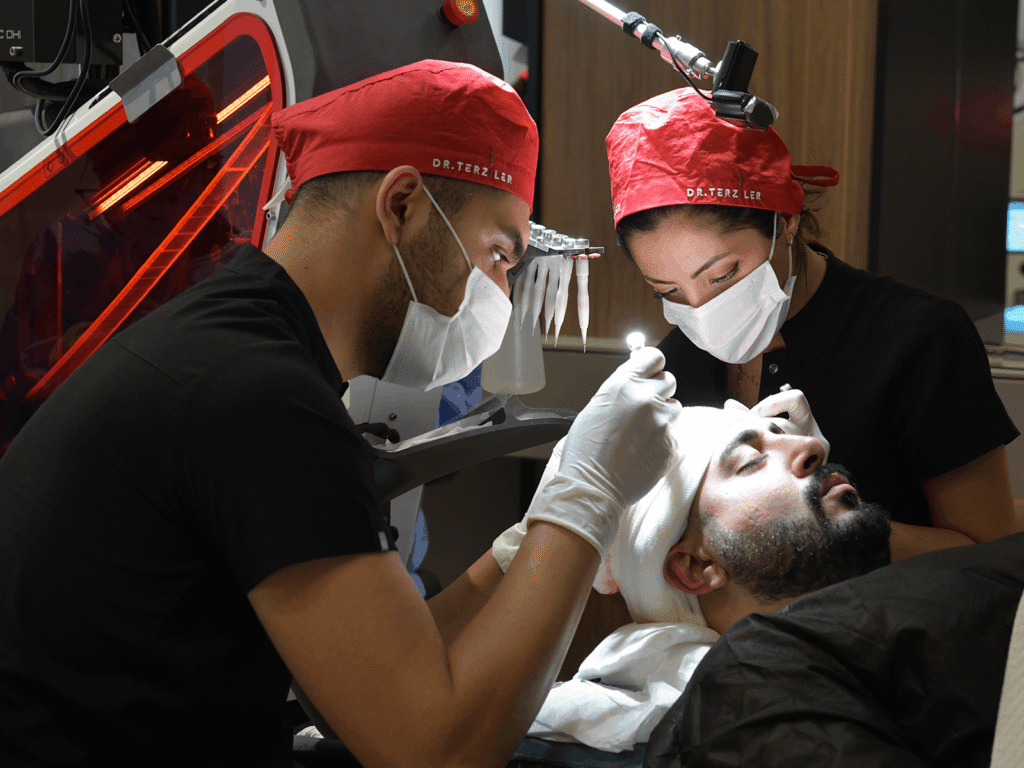
If you have spent even an hour researching modern hair restoration, you have undoubtedly run into a classic debate: FUE (Follicular Unit Extraction) vs. DHI (Direct Hair Implantation).
Both methods are highly effective, minimally invasive, and miles ahead of the old-school “hair plugs” of the past. However, marketing terms can make them sound completely different, leaving patients confused about which method actually delivers the best results.
The truth is that DHI is actually a modified, specialized variation of FUE. The core difference isn’t how the hair is taken out, but how it is put back in.
Let’s lift the curtain on these two procedures, compare them side-by-side, and help you figure out exactly which one matches your hair restoration goals.
The Core Technical Differences
To understand which procedure is best for your scalp, it helps to understand the physical mechanics of how a surgeon handles each hair graft.
Standard FUE: The Three-Step Process
In a standard FUE procedure, the process follows three distinct stages:
- Extraction: Individual hair follicles are harvested one-by-one from the permanent donor zone at the back of your head.
- Channel Creation: The surgeon uses a micro-blade or sapphire tip to open up thousands of tiny incisions (channels) in the balding area.
- Implantation: A technician uses fine tweezers to manually place the harvested grafts into those pre-cut channels.
DHI: The Two-Step Simultaneous Process
DHI simplifies the back-end of the surgery by using a specialized medical device called a Choi Implanter Pen.
- Extraction: Just like standard FUE, follicles are harvested individually from the back of the head.
- Simultaneous Implantation: Instead of cutting incisions beforehand, the hair follicles are loaded into the hollow needle of the Choi Pen. The surgeon then presses the plunger, which creates the channel and implants the graft at the exact same fraction of a second.
Head-to-Head Comparison
When deciding between these two procedures, several practical factors come into play, including graft counts, surgery time, and whether you want to shave your head.
| Feature | Standard FUE | DHI (Direct Hair Implantation) |
| Primary Tool | Micro-blades / Sapphire blades + Tweezers | Specialized Choi Implanter Pen |
| The Process | Channels are opened before inserting hair | Channels are opened and hair is inserted simultaneously |
| Max Grafts Per Session | High (Up to 4,000–5,000 grafts) | Moderate (Usually capped around 2,500–3,500 grafts) |
| Scalp Shaving Requirement | Complete head shave is almost always required | Can often be performed without shaving the recipient area |
| Time in Surgery | Faster (6 to 8 hours for large sessions) | Slower (More tedious, often taking longer or split into days) |
| Cost | Cost-effective / Standard pricing | Premium pricing (Due to tools and labor-intensive nature) |
The Pro/Con Breakdown
Why Choose Standard FUE?
Standard FUE remains the global benchmark for heavy-duty hair restoration for a reason.
- Ideal for Massive Baldness: If you need to cover a vast area—like a completely bare crown combined with a deeply recessed hairline—FUE is the clear winner. It allows the medical team to process and plant large numbers of grafts quickly.
- Faster Procedure Times: Because a team of technicians can place grafts into pre-cut channels simultaneously, you spend less time sitting in the surgical chair.
- Budget-Friendly: It requires fewer specialized, single-use tools, making it more accessible financially.
Why Choose DHI?
DHI shines when it comes to precision, density, and discretion.
- No Shave Option: Because the Choi Pen can neatly insert a graft directly between existing hairs without damaging them, DHI is perfect for people who want an unshaven hair transplant. You can keep your hair long, hide the crusts, and return to work without anyone knowing you had surgery.
- Unmatched Density for Thinning Hair: If you aren’t completely bald but have diffuse thinning, DHI allows surgeons to safely inject new hair between your native strands at ultra-high density.
- Shorter Out-of-Body Time: In DHI, the hair spends less time sitting on ice in a storage solution, which can sometimes lead to marginally better overall graft survival rates.
Which One Is Best For You?
Choosing between FUE and DHI ultimately comes down to the current state of your hair loss and your personal lifestyle preferences.
You should choose FUE if…
You have extensive baldness (Norwood Scale 4 or higher), need a high volume of grafts (3,500+), are completely fine with shaving your head for the procedure, and want to keep your financial investment practical.
You should choose DHI if…
You are experiencing localized thinning, want to lower or fill in a slightly recessed hairline, want maximum hair density, or absolutely refuse to shave your existing hair due to workplace or lifestyle reasons.
Frequently Asked Questions (FAQ)
Q1: Does DHI give a more natural look than FUE?
Not inherently. The natural look of a hairline depends entirely on the artistic skill, angle calculation, and experience of your surgeon—not the tool they hold. A skilled surgeon can create an absolutely seamless, invisible hairline using either method.
Q2: Why is DHI more expensive than standard FUE?
DHI requires a high number of specialized, single-use Choi Implanter needles for every single surgery. Furthermore, the process is incredibly tedious and physically demanding for the surgeon, meaning fewer patients can be treated in a single day.
Q3: Is the recovery time different between FUE and DHI?
The recovery timeline is highly similar; both require about 7 to 10 days for minor scabs to heal and shed. However, because DHI creates smaller, direct puncture points rather than pre-cut slits, some patients report slightly less bleeding, less post-op swelling, and a marginally faster initial healing phase.
Q4: Can DHI handle 5,000 grafts in one day?
Generally, no. Because loading and placing individual follicles with an implanter pen is a slower process, trying to plant 5,000 grafts via DHI in a single session would keep the patient in surgery for an unsafe amount of time. For massive mega-sessions, standard FUE or a combination approach is preferred.
Q5: Is graft survival better with DHI?
Because the hair is loaded into the pen and placed into the scalp almost immediately after extraction, its time spent outside the body is minimized. This can lead to excellent survival rates, but clinical studies show that standard FUE handled by an elite medical team yields nearly identical survival rates (typically above 90–95%). The talent of the clinic matters more than the acronym.