


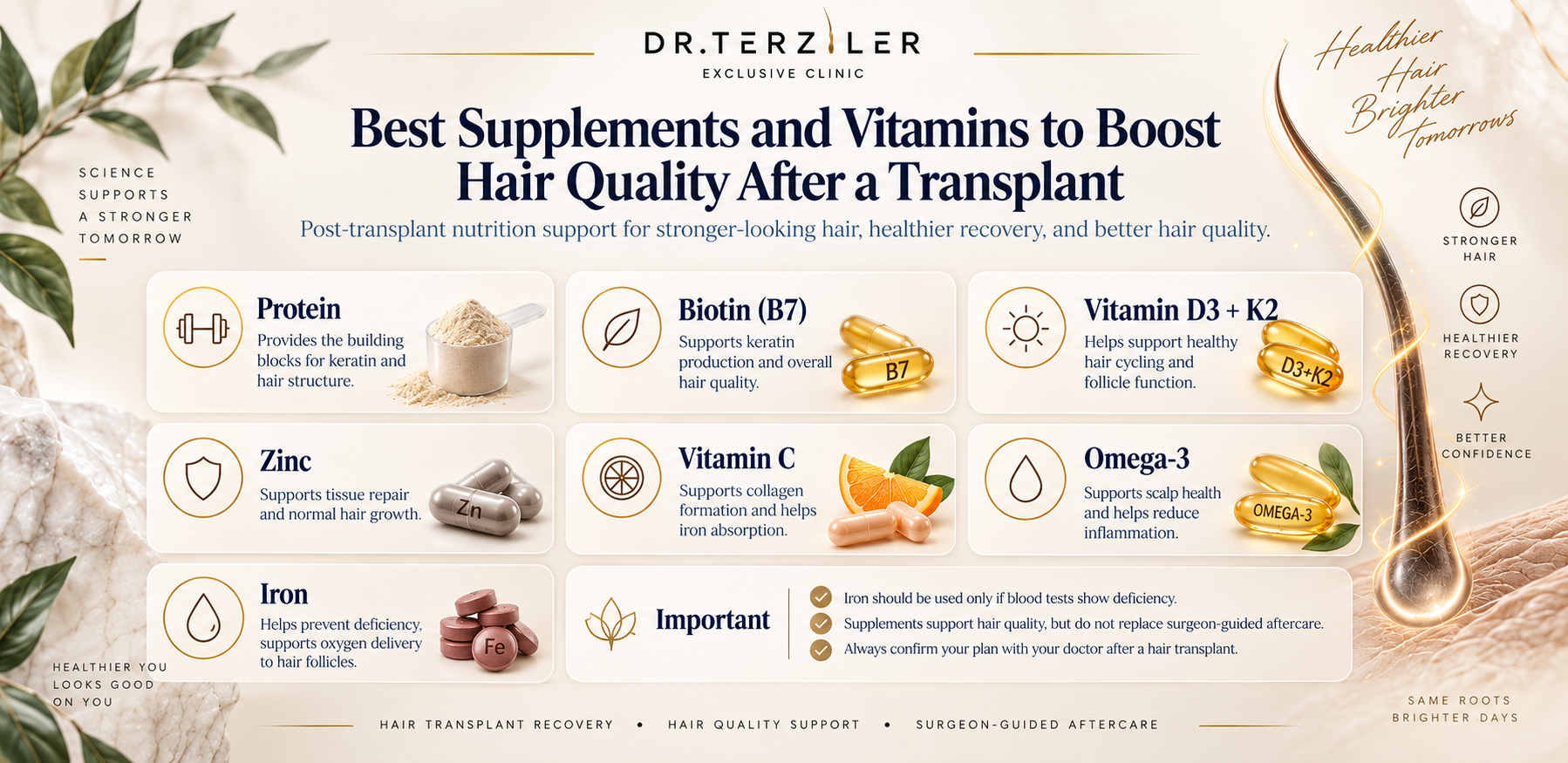
Seven nutrients do most of the work: protein, biotin (B7), vitamin D3 with K2, zinc, vitamin C, omega-3, and iron. They feed the healing scalp and the follicles that grow your new hair. They do not decide whether a graft survives. Surgical skill and aftercare do that. Food comes first. Pills fill real gaps.
REVISIONE MEDICA A CURA DI
AACI Accredited Surgeon, ISHRS Member and Inventor of Robotic DHI
Updated
Protein, biotin, vitamin D3 plus K2, zinc, vitamin C, omega-3, and iron are the most useful vitamins and supplements after a hair transplant. Protein and iron rebuild the follicle. Vitamin C and zinc repair the graft sites. Vitamin D and omega-3 support the new growth cycle. Start most of them once your surgeon clears you, usually a few days after surgery, and only supplement what a blood test shows you are low in.
What should you eat and take after a hair transplant?
A hair transplant moves your own follicles from the back of your head to a thinning area. Those follicles arrive stressed. The tiny channels that hold them need to close, calm down, and grow a fresh blood supply. That repair runs on nutrients. Give the scalp what it needs and the healing is smoother, the shedding phase is shorter, and the new hair comes in thicker.
The plan below is simple. You will see which nutrient does what, how much is sensible, what to avoid in the first days, and when to start each one. Every dose here is general guidance. The exact amounts should come from your own blood work, not a bottle label.
~90%
of each hair shaft is keratin, a protein
7
core nutrients your scalp uses to heal and regrow
30 ng/mL
ferritin level many dermatologists aim above for hair
3 to 4 mo
when new transplanted hair usually starts to show
Not sure which vitamins you actually need?
Send your details and Dr. Terziler’s team maps your exact plan from your blood work, so you buy three things you need instead of ten you do not.
Why does nutrition matter so much after a hair transplant?
A hair transplant is minor surgery. You have hundreds of small wounds in the recipient area and a healing donor area. Wound healing is hungry work. The body pulls protein, vitamin C, zinc, and iron toward the repair first. If those stores are low, healing slows and hair sits low on the priority list.
There is a second reason. Around two to eight weeks after surgery, most transplanted hairs fall out. This is normal shock loss, and it scares people who do not expect it. The follicle stays alive under the skin and rests before it grows again. Good nutrition does not stop shock loss, but it shortens the wait and helps the regrowth come in stronger.
Which 7 vitamins and supplements work best after a hair transplant?
Here is each nutrient, what it does for a healing scalp, where to get it from food, and a sensible supplement note.
1. Protein: the raw material for every new hair
Each hair shaft is roughly 90 percent keratin, which is a protein. When protein intake drops, the body slows hair production early to protect vital organs, which shows up as thinning and weak strands. After surgery your protein need rises because the wounds are rebuilding tissue at the same time.
Food first: eggs, chicken, fish, Greek yogurt, lentils, and beans. Aim for a protein source at every meal. A whey or plant shake is a simple gap-filler during recovery travel.
2. Biotin (vitamin B7): useful only if you are actually low
Biotin helps the body build keratin, so it is the most marketed hair vitamin on the shelf. The honest science is narrower. Biotin improves hair only in people with a true biotin deficiency, which is rare in healthy adults eating a normal diet (Patel DP et al, Skin Appendage Disord 2017). If your diet is fine, a mega-dose biotin pill will not add thickness that was not going to be there anyway.
Biotin can break your blood tests
High-dose biotin can distort common lab results, including thyroid hormones and the troponin test used to diagnose heart attacks (US FDA Safety Communication, 2019). Tell any doctor you take it, and pause it before blood work.
3. Vitamin D3 with K2: the growth-cycle switch
Vitamin D receptors sit inside the hair follicle and help start a new growth cycle. Blood levels of vitamin D tend to run lower in people with telogen effluvium and pattern hair loss (Almohanna HM et al, Dermatol Ther 2019). K2 pairs well with D3 because it helps direct calcium into bone rather than soft tissue, which matters when you take higher-dose D3 for a while.
Food and sun: oily fish, egg yolk, and sensible sun exposure. Many adults sit below the ideal range, so this is one of the most common nutrients a blood test flags. Dose to your result, not to a guess.
4. Zinc: repair and follicle structure
Zinc drives the protein-building and repair work the follicle depends on, and serum zinc runs lower in several types of hair loss (Almohanna HM et al, Dermatol Ther 2019). It also supports wound healing in the recipient area. Balance matters. Too much zinc blocks copper absorption, so more is not better.
Food first: oysters, red meat, pumpkin seeds, chickpeas, and cashews. If you supplement, a modest daily dose is enough.
5. Vitamin C: collagen and iron absorption
Vitamin C does two jobs that matter after a transplant. It is required to build collagen, the scaffold that supports the healing graft sites and blood vessels, and it helps the body absorb non-heme (plant) iron (NIH Office of Dietary Supplements). Low vitamin C shows up as slower wound healing, which is the opposite of what you want in week one. Pair an iron-rich meal with a vitamin C source.
Women with diffuse thinning often ask which nutrients help most. The iron and vitamin C pairing is usually near the top, and our trapianto di capelli per donne patients get an iron and ferritin check as standard.
6. Omega-3: the anti-inflammatory support act
Omega-3 fatty acids calm inflammation and support the scalp environment around the follicle. In one trial, six months of omega-3 and omega-6 with antioxidants increased hair density and pushed more follicles into the active growth phase in women with thinning hair (Le Floc’h C et al, J Cosmet Dermatol 2015). The catch is timing. High-dose fish oil thins the blood, so it belongs in your plan a little later, not on surgery day.
7. Iron: the nutrient behind stubborn shedding
Iron carries oxygen to the follicle, and low iron stores are one of the most common hidden drivers of hair shedding, especially in women and in anyone who eats little red meat. Ferritin, the stored form of iron, is the lab value that tracks best with hair loss, and correcting low iron supports regrowth (Trost LB et al, J Am Acad Dermatol 2006). Many dermatologists aim to keep ferritin above 30 ng/mL for hair.
| Nutrient | Main job after a transplant | Best food sources | Supplement note |
|---|---|---|---|
| Protein | Builds keratin and new tissue | Eggs, fish, chicken, lentils | Food usually covers it |
| Biotin (B7) | Keratin production | Egg yolk, nuts, salmon | Helps only if deficient; pause before labs |
| Vitamin D3 + K2 | Starts the growth cycle | Oily fish, egg yolk, sun | Dose to your blood level |
| Zinc | Follicle repair and structure | Oysters, red meat, seeds | Modest dose; too much blocks copper |
| Vitamin C | Collagen and iron absorption | Citrus, peppers, kiwi | Pair with iron-rich meals |
| Omega-3 | Calms inflammation | Salmon, sardines, walnuts | Start later; thins blood |
| Iron | Oxygen to the follicle | Red meat, spinach, legumes | Test ferritin first; never blind-dose |
When can you start taking vitamins after a hair transplant?
Timing is where most guides go quiet, so here is the plan we give patients. Nutrients that help healing can start early. Anything that thins the blood waits until the wounds are stable.
| Palcoscenico | What to take | What to hold |
|---|---|---|
| Days 0 to 3 | Protein-rich food, water, prescribed medication only | Fish oil, high-dose vitamin E, blood thinners |
| Days 3 to 7 | Restart most multivitamins, vitamin C, zinc, vitamin D once cleared | High-dose omega-3 until cleared |
| Week 2 onward | Add omega-3, biotin if advised, and iron if your ferritin is low | Nothing extra unless a new lab says so |
| Month 3 onward | Maintenance dosing based on a repeat blood test | Any pill you cannot explain the reason for |
If you had an trapianto di capelli non rasati or a technique-specific procedure, your surgeon may adjust these windows. Always follow the clearance you are given in person over any general timeline online.
They ran my bloods before anything and told me my iron was low, so we fixed that first. I was ready to buy every hair vitamin online. Instead I took three things that I actually needed. By month five my new hair looked thick and the healing was easy.
Quick question about timing or a supplement?
Message the clinic on WhatsApp and get a straight answer from Dr. Terziler’s team, not a chatbot. Same-day replies, no obligation.
Which supplements should you avoid right after a hair transplant?
This is the part the internet skips. Some popular supplements thin the blood or raise bleeding risk, which is a real problem when you have hundreds of fresh graft sites. In the first days they can lift the risk of bleeding, swelling, and bruising in the recipient and donor areas.
Pause these around surgery unless your doctor says otherwise
High-dose fish oil and omega-3, high-dose vitamin E, ginkgo biloba, high-dose garlic tablets, and ginseng all have blood-thinning effects. Stop them roughly 7 to 10 days before your procedure and restart only when cleared.
Also skip mega-dosing. More is not faster. Very high biotin distorts lab tests, too much zinc blocks copper, and excess iron is toxic. The goal is to correct real gaps, not to flood the body.
Do hair vitamins actually regrow transplanted hair?
Here is the honest answer, and it is the one that protects you from wasted money. Transplanted follicles are taken from the back and sides of the scalp, which are genetically resistant to the hormone (DHT) that causes pattern loss. That resistance is why a transplant lasts. A vitamin does not create that resistance and cannot make a dead follicle grow.
What nutrition does is real but specific. It helps the wounds heal, it supports the quality and thickness of the hair that grows, and it protects the native, non-transplanted hair around your grafts from thinning further. That native hair is not DHT-resistant, so keeping it healthy is where diet, and often a medical plan, earns its place.
The graft result itself is decided in the operating room. At Dr. Terziler Exclusive Clinic, grafts are placed with our own patented DHI robotizzato system, a machine Dr. Servet Terziler invented, which controls the depth, angle, and direction of every implant. Our Picasso Robotic DHI technique uses the same patented machine and adds an artistic hairline that Dr. Terziler designs by hand, so the front line looks natural and the transplant stays undetectable.
Supplements do not save a bad graft, and they do not build a hairline. We test first, correct only what is low, and pause anything that thins the blood before surgery. That is what doctor-led means. The pills support the healing. The result is built by the hand and the machine.
Does biotin thicken transplanted hair?
Only if you were biotin deficient to begin with. In a normal diet it adds little.
Will vitamins stop shock loss?
No. Shock loss is a normal resting phase. Good nutrition shortens the wait for regrowth.
Do I need collagen powder?
Protein and vitamin C give the body what it needs to make its own collagen. A powder is optional.
Are gummy hair vitamins enough?
They are usually low dose and sugar heavy. A blood test plus targeted dosing beats a gummy.
Want a transplant that lasts and a recovery that works?
Tell us about your hair and get a doctor-led plan plus your transparent all-in price, with no sales pressure and no surprises later.
How Dr. Terziler builds your post-transplant nutrition plan
We do not hand every patient the same bottle of pills. Before your procedure, a blood panel and a Tricho Test show your ferritin, vitamin D, zinc, thyroid, and scalp health. That data tells us what to correct, what to leave alone, and what to pause around surgery. It is the same diagnosis-first logic that runs through our non-surgical hair treatments.
The approach fits every hair type and case. Whether you need a standard DHI hair transplant oppure un Trapianto di capelli afro with its unique curl and skin needs, the nutrition plan is matched to your body and your procedure.
Want the price before you plan your recovery?
Curious what a full procedure costs first? Our hair transplant cost page lays out every price in plain numbers, with no hidden extras.
Plan your hair transplant and recovery with a doctor, start to finish
Great hair after a transplant is built twice: once in the operating room and once in the months of healing that follow. Clinica Esclusiva del Dott. Terziler covers both, from the patented Robotic DHI placement to a nutrition plan built on your own blood work. Send us your case and we will tell you exactly what your hair, and your recovery, actually need.
Frequently asked questions
Sources and references
- Almohanna HM, Ahmed AA, Tsatalis JP, Tosti A. The Role of Vitamins and Minerals in Hair Loss: A Review. Dermatol Ther (Heidelb). 2019. PubMed 30547302
- Patel DP, Swink SM, Castelo-Soccio L. A Review of the Use of Biotin for Hair Loss. Skin Appendage Disord. 2017. PubMed 28879195
- Trost LB, Bergfeld WF, Calogeras E. The diagnosis and treatment of iron deficiency and its potential relationship to hair loss. J Am Acad Dermatol. 2006. PubMed 16635664
- Le Floc’h C, et al. Effect of a nutritional supplement on hair loss in women. J Cosmet Dermatol. 2015. PubMed 25573272
- Guo S, DiPietro LA. Factors Affecting Wound Healing. J Dent Res. 2010. PubMed 20139336
- US Food and Drug Administration. Biotin (Vitamin B7): Safety Communication, updated 2019. fda.gov
- National Institutes of Health, Office of Dietary Supplements. Vitamin C Fact Sheet. ods.od.nih.gov