

Hair transplant regret can mean disappointment with the hairline, density, donor area, recovery or long-term plan. Reducing that risk starts with a clear diagnosis, realistic goals, a qualified surgical team and a plan for future hair loss.
Considering surgery—or thinking “I regret my hair transplant”? This guide explains five decisions to discuss before treatment, what published research actually says about failure and regret, and when a result needs medical review.

AACI-accredited clinic in Istanbul · View the accreditation record
Content updated: . Patient education; your treating clinician must assess your individual case.
What is the regret rate for hair transplants?
The evidence reviewed here does not establish a reliable, representative hair transplant regret rate. Satisfaction surveys, complication reports, graft survival figures and repair-case statistics measure different outcomes. None can simply be relabeled as the percentage of people who regret surgery.
A patient may have good graft growth but dislike a low hairline. Another may feel anxious during early shedding and later be satisfied. Ask any clinic quoting a “success rate” what was measured, when patients were assessed, how many were followed up and whether dissatisfied patients were included.
Expectations affect satisfaction
A 2025 narrative review highlights expectation management and psychological assessment. It does not provide a representative population-wide regret estimate.
Complications need a definition
Liu and colleagues reviewed 43 publications. Two large series reported overall complications of 1.2% and 4.7%; definitions and reporting varied. These are study-specific findings, not a universal failure or regret rate.
A referral statistic is different
In the 2025 ISHRS member survey, physicians reported an average 10% of their cases were repairs following previous black-market transplants. This describes responding practices’ caseloads, not 10% of all patients regretting surgery.
What I wish I knew before a hair transplant: 5 decisions that matter
If you are asking “What I wish I knew before a hair transplant?”, start with donor limits, realistic coverage, future hair loss, hairline design and medical responsibility. These five conversations help you make an informed decision before a deposit or surgery date.
Use these five questions to compare recommendations and discuss the tradeoffs for your own case.
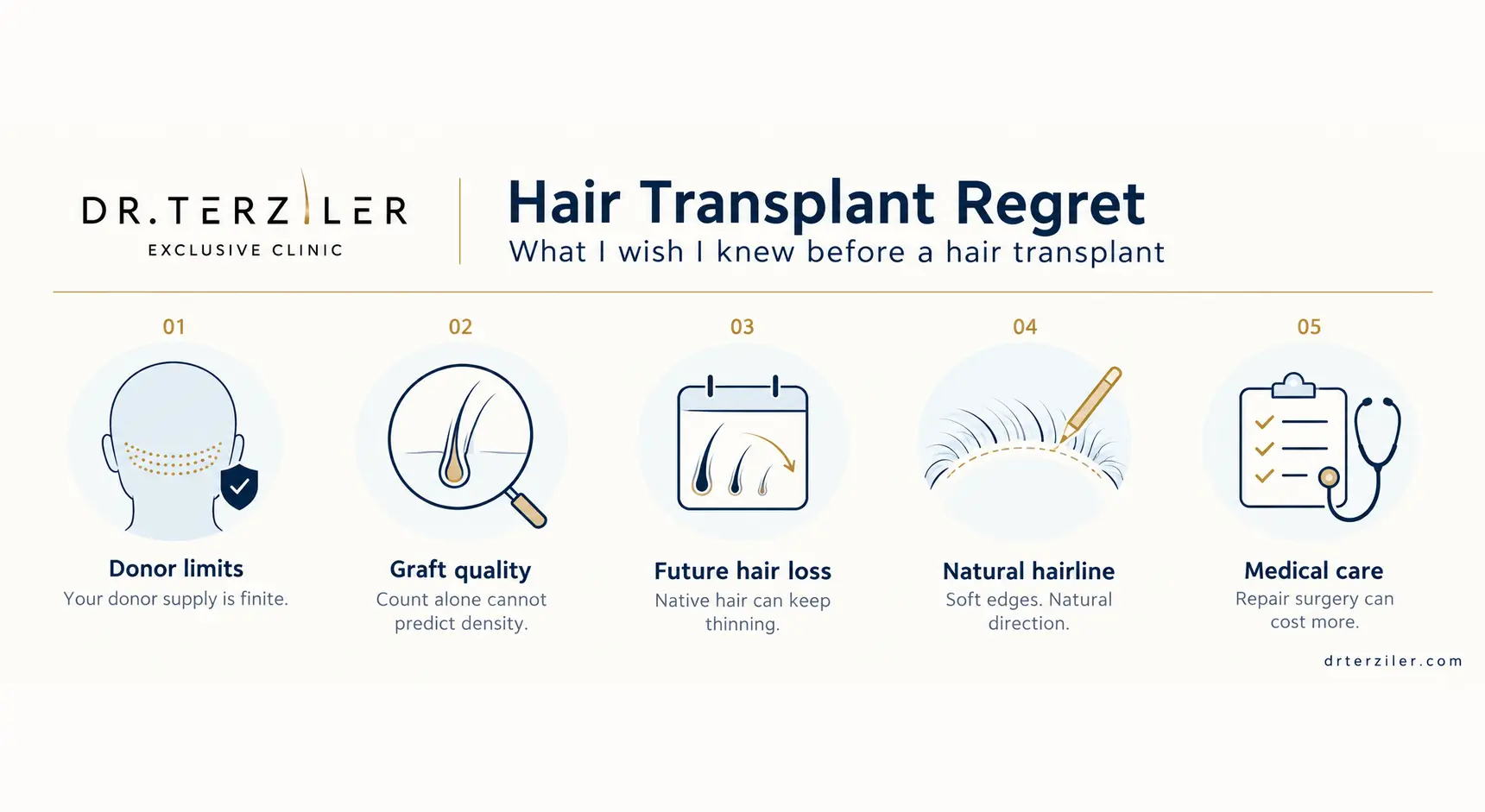
Your donor supply is finite
A transplant redistributes hair; it does not create an unlimited new supply. Taking too much from the back or sides can leave visible donor thinning and reduce future options. The safe plan depends on donor density, hair characteristics, scalp health and the area that needs coverage.
Before you agree to a graft number, ask to see the donor assessment and the longer-term allocation between your hairline, mid-scalp and crown. A large first session can be the wrong tradeoff when future loss is likely.
Medical context: ISHRS: five things to know before transplantation
Ask before surgery: What can be harvested safely in my case, and what donor reserve will remain?
Graft count alone cannot predict density
A graft is a follicular unit, not necessarily a single hair. Visible coverage also depends on hairs per graft, hair thickness, curl, contrast with the scalp, placement and growth. Two patients receiving the same count can look different.
Compare cases with similar hair characteristics and loss patterns. Ask whether the recorded count refers to grafts extracted or implanted, and how the team documents growth. A package promising “maximum grafts” should still explain donor safety and realistic coverage.
Medical context: Nadimi: Complications with Hair Transplantation (2020 review)
Ask before surgery: What density and coverage are realistic for my hair characteristics?
Surgery does not stop future hair loss
Transplanted hair and the surrounding native hair are different parts of the long-term plan. Existing hair can continue to thin, leaving gaps around an initially satisfactory transplant. A hairline must still make sense if loss progresses.
Ask about appropriate nonsurgical options, their limitations and potential adverse effects. Medication is an individual decision, not an automatic requirement to accept without discussion. Tell the physician if you do not want, cannot tolerate or cannot use ongoing treatment.
Medical context: American Academy of Dermatology: candidacy, growth and ongoing hair loss
Ask before surgery: What happens to my result if the hair around it keeps thinning?
A natural hairline is a long-term commitment
A hairline that is too low, sharply geometric or inconsistent with your hair direction may be hard to soften later. Design should consider your facial proportions, existing pattern and likely future needs—not simply reproduce a teenage hairline.
Request a clear explanation of the proposed height, shape, frontal graft selection and direction. Review healed results with the hair exposed and in comparable lighting. A digital simulation is a discussion tool, not a promise of your final appearance.
Medical context: ISHRS: revision and repair of previous hair transplants
Ask before surgery: Why is this hairline appropriate for me now and as I age?
Medical responsibility matters more than a package label
Price, a technique name and attractive hotel photos do not tell you who makes the medical decisions. Confirm the responsible physician, who performs each surgical stage, anesthesia arrangements and the plan for complications.
The ISHRS warns against unlicensed personnel performing medical aspects of transplantation and exaggerated “scarless” or fully machine-performed claims. Compare written inclusions, review access, cancellation terms and follow-up after returning home. A higher price alone is not proof of better care.
Medical context: ISHRS: consumer alert on unlicensed surgery and exaggerated claims
Ask before surgery: Who will assess me, perform each surgical step and manage my follow-up?
How often do hair transplants go wrong?
Hair transplants can go wrong, but there is no single reliable rate covering every clinic, technique and definition of failure. A disappointing cosmetic result, poor graft growth and a surgical complication are different outcomes. Your risk assessment should be specific to your diagnosis, donor area, medical history and surgical team.
Why do hair transplants fail?
Potential contributors include unsuitable patient selection, inadequate donor planning, graft damage or drying, poorly planned placement, and unrecognized medical problems. Continued native hair loss can also make a previously acceptable result look thinner. A clinical examination is needed to identify the cause; a photograph alone cannot establish every problem. Clinical review of transplantation complications.
Hair transplant side effects vs a failed result
| What you notice | What it may mean | What to do |
|---|---|---|
| Temporary swelling or scabbing | May be part of recovery, depending on timing and severity. | Follow the written aftercare plan; ask about changes outside the expected pattern. |
| Hair shedding after surgery | Transplanted shafts can shed before regrowth. Shedding alone does not prove graft failure. | Document progress and attend planned reviews. |
| Patchy donor appearance | Needs assessment for healing changes, shock loss, scarring or overharvesting. | Request donor examination and the extraction record. |
| Unnatural direction or hairline | Can reflect design or placement issues. | Discuss the concern with a physician experienced in revision assessment. |
| Severe pain or unexpected symptoms | Needs prompt medical evaluation; do not assume it is normal recovery. | Contact your operating clinic promptly and seek urgent local care when needed. |
Examples are not a diagnosis. Context: NHS patient guidance そして published complications review.
The scoping review linked above involves researchers affiliated with Harvard Medical School/Massachusetts Eye and Ear and Johns Hopkins. Its university publication record explains the study scope. It supports a careful risk discussion, not a claim that a specific clinic has a known failure rate.
Before your hair transplant: an interactive consultation checklist
Tick the topics your clinician has already explained. Use the remaining questions in your consultation. This is a discussion checklist, not a medical risk score or clearance for surgery.
Hair transplant recovery: shedding, shock loss and early regret
Early shedding and an unfinished hairline are not enough to diagnose a failed hair transplant. Healing, growth and final appearance happen on different schedules. Compare progress with the timeline given by your surgeon rather than judging the outcome immediately after surgery.
Protect the treated scalp and follow your clinic’s washing, sleeping and activity instructions.
Transplanted hair shafts can shed. Review concerns with the treating team.
The NHS says new hair usually begins to appear around this stage; individual progress varies.
The NHS describes this as the usual window for full results. Use your clinician’s review plan.
Timeline reference: NHSの植毛に関するガイダンス. This is a general guide, not a deadline or a promise of a particular result.
What if I feel regret during recovery?
Bring the concern to your treating team and describe what bothers you: the donor area, hairline, growth, discomfort or the decision itself. Keep consistent photographs and agreed review dates. Frequent comparisons with someone else’s result can make an incomplete result harder to interpret.
The psychological review emphasizes realistic expectations and support before and after treatment. If distress is affecting sleep, work or relationships, discuss it with a clinician or mental health professional. Repeating surgery is not automatically the right answer to appearance-related distress. Psychological evidence and its limitations.
Is it okay to masturbate after a hair transplant?
Wait until your surgical team clears sexual activity under your aftercare plan. The sources reviewed here do not establish a universal, masturbation-specific safe day. Early restrictions are intended to protect healing and limit exertion or accidental contact with the scalp.
The American Society of Plastic Surgeons states that some doctors advise avoiding sexual activity for at least 10 days. It also explains that strenuous activity can increase scalp blood flow and cause bleeding. This is general recovery guidance, not a study proving that masturbation is safe for everyone on day 10. Read the ASPS activity guidance.
Ask your team for a private, direct answer before returning to sexual activity. Your healing, procedure, symptoms and clinician’s instructions matter. The cited guidance does not establish ejaculation itself as a cause of graft failure; do not replace clinical advice with unsupported hormone claims online.
I regret my hair transplant: what should I do next?
If you are thinking “I regret my hair transplant”, first arrange a medical review and identify the specific concern. Some problems can be improved, but a bad transplant cannot always be completely reversed. Remaining donor supply, scarring, hair direction and the stage of healing affect the options.
Can a bad hair transplant be fixed?
Depending on the problem, a specialist may consider a revised hairline, additional grafts, selective removal or other approaches. The ISHRS repair guide describes correction strategies. Improvement may require more than one procedure, and extensive donor depletion can limit what is achievable.
- Get the records. Request the procedure date, technique, extracted and implanted graft counts, surgical roles, medication and follow-up notes.
- Document the issue. Take photographs with consistent lighting and angles. Separate appearance concerns from symptoms needing urgent attention.
- Ask for a clinical explanation. What is the likely cause, what remains uncertain and what needs an examination?
- Seek an experienced second opinion if needed. Ask which options are realistic and whether additional surgery should be delayed or avoided.
- Compare the full correction plan. Discuss donor use, scars, possible stages, limitations and written costs before committing.
Do not attempt to pull out grafts, treat an infection yourself or rush into another procedure because of a promotional deadline. Ask the examining physician when the result can be assessed meaningfully.
Avoiding hair transplant regret in Turkey: check the provider, plan and follow-up
Turkey hair transplant regret is not a separate diagnosis. Evaluate the individual clinic and surgical team, whether you travel to Istanbul or stay in the US. Location, a low package price or a premium label does not establish medical quality.
~が Dr. Terziler Exclusive Clinic in Istanbul, treatment is planned within a boutique, doctor-led model. The clinic offers DHI, Robotic DHI and Picasso Robotic DHI. Technique selection should follow your assessment rather than a claim that one branded method eliminates complications or regret.
Confirm the medical roles
Ask which physician is assigned to your case and who performs assessment, hairline planning, extraction, recipient-site creation and implantation. Confirm anesthesia arrangements and who manages complications.
Plan care after returning home
Confirm review dates, the contact route for concerns and what happens if you need an in-person examination locally. Keep a copy of the written treatment and aftercare plan.
For clinical background, Sahar Nadimi’s 2020 complications review—with an affiliation at Loyola University Medical Center—emphasizes patient selection, planning for future loss and postoperative instructions.
Before-and-after images help you discuss goals, but cannot predict your exact growth or satisfaction. Review documented patient results and compare complete written quotes using the hair transplant Turkey cost guide.
Hair transplant regret FAQ
What is the regret rate for hair transplants?
The sources reviewed in this guide do not establish a reliable population-wide regret rate. Satisfaction, complication rates, graft survival and repair referrals measure different outcomes. Ask a clinic to define any quoted success or regret percentage and provide the follow-up method.
What I wish I knew before a hair transplant?
The five key topics are finite donor supply, realistic coverage rather than graft count alone, future native hair loss, a natural long-term hairline and the medical team responsible for treatment and follow-up. Discuss recovery, limitations and the complete written quote before booking.
How often do hair transplants go wrong?
There is no single rate covering every provider and definition of failure. Published studies report different complications and follow-up methods. A disappointing hairline, poor growth, a surgical complication and temporary recovery changes should be assessed separately.
Is it okay to masturbate after a hair transplant?
Wait until your surgical team clears sexual activity under your aftercare plan. ASPS notes that some doctors advise avoiding sexual activity for at least 10 days, but this is not a universal masturbation-specific clearance date. Ask your treating team for instructions suited to your procedure and healing.
Is early shedding a sign of a failed hair transplant?
Not necessarily. Transplanted hair shafts can shed before regrowth, and early appearance does not establish the final outcome. Attend planned reviews and ask your treating physician about unexpected symptoms or progress outside your individual recovery plan.
Can an overharvested donor area be repaired?
Improvement may be possible in selected cases, but removed follicles are not restored simply by waiting. An examination must distinguish temporary shedding from permanent depletion or scarring. Remaining donor supply limits repair options, and complete restoration cannot be guaranteed.
Can an unnatural hairline be completely fixed?
Some hairlines can be improved through revision, additional grafts or selective removal, depending on the case. Direction, scarring, donor capacity and the original design affect the options. A specialist should explain achievable improvement and limitations before any additional surgery.
What is the best age for a hair transplant?
There is no universally best age. Diagnosis, hair-loss progression, donor capacity, health and realistic goals matter. The AAD notes that some men in their 20s may be advised to wait and consider medical treatment first. An individual consultation determines suitability.
Are FUE, DHI or robotic methods regret-proof?
No. A technique name does not guarantee natural appearance, growth, safety or satisfaction. Patient selection, donor planning, qualified surgical responsibility, execution and follow-up remain important for every method.
Can I keep losing hair after a hair transplant?
Yes. Native hair can continue to thin after transplantation. Discuss how future loss could change the appearance, whether nonsurgical treatment is suitable and how the donor reserve will be protected. Medication choices and possible adverse effects need an individual clinical discussion.
Should I rely on hair transplant regret stories on Reddit?
Patient stories can help you prepare questions, but they do not establish a regret rate or diagnose your result. Check the surgery date, follow-up stage, available records and photographs. Use a qualified clinical assessment for treatment decisions rather than a single online anecdote.
Research and medical sources
How the evidence is used: Research findings are attributed to their actual study type and scope. General patient guidance informs recovery discussions. These sources do not establish a universal regret rate.
- ISHRS: five things to know before transplantation
- Psychological Dimensions of Hair Transplantation (2025 narrative review)
- Liu et al.: complications scoping review (online 2024; journal issue 2025)
- Johns Hopkins University: publication record and abstract
- Nadimi: Complications with Hair Transplantation (2020 review)
- Kerure & Patwardhan: Complications in Hair Transplantation (2018 review)
- NHS: hair transplant recovery, risks and follow-up
- American Society of Plastic Surgeons: recovery and activity guidance
- American Academy of Dermatology: candidacy, growth and ongoing hair loss
- ISHRS: 2025 Practice Census results
- ISHRS: full 2025 Practice Census report (PDF)
- ISHRS: consumer alert on unlicensed surgery and exaggerated claims
- ISHRS: revision and repair of previous hair transplants