

 Medical reviewerセルヴェト・テルジラー博士Physician and clinic founder
 Medical reviewerクルシャト・ヤルヴァチ博士Physician, hair-restoration team
Prepared by the clinic editorial team
Reviewed · 22 sources
Nobody checks their hairline in good light on purpose. It happens by accident: a friend's photo from above, a lift mirror, a fresh haircut that suddenly shows your temples. Then the questions start. Is this normal? Is it getting worse? Can it grow back?
A receding hairline is hair loss that moves the front hairline back, usually starting at the temples and forming an M shape. In men, a common cause is androgenetic alopecia: DHT gradually shrinks genetically sensitive follicles. Ongoing change and thinning matter more than a single forehead measurement. [1] [2]
TL;DR
- Mature hairline: an adult line may settle higher than the childhood line, with stable density. No single distance confirms it.
- Receding hairline: the temples or front keep moving back, and edge hairs become finer and shorter. [1] [2]
- How common is it? A 1998 study found Norwood III-or-greater loss in 16% of men aged 18–29 and 53% aged 40–49. These are sample findings. [8]
- Can it grow back? Thinning hair may improve with treatment. Longstanding bare corners need realistic expectations and a scalp assessment. [1] [2]
- Treatment evidence: finasteride has frontal-scalp trial evidence; its label does not establish temple-corner efficacy. The reviewed US men’s minoxidil foam label is not intended for a receding hairline. [3] [4] [5]
- 女性: traction, frontal fibrosing alopecia and pattern loss need different care. Eyebrow loss, burning or a receding band warrant early assessment. [10] [11] [12]
Is my hairline maturing or receding?
A stable adult hairline and progressive hair loss can look similar in one photograph. The useful clues are change, hair density and scalp symptoms, not how many fingers fit on your forehead. [1] [2]
Find your next step in five observations
Choose what you have noticed. Your result explains what to bring and which assessment to request.
This tool is an educational discussion guide. It cannot diagnose a mature hairline, pattern loss or scarring. Your selections stay in this page and are included in a WhatsApp draft only if you choose that option. They are not sent to analytics.
About the “one-finger test”. Finger size, forehead wrinkles and natural hairline height vary. These are not validated cutoffs for diagnosing baldness. A single home measurement should not decide whether you start medication or book surgery.
Compare like with like
Use older photographs with a similar angle, lighting and hairstyle. A wet-hair selfie and a styled photograph are poor comparisons.
Look beyond the shape
Note visible thinning, broken hairs, patches and symptoms. A central point or an M shape alone does not prove progression.
Ask what the scalp shows
A clinician can examine follicle openings and variation in shaft diameter with trichoscopy, and arrange other tests when indicated.
A trichoscopy study of 131 women compared female pattern loss, chronic shedding and healthy controls. Thin hairs and frontal-to-occipital differences helped the assessment. Its female study thresholds should not be converted into a self-test for male temples. [7] Explore the clinic’s Tricho Test assessment. If surgery is later appropriate, our トルコでの植毛 guide explains planning and medical responsibility.
Mature hairline vs receding hairline: what matters?
| Clue | A stable adult hairline | Possible progressive loss |
|---|---|---|
| Change over time | Little change on comparable photographs | Corners or the front continue to move back |
| Hair density | Density appears maintained | The edge becomes visibly thinner or more see-through |
| Shape | Can be high, rounded, pointed or slightly recessed | Can deepen at the temples or recede across the front |
| Scalp and eyebrows | No new symptoms | Pain, scale, redness, patches or eyebrow loss need assessment |
| What confirms it? | History and a scalp examination when needed | Clinical assessment, often with trichoscopy |
What is a mature hairline?
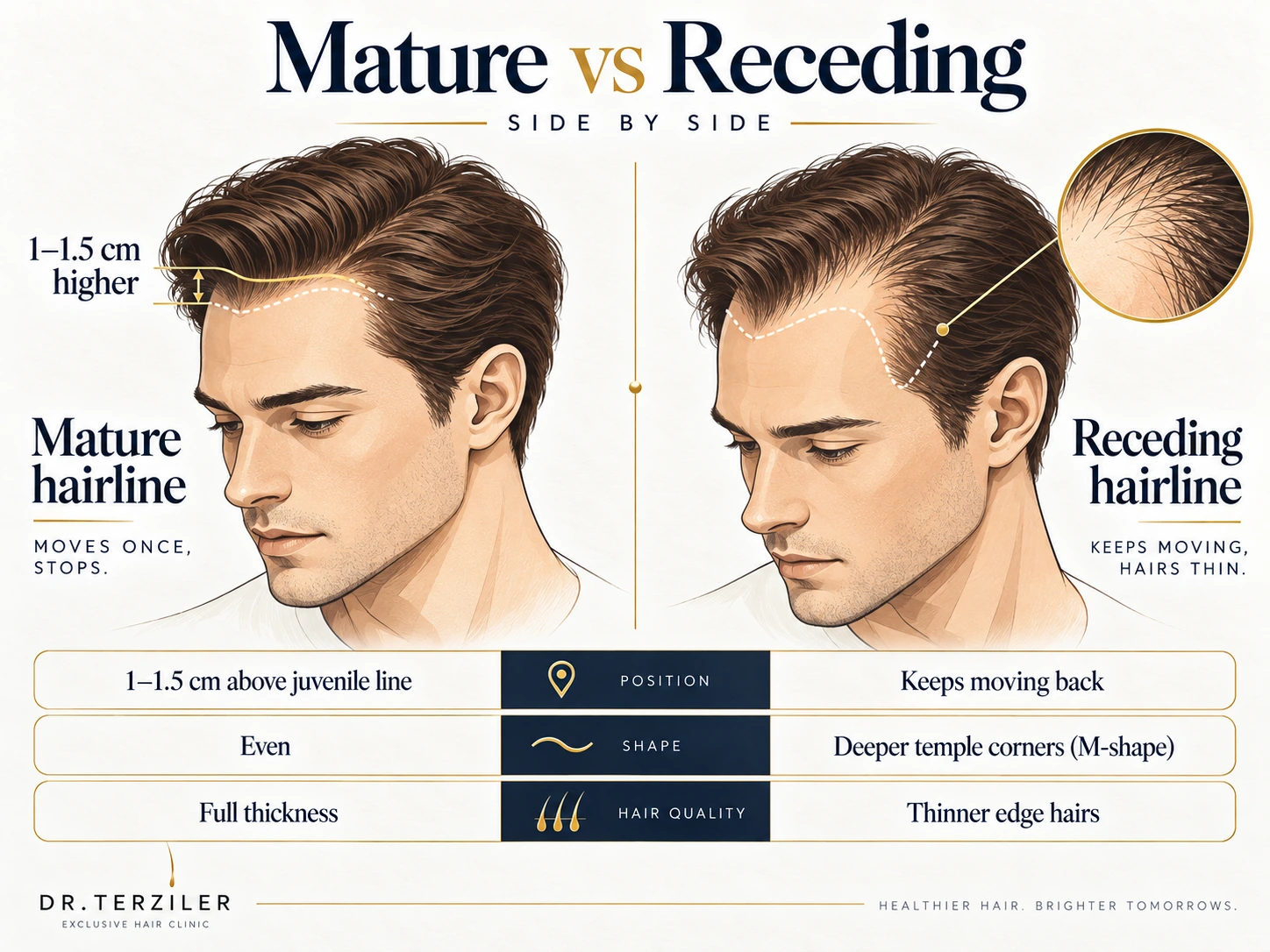
“Mature hairline” is an informal description of an adult hairline that has settled higher than the childhood line. It is not a diagnosis made from a centimetre or finger-width threshold. Natural shape and density vary. Continued change or thinning is a reason to ask for an assessment.
What is a normal hairline? Good vs bad hairlines
There is no single normal hairline. Straight, rounded, M-shaped, widow’s-peak and bell-shaped hairlines can all be natural. Shape alone does not tell you whether hair loss is present. A changing edge, declining density or new scalp symptoms are more useful reasons to seek an assessment than whether a line looks “good” or “bad”.
Widow’s peak or a receding hairline?
A widow’s peak is a central V-shaped point. It can be a longstanding natural feature, and it can also coexist with temple loss. Compare the surrounding density and the corners over time instead of using the central point as a test.
A high forehead or a receding hairline?
A naturally high forehead can have a stable, dense hairline. A line that keeps changing needs a different discussion. Old photographs can be useful, but a home photo cannot show everything a scalp examination can.
Is there a “good” or “bad” hairline?
Aesthetic preferences are not medical diagnoses. Straight, rounded, pointed and uneven hairlines can all be natural. For clinical decisions, the questions are change, density, scalp health and your goals.
What are the stages of a receding hairline?
The Hamilton–Norwood scale describes male-pattern-loss distributions. It includes the front そして the crown. Stage II is not automatically “normal maturation”, and a front-only photograph cannot establish a vertex stage. [8]
Explore the patterns, then the planning questions
The diagrams are simplified illustrations, not a self-diagnosis tool.
Norwood I: what to discuss
A low-recession pattern. A front view alone cannot establish scalp health; symptoms and change still matter.
Next step: Make a consistent photo baseline if you are concerned.
Ask about a changing hairlineNorwood II: what to discuss
Small temple changes can resemble an adult hairline or early pattern loss. Norwood II does not automatically mean harmless maturation.
Next step: Compare older photos and ask about visible thinning or continued change.
Help me understand my temple changesNorwood III: what to discuss
Deeper frontotemporal corners can fit a male-pattern-loss distribution. A clinician also checks density, progression and possible alternative causes.
Next step: Discuss a diagnosis and preservation of native hair before planning a new hairline.
Discuss my treatment optionsNorwood III vertex: what to discuss
The vertex variant includes crown loss. You cannot classify it accurately from a front-only selfie.
Next step: Include a clear top/crown photo with the front and temple views.
Review my hairline and crownNorwood IV: what to discuss
More substantial frontal recession and vertex loss are separated by remaining hair. The top view is essential.
Next step: Ask how donor supply and continued native-hair loss affect the long-term plan.
Discuss a donor-safe planNorwood V: what to discuss
Frontal and crown areas enlarge, with a narrower connecting bridge. Coverage priorities become particularly important.
Next step: Review donor capacity, realistic density and the possible need for staged treatment.
Explore realistic coverage optionsNorwood VI: what to discuss
Frontal and vertex loss have joined. This is a broad scalp pattern, not simply a deeper hairline.
Next step: Discuss full-scalp planning and the limits of available donor hair.
Ask about full-scalp planningNorwood VII: what to discuss
Only a relatively narrow band of hair remains around the sides and back. Donor limitations can restrict surgery.
Next step: Consider limited restoration goals and cosmetic alternatives alongside medical advice.
Discuss what is achievableA range of stages is shown so you can understand the vocabulary used at a consultation. Selecting a stage does not generate a diagnosis, graft prescription or price.
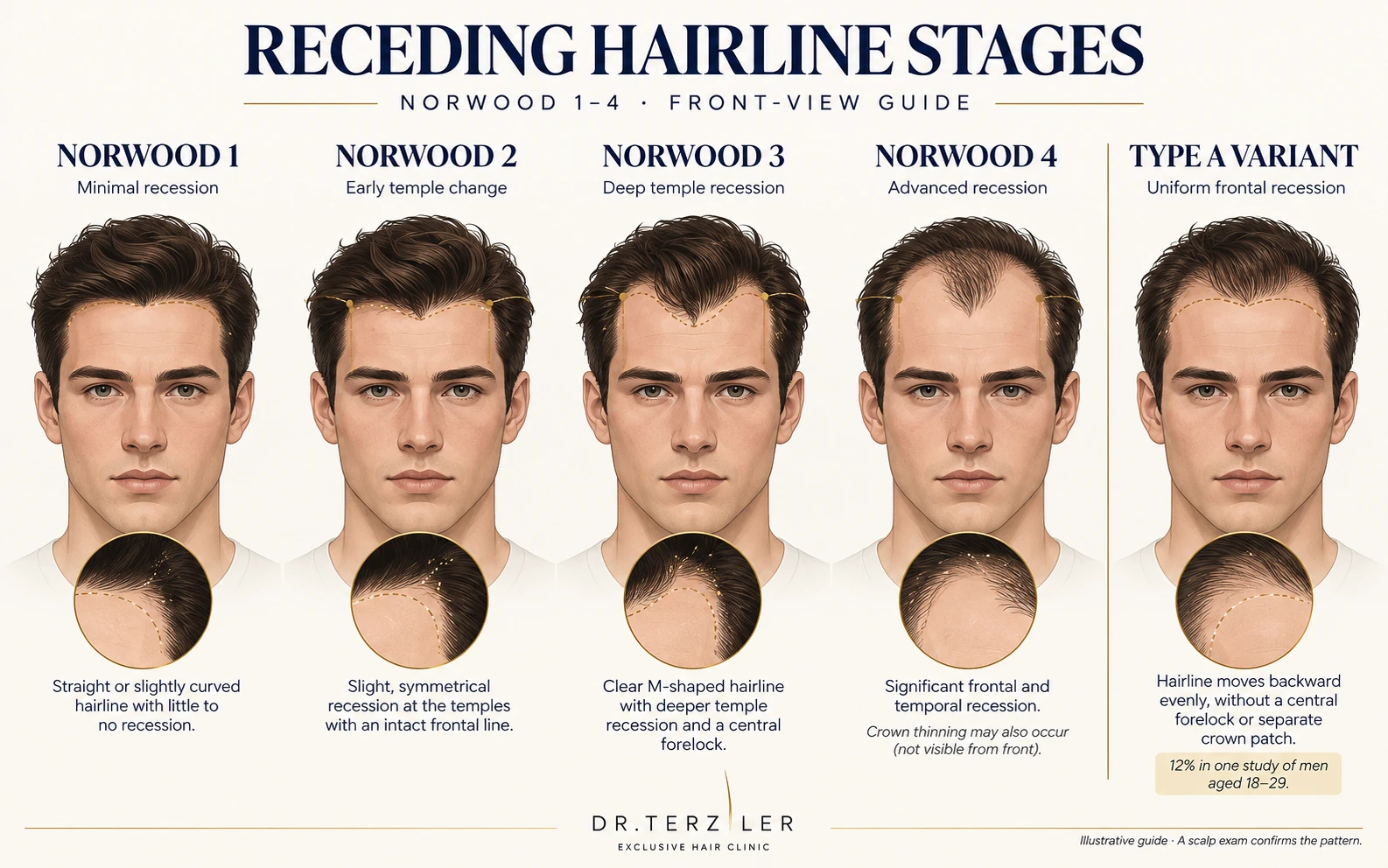
Frontal-first loss can look different. A type A variant recedes mainly from front to back rather than leaving a deep M shape. In the historical Rhodes community study, 12% of men aged 18–49 were classified with predominantly frontal type A variants. This is a study-specific proportion, not your personal risk. [8] See the full Norwood scale guide.
Receding hairline stages at a glance
| Norwood stage | Hairline and scalp pattern | What to discuss |
|---|---|---|
| I | No substantial frontotemporal recession | A longstanding shape may only need a photographic baseline. |
| II | Mild recession at the temple corners | Compare change and density; this stage alone does not distinguish maturation from early pattern loss. |
| III | Deeper frontotemporal recession | Ask about diagnosis, preservation treatment and realistic restoration goals. |
| III vertex | Vertex thinning with a less advanced frontal pattern | Assess the crown as well as the front; a hairline-only photograph is insufficient. |
| IV | More substantial frontal and crown loss, separated by hair | Review the full scalp, donor supply and future coverage needs. |
| V | Larger frontal and crown areas with a narrower bridge | Discuss coverage priorities and long-term donor management. |
| VI | The frontal and crown loss have joined | Ask about realistic density, staged treatment and available donor hair. |
| VII | Extensive top-scalp loss with a remaining side-and-back band | Discuss donor limitations, limited restoration goals and cosmetic alternatives. |
Track your hairline before you buy another product
Make a comparison you can actually use.
Take the same four views in similar lighting and keep them in a private album. Monthly photos can document change without encouraging daily checking. They do not replace assessment when symptoms or rapid loss appear.
Download the free 12-month trackerPrintable PDF · no email required · photo consistency guide and monthly log. Measurements are for documentation, not diagnosis.
Tracker12 months. Four repeatable views.Open the printable guide
Prepare your photo set
Mark the views you already have. The checklist prepares your message; this page does not upload or analyse photos.
Why is my hairline receding?
In men, a common cause is 男性型脱毛症: genetically susceptible follicles gradually produce thinner hairs. Repeated tension, inflammatory scalp disease and other conditions can also change the hairline. A receding edge is a finding, not one diagnosis. [1] [10] [11]
| Possible cause | Clues to discuss | Why the distinction matters |
|---|---|---|
| Androgenetic alopecia | Gradual temple/front or crown thinning; family history can help | Treatments aim to preserve susceptible native hair; outcomes vary. |
| Traction alopecia | Tight styling, discomfort, broken hairs or loss along pulled edges | Early reduction of tension may help; longstanding scarring can limit recovery. |
| Frontal fibrosing alopecia | A receding band, eyebrow change, scalp symptoms or fewer visible follicle openings | Scarring can be permanent. Dermatology assessment and disease control come before cosmetic surgery. |
| Diffuse shedding / telogen effluvium | More shedding across the scalp after a possible trigger | It can make the hairline look less dense without following the same pattern as androgenetic loss. |
| Other medical or scalp conditions | Patchiness, significant scale, a changing parting or other symptoms | Examination guides selective testing; a generic supplement pack is not a diagnosis. |
Family history comes from both sides. A UK Biobank study of more than 52,000 men identified many genetic signals associated with male-pattern baldness. One relative’s hairline cannot predict your future on its own. [9] DHT is part of the biology of androgenetic loss, not an explanation for every receding hairline. Read how DHT affects susceptible follicles.
What are the early signs of a receding hairline?
Look for a pattern of change, rather than judging one harshly lit selfie.
Continuing movement
Comparable photographs show progressively deeper corners or frontal recession over time.
Changing density
The edge becomes more see-through or contains increasingly fine, short hairs. A clinician can assess miniaturization.
A different distribution
Crown thinning, a widening part, broken hairs or distinct patches broaden the assessment beyond the hairline.
Can a receding hairline grow back?
Some thinning hair can become thicker with treatment. That is different from promising a new hairline at bare temple corners.
The cause, duration, scalp health and remaining follicles affect what is achievable. A shiny or bare-looking area in a phone photo does not establish whether follicles are scarred or whether surgery is appropriate. A clinician can distinguish a potentially treatable process from permanent scarring. [1] [2] [11]
Preserve thinning hair
For diagnosed pattern loss, treatment may reduce further loss and improve density. Continued use is commonly needed to maintain benefits.
Treat the cause
Tension, inflammation or a shedding trigger need their own plan. A serum cannot substitute for assessing those conditions.
Assess restoration
Surgery may restore selected areas in suitable patients. It redistributes a finite donor supply and does not stop future native-hair loss.
Age alone does not decide whether regrowth is possible. A person with active thinning and preserved follicles faces a different decision from someone with longstanding scarring, even if they are the same age.
What is the best treatment for a receding hairline?
The best option depends on the diagnosis and the goal: preserving native hair, treating scalp disease, restoring a bare area, or changing appearance. The table separates those jobs instead of giving every treatment one misleading score.
Start with the diagnosis. The same treatment is not suitable for every type of recession.
Read how the causes differ| Option | Role | What the evidence can support | Before you choose |
|---|---|---|---|
| Finasteride for suitable men | Pattern-loss treatment | An anterior/mid-scalp randomized trial supports improvement. The label does not establish efficacy for bitemporal recession. | Prescription assessment; discuss sexual and psychiatric risks. [3] [4] [6] |
| Topical minoxidil | Pattern-loss treatment | Can improve some pattern thinning. The reviewed US men’s 5% foam label is not intended for frontal baldness or a receding hairline. | Discuss site-specific expectations and any off-label use; ongoing use is usually needed. [5] |
| Low-dose oral minoxidil | Clinician-supervised, off-label for hair loss | An option some clinicians consider after reviewing individual risks; not an established promise of temple regrowth. | Requires medical assessment, including cardiovascular history and potential adverse effects. |
| Dutasteride | Specialist discussion | Evidence in androgenetic alopecia does not make every route or scalp-injection protocol equivalent. | Approval and off-label status vary by country; discuss risks and alternatives. |
| Microneedling with minoxidil | Adjunctive evidence | A meta-analysis found benefits in androgenetic alopecia studies, without establishing a guaranteed temple response. | Protocols vary. Avoid a do-it-yourself needling plan on an inflamed or undiagnosed scalp. [13] |
| PRP そして low-level laser therapy | Adjunctive options | Some studies show density improvements, but results and protocols vary. | Ask what evidence relates to your diagnosis and the frontal area, and what the complete course costs. |
| Reduce repeated styling tension | Cause-specific care | Relevant when traction contributes; early changes can help preserve follicles. | Persistent thinning, discomfort or scarring signs need assessment. [10] |
| Dermatology care for inflammatory / scarring loss | Cause-specific care | The aim is disease control and preservation of remaining hair; destroyed follicles do not reliably regrow. | Diagnosis and follow-up come before transplant planning. [11] [12] |
| Hair transplantation | Surgical redistribution | Can restore selected hairline areas in suitable patients. Donor supply and future loss limit the design. | Not a first response to active scarring, uncertain diagnosis or rapidly progressing loss. [15] |
| Cosmetic coverage and styling | Appearance option | Hair fibres, a suitable haircut or scalp micropigmentation can change appearance without regrowing follicles. | Check scalp suitability and realistic expectations. Permanent pigment needs careful provider selection. |
| Vicks, onion juice and cosmetic “miracle” serums | Not a substitute for diagnosis | These are not established ways to reconstruct a receding hairline. Rosemary evidence does not establish predictable hairline restoration. | A cooling feeling, product review or before/after advertisement is not clinical proof. |
11 options and categories shown. This is a comparison guide, not a prescription or an individual ranking.
Hairline use is not the same as the labelled crown indication
The reviewed men’s 5% foam label limits the intended area to the top of the scalp and says it is not intended for frontal baldness or a receding hairline. That does not prove that a clinician will never consider it at the front; it makes site-specific expectations and off-label discussion important. [5]
Frontal scalp is not the same as both temple corners
The Leyden trial studied anterior/mid-scalp thinning. The prescribing information separately states that efficacy in bitemporal recession has not been established. Do not translate a frontal-study result into guaranteed recovery of an M-shaped hairline. [3] [4]
What should I ask about treatment risks?
Ask your prescriber about expected benefit, alternatives, contraindications, pregnancy considerations, monitoring and what to do if side effects appear. Finasteride has sexual and psychiatric safety warnings; oral minoxidil requires a medical risk review. The MHRA advises stopping finasteride 1 mg and contacting a doctor promptly if depression or suicidal thoughts develop. [4] [6]
How do you stop or fix a receding hairline?
“How to stop a receding hairline” is really a question about the cause. For diagnosed androgenetic loss, treatment may slow progression; traction requires less pulling; inflammatory disease needs its own medical management. Not everyone needs a transplant. [1] [10] [11]
- Establish the diagnosis. Bring the timeline, photographs and details of scalp symptoms or pulling hairstyles.
- Choose the goal. Preserving hair, increasing density and rebuilding a hairline are different outcomes.
- Agree on a review plan. Ask what photographs or scalp measurements will show progress, and how long your particular option needs.
- Check the whole commitment. Include ongoing treatment, monitoring, adverse effects and any later procedure in the decision.
Before you buy, choose what you want answered
Build a short appointment checklist. Your selected questions appear below and can be copied or included in your WhatsApp draft.
- Select the questions you want to discuss.
What is new in hairline treatment research?
New products are worth following, but a sponsor announcement is different from an approved treatment and a general scalp endpoint is different from a temple-specific result.
Clascoterone 5% solution
Cosmo reported 12-month results from the SCALP programme in April 2026. The announcement is company-reported evidence, not a basis for buying an unapproved hair-loss product or assuming it rebuilds bare temple corners. [20]
VDPHL01
Veradermics reported Phase III Study 304 results in October 2026 for its extended-release oral-minoxidil formulation. The reported programme does not establish a personal hairline-regrowth guarantee or replace clinician review of oral-minoxidil risks. [21]
Research status reviewed 27 October 2026. Study results and marketing authorization are separate questions; discuss available approved options in your own country.
When does a hair transplant for a receding hairline make sense?
A transplant moves existing donor follicles. A good plan protects the donor area and allows for the hair you could lose later.
Suitability depends on the cause of loss, scalp health, available donor hair, progression and expectations. A Norwood stage or birthday alone does not make someone a suitable candidate. Active scarring disease requires specialist management; rapidly changing loss needs careful assessment before a permanent design. [11] [15]
| Planning situation | What the source guide illustrates | Decision before surgery |
|---|---|---|
| Limited temple restoration | Approximately 1,000–2,000 grafts in some suitable cases | Confirm recipient area, donor quality and whether preservation treatment is appropriate. Explore the 2,000-graft guide. |
| Larger frontal restoration | Approximately 2,000–3,000 grafts in some suitable cases | Review coverage, density goals and future progression. Explore the 3,000-graft guide. |
| Frontal-first pattern | May need a broader plan than the temple corners alone | Protect donor supply and avoid a low isolated line ahead of future thinning. |
| Inflamed or potentially scarred scalp | A graft count is not the first decision | Get the diagnosis and disease-control plan established first. |
These graft ranges are illustrations, not a prescription or a price calculator. The clinic’s reported average of 1,850 grafts applies to its operated hairline-only subgroup, described in the clinic report below.
How Dr. Terziler approaches hairline design
Dr. Terziler’s team considers facial proportions, single-hair graft placement at the leading edge, natural irregularity and the hair that may thin behind the transplant. A fixed forehead height, perfectly straight edge or maximum graft count is not a universal design target. See the clinic’s guide to natural hairline design.
The clinic offers DHI, ロボット式DHI そして ピカソ・ロボティック DHI. Technology supports a treatment plan; it does not remove the need for named-physician involvement, careful graft handling and realistic donor management.
Clinic-reported outcome: an internal Picasso Robotic DHI audit reported 98.1% graft survival at 12 months in 120 cases. It was not an independently verified comparative trial, and it does not establish a hairline-specific success rate or guarantee an individual result.
Existing hair can continue to thin after surgery. A randomized study in 79 men examined finasteride around transplantation and found benefits for surrounding native hair; medication suitability still needs an individual risk–benefit discussion. [14] For people who do not want surgery, styling and scalp micropigmentation are cosmetic options to discuss.
Dr. Terziler’s hair-transplant packages start from €4,500, with DHI as the entry option. Robotic DHI and Picasso Robotic DHI are priced according to the assessed treatment plan and confirmed package scope. See hair transplant Turkey cost and package details.
What causes a receding hairline in women?
A changing female hairline deserves a cause-specific assessment. Traction, frontal fibrosing alopecia and female-pattern thinning can overlap visually, while a widening part may have a different distribution from a receding frontal band. [10] [11] [12]
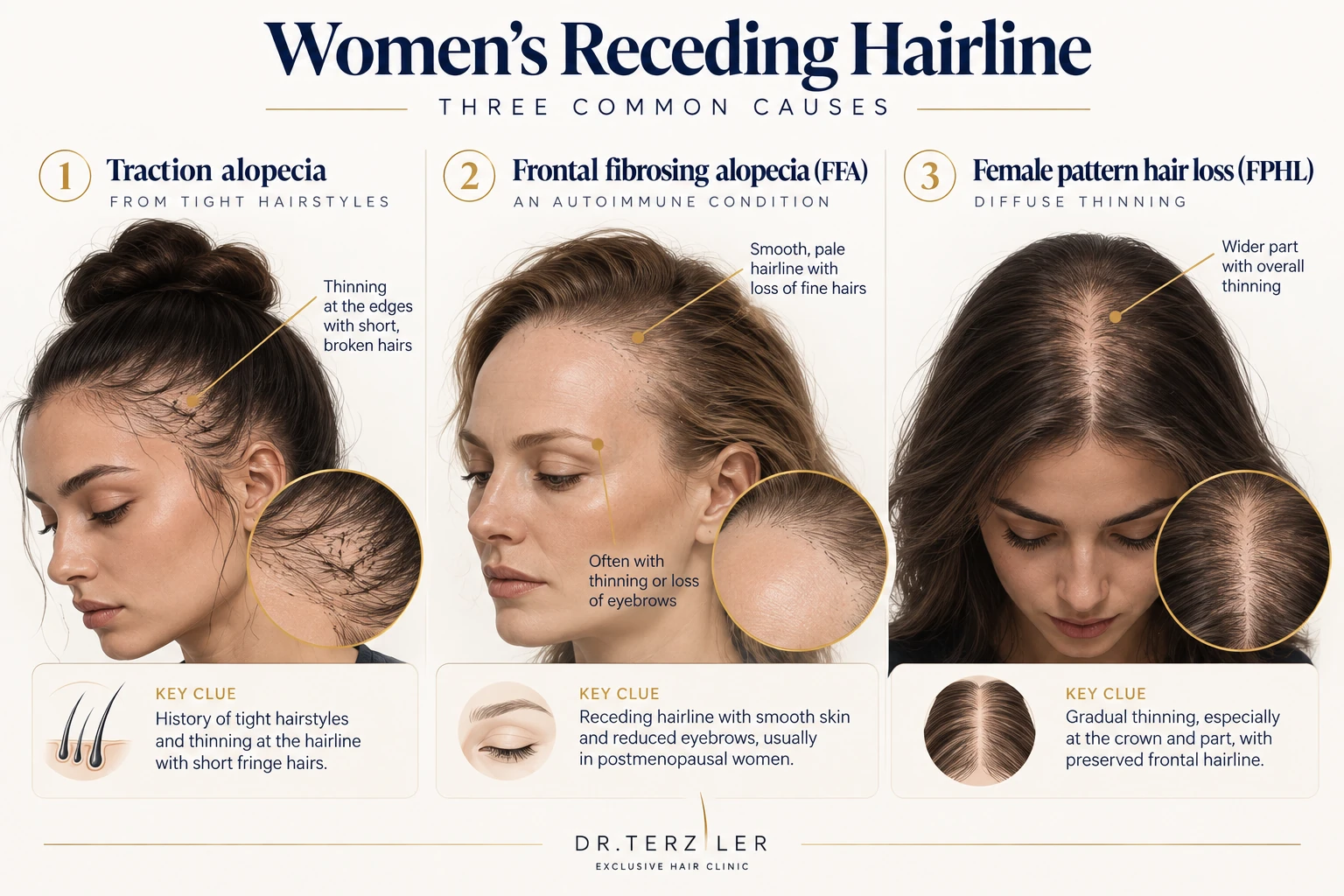
| Possible cause | Clues to bring to your appointment | What to discuss |
|---|---|---|
| Traction alopecia | Pulling hairstyles, discomfort and broken edge hairs | Reduce repeated tension; ask whether inflammation or scarring is present. |
| Frontal fibrosing alopecia | A receding band, eyebrow loss, burning or a smooth area | Arrange dermatology assessment; examination and sometimes biopsy clarify the diagnosis. |
| Female-pattern loss | A widening part or more general thinning; the front edge may remain | Discuss diagnosis, selective blood tests and suitable treatment options. |
Research in South African schoolchildren illustrates that traction can begin well before adulthood, but its study percentages should not be generalized to every population. [18] FFA can also affect men, including the eyebrows, beard or sideburns. [16]
Does sunscreen cause frontal fibrosing alopecia?
Some observational studies report associations between FFA and personal-care-product use. These data do not establish that sunscreen causes the condition or justify stopping sun protection on your own. Bring your product history to a dermatologist if you have symptoms. [17]
If restoration is later appropriate, our female hair transplant guide explains planning. A transplant discussion should follow diagnosis and scalp-health assessment.
Is hairline recession normal at your age?
This is an age-neutral guide because the useful question is whether your hairline is changing and why. Pattern loss can start in the late teens, but neither age nor forehead height gives the diagnosis. [1]
| Life stage | A useful question | A sensible next step |
|---|---|---|
| Teens and early adulthood | Is it a longstanding shape, a stable adult transition or ongoing loss? | Bring older photos; ask for assessment if the change is persistent or symptomatic. |
| Twenties and thirties | Is density changing, and is the cause established? | Discuss preservation and a review plan before deciding on a procedure. |
| Later adulthood | What are the donor limits, scalp health and longer-term goals? | Assess the full scalp and choose a realistic treatment or restoration plan. |
A 1998 community study found Norwood III-or-greater loss in 16% of men aged 18–29 and 53% of those aged 40–49. These historical, study-specific figures describe a sample, not your individual prognosis. We do not interpolate a made-up rate for people in their thirties. [8]
Is Gen Z balding earlier than previous generations?
A selfie trend or a rise in searches cannot establish an earlier biological onset. Comparisons need similar populations, definitions and measurements across generations. Focus on your documented changes rather than assuming your generation is destined to lose hair faster.
Which haircuts can suit a receding hairline?
A haircut changes appearance rather than the follicle’s biology. A buzz cut, crew cut, textured crop, French crop or a suitable fade may make the transition between dense and sparse areas less obvious. Your texture, density and preferred styling matter more than one universally “best” cut.
Ask your barber about a style you can maintain without pulling tightly at the front. Fibres or cosmetic coverage may help appearance on a suitable scalp, but persistent thinning or symptoms still deserve assessment.
Can you prevent a receding hairline?
You cannot choose the genes you inherit. You can reduce repeated styling tension, seek help for persistent change and make an informed choice about treatment. Gentle care supports the scalp; it does not guarantee prevention of androgenetic loss. [1] [10]
An observational study of identical male twins reported associations between environmental factors, including smoking history, and hair loss. Shared genes make this an interesting comparison, but the study does not prove that one habit caused the difference. [19]
Avoid making supplement or shampoo purchases the first response to an uncertain diagnosis. Bring a list of what you use so a clinician can help distinguish a useful treatment, a cosmetic preference and an unnecessary expense.
How Dr. Terziler’s team approaches hairline concerns
~が Dr. Terziler Exclusive Clinic in Istanbul, a hairline consultation starts with the pattern, timeline, donor area and the patient’s goals. Dr. Servet Terziler and Dr. Kürşat Yalvaç are part of the clinic’s named-physician model. The clinic reports a boutique schedule of no more than four hair-transplant patients per day.
A cause before a technique
Ask whether the findings support maturation, pattern loss, traction, another condition or referral.
A donor-safe long-term plan
Discuss what can be preserved, where grafts may help and what future thinning could mean.
Clear medical responsibility
Confirm who performs each medical stage, what the package includes and how follow-up works.
Meet the medical team, explore Tricho Test assessment, or read the broader hair loss guide if the change extends beyond the hairline.
Dr. Terziler Hairline Data 2026
Clinic-reported descriptive findings from consultations for a receding hairline. These observations describe this clinic’s attendees, not the general population.
Were assessed as having a mature hairline
This percentage refers to the under-25 male subgroup, not all 412 patients. These patients were advised to document the hairline rather than start surgery or medication for baldness.
These are the three most common reported stages. The summary also reports a frontal-first type A pattern in 14%. Type A can coexist with a Norwood stage; the figures are not an exhaustive stage breakdown.
The reported range was 1,100–2,800 grafts
Frontal-first cases needed approximately 600 more grafts on average. These are subgroup observations, not graft requirements for every visitor or a per-graft price list.
Were referred for further assessment
27% were referred for traction-alopecia assessment and 14% for suspected frontal fibrosing alopecia. The clinic reports eyebrow thinning in most of the suspected-FFA referral group. Referral does not equal a confirmed diagnosis.
How to interpret the clinic findings
The clinic supplied an aggregate summary of 412 first consultations: 356 men and 56 women. The source reports percentages for specific subgroups and graft counts only for operated hairline-only cases. Exact sizes of the under-25, staged and operated subgroups are not stated in this summary; no event counts are reconstructed from rounded percentages.
The observations are not a controlled trial, national prevalence estimate or independently audited treatment comparison. Type A is a pattern variant reported alongside the stage figures; the summary does not specify category overlap. Suspected conditions and referrals are distinguished from confirmed diagnoses.
Receding hairline FAQ
Can a receding hairline grow back?
Some thinning hairs can become thicker with treatment, depending on the cause and the condition of the follicles. Regrowth at bare temple corners is less predictable. A scalp examination distinguishes pattern loss from traction, inflammation and scarring before treatment or surgery is considered.
Does a receding hairline mean I will go bald?
No single hairline shape predicts your future. A naturally high or stable adult hairline can look recessed without progressive loss. Androgenetic alopecia can progress, but its speed and extent vary. Compare consistent photographs and seek an assessment if the line keeps changing.
How can I tell a mature hairline from a receding hairline?
Change over time matters more than a single forehead measurement. A stable adult hairline with preserved density differs from progressively deeper corners and thinner edge hairs. Finger widths, forehead wrinkles and an M shape cannot confirm a diagnosis; trichoscopy can help assess the follicles.
Is a receding hairline normal at 20?
Some change in the transition to an adult hairline can occur in young adults. Continued recession, visible thinning, patches or scalp symptoms deserve assessment. Age alone does not establish either a mature hairline or male pattern hair loss, and it does not decide whether surgery is suitable.
Is a receding hairline at 19 normal?
A high or slightly recessed hairline can be a natural feature at 19. A line that changes quickly or loses density should be examined. Avoid diagnosing yourself from a finger-width rule or starting prescription treatment without medical advice.
Is a receding hairline normal at 30?
A hairline that has stayed stable for years may simply be your adult shape. Continued temple recession or thinning can indicate pattern loss or another condition. Treatment depends on the diagnosis and your goals, rather than your age alone.
When does a hairline start receding?
Pattern hair loss can begin in the late teens or later in adult life. Natural hairline position also changes with development. There is no single age or centimetre cutoff that separates normal maturation from progressive loss.
Is a three-finger hairline good?
Finger widths vary between people, and forehead proportions vary too. A three-finger measurement does not classify a hairline as healthy, attractive or balding. Use consistent photos to document change and ask a clinician about persistent recession or thinning.
Does minoxidil work on a receding hairline?
Minoxidil can help some people with pattern hair thinning, but the reviewed US men’s 5% foam label is not intended for frontal baldness or a receding hairline. A clinician can explain the evidence and any off-label use for your situation. It does not guarantee temple-corner regrowth.
Does finasteride work on a receding hairline?
Finasteride improved anterior and mid-scalp thinning in a randomized trial in men. That is different from proving regrowth at both temple corners: the US label states that efficacy in bitemporal recession has not been established. Prescription suitability and sexual and psychiatric risks require discussion with a clinician.
Does Vicks bring back a hairline?
Vicks VapoRub is not an established treatment for hairline regrowth. Avoid using a chest rub as a substitute for diagnosing hair loss, particularly on an irritated scalp. A product that creates a cooling sensation does not demonstrate that follicles are regrowing.
Why is my hairline receding on one side?
Natural asymmetry, styling tension and different hair-loss patterns can make one side look more recessed. A new one-sided patch, inflammation or continued change should be examined. A photograph alone cannot reliably identify the cause.
Can women have a receding hairline?
Yes. Tight hairstyles can cause traction alopecia; frontal fibrosing alopecia can cause permanent scarring; and other patterns can affect the front. Eyebrow loss, scalp pain, redness or a smooth receding band are reasons to arrange a dermatology assessment.
How much does a hair transplant for a receding hairline cost in Turkey?
Dr. Terziler’s hair-transplant packages start from €4,500, with DHI as the entry option. Robotic DHI and Picasso Robotic DHI are priced according to the assessed treatment plan. Your final written quote follows donor assessment and confirmation of the package inclusions. See the hair transplant Turkey cost guide.
What is the prettiest hairline?
There is no single ideal hairline. A suitable design considers facial proportions, natural irregularity, donor supply and future hair loss. A low, straight teenage hairline is not automatically the most natural choice for an adult.
Why you can trust this guide
This guide is prepared by the Dr. Terziler Exclusive Clinic editorial team with medical review by Dr. Servet Terziler and Dr. Kürşat Yalvaç. It distinguishes clinical guidance, drug labels, peer-reviewed research, sponsor announcements and clinic-reported observations.
The clinic’s AACI facility accreditation can be checked in the public certificate record, which shows validity through 21 December 2028. [22] Accreditation is a facility credential; treatment suitability still requires an individual medical assessment.
The clinic provides hair-restoration services, which is a commercial interest relevant to this page. An assessment may lead to monitoring, medical treatment, specialist referral or surgery. The guide is educational and cannot replace an examination or an individual prescription.
Source links appear beside the claims they support as well as below. Research status was checked on 27 October 2026. A study in another population, a company announcement and an internal clinic audit are not interchangeable kinds of evidence.
Your hairline is the first thing people see. It deserves a diagnosis, not a guess.
Sources and further reading
- American Academy of Dermatology. Male pattern hair loss and treatment Clinical patient guidance
- American Academy of Dermatology. Hair loss: diagnosis and treatment Clinical patient guidance
- Leyden et al., 1999. Finasteride in men with frontal male pattern hair loss Randomized trial; anterior/mid scalp, not a promise of temple-corner regrowth
- DailyMed. Finasteride 1 mg prescribing information US label; efficacy in bitemporal recession is not established
- DailyMed. Minoxidil 5% foam for men: Drug Facts US OTC product label; read the label on your own product
- MHRA. Finasteride: psychiatric and sexual side effects UK medicine-safety communication
- Rakowska et al., 2009. Trichoscopy criteria in female androgenic alopecia 131 women; findings are not a home test for male temple recession
- Rhodes et al., 1998. Prevalence of male pattern hair loss in men aged 18–49 Historical community sample; not a universal current prevalence estimate
- Hagenaars et al., 2017. Genetic prediction of male pattern baldness UK Biobank genetic association study
- American Academy of Dermatology. Hairstyles that pull can lead to hair loss Traction alopecia guidance
- American Academy of Dermatology. Frontal fibrosing alopecia: diagnosis and treatment Scarring alopecia; early assessment matters
- British Association of Dermatologists. Frontal fibrosing alopecia Patient information; scarring and treatment limits
- Abdi et al., 2023. Minoxidil plus microneedling: systematic review and meta-analysis Androgenetic alopecia studies; not a temple-specific regrowth guarantee
- Leavitt et al., 2005. Effects of finasteride on hair surrounding a transplant Randomized study of 79 men; native-hair outcomes
- NHS. Hair transplant: suitability, recovery and risks Patient information on surgery and continued thinning
- Melián-Olivera et al., 2025. Frontal fibrosing alopecia in men: a review Clinical review; eyebrow, beard and hairline involvement
- Kam et al., 2023. Frontal fibrosing alopecia and personal care products Observational meta-analysis; association does not establish cause
- Khumalo et al., 2007. Hairdressing and scalp disease in African schoolchildren School-based study; findings are population-specific
- Gatherwright et al., 2013. Endogenous and exogenous factors in male alopecia Identical-twin observational study; not proof of causation
- Cosmo Pharmaceuticals, 15 April 2026. Clascoterone 5%: sponsor-reported 12-month Phase III results Company announcement; investigational hair-loss formulation
- Veradermics, 19 October 2026. VDPHL01: sponsor-reported Phase III 304 results Company-issued Business Wire announcement; investigational formulation
- AACI. Public accreditation certificate for Dr. Terziler Exclusive Hair Clinic Facility accreditation; certificate valid through 21 December 2028