


Most patients need 2,000 to 5,000 grafts for a hair transplant: about 1,500 to 2,500 grafts to rebuild a receding hairline and temples, 3,000 to 4,500 grafts for the front plus a thinning crown, and 5,000 to 6,500+ grafts for advanced baldness. Your exact graft count is not a guess from a photo. It is calculated from your Norwood stage, the surface area that needs coverage, your hair caliber and texture, your hair-to-graft ratio and your donor capacity. This guide shows you how surgeons reach a real number, and how to spot a graft count that has been inflated to sell you.

医学的監修:
AACI-Accredited Hair Restoration Surgeon, ISHRS Member and Inventor of Robotic DHI
Last reviewed September 2026
Most hair transplants use 2,000 to 5,000 grafts. A receding hairline and temples usually need 1,500~2,500グラフト, front plus a thinning crown needs 3,000~4,500グラフト, and advanced baldness needs 5,000~6,500以上グラフト, often over two sessions. The exact number is confirmed only after a donor-area assessment, because hair caliber, texture, hair-to-graft ratio and donor capacity change the count.
How Many Grafts Do I Need for a Hair Transplant?
Most patients need 2,000 to 5,000 grafts, and the count is driven by how much scalp needs coverage and how much donor hair you can safely spare. Determining the ideal graft count is a clinical calculation, not a number to compare against a friend or an online forum. A hair transplant graft is a living tissue unit that contains one, two, three or four individual hair follicles, so the total you need depends on your hair-loss pattern, your facial anatomy and your long-term styling goals. Worldwide, clinics performed 735,312 surgical hair restoration procedures in a single reporting year, according to the ISHRS Practice Census, and graft estimation is the first step in every one of them.
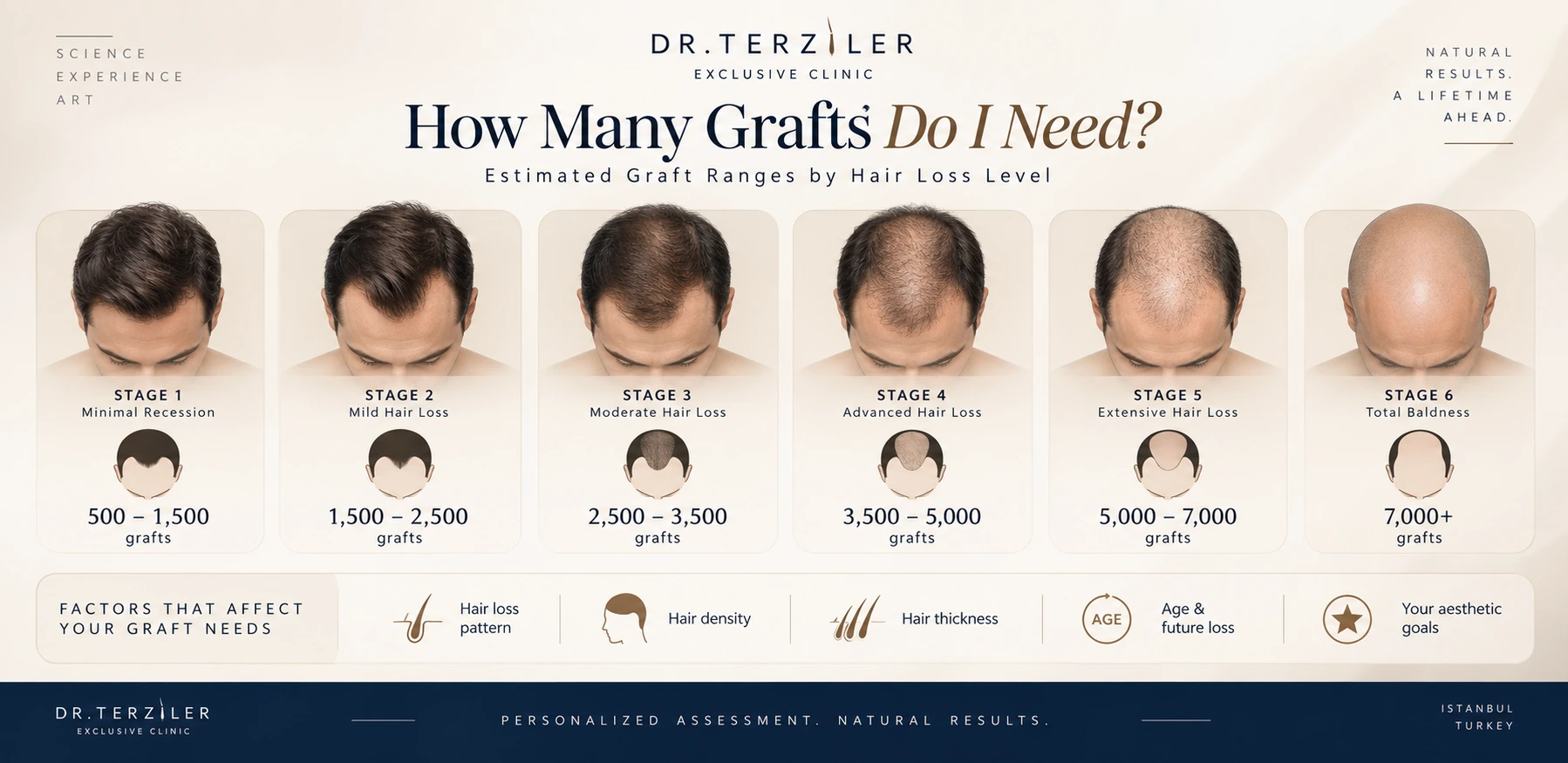
| Hair-Loss Stage (Norwood) | What It Looks Like | Typical Graft Range |
|---|---|---|
| ノーウッド 2-3 | Receding hairline and temples | 1,500~2,500グラフト |
| ノーウッド 4-5 | Deeper hairline plus a thinning or bald crown | 3,000 – 4,500 grafts |
| ノーウッド 6-7 | Front and crown merged; top of scalp bare | 5,000 – 6,500+ grafts (often 2 sessions) |
Understanding how accredited clinics reach these numbers helps you walk into a consultation with realistic expectations and protects you from marketing traps. Cost follows graft count closely, so once you know your range you can read the full hair transplant cost breakdown by country, graft count and technique.
What Is a Hair Graft, and How Many Hairs Does It Hold?
A hair graft is a naturally occurring follicular unit that holds 1 to 4 (rarely 5) hairs, with an average of about 2.2 hairs per graft. This is why graft count and hair count are not the same thing. A plan of 3,000 grafts can deliver roughly 6,600 individual hairs. Elite clinics separate these units under magnification and place single-hair grafts along the very front edge of the hairline for a soft, natural border, while multi-hair grafts sit deeper to build visual thickness.
How Does the Norwood Scale Estimate Your Graft Count?
For men with androgenetic alopecia (male pattern baldness), the global clinical standard for staging hair loss is the ノーウッド分類, which sorts progressive loss into seven stages and gives surgeons a baseline graft requirement per stage.
Norwood 2 & 3 – The Receding Hairline
Loss concentrated at the temples and frontal hairline. Rebuilding this zone to a youthful density typically needs 1,500~2,500グラフト.
Norwood 4 & 5 – Mid-Scalp & Thinning Crown
The hairline has receded deeper and a bald patch has formed at the vertex. Bridging both zones cleanly needs 3,000~4,500グラフト.
Norwood 6 & 7 – Advanced Baldness
The bridge of native hair between the front and crown is gone. Comprehensive coverage needs 5,000~6,500以上グラフト, often split across two consecutive sessions.
Women & Diffuse Thinning
Women more often show diffuse thinning than a bald patch. A 女性向け植毛 is planned by density added between existing hairs, so counts are assessed case by case rather than by Norwood alone.
What 4 Factors Change Your Graft Count Beyond the Norwood Scale?
Two men at an identical Norwood 4 can need very different counts, one 3,000 grafts and the other 4,500. Surface area is only part of the equation. Surgeons weigh four biological factors on top of the stage.
1. Hair Caliber (Thickness)
Coarse, thick hair blocks light from the scalp far better than fine hair. Patients with fine hair need more grafts to reach the same visual density.
2. Hair Texture (Straight vs Curly)
Curly and wavy hair overlaps as it grows, blanketing the skin for maximum coverage. Straight hair stands perpendicular and must be packed more tightly to hide the scalp. This is central to planning an アフロヘアの植毛.
3. 毛髪対移植片の比率
A donor area rich in 3- and 4-hair grafts delivers far more volume from 3,000 grafts than one that yields mostly 1- and 2-hair units.
4. Facial Architecture & Age
A flat, low, teenage hairline on a 45-year-old wastes grafts and ages badly. A mature, conservative hairline preserves grafts for future loss and looks age-appropriate.
What Graft Density Do You Need Per Scalp Zone?
Grafts are not spread evenly. Each zone of the scalp has its own target density, measured in grafts per square centimetre. This is how a surgeon turns a Norwood stage into a real number for your head.
| 頭皮のターゲットゾーン | Desired Density (grafts / cm²) | Average Graft Range |
|---|---|---|
| Frontal Hairline (the frame) | 45~55グラフト/cm² | 1,500~2,500グラフト |
| Mid-Scalp (the bridge) | 35~45グラフト/cm² | 1,000~2,000グラフト |
| Crown / Vertex (the spiral) | 30~40グラフト/cm² | 1,500~2,500グラフト |
How Can You Estimate Your Own Graft Count?
You can get a rough estimate at home by matching your pattern to the ranges below, then adding the zones you want treated. It is a preparation tool, not a medical quote, because only a donor-area assessment confirms the safe number.
| エリア | Reference Graft Capacity | When to Include It |
|---|---|---|
| ヘアライン | Up to 1,200 grafts | Recession at the first frontal line |
| Temples (each side) | Up to 700 grafts each | Assess left and right separately; loss is often uneven |
| Forelock / front-central | Up to 1,000 grafts | Thinning behind the hairline |
| Mid-scalp | Up to 1,500 grafts | Visible thinning between front and crown |
| Crown / vertex | Up to 1,800 grafts | Depends heavily on swirl direction and donor reserve |
Add the zones that apply to you for a ballpark total, then have it confirmed. On average each graft carries 2 to 3 hairs, so your hair count will be roughly double your graft count. When you are ready, read how to choose the right hair transplant clinic so the number you are quoted comes from a real assessment, not a sales script.
How Does Donor Capacity Limit Your Graft Count?
Your donor area at the back and sides of your head holds a finite, non-renewable supply of about 6,000 to 8,000 lifetime grafts for most men. That ceiling, not your wish list, sets the maximum. Removing too many grafts in one session creates two clinical problems.
If your scalp donor is limited but your loss is extensive, a body hair transplant (BHT) can add follicles from the beard or chest. Beard hair is thick and robust, making it a strong filler for the crown and mid-scalp when scalp supply runs short.
Why Is the “Maximum Grafts” Promise a Marketing Trap?
The focus should always be survival rate and efficiency, not raw graft count. A masterfully executed 3,000-graft procedure with high survival yields a thicker, more natural look than an aggressive 5,000-graft session where half the follicles fail. This is exactly why technique matters: FUE, サファイアFUE, 持っていますか?, ロボット式DHI and the artistic ピカソ・ロボティック DHI all protect graft viability differently, and an ひげを剃らない状態での植毛 can be planned when donor access allows.
Does Graft Count Decide the Cost?
Graft count is the single biggest driver of price in per-graft markets, but not in every model. US and European clinics usually multiply your graft count by a per-graft rate, so a higher count means a higher bill. Turkey’s all-inclusive package model replaces per-graft billing with one flat fee that covers the surgery, hotel, transfers and aftercare, so the graft count changes the plan rather than the headline number. For the full picture across countries and techniques, see the hair transplant cost guide.
A graft estimate should always come before a price. If a clinic throws out a large number like 5,000 grafts without a digital scalp analysis or a donor-capacity check, the number is a sales tactic, not a diagnosis.
How Does Dr. Terziler Calculate Your Exact Graft Count?
Dr. Terziler Exclusive Clinic is an AACI-accredited hair transplant clinic in Istanbul, Turkey, led by Dr. Servet Terziler, the inventor of the Robotic DHI machine. Graft estimation here is measured, not guessed. Using high-magnification trichoscopic analysis and digital densitometry, the team measures your exact hair caliber, donor capacity and hair-to-graft ratio before drawing a single line, then maps a conservative, high-survival blueprint that maximises visual density while protecting your donor supply for life.
“The right graft count is the number that covers you today and still leaves a safe donor reserve for the next twenty years. Anyone can quote a big number. Planning a result that survives is the actual work.”
Every hairline is designed and surgically executed under Dr. Terziler’s direct supervision, and outcomes are documented in the clinic’s before and after results archive. The Robotic DHI system records a 97.3 percent graft survival rate, which is the proof point behind planning for survival over sheer numbers. Facial-hair goals such as a beard transplant または eyebrow transplant are mapped with the same graft-by-graft discipline.
よくある質問
How many grafts do I need for a full head of hair?
A full-looking result usually needs 2,000 to 5,000 grafts, depending on your Norwood stage. A hairline and temples take 1,500 to 2,500 grafts, front plus crown takes 3,000 to 4,500, and advanced baldness takes 5,000 to 6,500+ grafts, often over two sessions. “Full” is achieved through the illusion of density at about 40 to 50 grafts per cm², not by matching native density.
1つの移植片に複数の毛髪を含めることはできますか?
Yes. Follicular units grow in natural families of 1 to 4 (rarely 5) hairs, averaging about 2.2 hairs per graft. Clinics separate them under microscopes, using single-hair grafts at the front edge of the hairline and multi-hair grafts deeper in the scalp to build volume.
What if my donor area doesn’t have enough grafts to cover my baldness?
If your scalp donor is limited but your loss is extensive, a body hair transplant (BHT) can safely extract follicles from the beard or chest. Beard hair is thick and robust, making it excellent for adding density to the crown and mid-scalp when scalp supply runs short.
クリニックが提示する移植片数の見積もりが妥当なものか、それとも誇張されているものか、どうすれば見分けられますか?
An honest clinic shows its math: your Norwood stage, the square-centimetre area to cover and the exact density it plans to plant. If a clinic quotes a large number like 5,000 grafts without a digital scalp analysis or a donor-capacity check, it is likely using a sales tactic rather than a diagnosis.
Will transplanted grafts eventually fall out?
No. Follicles taken from the back and sides of the head are genetically resistant to DHT, the hormone that causes pattern baldness. Relocated to the front or crown, they keep that resistance and grow for life. See are transplanted grafts permanent for the full explanation.
Can 5,000 grafts be done safely in a single day?
It is technically possible but demanding on both the patient and the grafts. Sessions over 4,000 grafts are often safer and more successful split over two consecutive days, which keeps grafts hydrated and viable for a maximum survival rate rather than leaving them outside the body too long.
Sources
- ISHRS. 2022 Practice Census Results. https://ishrs.org/wp-content/uploads/2022/04/Report-2022-ISHRS-Practice-Census_04-19-22-FINAL.pdf
- ISHRS. Survey Finds Hair Restoration Surgery on the Rise Worldwide. https://ishrs.org/survey-finds-hair-restoration-surgery-on-the-rise-worldwide/
- American Academy of Dermatology. Hair loss: Diagnosis and treatment. https://www.aad.org/public/diseases/hair-loss/treatment/diagnosis-treat
- NHS. Hair transplant. https://www.nhs.uk/tests-and-treatments/cosmetic-procedures/cosmetic-surgery/hair-transplant/
- Norwood OT. Male pattern baldness: classification and incidence. Southern Medical Journal, 1975 (Norwood-Hamilton Scale).