

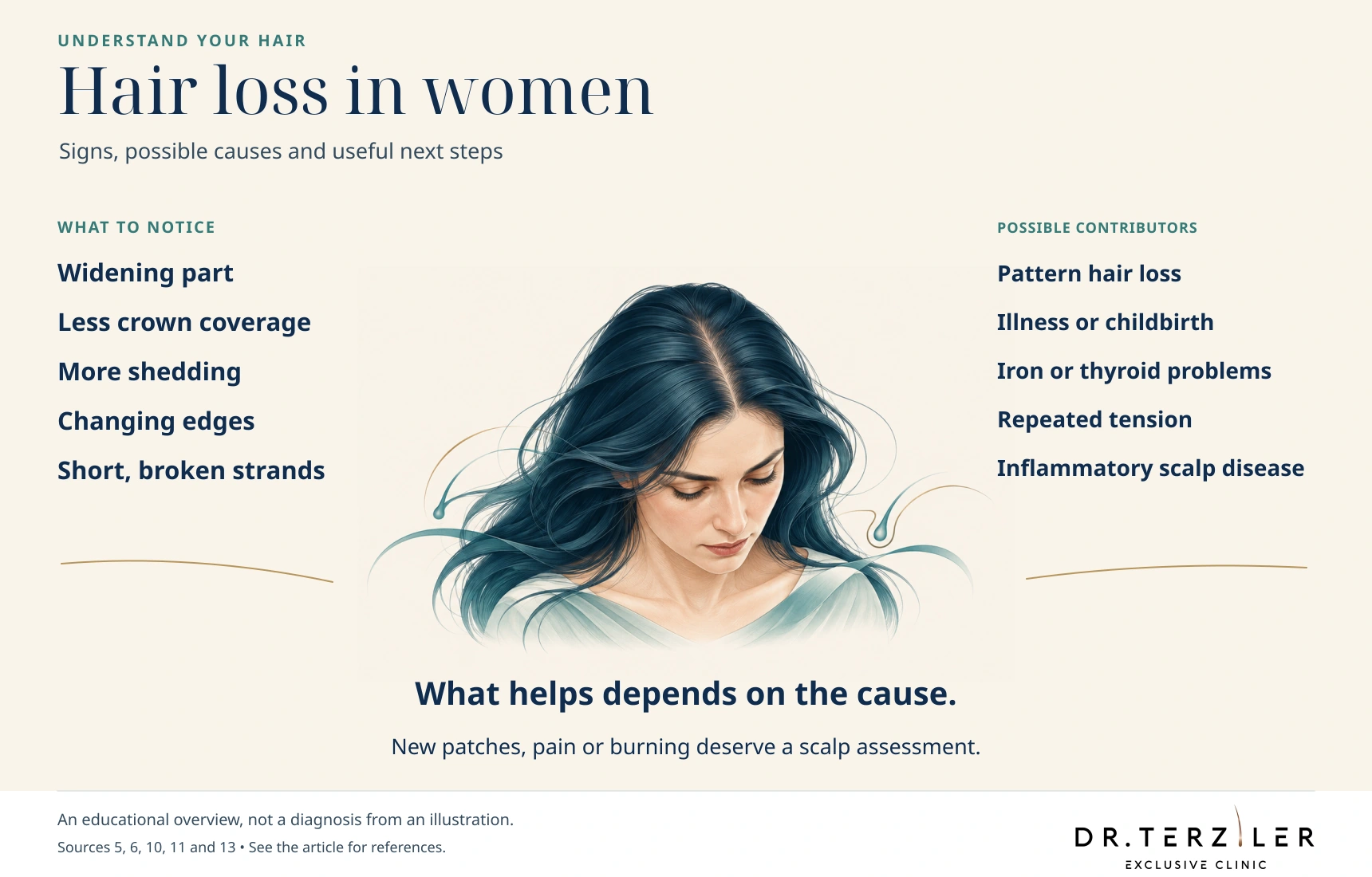
Hair loss in women can mean gradual thinning, increased shedding, bald patches or damaged strands. Female pattern hair loss is a common cause, but childbirth, illness, iron deficiency, thyroid disease, tight hairstyles and inflammatory scalp conditions can produce different kinds of loss. The treatment that helps depends on which process is happening. [1, 5]
A widening part and a handful of hair in the shower are different observations. You may have one without the other, or both at once. Before buying a hair-growth product, establish what changed, when it changed and whether your scalp has symptoms.
This guide explains how to recognize the main patterns, which investigations can be useful and what the evidence actually supports for women. If you are also comparing other patterns, our broader hair loss guide explains how these findings fit together.
Which question would you like to start with?
Why am I losing so much hair as a woman?
Heavy shedding can follow childbirth, fever, surgery, substantial weight loss, dietary restriction or a medication change. Gradual loss of coverage more often raises the possibility of female pattern hair loss. Patchy loss, broken hairs and an uncomfortable scalp need their own assessment rather than being grouped under “stress.” [1, 4, 5]
Start by describing the change in ordinary language. “My part has widened over a year” tells a clinician something different from “I started shedding much more six weeks ago.” Neither description establishes the diagnosis, but both make the consultation more useful.
Swipe horizontally to read all columns.
| What have you noticed? | What does it describe? | What is useful to record? |
|---|---|---|
| More full-length hairs coming out | Increased shedding | Start date, recent illness, birth, weight change and medicines |
| More scalp showing in the same area | Reduced coverage | Comparable earlier photographs and where the change began |
| Short, snapped strands or uneven lengths | Possible breakage | Heat, bleaching, straightening, extensions and handling |
| Round patches, changing edges or scalp symptoms | A finding needing a closer examination | Patches, eyebrow changes, pain, burning, scale or tenderness |
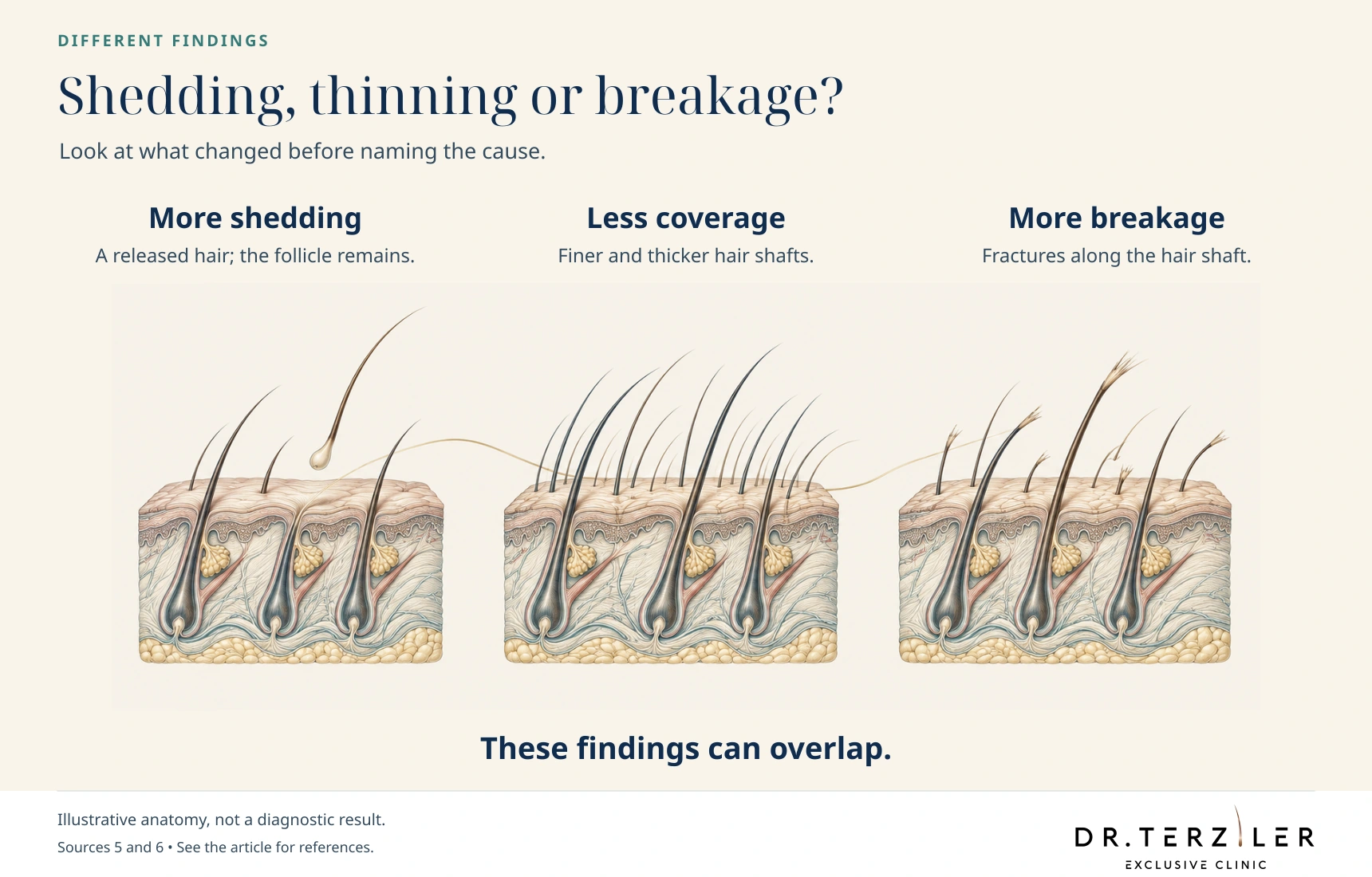
These findings can overlap. Someone with long-standing pattern thinning can also develop a temporary shedding episode. Treating the trigger may improve shedding without fully restoring the density that was already being lost. [6]
What are the early signs of hair loss in women?
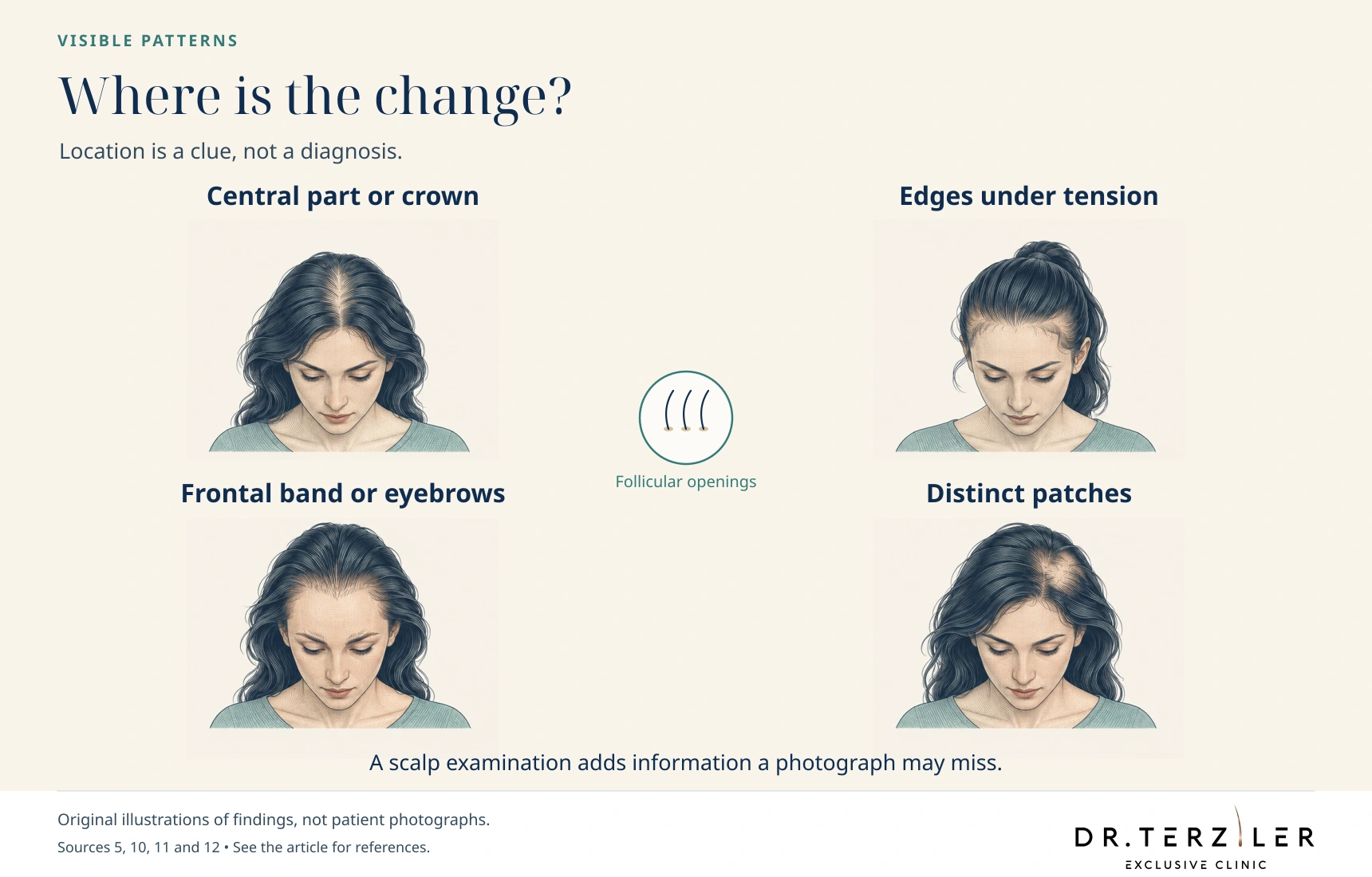
Early signs include a gradually widening part, less coverage over the top or crown, a smaller ponytail and a change at the temples or hairline. Increased shedding may be another clue, but female pattern hair loss can progress without dramatic daily hair fall. [2, 7]
One photograph under a bathroom spotlight is a weak baseline. Wet hair groups into strands, a different part exposes different skin, and a shorter haircut changes the way hair lies. Compare the same scalp area with similar lighting, camera angle, parting and hair condition.
Is my hair naturally fine, or is it becoming thinner?
Naturally fine hair has a small strand diameter; thinning means less coverage than your own previous baseline. Fine hair can still be dense, and coarse hair can become sparse. The useful comparison is with your earlier hair, rather than someone else's ponytail.
Swipe horizontally to read all columns.
| Observation | What it can tell you | What it cannot establish |
|---|---|---|
| A wider part in matched photographs | A repeatable change in appearance | The cause or a measured hair count |
| A smaller ponytail with a similar haircut | A change worth discussing | Whether shedding, breakage or miniaturization caused it |
| Scalp visible only when wet or strongly lit | Conditions affect visibility | Whether a scalp disease is present or absent |
| Fine and thicker strands seen on trichoscopy | Hair-shaft variation may support the examination | A diagnosis without the rest of the findings |
Our hair-thinning self-check can help organize observations before an appointment. It cannot confirm a cause or predict whether you will become bald.
Does hair thinning at the crown mean female pattern baldness?
Crown thinning can occur in female pattern hair loss, but it is not specific to that condition. Central scarring alopecia, shedding and other processes can also reduce coverage there. A natural hair whorl describes the direction of hair growth; it does not explain a progressive change around it. [5, 11]
What does hair loss at the temples or frontal hairline mean?
Temples and edges can thin because of repeated traction, pattern loss or an inflammatory condition. A receding frontal band with eyebrow loss deserves particular attention because frontal fibrosing alopecia can scar follicles. Do not assume every changing hairline in a woman is the female equivalent of male-pattern recession. [10, 12]
When should I worry about female hair loss?
Arrange a medical assessment for new bald patches, a rapidly changing hairline, eyebrow loss, persistent shedding or progressive thinning. Pain, burning, significant scale, redness, sores or pustules make an examination particularly important. Some inflammatory disorders can permanently damage follicles, and waiting for more photographs can delay useful treatment. [5, 10, 11]
Scalp symptoms are not required for a disease to be present. Equally, an itchy scalp does not prove scarring alopecia. The combination of distribution, timing and examination findings determines what needs investigating.
Mention fatigue, unexplained weight change, heavy menstrual bleeding, irregular periods, new facial hair or a recent medication change. Rapidly developing facial hair or voice changes also deserve prompt medical review. Do not wait until hair loss looks severe enough to qualify for help. [8, 13]
If you feel unwell or have a painful, inflamed scalp, use an appropriate local medical service. For an assessment of persistent thinning, you can request an appointment with Dr. Terziler Exclusive Clinic. Photographs can start the discussion; an examination may still be necessary.
What are the main causes and types of hair loss in women?
The main categories are pattern thinning, excessive shedding, autoimmune loss, traction, inflammatory or scarring alopecia, and hair-shaft damage. “Alopecia” means hair loss; it does not identify one particular disease. Several causes can coexist in the same woman. [1, 5, 6]
Swipe horizontally to read all columns.
| Cause or type | How it may appear | What changes the next step? |
|---|---|---|
| Female pattern hair loss, also called female androgenetic alopecia | Gradual central-part or top-of-scalp thinning; finer hair output | Examination for miniaturization and a sustainable treatment plan |
| Telogen effluvium | Increased diffuse shedding, often after a delay following a trigger | Review the trigger, nutrition, medicines and possible ongoing contributors |
| Thyroid disease or iron deficiency | Diffuse shedding, sometimes with symptoms elsewhere | Targeted investigation and treatment of the underlying problem |
| Alopecia areata | Often smooth round patches; sometimes more extensive loss | Assessment for an autoimmune hair-loss disorder |
| Traction alopecia | Thinning where hairstyles repeatedly pull, often along edges | Remove the tension and assess whether follicles have scarred |
| Frontal fibrosing alopecia or CCCA | A receding frontal band, eyebrow changes, or progressive central loss | Dermatology assessment for inflammation and scarring |
| Anagen effluvium | Rapid loss during certain cancer treatments or other toxic exposures | Review with the treating medical team |
| Breakage | Fractured strands, uneven lengths and reduced hair volume | Examine shaft damage and styling practices |
The table describes possibilities, not a way to diagnose yourself from a mirror. A scalp examination may reveal features that a full-head photograph cannot show. [5, 6]
Is female pattern hair loss the same as female pattern baldness?
These terms usually refer to the same pattern disorder. “Female pattern hair loss” is often more descriptive because many women develop diffuse thinning rather than complete baldness. Over successive hair cycles, susceptible follicles produce finer, shorter hairs, reducing coverage. The frontal hairline is often relatively preserved, but that is not an absolute rule. [7, 16]
The Ludwig and Sinclair scales describe the visible severity of this pattern. They do not measure iron stores, identify PCOS, predict your final stage or decide a graft count. A clinical grade is useful for describing change; it is not the whole diagnosis. [7, 41]
How does female hair loss differ from male hair loss?
Female pattern hair loss usually causes a widening part and thinning across the top of the scalp. Male pattern hair loss more often starts with temple recession, a receding hairline or crown thinning. Both involve follicular miniaturization, but the distribution, hormonal interpretation and treatment choices can differ. [41, 45]
Swipe horizontally to read all columns.
| Característica | Female pattern hair loss | Male pattern hair loss |
|---|---|---|
| Typical visible change | A widening central part and reduced coverage across the top or crown | Recession at the temples or frontal hairline, crown thinning, or both |
| Frontal hairline | Often relatively preserved, although recession can occur | Commonly recedes as the pattern develops |
| Androgen interpretation | Can occur without elevated blood androgen levels; thinning alone does not diagnose PCOS | DHT acts on genetically susceptible follicles; the pattern does not by itself prove unusually high testosterone |
| Describing severity | Ludwig or Sinclair scales are commonly used | The Hamilton–Norwood scale is commonly used |
| Treatment considerations | Topical minoxidil is an established option; prescription choices also depend on pregnancy plans and individual risks | Topical minoxidil and oral finasteride have established roles in suitable patients; adverse effects still require discussion |
The pattern and treatment distinctions are supported by dermatology guidance and the US finasteride label. Oral finasteride is FDA-approved for male pattern hair loss, not for female hair loss; use in selected women is off-label. A treatment routinely prescribed to men should not automatically become a woman's treatment plan. [2, 8, 41, 45, 46]
The Norwood scale for male pattern hair loss describes a different distribution from the Ludwig or Sinclair scales. There is no direct stage-for-stage conversion between them, and none determines an individual graft requirement by itself. [41, 47]
This comparison concerns pattern hair loss, not every reason a woman or man may lose hair. Both can develop telogen effluvium, alopecia areata, traction or scarring disease. A new patch or painful scalp needs assessment even when another area looks like familiar pattern thinning. [5]
Which hormones can cause hair loss in women?
Androgen activity can contribute to female pattern hair loss, while thyroid disorders and hormonal transitions can contribute to shedding. There is no single hormone that explains all female hair loss. Many women with pattern thinning have no clear biochemical androgen excess. [7, 8, 41]
This is why “hormonal hair loss” can be an incomplete explanation. It should lead to questions about menstrual history, pregnancy, menopause, medicines and other symptoms, rather than automatically to a large hormone panel or a DHT-blocking supplement.
Does a widening part mean I have PCOS or high testosterone?
No. The 2023 international PCOS guideline identifies female pattern hair loss on its own, without hirsutism, as a relatively weak predictor of biochemical androgen excess. Irregular cycles, excess facial or body hair, and other clinical findings make the overall history more informative. [8]
PCOS can be relevant, but thinning hair alone does not diagnose it. Conversely, a woman with PCOS may also have low iron stores, a shedding trigger or scalp disease. One diagnosis should not stop the clinician looking for another contributor.
The role of DHT in hair loss helps explain why androgen-sensitive follicles may change. It does not mean every woman with thinning hair needs the same antiandrogen treatment.
Can menopause or perimenopause cause thinning hair?
Pattern thinning becomes more common with age and after menopause. Hormonal changes may contribute, but they do not explain every new hair complaint in midlife. Thyroid disease, medicines, iron deficiency, weight changes and inflammatory conditions still need consideration. [7, 35, 41]
Menopausal hormone therapy is not a standard stand-alone hair-regrowth treatment. Decisions about it should be made for the person's overall menopausal symptoms and medical history, rather than a promise that replacing estrogen will restore hair. [7]
Why can sudden shedding start months after stress, illness or childbirth?
Telogen effluvium commonly becomes noticeable a few months after a trigger because affected hairs do not fall out immediately. A fever, operation, illness, major stressor, restricted diet or substantial weight change may therefore matter even if it happened before you noticed the shedding. [4]
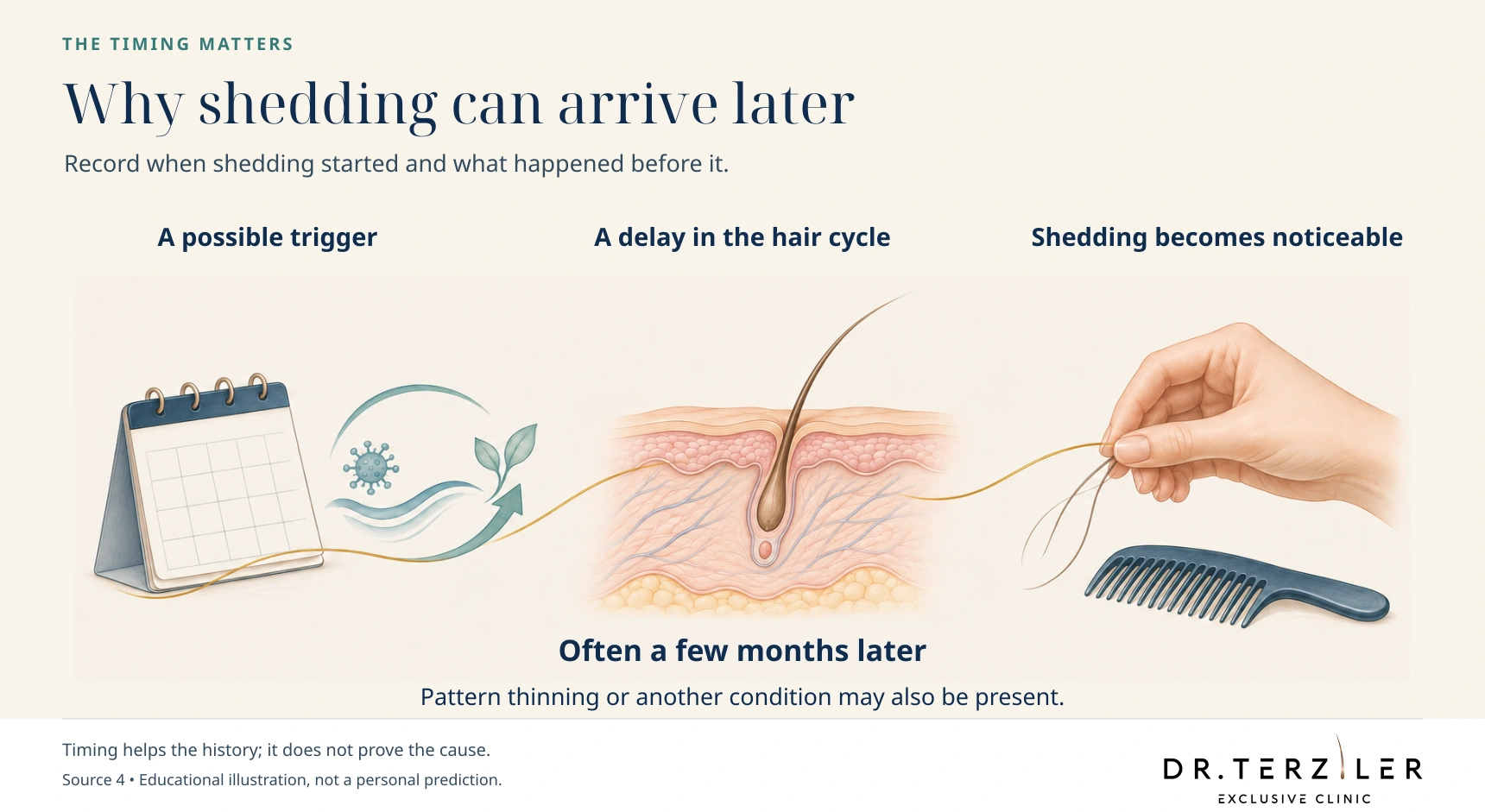
Write down two dates: when you noticed increased hair fall, and when a possible trigger occurred. A product started last week may seem responsible for shedding that was already developing after an earlier event. Timing helps the clinician assess possibilities; it cannot prove causation by itself.
Does stress cause a particular female hair-loss pattern?
Stress-related telogen effluvium usually causes diffuse shedding rather than one distinctive “stress patch.” A thinning crown, a receding temple or a round bald patch should not be labelled stress-related just because life has been difficult. Stress and another hair disorder can occur together. [4, 5]
Is postpartum hair loss temporary?
Postpartum shedding is usually temporary. The American Academy of Dermatology notes that it often peaks around four months after birth, with most women regaining their usual fullness by the child's first birthday. That is a general pattern, not a deadline every person must meet. [9]
Persistent thinning, patches, symptoms or incomplete recovery should prompt a review for additional causes. Pregnancy, plans for pregnancy and breastfeeding also change which treatments are appropriate; a routine recommended before pregnancy may need to change.
Can weight-loss medicines such as Wegovy or Zepbound be involved?
Hair loss is reported in the US prescribing information for Wegovy and Zepbound, where the reactions are described as associated with weight reduction. Reduced intake, nutritional problems and another hair disorder may also be relevant in someone losing weight. A report of hair loss does not identify the exact mechanism in an individual. [38, 39]
The Zepbound label reports hair loss in 7.1% of female participants receiving treatment versus 1.3% of female participants receiving placebo in pooled studies 1 and 2. Those are trial-specific adverse-event reports, not a prediction for every woman or a valid head-to-head comparison with another drug. [38]
Bring the medicine name, dose-change dates, weight trajectory and dietary changes to the prescriber. Do not stop a prescribed medicine solely because an online article suggests a connection.
How does hair loss differ in women in their 20s, 40s, 50s and over 60?
Hair loss can begin in early adulthood, although female pattern thinning becomes more common with age. Age changes the questions worth asking; it does not confirm the cause. There is no single age when hair loss becomes inevitable or no longer deserves treatment. [2, 7, 36]
In your 20s or 30s, the history may include inherited thinning, restrictive eating, illness, childbirth, traction or signs of androgen excess. New thinning at 23 should not be dismissed because you are “too young.”
In your 40s and 50s, perimenopause may coincide with previously subtle pattern thinning. A change in periods, heavy bleeding, a new medicine or substantial weight change can add another contributor. The timing of menopause does not remove the need for an examination.
For women over 60 or 70, pattern loss may coexist with medication effects, nutritional problems or scalp disease. A newly receding frontal band and eyebrow loss are especially worth checking for frontal fibrosing alopecia. A shampoo marketed for a particular age cannot establish which process is present. [10, 35]
What deserves particular attention in Black women or tightly styled hair?
Traction alopecia and central centrifugal cicatricial alopecia are important considerations in Black women, alongside pattern thinning and shedding. They are different conditions and can coexist. Hair loss should not be blamed on styling without examining the scalp. [11, 12]
Traction follows repeated tension from styles such as tight braids, extensions or pulled-back hair. Early changes may improve when tension stops, while established scarring can be permanent. A hairstyle that hurts, stings or produces bumps is a reason to change it and seek advice if loss is developing. [12]
CCCA often begins near the center or crown and can spread outward. Early assessment aims to protect follicles before scarring progresses. Although it is more common in Black women, it is not exclusive to one ethnicity. [11]
How is female hair loss diagnosed?
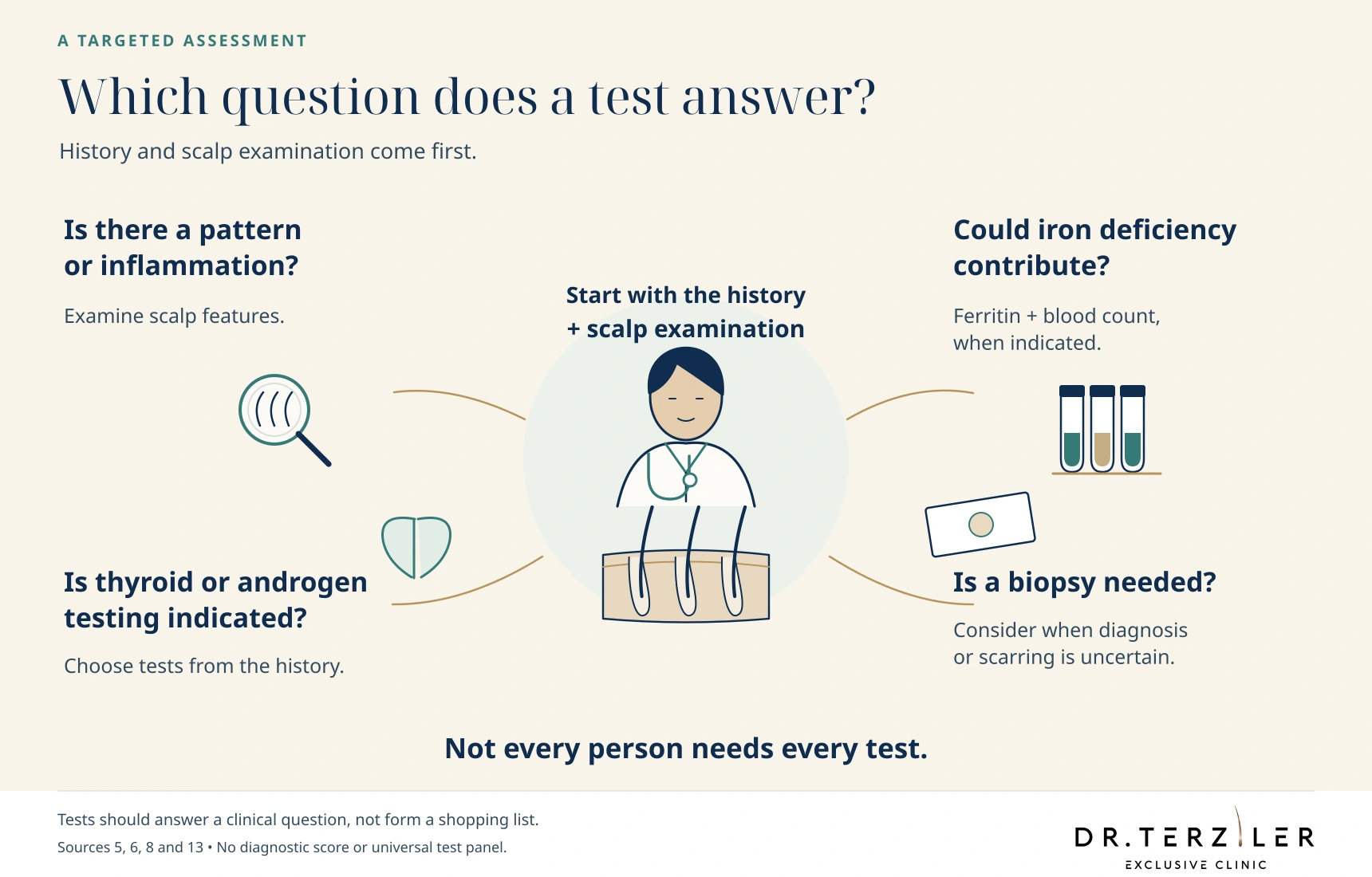
Diagnosis starts with your history and a scalp examination. A clinician may then use trichoscopy, a clinical hair-pull test, selected blood tests or a scalp biopsy when those investigations can answer a specific question. No single blood test, photograph or genetic result diagnoses every type of female hair loss. [5, 6]
Trichoscopy is a magnified view of the scalp and hairs. It can help assess hair-shaft variation, follicular openings, breakage and inflammatory features. A biopsy may be useful when scarring is suspected or the diagnosis remains uncertain; it is not automatically needed for every widening part. [5, 41]
Bring previous photographs, a medicine and supplement list, relevant laboratory results, and a short timeline. Include products applied to the scalp and any recently stopped medicines, not just current tablets.
Which blood tests might be useful for hair loss in women?
Tests are selected from the history and examination. A complete blood count, ferritin and thyroid tests may help when anemia, iron deficiency or thyroid disease is suspected. Other nutrient or hormone tests depend on the person's symptoms and risk factors rather than a universal “hair-loss panel.” [5, 8, 13]
Swipe horizontally to read all columns.
| Clinical question | Investigation a clinician may consider | Important limit |
|---|---|---|
| Could iron deficiency or anemia be contributing? | Ferritin and a complete blood count | Normal hemoglobin does not rule out low iron stores |
| Could thyroid disease be involved? | Thyroid function tests | Results need interpretation with the history |
| Is androgen excess plausible? | Selected androgen investigations when indicated | Hair thinning alone is a weak PCOS predictor |
| Is a particular deficiency likely? | Targeted nutrient testing | Testing every vitamin is not automatically useful |
| Could this be inflammatory or scarring alopecia? | Trichoscopy and sometimes a scalp biopsy | A normal blood panel does not exclude scalp disease |
Why can my blood tests be normal while my hair is still thinning?
Pattern hair loss and several scalp disorders are diagnosed mainly through clinical findings, not an abnormal routine blood panel. Normal laboratory results can narrow the possibilities without explaining everything seen on the scalp. They do not mean the change is imaginary. [5, 6, 7]
Ask which question each test answered and what remains uncertain. Repeating the same normal panel may be less informative than examining the changing area more closely.
Does low ferritin prove iron deficiency is causing my hair loss?
No. Low ferritin can identify depleted iron stores, but a woman may have iron deficiency and pattern hair loss at the same time. Ferritin also rises with inflammation, so results need context. A normal blood count does not exclude iron deficiency. [13]
A systematic review of 36 studies involving 10,029 participants found lower average ferritin in women with nonscarring alopecia than in comparison groups. This association does not establish a universal ferritin target for regrowth or show that iron supplements treat every kind of female hair loss. [14]
What does Dr. Terziler's own consultation report add?
In its 2026 Hair Loss Report, Dr. Terziler Exclusive Clinic reports that 41% of its 150 female first-consultation patients had ferritin below 30 ng/mL. The records cover January–October 2026; the percentage is rounded. [15]
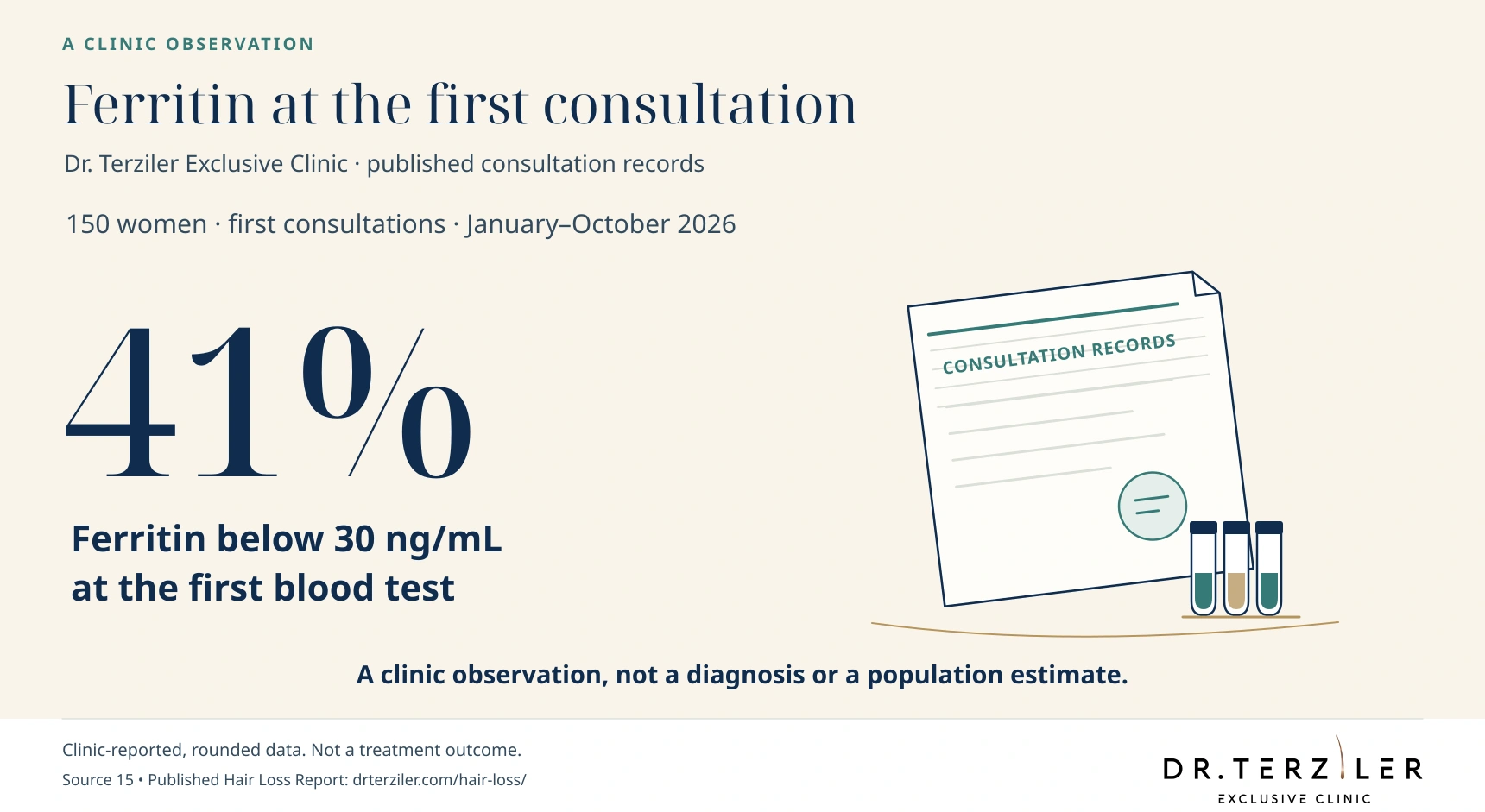
This is a selected clinic group, not an estimate for women in the US, UK, Canada or Turkey. It does not show that low ferritin caused each patient's hair loss or that raising it produced regrowth. Its practical value is narrower: iron status can deserve attention alongside the scalp findings, even when someone initially asks about a procedure. [13, 15]
If you already have results, ask the clinic what to bring to an assessment. A list of numbers is most useful when reviewed with your symptoms and timeline.
What is the best treatment for female hair loss?
For confirmed female pattern hair loss, topical minoxidil has the strongest established evidence among widely used first-line options. Other causes require different treatment: correct a relevant deficiency, address a shedding trigger, remove traction, or treat autoimmune or inflammatory disease. There is no single best product for every woman. [5, 16]
Some women need more than one approach. That does not mean adding every available procedure improves results. Each addition should have a clear purpose, a realistic evidence base and a way to assess whether its benefit justifies the cost and burden.
Swipe horizontally to read all columns.
| Option | Where it may fit | What the evidence or limitation means |
|---|---|---|
| Topical minoxidil | Confirmed female pattern hair loss | Supported by multiple randomized trials; formulation, tolerability and continued use matter |
| Low-dose oral minoxidil | Selected women after medical assessment | Off-label for hair loss; systemic risks and monitoring differ from topical use |
| Spironolactone | Selected women with pattern thinning | Off-label; emerging controlled evidence alongside observational research |
| Finasteride or dutasteride | Selected specialist-managed cases | Not routine FDA-approved female hair-loss treatments; pregnancy precautions are central |
| Treating a deficiency or medical cause | Relevant confirmed contributors | Treat the finding and investigate its cause; supplements do not replace the diagnosis |
| PRP or low-level light therapy | Possible adjuncts for pattern hair loss | Female-specific trials exist, but protocols, follow-up and comparative evidence vary |
| Treatment for alopecia areata or scarring disease | A diagnosis requiring its own management | A generic hair-growth serum cannot replace disease-directed care |
| Hair transplantation | Carefully selected, stable cases with a suitable donor area | Redistributes existing hair; does not treat all causes or create a new donor supply |
This is a practical comparison, not an official evidence-grading scale or a prescription. The clinic's non-surgical hair treatments cover different approaches; suitability depends on the diagnosis rather than the length of the menu.
What if the diagnosis is alopecia areata or scarring alopecia?
These conditions need disease-directed treatment rather than a standard pattern-loss routine. Depending on the diagnosis, a dermatologist may prescribe topical, injected or systemic medicines to control the disease. In scarring alopecia, preserving remaining follicles can be a more realistic immediate goal than regrowing hair in an already scarred area. [5, 11, 35]
Treating visible thinning while leaving active inflammation untreated can miss the more urgent problem. Ask which part of the plan treats the underlying disorder and which part is intended to improve growth or appearance.
Does minoxidil work for women, and which formulation matters?
Topical minoxidil can improve hair growth in female pattern hair loss, but it does not work for everyone and does not treat every cause of shedding. Consistent use and tolerability matter because the benefit generally requires continued treatment. [16, 17, 18]
A 2016 Cochrane review included 47 trials of treatments for female pattern hair loss and found evidence supporting minoxidil. Much of the evidence had methodological limitations; that review is an important foundation, not a complete account of every study published since then. [16]
Are 2% solution and 5% foam used in the same way?
No. Concentration alone does not identify the instructions. US women's labels include 2% solution applied twice daily and 5% foam applied once daily. The UK also has a licensed once-daily 5% women's foam, and Canada has an authorized women's 5% foam product. Check the exact product's local label rather than transferring directions between bottles or countries. [17, 18, 19, 20]
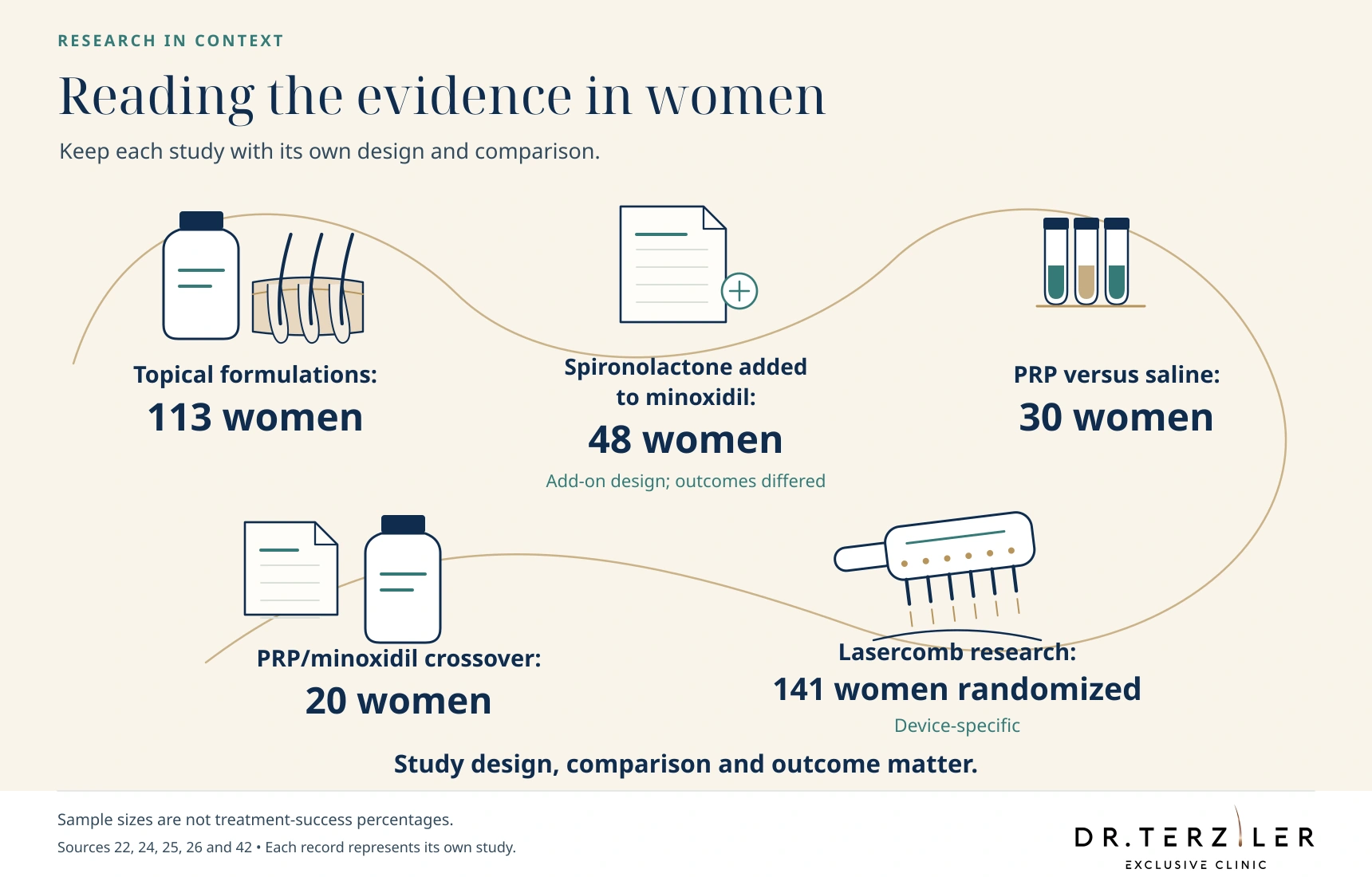
A randomized trial of 113 women compared once-daily 5% foam with twice-daily 2% solution over 24 weeks. It supports the distinction between complete formulations and routines; it does not mean any 5% product should be used interchangeably with any 2% product. [42]
How long does minoxidil take, and can it cause more shedding initially?
An initial increase in shedding can occur, and visible improvement takes months. The US 5% women's foam label describes results from three months in some users, with at least six months needed for others. Product review and stop instructions differ, so follow the actual label and prescriber's advice. [18, 19]
Do not treat every new symptom as “normal shedding.” Persistent irritation, redness or worsening loss deserves review. Chest pain, rapid heartbeat, dizziness, unexplained weight gain or swelling are reasons to stop and seek medical advice as directed by the label. [17, 18]
Irritation and unwanted facial hair are relevant practical downsides. Applying more than directed does not improve results. Minoxidil should be avoided during pregnancy and breastfeeding, and women planning pregnancy should discuss treatment changes with their clinician. [2, 17, 18, 19, 20]
Can women use oral minoxidil, spironolactone or finasteride?
These medicines may be considered for selected women, but they are not interchangeable with an over-the-counter scalp product. Oral minoxidil, spironolactone and finasteride use for female pattern hair loss is off-label in the US. The balance of benefit, side effects, other medicines and pregnancy considerations needs an individual discussion. [2, 21, 22, 23, 35]
Is oral minoxidil better than topical minoxidil?
It is not established as the better option for every woman. A randomized trial of 72 women found improvement with both low-dose oral minoxidil and topical 2% minoxidil, without a statistically significant between-group difference in the hair outcomes reported. A small trial cannot establish equal long-term safety or universal superiority. [21]
Oral treatment may suit someone who cannot tolerate or consistently apply a topical product. It also exposes the body systemically: unwanted hair growth, fluid retention, blood-pressure changes and heart-rate effects need consideration. It should be prescribed and monitored, rather than obtained by converting topical instructions into a tablet dose. [43, 44]
What does the recent spironolactone research actually show?
A 2025 pilot trial randomized 48 premenopausal women to spironolactone or placebo while both groups used topical minoxidil. Some photographic outcomes favored the addition of spironolactone, but the between-group terminal hair-count comparison did not meet the usual statistical threshold, with P = .063. Menstrual irregularities were an important adverse effect. [22]
That supports a considered discussion, not a claim that spironolactone alone has a proven success percentage for all women. Blood pressure, kidney function, potassium, other medicines and pregnancy plans affect suitability and monitoring. [23]
Are finasteride and dutasteride routine treatments for women?
No. Specialists sometimes consider them off-label in selected cases, but they are not FDA-approved female hair-loss treatments. They require particular caution around pregnancy and should not be adopted from a male hair-loss routine. The evidence varies with the population and regimen studied. [2, 35]
Can PRP or red light therapy help female hair loss?
PRP and low-level light therapy may help selected women with pattern hair loss, usually as options to discuss alongside established medical treatment. Neither should be presented as a guaranteed cure or as a treatment for every kind of alopecia. Studies of a particular protocol or device do not validate every clinic package. [24, 25, 26]
What do trials in women tell us about PRP?
A randomized trial of 30 women found improvements with PRP compared with saline over 24 weeks. The study used one preparation system and a defined protocol, with two participants lost to follow-up. It is evidence of possible benefit, not a clinic-wide success rate. [24]
A separate crossover pilot involving 20 women compared PRP with topical minoxidil. Some hair outcomes improved with both, while minoxidil performed better on the reported hair-growth measures; some satisfaction measures favored PRP. Those different outcomes should not be collapsed into a simple claim that one treatment “wins.” [25]
The distinction matters when discussing PRP hair treatment: ask which outcome will be reviewed, what other treatment continues, and what the proposed course costs in total. Injection discomfort, bruising and post-treatment symptoms also belong in that conversation.
Is a laser cap or clinic light treatment the same as laser hair removal?
No. Low-level light therapy is intended to support growth in existing follicles; laser hair removal is intended to reduce unwanted hair. They use different approaches and cannot be substituted for one another.
In a sham-controlled lasercomb research program, 141 women were randomized alongside separate male participants, with follow-up over 26 weeks. This supports device-specific investigation rather than claims that every red light, wavelength or treatment schedule produces the same effect. [26]
When comparing red light therapy for hair loss, consider the device, evidence in women, routine, total cost and ability to keep using it. US FDA clearance for a particular device is not approval of every light-based service or proof that it works for every diagnosis.
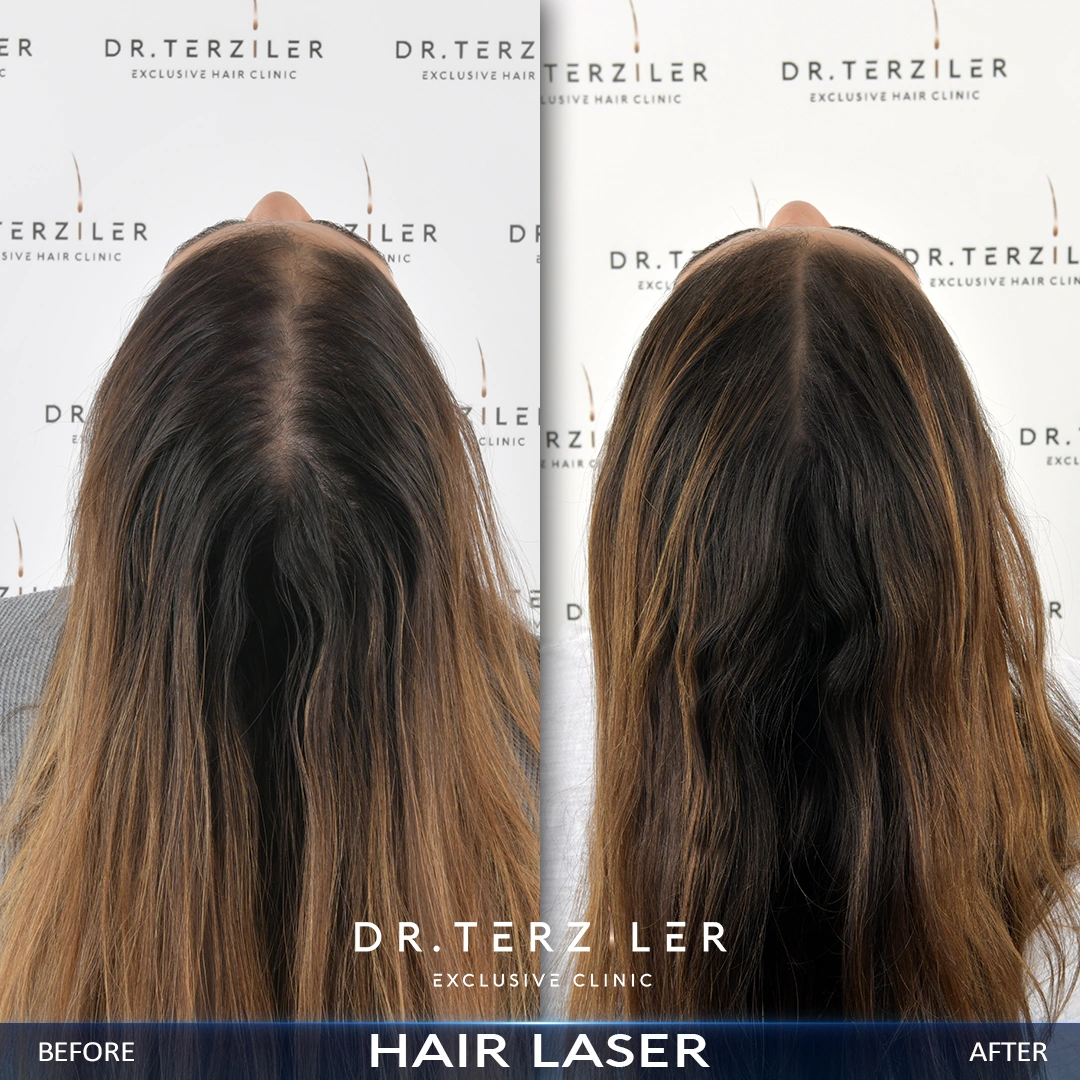
Where do microneedling, copper peptides and exosomes fit?
These options need separate evidence discussions rather than being grouped as equally established alternatives. The preparation, route and combination treatment used in a study matter. A result from one procedure cannot be assumed for every product applied to a needled scalp. [5, 28, 43]
Research into copper peptides for hair includes different peptide identities and formulations. Early findings should not be presented as equivalent to the established evidence for topical minoxidil. [28]
Similarly, the appeal of exosome hair treatment does not establish a predictable benefit for female hair loss. The FDA states that there are no FDA-approved exosome products. Any proposal needs a clear explanation of the preparation, route, evidence, regulatory status and uncertainties. [27]
How should the clinic’s exosome and stem-cell-labelled photographs be read?
The clinic supplied these records under the labels “Hair Exosome Treatment” and “Hair Stem Cell”. The wording identifies the supplied image records; it does not independently verify the preparation or establish how much one intervention contributed. Compare the documented conditions and ask what else was used.
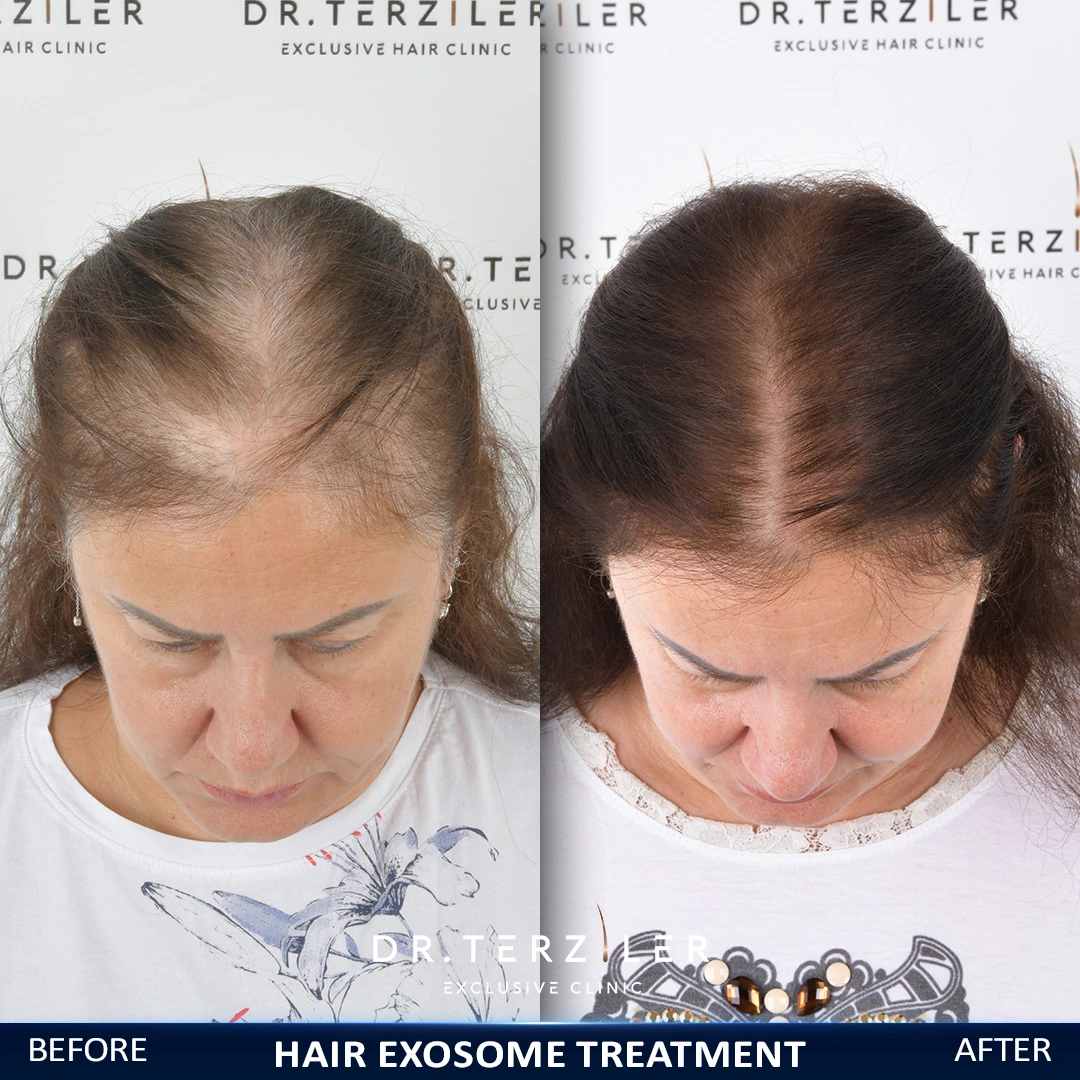
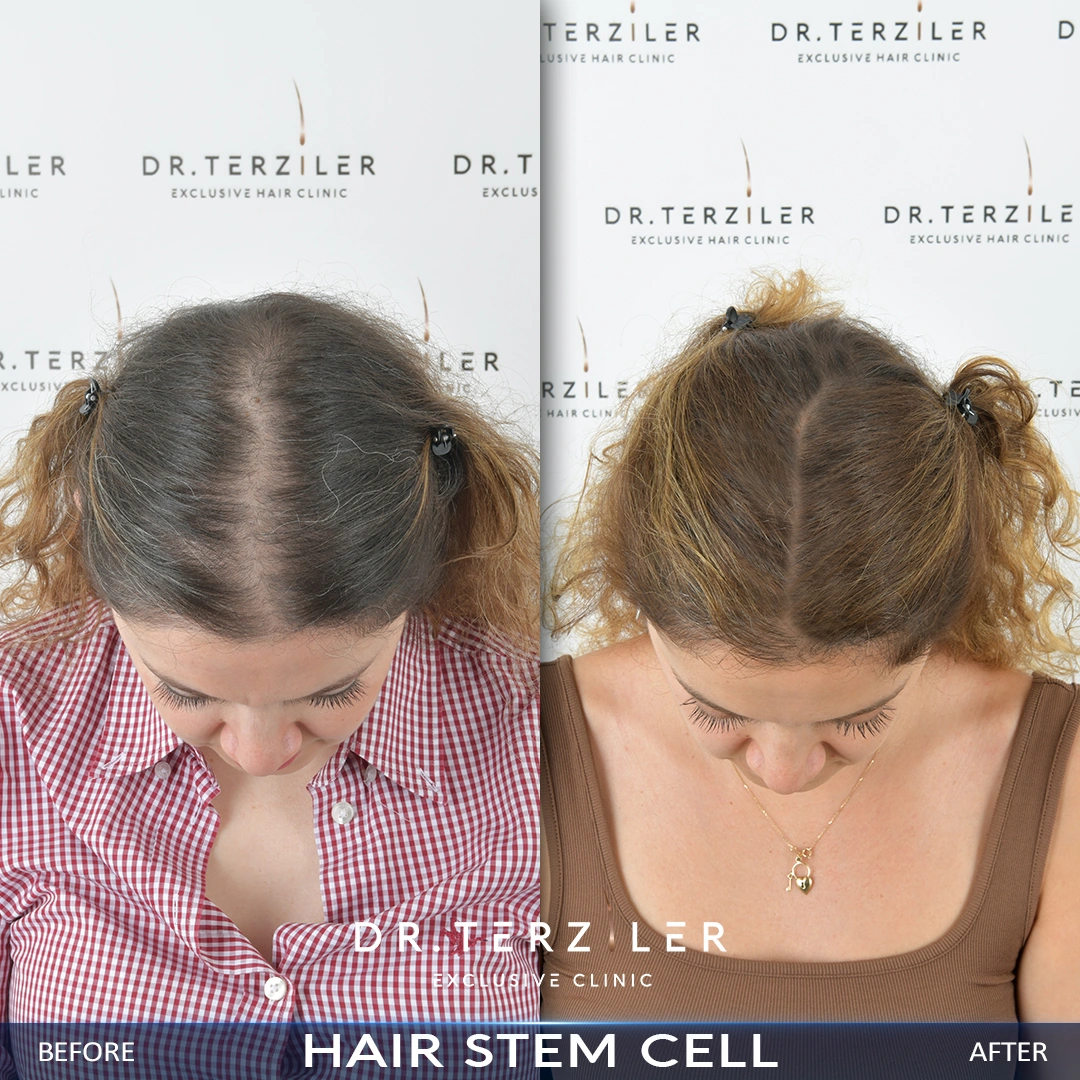
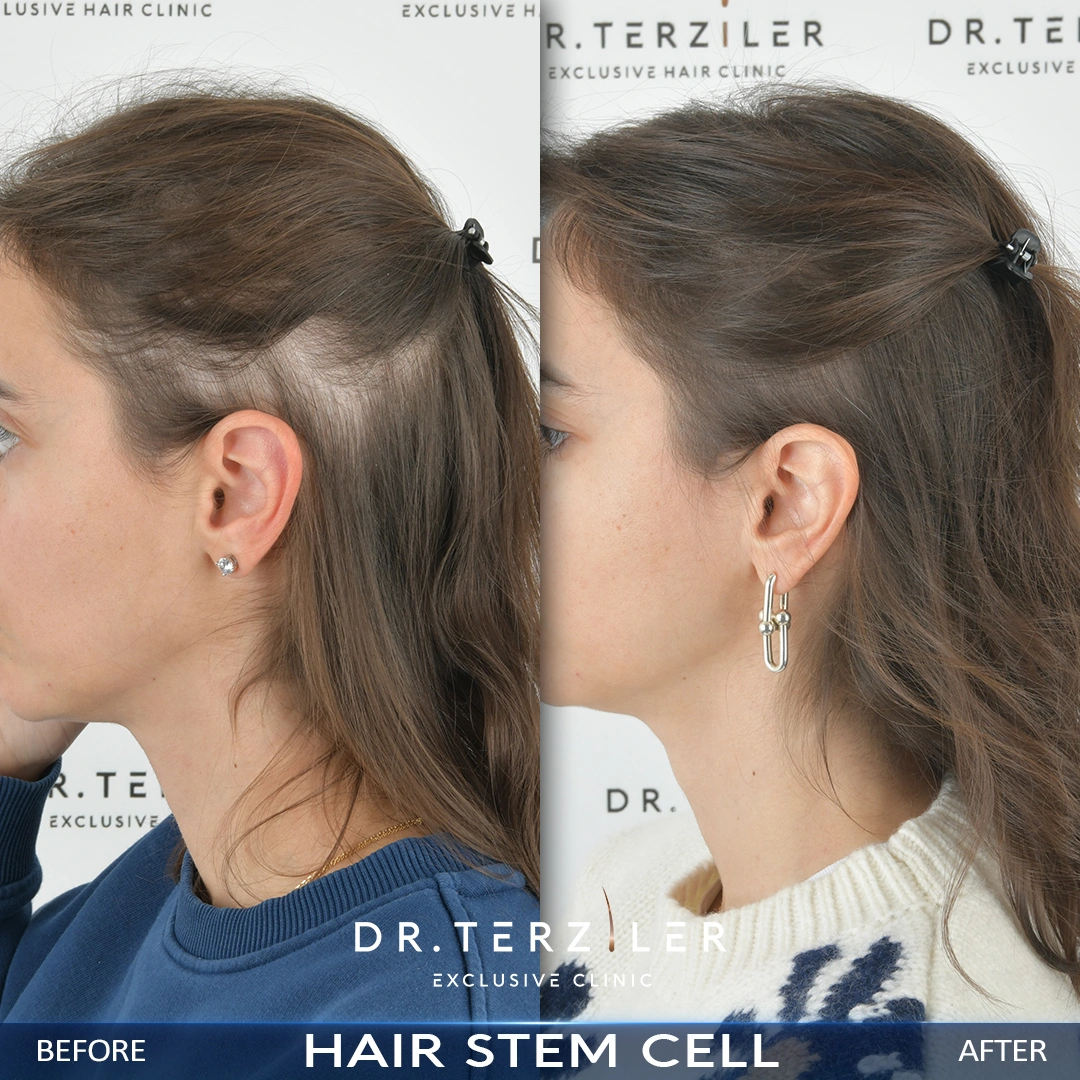
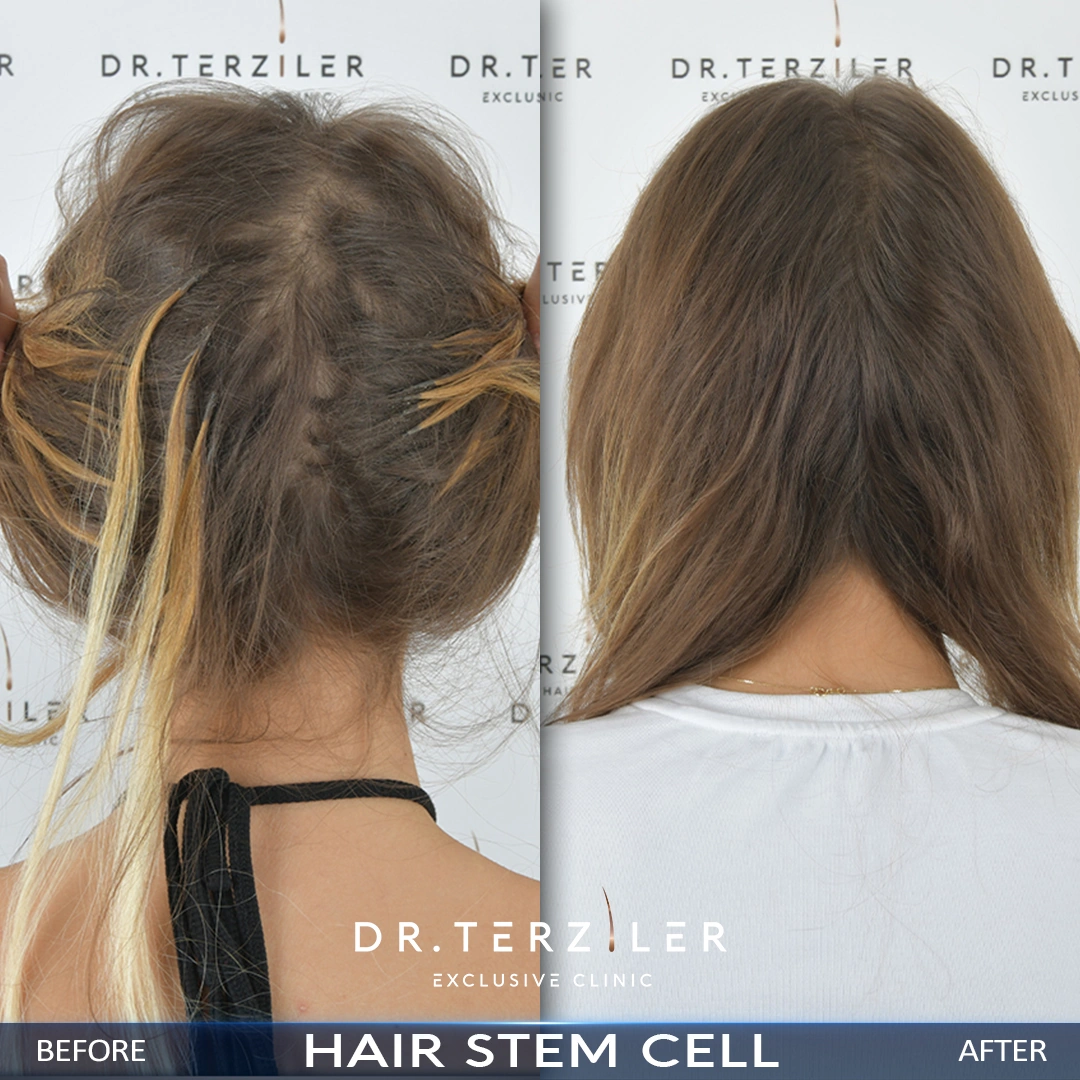
These individual photographs document appearance under the conditions shown. They cannot isolate a treatment effect or predict another person’s outcome.
Can female hair loss grow back, and how should progress be measured?
Regrowth depends on the cause and whether functioning follicles remain. Temporary shedding may recover after its trigger resolves. Pattern thinning often needs ongoing management, while established scarring can limit regrowth permanently. Treatment may aim to preserve existing hair, improve coverage, reduce shedding or control inflammation; these are different outcomes. [4, 11, 35]
Ask what improvement would mean for your diagnosis. “My hair feels softer” is not a measured density gain. “I shed less” is not the same as “the part is narrower.” Feeling better about your hair still matters, but it should be recorded separately from a clinical hair count.
What should a useful before-and-after record include?
A useful record shows the same scalp areas under comparable conditions and identifies the dates, diagnosis, treatments and major changes between photographs. Hair length, parting, lighting, fibers and wetness can change the appearance of coverage.
Record the baseline before treatment, agree on a review point, and decide which observation will guide the next decision. If several therapies begin together, a photograph cannot isolate the contribution of one of them. Stabilization may be a worthwhile outcome even when dramatic regrowth is absent.
At follow-up, discuss benefit, irritation or other adverse effects, cost, convenience and adherence. If the result is disappointing, revisit the diagnosis and routine before automatically buying an additional course.
Which vitamins help with hair loss in women?
Vitamins or minerals can help when a relevant deficiency is contributing to hair loss. They are not a universal treatment for pattern thinning, autoimmune loss or scarring alopecia. Iron, zinc and other investigations should be selected from the history rather than inferred from the number of hairs in a brush. [6, 13, 29, 30, 31]
What vitamin am I lacking if my hair is falling out?
Hair fall alone cannot identify a deficiency. Iron deficiency, inadequate protein or energy intake, and certain nutrient deficiencies can contribute, but many women with thinning hair have a different cause. Heavy periods, dietary restrictions, gastrointestinal problems or substantial weight loss may help determine what to investigate. [5, 13, 31]
Vitamin D and other nutrient associations reported in hair-loss research do not mean every low result is the sole cause or that routine high-dose supplementation regrows hair. Treat a confirmed problem appropriately and keep assessing the scalp findings.
Does biotin help if I am not deficient?
There is little evidence that biotin supplements improve hair in people without a relevant deficiency. Biotin deficiency is rare in the US, and “hair, skin and nails” marketing is not evidence that a supplement matches your diagnosis. [29]
High biotin intake can also distort some laboratory results, including thyroid-related tests. Tell the clinician and laboratory what you take and follow their instructions before testing. Do not assume a supplement is irrelevant to a medical assessment because it is sold without a prescription. [29]
Can too many hair vitamins make things worse?
Yes. Excess intake of some nutrients, including vitamin A and selenium, has been linked to hair loss. Iron can also be harmful when taken unnecessarily. Check the combined contents of multivitamins, hair gummies and separate supplements before adding another product. [30, 31]
What foods support hair growth without promising a cure?
Adequate energy and protein, together with a varied diet that supplies iron and other nutrients, support normal hair growth. Five useful food groups to build meals around are beans and lentils; eggs, fish, poultry or suitable alternatives; iron-fortified grains; vegetables and fruit; and nuts or seeds. [30, 31]
Pair plant iron sources with vitamin-C-containing foods to support absorption. Food cannot reliably correct every deficiency quickly, and no ingredient prevents every form of alopecia. Restrictive dieting to “eat clean” can be counterproductive if it leaves you short of energy or protein.
Which shampoos, oils or natural remedies actually help?
A suitable shampoo can cleanse the scalp, reduce product buildup or help manage a diagnosed scalp condition. Conditioner and gentle handling can reduce breakage and improve the appearance of fullness. These effects differ from reversing follicular miniaturization. A product labelled for “female hair loss over 50” does not establish an age-specific treatment benefit. [2, 30, 37]
Can not washing my hair cause hair loss?
Avoiding shampoo does not treat pattern hair loss. Hair that has already detached can remain caught among other strands until washing or detangling, making one wash look dramatic. The number you see depends partly on the interval since the last wash and your hair type. Use a cleansing routine that suits your scalp rather than repeatedly postponing washing out of fear. [3, 4, 37]
Persistent scale, irritation or an uncomfortable scalp needs assessment. Harsh rubbing and damaging products are separate problems from ordinary cleansing.
Is rosemary oil as effective as minoxidil for women?
That conclusion is not established. A frequently cited 2015 trial compared rosemary oil with 2% minoxidil in 100 people with androgenetic alopecia over six months. A study finding no significant difference on a measure is not automatically proof of equivalence, and it does not validate every oil formulation or establish superiority to today's women's minoxidil regimens. [32]
Essential oils can irritate a sensitive scalp. A preference for natural products is worth discussing, but it should not delay treatment of a scarring or autoimmune condition.
What are seven practical ways to reduce avoidable hair damage?
Gentle care can reduce breakage and traction, although it cannot prevent every cause of female hair loss. The most useful steps are ones you can sustain without turning daily hair care into repeated checking. [12, 30, 37]
- Loosen styles that pull at the edges or hurt the scalp.
- Detangle gently with a method suited to your hair type.
- Use conditioner to reduce friction and breakage.
- Limit repeated high heat, bleaching and harsh chemical processing.
- Eat enough overall, including adequate protein and iron-containing foods.
- Review supplements and new medicines with a clinician when shedding changes.
- Arrange an assessment for persistent thinning, patches or scalp symptoms instead of repeatedly switching products.
If dryness and snapping are the main changes, distinguishing dry or damaged hair from follicular thinning can prevent the wrong problem being treated.
How can hair loss affect mental health, and what support helps?
Hair loss can affect confidence, relationships, work and daily routines. The impact does not have to match the area of visible loss. A woman distressed by a small widening part deserves to be taken seriously just as someone with extensive alopecia does. [33, 34]
A systematic review of 41 studies involving 7,995 people with androgenetic alopecia found important quality-of-life effects, including emotional impairment. It included men and women, so it should not be presented as a female-only depression rate. Distress, depression and dissatisfaction with appearance are related but different outcomes. [33]
Wigs, toppers, cosmetic fibers and changing a hairstyle can be useful while treatment is assessed or as a longer-term choice. Psychological support can help when hair concerns interfere with sleep, social life or daily functioning. Choosing camouflage does not mean giving up on medical care. [34]
When is a hair transplant appropriate for a woman?
A hair transplant may help selected women with a stable pattern of loss and a sufficiently healthy donor area. It moves existing follicles; it does not treat an active shedding trigger, resolve ongoing inflammation or restore an unlimited supply of hair. Diffuse thinning in the proposed donor region can limit suitability. [2, 35]
The decision needs assessment of the diagnosis, progression, donor miniaturization, existing recipient hair and realistic coverage goals. Active scarring disease requires specialist management; an attractive transplant package does not resolve that uncertainty.
For women concerned about shaving their existing hair, planning can also establish whether an trasplante capilar sin afeitarse is suitable and which areas would still need trimming. This should be discussed alongside donor suitability and the coverage being proposed.
The clinic’s female hair transplant assessment addresses these planning questions. When hair remains in the recipient area, the risks and limitations of transplanting into thinning hair also need discussion. Surgery should follow the diagnosis rather than substitute for it.
What do these female hair transplant records show?
The supplied records show different individual hairline and coverage examples. Graft totals and follow-up intervals below are transcribed from the clinic labels; they are not a stage-based prescription or a measured graft-survival result.
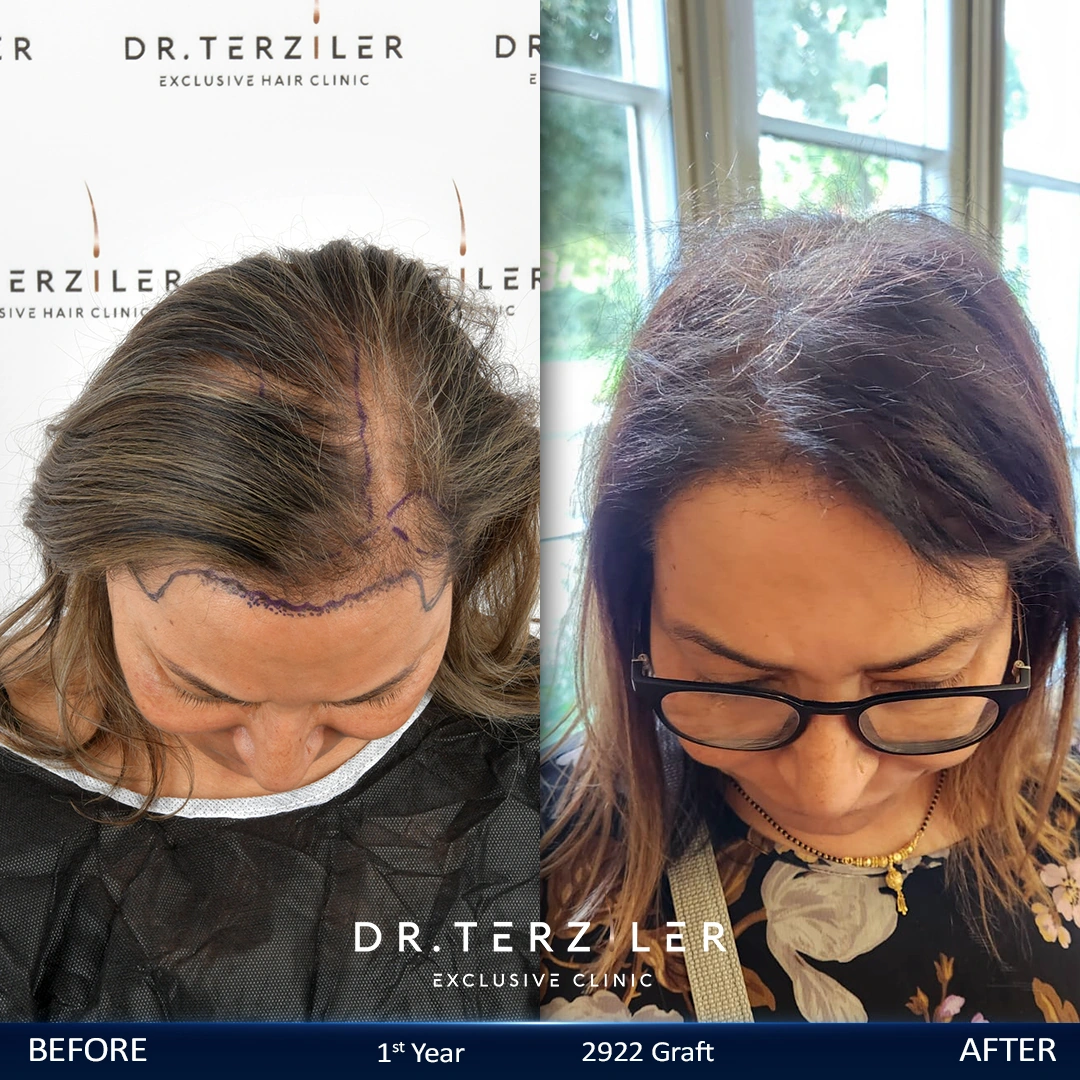
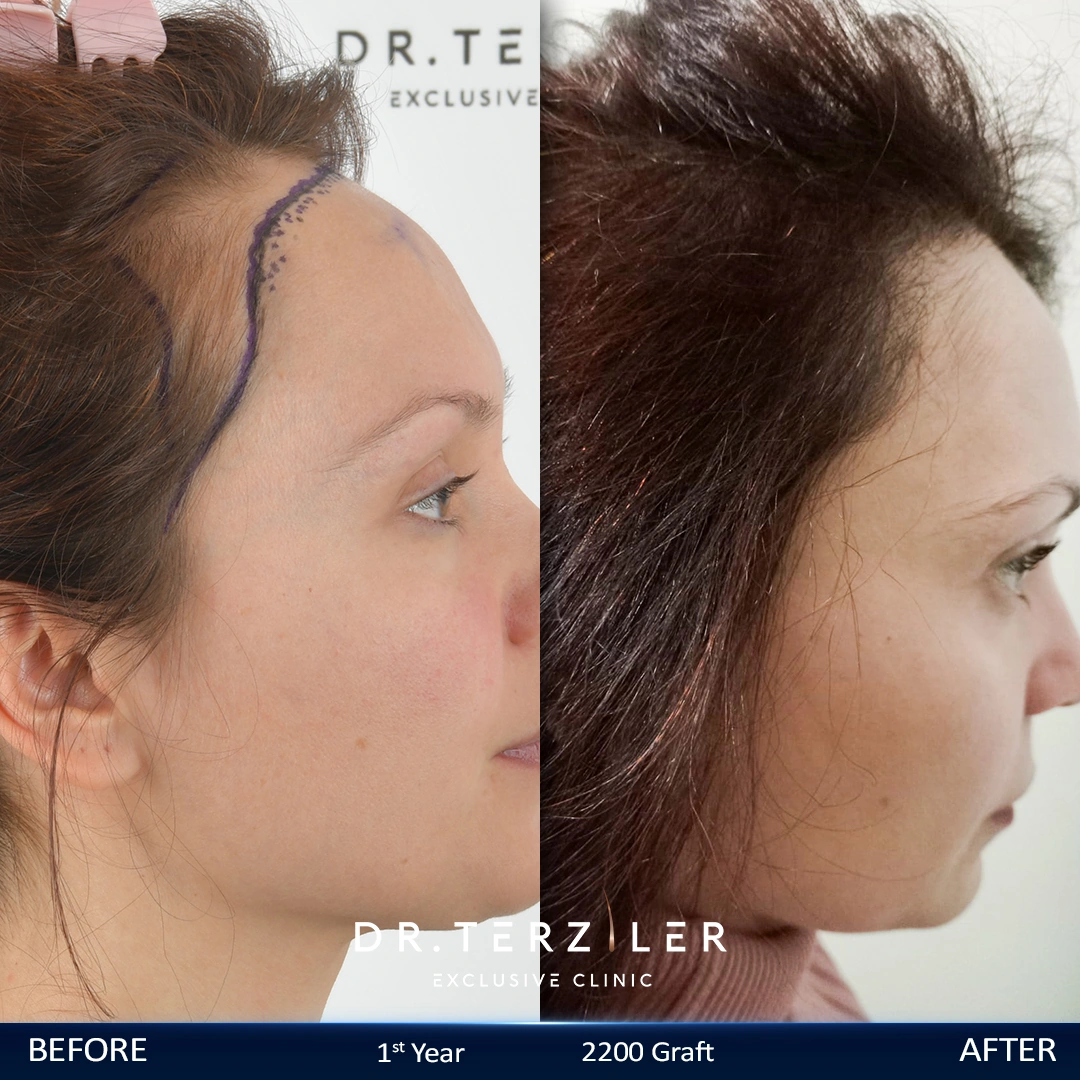
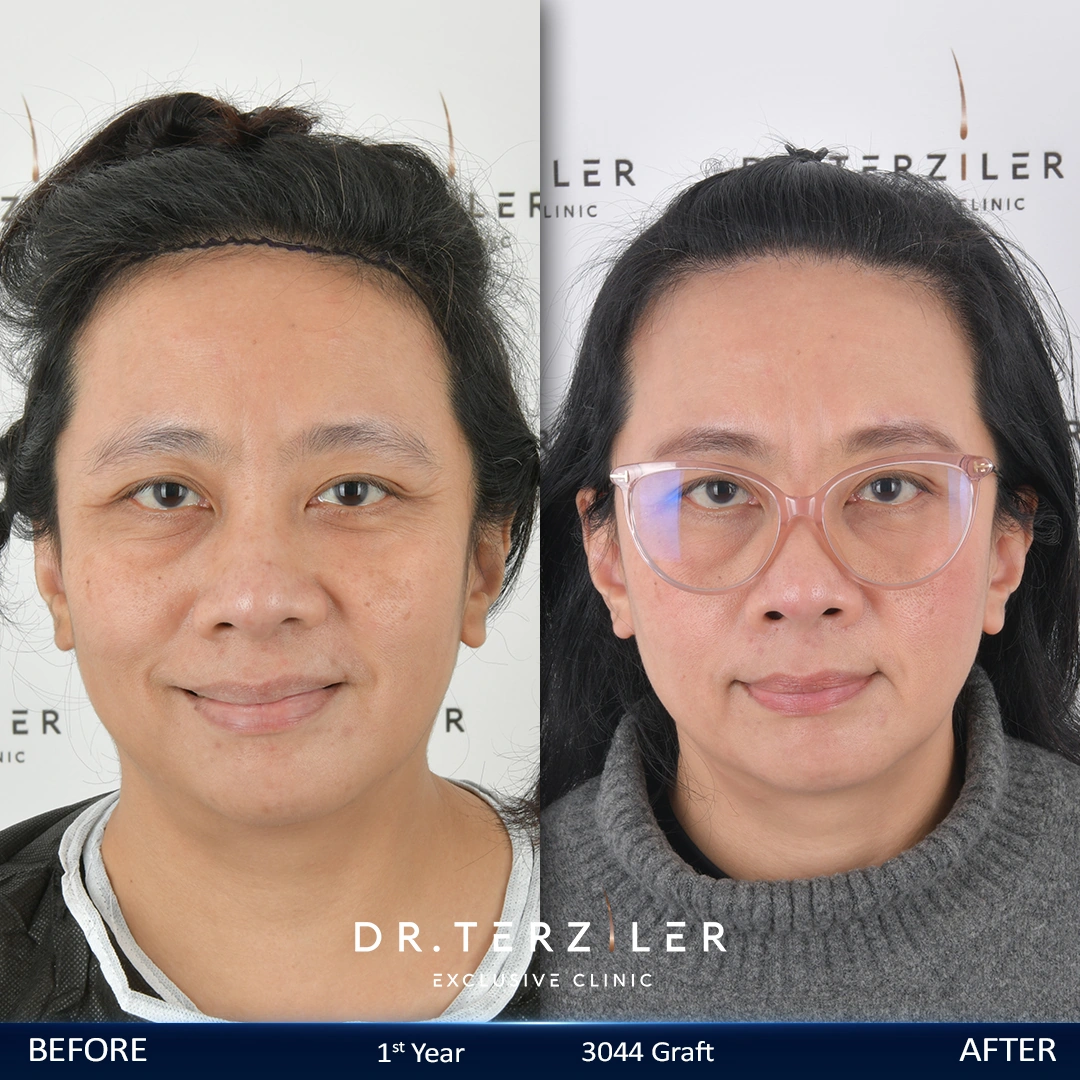
How did one 3,120-graft case look across three documented stages?
The supplied sequence is labelled before treatment, day one and month seven. These are different stages of one record; the day-one photograph is not a regrowth result.
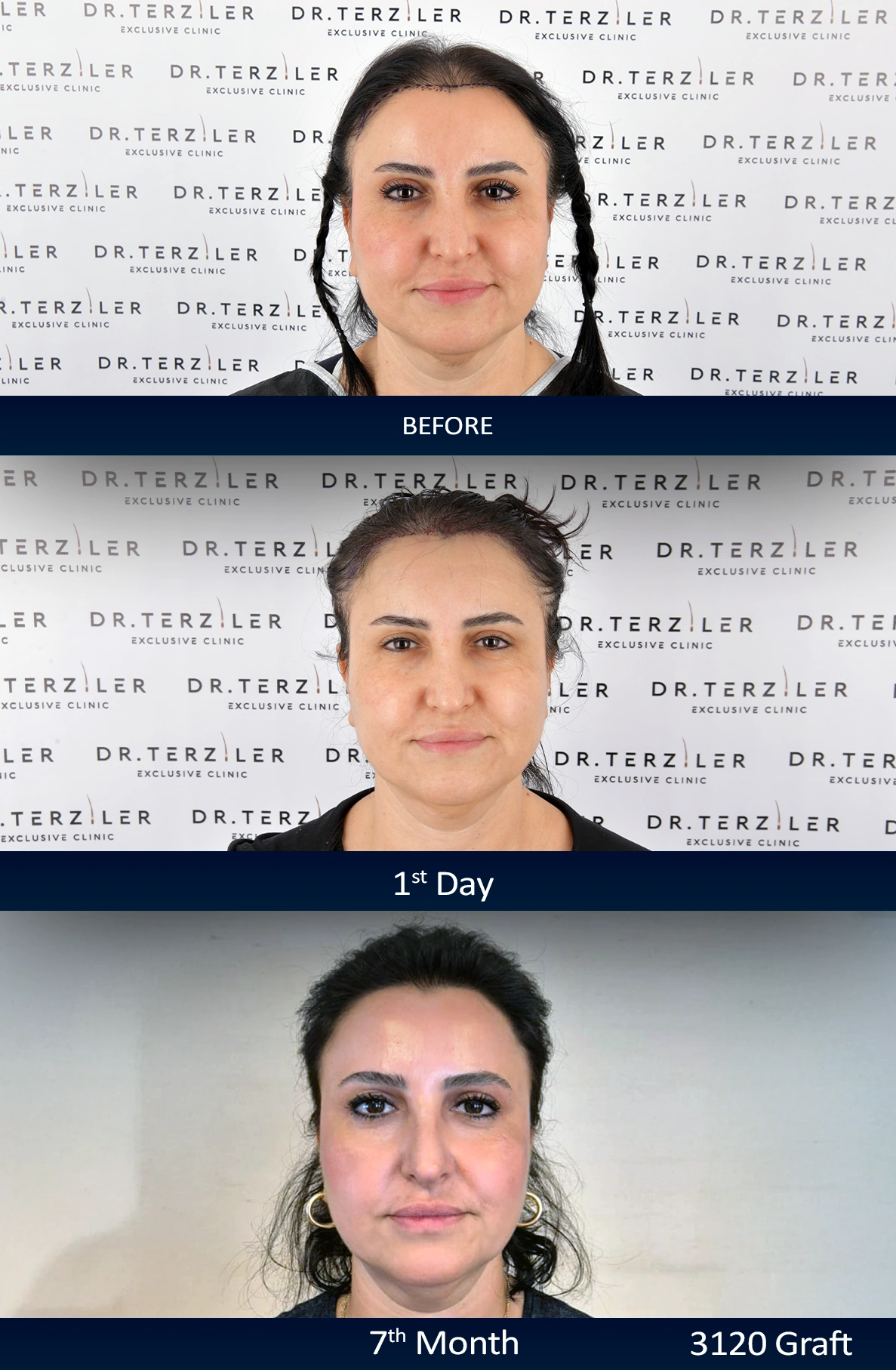
If a trasplante capilar en Turquía is being considered, confirm who assesses the donor area and how follow-up would be arranged after returning home.
What should I bring to a female hair-loss consultation?
Bring a short timeline, earlier photographs, a complete medicine and supplement list, relevant blood results and your main concern. Include changes in periods, childbirth, illness, weight, diet, styling and scalp symptoms. These details help distinguish overlapping causes and avoid repeating investigations without a clear purpose. [5, 6]
Ask what diagnosis is most likely, what remains uncertain, which tests would change the plan and how progress will be reviewed. If you live in the US, UK or Canada, local assessment may be the appropriate first step, particularly for symptoms, patches or suspected medical contributors. Travel should follow a clear plan for treatment and follow-up.
Would you like to prepare a consultation note?
Organize what you noticed before discussing a diagnosis or treatment. These optional observations stay on this page unless you choose to copy, download or include them in a WhatsApp draft.
- Record where the change is and when you first noticed it.
- Separate shedding, reduced coverage and breakage.
- Include scalp symptoms, relevant events and photograph conditions.
This prepares an educational discussion note. It does not diagnose hair loss, calculate future risk or rule out a scalp disorder. Do not change prescribed treatment on the basis of this tool.
What could be useful to discuss?
Opening WhatsApp creates a draft. You choose whether to send it.
To discuss an assessment in Istanbul, request an appointment o open a WhatsApp conversation about female hair loss. You can explain what changed before deciding whether any procedure is appropriate.
What else do women commonly ask about thinning hair?
Is hair loss in women a sign of cancer?
Hair loss by itself does not identify cancer. Pattern thinning, shedding and other non-cancer causes are common, while some cancer treatments can cause rapid hair loss. New systemic symptoms, persistent unexplained changes or a concern about a medicine warrant a medical review rather than self-diagnosis from a hair photograph. [1, 5]
What are the “big three” for female hair regrowth?
There is no universal medical “big three” for women. Online routines often borrow combinations discussed for men, including finasteride, but that does not make them appropriate for women or during pregnancy. The useful combination is the one that fits the diagnosis, evidence, safety considerations and ability to continue treatment. [2, 35]
Can I regrow a bald spot quickly at home?
Does creatine cause hair loss in women?
Good direct evidence in women is lacking. A 2025 randomized trial recruited 45 men and found no significant hair-related difference after 12 weeks of creatine versus placebo; 38 completed the study. That cannot be treated as a long-term female safety trial or proof that a woman's shedding has a particular cause. [40]
Is Gen Z losing hair faster than previous generations?
Individual cases and social-media visibility cannot establish a generational increase. The evidence discussed here does not support a definite claim that Gen Z women are losing hair faster. New thinning at any age still deserves the same careful assessment of pattern, timing, symptoms and contributing factors.
Can hair grow back if the follicles have scarred?
Established scarring can permanently destroy follicles, limiting regrowth in those areas. Early treatment aims to control the disease and preserve follicles that remain. This is why new central patches, a changing frontal band or eyebrow loss should not be managed only by waiting for a hair-growth supplement to work. [10, 11, 35]
Which sources support this guide?
- Cleveland Clinic. Hair Loss in Women: Causes, Treatment & Prevention. Patient overview.
- American Academy of Dermatology. Thinning hair and hair loss: Could it be female pattern hair loss? Clinical patient guidance.
- NHS. Hair loss. Patient guidance.
- American Academy of Dermatology. Do you have hair loss or hair shedding? Shedding and trigger timing.
- American Family Physician. Hair Loss: Diagnosis and Treatment. 2024;110:243–250. Clinical review.
- American Academy of Dermatology. Hair loss: Diagnosis and treatment. Assessment and overlapping causes.
- British Association of Dermatologists. Hair loss female pattern (androgenetic alopecia). Patient information leaflet.
- Teede HJ et al. Recommendations From the 2023 International Evidence-based Guideline for the Assessment and Management of Polycystic Ovary Syndrome. Guideline, including recommendation 1.3.2.
- American Academy of Dermatology. Hair loss in new moms: Dermatologist tips. Postpartum guidance.
- American Academy of Dermatology. Frontal fibrosing alopecia: Signs and symptoms. Clinical features.
- American Academy of Dermatology. Central centrifugal cicatricial alopecia overview. CCCA and scarring.
- American Academy of Dermatology. Hairstyles that pull can lead to hair loss. Traction alopecia.
- Province of British Columbia. Iron Deficiency – Diagnosis and Management. Clinical guideline.
- Treister-Goltzman Y et al. Iron Deficiency and Nonscarring Alopecia in Women: Systematic Review and Meta-Analysis. 36 studies; 10,029 participants.
- Dr. Terziler Exclusive Clinic. Hair Loss Report 2026. January–October 2026 first-consultation records; women's subgroup n = 150. Clinic-reported descriptive findings within the hair loss guide. Not independently audited or population prevalence.
- van Zuuren EJ et al. Interventions for female pattern hair loss. Cochrane Database of Systematic Reviews. 2016. Systematic review.
- DailyMed. Minoxidil Topical Solution for Women, 2%. US product label.
- DailyMed. Minoxidil 5% for Women, aerosol foam. US product label.
- Regaine for Women Once a Day Scalp Foam 5% w/w. UK Summary of Product Characteristics.
- Women's Rogaine Foam 5%. Canadian product monograph hosted by Health Canada. Product-specific instructions and contraindications apply.
- Vahabi-Amlashi S et al. A randomized clinical trial on therapeutic effects of 0.25 mg oral minoxidil tablets on treatment of female pattern hair loss. Randomized trial; 72 women.
- Efficacy and safety of oral spironolactone for female pattern hair loss in premenopausal women: a randomized, double-blind, placebo-controlled, parallel-group pilot study. 2025. 48 women; add-on trial.
- Gloucestershire Hospitals NHS Foundation Trust. Spironolactone for female pattern hair loss. Off-label use, precautions and monitoring.
- Dubin DP et al. The effect of platelet-rich plasma on female androgenetic alopecia: A randomized controlled trial. 30 women; placebo-controlled study.
- Bruce AJ et al. A Randomized, Controlled Pilot Trial Comparing Platelet-Rich Plasma to Topical Minoxidil Foam for Treatment of Androgenic Alopecia in Women. 20 women; crossover pilot.
- Jimenez JJ et al. Efficacy and safety of a low-level laser device in the treatment of male and female pattern hair loss. Multicenter randomized sham-controlled study.
- US Food and Drug Administration. Consumer Alert on Regenerative Medicine Products Including Stem Cells and Exosomes. Regulatory information.
- Fan C et al. Overview of Short Peptides for Hair Loss. Biomedicines. 2026;14:864. Review of peptide preparations and evidence limitations.
- NIH Office of Dietary Supplements. Biotin. Evidence and laboratory interference.
- American Academy of Dermatology. Hair loss: Tips for managing. Hair care, nutrition and supplement cautions.
- NIH Office of Dietary Supplements. Iron. Food sources, absorption and safety.
- Panahi Y et al. Rosemary oil vs minoxidil 2% for the treatment of androgenetic alopecia: a randomized comparative trial. 2015. Comparative study.
- Health-Related Quality of Life, Depression, and Self-esteem in Patients With Androgenetic Alopecia: A Systematic Review and Meta-analysis. 2021. 41 studies; mixed-sex population.
- NHS. Women and hair loss: Coping tips. Psychological support and camouflage.
- Canadian Dermatology Association. Alopecia. Hair-loss types and management.
- Olsen EA. Hair Loss in Women. N Engl J Med. 2025;393:1509–1520. Clinical practice review and abstract.
- American Academy of Dermatology. Tips for healthy hair. Cleansing and care by hair type.
- Zepbound prescribing information. US label; pooled trial hair-loss reports and female subgroup.
- Wegovy prescribing information. US label; hair-loss adverse reactions.
- Does creatine cause hair loss? A 12-week randomized controlled trial. 2025. Male study; limits of extrapolation to women.
- Female Pattern Hair Loss: An Overview with Focus on the Genetics. 2023. Genetic and clinical overview.
- Blume-Peytavi U et al. A randomized, single-blind trial of 5% minoxidil foam once daily versus 2% minoxidil solution twice daily in women. Randomized trial; 113 women.
- Landells I et al. A Canadian Consensus on Androgenetic Alopecia: Approach and Management. 2025. Expert consensus; distinguish recommendations from regulatory approval.
- Gloucestershire Hospitals NHS Foundation Trust. Minoxidil for hair loss. Oral treatment, precautions and monitoring.
- American Academy of Dermatology. Finding the right treatments for genetic hair loss. Typical differences between male and female pattern hair loss.
- DailyMed. Propecia (finasteride) tablets. US prescribing information and indication.
- Classifications of Patterned Hair Loss: A Review. Classification systems and their scope.