
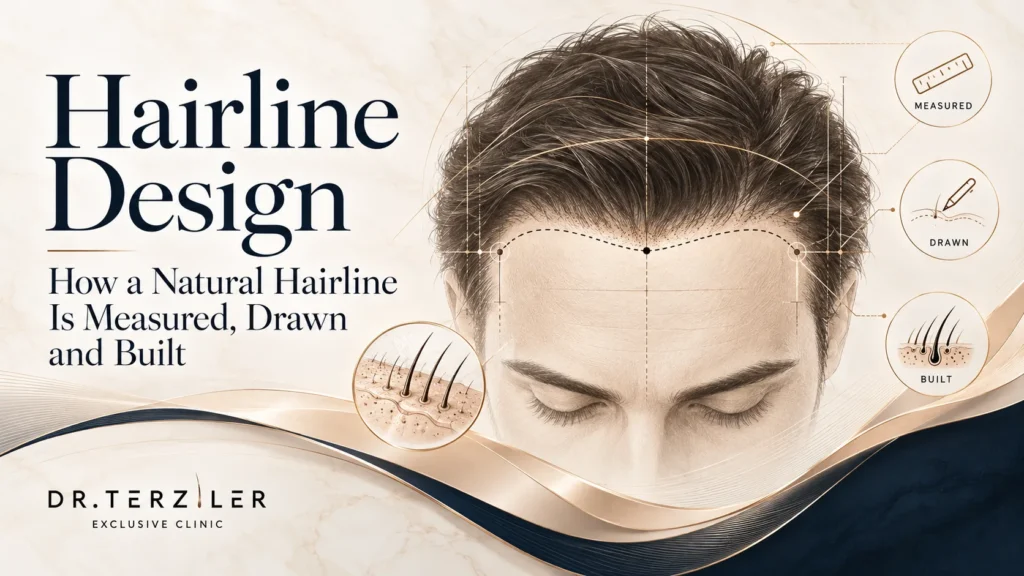
Nobody ever compliments a good hairline. People only notice the bad ones. That is the strange job of hairline design: when we do it right, the result is invisible.
A hair transplant can move thousands of healthy grafts and still fail. The usual reason is not the grafts. It is the drawing. A line placed 1 cm too low, temples filled flat, or thick grafts at the front edge can make a 30-year-old look like he bought his hair online. This guide explains how surgeons decide where your hairline goes, what shape it takes, and how to tell a good design from a bad one before anyone touches your scalp.
Hairline design in 60 seconds
Hairline design is the planning step of a hair transplant. The surgeon draws your new front hair border on the scalp before surgery.
Most adult male transplant hairlines start 7 to 9 cm above the glabella (the point between the eyebrows).
The front 3 to 5 mm uses single-hair grafts only. Thicker grafts sit behind them.
Front hairs exit at roughly 35° to 45°. Natural hairlines are irregular and slightly asymmetric on purpose.
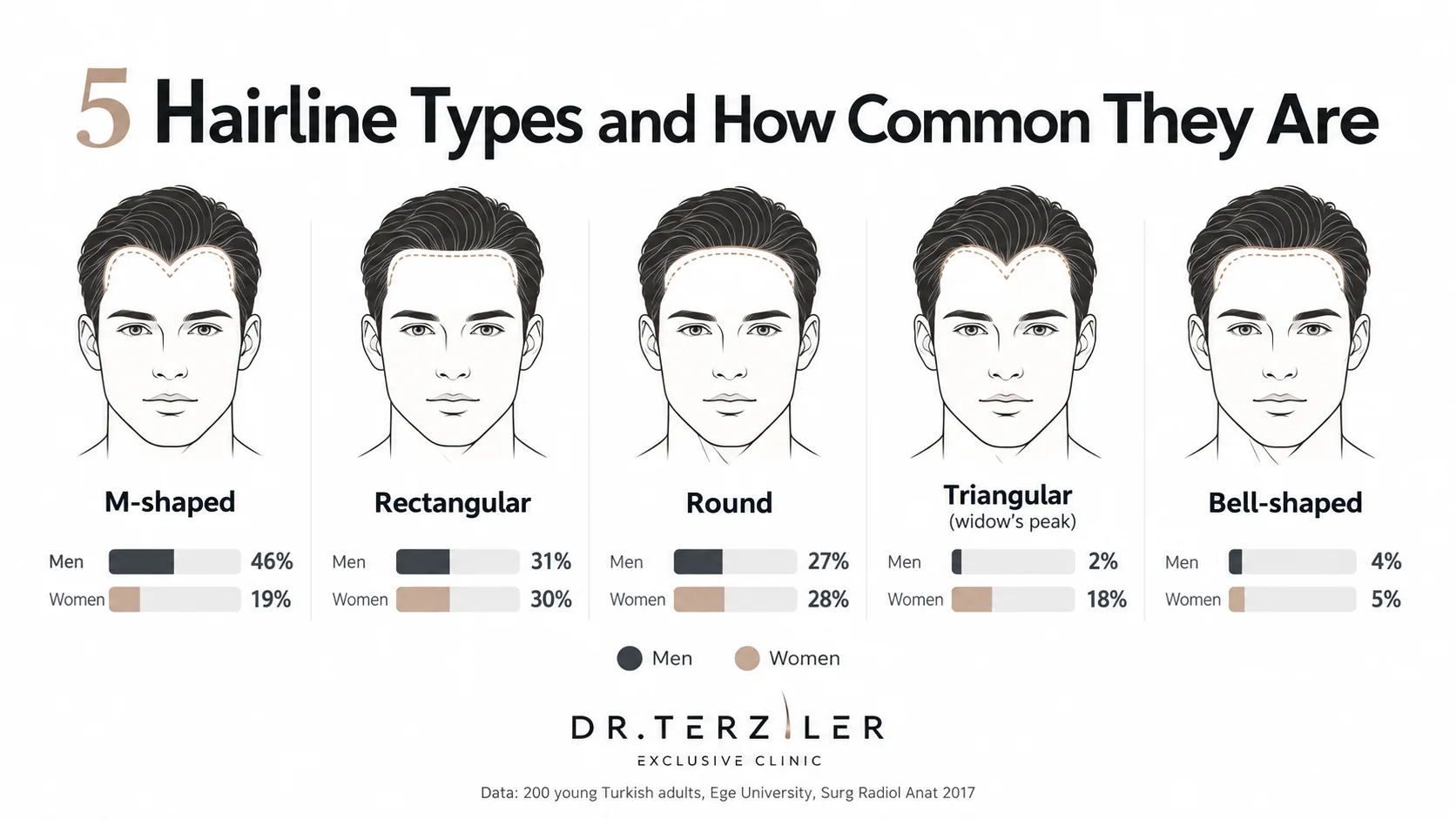
The M-shaped hairline is the most common male type. In a study of 200 young Turkish adults, 46% of men had it.
A good design still looks right at age 60. If a hairline only works at 25, it is a bad design.
What is hairline design? Hairline design is the surgical planning of the front hair border before a hair transplant. The surgeon marks the hairline height, shape, temple points, graft zones and hair direction on the scalp. A natural design uses an irregular edge, single-hair grafts in the front 3 to 5 mm, forward angles of about 35° to 45°, and a height that suits the patient's age, face and future hair loss.

Révisé sur le plan médical par
Founder of Dr. Terziler Exclusive Clinic · Inventor of Robotic DHI · ISHRS workshop alumnus (34.55 AMA PRA Category 1 credits)
Updated:
What Is Hairline Design in a Hair Transplant?
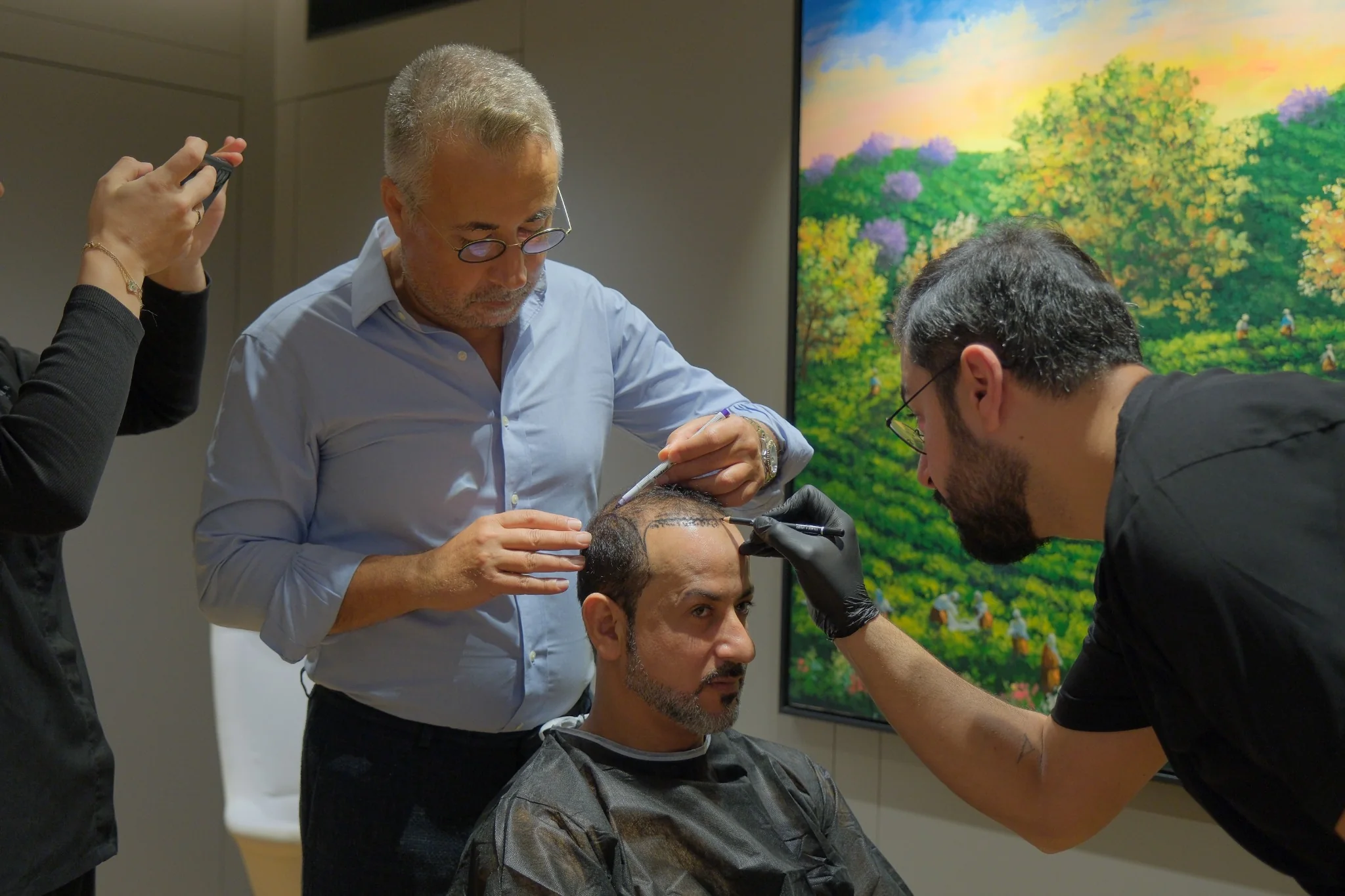
Hairline design is the blueprint of a greffe de cheveux en Turquie or anywhere else. Before any anaesthetic, the surgeon draws the future front border of your hair with a surgical marker. That line decides height, shape, temple depth, graft distribution and the direction every hair will grow.
In this short video, a guest shares his hair transplant experience at Dr. Terziler Exclusive Clinic. The team also adds a playful hairline-design moment featuring Shrek. The clip introduces the patient experience and the clinic’s approach to drawing a hairline; it is not a step-by-step clinical demonstration.
Watch on YouTubeThe front hairline holds only a small share of the grafts. It carries most of the first impression. People read your face from the hairline down. A clean, dense crown cannot rescue a front line that looks stamped on.
Peer-reviewed reviews agree on this point. A 2025 review in Dermatologic Surgery screened 1,030 study abstracts from 2019 to 2024 and listed "thoughtful hairline design" as one of the two main drivers of better aesthetic results, next to medical therapy [1]. A 2020 review on robotic transplantation made the same point from the other side: the robot extracts grafts with precision, but it "does not replace appropriate candidate selection, hairline design, and the judgment of where to place and not place transplanted hair" [2].
Hairline design, hairline haircut, hairline app: three different things
Search "hairline design" in the US and you get three worlds mixed together. A hairline design haircut is a barber service: a line-up, edge-up or shape-up that sharpens the existing hair edge with clippers or a razor. It lasts about two weeks. A hairline design app is a phone filter or AR simulator that previews a new hairline on your selfie. It helps you imagine a result but it cannot see your donor area, hair caliber or future loss. Surgical hairline design is the medical plan behind a transplant. It is permanent. This article covers the third one, with notes on the other two where they help.
A hairline app shows you a wish. A surgical hairline design shows you a plan that your donor area can afford for life.
The Anatomy of a Natural Hairline: 7 Landmarks Surgeons Measure
A natural hairline is not one line. It is a zone with a soft front edge, a denser core behind it, and side corners that bend toward the temples. Hair surgeons describe it with fixed landmarks so two doctors can discuss the same design in the same language.
1. Mid-Frontal Point (MFP). The lowest central point of the hairline. In adult male transplants it usually sits 7 to 9 cm above the glabella.
2. Frontotemporal Points (FTPs). The left and right corners where the front line turns back toward the temples. Shapiro and Shapiro describe locating them along the lateral epicanthal line, a vertical line from the outer corner of each eye [3].
3. Temporal Points. The small triangles of hair above the sideburns that frame the face. Losing them ages a face fast.
4. Transition Zone. The front 3 to 5 mm, built only from single-hair grafts.
5. Defined Zone. A band about 5 mm behind the front edge, reserved for 2-hair grafts in the 2025 ISHRS Forum template system [4].
6. Frontal Tuft. An oval area behind the MFP that takes 3-hair grafts and gives the front its density.
7. Widow's peak or macro-irregularity. The gentle central point or wave that breaks a straight line.
The September 2025 issue of Hair Transplant Forum International, the journal of the International Society of Hair Restoration Surgery (ISHRS), published a printable template method by Speranzini, Souza, Nakano and True [4]. The team prints hairline designs on thermal tattoo paper, transfers them to the scalp, and splits the recipient area into 2 × 2 cm squares to plan graft density square by square. Their method positions the MFP with a 45° line from the intersection of a horizontal line at the top of the head and a vertical line at the forehead. This matters for patients: it shows that elite surgeons now treat hairline design as a measurable system, not a freehand guess.
| Hairline design by numbers | Typical value | Source |
|---|---|---|
| MFP height (adult male transplant) | 7 to 9 cm above glabella | Clinic protocol; Shapiro 2013 [3] |
| Average forehead height, young Turkish men | 61.4 mm (6.1 cm) | Ege University, n=200 [5] |
| Average forehead height, young Turkish women | 58.3 mm (5.8 cm) | Ege University, n=200 [5] |
| Transition zone depth | 3 to 5 mm, single-hair grafts only | ISHRS Forum 2025 [4] |
| Defined zone | ~5 mm behind front edge, 2-hair grafts | ISHRS Forum 2025 [4] |
| Front hair exit angle | 35° to 45° | Picasso Robotic DHI protocol |
| Natural left/right direction difference | 22.2° average | Kim et al. 2025, n=125 [6] |
| Single grafts in the first 1 cm strip | 250 to 400 | Picasso Robotic DHI protocol |
| Density at the hairline (selected cases) | up to 60 grafts/cm² | Clinic-reported |
| Planning grid | 2 × 2 cm squares | ISHRS Forum 2025 [4] |
Want to know how many grafts your own hairline needs? Our hair graft calculator gives a first estimate from your Norwood stage before a doctor checks your donor area.
Hairline Types: Which Hairline Shape Do You Have?
People want to know what hairline types they have before they decide what hairline shape they want. The best data on this comes from Turkey. Anatomists at Ege University in Izmir photographed 200 young Turkish adults and sorted their hairlines into five shapes [5].
| Hairline type | Men | Women | What it signals |
|---|---|---|---|
| M-shaped | 46% | 19% | Most common male shape; reads masculine |
| Rectangular (straight) | 31% | 30% | Most common female shape; strong, square look |
| Round (oval) | 27% | 28% | Soft frame; reads feminine |
| Triangular (V / widow's peak) | 2% | 18% | Rare in men; clear central peak |
| Bell-shaped | 4% | 5% | Rare in both sexes |
Note: the published male percentages add up to more than 100%, so some men likely fit two categories. Read the numbers as a ranking, not an exact census. The ranking is still clear: M-shaped first in men, rectangular first in women, triangular and bell-shaped rare.
M-shaped hairline est two soft temple recessions with a central front. A straight or rectangular hairline is a flat front with square corners, common in teenagers. A round or oval hairline is a continuous curve with no sharp corners. V hairline or widow's peak is a downward point at the centre. A bell-shaped hairline is a rounded centre that flares at the sides. Uneven or zigzag ( Z hairline) is a jagged edge, often from cowlicks or old grafts. Receding hairline is a pattern where the temples move back over time, the early sign of male pattern hair loss.
Is an M-shaped hairline normal?
Yes. An M-shaped hairline is the most common male hairline. In the Ege University study, 46% of young men had one [5]. A mild M-shape is a normal adult feature. It becomes a hair loss sign only when the recessions deepen year after year or the hair inside them gets thinner and finer. In surgery, we rarely erase an M-shape completely. We soften it. A gentle M ages well. A flat box does not.
Juvenile, Mature or Receding? What a Normal Hairline Looks Like at 20, 30 and 50
A teenage hairline is low, flat and often touches the upper forehead crease. Hair surgeons call it the juvenile hairline. Between the late teens and the late twenties, most men lose a little height at the temples. Hair surgeons commonly describe this "mature hairline" as sitting about 1 to 1.5 cm above the juvenile line, with mild, even temple recession. It is a normal adult change, not baldness.
A receding hairline is different. The temples keep moving back, the hairs inside the recession get finer (miniaturisation), and the line rarely stops on its own. A US community study of 18 to 49-year-old men found that 16% of men aged 18 to 29 already had moderate to extensive hair loss (Norwood III or higher). The figure rose to 53% in men aged 40 to 49 [7]. The same study found that 12% of men had a predominantly frontal pattern, which hits the hairline first [7].
So, what does a normal 20-year-old hairline look like? Usually low and fairly straight, with forehead height near 6 cm. In the Turkish sample, young men averaged 61.4 mm [5]. Compare that with the 7 to 9 cm height surgeons usually choose for an adult transplant. That gap is intentional. It is the mature-hairline margin that keeps a transplant believable for decades.
A mature hairline moves once and stops. A receding hairline keeps moving. The difference shows under a trichoscope long before it shows in the mirror.
Not sure which one you have? A Tricho Test measures hair diameter and density at the temples and compares it with your donor area. If the temple hairs are thinner than the back hairs, miniaturisation has started.
The 7 Rules of Natural Hairline Design
Every good surgeon has a personal style, but the rules underneath are shared. These seven rules come from the peer-reviewed literature and from what we see every week in repair consultations.
Rule 1: Choose an age-appropriate height
The classic face is split into three equal thirds: hairline to brows, brows to nose tip, nose tip to chin. A transplant hairline usually closes the upper third at 7 to 9 cm above the glabella in adult men. A 45-year-old with a teenager's hairline looks wrong, even when every graft survives. Beehner's classic paper lists hairline height as the first of five essential components of design [8].
Rule 2: Nature refuses straight lines
A real hairline has two kinds of irregularity. Macro-irregularity is the larger shape: soft waves, a gentle peak, small bays. Micro-irregularity is the edge itself: single hairs scattered a few millimetres ahead of the main line. The 2025 ISHRS template method builds this in with irregular incisions in the transition zone [4]. Straight edges are the number one sign of a "done" hairline.
Rule 3: Single hairs in front, density behind
The front 3 to 5 mm takes only 1-hair grafts. Behind that, 2-hair grafts. Deeper still, 3 and 4-hair grafts create density. A 2009 review in Dermatologic Surgery called the old "pluggy" punch grafts the main reason early transplants looked fake, and credited follicular unit grafting for making results "virtually undetectable" [9]. Putting a 3-hair graft on the front edge brings the plug look straight back.
Rule 4: Copy the angle and direction
Front hairs grow forward and low, at roughly 35° to 45° to the scalp. At the temples they turn down and back. Beehner prefers curving the direction through the front-central part of the hairline rather than pointing every hair straight ahead [8]. Wrong angles create hairs that stand up like a brush and refuse to be styled.
Rule 5: Build in a little asymmetry
This rule surprises most patients. A 2025 study in The Journal of Craniofacial Surgery measured hair direction in 125 men with stable hairlines. Hair on the right side averaged 55.03°, the left side 32.83°: a natural difference of 22.2°. Only 8.8% of men showed the opposite skew [6]. The authors warn that perfectly symmetrical designs may look unnatural. Faces are not mirror images. Hairlines should not be either.
Rule 6: Respect the temples and the frontotemporal triangle
Filling deep temple recessions flat is the fastest way to a fake look. Surgeons keep a soft recession and connect the front line to the side hair at the frontotemporal angle [3]. Rebuilding the temporal points, the small hair triangles above the sideburns, often frames the face better than lowering the centre. If your sideburns have thinned too, the same principles apply to a sideburn transplant.
Rule 7: Design for age 60, not for next summer
Your donor area is a fixed budget. Every graft spent on an aggressive low hairline is a graft you cannot spend on the crown at 50. A good design asks one question: if I lose all the native hair behind this line, will it still look like a natural, mature hairline? If the answer is no, the line is too low.
A hairline should be drawn for the face you will have at 60, with the donor hair you have today.
Hairline Design by Face Shape
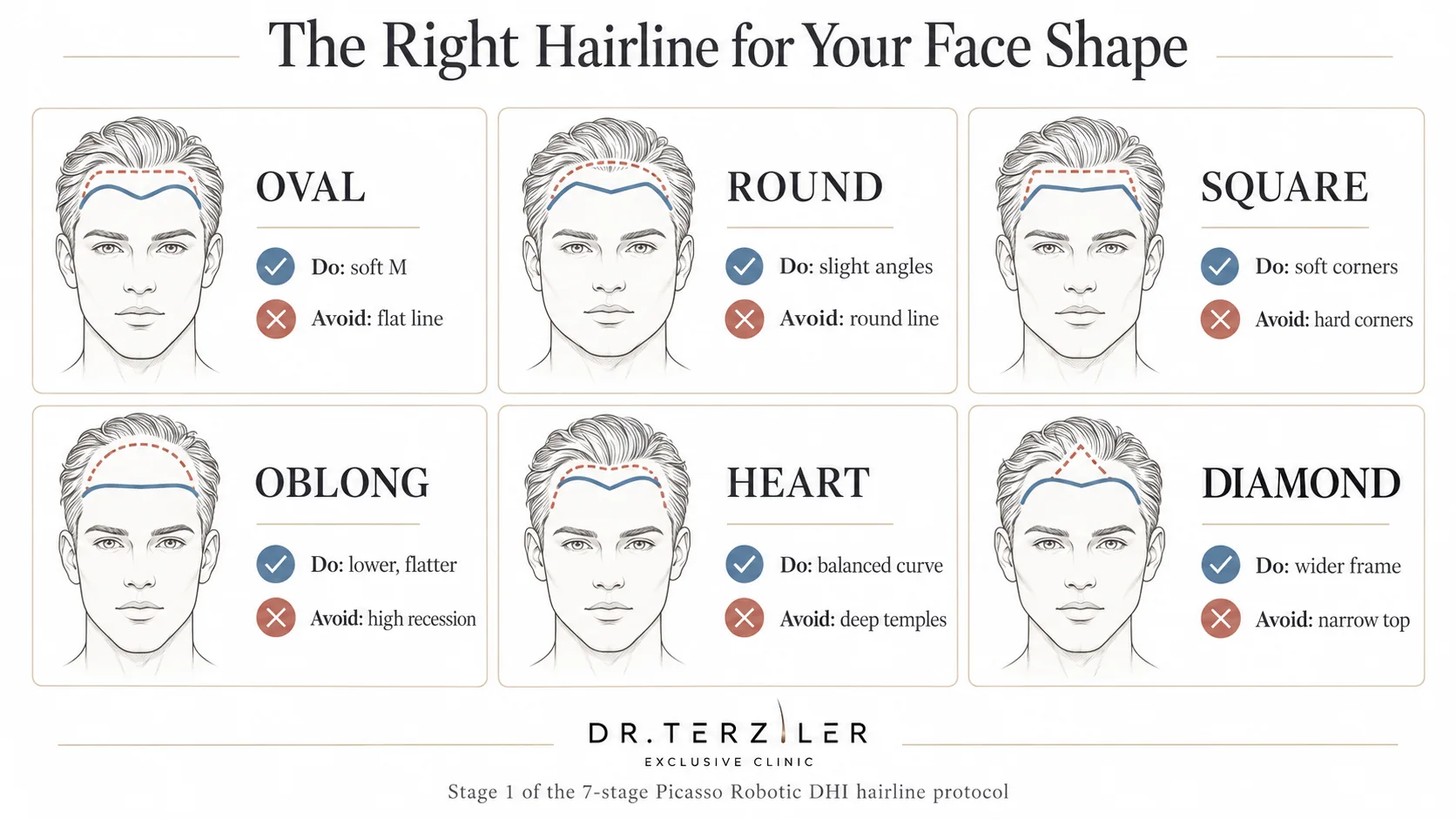
Face shape changes the ideal height and corner depth. Our 7-stage protocol starts by classifying the face into one of six shapes. The table below shows the starting logic. A surgeon adjusts it for age, hair type and donor supply.
| Face shape | Hairline approach | Avoid |
|---|---|---|
| Oval | Classic soft M with moderate temple recession. Most designs work. | Over-lowering the centre |
| Round | Slightly higher centre and defined corners add vertical length. | A round hairline that repeats the round face |
| Square | Soften corners with a gentle curve; keep a masculine M. | Hard 90° corners that make the jaw look wider |
| Oblong / long | Lower the MFP within safe limits to shorten the upper third. | Deep temple recessions that lengthen the face more |
| Heart | Moderate height, slightly fuller temples to balance a wide forehead. | A sharp widow's peak that points to a narrow chin |
| Diamond | Fuller frontotemporal corners to widen the narrow forehead. | Deep recessions at the narrowest point |
Male vs Female Hairline Design
Male and female hairlines follow different rules. A male hairline has temple recessions and an M or rectangular frame. A female hairline is usually lower, rounder, and keeps the temples full. The Ege University data shows this split: round and rectangular shapes lead in women, the M-shape leads in men, and the authors note that the round hairline "resembles femininity" [5]. Beehner adds that a female design needs only a shallow, gently curved recession on each side [8].
Women usually come to us for one of three reasons: a high or wide forehead since birth, a hairline damaged by tight hairstyles (traction), or a hairline that looks too masculine. Hair transplantation can lower and round the line. In a 2025 Shanghai study of 60 women with high, wide foreheads, FUE hairline transplants lowered the mid-frontal height by an average of 1.33 cm and narrowed the temple-to-temple width by 1.47 cm. Patients received about 3,243 follicular units at 50 to 60 units per cm². Satisfaction averaged 4.70 out of 5 [10]. A 2026 study of 36 women reported similar gains, with 2 of 36 patients needing a touch-up for density [11].
The darker side deserves a line too. In 980 female hairline corrections, 3.9% of patients grew curly, kinky-looking hair in the transplanted zone, usually from around month 4. Several cases came from grafts placed too shallow or blocked by surrounding hair [12]. Laser hair removal is another trap. A five-centre Chinese study found 82 of 915 laser hair removal patients unhappy with their hairline afterwards; 64% of the women who needed transplant repair had a "stiff" artificial line [13]. If you want a female hairline redesigned, ask the surgeon how they prevent both problems.
How do you fix a masculine hairline as a woman? There are two routes. A hair transplant rounds the corners and fills the temples graft by graft. Surgical hairline lowering removes a strip of forehead skin and advances the scalp, best for women with a stable hairline and a mobile scalp [14][15]. Our greffe de cheveux chez la femme page explains which route fits which patient.
Male vs Female Hairline Design
Male hairline
- Temple recession: yes
- Shape: M or rectangular
- Height: 7–9 cm
Female hairline
- Temple recession: minimal
- Shape: round / oval
- Fine, slightly curly risk: avoid shallow grafts
Hair Type and Ethnicity Change the Design
The same drawing does not suit every hair type. Hair caliber, curl, colour contrast with the skin, and the natural hairline pattern all change the plan. East Asian men, for example, tend to keep more of the frontal hairline as they age. A Korean study of 5,531 men found pattern hair loss (Norwood III or higher) in 14.1% overall and noted "more frontal hairline preservation" than in Caucasian men [16]. A six-city study in China found 21.3% prevalence in men, and only 2.8% in men aged 18 to 29 [17]. Korean surgeons have published hairline guidelines adapted to thicker, straighter East Asian hair [18].
Afro-textured hair needs its own rules. Curled follicles curve under the skin, so extraction and placement angles must follow the curl. Tightly curled hair also gives more visual coverage per graft, which changes the graft count for the same density. Our Greffe de cheveux afro guide covers this in detail.
Colour contrast matters as well. Dark, coarse hair on light skin shows every graft at the edge, so the transition zone must be softer and longer. Fair or grey hair on fair skin forgives more. A good surgeon designs for contrast, not just for shape.
Picasso Robotic DHI: How Dr. Servet Terziler Draws a Hairline
Patients and colleagues call Dr. Servet Terziler the "Picasso of Hair" because he treats the hairline as a drawing, not a template. He invented the DHI robotisé machine used at Dr. Terziler Exclusive Clinic and built the Picasso Robotic DHI method around one idea: the machine gives precision, the hand gives art.
Picasso Robotic DHI combines three parts: a hand-drawn hairline by Dr. Terziler, implantation with the Robotic DHI machine, and a 0.70 mm Choi implanter pen. The drawing follows a 7-stage protocol that takes 25 to 40 minutes, before any anaesthetic is given.
| # | Scène | What happens |
|---|---|---|
| 1 | Face shape classification | Oval, round, square, oblong, heart or diamond sets the starting frame. |
| 2 | Frontotemporal triangle | The corners are positioned so the front line meets the side hair naturally. |
| 3 | Mid-frontal point | The MFP is placed, usually 7 to 9 cm above the glabella in adult men. |
| 4 | Transition zone | A soft, irregular front band is drawn for single-hair grafts. |
| 5 | Single-graft micro-irregularity | Single hairs are planned ahead of the line, front row only. |
| 6 | Whorl and cowlick mapping | Native hair direction, including swirls, is traced and respected. |
| 7 | Aging projection | The design is checked against the patient's likely look at 50 and 60. |
After the drawing, the Robotic DHI machine places grafts at 35° to 45° angulation and 3.5 to 4.5 mm depth, with the same depth and angle graft after graft. The 0.70 mm channel matches a typical hair shaft of 0.06 to 0.08 mm closely, which supports dense packing. Average out-of-body time for a graft stays under 90 seconds, and grafts rest in HypoThermosol holding solution with ATP. Roughly 250 to 400 single grafts go into the first 1 cm strip, and density can reach up to 60 grafts per cm² at the hairline in selected cases.
Clinic-reported outcome: in an internal 12-month audit of 120 patients, graft survival was 98.1%. This is our own audit, not a peer-reviewed trial, and we publish it as such.
"The robot can repeat an angle a thousand times without getting tired. It cannot decide where a hairline should start. That decision is still a drawing, and I make it by hand."
Is DHI Better for Hairline Design? DHI vs FUE at the Front Line
Both FUE and DHI can produce a natural hairline. The design matters more than the tool. The tools differ in how they place the graft. In classic FUE, the surgeon first opens channels in the scalp, then a technician inserts grafts into them. In DHI hair transplant, a Choi implanter pen opens the site and places the graft in one move.
For the hairline, DHI has three practical advantages. The surgeon controls the exact angle and depth of every graft at the moment of placement. Grafts can be packed close together without pre-made channels widening each other. And grafts spend less time handled by forceps. The trade-off: DHI is slower and needs a highly trained team, so many clinics combine both methods, using DHI at the front and FUE-style placement deeper in. Robotic DHI removes most of the human fatigue from the DHI step, which helps keep graft 1,800 as precise as graft 18.
Is DHI better for hairline design? DHI is often preferred for the hairline because the Choi implanter controls angle and depth for each graft and allows dense packing at the front edge. FUE can also create a natural hairline in skilled hands. The surgeon's design, graft sorting and angle control matter more than the method name.
Your Hairline Design Consultation, Step by Step
A hairline design consultation should feel like a fitting, not a sales call. At our clinic it follows the same order every time. First, we diagnose: scalp and donor trichoscopy, hair caliber, miniaturisation at the temples, and family history. Second, we photograph you from the front and both sides, the same three angles used in the ISHRS template research [4]. Third, the doctor draws the line on your scalp with a surgical marker. You look in the mirror and on screen, and you say what you think.
Then comes the uncomfortable but honest step: the aging projection. We show you how the design looks if your native hair behind it thins in 10 or 20 years. Many patients ask for a lower line at this point. A good surgeon explains the donor maths and lowers it only if the budget allows. Finally, the approved design is photographed and saved in your file before anaesthesia. You leave with the same design you agreed to.
Prefer to keep your hair long during this process? An unshaven DHI plan lets suitable patients have the hairline worked on without a full head shave.
Questions to ask any surgeon before you approve a design: Who draws my hairline, the doctor or a technician? How many single-hair grafts go in the front row? How will this look at 60? What happens if I keep losing hair behind it? Can I see three hairline results from patients with my hair type?
How to Know a Good Hairline: The Five-Distance Test
Most patients judge a hairline in a bathroom mirror at 30 cm. Real life judges it at every distance. We use a simple five-step check we call the Five-Distance Test. A natural hairline passes all five.
| Test | How to check | A good hairline… |
|---|---|---|
| 1. Conversation (1-3 m) | Ask a friend to look at you across a table. | reads as "your hair", not "a hairline". |
| 2. Close-up (30-50 cm) | Selfie camera, bright window light. | shows single hairs at the edge, no rows, no clumps. |
| 3. Wet test | After a shower or swim, hair pushed back. | still looks soft and irregular when hair is flat and see-through. |
| 4. Wind test | Hair blown back on a windy day or in a car. | has no visible straight edge or doll-hair tufts. |
| 5. Twenty-year test | Picture the native hair behind it gone. | still looks like a mature, believable hairline. |
Red flags of a bad hairline: a ruler-straight edge, thick multi-hair grafts at the very front, hairs pointing straight up, a hairline that is too low for the face, flat-filled temples, and visible gaps between the transplanted line and thinning native hair behind it.
Bad hairlines can be repaired, but repair is harder than doing it right once. A 2026 multicentre Spanish study followed 20 men who needed FUE repair of unnatural or too-low hairlines. Patients had a median age of 37.5. Extraction from the old hairline had high graft transection rates, and 28% needed a second corrective procedure, although 95% were satisfied in the end [19]. You can browse documented hair transplant case studies to see how we plan both first-time and repair hairlines.
A good hairline passes five distances: across a table, in a selfie, in the shower, in the wind, and twenty years from now.
What Are the Real Hairline Results?: Before and After
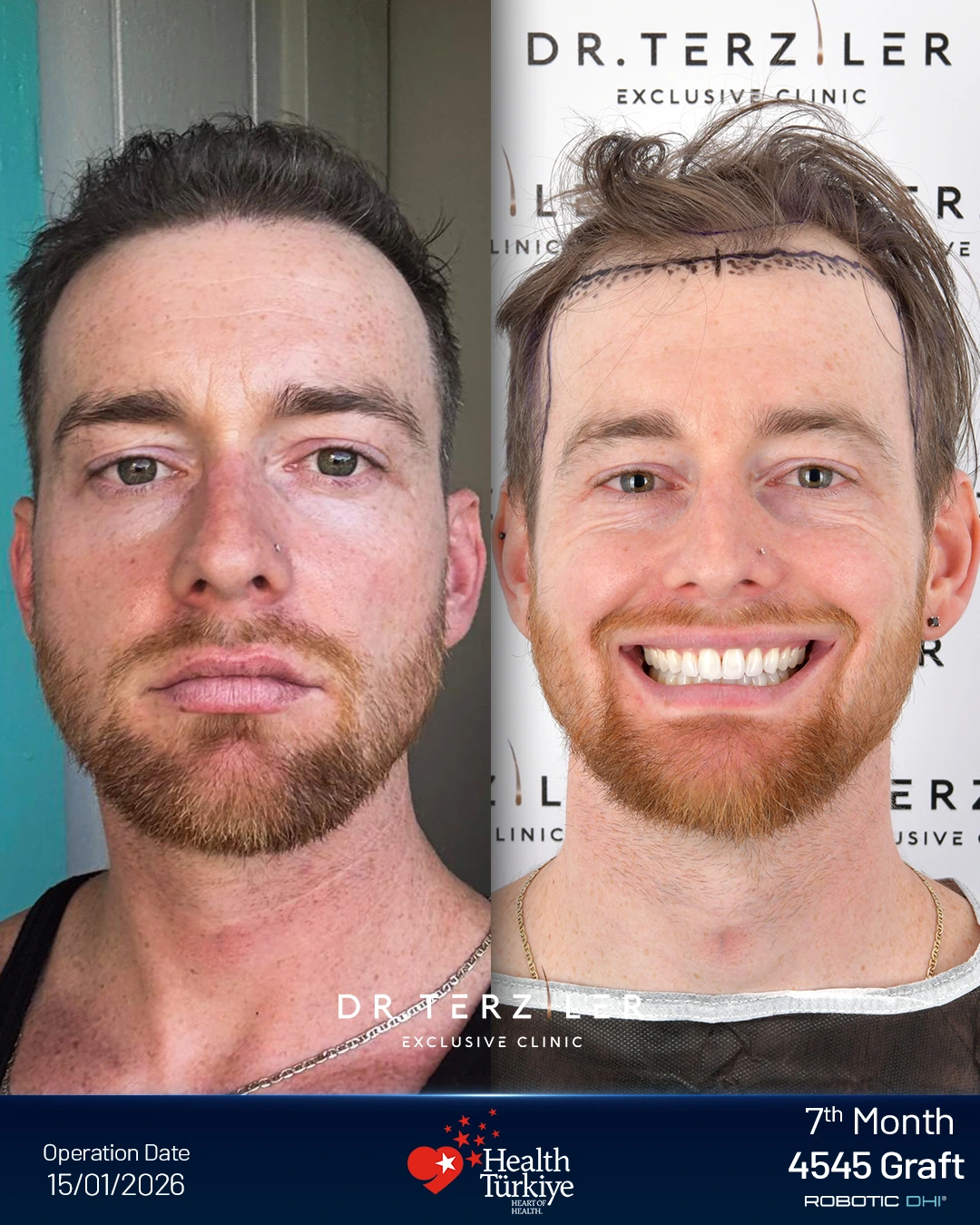
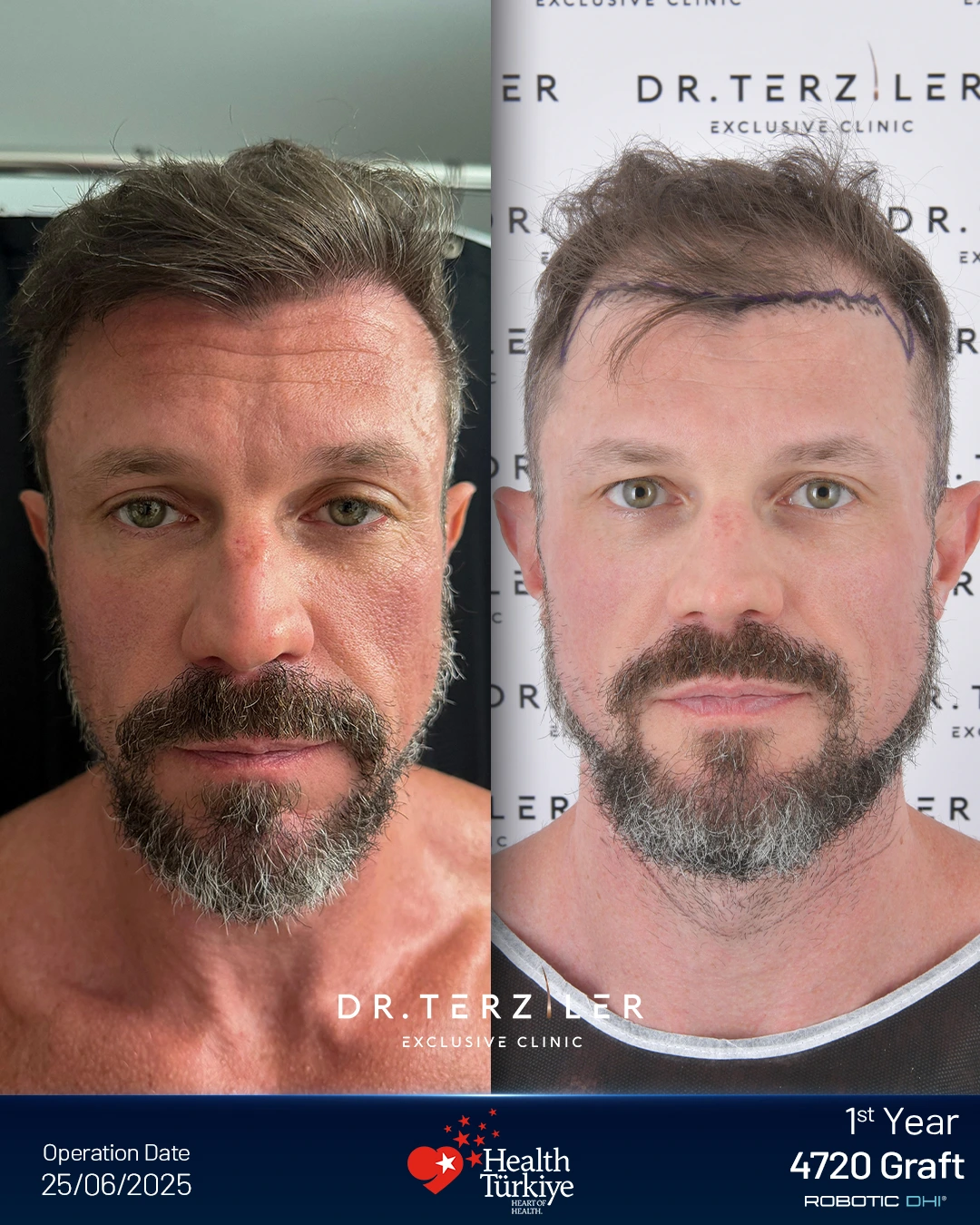
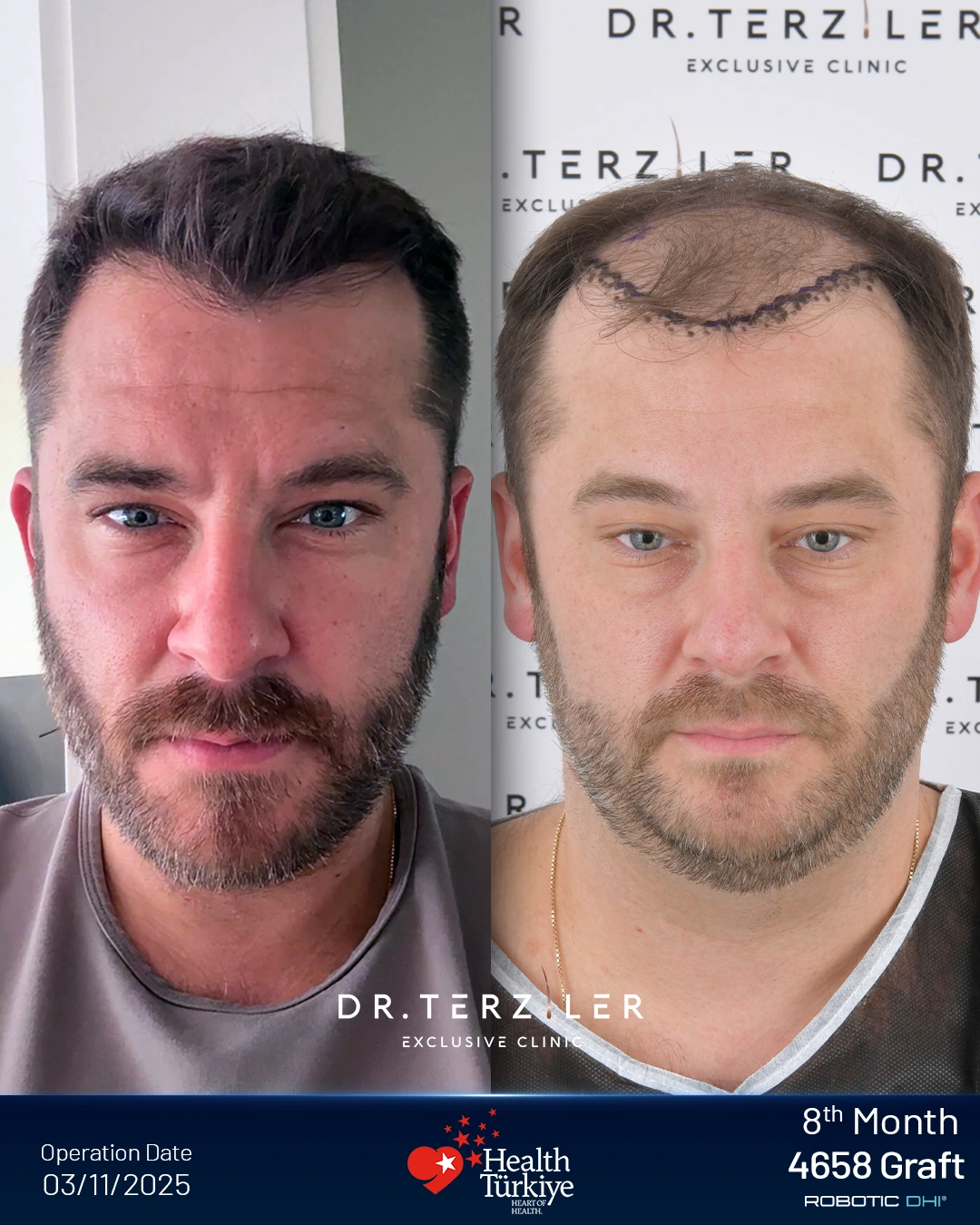
Words describe a hairline. Photos prove it. Below are three hairline cases from Dr. Terziler Exclusive Clinic, shown at the same angle and in the same light before surgery and after full growth. More results are in our hair transplant before and after gallery.
View the original photo
Drag to compare the hairline detail
The slider displays cropped halves of the original photo without retouching. The complete photo, graft count and follow-up month remain above.
View the original photo
Drag to compare the hairline detail
The slider displays cropped halves of the original photo without retouching. The complete photo, graft count and follow-up month remain above.
View the original photo
Drag to compare the hairline detail
The slider displays cropped halves of the original photo without retouching. The complete photo, graft count and follow-up month remain above.
Hairline Timeline: From Drawing Day to Month 18
A new hairline arrives slowly, and the middle months test patience. Day 1 shows the design as tiny crusts along the drawn line. By day 10 the crusts are gone. Between weeks 2 and 8, most transplanted hairs shed. This is normal: the follicles stay in the skin and restart. New hairs appear around months 3 to 4. They are thin and sometimes wiry at first. Between months 6 and 9, the hairline fills in and the hairs thicken. Most patients see the near-final hairline at 12 months, and the hair keeps maturing up to month 15 to 18.
Our Picasso Robotic DHI package includes PRP hair treatment at months 3 and 6 and an exosome session at month 4, timed for the stage when new hairs are thin and growing. We follow every hairline with photos for 12 months.
Your New Hairline, Month by Month
Day 1
drawn line + crusts
Dixième jour
crusts gone
Weeks 2–8
shedding (normal)
Months 3–4
first fine hairs
PRP: month 3 · Exosome: month 4
De 6 à 9 mois
fill-in and thickening
PRP: month 6
Month 12
near-final hairline
Months 15–18
full maturity
How Much Does a Hairline Design Cost in Turkey?
Hairline design is not a separate product at a serious clinic. It is the first and most important part of the transplant, and its price sits inside the procedure. At Dr. Terziler Exclusive Clinic, the doctor-drawn design is included in every plan. We do not charge a "design fee" and we do not hand the drawing to a technician.
Across Turkey, hair transplant prices generally range from about €3,500 to €10,000 in 2026. The spread comes from who designs and implants (doctor or technician), the method (FUE, DHI, Robotic DHI), the number of grafts, how many patients a clinic treats per day, and what the package includes. US clinics usually quote per graft, so a full frontal hairline project of 1,500 to 2,500 grafts often reaches five figures in US dollars. Price your hairline by the design and the doctor, not by the graft. Our hair transplant cost in Turkey page explains how a personal quote is built after a donor assessment.
How much does hairline design cost in Turkey? Hairline design is usually included in the hair transplant price, not billed separately. Hair transplants in Turkey generally cost €3,500 to €10,000 in 2026. The final price depends on graft count, technique (FUE, DHI or Robotic DHI), whether a doctor draws and implants the hairline, and package inclusions.
Protecting Your New Hairline for Life
Transplanted hairs come from the back of the scalp, which resists the hormone DHT. This principle, called donor dominance, is why transplanted hair keeps growing for life [1]. Your native hair behind the new hairline does not share that protection. If it keeps thinning, a gap can open between a strong new front and a weak middle.
That is why the medical plan matters as much as the surgical one. Minoxidil and finasteride are the two US FDA-approved treatments for pattern hair loss. A panel of 11 international hair surgeons concluded that using them around transplant surgery can increase density, speed regrowth and slow further loss [20]. Finasteride is prescription-only and not for everyone, so your doctor decides. Non-drug options such as PRP, exosomes and low-level laser can support the result. Our hair treatments hub compares them side by side.
Why Patients Trust Dr. Terziler Exclusive Clinic With Their Hairline
A hairline is drawn once and worn for life, so the hand that draws it matters. At Clinique Exclusive du Dr Terziler in Beşiktaş, Istanbul, the doctor draws every hairline. Dr. Servet Terziler, the "Picasso of Hair", invented the Robotic DHI machine, is an ISHRS workshop alumnus with 34.55 AMA PRA Category 1 credits, and is the founder and president of TÜSATDER. Dr. Kürşat Yalvaç leads consultations and hairline design with him.
The clinic holds AACI international accreditation (Cert No. C150-2022-ACC-TR-IEEA) and the Turkish Ministry of Health International Health Tourism Authorization (Cert No. ST-1905), and works to ISO 9001 quality standards. We treat a maximum of 4 patients per day. Every patient gets a verifiable graft count, a printed surgery record, and a written 2-year graft survival guarantee. Patients rate us 4.9/5 on both Google and Trustpilot.
Your hairline will be the first thing people see for the next 40 years. It deserves more than 40 minutes of thought, and less than 40 seconds of anyone noticing.
Hairline Design FAQ
Short answers to the questions people ask Google most about hairlines. Each answer is written to stand alone.
Which type of hairline is most attractive?
Attractiveness depends on sex and face shape. In men, a straight or soft M-shaped hairline with mild temple recession usually reads as strong and masculine. In women, a low, round or oval hairline usually reads as soft and feminine. Proportion matters most: a hairline that closes the upper third of the face looks best.
How should a good hairline look?
A good hairline has an irregular, feathered edge, single hairs at the very front, more density 5 mm behind, and hairs angled forward at about 35° to 45°. Temples keep a soft recession in men. It should look natural at conversation distance, in a selfie, when wet, and in 20 years.
How do I make my hairline look good?
Without surgery: choose a haircut that matches your hairline (textured fringe or crop for recessions), avoid tight hairstyles that pull the edge, and treat early thinning with doctor-guided therapy. A barber line-up sharpens the edge for a few weeks. For lost hair, a doctor-designed transplant rebuilds the line permanently.
What is the most rare hairline?
In a study of 200 young Turkish adults from Ege University, the triangular (widow's peak) hairline was the rarest in men at 2%, and the bell-shaped hairline was rare in both sexes (4% of men, 5% of women).
How do I know if a hairline is good?
Use the Five-Distance Test: it should look natural across a table, in a close-up selfie, when wet, in the wind, and imagined 20 years older. Warning signs are a straight edge, thick clumps at the front, hairs standing up, flat temples, or a line too low for the face.
What is the most feminine hairline?
The round or oval hairline is the most feminine shape. Anatomy research from Ege University links round hairlines with femininity and rectangular or M-shaped hairlines with masculinity. Full temples and a lower, gently curved front add to a feminine look.
Why is Gen Z balding so fast?
No large study proves Gen Z loses hair earlier than past generations. As far back as 1998, a US study found 16% of men aged 18 to 29 already had moderate to extensive hair loss. Hair loss feels earlier now because front cameras, video calls and social media show hairlines constantly. Genetics and DHT remain the main cause.
How many cm from the eyebrows is a normal hairline?
A young adult hairline usually sits about 5.5 to 6.5 cm above the brow centre. Young Turkish men averaged 6.1 cm and women 5.8 cm in an Ege University study. For adult male hair transplants, surgeons usually place the new hairline 7 to 9 cm above the glabella to suit a mature face.
Which race is the least bald?
Population studies show lower pattern hair loss rates in East Asian men than in Caucasian men. Korean men had a 14.1% prevalence and Chinese men 21.3%, while a US community study found 42% of men aged 18 to 49 had moderate to extensive loss. Korean men also tend to keep their frontal hairline longer.
What does a normal 20-year-old hairline look like?
A normal 20-year-old hairline is usually low, fairly straight or softly M-shaped, and about 6 cm above the brow centre. Slight, even temple recession is normal. Recession that deepens each year, or thin and fine hairs at the temples, suggests early pattern hair loss.
At what age do hairlines start receding?
Most men show slight temple maturing in the late teens to late twenties. True receding from pattern hair loss can start after puberty. A US study found 16% of men aged 18 to 29 had moderate to extensive loss, rising to 53% by ages 40 to 49.
How do you fix a masculine hairline?
A masculine hairline in women can be fixed with a hair transplant that rounds the corners and fills the temples, or with surgical hairline lowering that advances the scalp. Transplants suit women who also want density; lowering surgery suits women with a stable hairline and a flexible scalp.
What is the prettiest hairline?
There is no single prettiest hairline. Hairlines look best when they fit the face: round or oval shapes soften a face, a gentle peak adds interest, and the height should close the upper third of the face in balance with the other two thirds.
Do you get your hairline from your mom or dad?
From both, but the mother's side carries a key gene. The androgen receptor (AR) gene sits on the X chromosome, which men inherit from their mother. A University of Bonn study found AR gene variation is the main determinant of early-onset pattern baldness, with an etiological fraction of 0.46 [21]. Other genes come from both parents.
Which hairline is attractive in men?
A soft M-shaped or straight hairline with mild, even temple recession is widely seen as attractive in men. It frames the face, keeps a masculine look and ages well. A perfectly flat, low hairline often looks younger than the face and can look artificial after a transplant.
Can I choose where my new hairline goes?
Yes, design is shared. You tell the doctor what you want; the doctor checks it against your face, age, donor supply and future loss, then draws it on your scalp. You approve it in the mirror before surgery. A good surgeon will lower a line only if your donor area can support it for life.
Are hairline design apps accurate?
Hairline apps are useful for previewing a shape, but they cannot measure donor density, hair caliber, angle or future hair loss. Use an app to start the conversation, then let a doctor draw the real design on your scalp.
References
[1] Queen D, Avram MR. Hair Transplantation: State of the Art. Dermatol Surg. 2025;51(9):874-881. doi:10.1097/DSS.0000000000004675
[2] Avram MR, Watkins S. Robotic Hair Transplantation. Facial Plast Surg Clin North Am. 2020;28(2):189-196. doi:10.1016/j.fsc.2020.01.011
[3] Shapiro R, Shapiro P. Hairline design and frontal hairline restoration. Facial Plast Surg Clin North Am. 2013;21(3):351-362. University of Minnesota. doi:10.1016/j.fsc.2013.06.001
[4] Speranzini M, Souza SEG, Nakano C, True RH. Printable Hairline Designs and Hectographic Templates: Novel Tools for Hairline Creation and Graft Placement in Men. Hair Transplant Forum International (ISHRS). 2025;35(5):153-161. ishrs-htforum.org
[5] Sirinturk S, Bagheri H, Govsa F, Pinar Y, Ozer MA. Study of frontal hairline patterns for natural design and restoration. Surg Radiol Anat. 2017;39(6):679-684. Ege University Faculty of Medicine, Izmir. doi:10.1007/s00276-016-1771-1
[6] Kim J, Wan J, Jang T, Yi KH. Natural Asymmetry in Hair Growth Direction: Implications for Hairline Design in Male Patients. J Craniofac Surg. 2025;36(7):e843-845. Yonsei University. doi:10.1097/SCS.0000000000011231 | Free full text: PMC12502931
[7] Rhodes T, Girman CJ, Savin RC, et al. Prevalence of male pattern hair loss in 18-49 year old men. Dermatol Surg. 1998;24(12):1330-1332. doi:10.1111/j.1524-4725.1998.tb00009.x
[8] Beehner M. Hairline design in hair replacement surgery. Facial Plast Surg. 2008;24(4):389-403. doi:10.1055/s-0028-1102903
[9] Avram M, Rogers N. Contemporary hair transplantation. Dermatol Surg. 2009;35(11):1705-1719. Weill Cornell Medical College. doi:10.1111/j.1524-4725.2009.01283.x
[10] Wu W, Liu C, Zhang P, et al. Enhancing Mid-Upper Facial Contours: Hairline Transplant Solutions for East Asian Women With High and Wide Foreheads. J Cosmet Dermatol. 2025;24(8):e70374. Shanghai Jiao Tong University. doi:10.1111/jocd.70374 | Free full text: PMC12319885
[11] Tang S, Wu X. Natural-Looking Hairline Restoration with Refined Hair Transplantation Techniques to Improve Facial Aesthetic in East Asian Females. Aesthetic Plast Surg. 2026;50(11):4441-4449. Westlake University / Zhejiang University. doi:10.1007/s00266-026-05815-1
[12] Park JH, Kim N, Manonukul K. Post-Hair Transplantation Complication: Kinky or Severely Curly Hair. J Craniofac Surg. 2024;35(2):e146-e150. doi:10.1097/SCS.0000000000009926
[13] Fu D, Tang Q, Huang J, et al. Evaluation of hair transplantation for improving unnatural hairlines after laser hair removal: a multicenter retrospective study. J Plast Reconstr Aesthet Surg. 2024;95:114-120. Southern Medical University. doi:10.1016/j.bjps.2024.05.054
[14] Kabaker SS, Champagne JP. Hairline lowering. Facial Plast Surg Clin North Am. 2013;21(3):479-486. University of California, San Francisco. doi:10.1016/j.fsc.2013.05.007
[15] Arnaoutakis D. Hairline-Lowering Surgery. Facial Plast Surg Clin North Am. 2026;34(1):97-102. University of South Florida. doi:10.1016/j.fsc.2025.08.003
[16] Paik JH, Yoon JB, Sim WY, Kim BS, Kim NI. The prevalence and types of androgenetic alopecia in Korean men and women. Br J Dermatol. 2001;145(1):95-99. Kyung Hee University. doi:10.1046/j.1365-2133.2001.04289.x
[17] Wang TL, Zhou C, Shen YW, et al. Prevalence of androgenetic alopecia in China: a community-based study in six cities. Br J Dermatol. 2010;162(4):843-847. Peking University People's Hospital. doi:10.1111/j.1365-2133.2010.09640.x
[18] Lee IJ, Jung JH, Lee YR, Kim JC, Hwang ST. Guidelines on Hair Restoration for East Asian Patients. Dermatol Surg. 2016;42(7):883-892. doi:10.1097/DSS.0000000000000773
[19] Gómez-Zubiaur A, Mir-Bonafé JM, Muñoz Moreno-Arrones O, et al. FUE for the repair of unnaturally designed or low hairlines in men with androgenetic alopecia: a retrospective, multicenter observational study. Front Med. 2026;13:1735251. doi:10.3389/fmed.2026.1735251 | Free full text: PMC13017281
[20] Avram MR, Cole JP, Gandelman M, et al. The potential role of minoxidil in the hair transplantation setting. Dermatol Surg. 2002;28(10):894-900. doi:10.1046/j.1524-4725.2002.02068.x
[21] Hillmer AM, Hanneken S, Ritzmann S, et al. Genetic variation in the human androgen receptor gene is the major determinant of common early-onset androgenetic alopecia. Am J Hum Genet. 2005;77(1):140-148. University of Bonn. doi:10.1086/431425 | Free full text: PMC1226186
[22] Marwah MK, Mysore V. Recipient Area. J Cutan Aesthet Surg. 2018;11(4):202-210. Free full text PDF: PMC6371721 doi:10.4103/JCAS.JCAS_124_18
[23] Chouhan K, Roga G, Kumar A, Gupta J. Approach to Hair Transplantation in Advanced Grade Baldness by FUE: A Retrospective Analysis of 820 Cases. J Cutan Aesthet Surg. 2019;12(4):215-222. Free full text: PMC6967160 doi:10.4103/JCAS.JCAS_173_18