
You may be developing hair loss if your hairline keeps receding, your part is widening or your crown shows progressively less coverage in comparable photographs. A single bright-light selfie or a shower full of hair does not confirm pattern baldness. Check the pattern, timeline and scalp findings together. [1][2]
If you are asking “am I balding or just paranoid?”, start with whether a repeatable change is present. This guide includes a short self-check, a way to judge photo comparisons and an explanation of what clinical tests can actually tell you.
Use the short check below to organise what you have noticed. It helps you choose a next step; it does not diagnose hair loss or predict when you might go bald.
 Clinical teamセルヴェト・テルジラー博士Physician and clinic founder
 Clinical teamクルシャト・ヤルヴァチ博士Physician, clinical team
Prepared by the clinic editorial team · 23 linked sources. Ask who will assess and take responsibility for your case.
How can I check whether I am balding in about two minutes?
Check for a repeatable change in your hairline, part or crown, consider how quickly it developed, and notice any scalp symptoms. Answer the six questions once. You do not need to pull out hairs, measure your forehead or count every strand.
Answer six questions about your hair, photographs and timeline. Get an observation summary and a useful next step.
Are you under 18?
If you are under 18, involve a parent or trusted adult and arrange a medical assessment for new hair loss. Adult treatment advice and an online result should not decide your care. [3]
Use the six questions and the result table below to organise your observations.
If symptoms are severe, rapidly worsening or accompanied by fever or feeling unwell, seek prompt local medical care. Do not wait to finish this check or for a clinic photo reply.
What you reported
What this does not establish
This is a summary of your answers. It does not diagnose hair loss, analyse photographs, confirm miniaturisation, predict future loss or decide treatment suitability.
Your next useful step
What to bring
Your answers stay on this page unless you choose to copy, download or include them in a WhatsApp draft. This is an educational check, not a medical test or future-risk score.
Am I balding or am I just paranoid?
The useful distinction is whether your hair is changing consistently, rather than how worried you feel. A progressively receding hairline, widening part or increasing crown exposure deserves assessment. A single photograph taken with wet hair, a new parting or harsh overhead light is weaker evidence of change. [1][6]
“Is my hair thinning or am I paranoid?” is a reasonable question when your hair looks different in every picture. Hair loss can develop subtly, but changes in presentation can also be dramatic. The answer becomes clearer when you separate what you can observe from what you are assuming.
Ask yourself what is new. Is the temple border further back in several comparable photographs, or does it only look higher when the hair is pulled tightly? Is the same central part wider, or have you moved the part? Is the crown showing more scalp around the whorl, or did you photograph it from directly above for the first time?
| What you noticed | What it tells you | What would make the finding more useful |
|---|---|---|
| The same area looks less covered in matched photographs | There may be a persistent change in coverage | A dated sequence and a scalp examination |
| Hair looks thin only when wet, oily or under flash | Hair grouping and lighting may be influencing the view | Repeat the photograph in your usual dry, evenly lit condition |
| A family member is bald | Family history is relevant background | Compare your own pattern and progression rather than assuming the same outcome |
| You are checking mirrors repeatedly | You are concerned; this does not measure hair density | One planned photo set and an appointment if uncertainty or distress persists |
| You have new shedding, patches or scalp symptoms | There is a separate finding to investigate | Describe its onset and symptoms even if the hairline looks unchanged |
You do not need to prove that you are “really balding” before asking for an assessment. Equally, an online comment saying “looks fine” does not examine the scalp. The aim is to replace repeated guessing with a useful observation and a next step.
Is my hair thinning or am I paranoid when every photo looks different?
Repeated checking can leave you with more photographs and less certainty when the conditions keep changing. Set one repeatable method, record a baseline and decide when you will review it. If the concern is affecting sleep, concentration or social life, discuss that distress alongside the hair itself. [15]
This does not make the concern imaginary or establish a mental-health diagnosis. Visible hair loss and distress can exist together. A clinician can assess the hair, while appropriate support can help if checking has become difficult to control. Avoid using this guide as another test to repeat until it gives a reassuring answer.
Can overthinking cause baldness?
Worrying about hair does not by itself establish a cause of baldness. Significant physical or emotional stress can contribute to delayed shedding, while hereditary pattern loss is a different process. A stress history and progressive thinning can coexist, so persistent changes should be assessed rather than explained away as anxiety. [7][11]
Tell the clinician about both the hair change and the impact of worrying. Support for distress does not replace examining a reported change, and a scalp examination does not require you to prove that your concern is severe enough.
What does my self-check mean?
Your answers can identify the next useful action, but they cannot produce a medical diagnosis, a percentage risk or a “safe” score. Use the route that fits the most concerning finding, even if other answers seem reassuring.
| What you reported | A useful next step |
|---|---|
| New patches, scalp symptoms or loss beyond the scalp | Arrange a medical assessment. Describe the symptoms and speed of change rather than relying on a hairline stage. |
| A repeatable hairline, part or crown change | Book a scalp examination to discuss pattern loss and other possible causes. Bring the comparison photographs. |
| A sudden increase in shedding | Review the timing, medicines and possible triggers with a clinician. A stable-looking hairline does not exclude a shedding problem. |
| Different lighting, one photograph or no baseline | Take a consistent baseline set. You can still arrange an assessment now if the change worries you. |
| Broadly unchanged photographs and no new symptoms | You have not identified a clear change with this check. That does not exclude early loss or guarantee future stability. |
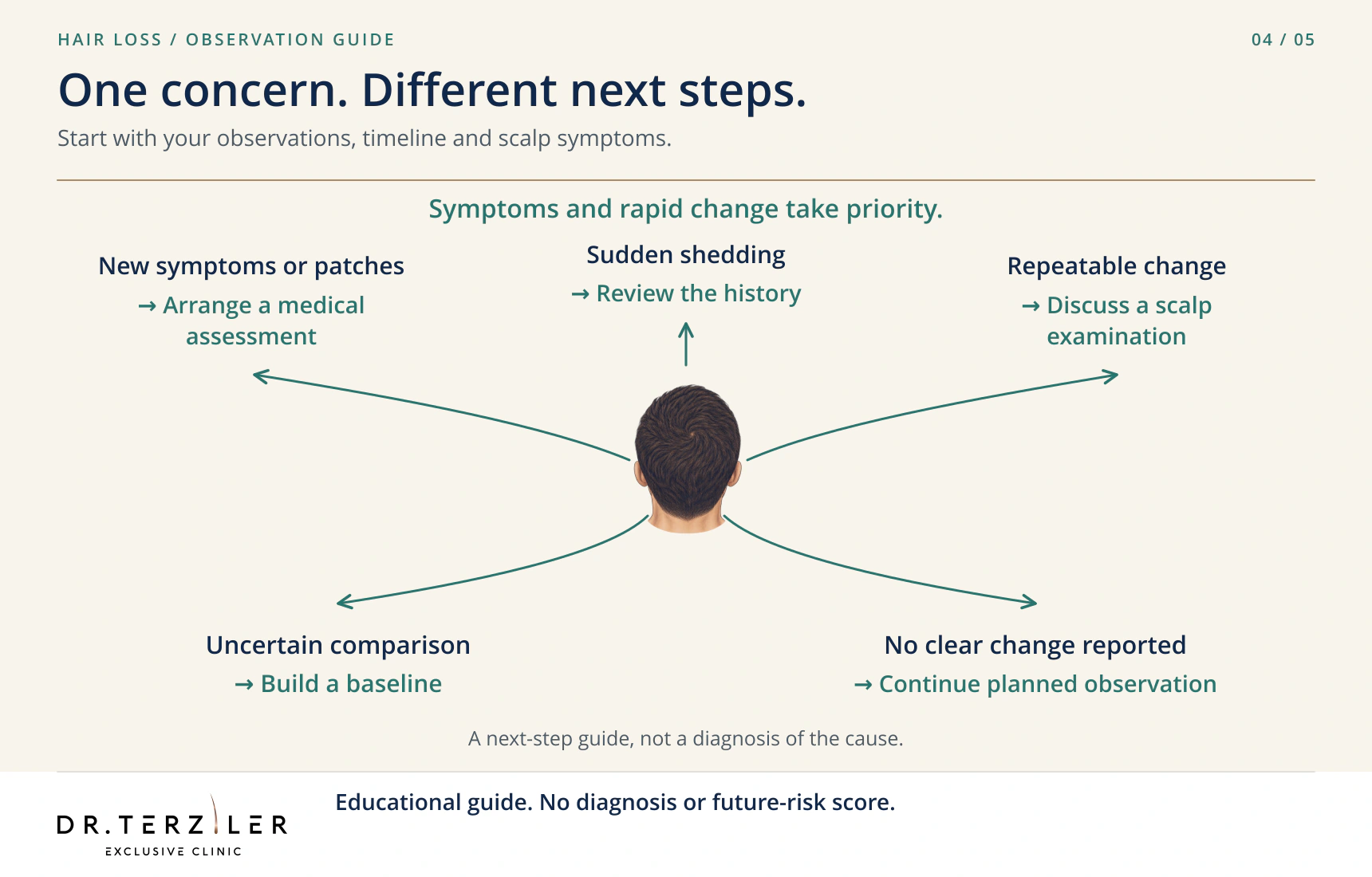
If symptoms are severe, rapidly worsening or accompanied by fever or feeling unwell, seek prompt local medical care. Do not wait for a clinic photo reply. [1][4]
What should I take from the self-check to an appointment?
Take a short description of the location, timeline and evidence, together with any symptoms. A useful summary keeps observed facts separate from assumptions about the cause. You can copy the structure below and replace the examples with your own details.
“I first noticed [change] around [date]. It is mainly at [location]. It developed [gradually / as increased shedding / in another way]. My comparison photographs are [similar conditions / different conditions / not available]. I have noticed [symptoms or none noticed]. Relevant recent changes include [history to discuss].”
How can I summarise my observations for an appointment?
Keep the facts you noticed separate from the diagnosis you want checked. These fields are optional and editable.
A message is a starting point for arranging care, not a confirmed diagnosis. You choose what to share.
You do not need to turn this into “I have androgenetic alopecia” or select a treatment. The summary gives a clinician better starting information than a risk percentage or an unlabelled photo.
If your main uncertainty is the front hairline, a focused hairline self-check explores that area in more detail. A broader hair-loss discussion guide can help organise mixed patterns or shedding before an appointment.
Want help choosing the next step? Ask about a hair-loss assessment または ask the clinic which photographs to send. A photo discussion can help prepare an appointment; an examination may still be needed.
How do I tell if my hair is thinning rather than naturally fine?
Naturally fine hair describes individual strand thickness; thinning describes a loss of coverage or fullness over time. These can occur separately or together. Look at the same scalp region in comparable conditions and ask whether it has changed from your own starting point. [5][14]
The word “thin” often bundles four different observations into one. Separating them helps explain why a shampoo recommendation, a hairline photograph and a scalp examination answer different questions.
| Finding | What it means | What to compare |
|---|---|---|
| Fine strands | Individual hairs have a small diameter | Your usual texture and clinically assessed shaft thickness |
| Reduced density or coverage | Less hair is covering a scalp region | The same part, crown or hairline over time |
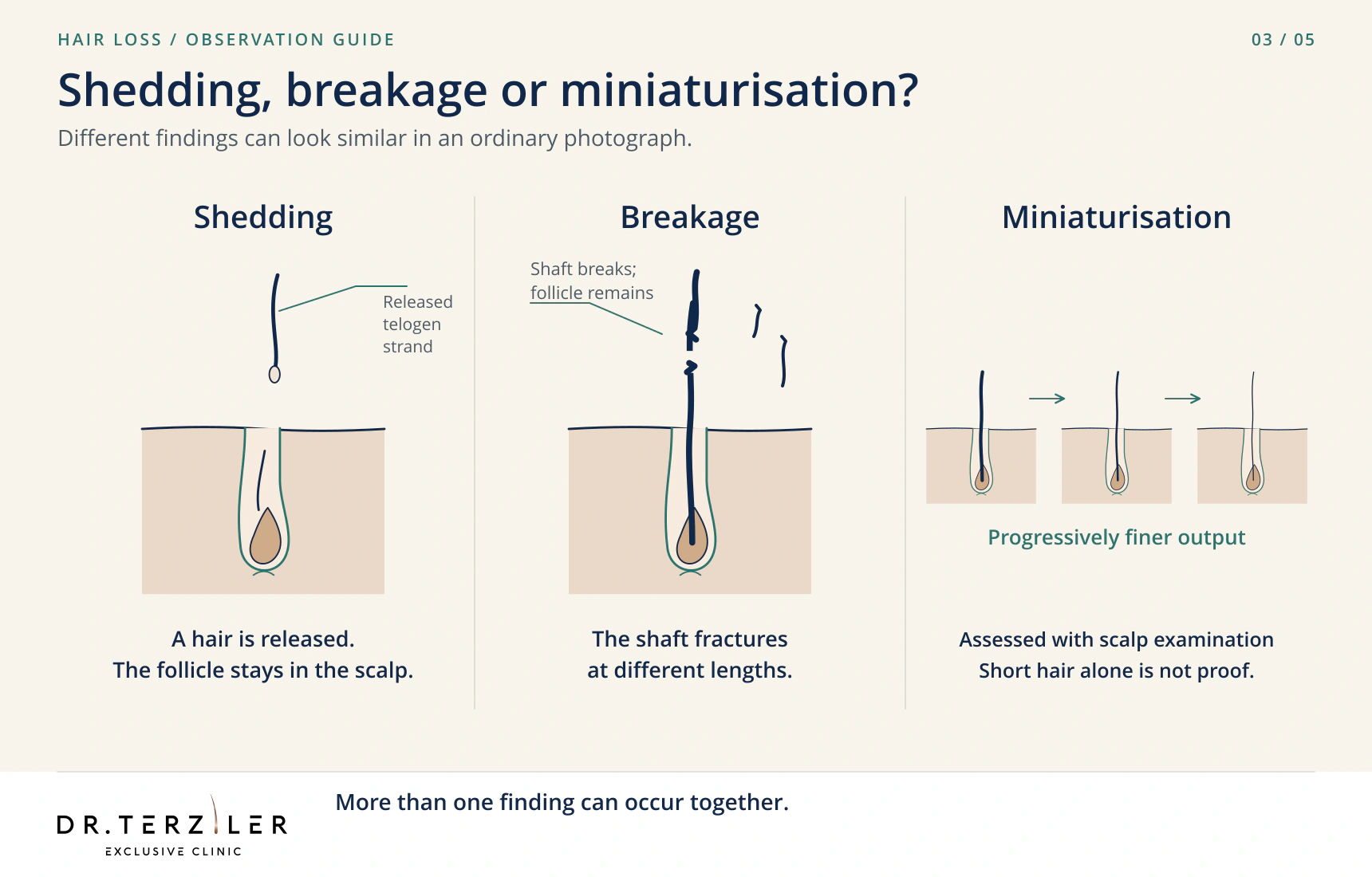
| Breakage | Shafts fracture, leaving shorter pieces | Hair lengths, damaged ends and styling practices |
| Hair grouping or separation | Styling, oil or wetness changes how strands lie together | Similar hair condition, parting and lighting |
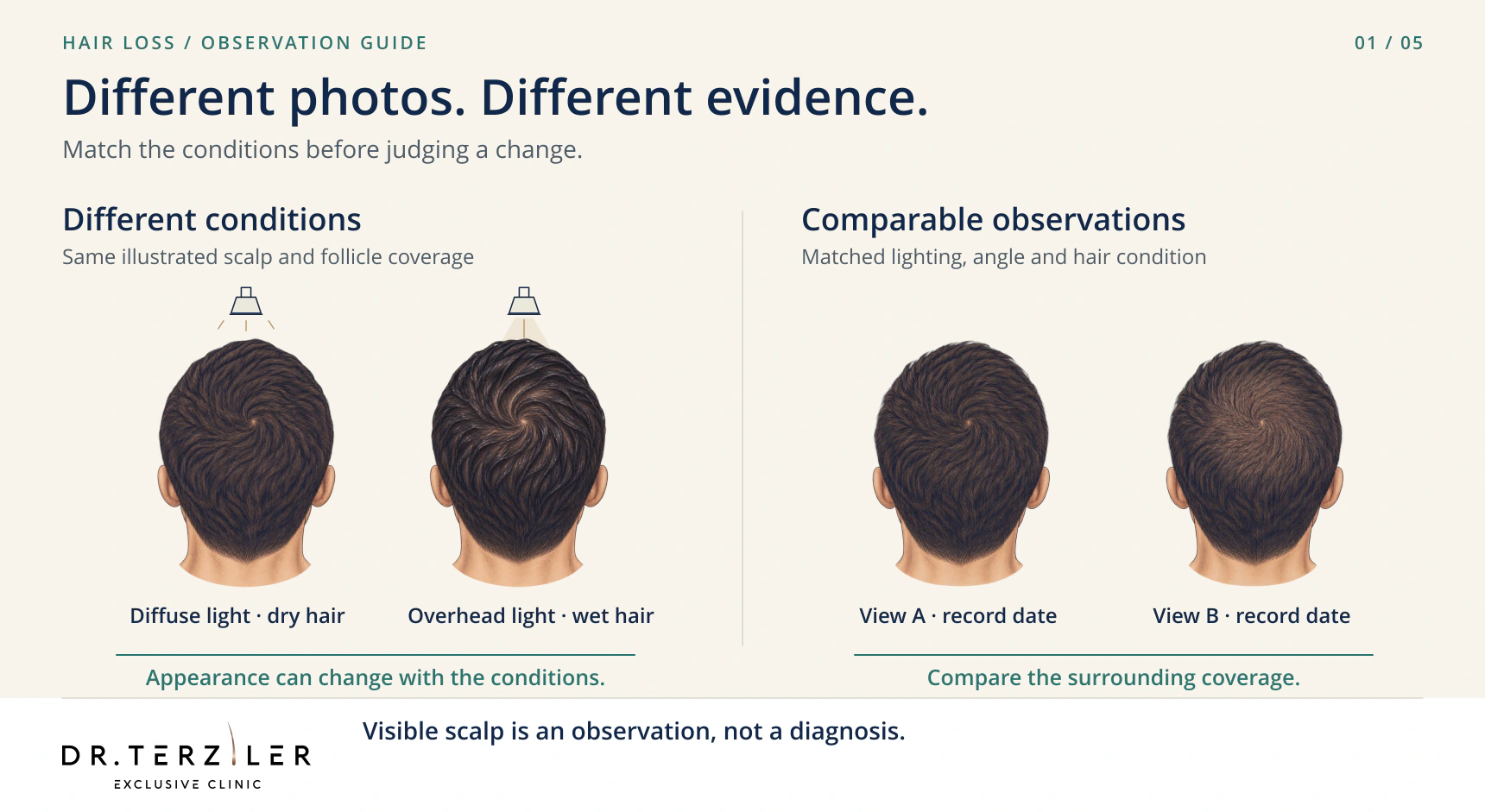
An apparently wider part does not tell you which of these is responsible. Someone with naturally fine hair may retain a stable density. Someone with coarse hair may develop progressive loss while the remaining strands still feel thick. The meaningful question is whether the amount or character of hair covering a particular area has changed.
Breakage adds another complication. Bleaching, heat and repeated tension can damage hair, while traction can also affect follicles. Short hairs therefore need context: they might be new growth, broken shafts or miniaturised hairs. A magnified examination helps distinguish findings that a phone image cannot reliably separate. [8][20] Record signs of dry hair and changes in texture separately from a change in scalp coverage.
What are the early signs of balding?
Early signs include progressive temple recession, increasing crown visibility, a widening part and reduced fullness. Clinicians may identify miniaturisation, in which affected follicles produce progressively finer, shorter hairs. A single short strand or naturally high hairline is insufficient to establish this process. [1][18]
Check the distribution as well as the amount. Does the change concentrate at the temples and crown, mainly through the part, or across the scalp? Is the border moving back, the coverage behind it decreasing, or both? These are useful descriptions even before you know the diagnosis.
Changes in styling can be a clue without being a measurement. You might need a different parting to cover the same area, notice less ponytail fullness or find that a familiar hairstyle exposes more scalp. Record when this began and whether the haircut or routine changed at the same time.
Does more visible scalp mean I am balding?
More visible scalp can reflect reduced coverage, but visibility also depends on hair arrangement and the photograph. A repeatable increase under similar conditions is more informative than one exposed line of scalp. The surrounding hair, pattern of change and scalp findings determine what needs investigation.
Do not compare a dry, fluffed-up hairstyle with wet, flattened hair and call the difference a loss of density. Likewise, do not dismiss a persistent change merely because you can hide it by restyling. Camouflage changes the appearance; it does not establish whether the underlying hair is stable.
Am I going bald or is it just my crown or cowlick?
A crown whorl describes the direction in which hair grows; crown thinning describes reduced coverage. Visible scalp where the hairs separate does not automatically mean balding. Look for a change in the surrounding coverage, because a natural whorl and pattern thinning can occur in the same area. [9][10]
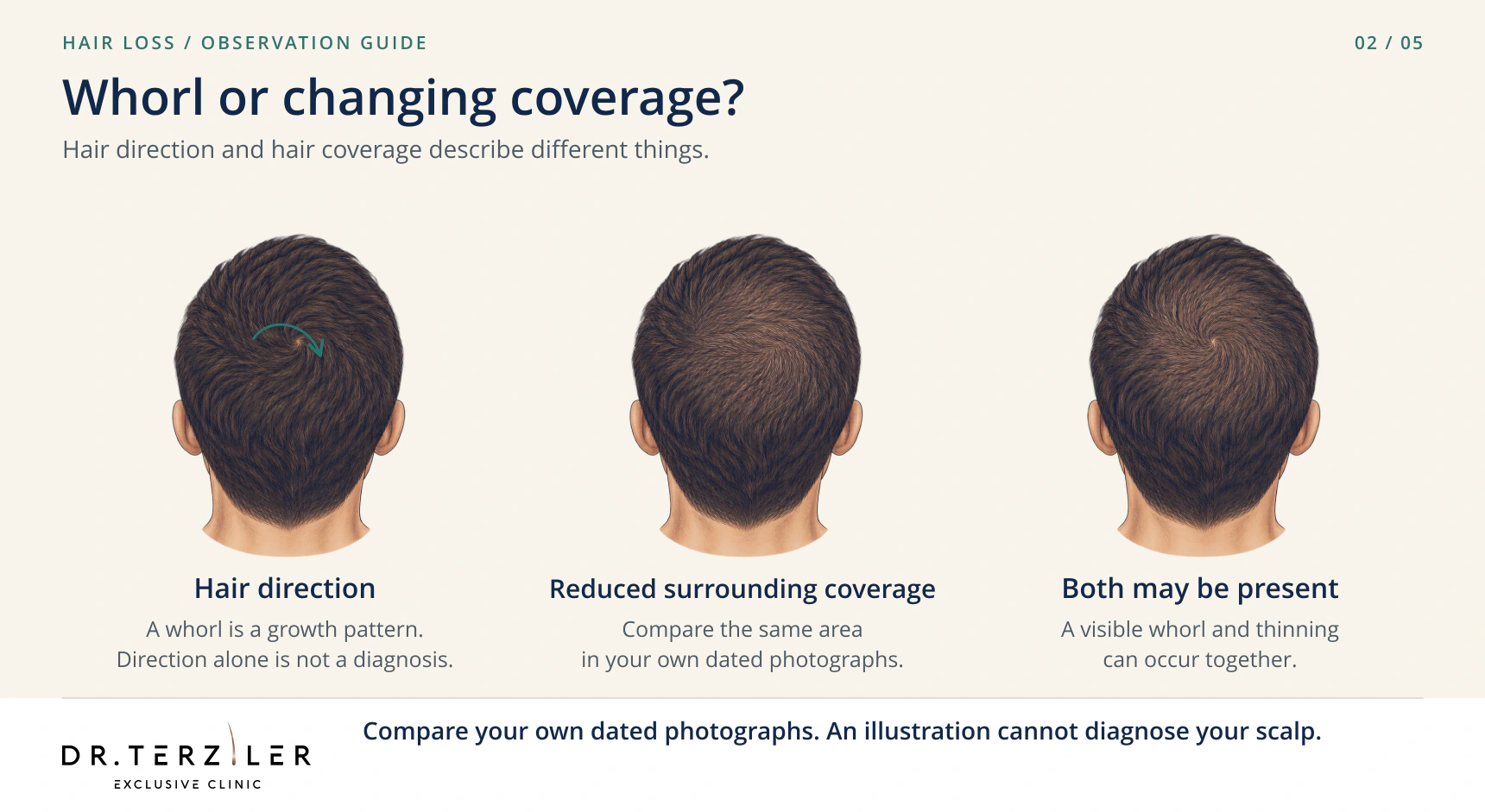
The centre of a whorl naturally exposes a different view of the scalp from the hair around it. Its appearance changes when strands are flattened, separated or photographed under a concentrated light. A first close-up is therefore a baseline observation, not evidence that the area has recently enlarged.
Compare the same angle from behind and slightly above the head. Look beyond the central point: is the surrounding region becoming less covered, or is the apparent gap following the direction of the hair? Do older, comparable photographs show the same arrangement? If only one side seems different, record the location and timeline before attributing it to sleeping on one side.
| Crown observation | Interpretation worth discussing |
|---|---|
| A longstanding visible centre with broadly similar surrounding coverage | A whorl may account for the appearance; this alone cannot establish future stability |
| A growing area of scalp visibility extending beyond the usual centre | A density change deserves assessment |
| A new sharply defined patch or symptoms in the area | Consider causes beyond ordinary pattern thinning |
| A different appearance only after wetting, flattening or flash photography | Recheck the conditions before judging progression |
There is no reliable universal “normal cowlick diameter” you can measure from a phone photograph. A ruler also cannot distinguish naturally separated hair from miniaturisation. For male-pattern reference illustrations, the Norwood pattern comparison separates frontal and vertex involvement without diagnosing every crown finding.
Is my hairline maturing or receding?
A mature-looking hairline may remain stable, while progressive recession means the border or coverage behind it continues to change. Forehead height, an M shape or a fixed centimetre rule cannot establish the difference. Assess both temples, the frontal hair behind the border and any crown change. [18]
A photograph can show a shaped border without explaining its history. The distinction becomes more useful when you ask whether the corners have moved, whether the hair immediately behind them looks less substantial, and whether the difference persists under similar conditions.
Avoid forcing a yes-or-no conclusion from one feature. A naturally high forehead can coexist with healthy hair. A widow's peak can be longstanding while new thinning develops elsewhere. Mild recession can be stable for a period, while an apparently modest change can still matter if it continues.
The mature versus receding hairline guide examines these patterns in more detail. If the uncertainty is mainly at the front, the focused hairline self-check helps organise what to show at an assessment.
What is stage 1 balding?
Norwood I describes little or no visible recession in the male-pattern classification. It is a reference appearance, not confirmation of active balding. The classification does not determine why you are shedding, measure follicle health or forecast the stage you will eventually reach.
A person can have a Norwood I-looking hairline and a separate shedding problem. Another can have longstanding recession without a recent change. Use a stage to communicate distribution, then discuss activity, cause and scalp findings separately.
Does shedding more hair mean I am going bald?
Increased shedding does not automatically mean permanent pattern baldness, and a modest shed count does not rule pattern loss out. Shedding describes hairs being released; thinning describes reduced coverage. Either can appear first, and the two findings can coexist. [4][7]
This is why a hairline comparison and a shower photograph can tell different stories. You may notice a sudden increase in shed hairs with little immediate change in the border. You may instead notice gradual loss of coverage without an obvious increase in the drain.
| Coverage compared with your baseline | Shedding compared with your usual pattern | What deserves discussion |
|---|---|---|
| Broadly unchanged | Broadly unchanged | No clear trend has been demonstrated; investigate persistent concern or other symptoms |
| Broadly unchanged | Noticeably increased | Assess shedding history; an unchanged hairline does not settle the cause |
| Progressively reduced | No obvious increase | Assess density and miniaturisation rather than relying on a low shed count |
| Progressively reduced | Noticeably increased | Consider overlapping processes rather than assuming one explanation |
What has changed: shedding, coverage or both?
Keep the amount you shed separate from how the same area looks over time.
Opens an editable draft with these two answers and the educational summary.
A new patch, scalp symptoms or persistent loss deserves assessment regardless of these two choices.
Is losing 50 to 100 hairs a day a reliable balding test?
No. The NHS and AAD commonly describe around 50–100 hairs a day as normal shedding, while the BAD's October 2025 telogen-effluvium leaflet gives a broader 30–150 range. These are general reference ranges, not diagnostic boundaries that can classify an individual scalp. [2][7][11]
Hair length, washing and collection method influence what a pile looks like and which hairs you count. A long strand occupies more visible space than a short one. Hairs released between washes can also appear together at the next wash. Dividing one shower pile into a daily estimate does not turn it into a validated test.
The useful record is a change from your usual shedding alongside photographs, symptoms and timing. You can have clinically important thinning without exceeding an internet count. You can also shed heavily for a reason that is not hereditary pattern loss.
Could sudden shedding be telogen effluvium?
Telogen effluvium is increased shedding following a change in the hair cycle, often becoming noticeable a few months after illness, childbirth, major stress, surgery or marked weight loss. It commonly affects the scalp diffusely. A history and examination help determine whether it fits or another process is contributing. [7][11]
Write down when shedding started, then review events roughly two to three months earlier. The shedding timeline tool can help you prepare this history. A possible trigger does not prove the diagnosis, and the absence of an obvious event does not exclude it.
Shedding and pattern loss can appear together. If shedding improves but a part continues to widen or the crown remains progressively less covered, ask whether there is an additional process. Conversely, a family history of pattern loss should not make a sudden, different shedding episode invisible in the assessment. If shedding began after a change in training, put exercise and hair loss in the context of diet, body weight and recovery rather than assuming the workout explains it.
Should I do a hair-pull test at home?
Repeated home pulling is not a reliable way to decide whether you are balding. A clinician's hair-pull test assesses active shedding in context; it does not establish the cause by itself. Online instructions also quote different protocols and cutoffs, so repeating a test until a particular number appears adds little clarity. [6][12]
Use your hands to arrange hair for photographs rather than repeatedly tugging on the same area. If a clinician considers a shedding test useful, ask what finding it evaluates and how the result changes the assessment.
What do hair-loss test numbers actually measure?
Hair-loss numbers only make sense when you know the method, population and question being tested. A daily shedding estimate, a timed comb count and a clinician's pull test are different measurements. A research test's performance also cannot be transferred to an online quiz or an ordinary scalp selfie.
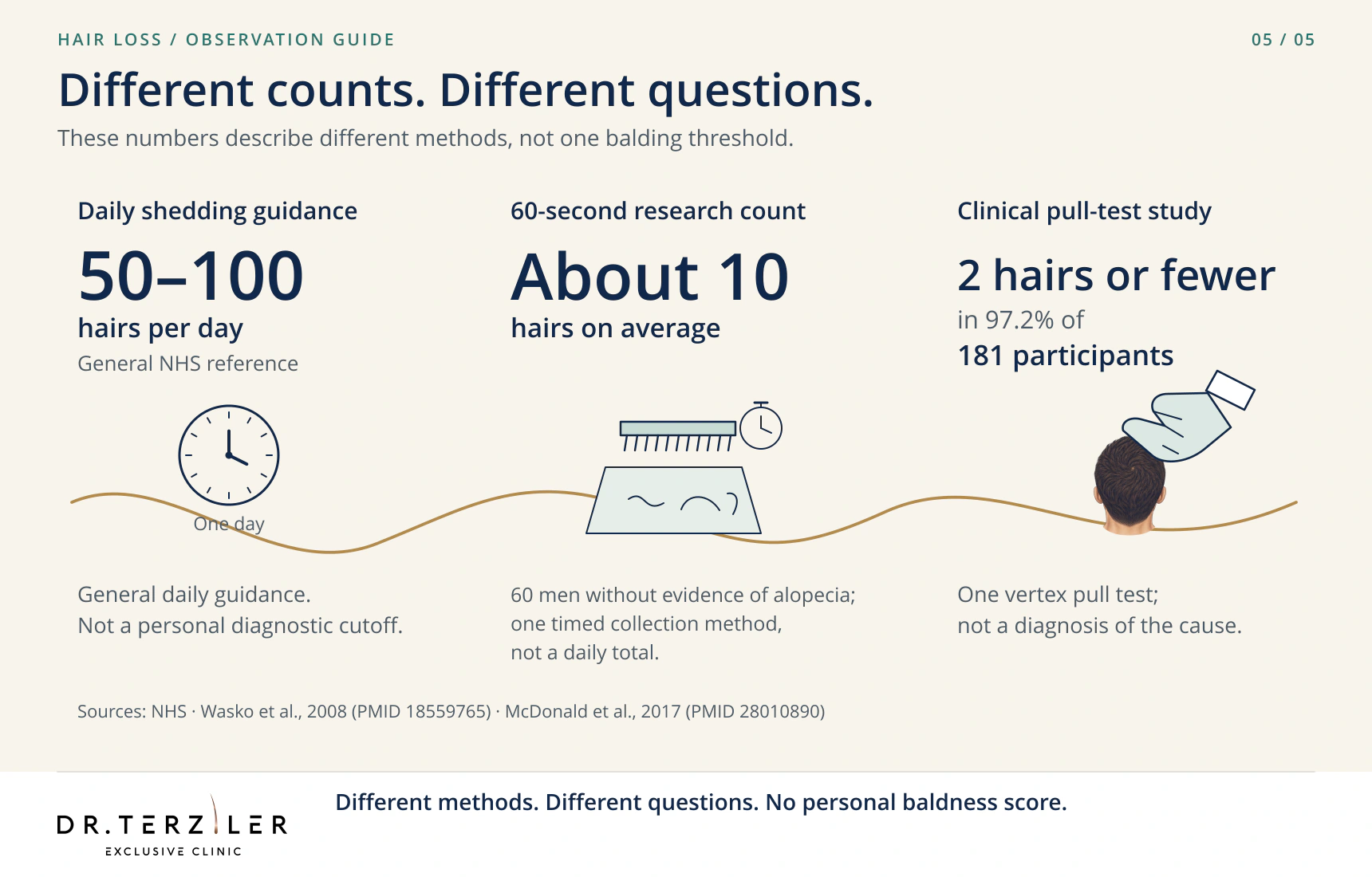
Why do some hair-pull instructions say six hairs while research reports two?
A 2017 study of 181 participants found that 97.2% released two hairs or fewer during a single vertex pull test, leading the authors to propose lower normal values. That finding differs from older thresholds still repeated online. It does not make “three hairs” a diagnosis of balding. [12]
The study measured a particular shedding test. It did not validate a lifetime baldness prediction, a self-administered repeated test or a way to distinguish all causes of hair loss. The practical lesson is to ask which protocol a clinician uses and how the result fits the scalp findings.
Is a 60-second hair count the same as a day's shedding?
No. A 2008 study tested a standardised 60-second hair count in 60 healthy men aged 20–60, without evidence of alopecia. Mean counts were approximately ten hairs in the two age groups. This was a timed collection method, not a finding that people should shed only ten hairs per day. [21]
The sample was almost entirely white men with straight hair, and the authors noted limits on generalising the findings. Those averages should not become a universal home cutoff for women, long or curly hair, or people with scalp disease. If monitoring counts is clinically useful, keep the method consistent and review the results with the clinician who recommended it.
What can trichoscopy show that a phone photograph cannot?
Trichoscopy magnifies the hair and scalp so a clinician can examine shaft-diameter variation, follicular units and surrounding skin. It can provide evidence about miniaturisation or another process when the visible pattern alone is ambiguous. It should be interpreted alongside the history and examination. [6][20]
One study retrospectively assessed 131 women: 59 with female androgenic alopecia, 33 with chronic telogen effluvium and 39 healthy controls. The researchers compared several scalp regions under magnification and developed combined diagnostic criteria. They reported 98% specificity for their criteria, rather than 98% accuracy for an ordinary photograph. [20]
That distinction matters when an app promises a certainty score. A clinical method studied in a defined population does not validate a different image, device, population or quiz. Ask what was actually measured and which independent assessment was used for comparison.
What do the clinical sources agree on, and where do they differ?
Read together, the AAD, NHS, BAD and Canadian Dermatology Association guidance supports assessing the pattern and history of hair loss before choosing treatment. Their descriptions distinguish progressive pattern loss, increased shedding and other causes. A visible finding helps start the assessment; it does not identify the cause by itself. [1][2][3][5][11]
| 質問 | Where the guidance converges | What remains individual |
|---|---|---|
| What should I notice? | Hairline, part, crown, shedding and scalp changes are relevant observations | Which findings explain your own presentation |
| Does every shed hair mean baldness? | Normal shedding occurs, while increased shedding can have several causes | Whether your recent change needs investigation |
| Can it begin young or affect women? | Pattern loss is not limited to older men | Age, distribution and other possible contributors |
| Can one treatment fit everyone? | Treatment depends on the cause and suitability | Expected benefit, risks, burden and follow-up |
The guidance does not supply one universal centimetre measurement, daily count or online score that settles “am I balding?” Differences in quoted shedding ranges illustrate why a reference number needs context. For an individual, the more useful evidence is what changed, how quickly it changed and what the examination shows.
Research adds another layer. It can investigate a particular test or diagnostic feature in a defined group. That is valuable evidence, but it does not make every home observation equivalent to the studied clinical method.
Am I balding as a woman if my hairline has not changed?
Yes. Female pattern hair loss can reduce coverage through the central part and top of the scalp while the frontal border remains largely preserved. A widening part or less ponytail fullness can therefore matter even without temple recession. Diffuse shedding and other causes may resemble or accompany this pattern. [13][14]
Compare the same part, not whichever part looks widest that day. Record whether the difference is mainly through the top, along the edges or across the scalp. Changes in hair length and styling matter when interpreting ponytail thickness, so that observation is most useful alongside other findings.
Mention recent childbirth, menstrual changes, illness, marked weight change, restrictive eating, medicines and repeated tension from hairstyles. These details guide the investigation; they do not automatically mean that a hormone imbalance or deficiency is responsible. The clinician selects relevant tests rather than ordering the same panel for everyone. [22] If female hair transplantation is being considered, the cause of thinning and the condition of the donor area need assessment before surgical planning.
Can postpartum shedding and pattern thinning happen together?
They can. A period of increased shedding after childbirth may make previously subtle thinning easier to notice, and more than one cause can contribute to the appearance. The history of the part and crown before pregnancy is useful alongside the timing of the new shedding. [7][16]
If the shedding settles but the part keeps widening, or there are symptoms and patches, arrange a review rather than assuming every change is a normal postpartum event. Do not start an adult treatment plan from a photograph; pregnancy and breastfeeding change which options are appropriate.
Can balding start at 16, 20, 23 or 27?
Pattern hair loss can begin after puberty, including in the late teens and twenties. Age does not confirm the diagnosis or predict the final extent. A new change at 16, 20, 23 or 27 still needs the same basic questions about distribution, speed, symptoms and medical history. [3][5]
The word “normal” can hide two questions: whether something is possible at your age, and whether you should simply ignore it. Early-onset pattern loss is possible. That does not mean every young person with a visible scalp has it, or that a persistent change deserves no attention.
What are the early signs of balding at 20?
At 20, useful clues include progressive temple recession, increasing crown visibility and reduced coverage over time. A newly photographed whorl or a naturally high hairline is weaker evidence. Look for a repeatable change and have persistent thinning assessed rather than predicting your future from your age. [18]
If you are comparing an adult hairstyle with an older short haircut, note the difference before judging the border. Likewise, a heavy shedding episode after illness needs its own history even if relatives began losing hair young.
Is balding at 23 or 27 normal?
Pattern loss can occur at both ages, but an age label does not explain why a particular person's hair is changing. The useful question is whether you have an active, treatable problem and what the examination shows. Waiting for a supposedly “normal” age is unnecessary if change is persistent. [5]
Avoid interpreting a cohort percentage as your personal timetable. How common hair loss is in a study depends on the population, definition and degree of loss counted. Mild recession and extensive baldness are different outcomes.
What should I do if I think I am balding at 16?
Arrange an assessment with a healthcare professional and involve a parent or trusted adult where appropriate. Hair loss in teenagers can have several explanations, and adult medicine or transplant advice should not be applied automatically. Bring photographs, the onset and any scalp or health symptoms. [3][4]
The first aim is to identify the cause and protect your health, not to choose a graft count or buy a treatment package. You do not have to wait until you are 18 to ask a doctor about a change.
Is Gen Z going bald faster?
Selected clinic or student surveys and viral photographs cannot establish that an entire generation is balding faster. A convincing comparison needs population data measured consistently across ages and birth cohorts. The genetic and hair-count studies discussed here do not test a rise in hair loss among Gen Z. [19][21]
For your own assessment, record actual change and relevant history. Stress, illness, diet, medicines or styling may be worth discussing without turning any one of them into an explanation for a whole generation.
How do similar hair concerns lead to different next steps?
The same phrase, “I can see my scalp,” can describe different situations. The next useful step depends on the timeline, the quality of the comparison and any accompanying symptoms. These hypothetical examples illustrate how to organise the evidence; they are not clinic patients, diagnoses or treatment outcomes.
What if my crown only looks bare under a phone flash?
A first flash photograph of a wet crown provides little evidence about progression. Retake the view with dry hair, even lighting and the same head angle, then compare any useful older photographs. If you still suspect a change, an examination can assess it without requiring months of home monitoring.
Imagine that the central swirl looks striking in one image but the surrounding coverage appears similar in several comparable views. The useful observation is “the appearance changes with conditions,” rather than “I am definitely balding” or “I definitely cannot be.” Record a baseline and note symptoms or a new trend if they appear.
What if my temples have changed but I barely shed?
A gradual temple change deserves assessment even without a dramatic shed count. Pattern loss can become apparent through reduced coverage and miniaturisation rather than a sudden shower event. Compare the border and the hair behind it, and show the clinician the dated sequence. [10][18] The role of DHT in hair loss helps explain why a gradual change in coverage can occur without a dramatic increase in shedding.
For example, an adult reports that the same hairstyle exposes more of both corners over several months, while the drain looks ordinary. Counting more hairs is not the missing proof. The useful questions are whether there is miniaturisation, how the crown looks and whether the pattern is active.
What if shedding started after an illness but my part was already widening?
Discuss both timelines. A delayed shedding episode may fit a recent trigger while the older widening part raises a separate question about pattern thinning. Finding a plausible trigger should not erase the history of gradual change, and the combination cannot be resolved by a single selfie. [11][16]
A useful appointment summary might say: “My part had looked wider for a year. Shedding increased more suddenly a few months after illness.” That separates an older coverage trend from a newer shedding event, allowing the clinician to investigate whether one or more processes are present.
What if I have a new smooth patch but no pain?
A new patch warrants assessment even when it is painless and the rest of the scalp looks full. Alopecia areata can produce sudden patches without visible rash or scarring, and other conditions can resemble it. Lack of pain does not establish that monitoring alone is enough. [23]
Describe when the patch appeared, whether it is expanding and whether eyebrows, beard, body hair or nails have changed. A clinician may examine follicular openings and the surrounding hairs and select further tests if needed. A generic hereditary-risk calculator is not designed to resolve this presentation.
Can an AI hair checker or genetic calculator tell if I will go bald?
An online checker can help organise images or observations, but a prediction score is not a diagnosis or a guaranteed future. A photograph cannot supply the full history or replace scalp examination. Ask whether the tool detects current coverage, estimates a stage or claims to forecast future loss; these are different tasks. [6][10]
AI tools may struggle to interpret changes in lighting, hair condition and camera position unless their validation specifically addresses them. A useful report should explain its limitations and leave unclear findings unclear. A precise-looking percentage is not enough without a defined population, clinical reference and evidence about performance.
Before uploading identifiable scalp photographs, check what is stored and whether the images may be reused. You should be able to understand the educational guidance without providing a face photograph or buying a treatment. Keep a copy of the original image if you use software to organise comparisons.
What does a study of 52,874 men tell us about genetic risk?
A 2017 study of 52,874 White British men aged 40–69 identified 287 independent genetic loci associated with male pattern baldness. It illustrates the complexity of the trait and why one relative is an incomplete guide. It was not a study validating a selfie quiz for teenagers or predicting an individual's exact future hairline. [19]
Its research model compared categories of hair loss using genetic information. Those categories and that population do not automatically represent a different age, ancestry or commercial questionnaire. Family history from either side is relevant background, while your current pattern and examination remain necessary for a personal assessment.
Can I know for certain that I will never go bald?
No current photograph, age or family-history checklist can guarantee lifelong hair retention. Pattern loss varies in onset and severity and has a complex genetic basis. You can evaluate the hair you have now and decide how to monitor or treat a demonstrated problem without obtaining a certain lifetime forecast. [5][10]
Equally, a bald father or grandfather does not prove that you will develop the same degree of loss at the same age. Family history informs the discussion; it should not become a reason to disregard your own findings or begin treatment without assessment.
How should I photograph my hair to check for change?
Photograph the same regions under similar conditions: frontal hairline, both temples, top and crown. Match lighting, distance, head position, parting and hair condition. Add the back and sides for a consultation. These views document appearance and distribution; ordinary photographs do not count follicles or confirm miniaturisation.
- Choose an evenly lit place you can reuse. Avoid comparing a flash image with a shaded room image.
- Keep the camera distance and head angle similar. Ask someone to help with the crown rather than tilting differently every time.
- Use the same parting and style. Compare dry with dry, or clearly record wetness when that is the chosen method.
- Note haircuts, colour changes, concealing fibres, treatments and styling products that could change the appearance.
- Label the images with dates and conditions. Keep unedited originals rather than filters or enhanced contrast.
Top and crown are separate views. A top photograph looks down over the mid-scalp; the crown view shows the whorl further back. The consultation photo checklist helps prepare a complete set rather than repeatedly photographing only the most worrying angle.
Can I fairly compare these photographs?
Record the conditions without uploading a photograph.
Opens a draft containing the conditions you selected and this checklist summary. Review it before sending.
Comparable conditions make a comparison easier to interpret. You can arrange an assessment even without older photographs.
What should I record alongside the photographs?
Record when you first noticed the change, where it occurs, whether shedding has increased, any scalp symptoms and relevant changes in health, medicines or styling. A photograph documents appearance; the accompanying history explains when and how the concern developed.
| Record | Example of useful wording |
|---|---|
| Location | “Both temple corners” or “the same central part” |
| Onset | “First noticed in August; older photographs available” |
| Conditions | “Dry hair, usual part, same room and camera distance” |
| Shedding | “More than my usual wash-day amount for several weeks” |
| Other findings | “New scale and tenderness” or “no new symptoms noticed” |
| Context | “Recent illness; medication list available” |
An example is a model for describing the concern, not a symptom threshold. You do not need a perfect photo archive or exact hair counts before asking for help.
How often should I check without getting stuck in a checking loop?
Use a planned interval, such as monthly photographs, unless a clinician recommends otherwise. Repeating pictures throughout the day mostly creates differences in lighting and styling. If symptoms, a new patch or rapid change appear, arrange an assessment rather than waiting for the next scheduled photograph.
A practical plan is to take one baseline set, keep the conditions written down and use the next scheduled set only if monitoring remains appropriate. If the comparison is still unclear or concern persists, a scalp examination is the useful next step. There is no requirement to complete a 30-, 60- or 90-day waiting period before being assessed.
When should I see a doctor instead of monitoring at home?
Arrange an assessment for persistent thinning, repeated increased shedding, a new patch or scalp symptoms. Seek help sooner for rapidly changing loss, pain, burning, sores, pus or loss involving eyebrows or other body hair. A painless scalp or unchanged frontal border does not exclude a problem. [1][4][23]
If symptoms are severe, rapidly worsening or accompanied by fever or feeling unwell, seek prompt local medical care. Do not wait for a clinic photo reply. Children and teenagers with new hair loss also need an age-appropriate medical assessment.
What will the clinician examine beyond the hairline?
The clinician assesses the distribution of the loss, scalp skin, follicular openings, hair shafts and relevant findings elsewhere, alongside the history. Magnification can help distinguish miniaturisation, breakage and inflammation. Blood tests or a biopsy may be selected when the findings suggest a specific question; they are not mandatory for everyone. [22][23]
Ask what the proposed diagnosis explains. Does it account for both the pattern and the timing? If your hairline has slowly changed but shedding suddenly increased, both details deserve an explanation. If a treatment is proposed, ask which finding it is intended to address and how the response will be reviewed.
The hair-loss assessment guide explains how photographs and history support this process. In the United States, United Kingdom or Canada, local primary care or a dermatologist can start the assessment; you do not need to travel to Istanbul to evaluate a new symptom.
Can I stop early balding or grow thinning hair back?
Some causes of hair loss improve, and treatment can slow pattern loss or improve coverage in suitable people. Regrowth depends on the diagnosis, how long the change has been present and the response to treatment. No option guarantees complete restoration, and pattern-loss treatment usually needs ongoing use to maintain benefit. [2][16]
Topical minoxidil is an established option for suitable male and female pattern loss; finasteride is used for appropriate adult male patients after discussing risks and suitability. Do not choose medicine from this self-check. Age, pregnancy or pregnancy plans, medical history and the cause of the loss change the decision. [2][13][17]
Other approaches, including red light therapy for hair loss そして PRP hair treatment, have their own evidence, limitations and treatment burden. They are not automatic next steps for everyone who sees scalp in a photograph. A diagnosis gives the discussion of non-surgical hair treatments a useful starting point.
Does early thinning mean I need a hair transplant?
No. Hair transplantation moves existing follicles and is suitable for selected cases; it does not diagnose hair loss or stop every cause of future thinning. The cause, likely progression, donor area and goals need assessment before surgical planning. [3] With a hair transplant on thinning hair, the discussion should also cover the risk to existing hair and how ongoing loss would be managed.
If surgery later becomes relevant, planning a トルコでの植毛 should include the same questions, along with follow-up after you return home.

What should I ask at a hair-loss consultation?
Ask what finding supports the proposed diagnosis, what else could explain the change and how progress will be assessed. A useful consultation should explain the plan and its limits before you decide about medicines, procedures or surgery. If DHI hair transplantation is proposed, ask how the plan accounts for your existing hair, donor supply and possible future loss.
- What do you see on my scalp, and is magnification useful?
- Could shedding, breakage, traction or inflammation be contributing?
- Do I need any tests, and what would each result change?
- What are the benefits, risks, costs and ongoing commitments of the options?
- Which photographs or measurements will we compare, and when should I return sooner?
At Dr. Terziler Exclusive Clinic in Istanbul, you can ask the team to arrange an assessment and clarify which clinician will evaluate you. The clinical team includes セルヴェト・テルジラー博士 そして クルシャト・ヤルヴァチ博士.
Ready to discuss what you have noticed? Request a hair-loss assessment または ask the team on WhatsApp. Share only the information you choose. A message is a starting point for arranging care, not a confirmed diagnosis.
Which sources support this guide?
- American Academy of Dermatology. Hair loss: Signs and symptoms.
- NHS. Hair loss.
- Canadian Dermatology Association. Alopecia.
- Mayo Clinic. Hair loss: Symptoms and causes.
- British Association of Dermatologists. Hair loss male pattern (androgenetic alopecia).
- NYU Langone Health. Diagnosing Hair Loss.
- American Academy of Dermatology. Do you have hair loss or hair shedding?
- American Academy of Dermatology. Hairstyles that pull can lead to hair loss.
- Allanson JE et al. Elements of morphology: Standard terminology for the head and face. American Journal of Medical Genetics Part A. 2009;149A:6–28.
- MedlinePlus Genetics. Androgenetic alopecia.
- British Association of Dermatologists. Telogen effluvium.
- McDonald KA et al. Hair pull test: Evidence-based update and revision of guidelines. Journal of the American Academy of Dermatology. 2017;76:472–477.
- American Academy of Dermatology. Thinning hair and hair loss: Could it be female pattern hair loss?
- British Association of Dermatologists. Hair loss female pattern (androgenetic alopecia).
- NHS. Body dysmorphic disorder (BDD).
- American Academy of Dermatology. Hair loss: Diagnosis and treatment.
- Gloucestershire Hospitals NHS Foundation Trust. Minoxidil for hair loss.
- American Hair Loss Association. Men's Hair Loss.
- Hagenaars SP et al. Genetic prediction of male pattern baldness. PLOS Genetics. 2017;13:e1006594.
- Rakowska A et al. Dermoscopy in female androgenic alopecia: Method standardization and diagnostic criteria. International Journal of Trichology. 2009;1:123–130.
- Wasko CA et al. Standardizing the 60-second hair count. Archives of Dermatology. 2008;144:759–762.
- Mayo Clinic. Hair loss: Diagnosis and treatment.
- National Institute of Arthritis and Musculoskeletal and Skin Diseases. Alopecia areata, including diagnosis and steps to take.