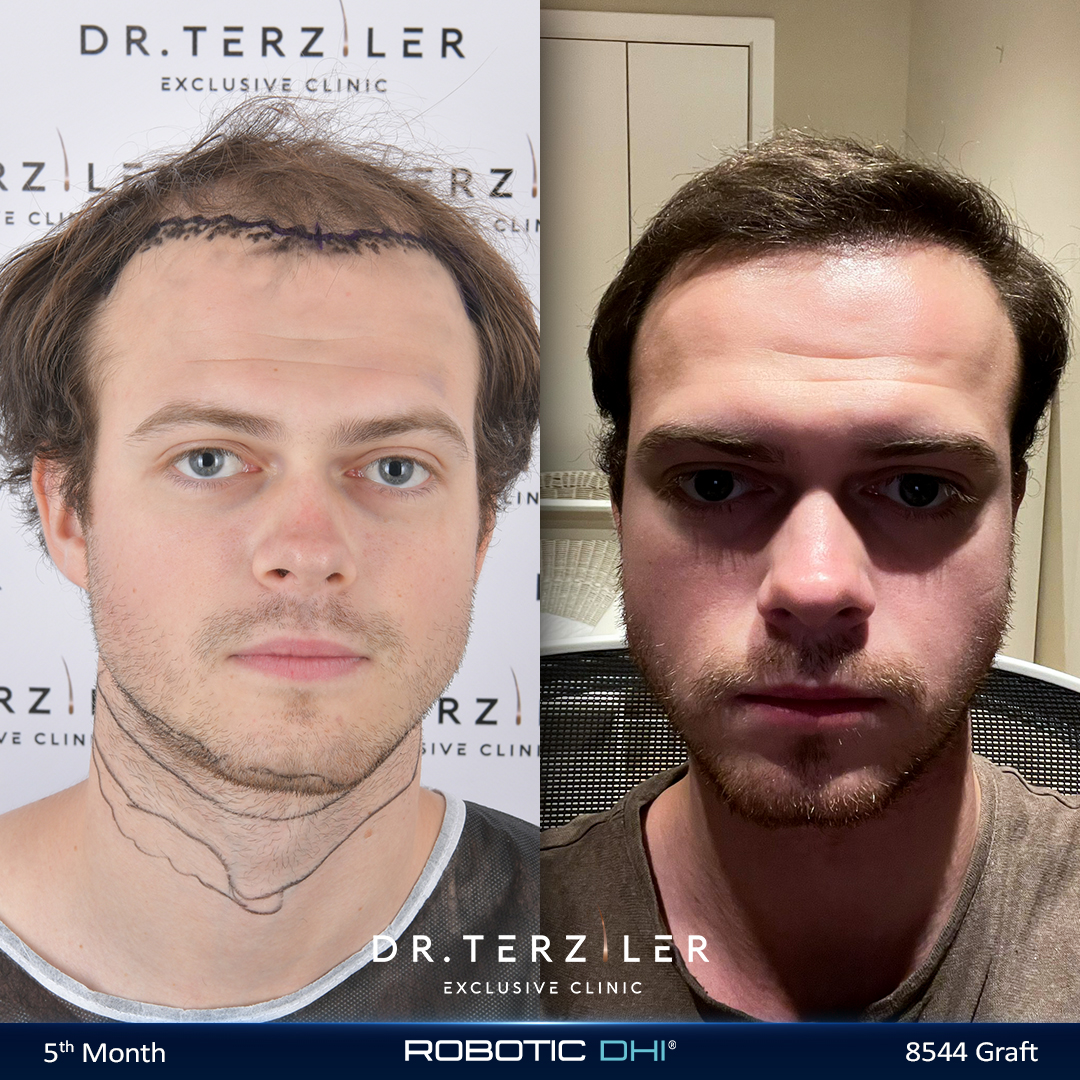
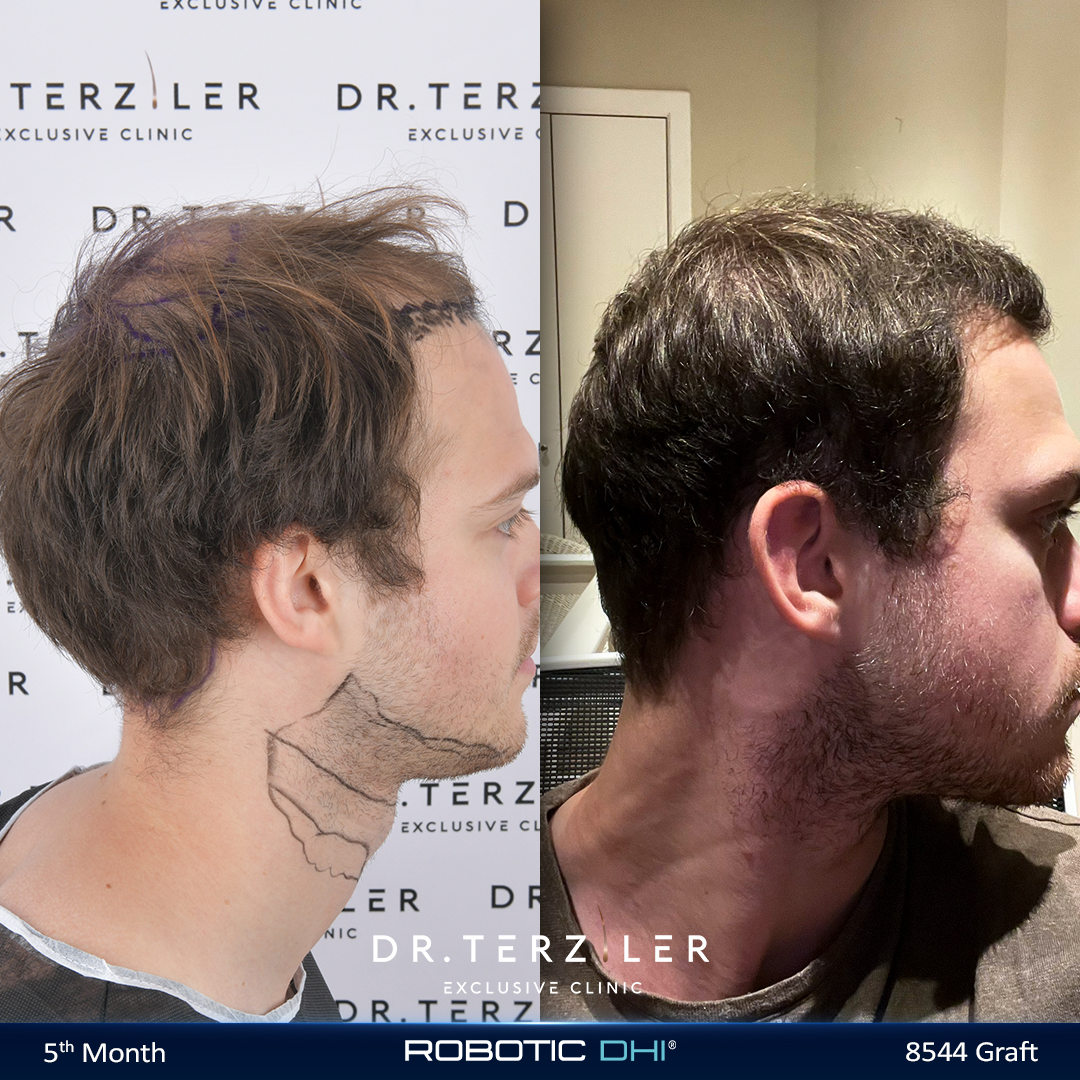
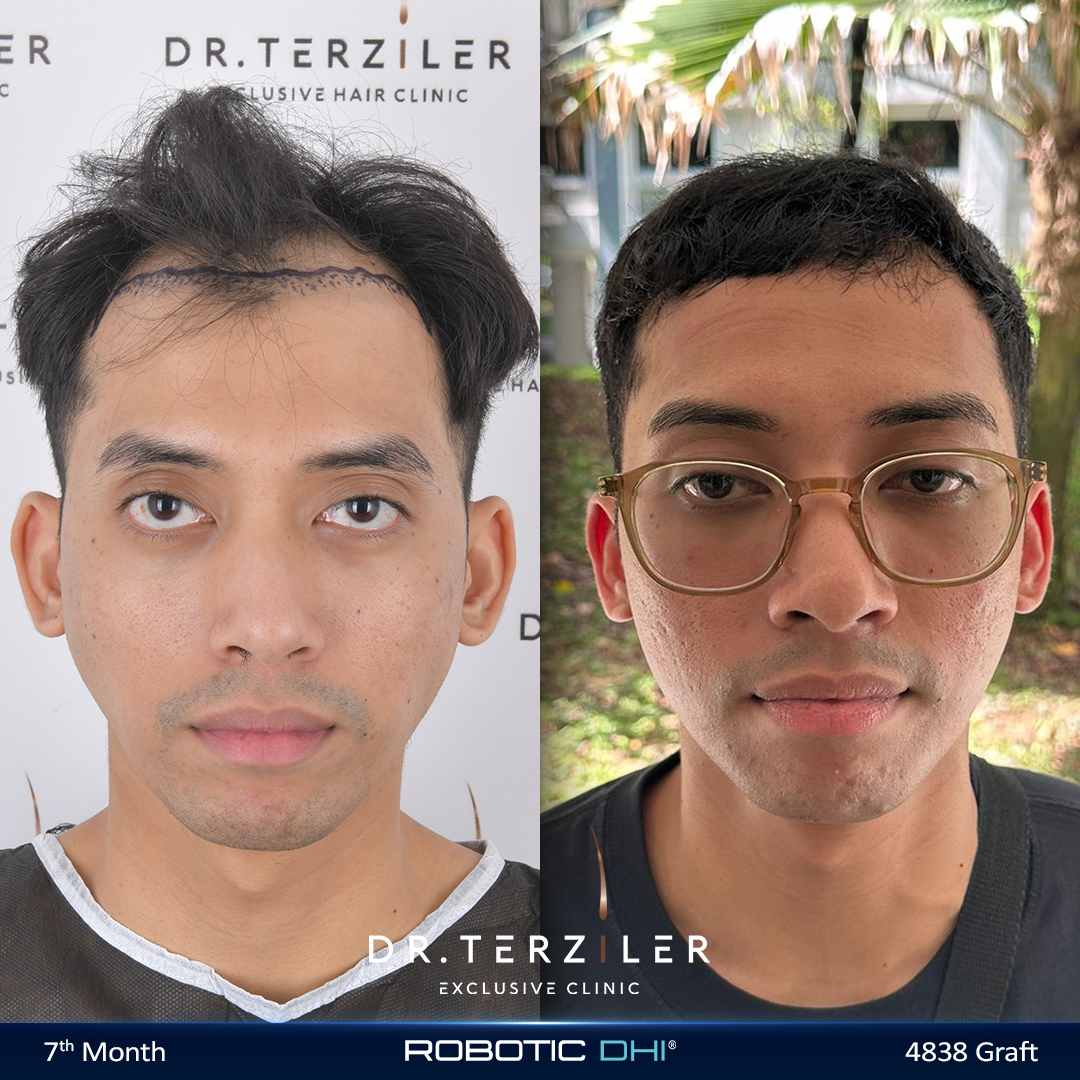
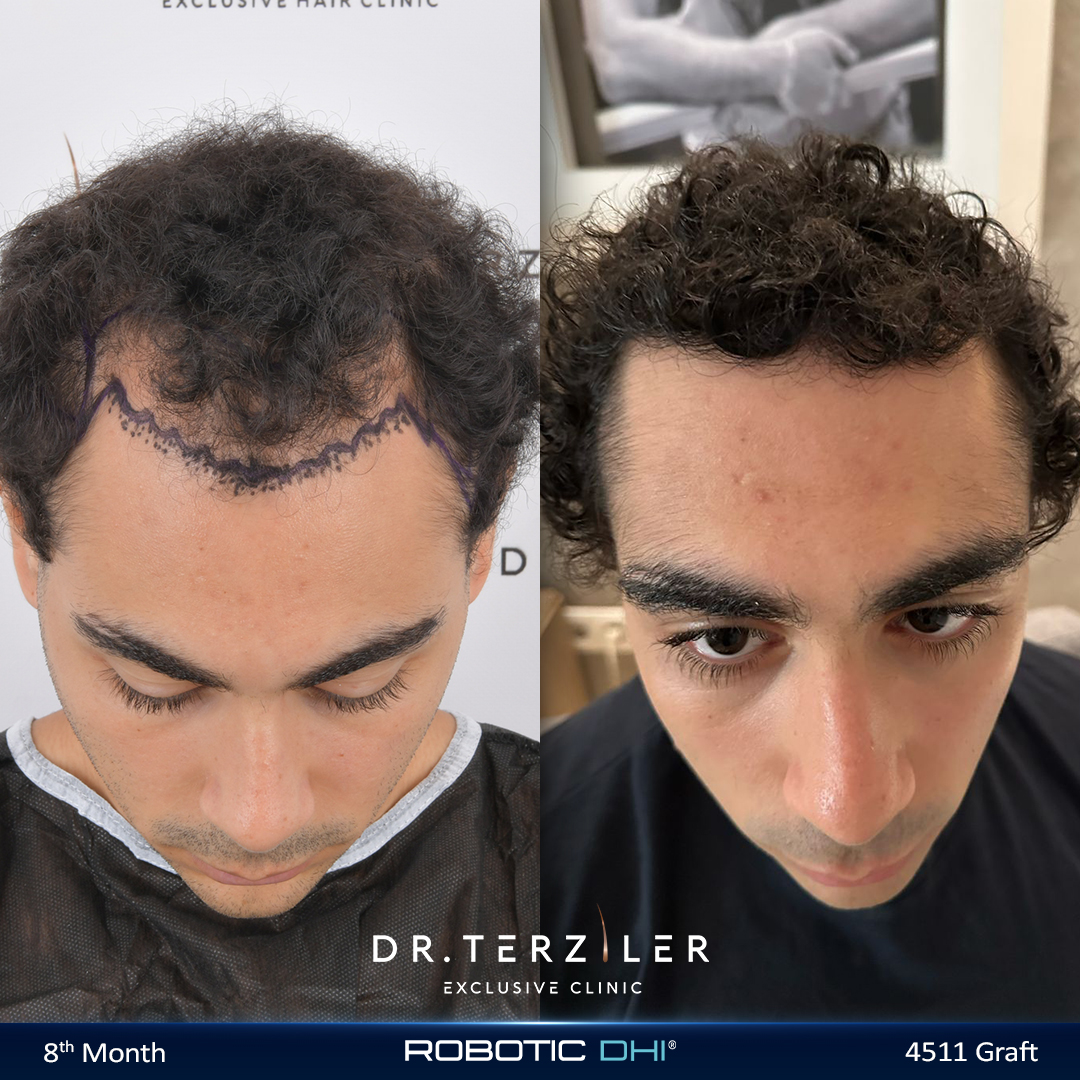
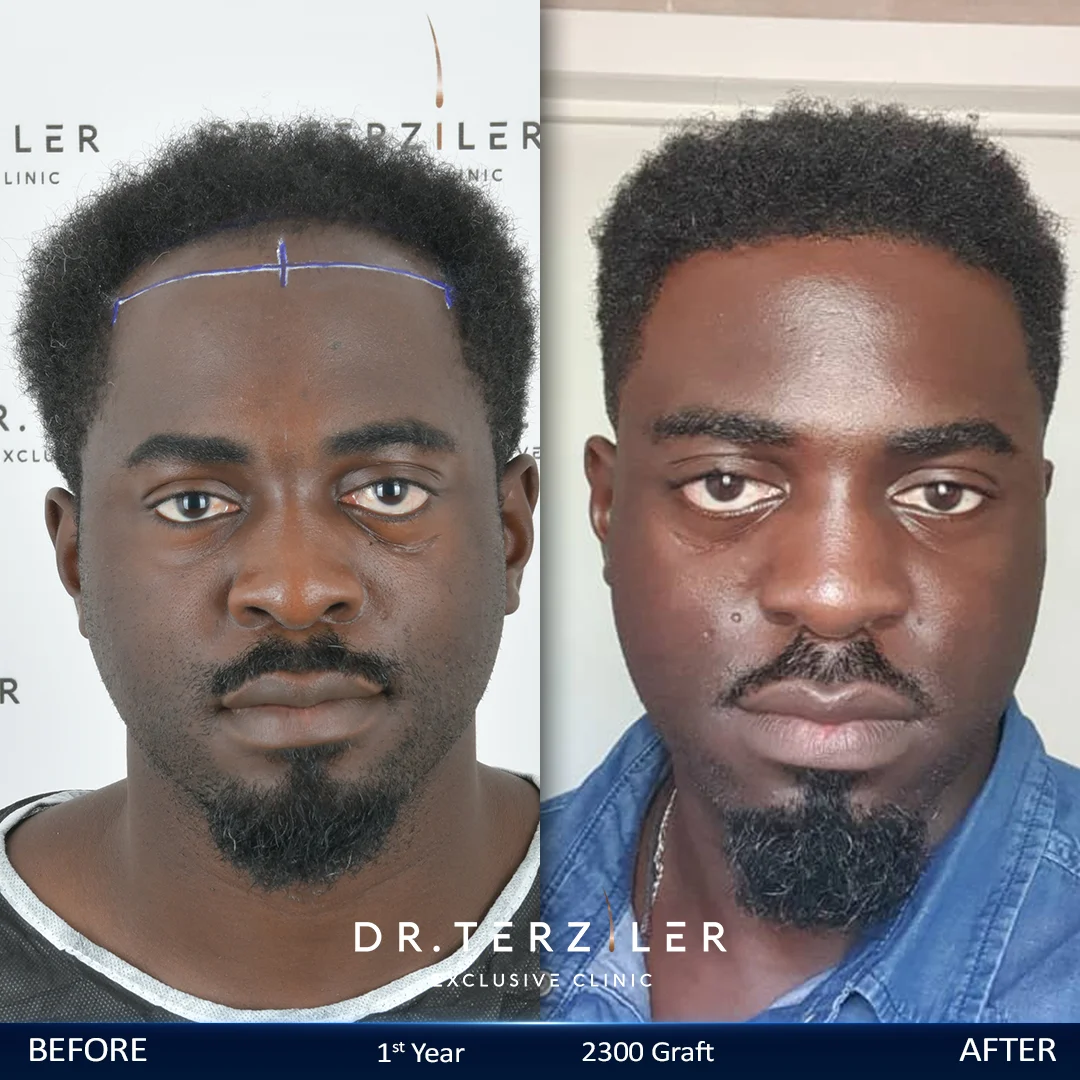
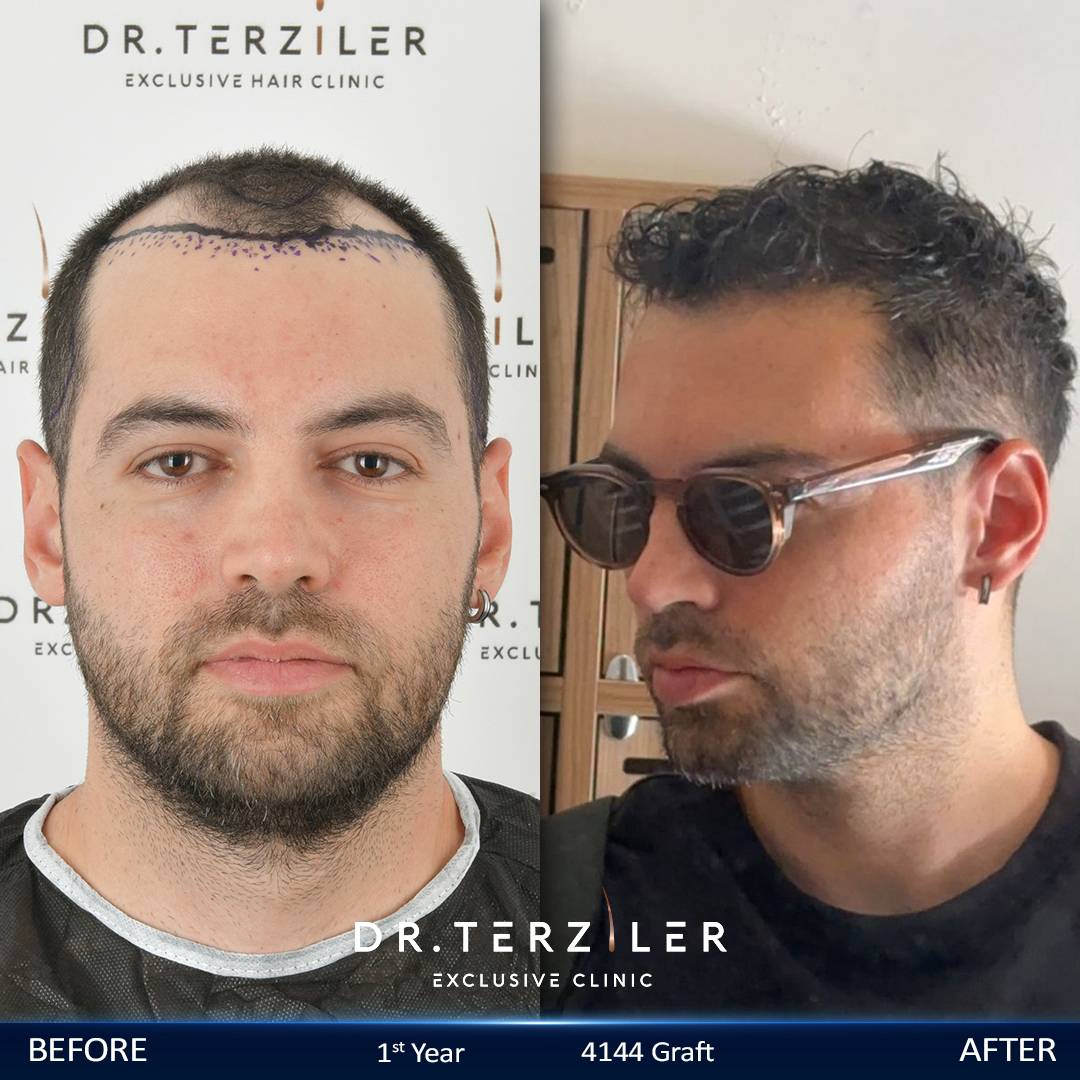
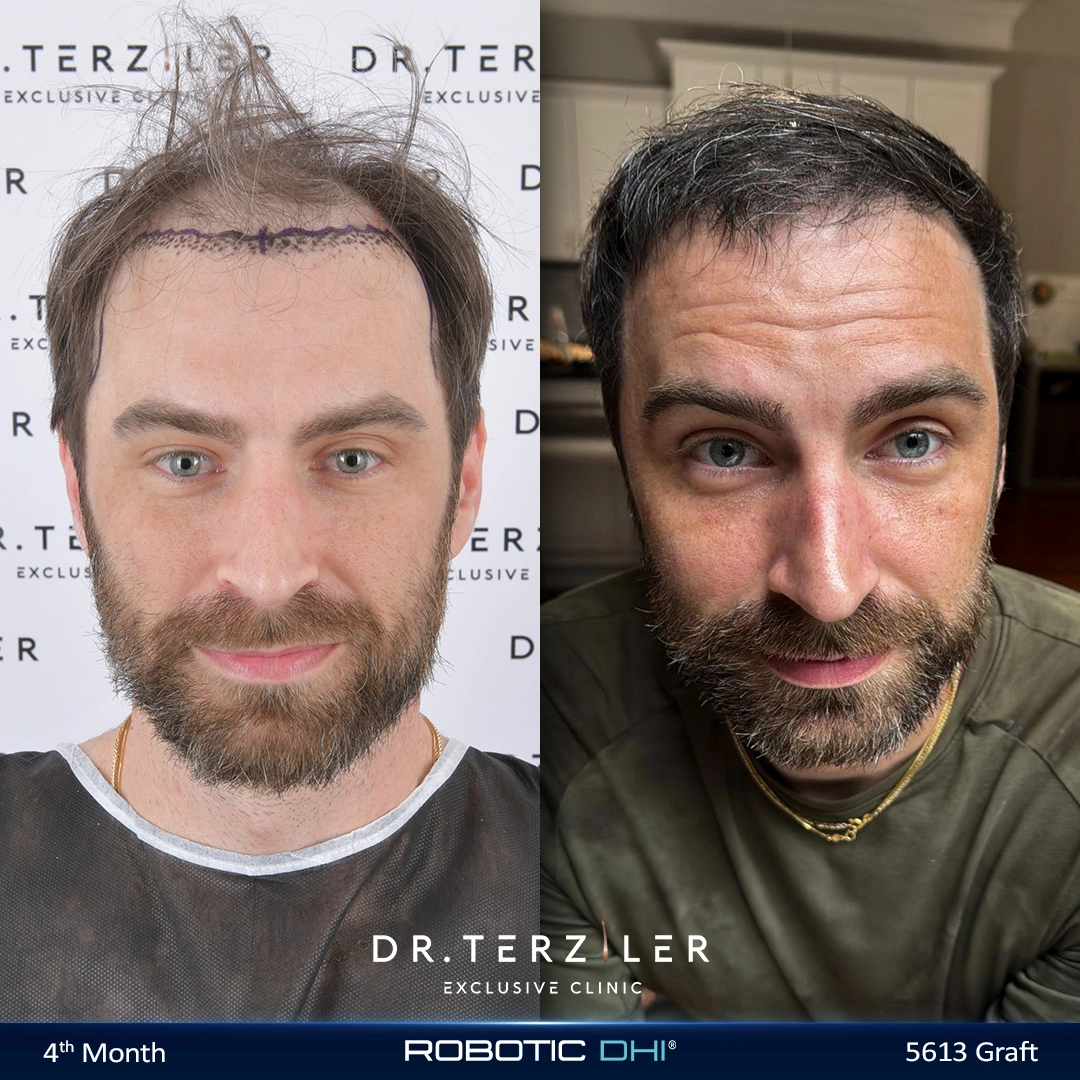
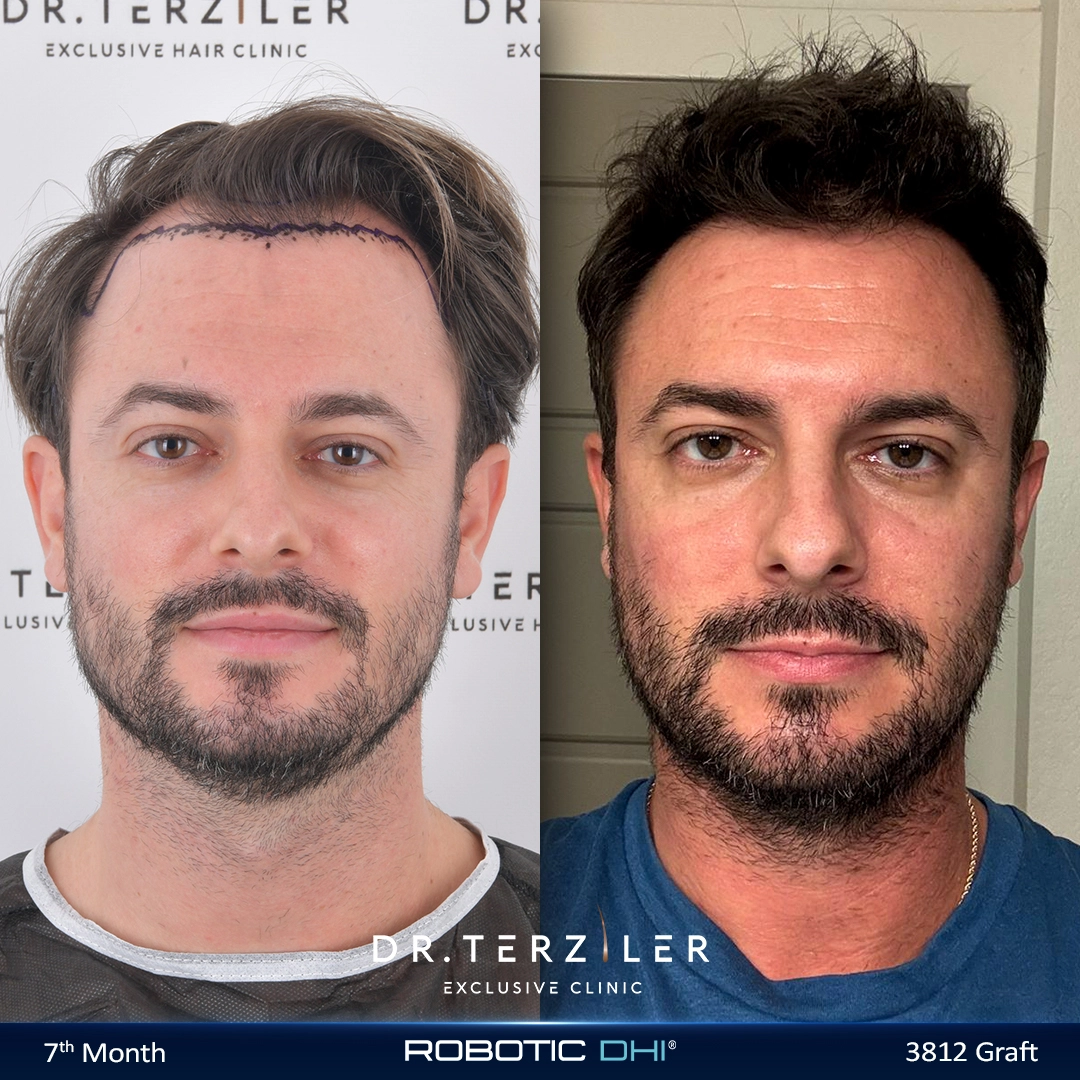
Some people freeze their eggs. Some freeze their embryos. Since 2019, some people have been freezing a few dozen hair grafts from the back of their head, paying a yearly storage fee, and waiting for science to catch up. In October 2026 the idea went viral again, with US coverage framing frozen follicles as a future alternative to hair transplants.
We get the question every week now: "Should I bank my hair?" Here is the honest answer, step by step. Banking follicles is real and available today. Turning those frozen follicles into thousands of new, permanent hairs is not. The gap between those two sentences is where your money goes, so this guide measures it.
Linked researchClaims vs human evidenceTransparent cost scenarios
TL;DR · Hair banking in 60 seconds
Banking follicles is available. Reliable future hair growth from banked cells is a separate, unresolved question.
100–120follicles reported by providers
−180°C to −196°Cquoted storage conditions
£5,90020-year example, before treatment
Providers describe about 100–120 follicles, roughly 40–50 grafts, extracted and frozen at around −180°C to −196°C. [1][11]
Extraction and storage are available. HairClone’s proposed future cell treatment is still described as experimental. [1]
Japanese dermal sheath cup studies are different from HairClone’s program. In a 36-person study, 30% improved on photographic assessment; an earlier trial found a temporary effect through 9 months. [4][5]
Published UK provider prices are £2,300 alongside a transplant or £2,900 standalone, plus about £150 a year. At unchanged fees, 20 years totals £5,900 before treatment. [11]
Proof-of-concept follicle induction does not establish a routine, scalable hair-cloning treatment for bald scalp. [2][3]
Protecting donor supply and treating suitable cases of ongoing hair loss are decisions available today.
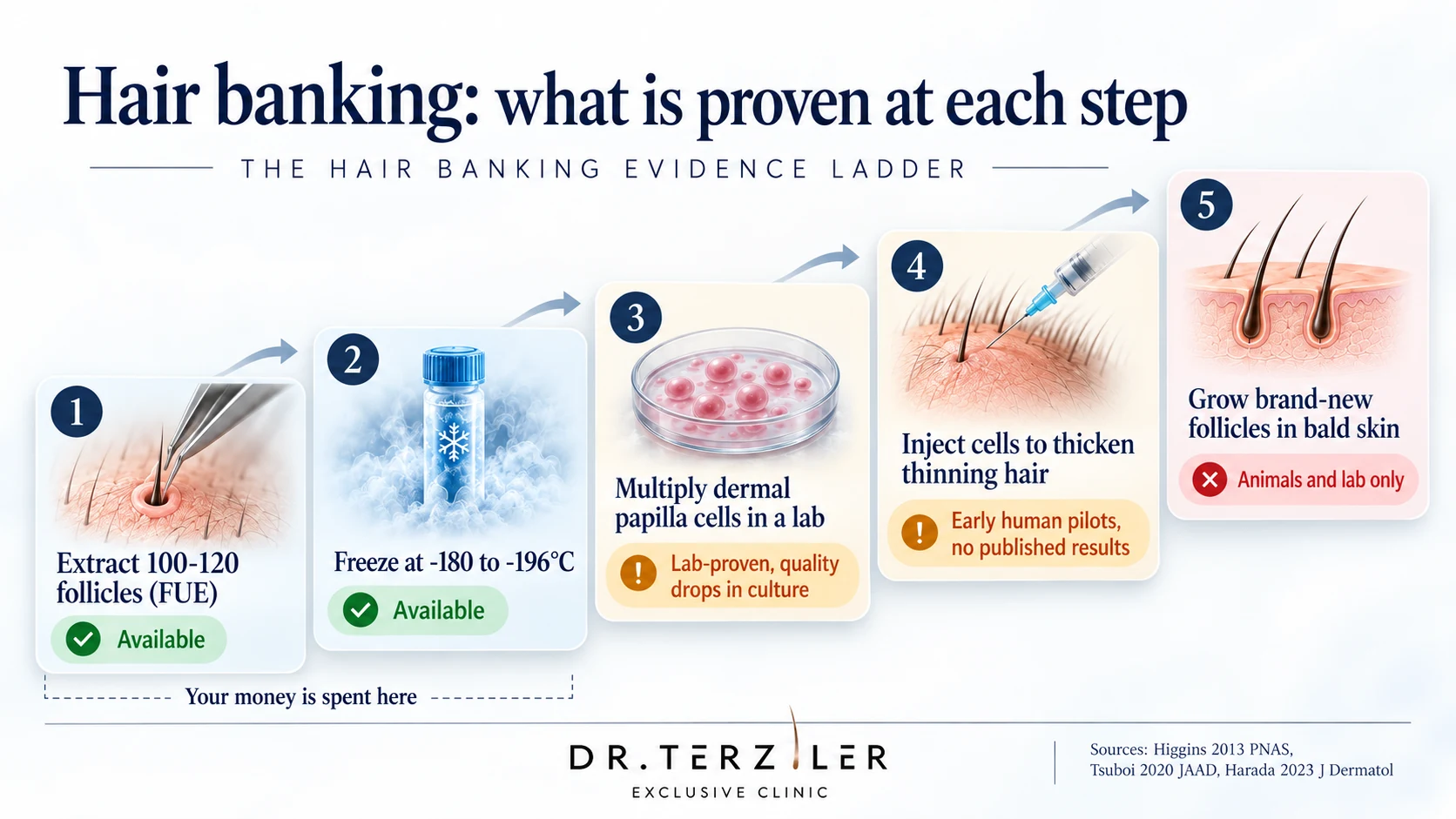
A visual summary of the pathway. The “no published results” label concerns HairClone’s own program; Japanese cell studies and historic human proof-of-concept work are discussed separately below. View full size
What Is Hair Banking?
Hair banking, also called hair follicle banking, is the frozen storage of your own healthy hair follicles for possible future treatment. A doctor removes about 100 to 120 follicles from the back of the scalp using a small FUE punch. That equals roughly 40 to 50 grafts. The follicles travel to a licensed tissue facility and are frozen in liquid nitrogen conditions.
The idea borrows from egg freezing: young cells are stored before age and hair loss weaken them. HairClone, the UK company that launched the service, says frozen cells "do not age" while stored. The plan is to thaw them years later, multiply the cells that control hair growth, and inject them back into thinning areas.
Banking is not a hair loss treatment. Nothing grows after banking. You are paying to store raw material for a treatment that does not yet exist as an approved product. A トルコでの植毛 or anywhere else works differently: it moves living, DHT-resistant follicles that start growing new hair within months.
Hair banking returned to the headlines in mid-October 2026. The New York Post covered it on 13 October and The Daily Beast followed on 16 October, describing extraction of about 100 follicles, costs above $2,000 in the UK plus yearly storage fees, and availability at about 10 US clinics. The Daily Beast also reported that HairClone "started clinical testing in March 2026" and that the technique is not FDA-approved.
HairClone reports that its cell-manufacturing facility and clinical testing are operating in Guatemala City. Its current FAQ describes the treatment as experimental and says outcomes cannot be assured. Media reports differ on the exact start month in 2026, so the location and experimental status matter more than a claimed launch date. [1][13]
HairClone’s public information still describes protocol optimization and the need for clinical trials and marketing licences. The sources reviewed for this guide do not establish peer-reviewed outcomes from its banked-follicle treatment program. Conference discussion or early patient reports should not be treated as a published controlled trial. [1]
How Does Hair Banking Work? Step by Step
Provider-described hair banking process
Step
What happens
Numbers reported by providers
1. Consultation
A partner clinic checks your age, hair loss pattern and family history.
Providers usually target adults under about 45 with early thinning.
2. Extraction
FUE under local anesthesia from the back of the head. No shaving of the whole donor area.
100 to 120 follicles, about 40 to 50 grafts, under 1 hour.
3. Transport
Follicles go to a licensed tissue bank in a controlled container.
Same or next day.
4. Cryopreservation
Follicles are frozen with cryoprotectants and stored in liquid nitrogen vapor or liquid.
About -180°C to -196°C; storage quoted up to 20 to 25 years.
5. Future treatment (not approved)
A few follicles are thawed, dermal papilla cells are multiplied in a lab, and the cells are injected into thinning areas.
HairClone reports more than 1,000-fold cell multiplication in the lab.
Swipe or scroll horizontally on smaller screens. Provider-described hair banking process.
Steps 1 to 4 describe the extraction and storage service. They do not, by themselves, establish the success of the future treatment. Step 5 still needs convincing clinical evidence for the particular cells, processing method and outcomes being offered. [1][3]
The Hair Banking Evidence Ladder: What Is Proven at Each Step
Hair banking is only as good as its weakest step, and the weakest step is the future treatment. We graded each step against published, peer-reviewed research.
Proven. Routine FUE. Like any FUE session, it can rarely cause temporary shedding around the extraction sites, known as donor area shock loss. This usually starts 2 to 4 weeks later and regrows within 3 to 6 months.
Evidence: Standard hair transplant technique.
02
Storage service available
Freezing whole follicles
Proven in animals. Mouse follicles frozen in DMSO grew extensive hair over 8 weeks after transplant [6]. We found no published human study of thawed follicles regrowing hair.
Works in the lab, with a catch. Human dermal papilla cells lose their hair-inducing power when grown flat in a dish. Growing them as 3D spheroids partly restores it [3].
Early human evidence from different cell preparations. The 2023 Japanese study reported 30% photographic improvement; the earlier trial found temporary benefit through 9 months. These are not results from HairClone’s banked-follicle program. [4][5]
Evidence: Tsuboi et al., JAAD 2020 [4]; Harada et al., J Dermatol 2023 [5]
05
Routine treatment unproven
Growing new follicles in bald skin (true "cloning")
No established routine scalp treatment. A small 1999 human proof-of-concept exists [2]; the 2013 human-skin-on-mouse, 2022 mouse follicloid and 2026 mouse organoid studies do not establish scalable clinical hair cloning [3][7][8].
Evidence: Higgins 2013 [3]; Kageyama 2022 [7]; Wang 2026 [8]
Hair Banking vs Hair Cloning vs Stem Cell Hair Treatment
These three terms are often used as if they mean the same thing. They do not.
Hair banking, hair cloning, cell therapy and transplantation
Term
What it means
Available today?
Hair banking
Freezing your own follicles for future use.
Yes, at licensed partner clinics.
Hair multiplication / cell therapy
Multiplying cells from your follicles and injecting them to strengthen thinning hairs.
Experimental pilots only.
Hair cloning
Creating brand-new, permanent follicles from a few cells, to grow hair where none exists.
No established routine, scalable bald-scalp treatment; laboratory, animal and limited proof-of-concept research.
"Stem cell hair transplant" (as marketed)
Usually injections of fat-derived cells, cell secretions or exosomes. Not a transplant of new follicles.
Some products are marketed, but availability does not establish evidence or approval. Check the exact product and jurisdiction. [10]
Hair transplant (FUE, DHI)
Moving your own DHT-resistant follicles from the donor area to thinning areas.
Established surgery, with individual suitability, risks and long-term limitations.
Swipe or scroll horizontally on smaller screens. Hair banking, hair cloning, cell therapy and transplantation.
No proven routine treatment currently offers scalable, brand-new follicle creation for bald scalp in the sources reviewed here. Banking services and experimental cell injections are different from a validated cloning treatment. Historic proof-of-concept experiments do not establish routine clinical availability.
In a randomized, placebo-controlled study of 50 men and 15 women, dermal sheath cup cell injections increased hair density and cumulative hair diameter at the lowest tested dose, 3.0 × 10⁵ cells, at 6 and 9 months. The authors described the positive effect as temporary, through 9 months. This was a different cell approach from HairClone’s dermal papilla program. [4]
A later single-arm, multi-center study gave 36 participants two dermal sheath cup cell injections three months apart. Blinded photographic assessment found improvement in 30%, and mean hair diameter rose by 2.2% from baseline; no serious adverse events were detected in that small study. Patient-reported outcomes were followed for 12 months. It was not a controlled test of HairClone’s banked follicles. [5]
These results are early, study-specific signals. They do not establish permanent improvement, the safety of every cell product, or the result that a different clinic’s preparation will achieve. The two Japanese studies should not be combined into a universal success rate. [4][5][9]
What about HairClone in Guatemala?
HairClone’s own FAQ says that dermal papilla cells are multiplied at its Guatemala City facility and that testing has begun at the Schambach Hair Clinic. The stated aim is to rejuvenate miniaturizing hair rather than provide a proven method of generating unlimited new scalp follicles. The company describes the protocol as experimental and gives no assurance of outcome; any proposed repeat-treatment schedule remains a development plan. [1][13]
What about lab-grown follicles?
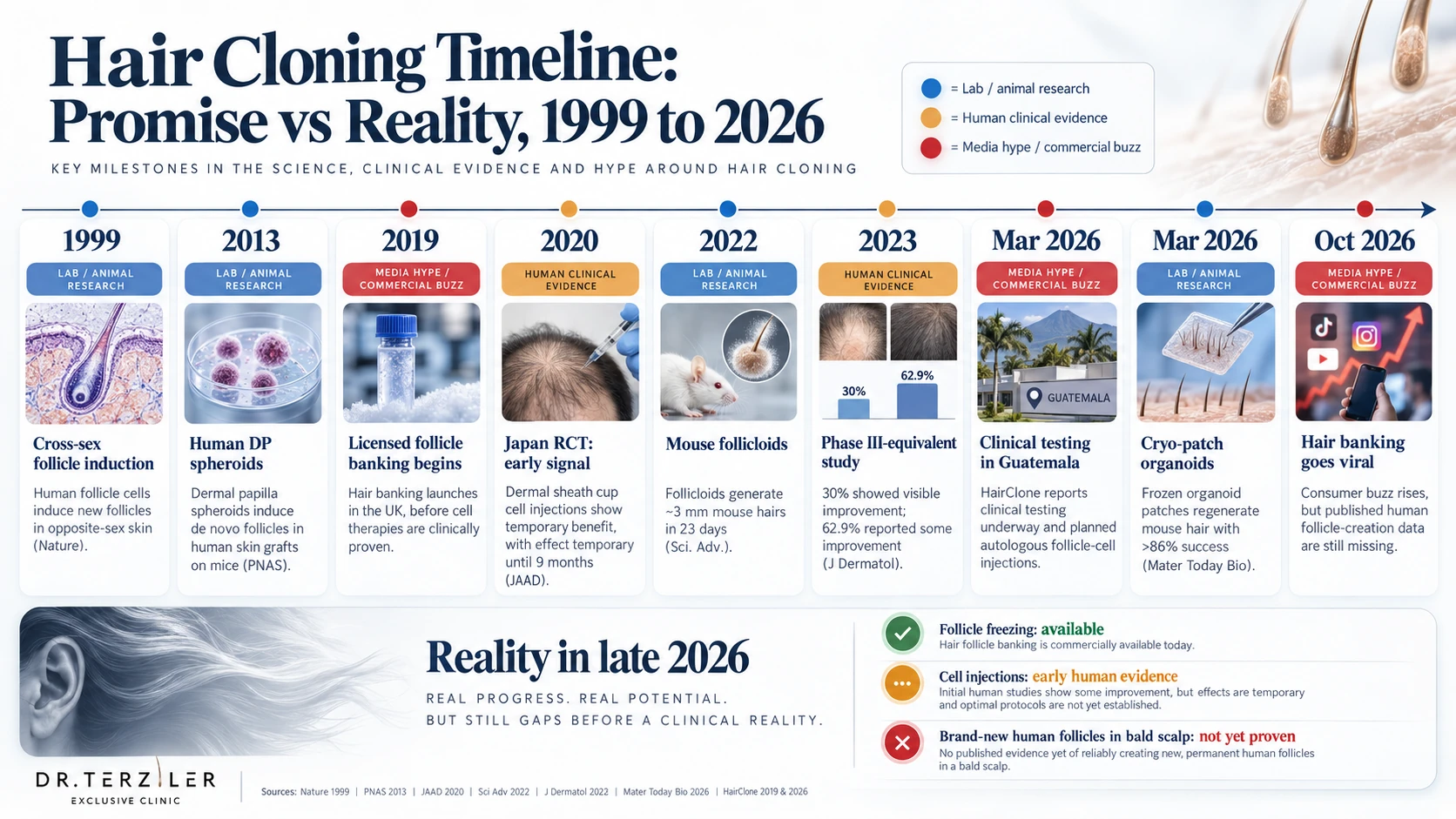
In 1999, researchers reported a small human proof-of-concept: follicular dermal sheath tissue from a man induced follicles in a woman’s skin. That was not a scalable bald-scalp treatment. Later work includes human skin grafted onto mice, mouse follicloids producing about 3 mm shafts in 23 days, and a 2026 mouse organoid cryo-microneedle study reporting more than 86% follicle growth. These models must be distinguished from an approved routine human treatment. [2][3][7][8]
Research milestones are different kinds of evidence. The 1999 report was a small human proof-of-concept, while later mouse and organoid results do not prove routine bald-scalp treatment. View full size
How Much Does Hair Banking Cost?
How much does hair banking cost?
How much does hair banking cost? In the UK, hair banking costs about £2,300 when done alongside a hair transplant and about £2,900 as a standalone procedure, plus about £150 a year for storage. US coverage in October 2026 reported costs above $2,000 plus yearly fees. The future cell treatment is not included and has no confirmed price.
Banking plus storage at unchanged £150 annual fees
Years stored
Banking (standalone)
Storage at about £150/year
Total before any treatment
5
£2,900
£750
£3,650
10
£2,900
£1,500
£4,400
20
£2,900
£3,000
£5,900
25 (max quoted storage)
£2,900
£3,750
£6,650
Swipe or scroll horizontally on smaller screens. Banking plus storage at unchanged £150 annual fees.
Calculated from published UK clinic pricing. Excludes inflation, fee increases, travel and the cost of any future treatment. Check your provider’s current price list. For comparison, the 20-year banking total alone is in the same range as many graft-inclusive packages for a トルコでの植毛, which moves living follicles that grow hair now rather than storing cells for a treatment that is not yet approved.
Annual storage fees and cumulative banking plus storage cost
Year
Storage fee
Storage paid to date
Banking + storage total
20-year static example
£150 per year
£3,000
£5,900
Method: one initial banking fee plus each year’s storage fee. Year 1 uses the selected annual fee; year n uses that fee × (1 + annual increase)^(n − 1), rounded to the nearest penny. Excludes future treatment, travel and other unknown charges. No live currency conversion. Inputs stay on this page unless you choose to share the summary.
The 100-Follicle Math: What Banked Hair Can and Cannot Do
Providers describe about 100 to 120 follicles as roughly 40 to 50 grafts. Against a 4,000-graft example, that is about 1% to 1.25% by graft count—not 100 follicles divided by 4,000 grafts. The banked sample is intended as a future cell source, rather than a graft supply for broad cosmetic coverage. [11]
That changes the question. You are not storing hair. You are storing a cell sample. The value of that sample depends entirely on a therapy that must still prove three things in humans: that frozen and thawed cells keep their hair-making power, that injected cells make a visible difference, and that the difference lasts.
Who Might Consider Hair Banking, and Who Should Not?
Providers tend to market banking to younger adults with early inherited thinning who want to store follicles before further miniaturization. “Under about 45” is a provider positioning guideline, not a validated medical eligibility cutoff. Suitability, donor health and the reason for hair loss need an individual assessment. [1][11]
Provider-targeted groups and reasons for caution
Might consider it
Probably should not
Under about 45, early thinning, family history of pattern hair loss
Advanced baldness (Norwood 5 to 7): cell injections aim to strengthen existing hairs, not regrow bald skin
Already planning a transplant and willing to add banking for a lower combined price
Anyone who needs visible results in the next 1 to 3 years
Comfortable paying for a long-term research bet
Alopecia areata or scarring alopecia (different diseases)
Already using proven treatment to stabilize hair loss
Anyone using banking instead of proven treatment
Swipe or scroll horizontally on smaller screens. Provider-targeted groups and reasons for caution.
9 Questions to Ask Before You Pay for Hair Banking
Is Hair Banking Regulated?
Tissue storage and a cell treatment are separate regulatory questions. A storage licence is not proof that a later hair-growth treatment is approved, effective or available in every country. Ask for the named facility, licence scope and treatment-specific authorization. [1][10][15]
UK: Human tissue procurement, storage and use fall within specific regulatory frameworks. HairClone’s banking launch was reported as HTA-authorised in 2019. Confirm the current named storage facility and its licence directly; do not treat a historic storage authorization as approval of a future cell medicine. [14][15]
US: The FDA warns about unapproved regenerative products, including certain cell products and exosomes. It reports serious harms across that wider product category and advises patients to check approval and FDA oversight. Those reports are not a measured complication rate for hair banking or for HairClone’s program. [10]
Guatemala: HairClone confirms experimental testing there. The existence of a local program does not establish FDA or UK marketing approval, or an equivalent regulatory standard in another jurisdiction. Ask the provider for the applicable authorization and oversight documents. [1]
Turkey: The sources reviewed here do not establish an approved routine hair-cloning treatment. Ask any provider using “hair cloning” or “stem cell hair transplant” for the exact product, evidence, licensing and treatment-specific approval. A marketing label alone does not answer those questions. [10][15]
Does Hair Banking Damage Your Donor Area?
Removing a small sample generally uses far fewer grafts than a large transplant, but its effect still depends on donor density, extraction distribution, healing and the actual number removed. Providers describe a small FUE session under local anaesthesia. Recovery instructions and risks should be confirmed with the responsible physician. [11][16]
Every extracted follicle counts toward a finite donor reserve. Tell your future transplant surgeon about any prior banking extraction and keep the written graft record. Careful donor planning supports future options; no donor area or surgical result can be guaranteed for every patient. [16]
The Proven Alternative: Protect the Hair Bank You Already Have
Follicles from a suitably assessed donor area are relatively resistant to androgen-related miniaturization; they are not immune to every cause of hair loss. Protecting donor supply and treating suitable cases of ongoing native-hair loss are established parts of long-term planning. Medication, surgery and experimental cell approaches have different indications and limitations.
Established options and experimental banking pathways
Option
Proven in humans?
When you see results
What it does
Hair banking + future cell therapy
Storage is available; future banked-follicle treatment outcomes remain unproven.
Unknown
Stores a cell sample
Finasteride (men)
Yes, randomized trials
6 to 12 months
Slows or stops pattern loss
Minoxidil (topical or oral)
Evidence depends on formulation; oral use for hair loss requires individual prescribing.
Swipe or scroll horizontally on smaller screens. Established options and experimental banking pathways.
At Dr. Terziler Exclusive Clinic, lifetime donor planning comes before any graft is moved. We map donor density, estimate future loss, and plan sessions so the donor bank lasts. Every patient receives a verifiable graft count and a printed surgery record, so you always know how much of your donor bank has been used. Dr. Servet Terziler invented the ロボット式DHI machine to place each graft at a consistent angle and depth, and ピカソ・ロボティック DHI combines it with an artistic, natural hand-drawn hairline. We treat a maximum of 4 patients a day.
Why Patients Trust Dr. Terziler Exclusive Clinic With Their Donor Bank
Your donor area is finite. At Dr. Terziler エクスクルーシブ・クリニック in Beşiktaş, Istanbul, a doctor plans every graft. Dr. Servet Terziler, the "Picasso of Hair", invented the Robotic DHI machine, is an ISHRS workshop alumnus with 34.55 AMA PRA Category 1 credits, and is the founder and president of TÜSATDER. The clinic holds AACI international accreditation (Cert No. C150-2022-ACC-TR-IEEA) and the Turkish Ministry of Health International Health Tourism Authorization (Cert No. ST-1905). Every patient gets a verifiable graft count, a printed surgery record and a written 2-year graft survival guarantee. The clinic’s written 2-year graft-survival policy is subject to its stated terms, eligibility and exclusions; it is not a guarantee of regrowth of every native hair.
Freezing your hair is a bet on the future. Protecting it is a decision you can make today.
Hair Banking & Hair Follicle Cloning FAQ
What is hair banking?+
Hair banking is the extraction and freezing of about 100 to 120 of your own healthy hair follicles for possible use in future cell-based hair loss treatments. Banking stores cells. It does not grow hair, and the treatments it is meant for are still experimental.
Is hair cloning currently available?+
No proven routine treatment offers scalable hair-follicle cloning for bald-scalp coverage in the evidence reviewed here. Banking is available and cell-injection programs exist, but these are different from creating a reliable new supply of scalp follicles. [1][2][3]
Does hair banking work?+
The extraction and storage service is available. The sources reviewed here do not establish that a treatment made from banked follicles produces reliable, lasting cosmetic hair growth. Banking a sample and proving a later cell treatment are separate steps. [1][11]
How much does hair banking cost?+
Farjo publishes £2,300 when banking accompanies a transplant, or £2,900 standalone, plus about £150 a year. At unchanged fees, the standalone 20-year example totals £5,900 before any future treatment. These are that provider’s UK prices, not a Dr. Terziler hair-banking tariff. [11]
How long can hair follicles stay frozen?+
Providers quote storage of up to 20 to 25 years at about -180°C. Cells frozen at these temperatures stop biological activity, but long-term human data on hair regrowth from thawed follicles does not exist yet.
How many follicles are taken for hair banking?+
About 100 to 120 follicles, equal to roughly 40 to 50 grafts, are taken by FUE from the back of the scalp under local anesthesia. The procedure takes under an hour and leaves small dots that heal in days.
Can banked follicles be used for a hair transplant later?+
Not in a useful way. 40 to 50 grafts are about 1% of a typical transplant and would not give visible coverage. Banked follicles are meant as a cell source for future cell therapy, not as transplant grafts.
Is hair banking worth it?+
Hair banking can make sense only as a long-term research bet for younger people with early thinning who are already using proven treatment. It is not worth it as a replacement for finasteride, minoxidil or a hair transplant.
Who is the best candidate for hair banking?+
Providers tend to target younger adults with early inherited thinning. Age alone is not a validated selection rule. Diagnosis, donor health, expectations, cost and willingness to accept uncertain future benefit need an individual discussion. [1][11]
What is HairClone?+
HairClone is a UK biotech company that launched hair follicle banking in 2019 and began experimental dermal papilla cell injections in Guatemala in 2026. Its cell treatment is not approved by the FDA or UK regulators.
Are stem cell hair transplants real?+
The marketing term is used for different products, including some cell preparations or exosomes; it does not establish that new follicles are created. Ask for the exact product, human evidence and local authorization. The FDA’s warning concerns unapproved regenerative products and should not be treated as a universal risk rate. [10]
Does hair banking hurt?+
The extraction uses local anesthesia, so most people feel only the initial injections. It is similar to a very small FUE session and most people return to normal activity the same day.
References and evidence notes
Company and provider pages describe their services and claims. Research papers describe specific studies; results from different cell types and research models are not interchangeable.
HairClone. Hair Follicle Banking. hairclone.me and FAQs hairclone.me/about-us/f-a-qs (company source).
Higgins CA, Chen JC, Cerise JE, Jahoda CAB, Christiano AM. Microenvironmental reprogramming by three-dimensional culture enables dermal papilla cells to induce de novo human hair-follicle growth. PNAS. 2013;110(49):19679-19688. Columbia University. doi:10.1073/pnas.1309970110
Tsuboi R, Niiyama S, Irisawa R, Harada K, Nakazawa Y, Kishimoto J. Autologous cell-based therapy for male and female pattern hair loss using dermal sheath cup cells: a randomized placebo-controlled double-blinded dose-finding clinical study. J Am Acad Dermatol. 2020;83(1):109-116. Tokyo Medical University. doi:10.1016/j.jaad.2020.02.033
Harada K, Ohyama M, Niiyama S, et al. Efficacy of autologous dermal sheath cup cell transplantation in male and female pattern hair loss: a single-arm, multi-center, phase III equivalent clinical study. J Dermatol. 2023;50(12):1539-1549. doi:10.1111/1346-8138.16957
Cao W, Li L, Tran B, et al. Extensive hair shaft growth after mouse whisker follicle isolation, cryopreservation and transplantation in nude mice. PLoS One. 2015;10(12):e0145997. UC San Diego. doi:10.1371/journal.pone.0145997
Kageyama T, Shimizu A, Anakama R, et al. Reprogramming of three-dimensional microenvironments for in vitro hair follicle induction. Sci Adv. 2022;8(42):eadd4603. Yokohama National University. doi:10.1126/sciadv.add4603
Wang S, Sun J, Li Y, et al. Matrix-free cryo-microneedles array patch for 3D hair follicle organoids delivery and rapid hair regeneration. Mater Today Bio. 2026;37:102997. Southeast University, Nanjing. doi:10.1016/j.mtbio.2026.102997
Romera de Blas C, Vega Díez D, Ricart Vayá JM. Complications in follicular unit excision hair transplantation: current evidence and practical approaches. Front Med (Lausanne). 2026;13:1750989. doi:10.3389/fmed.2026.1750989
The 2023 Japanese study has a 2026 affiliation correction: publisher correction. It does not change the efficacy endpoints summarized here.
This article is for education and does not replace an individual consultation. Hair banking is a storage service; the future cell-based treatment discussed here remains experimental. Suitability, risks, licensing and outcomes depend on the specific intervention and patient.
Your next step
Protect your donor area. Plan with a doctor.
Freezing follicles is a bet on future development. Understanding your diagnosis and donor capacity is a decision you can make today.
Shock Loss After a Hair Transplant: What Falls Out, What Grows Back, and When
Hair transplant recovery · Patient guide
Shedding after a hair transplant can be unsettling, especially when transplanted hair and existing hair seem to fall out together. People use “shock loss” for several different events. This guide separates them, explains what published numbers actually measure, follows recovery week by week and identifies the signs that need a medical review.
Illustrative scalp zones, not a map for diagnosing your own hair loss. Miniaturized native hairs can fail to recover after surgical stress; the diagram does not establish the cause of an individual loss. View full size
What Is Shock Loss After a Hair Transplant?
Shock loss is temporary shedding of existing hair following the stress of hair transplant surgery. Doctors also call it post-operative effluvium. Patients and clinics often use the term more broadly to include expected shedding of transplanted hair shafts. The 2021 review in the Indian Journal of Plastic Surgery discusses both types of shedding [1]. Planning a トルコでの植毛 should include a clear explanation of which hairs may shed and how follow-up will work.
In temporary shedding, the visible hair shaft falls out while the follicle remains capable of regrowth. That is why a thin appearance at week 6 does not establish graft failure. Some miniaturized native hairs may not recover, and infection, scarring or poor graft growth require a different assessment [1][2].
Shock loss vs normal daily shedding
The American Academy of Dermatology describes shedding 50 to 100 hairs a day as normal [9]. Post-operative shedding is different because of its timing and location: it may concentrate around the recipient or donor area within weeks of surgery. A hair count on your pillow cannot, by itself, distinguish expected shedding from a complication.
What Are the 4 Types of Hair Loss After a Hair Transplant?
Most confusion online comes from one word covering four events. Each one has its own timing, cause and outcome. Read this table first, then the rest of the guide makes sense.
Four types of post-transplant hair loss
種類
Where
Usually starts
How common
Grows back?
1. Transplanted hair shedding
Recipient area (the new grafts)
Weeks 2 to 4
Expected in most patients. Implanted hair "usually falls within 3 to 4 weeks" [1]
Scroll horizontally on smaller screens. Four types of post-transplant hair loss.
Is transplanted hair falling out the same as shock loss?
Expected transplanted-hair shedding and native-hair shock loss are related but distinct. In the first, the transplanted shaft releases as its follicle adapts after surgery. In the second, hair that was not transplanted sheds following stress around the operated area. When a patient asks “does transplanted hair fall out?”, the useful distinction is the hair shaft versus the living follicle [1][2].
Why Does Shock Loss Happen?
Shock loss happens because surgery briefly disturbs the follicle environment. Three triggers stand out in the literature: direct trauma to existing follicles when the surgeon opens recipient sites, swelling (edema), and damage to small blood vessels [1]. A 2021 case series in Skin Appendage Disorders adds a fourth: short-term ischemia, meaning a temporary drop in blood and oxygen supply [4].
The 2026 review of FUE complications in Frontiers in Medicine lists the factors that raise the risk: high implantation density, local trauma, too much tumescent fluid (the saline-anesthetic mix injected into the scalp), and psychological stress [2]. In the donor area, the same review points to high extraction density and strong vasoconstriction [2].
Is shock loss telogen effluvium or anagen effluvium?
Post-operative shedding is not always a simple telogen-effluvium process. Telogen effluvium typically appears a few months after a stressor; the AAD describes this delayed pattern [9]. Earlier shedding after scalp surgery has also been described with anagen-effluvium features [4].
Contin and colleagues reported three cases after therapeutic scalp surgery in 2021. Their early timing and trichoscopic findings supported an anagen-effluvium explanation [4]. These were not three routine hair-transplant patients. The paper’s reference to 85% anagen hairs is background hair-cycle context, not a measured 85% shock-loss rate in transplant patients. The 2026 review describes overlapping mechanisms in donor shedding [2].
For a patient, timing helps frame the discussion but does not make the diagnosis. Shedding around week 2 can fit an expected recovery pattern. Pain, discharge, spreading redness or a new patch still deserve assessment, regardless of the week [1][2].
Shock Loss Timeline: Week by Week After a Hair Transplant
Hair transplant shock loss timeline: Shedding starts at weeks 2 to 4 and can continue to week 8. Months 2 to 3 are the thinnest, called the ugly duckling phase. New fine hairs appear at months 3 to 4. Visible density builds from month 6. Most results show at month 9 to 12, and the crown can take 12 to 18 months.
Recovery timing and possible appearance
When
What you see
What is happening
Normal?
Days 1 to 7
Small crusts around each graft. Grafts look like short stubble.
Grafts are anchoring. This is the fragile window.
Can fit expected recovery; assess any warning signs
Days 7 to 14
Crusts fall off. Some hairs come out with them.
Hair shafts may release as crusts loosen; follow the prescribed washing plan.
Can fit expected recovery; assess any warning signs
Weeks 2 to 4
Transplanted hairs shed. Some native hair may thin.
Shedding phase. Implanted hair usually falls by week 3 to 4 [1].
Can fit expected recovery; assess any warning signs
Weeks 4 to 8
Peak thinness. Native shock loss shows here if it happens.
Can fit expected recovery; assess any warning signs
Months 2 to 3
You may look like before surgery, or worse.
Ugly duckling phase. Follicles are resting.
Can fit expected recovery; assess any warning signs
Months 3 to 4
Fine, soft, sometimes curly or wiry hairs appear.
Follicles restart. Native shock loss regrows around now [1].
Can fit expected recovery; assess any warning signs
Months 4 to 6
Patchy growth, uneven lengths.
New hairs thicken. About 1 cm of growth per month.
Can fit expected recovery; assess any warning signs
Months 6 to 9
Clear visual change. Friends notice.
Shafts mature and gain diameter.
Can fit expected recovery; assess any warning signs
Months 9 to 12
Most of the final density.
Texture settles.
Can fit expected recovery; assess any warning signs
Months 12 to 18
Final result. Crown and dense packing finish last.
Maturation.
Can fit expected recovery; assess any warning signs
Scroll horizontally on smaller screens. Recovery timing and possible appearance.
When does shock loss start after a hair transplant?
Shock loss usually starts 2 to 4 weeks after surgery. The 2021 Indian Journal of Plastic Surgery review places recipient effluvium "mostly after 3 to 4 weeks" [1]. Some patients see the first shafts leave at day 10 to 14, when the crusts come off.
How long does shock loss last?
The active shedding often lasts several weeks. The visible thin phase can continue until new growth appears around months 3 to 4, because the new shafts need time to reach the surface. There is no guaranteed day on which every patient is past this stage.
How long after shock loss does hair grow back?
Native hair lost to shock loss usually regrows in about 3 to 4 months [1]. Donor area shock loss resolves within 3 to 6 months [2]. Transplanted hair starts to show at months 3 to 4 and keeps improving for a year or more.
Interactive recovery guide
Where are you in your recovery?
Choose a stage, drag the slider or select your surgery date.
Example recovery stage
Expected shedding window
Transplanted shafts may shed around weeks 2 to 4. Native-hair shedding can appear around weeks 2 to 8. Timing alone does not establish graft survival.
What to do
Follow your washing plan and compare consistent photographs. Do not pick crusts or start a medicine without your clinician’s advice.
Next milestone
Months 3–4: look for early new growth.
Hairline growth may remain uneven for several months.
Any stage: pus, spreading redness, fever, increasing pain or dark skin changes need prompt medical advice. Do not wait for a marketing enquiry or an online reply if symptoms are severe. This tool describes common timing; it does not diagnose your scalp or confirm graft survival.
What Is the Ugly Duckling Phase?: Months 2 to 4
The ugly duckling phase is the temporary thin-looking period after transplanted shafts shed and before new growth becomes visible, often around months 2 to 4. Appearance at this stage does not reliably predict the final density.
This period can be emotionally difficult. Before surgery, ask what your own recipient area may look like after shedding and how the clinic will review progress. Counselling and realistic expectations are part of follow-up; the 2021 review emphasizes preparing patients for this stage [1].
What helps in this phase:
Take a consistent photo set about every 2 weeks: the same lighting, angles and dry-hair condition. A sequence is more useful than repeatedly checking different mirrors.
Use camouflage only when your surgical team says the scalp has healed enough. Ask specifically about a loose cap, hair fibers and styling products rather than treating a calendar date as clearance.
Keep a short haircut. Short native hair makes the contrast smaller.
Avoid judging the final result at month 4. Newly emerging hairs may still be short, fine and uneven. Discuss changes at the planned check-ups and ask earlier if you notice warning signs.
In the 2025 ISHRS Practice Census, members reported that 44% of their patients treated in 2024 planned to tell others about their transplant [8]. This describes disclosure plans; it does not show why the remaining patients preferred privacy or how they experienced the ugly duckling phase. Planning a natural hairline and a manageable recovery appearance are separate discussions.
Does Everyone Get Shock Loss After a Hair Transplant?
No. Most patients shed transplanted hair shafts, but true native-hair shock loss affects a minority. The numbers online look contradictory because they measure different things. Here they are side by side.
Why published shock-loss numbers differ
Number you see online
What it actually measures
Source
"Almost everyone sheds"
Type 1: transplanted shafts falling at weeks 2 to 4. This is the normal graft cycle, not a complication.
Scroll horizontally on smaller screens. Why published shock-loss numbers differ.
So the honest answer to "does shock loss always happen?" is this: you will probably see your new hairs fall out, and that is part of the plan. Losing a visible amount of your own existing hair is less likely, and when it happens it usually comes back.
Is it bad if I have no shedding after my hair transplant?
No shedding is not, on its own, a warning sign or proof of better graft survival. Some grafts retain their shafts. A small 40-patient study reported more early graft-density retention with intra-operative PRP, but that does not establish what an individual patient’s final result will be [6].
Who Is Most at Risk of Shock Loss? 9 Risk Factors
Shock loss risk depends on your hair, your health on surgery day, and the surgical plan. These factors come from the published reviews and case series.
Factors to discuss before surgery
Risk factor
Why it matters
Source
Miniaturized native hair in the recipient area
Miniaturized follicles may be more vulnerable and may not fully recover.
Scroll horizontally on smaller screens. Factors to discuss before surgery.
Before your consultation
Which topics should you discuss?
Select anything that applies. The result is a question list, not a medical risk score.
Selections stay in your browser. The WhatsApp link opens an editable draft; nothing is sent automatically. A count of selected topics is not a prediction of shock loss.
What Is the Donor Area Shock Loss: Thin Patches at the Back of the Head
Donor area shock loss is temporary shedding in the zone where grafts were harvested. It is rare. In the 2,896-patient series it occurred in 1 patient [1]. The 2026 Frontiers review says its true incidence is unknown but "considerably less frequent" than recipient shock loss. It typically starts 2 to 4 weeks after surgery and resolves within 3 to 6 months [2].
It can look alarming. Kerure, Agrawal and Dhurat described four FUE patients who developed round, non-scarring patches at the donor site 2 to 3 weeks after surgery [3]. Under the trichoscope, the patches looked like alopecia areata, with exclamation-mark hairs and black dots. Biopsies showed something else: dilated blood vessels and the pattern of a healing wound [3]. The authors linked it to compromised blood supply and trauma to existing hairs [3].
A new round donor-area patch should be shown to your surgeon. Do not diagnose or treat alopecia areata yourself from a photograph. Temporary donor effluvium often recovers over months, while persistent donor thinning, inflammation or scarring needs examination [1][2][3]. Minoxidil may be considered by the treating clinician; do not start treatment simply because a patch appears.
Shock Loss vs Graft Failure: Normal Signs and Red Flags
Shedding alone does not prove graft failure. Use the signs below to decide when to contact a clinician. Suspected infection, tissue damage or a bleeding displaced graft needs prompt advice; delayed growth at month 6 is a reason to arrange review, rather than an emergency solely because of its timing.
Often expected
Hair shafts shed within weeks 2–8 without fresh bleeding or worsening symptoms.
Stubble releases as crusts loosen under the prescribed washing plan.
A thin appearance around months 2–3.
Fine, wiry or uneven new growth around months 3–6.
Arrange a clinical review
Itchy bumps or persistent redness.
A new localized donor-area patch.
Unexpectedly increasing shedding.
Very little or no new growth around month 6.
Seek prompt medical advice
Pus, yellow discharge or a bad smell.
Spreading redness with increasing pain or a hot scalp.
Fever or black/dark, painful skin changes.
Fresh bleeding or suspected graft displacement after trauma in the early days.
Redness deserves one extra sentence. In a cohort of 1,090 patients summarized in the 2026 Frontiers review, more intense redness around the grafts was associated with more post-op shedding and lower graft survival. Mild redness affected 16.3%, moderate 5.1% and severe 0.9% [2]. Mild pink skin for a few weeks is common. Strong redness that does not fade after month 3 is worth a photo to your doctor.
How to tell shock loss from graft failure
You cannot reliably identify a living or failed graft from the appearance of a shed hair alone. Fresh bleeding or tissue after trauma in the first days should be reported promptly. In a study of 42 patients, graft anchoring became more secure during the first week, with no dislodgement in the study’s tests by day 9 [12]. That finding is not permission to pull hairs, pick crusts or comb aggressively; follow your own surgical team’s washing protocol.
What Does Shock Loss Look Like? Photo Guide
Shock loss looks like general thinning around and between the new grafts, rarely like bald patches. In the hairline, the stubble from surgery thins out and the scalp shows through again. Around the crown, native hair can look see-through for a few weeks. In the donor area, it can appear as a small round thin patch [3].
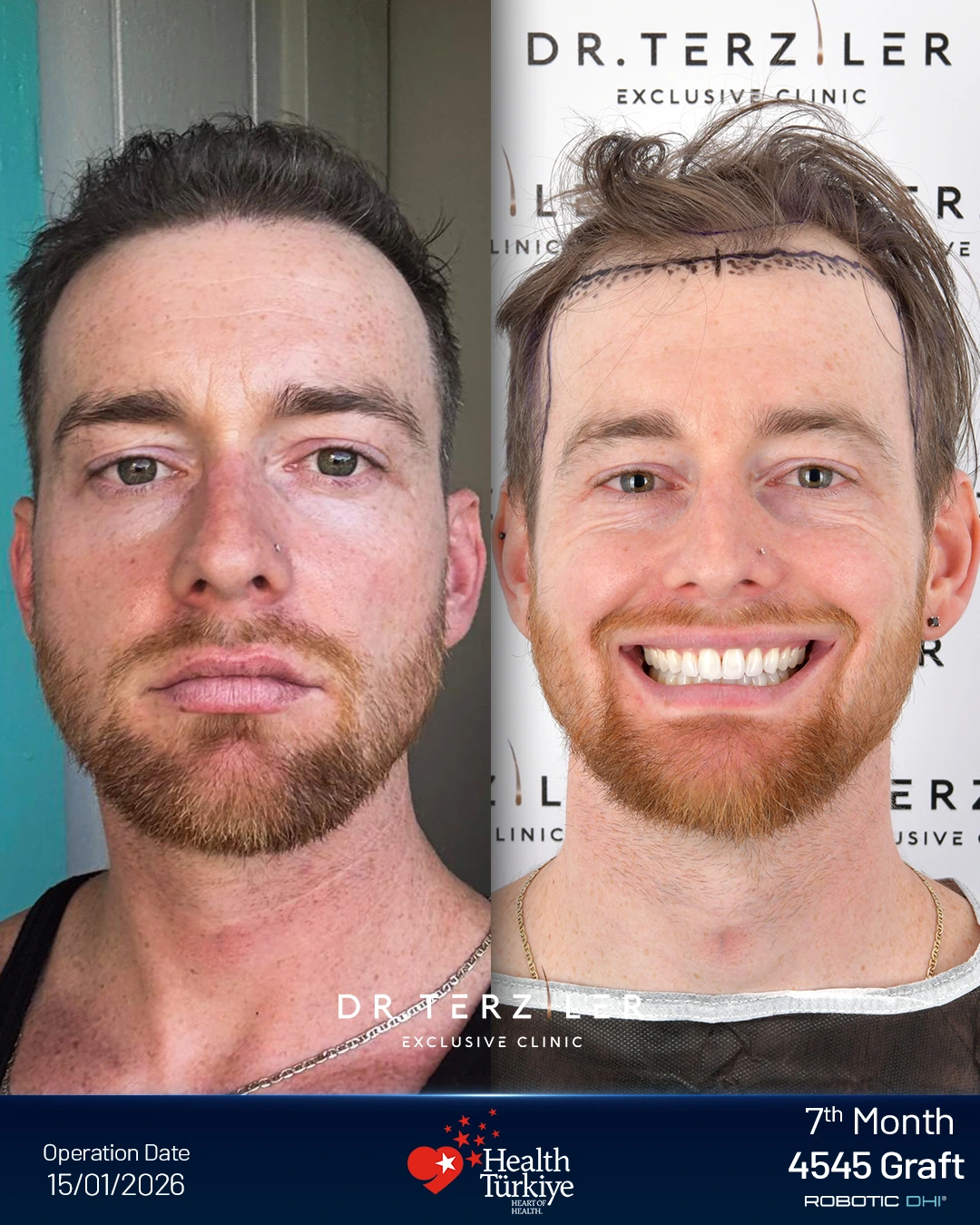
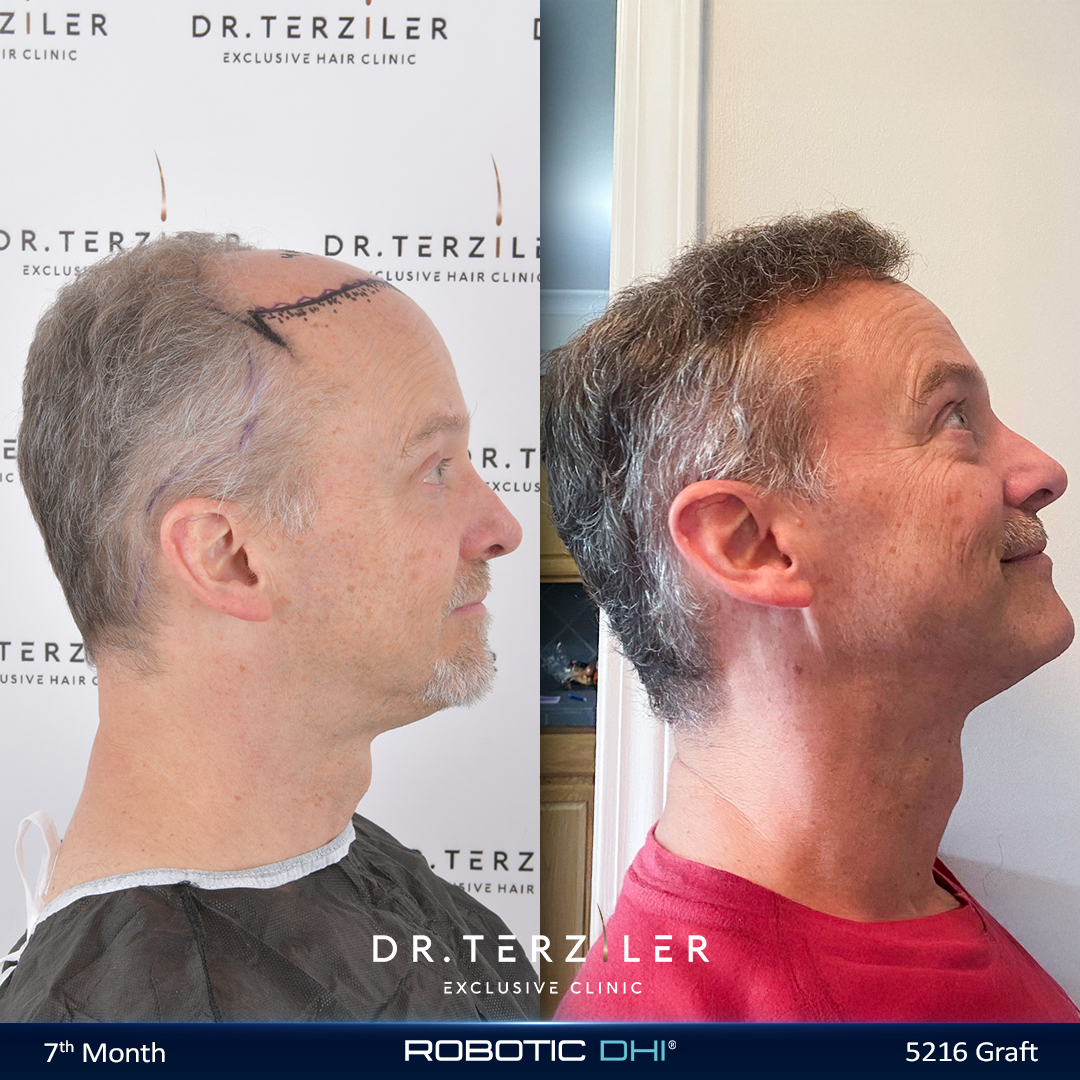
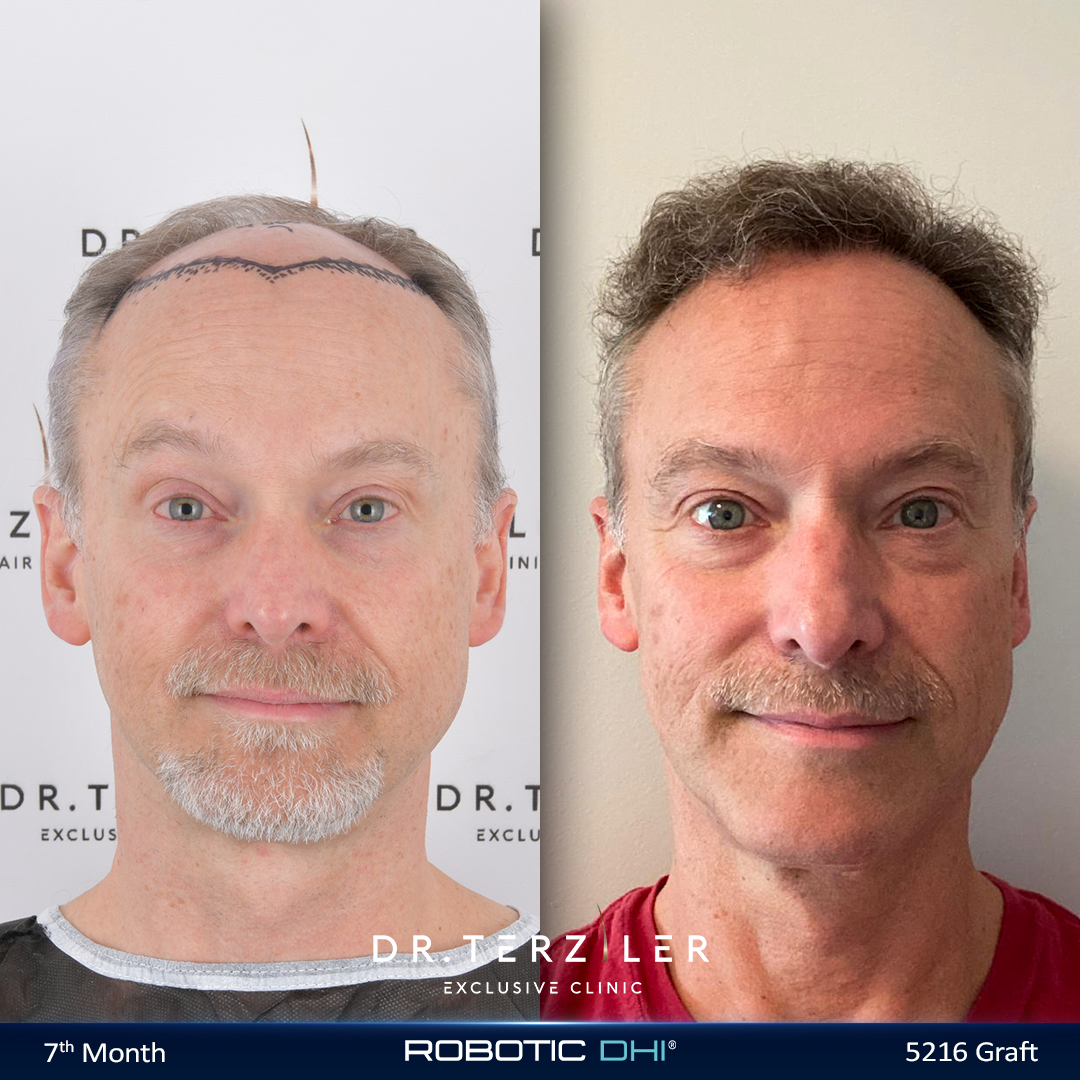
One clinic-provided patient sequence, photographed before surgery and through month 7. It illustrates changing appearance over time; it does not diagnose shock loss or predict another patient’s growth. View full size
How to Reduce Shock Loss: What the Evidence Supports
Risk cannot be eliminated. Gentle surgery, donor planning and aftercare matter, while medication and supportive-treatment studies measure different outcomes. Improved hair counts or faster early growth should not be presented as a proven percentage reduction in native-hair shock loss.
Before surgery
Finasteride, when prescribed for an appropriate patient. In a randomized trial of 79 men with androgenetic alopecia, 1 mg daily from 4 weeks before until 48 weeks after surgery improved surrounding hair counts. Visible increases in superior/frontal scalp hair were recorded in 94% versus 67% with placebo at follow-up [7]. These are hair-growth outcomes, not shock-loss-prevention rates. Discuss adverse effects, contraindications and whether the medicine is appropriate with your doctor; do not start it based on this article.
Stabilize ongoing hair loss where appropriate before adding grafts. Surgery does not stop future loss of non-transplanted hair [1]. A clinician should assess the diagnosis, donor capacity and miniaturization before deciding on medical treatment or additional testing, including whether a トリコ・テスト would be relevant to your case.
Report fever, flu, infection and smoking or nicotine use before surgery [1]. The medical team should decide whether the date needs to change and give you an individualized pre-operative plan.
During surgery
Moderate density and gentle sites. High implantation density and local trauma are listed risk factors [2]. Density should match your hair, not a brochure number.
Careful tumescence and low vasoconstrictor doses. The 2026 review advises avoiding excessive tumescent fluid and high vasoconstrictor concentrations [2].
Short out-of-body time and careful graft handling. Prolonged out-of-body time is a listed cause of poor growth, and minimizing ischemia time is a listed prevention step [2].
After surgery
Minoxidil may be used to support regrowth when the treating clinician recommends it [1][2]. A 2002 expert consensus discussed its role around transplantation [11]. The start or restart date depends on scalp healing and the prescribed formulation. Do not apply it to open wounds or change a prescription without your clinician’s instructions.
PRP. A prospective 40-patient FUE study, described by its author as randomized but using alternating allocation, reported greater early graft-density retention and faster regrowth in the PRP group [6]. At week 4, 12 of 20 PRP patients versus none of 20 controls retained more than 75% graft density; at month 6 the reported regrowth category exceeded 75% in 20 versus 4 patients. These small-study endpoints are not a validated native-hair shock-loss prevention rate. Ask whether ヘアPRP is appropriate for your plan.
Low-level laser therapy (LLLT). Listed as an adjuvant that may speed donor regrowth [2]. Evidence after transplants is limited.
Follow the written aftercare plan: avoid scratching or picking crusts, wash as instructed, and ask when hats, exercise and styling products are appropriate. Contact the surgical team if the recovery pattern changes.
Nutrition: correct deficiencies, do not megadose. No study shows that a supplement prevents shock loss. Low iron, vitamin D or protein can worsen shedding in general, so check them with a blood test if you diet strictly. More is not better.
Evidence and treatment timing
Measure
What the evidence measures
Timing / suitability
Finasteride
Trial in 79 men: surrounding hair counts, not a shock-loss prevention rate [7]
Prescription and individual assessment; the trial started 4 weeks before surgery
Minoxidil
Expert consensus and reviews describe support for regrowth [1][2][11]
Only when prescribed or cleared after healing
PRP
Small prospective study, n=40; early density and regrowth endpoints [6]
No established evidence here for preventing shock loss
Correct a diagnosed deficiency; avoid unnecessary supplements
Scroll horizontally on smaller screens. Evidence and treatment timing.
How Dr. Terziler Exclusive Clinic Plans Around Shock Loss
At Dr. Terziler Exclusive Clinic, planning considers the hair a patient already has as well as the area to be restored. セルヴェト・テルジラー博士 developed the clinic’s proprietary robotic hair transplant system. The clinical model described here is clinic-provided information, rather than independent proof that a technique prevents shock loss.
Hair transplantation at Dr. Terziler Exclusive Clinic. Ask which physician will perform each medical step and how donor and existing hair will be protected in your case. View full size
Consultation and hairline design. The assigned physician, Dr. Servet Terziler or Dr. Kürşat Yalvaç, assesses native hair, miniaturization and donor supply within the confirmed treatment plan. Where existing hair is vulnerable, the plan may involve adjusted density, medical treatment first or a staged approach.
ピカソ・ロボティック DHI. The clinic describes implanter-based placement with a 0.70 mm Choi pen and controlled planning around placement angle and depth. Device settings and suitability depend on the case. Careful graft handling and recipient-site planning matter, but no comparative study cited here establishes that Picasso Robotic DHI eliminates or always reduces shock loss versus other methods [1][2].
Graft handling. The clinic reports short out-of-body handling intervals and use of HypoThermosol with ATP within its preservation protocol. Ask the team to explain the actual handling workflow for your case. These clinic-described process details are not an independently verified shock-loss prevention rate.
Boutique scheduling. The clinic states that it treats a maximum of four hair-transplant patients per day, to support named-physician involvement and clinical oversight.
Follow-up on WhatsApp. Patients can share progress photographs with the clinic team at agreed milestones or when concerns arise. Confirm who reviews them, expected contact hours and the urgent-care pathway before travelling.
Written records and follow-up terms. Request the surgical record, graft count and current written guarantee or repair policy, including eligibility, exclusions and any travel costs. A written policy does not guarantee regrowth of every native hair.
Clinic-reported outcome: the clinic’s internal 12-month audit of 120 Picasso Robotic DHI cases recorded 98.1% graft survival. This is not a peer-reviewed comparative trial or a shock-loss incidence study, and it does not predict an individual patient’s outcome.
Why Are There No Results 4 Months After My Hair Transplant?
At month 4, some patients have only early, fine growth, so the appearance can still be thin or uneven. Timing varies between people and scalp areas. A photograph cannot establish the number of surviving grafts at this stage; use the scheduled follow-up to review the trend.
Descriptive growth stages without fixed completion percentages
Month
Possible appearance
その解釈方法
3
First fine hairs may emerge
Early growth is variable
4
Short, fine or uneven growth
A thin appearance alone does not prove failure
6
Coverage may become more noticeable
Arrange review if there is very little or no growth
9
Hair can thicken and mature
Compare consistent photographs
12
More mature appearance
Review density and ongoing native hair loss
12–18
Later maturation, especially the crown
Individual assessment; no fixed percentage complete
Scroll horizontally on smaller screens. Descriptive growth stages without fixed completion percentages.
These are descriptive recovery stages, not validated percentages of a final result. Age, hair characteristics, scalp area, surgical factors and ongoing hair loss can change the pace.
If there is very little or no new growth around month 6, arrange a review rather than waiting silently until month 12. Your clinician can assess photographs, donor and recipient areas, ongoing hair loss and possible reasons for delayed growth. Seek help earlier for painful, inflamed or infected areas.
Hair Loss After Other Surgery: Is It the Same as Shock Loss?
Hair loss after general surgery is usually telogen effluvium, and it is different from transplant shock loss. The AAD lists having an operation as a trigger for excessive shedding and notes that most people notice it a few months after the event [9]. Shedding is spread over the whole scalp, not one area, and stops as the body readjusts [9].
Physical stress, illness, blood loss or reduced nutrition around an operation can contribute to later diffuse shedding. Anaesthesia alone should not automatically be blamed. If hair thins throughout the scalp a few months after another operation, seek a dermatology assessment; tests may be appropriate for suspected nutritional or thyroid problems [9][10].
What Happens 2 Years After a Hair Transplant?
By year 2, a transplant is usually beyond its early growth phase, while native hair may continue to thin. Donor hair is selected for relative resistance to androgenetic loss, but no graft is guaranteed to last for life. New or progressive hair loss needs assessment of both transplanted and native hair.
The 2,896-patient series reported 26 patients who were unhappy because of loss of non-transplanted, androgen-dependent hair [1]. This illustrates one explanation for a changing result; it does not prove that every late loss is native hair. Discuss the diagnosis and a suitable long-term plan through the clinic’s hair treatments service.
Is 4,000 or 5,000 Grafts Overharvesting?
A count of 4,000 or 5,000 grafts does not, by itself, establish overharvesting or safety. Donor density, usable area, extraction distribution, hair characteristics and future hair loss determine what can be removed. A smaller session can also be excessive for a limited donor area.
Overharvesting is persistent donor depletion from excessive or poorly distributed extraction. It can produce a moth-eaten appearance and should be distinguished from temporary donor effluvium [2]. Ask for measured donor density and a lifetime donor plan before agreeing to a large session. A graft calculator can support a discussion, but it does not establish your safe donor capacity.
Shock Loss FAQ
Does shock loss always happen after a hair transplant?+
No. Most patients shed transplanted hair shafts at weeks 2 to 4, which is expected. Visible loss of native hair is less common. Published estimates range from 0.15% to 15%, and one 2,896-patient series recorded only 3 recipient-area cases.
How long does the shock phase last after a hair transplant?+
Shedding lasts about 2 to 6 weeks and usually ends by week 8. The thin look lasts until new hair surfaces at months 3 to 4. Donor area shock loss resolves within 3 to 6 months.
How long after shock loss does hair grow back?+
Native hair lost to shock loss usually grows back in about 3 to 4 months. Transplanted hair starts to appear at months 3 to 4, shows clearly at month 6, and reaches its final look at 12 to 18 months.
How can I reduce shock loss after a hair transplant?+
Discuss the plan with your surgeon: protect vulnerable native hair, avoid excessive implantation or extraction density, report recent illness and follow aftercare. Finasteride or minoxidil may be appropriate for selected patients, but the prescription and timing require individual medical advice.
How do I help transplant shock?+
Follow your aftercare plan, avoid scratching or picking and take comparable progress photographs. Ask the treating team before starting or restarting minoxidil or adding PRP. Most temporary shedding improves over time, but new patches, inflammation or unexpectedly delayed growth should be reviewed.
Is shock loss permanent?+
Usually not. Healthy follicles regrow. Permanent loss mainly affects native hairs that were already heavily miniaturized and close to the end of their life before surgery.
Can transplanted hair fall out permanently?+
Yes, poor graft growth or permanent loss can occur. Expected shaft shedding in the first weeks is different from losing a graft. Donor selection, surgical handling, healing and underlying scalp disease affect long-term growth; hair loss later on also needs assessment of native hair.
What does shock loss look like?+
Shock loss looks like diffuse thinning around and between new grafts, so the scalp shows through again. In the donor area, it can look like a small round thin patch at weeks 2 to 4.
Does FUE or DHI cause less shock loss?+
The cited evidence does not establish that one technique always causes less shock loss. FUE describes harvesting and DHI describes implantation, so they are not mutually exclusive alternatives. Diagnosis, donor planning, surgical trauma, density and blood flow matter alongside the technique. Ask about the proposed DHI hair transplant plan for your own scalp.
Can I use minoxidil to prevent shock loss?+
Minoxidil may support regrowth in selected patients, but it does not guarantee prevention. Ask your prescriber when it is appropriate to start or restart after healing. Do not apply it to open wounds or alter treatment based on a general online timeline.
Does finasteride prevent shock loss?+
A trial in 79 men found improved surrounding hair counts with finasteride taken from 4 weeks before to 48 weeks after surgery; visible increases were reported in 94% versus 67% with placebo. The trial did not establish a shock-loss prevention percentage. It is a prescription decision that requires discussion of suitability and adverse effects.
Why is my new hair curly or wiry?+
New hairs often grow fine, curly or wiry at months 3 to 5. The follicle is restarting and the shaft is still thin. Texture usually normalizes by month 9 to 12.
Is it normal to have no shedding after a hair transplant?+
Yes. Some grafts retain their shafts, so no shedding is not automatically a warning. A small PRP study reported early density retention, but absence of shedding alone cannot confirm final graft survival.
When should I worry about shedding after a hair transplant?+
Contact a clinician promptly for pus, spreading redness, fever, worsening pain, dark skin changes or a suspected displaced graft with fresh bleeding. Arrange a planned review for very little growth around month 6. Shedding within an expected time window should still be assessed if accompanied by other symptoms.
Can I get shock loss from PRP or minoxidil?+
Minoxidil can cause an initial shedding phase, which is different from surgical shock loss. If shedding starts after PRP, medication or another intervention, tell the treating clinician rather than assuming the cause or stopping a prescribed treatment yourself.
References and evidence notes
Sources are linked so you can distinguish reviews, small studies, historical expert opinion and general patient guidance. Study estimates are not a personalized risk calculation.
This guide is for education and does not replace your own surgical team’s instructions or a medical examination. For severe or rapidly worsening symptoms, seek prompt local medical care.
Discuss your donor supply, existing hair and recovery concerns with the clinic team. An individual assessment can clarify whether the next step is observation, treatment or an in-person review.
Share your concerns with the team and confirm the follow-up plan for your own case.
植毛を後悔しないために知っておくべき5つのこと
Before you book · Before you judge your result
Hair transplant regret can mean disappointment with the hairline, density, donor area, recovery or long-term plan. Reducing that risk starts with a clear diagnosis, realistic goals, a qualified surgical team and a plan for future hair loss.
Considering surgery—or thinking “I regret my hair transplant”? This guide explains five decisions to discuss before treatment, what published research actually says about failure and regret, and when a result needs medical review.
Content updated: . Patient education; your treating clinician must assess your individual case.
What is the regret rate for hair transplants?
The evidence reviewed here does not establish a reliable, representative hair transplant regret rate. Satisfaction surveys, complication reports, graft survival figures and repair-case statistics measure different outcomes. None can simply be relabeled as the percentage of people who regret surgery.
A patient may have good graft growth but dislike a low hairline. Another may feel anxious during early shedding and later be satisfied. Ask any clinic quoting a “success rate” what was measured, when patients were assessed, how many were followed up and whether dissatisfied patients were included.
Psychological evidence
Expectations affect satisfaction
A 2025 narrative review highlights expectation management and psychological assessment. It does not provide a representative population-wide regret estimate.
Liu and colleagues reviewed 43 publications. Two large series reported overall complications of 1.2% and 4.7%; definitions and reporting varied. These are study-specific findings, not a universal failure or regret rate.
In the 2025 ISHRS member survey, physicians reported an average 10% of their cases were repairs following previous black-market transplants. This describes responding practices’ caseloads, not 10% of all patients regretting surgery.
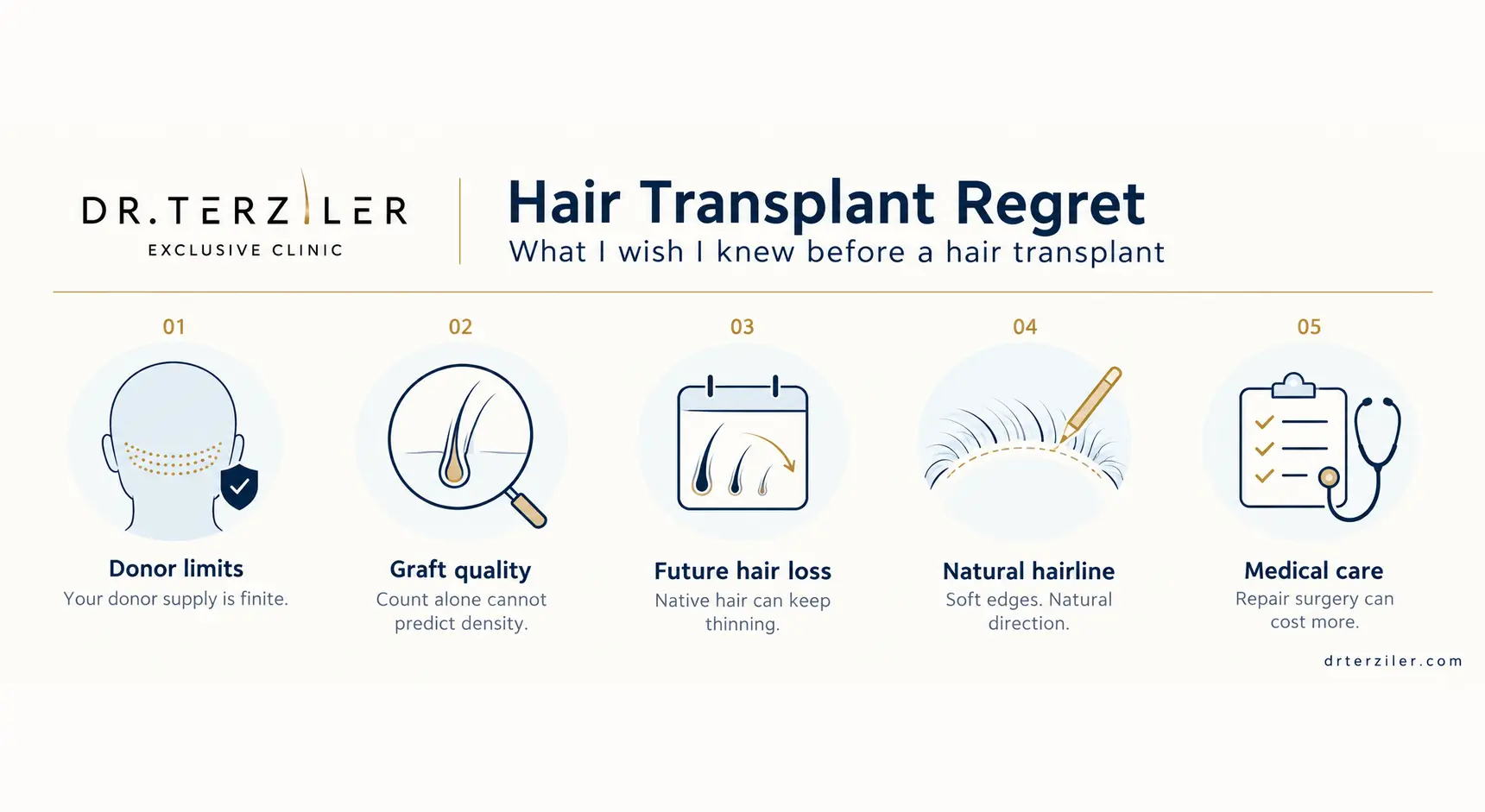
What I wish I knew before a hair transplant: 5 decisions that matter
If you are asking “What I wish I knew before a hair transplant?”, start with donor limits, realistic coverage, future hair loss, hairline design and medical responsibility. These five conversations help you make an informed decision before a deposit or surgery date.
Use these five questions to compare recommendations and discuss the tradeoffs for your own case.
Five planning topics to discuss with your physician before a hair transplant. The infographic summarizes this guide; individual suitability requires an assessment.Open the full-size infographic
01
Your donor supply is finite
A transplant redistributes hair; it does not create an unlimited new supply. Taking too much from the back or sides can leave visible donor thinning and reduce future options. The safe plan depends on donor density, hair characteristics, scalp health and the area that needs coverage.
Before you agree to a graft number, ask to see the donor assessment and the longer-term allocation between your hairline, mid-scalp and crown. A large first session can be the wrong tradeoff when future loss is likely.
Ask before surgery: What can be harvested safely in my case, and what donor reserve will remain?
02
Graft count alone cannot predict density
A graft is a follicular unit, not necessarily a single hair. Visible coverage also depends on hairs per graft, hair thickness, curl, contrast with the scalp, placement and growth. Two patients receiving the same count can look different.
Compare cases with similar hair characteristics and loss patterns. Ask whether the recorded count refers to grafts extracted or implanted, and how the team documents growth. A package promising “maximum grafts” should still explain donor safety and realistic coverage.
Ask before surgery: What density and coverage are realistic for my hair characteristics?
03
Surgery does not stop future hair loss
Transplanted hair and the surrounding native hair are different parts of the long-term plan. Existing hair can continue to thin, leaving gaps around an initially satisfactory transplant. A hairline must still make sense if loss progresses.
Ask about appropriate nonsurgical options, their limitations and potential adverse effects. Medication is an individual decision, not an automatic requirement to accept without discussion. Tell the physician if you do not want, cannot tolerate or cannot use ongoing treatment.
Ask before surgery: What happens to my result if the hair around it keeps thinning?
04
A natural hairline is a long-term commitment
A hairline that is too low, sharply geometric or inconsistent with your hair direction may be hard to soften later. Design should consider your facial proportions, existing pattern and likely future needs—not simply reproduce a teenage hairline.
Request a clear explanation of the proposed height, shape, frontal graft selection and direction. Review healed results with the hair exposed and in comparable lighting. A digital simulation is a discussion tool, not a promise of your final appearance.
Ask before surgery: Why is this hairline appropriate for me now and as I age?
05
Medical responsibility matters more than a package label
Price, a technique name and attractive hotel photos do not tell you who makes the medical decisions. Confirm the responsible physician, who performs each surgical stage, anesthesia arrangements and the plan for complications.
The ISHRS warns against unlicensed personnel performing medical aspects of transplantation and exaggerated “scarless” or fully machine-performed claims. Compare written inclusions, review access, cancellation terms and follow-up after returning home. A higher price alone is not proof of better care.
Ask before surgery: Who will assess me, perform each surgical step and manage my follow-up?
How often do hair transplants go wrong?
Hair transplants can go wrong, but there is no single reliable rate covering every clinic, technique and definition of failure. A disappointing cosmetic result, poor graft growth and a surgical complication are different outcomes. Your risk assessment should be specific to your diagnosis, donor area, medical history and surgical team.
Why do hair transplants fail?
Potential contributors include unsuitable patient selection, inadequate donor planning, graft damage or drying, poorly planned placement, and unrecognized medical problems. Continued native hair loss can also make a previously acceptable result look thinner. A clinical examination is needed to identify the cause; a photograph alone cannot establish every problem. Clinical review of transplantation complications.
Hair transplant side effects vs a failed result
How to distinguish recovery changes from concerns needing assessment
What you notice
What it may mean
What to do
Temporary swelling or scabbing
May be part of recovery, depending on timing and severity.
Follow the written aftercare plan; ask about changes outside the expected pattern.
Hair shedding after surgery
Transplanted shafts can shed before regrowth. Shedding alone does not prove graft failure.
Document progress and attend planned reviews.
Patchy donor appearance
Needs assessment for healing changes, shock loss, scarring or overharvesting.
Request donor examination and the extraction record.
Unnatural direction or hairline
Can reflect design or placement issues.
Discuss the concern with a physician experienced in revision assessment.
Severe pain or unexpected symptoms
Needs prompt medical evaluation; do not assume it is normal recovery.
Contact your operating clinic promptly and seek urgent local care when needed.
The scoping review linked above involves researchers affiliated with Harvard Medical School/Massachusetts Eye and Ear and Johns Hopkins. Its university publication record explains the study scope. It supports a careful risk discussion, not a claim that a specific clinic has a known failure rate.
Before your hair transplant: an interactive consultation checklist
Tick the topics your clinician has already explained. Use the remaining questions in your consultation. This is a discussion checklist, not a medical risk score or clearance for surgery.
Hair transplant recovery: shedding, shock loss and early regret
Early shedding and an unfinished hairline are not enough to diagnose a failed hair transplant. Healing, growth and final appearance happen on different schedules. Compare progress with the timeline given by your surgeon rather than judging the outcome immediately after surgery.
Early recovery
Protect the treated scalp and follow your clinic’s washing, sleeping and activity instructions.
Following weeks
Transplanted hair shafts can shed. Review concerns with the treating team.
Around month 4
The NHS says new hair usually begins to appear around this stage; individual progress varies.
10–18 months
The NHS describes this as the usual window for full results. Use your clinician’s review plan.
Timeline reference: NHSの植毛に関するガイダンス. This is a general guide, not a deadline or a promise of a particular result.
What if I feel regret during recovery?
Bring the concern to your treating team and describe what bothers you: the donor area, hairline, growth, discomfort or the decision itself. Keep consistent photographs and agreed review dates. Frequent comparisons with someone else’s result can make an incomplete result harder to interpret.
The psychological review emphasizes realistic expectations and support before and after treatment. If distress is affecting sleep, work or relationships, discuss it with a clinician or mental health professional. Repeating surgery is not automatically the right answer to appearance-related distress. Psychological evidence and its limitations.
Is it okay to masturbate after a hair transplant?
Wait until your surgical team clears sexual activity under your aftercare plan. The sources reviewed here do not establish a universal, masturbation-specific safe day. Early restrictions are intended to protect healing and limit exertion or accidental contact with the scalp.
The American Society of Plastic Surgeons states that some doctors advise avoiding sexual activity for at least 10 days. It also explains that strenuous activity can increase scalp blood flow and cause bleeding. This is general recovery guidance, not a study proving that masturbation is safe for everyone on day 10. Read the ASPS activity guidance.
Ask your team for a private, direct answer before returning to sexual activity. Your healing, procedure, symptoms and clinician’s instructions matter. The cited guidance does not establish ejaculation itself as a cause of graft failure; do not replace clinical advice with unsupported hormone claims online.
I regret my hair transplant: what should I do next?
If you are thinking “I regret my hair transplant”, first arrange a medical review and identify the specific concern. Some problems can be improved, but a bad transplant cannot always be completely reversed. Remaining donor supply, scarring, hair direction and the stage of healing affect the options.
Can a bad hair transplant be fixed?
Depending on the problem, a specialist may consider a revised hairline, additional grafts, selective removal or other approaches. The ISHRS repair guide describes correction strategies. Improvement may require more than one procedure, and extensive donor depletion can limit what is achievable.
Get the records. Request the procedure date, technique, extracted and implanted graft counts, surgical roles, medication and follow-up notes.
Document the issue. Take photographs with consistent lighting and angles. Separate appearance concerns from symptoms needing urgent attention.
Ask for a clinical explanation. What is the likely cause, what remains uncertain and what needs an examination?
Seek an experienced second opinion if needed. Ask which options are realistic and whether additional surgery should be delayed or avoided.
Compare the full correction plan. Discuss donor use, scars, possible stages, limitations and written costs before committing.
Do not attempt to pull out grafts, treat an infection yourself or rush into another procedure because of a promotional deadline. Ask the examining physician when the result can be assessed meaningfully.
Avoiding hair transplant regret in Turkey: check the provider, plan and follow-up
Turkey hair transplant regret is not a separate diagnosis. Evaluate the individual clinic and surgical team, whether you travel to Istanbul or stay in the US. Location, a low package price or a premium label does not establish medical quality.
~が Dr. Terziler Exclusive Clinic in Istanbul, treatment is planned within a boutique, doctor-led model. The clinic offers DHI, Robotic DHI and Picasso Robotic DHI. Technique selection should follow your assessment rather than a claim that one branded method eliminates complications or regret.
Confirm the medical roles
Ask which physician is assigned to your case and who performs assessment, hairline planning, extraction, recipient-site creation and implantation. Confirm anesthesia arrangements and who manages complications.
Plan care after returning home
Confirm review dates, the contact route for concerns and what happens if you need an in-person examination locally. Keep a copy of the written treatment and aftercare plan.
For clinical background, Sahar Nadimi’s 2020 complications review—with an affiliation at Loyola University Medical Center—emphasizes patient selection, planning for future loss and postoperative instructions.
The sources reviewed in this guide do not establish a reliable population-wide regret rate. Satisfaction, complication rates, graft survival and repair referrals measure different outcomes. Ask a clinic to define any quoted success or regret percentage and provide the follow-up method.
What I wish I knew before a hair transplant?
The five key topics are finite donor supply, realistic coverage rather than graft count alone, future native hair loss, a natural long-term hairline and the medical team responsible for treatment and follow-up. Discuss recovery, limitations and the complete written quote before booking.
How often do hair transplants go wrong?
There is no single rate covering every provider and definition of failure. Published studies report different complications and follow-up methods. A disappointing hairline, poor growth, a surgical complication and temporary recovery changes should be assessed separately.
Is it okay to masturbate after a hair transplant?
Wait until your surgical team clears sexual activity under your aftercare plan. ASPS notes that some doctors advise avoiding sexual activity for at least 10 days, but this is not a universal masturbation-specific clearance date. Ask your treating team for instructions suited to your procedure and healing.
Is early shedding a sign of a failed hair transplant?
Not necessarily. Transplanted hair shafts can shed before regrowth, and early appearance does not establish the final outcome. Attend planned reviews and ask your treating physician about unexpected symptoms or progress outside your individual recovery plan.
Can an overharvested donor area be repaired?
Improvement may be possible in selected cases, but removed follicles are not restored simply by waiting. An examination must distinguish temporary shedding from permanent depletion or scarring. Remaining donor supply limits repair options, and complete restoration cannot be guaranteed.
Can an unnatural hairline be completely fixed?
Some hairlines can be improved through revision, additional grafts or selective removal, depending on the case. Direction, scarring, donor capacity and the original design affect the options. A specialist should explain achievable improvement and limitations before any additional surgery.
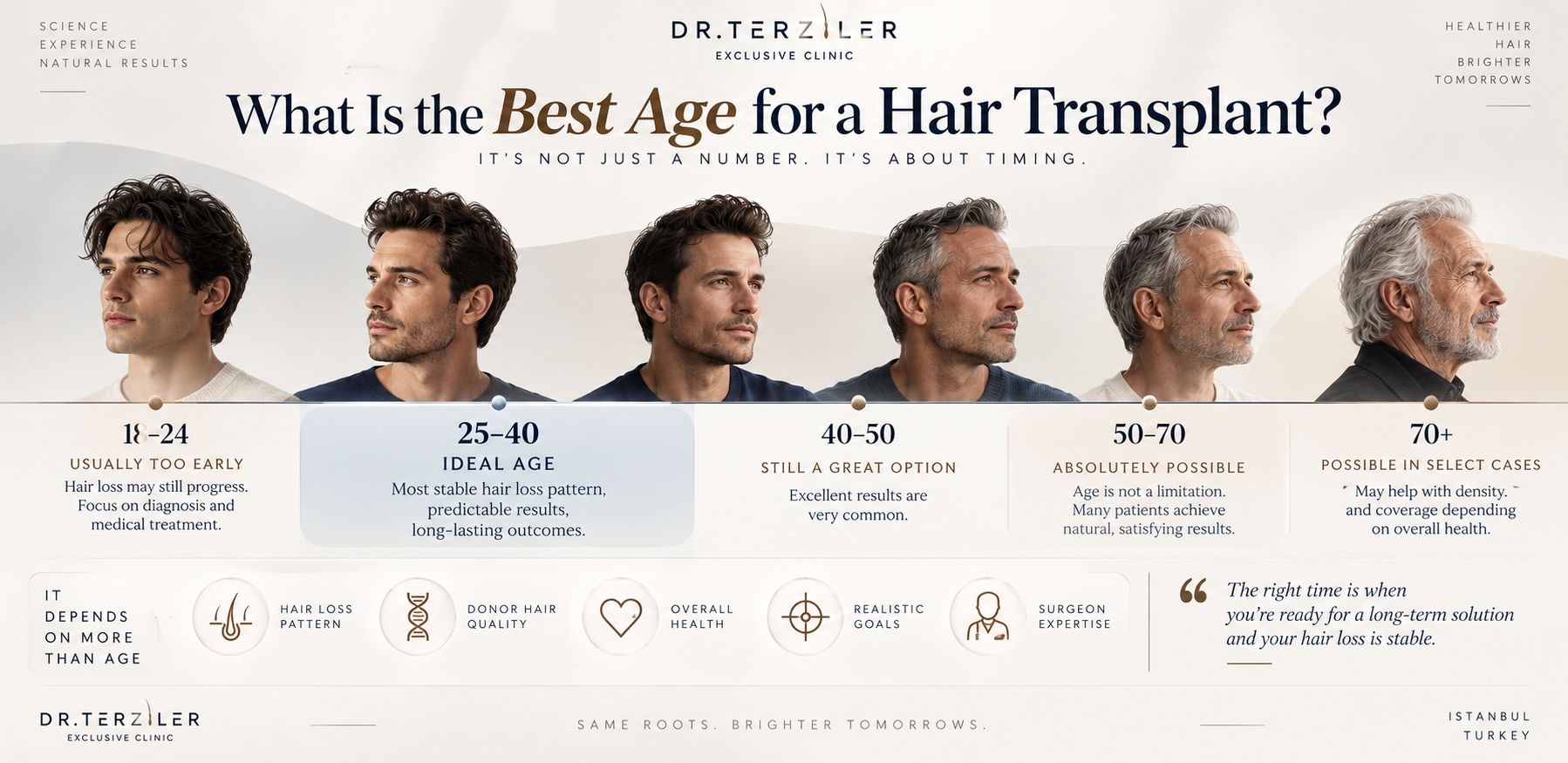
What is the best age for a hair transplant?
There is no universally best age. Diagnosis, hair-loss progression, donor capacity, health and realistic goals matter. The AAD notes that some men in their 20s may be advised to wait and consider medical treatment first. An individual consultation determines suitability.
Are FUE, DHI or robotic methods regret-proof?
No. A technique name does not guarantee natural appearance, growth, safety or satisfaction. Patient selection, donor planning, qualified surgical responsibility, execution and follow-up remain important for every method.
Can I keep losing hair after a hair transplant?
Yes. Native hair can continue to thin after transplantation. Discuss how future loss could change the appearance, whether nonsurgical treatment is suitable and how the donor reserve will be protected. Medication choices and possible adverse effects need an individual clinical discussion.
Should I rely on hair transplant regret stories on Reddit?
Patient stories can help you prepare questions, but they do not establish a regret rate or diagnose your result. Check the surgery date, follow-up stage, available records and photographs. Use a qualified clinical assessment for treatment decisions rather than a single online anecdote.
Research and medical sources
How the evidence is used: Research findings are attributed to their actual study type and scope. General patient guidance informs recovery discussions. These sources do not establish a universal regret rate.
Hairline Design: How a Natural Hairline Is Measured, Drawn and Built
Nobody ever compliments a good hairline. People only notice the bad ones. That is the strange job of hairline design: when we do it right, the result is invisible.
A hair transplant can move thousands of healthy grafts and still fail. The usual reason is not the grafts. It is the drawing. A line placed 1 cm too low, temples filled flat, or thick grafts at the front edge can make a 30-year-old look like he bought his hair online. This guide explains how surgeons decide where your hairline goes, what shape it takes, and how to tell a good design from a bad one before anyone touches your scalp.
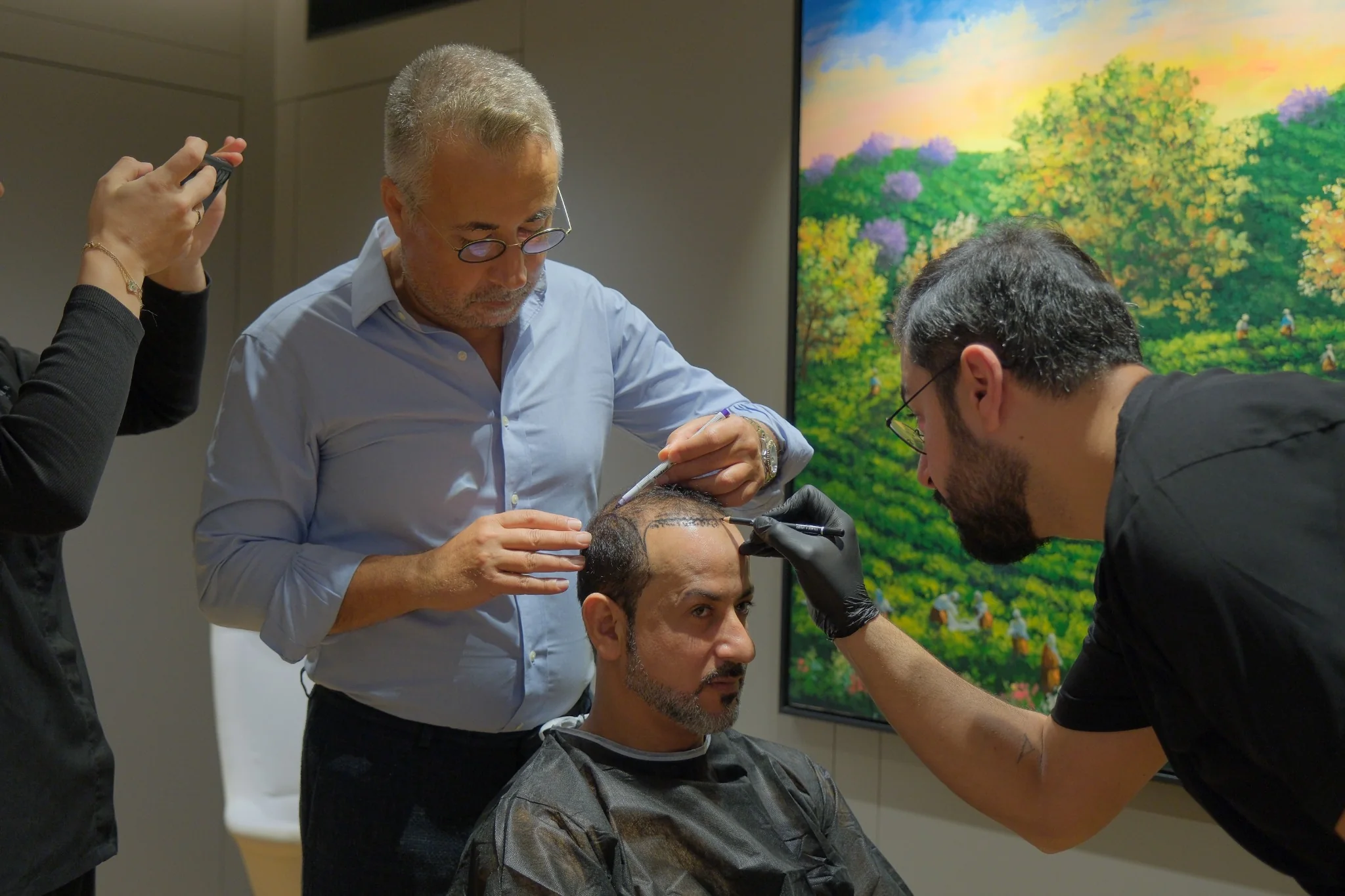
Dr. Servet Terziler and clinical team designing a patient’s hairline before hair transplant surgery at Dr. Terziler Exclusive Clinic in Istanbul
Hairline design in 60 seconds
Hairline design is the planning step of a hair transplant. The surgeon draws your new front hair border on the scalp before surgery.
Most adult male transplant hairlines start 7 to 9 cm above the glabella (the point between the eyebrows).
The front 3 to 5 mm uses single-hair grafts only. Thicker grafts sit behind them.
Front hairs exit at roughly 35° to 45°. Natural hairlines are irregular and slightly asymmetric on purpose.
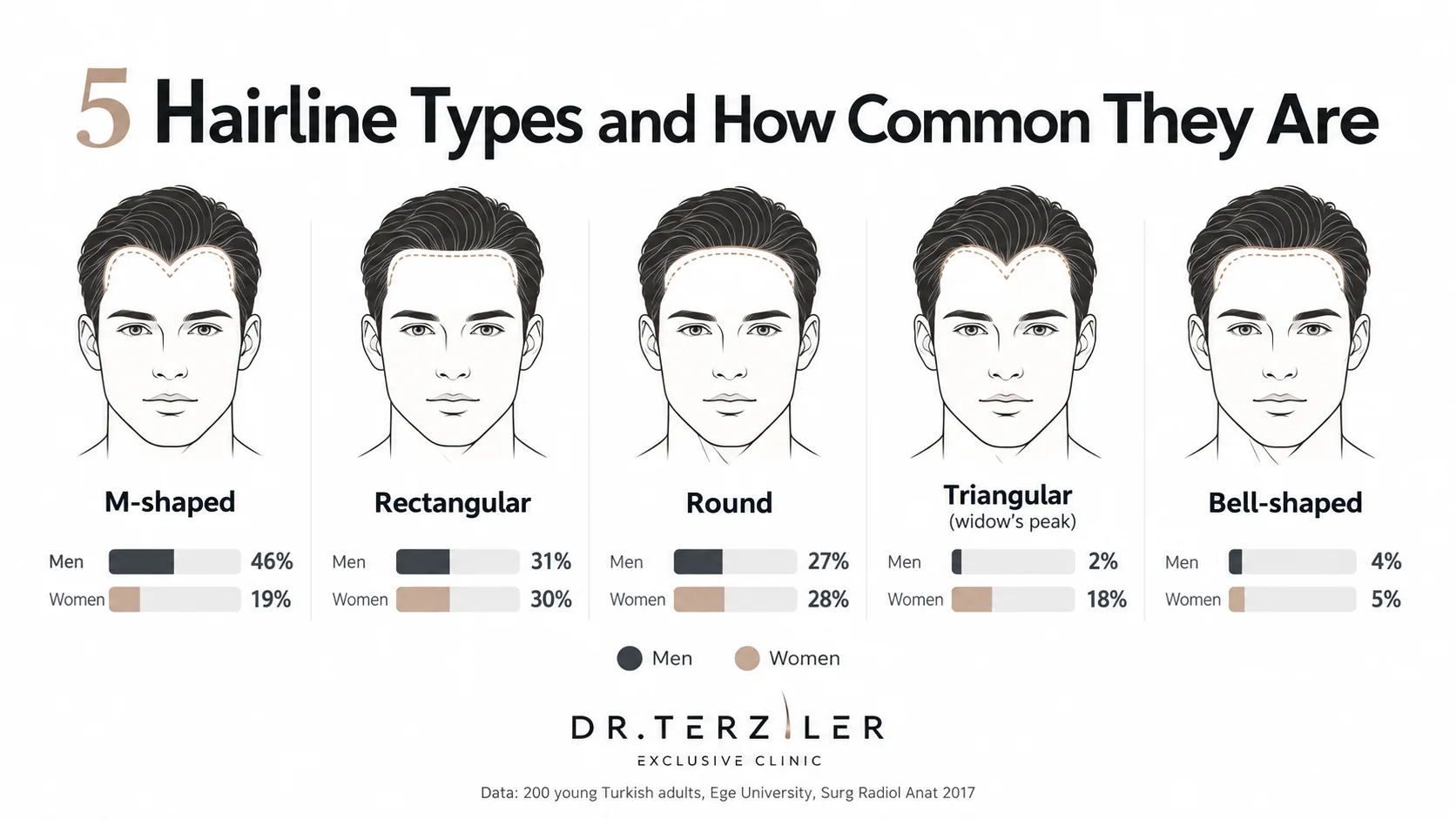
The M-shaped hairline is the most common male type. In a study of 200 young Turkish adults, 46% of men had it.
A good design still looks right at age 60. If a hairline only works at 25, it is a bad design.
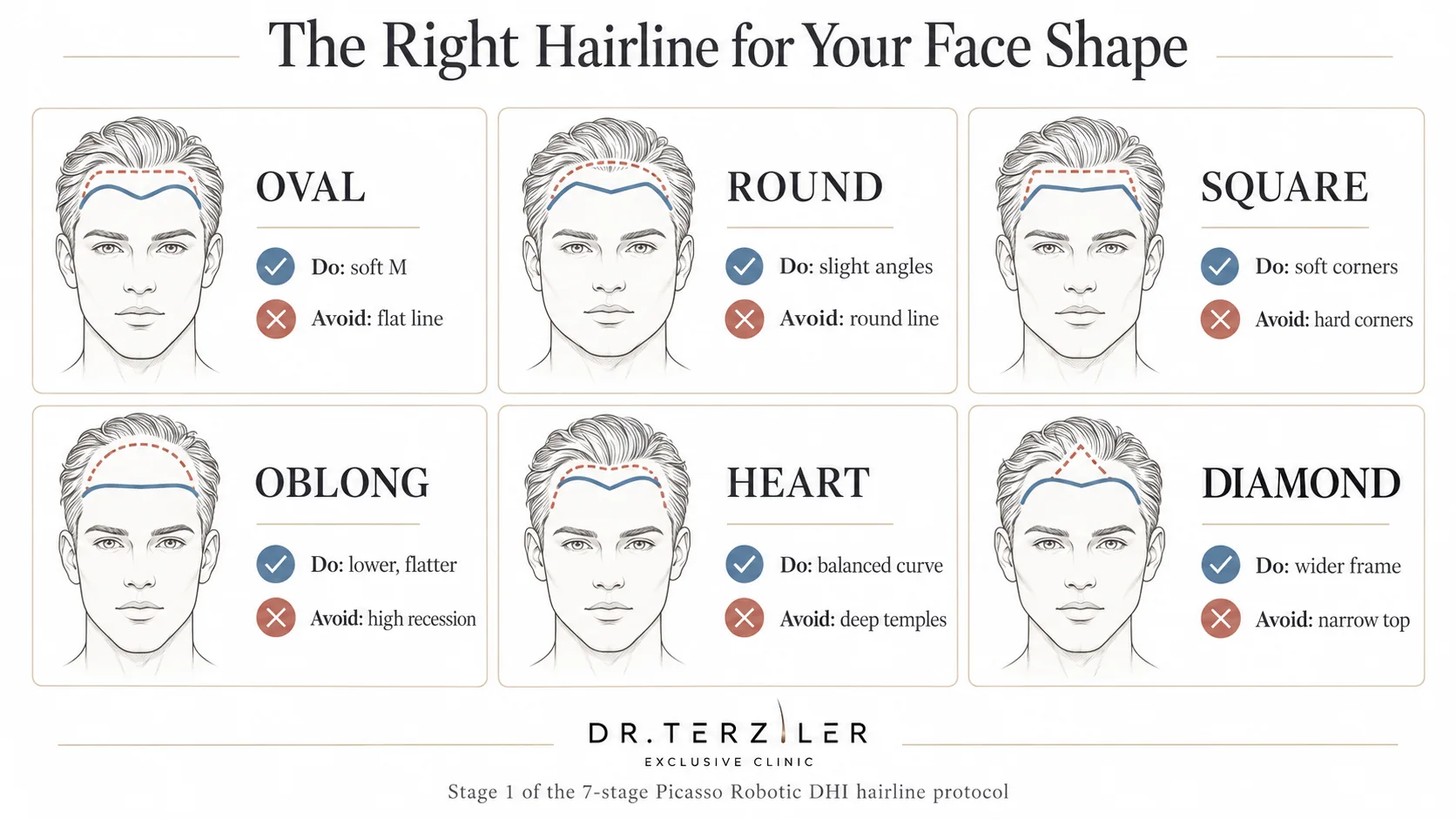
What is hairline design? Hairline design is the surgical planning of the front hair border before a hair transplant. The surgeon marks the hairline height, shape, temple points, graft zones and hair direction on the scalp. A natural design uses an irregular edge, single-hair grafts in the front 3 to 5 mm, forward angles of about 35° to 45°, and a height that suits the patient's age, face and future hair loss.
Founder of Dr. Terziler Exclusive Clinic · Inventor of Robotic DHI · ISHRS workshop alumnus (34.55 AMA PRA Category 1 credits)
Written by Dr. Terziler Exclusive Clinic
Updated:
What Is Hairline Design in a Hair Transplant?
Hairline design is the blueprint of a トルコでの植毛 or anywhere else. Before any anaesthetic, the surgeon draws the future front border of your hair with a surgical marker. That line decides height, shape, temple depth, graft distribution and the direction every hair will grow.
A guest’s hair transplant story, with a playful Shrek hairline-design moment at Dr. Terziler Exclusive Clinic.
In this short video, a guest shares his hair transplant experience at Dr. Terziler Exclusive Clinic. The team also adds a playful hairline-design moment featuring Shrek. The clip introduces the patient experience and the clinic’s approach to drawing a hairline; it is not a step-by-step clinical demonstration.
The front hairline holds only a small share of the grafts. It carries most of the first impression. People read your face from the hairline down. A clean, dense crown cannot rescue a front line that looks stamped on.
Peer-reviewed reviews agree on this point. A 2025 review in Dermatologic Surgery screened 1,030 study abstracts from 2019 to 2024 and listed "thoughtful hairline design" as one of the two main drivers of better aesthetic results, next to medical therapy[1]. A 2020 review on robotic transplantation made the same point from the other side: the robot extracts grafts with precision, but it "does not replace appropriate candidate selection, hairline design, and the judgment of where to place and not place transplanted hair"[2].
Hairline design, hairline haircut, hairline app: three different things
Search "hairline design" in the US and you get three worlds mixed together. A hairline design haircut is a barber service: a line-up, edge-up or shape-up that sharpens the existing hair edge with clippers or a razor. It lasts about two weeks. A hairline design app is a phone filter or AR simulator that previews a new hairline on your selfie. It helps you imagine a result but it cannot see your donor area, hair caliber or future loss. Surgical hairline design is the medical plan behind a transplant. It is permanent. This article covers the third one, with notes on the other two where they help.
A hairline app shows you a wish. A surgical hairline design shows you a plan that your donor area can afford for life.
The Anatomy of a Natural Hairline: 7 Landmarks Surgeons Measure
A natural hairline is not one line. It is a zone with a soft front edge, a denser core behind it, and side corners that bend toward the temples. Hair surgeons describe it with fixed landmarks so two doctors can discuss the same design in the same language.
1. Mid-Frontal Point (MFP). The lowest central point of the hairline. In adult male transplants it usually sits 7 to 9 cm above the glabella.
2. Frontotemporal Points (FTPs). The left and right corners where the front line turns back toward the temples. Shapiro and Shapiro describe locating them along the lateral epicanthal line, a vertical line from the outer corner of each eye [3].
3. Temporal Points. The small triangles of hair above the sideburns that frame the face. Losing them ages a face fast.
4. Transition Zone. The front 3 to 5 mm, built only from single-hair grafts.
5. Defined Zone. A band about 5 mm behind the front edge, reserved for 2-hair grafts in the 2025 ISHRS Forum template system [4].
6. Frontal Tuft. An oval area behind the MFP that takes 3-hair grafts and gives the front its density.
7. Widow's peak or macro-irregularity. The gentle central point or wave that breaks a straight line.
The September 2025 issue of Hair Transplant Forum International, the journal of the International Society of Hair Restoration Surgery (ISHRS), published a printable template method by Speranzini, Souza, Nakano and True [4]. The team prints hairline designs on thermal tattoo paper, transfers them to the scalp, and splits the recipient area into 2 × 2 cm squares to plan graft density square by square. Their method positions the MFP with a 45° line from the intersection of a horizontal line at the top of the head and a vertical line at the forehead. This matters for patients: it shows that elite surgeons now treat hairline design as a measurable system, not a freehand guess.
Natural hairline design: measurements, graft zones and the source of each value.
Natural hairline design: measurements, graft zones and the source of each value.
Want to know how many grafts your own hairline needs? Our hair graft calculator gives a first estimate from your Norwood stage before a doctor checks your donor area.
Hairline Types: Which Hairline Shape Do You Have?
People want to know what hairline types they have before they decide what hairline shape they want. The best data on this comes from Turkey. Anatomists at Ege University in Izmir photographed 200 young Turkish adults and sorted their hairlines into five shapes [5].
Five hairline types and their reported frequency in 200 young Turkish adults. Source: Ege University, 2017 [5].
Reported hairline types in men and women in the Ege University sample.
Reported hairline types in men and women in the Ege University sample.
Hairline type
Men
Women
What it signals
M-shaped
46%
19%
Most common male shape; reads masculine
Rectangular (straight)
31%
30%
Most common female shape; strong, square look
Round (oval)
27%
28%
Soft frame; reads feminine
Triangular (V / widow's peak)
2%
18%
Rare in men; clear central peak
Bell-shaped
4%
5%
Rare in both sexes
Note: the published male percentages add up to more than 100%, so some men likely fit two categories. Read the numbers as a ranking, not an exact census. The ranking is still clear: M-shaped first in men, rectangular first in women, triangular and bell-shaped rare.
M-shaped hairline はtwo soft temple recessions with a central front. A straight or rectangular hairline is a flat front with square corners, common in teenagers. A round or oval hairline is a continuous curve with no sharp corners. V hairline or widow's peak is a downward point at the centre. A bell-shaped hairline is a rounded centre that flares at the sides. Uneven or zigzag ( Z hairline) is a jagged edge, often from cowlicks or old grafts. Receding hairline is a pattern where the temples move back over time, the early sign of male pattern hair loss.
Is an M-shaped hairline normal?
Yes. An M-shaped hairline is the most common male hairline. In the Ege University study, 46% of young men had one [5]. A mild M-shape is a normal adult feature. It becomes a hair loss sign only when the recessions deepen year after year or the hair inside them gets thinner and finer. In surgery, we rarely erase an M-shape completely. We soften it. A gentle M ages well. A flat box does not.
Juvenile, Mature or Receding? What a Normal Hairline Looks Like at 20, 30 and 50
A teenage hairline is low, flat and often touches the upper forehead crease. Hair surgeons call it the juvenile hairline. Between the late teens and the late twenties, most men lose a little height at the temples. Hair surgeons commonly describe this "mature hairline" as sitting about 1 to 1.5 cm above the juvenile line, with mild, even temple recession. It is a normal adult change, not baldness.
A receding hairline is different. The temples keep moving back, the hairs inside the recession get finer (miniaturisation), and the line rarely stops on its own. A US community study of 18 to 49-year-old men found that 16% of men aged 18 to 29 already had moderate to extensive hair loss (Norwood III or higher). The figure rose to 53% in men aged 40 to 49[7]. The same study found that 12% of men had a predominantly frontal pattern, which hits the hairline first [7].
So, what does a normal 20-year-old hairline look like?Usually low and fairly straight, with forehead height near 6 cm. In the Turkish sample, young men averaged 61.4 mm[5]. Compare that with the 7 to 9 cm height surgeons usually choose for an adult transplant. That gap is intentional. It is the mature-hairline margin that keeps a transplant believable for decades.
A mature hairline moves once and stops. A receding hairline keeps moving. The difference shows under a trichoscope long before it shows in the mirror.
Not sure which one you have? A トリコ・テスト measures hair diameter and density at the temples and compares it with your donor area. If the temple hairs are thinner than the back hairs, miniaturisation has started.
The 7 Rules of Natural Hairline Design
Every good surgeon has a personal style, but the rules underneath are shared. These seven rules come from the peer-reviewed literature and from what we see every week in repair consultations.
Rule 1: Choose an age-appropriate height
The classic face is split into three equal thirds: hairline to brows, brows to nose tip, nose tip to chin. A transplant hairline usually closes the upper third at 7 to 9 cm above the glabella in adult men. A 45-year-old with a teenager's hairline looks wrong, even when every graft survives. Beehner's classic paper lists hairline height as the first of five essential components of design [8].
Rule 2: Nature refuses straight lines
A real hairline has two kinds of irregularity. Macro-irregularity is the larger shape: soft waves, a gentle peak, small bays. Micro-irregularity is the edge itself: single hairs scattered a few millimetres ahead of the main line. The 2025 ISHRS template method builds this in with irregular incisions in the transition zone [4]. Straight edges are the number one sign of a "done" hairline.
Rule 3: Single hairs in front, density behind
The front 3 to 5 mm takes only 1-hair grafts. Behind that, 2-hair grafts. Deeper still, 3 and 4-hair grafts create density. A 2009 review in Dermatologic Surgery called the old "pluggy" punch grafts the main reason early transplants looked fake, and credited follicular unit grafting for making results "virtually undetectable" [9]. Putting a 3-hair graft on the front edge brings the plug look straight back.
Rule 4: Copy the angle and direction
Front hairs grow forward and low, at roughly 35° to 45° to the scalp. At the temples they turn down and back. Beehner prefers curving the direction through the front-central part of the hairline rather than pointing every hair straight ahead [8]. Wrong angles create hairs that stand up like a brush and refuse to be styled.
Rule 5: Build in a little asymmetry
This rule surprises most patients. A 2025 study in The Journal of Craniofacial Surgery measured hair direction in 125 men with stable hairlines. Hair on the right side averaged 55.03°, the left side 32.83°: a natural difference of 22.2°. Only 8.8% of men showed the opposite skew[6]. The authors warn that perfectly symmetrical designs may look unnatural. Faces are not mirror images. Hairlines should not be either.
Rule 6: Respect the temples and the frontotemporal triangle
Filling deep temple recessions flat is the fastest way to a fake look. Surgeons keep a soft recession and connect the front line to the side hair at the frontotemporal angle[3]. Rebuilding the temporal points, the small hair triangles above the sideburns, often frames the face better than lowering the centre. If your sideburns have thinned too, the same principles apply to a sideburn transplant.
Rule 7: Design for age 60, not for next summer
Your donor area is a fixed budget. Every graft spent on an aggressive low hairline is a graft you cannot spend on the crown at 50. A good design asks one question: if I lose all the native hair behind this line, will it still look like a natural, mature hairline? If the answer is no, the line is too low.
A hairline should be drawn for the face you will have at 60, with the donor hair you have today.
Hairline Design by Face Shape
Face shape changes the ideal height and corner depth. Our 7-stage protocol starts by classifying the face into one of six shapes. The table below shows the starting logic. A surgeon adjusts it for age, hair type and donor supply.
Hairline design by face shape: starting approach and what to avoid.
Hairline design by face shape: starting approach and what to avoid.
Face shape
Hairline approach
Avoid
Oval
Classic soft M with moderate temple recession. Most designs work.
Over-lowering the centre
Round
Slightly higher centre and defined corners add vertical length.
A round hairline that repeats the round face
Square
Soften corners with a gentle curve; keep a masculine M.
Hard 90° corners that make the jaw look wider
Oblong / long
Lower the MFP within safe limits to shorten the upper third.
Deep temple recessions that lengthen the face more
Heart
Moderate height, slightly fuller temples to balance a wide forehead.
A sharp widow's peak that points to a narrow chin
Diamond
Fuller frontotemporal corners to widen the narrow forehead.
Deep recessions at the narrowest point
Six face shapes and the starting logic for a personalised hairline design.
Male vs Female Hairline Design
Male and female hairlines follow different rules. A male hairline has temple recessions and an M or rectangular frame. A female hairline is usually lower, rounder, and keeps the temples full. The Ege University data shows this split: round and rectangular shapes lead in women, the M-shape leads in men, and the authors note that the round hairline "resembles femininity" [5]. Beehner adds that a female design needs only a shallow, gently curved recession on each side [8].
Women usually come to us for one of three reasons: a high or wide forehead since birth, a hairline damaged by tight hairstyles (traction), or a hairline that looks too masculine. Hair transplantation can lower and round the line. In a 2025 Shanghai study of 60 women with high, wide foreheads, FUE hairline transplants lowered the mid-frontal height by an average of 1.33 cm and narrowed the temple-to-temple width by 1.47 cm. Patients received about 3,243 follicular units at 50 to 60 units per cm². Satisfaction averaged 4.70 out of 5 [10]. A 2026 study of 36 women reported similar gains, with 2 of 36 patients needing a touch-up for density [11].
The darker side deserves a line too. In 980 female hairline corrections, 3.9% of patients grew curly, kinky-looking hair in the transplanted zone, usually from around month 4. Several cases came from grafts placed too shallow or blocked by surrounding hair [12]. Laser hair removal is another trap. A five-centre Chinese study found 82 of 915 laser hair removal patients unhappy with their hairline afterwards; 64% of the women who needed transplant repair had a "stiff" artificial line [13]. If you want a female hairline redesigned, ask the surgeon how they prevent both problems.
How do you fix a masculine hairline as a woman? There are two routes. A hair transplant rounds the corners and fills the temples graft by graft. Surgical hairline lowering removes a strip of forehead skin and advances the scalp, best for women with a stable hairline and a mobile scalp [14][15]. Our 女性向け植毛 page explains which route fits which patient.
Male vs Female Hairline Design
Male hairline
Temple recession: yes
Shape: M or rectangular
Height: 7–9 cm
Female hairline
Temple recession: minimal
Shape: round / oval
Fine, slightly curly risk: avoid shallow grafts
HeightCornersGraft angle
Male vs female hairline design comparison: temple recession, shape and height. Schematic illustration.
Hair Type and Ethnicity Change the Design
The same drawing does not suit every hair type. Hair caliber, curl, colour contrast with the skin, and the natural hairline pattern all change the plan. East Asian men, for example, tend to keep more of the frontal hairline as they age. A Korean study of 5,531 men found pattern hair loss (Norwood III or higher) in 14.1% overall and noted "more frontal hairline preservation" than in Caucasian men [16]. A six-city study in China found 21.3% prevalence in men, and only 2.8% in men aged 18 to 29 [17]. Korean surgeons have published hairline guidelines adapted to thicker, straighter East Asian hair [18].
Afro-textured hair needs its own rules. Curled follicles curve under the skin, so extraction and placement angles must follow the curl. Tightly curled hair also gives more visual coverage per graft, which changes the graft count for the same density. Our アフロヘアの植毛 guide covers this in detail.
Colour contrast matters as well. Dark, coarse hair on light skin shows every graft at the edge, so the transition zone must be softer and longer. Fair or grey hair on fair skin forgives more. A good surgeon designs for contrast, not just for shape.
Picasso Robotic DHI: How Dr. Servet Terziler Draws a Hairline
Patients and colleagues call Dr. Servet Terziler the "Picasso of Hair" because he treats the hairline as a drawing, not a template. He invented the ロボット式DHI machine used at Dr. Terziler Exclusive Clinic and built the Picasso Robotic DHI method around one idea: the machine gives precision, the hand gives art.
ピカソ・ロボティック DHI combines three parts: a hand-drawn hairline by Dr. Terziler, implantation with the Robotic DHI machine, and a 0.70 mm Choi implanter pen. The drawing follows a 7-stage protocol that takes 25 to 40 minutes, before any anaesthetic is given.
The seven stages of the Picasso Robotic DHI hairline design protocol.
The seven stages of the Picasso Robotic DHI hairline design protocol.
#
ステージ
What happens
1
Face shape classification
Oval, round, square, oblong, heart or diamond sets the starting frame.
2
Frontotemporal triangle
The corners are positioned so the front line meets the side hair naturally.
3
Mid-frontal point
The MFP is placed, usually 7 to 9 cm above the glabella in adult men.
4
Transition zone
A soft, irregular front band is drawn for single-hair grafts.
5
Single-graft micro-irregularity
Single hairs are planned ahead of the line, front row only.
6
Whorl and cowlick mapping
Native hair direction, including swirls, is traced and respected.
7
Aging projection
The design is checked against the patient's likely look at 50 and 60.
After the drawing, the Robotic DHI machine places grafts at 35° to 45° angulation and 3.5 to 4.5 mm depth, with the same depth and angle graft after graft. The 0.70 mm channel matches a typical hair shaft of 0.06 to 0.08 mm closely, which supports dense packing. Average out-of-body time for a graft stays under 90 seconds, and grafts rest in HypoThermosol holding solution with ATP. Roughly 250 to 400 single grafts go into the first 1 cm strip, and density can reach up to 60 grafts per cm² at the hairline in selected cases.
Clinic-reported outcome: in an internal 12-month audit of 120 patients, graft survival was 98.1%. This is our own audit, not a peer-reviewed trial, and we publish it as such.
"The robot can repeat an angle a thousand times without getting tired. It cannot decide where a hairline should start. That decision is still a drawing, and I make it by hand."
Is DHI Better for Hairline Design? DHI vs FUE at the Front Line
Both FUE and DHI can produce a natural hairline. The design matters more than the tool. The tools differ in how they place the graft. In classic FUE, the surgeon first opens channels in the scalp, then a technician inserts grafts into them. In DHI hair transplant, a Choi implanter pen opens the site and places the graft in one move.
For the hairline, DHI has three practical advantages. The surgeon controls the exact angle and depth of every graft at the moment of placement.Grafts can be packed close together without pre-made channels widening each other. And grafts spend less time handled by forceps. The trade-off: DHI is slower and needs a highly trained team, so many clinics combine both methods, using DHI at the front and FUE-style placement deeper in. Robotic DHI removes most of the human fatigue from the DHI step, which helps keep graft 1,800 as precise as graft 18.
Is DHI better for hairline design? DHI is often preferred for the hairline because the Choi implanter controls angle and depth for each graft and allows dense packing at the front edge. FUE can also create a natural hairline in skilled hands. The surgeon's design, graft sorting and angle control matter more than the method name.
Your Hairline Design Consultation, Step by Step
A hairline design consultation should feel like a fitting, not a sales call. At our clinic it follows the same order every time. First, we diagnose: scalp and donor trichoscopy, hair caliber, miniaturisation at the temples, and family history. Second, we photograph you from the front and both sides, the same three angles used in the ISHRS template research [4]. Third, the doctor draws the line on your scalp with a surgical marker. You look in the mirror and on screen, and you say what you think.
Then comes the uncomfortable but honest step: the aging projection. We show you how the design looks if your native hair behind it thins in 10 or 20 years. Many patients ask for a lower line at this point. A good surgeon explains the donor maths and lowers it only if the budget allows. Finally, the approved design is photographed and saved in your file before anaesthesia. You leave with the same design you agreed to.
Prefer to keep your hair long during this process? An unshaven DHI plan lets suitable patients have the hairline worked on without a full head shave.
Questions to ask any surgeon before you approve a design: Who draws my hairline, the doctor or a technician? How many single-hair grafts go in the front row? How will this look at 60? What happens if I keep losing hair behind it? Can I see three hairline results from patients with my hair type?
How to Know a Good Hairline: The Five-Distance Test
Most patients judge a hairline in a bathroom mirror at 30 cm. Real life judges it at every distance. We use a simple five-step check we call the Five-Distance Test. A natural hairline passes all five.
The Five-Distance Test: five ways to assess a hairline.
The Five-Distance Test: five ways to assess a hairline.
テスト
How to check
A good hairline…
1. Conversation (1-3 m)
Ask a friend to look at you across a table.
reads as "your hair", not "a hairline".
2. Close-up (30-50 cm)
Selfie camera, bright window light.
shows single hairs at the edge, no rows, no clumps.
3. Wet test
After a shower or swim, hair pushed back.
still looks soft and irregular when hair is flat and see-through.
4. Wind test
Hair blown back on a windy day or in a car.
has no visible straight edge or doll-hair tufts.
5. Twenty-year test
Picture the native hair behind it gone.
still looks like a mature, believable hairline.
Red flags of a bad hairline: a ruler-straight edge, thick multi-hair grafts at the very front, hairs pointing straight up, a hairline that is too low for the face, flat-filled temples, and visible gaps between the transplanted line and thinning native hair behind it.
Bad hairlines can be repaired, but repair is harder than doing it right once. A 2026 multicentre Spanish study followed 20 men who needed FUE repair of unnatural or too-low hairlines. Patients had a median age of 37.5. Extraction from the old hairline had high graft transection rates, and 28% needed a second corrective procedure, although 95% were satisfied in the end [19]. You can browse documented hair transplant case studies to see how we plan both first-time and repair hairlines.
A good hairline passes five distances: across a table, in a selfie, in the shower, in the wind, and twenty years from now.
What Are the Real Hairline Results?: Before and After
Words describe a hairline. Photos prove it. Below are three hairline cases from Dr. Terziler Exclusive Clinic, shown at the same angle and in the same light before surgery and after full growth. More results are in our hair transplant before and after gallery.
View the original photoConnell · 4,545 grafts · Month 7. Result on the left; preoperative hairline design on the right. Operation: 15 January 2026.
Drag to compare the hairline detail
Month 7Before↔
The slider displays cropped halves of the original photo without retouching. The complete photo, graft count and follow-up month remain above.
View the original photoSean Joseph · 4,720 grafts · Month 12. Result on the left; preoperative hairline design on the right. Operation: 25 June 2025.
Drag to compare the hairline detail
Month 12Before↔
The slider displays cropped halves of the original photo without retouching. The complete photo, graft count and follow-up month remain above.
View the original photoCorey David Williams · 4,658 grafts · Month 8. Result on the left; preoperative hairline design on the right. Operation: 3 November 2025.
Drag to compare the hairline detail
Month 8Before↔
The slider displays cropped halves of the original photo without retouching. The complete photo, graft count and follow-up month remain above.
Hairline Timeline: From Drawing Day to Month 18
A new hairline arrives slowly, and the middle months test patience. Day 1 shows the design as tiny crusts along the drawn line. By day 10 the crusts are gone. Between weeks 2 and 8, most transplanted hairs shed. This is normal: the follicles stay in the skin and restart. New hairs appear around months 3 to 4. They are thin and sometimes wiry at first. Between months 6 and 9, the hairline fills in and the hairs thicken. Most patients see the near-final hairline at 12 months, and the hair keeps maturing up to month 15 to 18.
Our Picasso Robotic DHI package includes PRP hair treatment at months 3 and 6 and an exosome session at month 4, timed for the stage when new hairs are thin and growing. We follow every hairline with photos for 12 months.
Your New Hairline, Month by Month
1
Day 1
drawn line + crusts
2
10日目
crusts gone
3
Weeks 2–8
shedding (normal)
4
Months 3–4
first fine hairs
PRP: month 3 · Exosome: month 4
5
生後6~9ヶ月
fill-in and thickening
PRP: month 6
6
Month 12
near-final hairline
7
Months 15–18
full maturity
Hairline transplant growth timeline from day 1 to month 18. Schematic illustration. PRP and exosome markers show the package schedule described above; individual growth varies.
How Much Does a Hairline Design Cost in Turkey?
Hairline design is not a separate product at a serious clinic. It is the first and most important part of the transplant, and its price sits inside the procedure. At Dr. Terziler Exclusive Clinic, the doctor-drawn design is included in every plan. We do not charge a "design fee" and we do not hand the drawing to a technician.
Across Turkey, hair transplant prices generally range from about €3,500 to €10,000 in 2026. The spread comes from who designs and implants (doctor or technician), the method (FUE, DHI, Robotic DHI), the number of grafts, how many patients a clinic treats per day, and what the package includes. US clinics usually quote per graft, so a full frontal hairline project of 1,500 to 2,500 grafts often reaches five figures in US dollars. Price your hairline by the design and the doctor, not by the graft. Our hair transplant cost in Turkey page explains how a personal quote is built after a donor assessment.
How much does hairline design cost in Turkey? Hairline design is usually included in the hair transplant price, not billed separately. Hair transplants in Turkey generally cost €3,500 to €10,000 in 2026. The final price depends on graft count, technique (FUE, DHI or Robotic DHI), whether a doctor draws and implants the hairline, and package inclusions.
Protecting Your New Hairline for Life
Transplanted hairs come from the back of the scalp, which resists the hormone DHT. This principle, called donor dominance, is why transplanted hair keeps growing for life [1]. Your native hair behind the new hairline does not share that protection. If it keeps thinning, a gap can open between a strong new front and a weak middle.
That is why the medical plan matters as much as the surgical one. Minoxidil and finasteride are the two US FDA-approved treatments for pattern hair loss. A panel of 11 international hair surgeons concluded that using them around transplant surgery can increase density, speed regrowth and slow further loss [20]. Finasteride is prescription-only and not for everyone, so your doctor decides. Non-drug options such as PRP, exosomes and low-level laser can support the result. Our hair treatments hub compares them side by side.
Why Patients Trust Dr. Terziler Exclusive Clinic With Their Hairline
A hairline is drawn once and worn for life, so the hand that draws it matters. At Dr. Terziler エクスクルーシブ・クリニック in Beşiktaş, Istanbul, the doctor draws every hairline. Dr. Servet Terziler, the "Picasso of Hair", invented the Robotic DHI machine, is an ISHRS workshop alumnus with 34.55 AMA PRA Category 1 credits, and is the founder and president of TÜSATDER. Dr. Kürşat Yalvaç leads consultations and hairline design with him.
The clinic holds AACI international accreditation (Cert No. C150-2022-ACC-TR-IEEA) and the Turkish Ministry of Health International Health Tourism Authorization (Cert No. ST-1905), and works to ISO 9001 quality standards. We treat a maximum of 4 patients per day. Every patient gets a verifiable graft count, a printed surgery record, and a written 2-year graft survival guarantee. Patients rate us 4.9/5 on both Google and Trustpilot.
Your hairline will be the first thing people see for the next 40 years. It deserves more than 40 minutes of thought, and less than 40 seconds of anyone noticing.
Hairline Design FAQ
Short answers to the questions people ask Google most about hairlines. Each answer is written to stand alone.
Which type of hairline is most attractive?
Attractiveness depends on sex and face shape. In men, a straight or soft M-shaped hairline with mild temple recession usually reads as strong and masculine. In women, a low, round or oval hairline usually reads as soft and feminine. Proportion matters most: a hairline that closes the upper third of the face looks best.
How should a good hairline look?
A good hairline has an irregular, feathered edge, single hairs at the very front, more density 5 mm behind, and hairs angled forward at about 35° to 45°. Temples keep a soft recession in men. It should look natural at conversation distance, in a selfie, when wet, and in 20 years.
How do I make my hairline look good?
Without surgery: choose a haircut that matches your hairline (textured fringe or crop for recessions), avoid tight hairstyles that pull the edge, and treat early thinning with doctor-guided therapy. A barber line-up sharpens the edge for a few weeks. For lost hair, a doctor-designed transplant rebuilds the line permanently.
What is the most rare hairline?
In a study of 200 young Turkish adults from Ege University, the triangular (widow's peak) hairline was the rarest in men at 2%, and the bell-shaped hairline was rare in both sexes (4% of men, 5% of women).
How do I know if a hairline is good?
Use the Five-Distance Test: it should look natural across a table, in a close-up selfie, when wet, in the wind, and imagined 20 years older. Warning signs are a straight edge, thick clumps at the front, hairs standing up, flat temples, or a line too low for the face.
What is the most feminine hairline?
The round or oval hairline is the most feminine shape. Anatomy research from Ege University links round hairlines with femininity and rectangular or M-shaped hairlines with masculinity. Full temples and a lower, gently curved front add to a feminine look.
Why is Gen Z balding so fast?
No large study proves Gen Z loses hair earlier than past generations. As far back as 1998, a US study found 16% of men aged 18 to 29 already had moderate to extensive hair loss. Hair loss feels earlier now because front cameras, video calls and social media show hairlines constantly. Genetics and DHT remain the main cause.
How many cm from the eyebrows is a normal hairline?
A young adult hairline usually sits about 5.5 to 6.5 cm above the brow centre. Young Turkish men averaged 6.1 cm and women 5.8 cm in an Ege University study. For adult male hair transplants, surgeons usually place the new hairline 7 to 9 cm above the glabella to suit a mature face.
Which race is the least bald?
Population studies show lower pattern hair loss rates in East Asian men than in Caucasian men. Korean men had a 14.1% prevalence and Chinese men 21.3%, while a US community study found 42% of men aged 18 to 49 had moderate to extensive loss. Korean men also tend to keep their frontal hairline longer.
What does a normal 20-year-old hairline look like?
A normal 20-year-old hairline is usually low, fairly straight or softly M-shaped, and about 6 cm above the brow centre. Slight, even temple recession is normal. Recession that deepens each year, or thin and fine hairs at the temples, suggests early pattern hair loss.
At what age do hairlines start receding?
Most men show slight temple maturing in the late teens to late twenties. True receding from pattern hair loss can start after puberty. A US study found 16% of men aged 18 to 29 had moderate to extensive loss, rising to 53% by ages 40 to 49.
How do you fix a masculine hairline?
A masculine hairline in women can be fixed with a hair transplant that rounds the corners and fills the temples, or with surgical hairline lowering that advances the scalp. Transplants suit women who also want density; lowering surgery suits women with a stable hairline and a flexible scalp.
What is the prettiest hairline?
There is no single prettiest hairline. Hairlines look best when they fit the face: round or oval shapes soften a face, a gentle peak adds interest, and the height should close the upper third of the face in balance with the other two thirds.
Do you get your hairline from your mom or dad?
From both, but the mother's side carries a key gene. The androgen receptor (AR) gene sits on the X chromosome, which men inherit from their mother. A University of Bonn study found AR gene variation is the main determinant of early-onset pattern baldness, with an etiological fraction of 0.46 [21]. Other genes come from both parents.
Which hairline is attractive in men?
A soft M-shaped or straight hairline with mild, even temple recession is widely seen as attractive in men. It frames the face, keeps a masculine look and ages well. A perfectly flat, low hairline often looks younger than the face and can look artificial after a transplant.
Can I choose where my new hairline goes?
Yes, design is shared. You tell the doctor what you want; the doctor checks it against your face, age, donor supply and future loss, then draws it on your scalp. You approve it in the mirror before surgery. A good surgeon will lower a line only if your donor area can support it for life.
Are hairline design apps accurate?
Hairline apps are useful for previewing a shape, but they cannot measure donor density, hair caliber, angle or future hair loss. Use an app to start the conversation, then let a doctor draw the real design on your scalp.
References
[1] Queen D, Avram MR. Hair Transplantation: State of the Art. Dermatol Surg. 2025;51(9):874-881. doi:10.1097/DSS.0000000000004675
[2] Avram MR, Watkins S. Robotic Hair Transplantation. Facial Plast Surg Clin North Am. 2020;28(2):189-196. doi:10.1016/j.fsc.2020.01.011
[3] Shapiro R, Shapiro P. Hairline design and frontal hairline restoration. Facial Plast Surg Clin North Am. 2013;21(3):351-362. University of Minnesota. doi:10.1016/j.fsc.2013.06.001
[4] Speranzini M, Souza SEG, Nakano C, True RH. Printable Hairline Designs and Hectographic Templates: Novel Tools for Hairline Creation and Graft Placement in Men. Hair Transplant Forum International (ISHRS). 2025;35(5):153-161. ishrs-htforum.org
[5] Sirinturk S, Bagheri H, Govsa F, Pinar Y, Ozer MA. Study of frontal hairline patterns for natural design and restoration. Surg Radiol Anat. 2017;39(6):679-684. Ege University Faculty of Medicine, Izmir. doi:10.1007/s00276-016-1771-1
[6] Kim J, Wan J, Jang T, Yi KH. Natural Asymmetry in Hair Growth Direction: Implications for Hairline Design in Male Patients. J Craniofac Surg. 2025;36(7):e843-845. Yonsei University. doi:10.1097/SCS.0000000000011231 | Free full text: PMC12502931
[7] Rhodes T, Girman CJ, Savin RC, et al. Prevalence of male pattern hair loss in 18-49 year old men. Dermatol Surg. 1998;24(12):1330-1332. doi:10.1111/j.1524-4725.1998.tb00009.x
[8] Beehner M. Hairline design in hair replacement surgery. Facial Plast Surg. 2008;24(4):389-403. doi:10.1055/s-0028-1102903
[9] Avram M, Rogers N. Contemporary hair transplantation. Dermatol Surg. 2009;35(11):1705-1719. Weill Cornell Medical College. doi:10.1111/j.1524-4725.2009.01283.x
[10] Wu W, Liu C, Zhang P, et al. Enhancing Mid-Upper Facial Contours: Hairline Transplant Solutions for East Asian Women With High and Wide Foreheads. J Cosmet Dermatol. 2025;24(8):e70374. Shanghai Jiao Tong University. doi:10.1111/jocd.70374 | Free full text: PMC12319885
[11] Tang S, Wu X. Natural-Looking Hairline Restoration with Refined Hair Transplantation Techniques to Improve Facial Aesthetic in East Asian Females. Aesthetic Plast Surg. 2026;50(11):4441-4449. Westlake University / Zhejiang University. doi:10.1007/s00266-026-05815-1
[12] Park JH, Kim N, Manonukul K. Post-Hair Transplantation Complication: Kinky or Severely Curly Hair. J Craniofac Surg. 2024;35(2):e146-e150. doi:10.1097/SCS.0000000000009926
[13] Fu D, Tang Q, Huang J, et al. Evaluation of hair transplantation for improving unnatural hairlines after laser hair removal: a multicenter retrospective study. J Plast Reconstr Aesthet Surg. 2024;95:114-120. Southern Medical University. doi:10.1016/j.bjps.2024.05.054
[14] Kabaker SS, Champagne JP. Hairline lowering. Facial Plast Surg Clin North Am. 2013;21(3):479-486. University of California, San Francisco. doi:10.1016/j.fsc.2013.05.007
[15] Arnaoutakis D. Hairline-Lowering Surgery. Facial Plast Surg Clin North Am. 2026;34(1):97-102. University of South Florida. doi:10.1016/j.fsc.2025.08.003
[16] Paik JH, Yoon JB, Sim WY, Kim BS, Kim NI. The prevalence and types of androgenetic alopecia in Korean men and women. Br J Dermatol. 2001;145(1):95-99. Kyung Hee University. doi:10.1046/j.1365-2133.2001.04289.x
[17] Wang TL, Zhou C, Shen YW, et al. Prevalence of androgenetic alopecia in China: a community-based study in six cities. Br J Dermatol. 2010;162(4):843-847. Peking University People's Hospital. doi:10.1111/j.1365-2133.2010.09640.x
[18] Lee IJ, Jung JH, Lee YR, Kim JC, Hwang ST. Guidelines on Hair Restoration for East Asian Patients. Dermatol Surg. 2016;42(7):883-892. doi:10.1097/DSS.0000000000000773
[19] Gómez-Zubiaur A, Mir-Bonafé JM, Muñoz Moreno-Arrones O, et al. FUE for the repair of unnaturally designed or low hairlines in men with androgenetic alopecia: a retrospective, multicenter observational study. Front Med. 2026;13:1735251. doi:10.3389/fmed.2026.1735251 | Free full text: PMC13017281
[20] Avram MR, Cole JP, Gandelman M, et al. The potential role of minoxidil in the hair transplantation setting. Dermatol Surg. 2002;28(10):894-900. doi:10.1046/j.1524-4725.2002.02068.x
[21] Hillmer AM, Hanneken S, Ritzmann S, et al. Genetic variation in the human androgen receptor gene is the major determinant of common early-onset androgenetic alopecia. Am J Hum Genet. 2005;77(1):140-148. University of Bonn. doi:10.1086/431425 | Free full text: PMC1226186
[23] Chouhan K, Roga G, Kumar A, Gupta J. Approach to Hair Transplantation in Advanced Grade Baldness by FUE: A Retrospective Analysis of 820 Cases. J Cutan Aesthet Surg. 2019;12(4):215-222. Free full text: PMC6967160doi:10.4103/JCAS.JCAS_173_18
Transgender Hair Transplant in Turkey: The Complete MTF & FTM Guide (2026)
A transgender hair transplant is a gender-affirming surgical procedure that moves a person’s own permanent donor follicles to reshape the hairline and restore density so the result aligns with their gender identity. For trans women (MTF) this usually means feminizing the hairline: lowering it, rounding the corners, and erasing male-pattern temple recession. For trans men (FTM) it means masculinizing the hairline and building facial hair such as a beard, moustache or sideburns. At Dr. Terziler Exclusive Clinic in Istanbul the procedure is doctor-led, AACI-accredited and LGBTQ+ inclusive, with 90 to 97% graft survival (general) and 98.1% for Picasso Robotic DHI (n=120, 12-month photography), starting from €4,000 all-inclusive (about $4,300), against $25,000 to $40,000 charged by specialized gender-affirming hair clinics in the United States.
医学的監修:
セルヴェト・テルジラー博士
AACI Accredited Surgeon, ISHRS Member and Inventor of Robotic DHI
Last medically reviewed: October 2026
TL;DR: Transgender Hair Transplant at a Glance
Transgender (MTF and FTM) hair transplant: quick-reference summary.
What is it?
A permanent, same-day surgery that relocates your own follicles to feminize (MTF) or masculinize (FTM) the hairline, or to build beard and body hair.
Is it gender-affirming care?
Yes. WPATH Standards of Care 8 recognises hair restoration for androgenic alopecia and facial-hair goals as part of gender-affirming treatment.
MTF goal
A lower, rounded, oval hairline with no temple recession and a soft, natural density.
FTM goal
A stronger, more angular hairline plus beard, moustache and sideburn density using scalp-donor hair.
Does HRT regrow hair?
HRT can slow or stop loss and thicken active follicles, but it cannot regrow fully lost hair or move the hairline. A transplant does that.
Cost (2026)
From €4,000 to €10,000 all-inclusive in Turkey (about $4,300 to $10,800) vs $25,000 to $40,000 for MTF feminization in the US.
技術
DHI / unshaven DHI / Robotic DHI with a Choi pen for precise angle control, essential for a natural feminine or facial hairline.
最終結果
12 to 14 months, documented with standardised before-and-after photography.
What Is a Transgender (Gender-Affirming) Hair Transplant?
A transgender hair transplant is a hair restoration procedure that uses a patient’s own follicles to bring the hairline, density and facial hair into alignment with their gender identity. Across the field, the gender-affirming hair procedures most often requested are female hairline feminization, beard and eyebrow transplantation, surgical hairline lowering, and body-hair transplantation (Gender-affirming hair procedures, Operative Techniques in Otolaryngology-HNS, 2023). It is not a single operation but a toolkit matched to each person’s anatomy and goals.
MTF and FTM gender-affirming hair transplant pathways: goals, techniques, cost and recovery timeline at a glance.
It is also a recognised part of gender-affirming care rather than a purely cosmetic add-on. The WPATH Standards of Care, Version 8 include hair transplantation for androgenic alopecia in people assigned male at birth, alongside facial-hair goals, within the broader framework of gender-affirming treatment.
This guide covers both pathways, MTF (trans feminine) and FTM (trans masculine), the role of hormones, the right techniques, realistic cost, recovery, and how to choose a trans-competent, doctor-led clinic. Patients with afro-textured hair are welcome across both pathways; curly follicles curve under the skin and need a curved punch and angle-matched implantation.
Is a Hair Transplant Gender-Affirming Care?
Yes, a hair transplant can be gender-affirming care. When a transplant is used to feminize or masculinize the hairline or to create facial hair that matches a person’s gender identity, it fits squarely within the gender-affirming framework described by WPATH SOC-8, which lists hair restoration for androgenic alopecia in AMAB patients and facial-hair procedures among affirming treatments.
Insurance is a separate question from clinical classification. In the US, coverage for hair transplantation as gender-affirming care is inconsistent and often excluded as “cosmetic”, which is why many patients pay out of pocket, and why specialized US feminization transplants run $25,000 to $40,000. A doctor-led clinic in Turkey delivers the same clinical standard from €4,000 all-inclusive, making the procedure accessible without insurance approval. Ask any clinic for an itemised written quote before booking.
MTF Hair Transplant: Hairline Feminization for Trans Women
An MTF hair transplant feminizes the hairline by lowering it, rounding the temporal corners, and removing the receding, angular shape of male-pattern hair loss. A typically feminine hairline sits lower on the forehead and is more rounded or bell-shaped, framing the face softly. Surgeons place single-hair grafts along the leading edge and transition to multi-follicular units behind it for density (Operative Techniques in Otolaryngology-HNS, 2023).
Because trans women often still have usable donor hair at the back and sides, the transplant can both redraw the shape and add density in one plan. The design is the hard part: a feminine hairline is not just lower, it has a different geometry (central peak softened, temples filled, a gentle convex curve). This is where doctor-led planning matters most. See our dedicated 女性向け植毛 page for women-specific hairline design and Ludwig-pattern density work.
No-Shave (Unshaven) DHI for Privacy
Many trans women want results without an obvious recovery. Unshaven DHI lets the surgeon implant into the new hairline without shaving your existing hair, so the procedure stays discreet and you can return to daily life and work sooner. It is clinically equivalent to standard DHI and especially suited to hairline feminization where existing length hides the recipient area.
Hair Transplant vs Hairline-Lowering Surgery
Two procedures feminize the hairline, and they are not the same. A hair transplant moves follicles and can reshape any pattern, including temple recession, ideal when there is recession or thinning. Hairline-lowering (scalp advancement) surgery physically pulls the whole scalp forward in one operation, best only when density is good and the hairline is simply too high, and it leaves a fine incision line. In the US, hairline lowering runs $8,000 to $20,000; many trans women choose transplantation for its flexibility and lack of a linear scar. The two can also be combined.
FTM Hair Transplant: Masculine Hairline, Beard & Facial Hair for Trans Men
An FTM hair transplant masculinizes the hairline and builds facial hair. Testosterone often triggers male-pattern changes, so some trans men want a stronger, more angular hairline or temple definition; others want to fill a beard, moustache or sideburns that hormones alone did not complete. All of these use the patient’s own occipital scalp follicles as donor, implanted with a Choi pen for precise angle and direction.
ひげ移植: 1,500 to 3,000 grafts build a full beard; occipital donor matches beard calibre closely.
口ひげ & sideburns: 100 to 600 grafts per area at precise 10 to 20 degree angles.
Hairline masculinization: straightening the border and rebuilding angular temples; DHI control is essential for a natural facial result where a 2 degree error is visible.
Facial-hair work is the most angle-sensitive hair surgery there is, so technique and surgeon experience outweigh graft count. Body- and beard-donor hair can also supplement a limited scalp donor in larger cases.
HRT and Timing: Does Hormone Therapy Regrow Hair?
Hormone therapy can slow or stop hair loss and thicken follicles that are still active, but it cannot regrow hair that is already gone or move the hairline to a new position. For trans women, estrogen plus an anti-androgen reduces testosterone and DHT and can stabilise the lateral hairline. A peer-reviewed study found estrogen therapy stabilises the transfeminine lateral hairline, and a documented case recorded partial scalp regrowth after about six months of estradiol and spironolactone. But stabilising is not the same as rebuilding a lost hairline; that is what a transplant does.
When Should You Transplant, Before or After Starting HRT?
Surgeons generally recommend being on a stable hormone regimen for 6 to 12 months before a transplant, so hormone-driven changes settle and the surgeon can design around your true, stabilised pattern. You do not usually need to stop HRT for the procedure. Transplanting onto an unstable, still-changing scalp risks a design that looks mismatched later.
Is It Safe for a Trans Man to Take Finasteride?
Finasteride lowers DHT, so for some trans men it can conflict with masculinization goals and is usually approached cautiously and only with the prescribing clinician’s guidance; a transplant does not depend on it. For trans women, finasteride-type DHT control is often already covered by anti-androgen therapy. Any medication decision should be made with your hormone provider. This guide is educational, not medical advice.
Which Technique Is Best for a Transgender Hair Transplant?
DHI (and unshaven DHI), ideally ロボット式DHI, is the best technique for most transgender hair transplants because the Choi implanter places each graft at a controlled angle and depth, exactly what a natural feminine hairline or a facial-hair line needs. FUE is a reliable extraction method but gives the surgeon less implantation control for these precision cases.
Technique comparison for transgender (MTF and FTM) hair transplants.
Smoother channels for broad coverage at lower cost.
For afro-textured hair, the same angle-controlled DHI applies, with a curved punch matched to the follicle’s subcutaneous curl. See the afro hair transplant page for details that apply equally to MTF and FTM patients.
How Much Does a Transgender Hair Transplant Cost in Turkey?
A transgender hair transplant in Turkey costs from €4,000 to €10,000 all-inclusive in 2026 (about $4,300 to $10,800), depending on graft count, technique and whether the plan includes facial hair. That compares with $25,000 to $40,000 for specialized MTF hairline feminization in the US, $6,000 to $15,000 for a general US transplant, and $8,000 to $20,000 for hairline-lowering surgery. The all-inclusive Turkey package typically covers the procedure, anaesthesia, hotel, VIP transfers, aftercare kit and documented follow-up.
Transgender hair transplant cost: Turkey vs the United States (2026).
Country / option
Typical cost (2026)
注記
Turkey (Dr. Terziler)
From €4,000 to €10,000 (about $4,300 to $10,800)
All-inclusive, doctor-led, AACI-accredited
US, MTF feminization
$25,000 to $40,000
Specialized gender-affirming hair clinics
US, general transplant
$6,000 to $15,000+
Varies by graft count / city
US, hairline lowering surgery
$8,000 to $20,000
Scalp advancement, leaves an incision line
See the full Norwood-by-graft breakdown and per-graft pricing on our トルコでの植毛の費用 page.
Does a Transgender Hair Transplant Hurt?
No, the procedure itself does not hurt. It is performed under local anaesthesia, which numbs the scalp within about five minutes; patients rate the surgery 0 to 1 out of 10 on the pain scale, and the brief anaesthetic injection is the only uncomfortable moment. A vibrating, needle-free delivery device reduces even that. Full clinical detail is on our does a hair transplant hurt guide.
Recovery and Results Timeline
Transgender transplants follow the same healing curve as any transplant. Transplanted hairs shed first (shock loss), this is normal, then regrow permanently.
Transgender hair transplant recovery and results timeline.
年表
What happens
Week 1
Tiny scabs form at graft sites; keep the area clean and untouched.
Weeks 2 to 4
Shock loss: transplanted hairs shed. Expected and temporary.
Months 2 to 4
New growth begins, fine at first.
6か月目
50 to 60% density; the new shape becomes visible.
Months 12 to 14
Full, permanent result; documented with standardised photography.
How to Choose a Trans-Competent, Doctor-Led Clinic
The right clinic is both clinically excellent and genuinely inclusive. Before booking, confirm:
Accreditation: AACI or JCI, verifiable in a public registry, not self-reported.
Named, responsible surgeon: a doctor designs the hairline and performs implantation; not a technician-led line.
Trans-specific experience: ask to see MTF feminization and FTM facial-hair before-and-after cases at 12 months.
Feminine/masculine hairline design: the surgeon should explain geometry, not just graft numbers.
Published graft-survival data: with sample size and photography method.
Respectful, confidential care: correct name and pronouns, privacy, and a written aftercare plus guarantee.
Accreditation and named-surgeon accountability are the strongest safety filters: the ISHRS warns patients to avoid unlicensed, technician-only operators, and the NHS and AAD publish what to check before any hair-loss procedure.
Why Choose Dr. Terziler Clinic in Turkey for Gender-Affirming Hair
Dr. Terziler エクスクルーシブ・クリニック is an AACI-accredited, doctor-led hair restoration centre in Istanbul treating patients from 40+ countries with 35+ years of experience. Gender-affirming cases are planned by a named surgeon around feminine or masculine hairline geometry, performed with precise DHI / unshaven DHI / Robotic DHI, and documented with 90 to 97% graft survival (general) and 98.1% for Picasso Robotic DHI (n=120). Care is confidential and inclusive, the package is all-inclusive from €4,000, and every plan ends with a written guarantee and 12-month photographic follow-up. Start with a free, judgment-free WhatsApp assessment for a personalised graft count, technique and quote.
Transgender Hair Transplant FAQ
Does MTF HRT regrow hair?
Estrogen with an anti-androgen can slow or stop further loss and thicken follicles that are still active, and some patients see partial regrowth in the first months. But HRT cannot regrow hair that is fully lost or move the hairline. A transplant is what rebuilds a feminine hairline.
Is it safe for a transgender man to take finasteride?
Finasteride lowers DHT, which can work against masculinization goals, so trans men usually approach it cautiously and only with their prescribing clinician. A hair transplant does not require it. Always decide medication with your hormone provider.
How much does an MTF hair transplant typically cost?
In the US, specialized MTF hairline feminization runs $25,000 to $40,000. In Turkey at a doctor-led, AACI-accredited clinic it starts from €4,000 and ranges to about €10,000 all-inclusive (about $4,300 to $10,800), depending on graft count and technique.
What is a male-to-female (MTF) hair transplant?
It is a surgical procedure that feminizes the hairline by lowering it, rounding the temples and removing male-pattern recession, and adds density, using the patient’s own donor follicles implanted with a Choi pen for a soft, natural edge.
Is a hair transplant gender-affirming care?
Yes. When it aligns the hairline or facial hair with a person’s gender identity, it falls within the gender-affirming framework of WPATH SOC-8. Insurance coverage, however, varies and is often excluded as cosmetic in the US.
Can trans women get a no-shave hair transplant?
Yes. Unshaven DHI implants into the new hairline without shaving your existing hair, so recovery is discreet and you keep your length, a popular choice for MTF feminization.
How long after starting HRT should I wait?
Most surgeons recommend 6 to 12 months on a stable hormone regimen so your pattern settles before the hairline is designed. You usually do not need to stop HRT for the procedure.
Will a transgender hair transplant look natural?
At a doctor-led clinic that designs feminine or masculine geometry and controls every follicle angle (15 to 45 degrees), results at 12 months look natural. Unnatural results come from technician-only, template implantation, not from the procedure itself.
Is a transgender hair transplant permanent?
Yes. Transplanted follicles are DHT-resistant and keep growing for life. HRT and, where appropriate, medication protect your remaining native hair around the transplanted zone.
Transgender hair transplant: Turkey vs the USA?
Clinical standards at an AACI-accredited Turkish clinic match top Western centres, at 65 to 90 percent lower total cost after flights and hotel. The deciding factor is accreditation, named-surgeon accountability and trans-specific experience, not the country.
Graft-survival figures (90 to 97% general; 98.1% for Picasso Robotic DHI, n=120, 12-month standardised photography) are Dr. Terziler Exclusive Clinic reported outcome data. Reviewed by セルヴェト・テルジラー博士(医学博士), AACI Accredited Surgeon, ISHRS Member, Inventor of Robotic DHI. Last updated: October 2026.
About Dr. Terziler Exclusive Clinic
Dr. Terziler Exclusive Clinic in Istanbul is an AACI-accredited, doctor-led hair transplant and medical aesthetics centre. Dr. Servet Terziler, known as the Picasso of Hair, developed the proprietary Robotic DHI method in-house to deliver high-density, natural and gender-affirming hair restoration with confidential, inclusive care for international patients.
植毛の成功率はどのくらいですか?なぜ失敗する場合もあるのでしょうか?
Graft survival rate and patient satisfaction rate are two different metrics in hair transplant success rate. The first counts surviving follicles. The second counts happy patients. A procedure can score 95% on one and fail the other.
AACI Accredited Surgeon, ISHRS Member and Inventor of Robotic DHI
Updated September 2026
This content is reviewed by Dr. Servet Terziler for medical accuracy, hair graft survival relevance, technique comparison and patient safety.
TL;DR
→ The overall hair transplant success rate is 85 to 98% depending on technique, surgeon, and hair loss type.
→ Graft survival rate (per follicle) and patient satisfaction rate (overall result) are different metrics. Most clinics only cite one.
→ DHI and broader Robotic DHI achieve 90 to 97% graft survival. Picasso Robotic DHI achieved 98.1% graft survival in Dr. Terziler’s 12-month clinical outcome audit (n=120, clinic-reported). FUE and FUT: 90 to 95% (peer-reviewed literature).
→ Crown area success rate is lower (75 to 90%) due to radial whorl anatomy and limited vascular supply.
→ Scarring alopecia conditions: 30 to 60% success. Frontal Fibrosing Alopecia: 25 to 50%. These are often misdiagnosed as standard hair loss.
→ Transplanted grafts are permanent. Surrounding native hair is not. Medical management protects the long-term result.
What Is the Success Rate of a Hair Transplant?
The overall hair transplant success rate is 85 to 98 percent. That range covers all techniques, all hair loss types, and all levels of surgical experience. In a well-executed procedure by an experienced surgeon using DHI implantation, the graft survival rate reaches 90 to 97 percent. In a poorly executed procedure by an undertrained operator, hair transplant success rate can fall below 70 percent.
The number that matters most to you depends on what you are asking. There are two distinct metrics.
Graft survival rate: the percentage of individual follicular units that survive and produce hair after implantation. This is a per-follicle measurement.
Patient satisfaction rate: the patient’s assessment of their overall result, combining density, design, naturalness, and hairline coverage. These numbers are not the same.
A patient can have 95% graft survival and still be dissatisfied if the hairline design was wrong. A patient can have 80% graft survival and be completely satisfied if the right grafts were placed in the right positions. Most clinics publish graft survival. Dr. Terziler Exclusive Clinic reports both.
What Percentage of Hair Transplants Are Successful?
85 to 95 percent of hair transplant procedures produce a result the patient considers successful, based on published satisfaction surveys across ISHRS member clinics. Graft survival rates range from 90 to 97 percent in experienced hands. The gap between these figures explains why some patients with technically successful procedures are still dissatisfied. Design matters as much as graft survival.
What Does a Hair Transplant Look Like After One Year?
A one-year result is the most useful point for judging mature density, hairline naturalness and patient satisfaction because early shedding and temporary growth changes have passed. In this patient video, the patient explains that people cannot tell he had a hair transplant unless he tells them.
Patient-reported one-year hair transplant result and experience. Video evidence complements, but does not replace, an individual medical assessment.
“People cannot tell that I had a hair transplant unless I tell them.”
Patient describing the appearance of his one-year result in the published video.
What Is the Hair Transplant Success Rate by Technique?
Technique is the single biggest variable in graft survival. The implantation method and hair transplant technique determines how long each follicle spends outside the body. That out-of-body period, the ischemia window, is the primary predictor of survival. Shorter ischemia = higher survival. This is why DHI consistently outperforms standard FUE channel-then-implant protocols.
Hair transplant graft survival and patient satisfaction by technique.
TECHNIQUE
GRAFT SURVIVAL
PATIENT SAT.
FAILURE RISK
WHAT DRIVES THE RATE
FUT(ストリップ)
90–95%
85–92%
低
Strip condition + donor zone quality
FUE
90–95%
88–93%
Low–Moderate
Surgeon skill + ATP storage + transection rate
サファイアFUE
90–95%
89–94%
低
Same as FUE; blade affects channel healing, not graft survival
DHI / Choi pen
90–97%
91–95%
低
Minimal ischemia window via single-motion implant
ロボット式DHI
90–97%
93–97%
Very low
Sub-90 sec out-of-body time + AI angulation + ATP storage
Robotic FUE (ARTAS)
88–95%
85–91%
中程度
Robotic consistency; limited adaptability in complex donor zones
Hair transplant success rate by technique: graft survival, patient satisfaction and the variables that shape long-term results.
What Is the FUE Hair Transplant Success Rate?
FUE hair transplant achieves a graft survival rate of 90 to 95 percent when performed by an experienced surgeon with a transection rate below 5 percent. Transection rate is the percentage of follicles damaged during punch extraction. An expert surgeon keeps FUE hair transplant transection rate under 5 percent. Undertrained operators routinely exceed 15 to 20 percent, destroying that proportion of grafts before a single one reaches the recipient site.
“Transection is invisible to the patient but it dictates the result. A graft that was cut during extraction looks identical to a healthy one. You cannot tell by looking. You can only tell at month 12, when the density arrives, or does not.”Dr. Servet Terziler, M.D. | AACI Accredited | ISHRS Workshop | Inventor, Robotic DHI
What Is the Sapphire FUE Hair Transplant Success Rate?
Sapphire FUE achieves a graft survival rate of 90 to 95 percent, identical to standard FUE. The sapphire blade is used for opening the recipient channels, not for extraction or implantation. It produces cleaner, narrower V-shaped channels that heal faster and cause less recipient site oedema. This improves the healing experience but does not change the fundamental graft survival biology.
サファイアFUEmatters most in hairline work, where channel precision affects the naturalness of direction and angle. It does not increase graft survival versus standard steel blades when the implanting surgeon is experienced. The technique is best described as a refined FUE, not a different category of procedure.
What Is the DHI Hair Transplant Success Rate?
DHI hair transplant achieves a graft survival rate of 90 to 97 percent, higher than standard FUE because the Choi implanter pen eliminates the pre-made channel step. Each graft is extracted and implanted in a single continuous motion. The ischemia window, the time the follicle spends without blood supply, is reduced from minutes to seconds per graft.
At Dr. Terziler Exclusive Clinic, the Choi pen used measures 0.70mm in diameter. The industry standard is 0.75mm. That 0.05mm difference reduces recipient site trauma by an estimated 15 to 20 percent per channel, meaning less competition for local vascular supply around each newly placed graft. Every DHI hair transplant implantation in every session at this clinic is performed by Dr. Terziler personally. The ISHRS classifies Choi pen use as a skin incision, meaning it must be performed by a licensed surgeon. Technician implantation is not permitted under ISHRS clinical guidelines.
What Is the Robotic DHI Success Rate?
Picasso Robotic DHI achieved graft survival of 98.1 percent in Dr. Terziler’s 12-month clinical outcome audit (n=120, clinic-reported), while broader Robotic DHI is reported at 90 to 97 percent. The ロボット式DHI system was invented by Dr. Servet Terziler. It achieves an average out-of-body time under 90 seconds per graft, the shortest ischemia window of any available method.
ATP-enhanced graft storage is used as standard protocol for all Robotic DHI sessions. The AI-guided angulation system maintains consistent placement across thousands of implantation points throughout a session, eliminating the fatigue variable that affects manual surgeons in procedures lasting 6 to 8 hours. At hour 7 of manual placement, precision degrades. The ピカソ・ロボティック DHI is a Robotic DHI procedure with Dr. Terziler’s artistic hairline drawing.
What Is the Unshaven Hair Transplant Success Rate?
Unshaven (or U-FUE / U-DHI) hair transplant achieves a graft survival rate of 88 to 95 percent, slightly lower than standard shaved procedures. The reduction is not a biological limitation of the technique. It comes from increased extraction difficulty. In unshaven FUE, the punch must align around a visible shaft without the angle visibility that shaving provides. This raises the transection risk by approximately 3 to 7 percent compared to a fully shaved equivalent.
For patients with shorter Norwood I to III hair loss patterns、または women who need targeted restoration without exposing a shaved donor area, the trade-off is worthwhile. DHI is the preferred unshaven technique because the single-motion implantation requires no pre-made channels, reducing recipient site disruption in areas where existing hair must be preserved.
What Is the FUT Hair Transplant Success Rate?
FUT hair transplant achieves a graft survival rate of 90 to 95 percent. The strip method produces the highest single-session graft yield, up to 5,000 grafts, because strip dissection is more efficient than individual punch extraction. Success rate is driven primarily by donor strip quality. A healthy occipital donor zone with strong density produces the most viable grafts per cm² of harvested tissue.
FUT leaves a linear scar. In patients with very fine hair or who wear their hair short at the back, this scar is a permanent cosmetic consideration. For patients requiring maximum grafts in a single session with no planned follow-up, FUT remains a clinically valid choice.
Hair Transplant Crown Area Success Rate
Hair transplant crown area success rate is 75 to 90 percent. This is consistently lower than hairline procedures, and for reasons that have nothing to do with technique. The crown is the hardest area of the scalp to transplant successfully.
Crown hair grows in a radial whorl pattern: multiple directions radiating from a single central point. Every graft placed in the crown requires an individual directional decision. At the hairline, the angle is broadly consistent across the frontal zone. In the crown, every adjacent graft sits at a different angle from its neighbours. This makes crown transplant approximately 40% more technically demanding per graft than hairline work. The second factor is vascular biology. The crown receives the last branch of scalp vasculature. High-density crown implantation pushes the local vascular budget. When graft density exceeds what the local blood supply can sustain, borderline grafts fail not from poor technique but from ischaemia caused by competition for blood supply. The third factor is androgenetic progression. Crown hair loss continues in patients not maintaining DHT-blocking therapy. Transplanted grafts are permanent, but surrounding native hair is not. A successful crown transplant at year 1 can look less successful at year 5 if finasteride or dutasteride was discontinued.
Realistic density expectations at the crown are 30 to 40 percent lower per cm² than at the hairline. A coverage result at the crown will always appear less dense than the equivalent graft count placed frontally. This is biology, not surgical failure. Any clinic promising hairline density at the crown is either miscommunicating or misinformed.
What Makes a Hair Transplant Fail?
Hair transplants fail for eight documented reasons. Most of them are preventable. Only a small minority represent random biological events outside the surgeon’s control to cause a hair transplant gone wrong.
Hair transplant success-rate reference table.
#
FAILURE CAUSE
MECHANISM
HOW TO PREVENT IT
1
High transection rate
Follicle shaft cut during FUE extraction. Graft is dead before implantation.
Surgeon experience + correct punch diameter calibrated to follicle size
2
Long out-of-body time
ATP reserves in the follicle deplete during storage. Follicle dies before implantation.
DHI technique + HypoThermosol + ATP graft storage solution
3
Wrong storage solution
Saline = 0% graft survival at day 5 (Cooley, 2014). Many clinics still use saline as default.
HypoThermosol + ATP. Non-negotiable standard at Dr. Terziler Clinic.
4
Graft desiccation
Grafts dehydrate between extraction and implantation. A dry follicle dies.
Constant saline moisture on grafts throughout procedure. Humidity control in theatre.
5
Vascular budget exceeded
Over-packing grafts per cm² suffocates surrounding vasculature. Grafts compete for blood supply.
Conservative density mapping. Crown maximum: 35–40 grafts/cm².
Surgeon performs 100% of implantation. Verify this before booking.
7
Wrong candidacy
Active scarring alopecia, autoimmune disease, insufficient donor density. Transplanting into active inflammation destroys grafts.
Full trichoscopy + medical history + scalp biopsy where indicated before acceptance.
8
Shock loss misread as failure
Months 2–4: all transplanted hairs shed. Normal telogen effluvium. Not failure. But patients who were not warned panic.
Written month-by-month growth timeline given to every patient before discharge.
The most common source of 1-star reviews for hair transplants is not procedure failure. It is patients experiencing months 2 to 4 shock loss without prior education. Every transplanted hair sheds at this stage. The follicle is dormant, not dead. Growth re-emerges from month 4 to 6. At Dr. Terziler Exclusive Clinic, every patient receives a written growth timeline before leaving Istanbul. No one should reach month 3 in a panic.
What Is the Hair Transplant Failure Rate?
Clinical failure, defined as less than 70 percent graft survival, occurs in under 5 percent of procedures at ISHRS-member clinics. In non-accredited clinics where technicians perform implantation, failure rates of 20 to 30 percent have been documented in patient complaint studies.
How Often Do Hair Transplants Fail?
Clinically defined failure occurs in under 5 percent of procedures at accredited clinics. Patient-reported dissatisfaction, which includes design errors, insufficient density, and poor expectation management, occurs in approximately 10 to 15 percent of cases industry-wide. These are different metrics. Most procedures reported as failures on Reddit or YouTube are dissatisfaction cases or shock loss misreadings, not clinical graft failures.
What Is the Hair Transplant Success Rate for Women?
Female hair transplant success rate is 85 to 93 percent graft survival, comparable to male procedures at the same technique level. The clinical picture for a 女性向け植毛 is more complex, however, because female hair loss rarely follows the predictable recession patterns of androgenetic alopecia in men.
Female hair loss is predominantly diffuse thinning across the Ludwig I to III classification range. Transplanting into an area of active diffuse miniaturisation means placing permanent grafts among follicles that are still thinning and will eventually be lost. The transplanted grafts survive. The surrounding native hair does not. At year 1 the result looks good. By year 5, without concurrent medical management, the transplanted density stands out against progressively thinning native hair.
The single strongest predictor of female candidacy is hair loss stability. A 55-year-old woman with stable androgenetic loss confirmed by trichoscopy is a better candidate than a 28-year-old with rapidly progressive diffuse thinning. Success rates do not decline with age. They decline with unstable disease.
DHI is the recommended technique for female hair transplants. It enables targeted extraction without full shaving of the donor area, preserving the patient’s existing hairstyle through recovery.
What Is the Hair Transplant Success Rate by Alopecia Type?
Not all hair loss conditions produce the same transplant outcome. Androgenetic alopecia (pattern baldness) has the highest success rates. Inflammatory and scarring conditions have significantly lower rates, and several Alopecia types are contraindications.
Estimated hair transplant success rate by alopecia type.
ALOPECIA TYPE
SUCCESS RATE
CLINICAL NOTE
Androgenetic (AGA)
90–97%
Best candidacy. Stable donor zone. Predictable progression.
Traction Alopecia
88–93%
Good candidacy if traction cause is removed before surgery.
円形脱毛症
60–80%
Autoimmune. Must be in remission for minimum 12 months. Active disease destroys grafts.
Central centrifugal cicatricial alopecia. Common in Black women. Low graft density required. Must be quiescent.
前頭部線維性脱毛症(FFA)
25–50%
Lowest success rate. Active inflammation at the hairline destroys grafts. Often a contraindication.
Lichen Planopilaris (LPP)
35–55%
Biopsy confirmation of quiescence required. High reactivation risk post-surgery.
Frontal Fibrosing Alopecia and active Lichen Planopilaris are relative-to-absolute contraindications. ISHRS clinical guidelines require a minimum 12-month confirmed disease-free period and scalp biopsy before any scarring alopecia case is accepted for surgery. Dr. Terziler Exclusive Clinic does not accept scarring alopecia candidates without this verification.
What Is the Afro Hair Transplant Success Rate?
Afro hair transplant success rate reaches 88 to 93 percent with experienced surgeons using curved punch extraction. The curved subcutaneous shaft of Afro-textured follicles is the key variable. Standard straight punches cause transection rates of 15 to 25 percent in Afro hair because the shaft curves underground while the punch travels straight. An experienced surgeon uses a curved punch calibrated to match the follicle’s subcutaneous angle, achieving transection rates under 5 percent そして アフロヘアの植毛.
What Is the Beard Hair Transplant Success Rate?
Beard hair transplant success rate is 85 to 94 percent with DHI technique. Beard grafts are typically single-hair follicular units placed at precise angles matching the natural beard grain direction. The face has a rich vascular supply relative to the scalp, which supports high graft survival in well-executed beard procedures. The primary beard transplant technical challenge is matching the angle and direction of existing beard hair to ensure the result looks natural rather than planted.
What Is the Moustache Hair Transplant Success Rate?
Moustache hair transplant success rate is 83 to 92 percent. The moustache area is more technically demanding than the beard because the hairs grow in multiple competing directions across a small surface. The philtrum region (the central strip between nose and upper lip) requires particularly precise angulation. Grafts placed at the wrong angle in this area produce visibly unnatural growth. DHI is the standard technique for a moustache transplant because it allows the surgeon full directional control per graft without the disruption of pre-made channels.
What Is the Sideburn Hair Transplant Success Rate?
Sideburn hair transplant success rate is 88 to 94 percent. Sideburn restoration requires blending the temporal scalp hair with the facial beard, which means the surgeon must transition the hair angle and texture gradually from the scalp’s downward growth direction to the facial hair’s horizontal growth pattern. This transition zone is where most sideburn transplant failures occur. Correct zone mapping before the procedure is as important as the implantation itself.
What Is the Eyebrow Hair Transplant Success Rate?
Eyebrow hair transplant success rate is 80 to 92 percent with an experienced surgeon using DHI technique. The critical variable is angulation. Eyebrow hairs grow at a near-flat 10 to 15 degree angle relative to the skin surface. Incorrect angle placement, where the surgeon places grafts at 45 to 90 degrees, produces hairs that grow upright rather than lying flat along the brow. This is the most common technical failure in eyebrow transplants and it produces an immediately visible, unnatural result.
A second eyebrow transplant-specific consideration: the donor hair is scalp hair, not eyebrow hair. Scalp hair grows faster than eyebrow hair and does not have the same resting phase length. Eyebrow transplant patients need to trim the transplanted hairs periodically until, after 12 to 18 months, the growth cycle adapts partially to its new environment. This is normal biology, not a failure outcome.
How Long Does Hair Transplant Success Last?
Transplanted hair is permanent. Donor zone follicles are DHT-resistant and retain that genetic characteristic after transplantation to a new location. They do not miniaturise in response to DHT in the recipient site.
The transplanted grafts last a lifetime. The native hair around them does not. Androgenetic alopecia continues to affect non-transplanted follicles. A patient who stops finasteride or minoxidil after a transplant will continue losing their original native hair while keeping the transplanted grafts. By year 5 without medical management, the surrounding native hair thins progressively, making a formerly dense transplant result look increasingly isolated. The transplant is permanent. The overall density result depends on managing the ongoing native hair loss around it.
What Is the Turkey Hair Transplant Success Rate vs UK vs USA?
Turkey performs 25 to 35 percent of global hair transplant volume. The success rates at the highest-tier accredited Turkish clinics match or exceed UK and US outcomes at 30 to 50 percent lower cost. The critical variable is not country. It is accreditation and surgeon experience.
AACI-accredited hair transplant clinics in Turkey, including Dr. Terziler Exclusive Clinic, operate under the same facility standards required for US ambulatory surgery certification. This accreditation requires independent audit of sterilisation protocols, staff qualifications, surgical environment, and outcome documentation. The majority of Turkish clinics do not hold AACI accreditation.
‘Turkey hair transplant’ encompasses hundreds of clinics with wildly variable standards. The lower-cost clinics where technicians perform all implantation are the source of most documented failures in the Turkish market. AACI accreditation and ISHRS membership are the minimum standards to verify. The price difference between accredited and non-accredited Turkish clinics is typically 1,000 to 2,500 EUR. The cost of a repair procedure in Turkey after a failed transplant is three to five times that.
US patients who choose AACI-accredited Turkish clinics report success rates and satisfaction levels comparable to US clinic outcomes at 60 to 75 percent lower total cost. Dr. Terziler Exclusive Clinic provides accommodation coordination and daily post-procedure check-ins as standard for all international patients.
The Biology Behind Graft Survival: ATP and Storage
The single most important predictor of graft survival is out-of-body time, the period between extraction and implantation during which the follicle depletes its ATP reserves while separated from blood supply.
Graft storage solutions and their reported survival reference.
STORAGE SOLUTION
SURVIVAL AT DAY 5
CLINICAL IMPLICATION
Saline (common default)
0%
Complete graft loss. Still used as default storage in many clinics.
HypoThermosol alone
44%
Partial preservation. Still results in meaningful graft loss in long sessions.
ハイポサーモソル+ATP
72%
ATP replenishes follicle energy reserves during out-of-body period. Standard at Dr. Terziler for all sessions over 2,500 grafts.
A 2014 study by Dr. Jerry Cooley found that hair transplant grafts stored in HypoThermosol with ATP achieved 72 percent survival at day 5, compared to 44 percent in HypoThermosol alone and 0 percent in saline, confirming ATP as a clinically critical graft storage additive. (Source: Cooley JE, Journal of Hair Restoration Surgery.)
Robotic DHI achieves average out-of-body time under 90 seconds per graft. Combined with ATP storage, this produces the conditions for the highest achievable graft survival in current clinical practice.
What Is the Success Rate of Second Hair Transplant?
Second hair transplant success rate is 85 to 93 percent in patients with adequate residual donor density. The critical constraint is finite donor supply. The occipital and temporal donor zones contain a fixed number of available follicles. A second session depletes this reserve further, and a third session further still.
Timing: a second hair transplant requires a minimum of 12 months after the first session, allowing the donor area to fully recover and the first result to fully mature. At Dr. Terziler Exclusive Clinic, trichoscopy of the donor area is performed before any second session is accepted. Patients who had an unsuccessful first transplant elsewhere face an additional challenge: recipient area scarring from the failed procedure can reduce blood supply for repair work. Not every failed transplant is repairable with a second procedure.
What Is the PRP and Exosome Success Rate for Hair Loss
PRP (Platelet-Rich Plasma) success rate as a standalone hair loss treatment: 40 to 60 percent of patients show measurable density improvement after a 3-session protocol at 3-month intervals. The strongest evidence supports PRP as an intraoperative or post-transplant adjunct rather than a standalone treatment. As a post-transplant protocol, PRP accelerates graft integration and reduces shock loss duration.
Exosome therapy success rate is building evidence. Early clinical trials show 30 to 50 percent density improvement in early diffuse thinning when combined with microneedling. No large-scale RCT data yet. The most persuasive evidence is in the post-transplant healing context, where exosomes reduce shock loss duration and improve integration speed by up to 30 percent.
How to Maximise Your Hair Transplant Success Rate
Six variables within the patient’s control before and after surgery have the most significant impact on individual success rate.
Hair transplant success-rate reference table.
#
VARIABLE
WHY IT MATTERS
1
Stop nicotine 2 weeks pre-op, 4 weeks post-op
Nicotine causes microvascular vasoconstriction, reducing blood supply to transplanted grafts by 30 to 40 percent. This directly reduces graft survival in the first weeks post-implantation.
2
No alcohol 5 days pre-op, 7 days post-op
Alcohol thins blood, increasing intra-operative bleeding and affecting anaesthetic dosing. Post-op: impairs wound healing and graft site recovery.
3
No touching for 72 hours post-op
Grafts are not anchored in the first 72 hours. Any mechanical pressure, touching, or bending dislodges them permanently. Sleep face-up on a travel pillow.
4
Saline spray every 30 min, day 1–3
Prevents graft desiccation in the critical post-implantation window. A dry graft dies. The spray keeps the follicle hydrated while the surrounding tissue vasculature re-establishes.
5
Choose a surgeon who implants personally
The ISHRS classifies Choi pen implantation as a skin incision, meaning it is a surgical act requiring a licensed surgeon. Ask this question before booking: who places the grafts?
6
Maintain finasteride or dutasteride long-term
Transplanted grafts are permanent. The native hair around them is not. Medical therapy protects surrounding native hair and preserves the overall density result for decades rather than years.
Why Dr. Terziler Exclusive Clinic Achieves the Highest Success Rates
Clinical factors that can influence graft survival.
FACTOR
IMPACT ON SUCCESS RATE
0.70mm Choi pen (vs 0.75mm standard)
The smallest channel in clinical use. Less recipient site trauma means lower vascular competition per graft and higher marginal survival in dense packing scenarios.
ATP-enhanced graft storage (HypoThermosol + ATP)
72% vs 0% (saline) at day 5. Cooley data, 2014. Standard for all sessions above 2,500 grafts. Non-negotiable protocol.
Sub-90 sec out-of-body time ( Robotic DHI)
Shortest ischemia window of any technique in clinical practice. Supports graft viability by reducing out-of-body time; broader Robotic DHI is reported at 90–97% graft survival, while Picasso Robotic DHI achieved 98.1% in the clinic’s 12-month audit (n=120, clinic-reported).
Surgeon performs 100% of implantation
ISHRS classifies Choi pen use as a skin incision. Every graft at this clinic is placed by Dr. Terziler personally. Not delegated. Not supervised. Placed.
AACI認定
Facility audit by the same body that certifies US ambulatory surgery centres. Sterilisation, staff qualifications, environment, outcomes: all independently verified.
Tricho Test + trichoscopy pre-assessment
No candidate is accepted without donor density mapping and hair loss type confirmation. Wrong patient selection is the most preventable cause of failure in the industry.
“The Robotic DHI system does not replace surgical judgment. It extends it. I designed it to do what a surgeon’s hands cannot maintain across 6,000 grafts in a single session: perfect angulation on every single placement, without fatigue, without deviation.”Dr. Servet Terziler, M.D. | AACI Accredited | ISHRS Workshop | Inventor, Robotic DHI
よくある質問
What is the success rate of a hair transplant?
The hair transplant success rate is 85 to 98 percent depending on technique, surgeon experience, and hair loss type. Graft survival rate reaches 90 to 97 percent in DHI procedures and 90 to 97 percent with broader Robotic DHI; Picasso Robotic DHI achieved 98.1 percent in a 12-month clinical outcome audit (n=120, clinic-reported). Overall patient satisfaction rate ranges from 85 to 95 percent across all techniques.
What is the hair transplant crown area success rate?
Hair transplant crown area success rate is 75 to 90 percent, lower than hairline procedures. The crown’s radial whorl growth pattern requires individual directional placement for each graft. The crown also receives the scalp’s last vascular supply, limiting safe implantation density. Androgenetic progression around transplanted crown grafts continues without medical therapy.
Can a hair transplant fail?
Yes, hair transplants can fail. Clinical failure, defined as less than 70 percent graft survival, occurs in under 5 percent of procedures at ISHRS-member accredited clinics. The main causes are high transection rates during extraction, excessive out-of-body time, saline-only graft storage (0% survival at day 5), and implantation performed by technicians rather than surgeons.
How often do hair transplants fail?
Clinical failure occurs in under 5 percent of procedures at accredited clinics. Patient-reported dissatisfaction occurs in approximately 10 to 15 percent of cases industry-wide. The majority of reported failures on social media are shock loss events in months 2 to 4, where patients misidentify normal telogen effluvium as procedure failure.
What is the FUE hair transplant success rate?
FUE hair transplant achieves a graft survival rate of 90 to 95 percent when performed by an experienced surgeon with a transection rate below 5 percent. Undertrained operators exceed 15 to 20 percent transection, reducing effective graft survival before implantation begins.
What is the DHI hair transplant success rate?
DHI hair transplant achieves a graft survival rate of 90 to 97 percent, higher than FUE, because the Choi implanter pen places each graft immediately without a waiting period for pre-made channel creation. This reduces the ischemia window from minutes to seconds per graft.
What is the Robotic DHI success rate?
Broader Robotic DHI is reported at 90 to 97 percent graft survival. Picasso Robotic DHI achieved 98.1 percent in Dr. Terziler’s 12-month clinical outcome audit (n=120, clinic-reported). The Robotic DHI system achieves average out-of-body time under 90 seconds per graft, the shortest ischemia window in clinical practice. ATP-enhanced graft storage is used as standard protocol.
Does hair transplant success last forever?
Transplanted hair grafts are permanent. Donor zone follicles are DHT-resistant and retain that resistance after transplantation. They do not miniaturise in the new location. The surrounding native hair continues to progress with androgenetic alopecia without finasteride or minoxidil. The transplant is permanent. The overall density result depends on managing ongoing native hair loss.
What is the female hair transplant success rate?
Female hair transplant success rate is 85 to 93 percent graft survival, comparable to male procedures at the same technique level. Women with stable hair loss are better surgical candidates than women with rapidly progressive androgenetic alopecia. DHI is the preferred technique because it allows targeted extraction without full shaving of the donor area.
What is the scarring alopecia hair transplant success rate?
Scarring alopecia hair transplant success rate is 30 to 60 percent, significantly lower than androgenetic alopecia. Frontal Fibrosing Alopecia has the lowest rate at 25 to 50 percent and is a relative-to-absolute contraindication at most clinics. Active inflammation must be confirmed absent by biopsy before surgery.
What is the eyebrow hair transplant success rate?
Eyebrow hair transplant success rate is 80 to 92 percent with an experienced surgeon using DHI technique. The critical variable is angulation precision. Eyebrow hairs grow at a near-flat 10 to 15 degree angle. Incorrect angle placement produces hairs that grow upright rather than flat, the most common technical failure in eyebrow transplants.
What is the beard hair transplant success rate?
Beard hair transplant success rate is 85 to 94 percent with DHI technique. Beard grafts are single-hair follicular units placed at precise angles matching the natural beard grain. The face’s rich vascular supply supports high graft survival rates in beard procedures.
What is the success rate of a second hair transplant?
Second hair transplant success rate is 85 to 93 percent in patients with adequate residual donor density. A second session requires a minimum of 12 months after the first, after trichoscopy confirms sufficient residual follicle density in the donor zone.
What storage solution gives the highest hair transplant graft survival?
HypoThermosol combined with ATP gives the highest graft survival rate. Dr. Jerry Cooley’s research found 72 percent graft survival at day 5 with HypoThermosol plus ATP, compared to 44 percent with HypoThermosol alone and 0 percent with standard saline.
How can I increase my hair transplant success rate?
Six factors within patient control maximise success rate: no nicotine 2 weeks before and 4 weeks after surgery; no alcohol 5 days pre- and 7 days post-op; no touching of grafts for 72 hours post-op; saline spray every 30 minutes for the first 3 days; choosing a surgeon who performs implantation personally; and maintaining finasteride or dutasteride long-term to protect surrounding native hair.
References & Sources
All clinical data, statistics, and technique standards cited in this article are drawn from peer-reviewed research, ISHRS clinical guidelines, and Dr. Terziler Exclusive Clinic published protocols. Direct source links are provided below for editorial and schema verification.
1. ISHRS — 国際毛髪再生外科学会
Clinical guidelines on surgical technique standards, DHI implantation classification (Choi pen as skin incision), technician scope of practice, and technique safety protocols.
2. Cooley JE — Graft Storage & Preservation (Journal of Hair Restoration Surgery, 2014)
Primary source for HypoThermosol + ATP graft survival data: 72% survival at day 5 vs. 44% (HypoThermosol alone) vs. 0% (saline). Cited for all ATP storage references in this article.
3. NEJM — Finasteride for Male Androgenetic Alopecia
Clinical evidence for 80–90% androgenetic hair loss arrest in male finasteride users. Basis for long-term medical management recommendations post-transplant.
5. AACI — American Association for Accreditation of Ambulatory Surgery Facilities
Accreditation standards for ambulatory surgery facilities. Dr. Terziler Exclusive Clinic holds AACI accreditation. Source for all clinic accreditation claims.
7. Dr. Terziler Exclusive Clinic — Robotic DHI Clinical Data
Clinical outcome survey: Picasso Robotic DHI achieved 98.1% graft survival at 12 months in a standardized-photography audit (n=120), clinic-reported. Additional protocol data: average out-of-body time under 90 seconds per graft (Picasso Robotic DHI), 0.70mm Choi pen diameter, ATP graft storage protocol standard for sessions over 2,500 grafts.
Page reviewed and authored by セルヴェト・テルジラー博士(医学博士) AACI Accredited Surgeon | ISHRS Workshop Member | Inventor, Robotic DHI | Dr. Terziler Exclusive Clinic, Istanbul Last updated: June 2026
About Dr. Terziler Exclusive Clinic
Dr. Terziler Exclusive Clinic in Istanbul is an AACI-accredited premium hair transplant and medical aesthetics center. Dr. Servet Terziler, known as the Picasso of Hair, developed the proprietary Robotic DHI method and Robotic DHI machine to provide high-density, natural hair restoration and world-class medical safety for international patients.
Best Age for a Hair Transplant: When to Get One, and When to Wait
There is no single “best age” for a hair transplant, but the ideal window for most men is the late 20s through the 40s, once hair loss has slowed into a stable, predictable pattern. Age itself is not the real test. A good candidate is defined by stable hair loss, a healthy donor area and realistic expectations, which is why an ethical surgeon can turn away a distressed 21-year-old and happily operate on a healthy 65-year-old. This guide breaks down the right age for a hair transplant decade by decade, from your 20s to your 70s, explains when you are too young, and shows why it is almost never too late.
25+Minimum age most ethical clinics accept
Late 20s-40sIdeal window for most patients
No upper limitGood health & donor beat any birthday
Stability > AgeA settled loss pattern is the real test
AACI-Accredited Hair Restoration Surgeon, ISHRS Member and Inventor of Robotic DHI
Last reviewed September 2026
This content is reviewed by Dr. Servet Terziler for medical accuracy on hair-transplant candidacy, minimum age, hair-loss stability, donor planning and results in older patients.
Quick Answer
The best age for a hair transplant is when your hair loss is stable, usually the late 20s to 40s. Most reputable clinics set a minimum around 25, because transplanting a still-shifting hairline in your early 20s risks an unnatural look and wasted donor grafts. There is no upper age limit: healthy patients in their 50s, 60s and 70s are often ideal candidates because their loss has fully settled. In short, a hair transplant is decided by the stability of your hair loss and your donor supply, not by a number on your ID.
What Is the Best Age for a Hair Transplant?
The best age for a hair transplant is whenever your hair loss has become stable, which for most men falls between their late 20s and their 40s. There is no magic birthday that unlocks surgery. What matters is that your pattern of loss has settled enough for a surgeon to predict where it is heading, so the transplant still looks natural in ten and twenty years. A hair transplant moves permanent, DHT-resistant follicles into thinning zones, and that permanent result has to be designed around your future hairline, not just today’s.
This is why “hair transplant age” is one of the most searched questions in hair restoration, and also one of the most misunderstood. Two men can both be 30: one is a perfect candidate and the other should wait. The difference is not the number, it is how fast they are still losing hair, how much donor supply they have, and how realistic their goals are.
The best age for a hair transplant by decade — from why the early 20s are usually too soon, to the ideal late-20s-to-40s window, to why it is rarely too late after 50. Dr. Terziler Exclusive Clinic.
Best age for a hair transplant, decade by decade. Suitability always depends on a real assessment, not the age alone.
Age
Is It a Good Age for a Hair Transplant?
What a Surgeon Looks For
Under 18
No, other than rare non-genetic cases (scars, burns)
Pattern baldness has not begun; not appropriate for cosmetic surgery
18-24
Usually too early
Loss is still accelerating; medical treatment first to stabilise
25-29
Often suitable, case by case
Pattern is clearer; conservative, future-proof hairline
30-45
The ideal window for most men
Stable loss, defined pattern, strong donor, realistic goals
46-59
Excellent candidates
Fully settled loss; planning is highly predictable
60-70+
No upper limit if healthy
General health and donor density matter more than age
The rest of this guide walks through each of these stages, so you know exactly where you stand and what to do next, whether you are 22 and panicking or 62 and wondering if you have missed your chance.
Is There a Minimum Age? Why Under 25 Is Usually Too Early
Most ethical clinics set a minimum age of around 25 for a hair transplant, and are very cautious about anyone under that. You can legally consent to surgery at 18, but legality is not the same as suitability. In your late teens and early 20s, androgenetic alopecia (male pattern baldness) is usually still accelerating, and its final pattern has not revealed itself yet. Operating into a moving target is how young patients end up with results that look wrong within a few years. The International Society of Hair Restoration Surgery specifically warns that treating the young patient requires extra caution precisely because future loss is so hard to predict.
The “island” problem. If a surgeon rebuilds a dense, low hairline on a 21-year-old, the native hair behind that new line often keeps falling out. A few years later the transplanted hairline sits in front of a bald gap, leaving an unnatural island of hair. Fixing it wastes a finite donor supply that patient will desperately need in their 40s.
Being told to wait is not a rejection, it is protection. For a young man with early loss, the smartest first move is almost always medical treatment to stabilise the hair you still have before any surgery. That means clinically proven options and supportive therapies, not a scalpel. Explore the full range of non-surgical hair loss treatments, from PRP to regenerative exosome therapy, which can hold a hairline steady for years and buy you time to reach the age where a transplant makes lasting sense.
Young patientA younger patient treated only after his hair loss was confirmed stable and a conservative hairline was planned.Young patientDensity added between existing hairs with a future-proof design, not an aggressively low teenage hairline.
Hair Transplant in Your 20s: When It Can Actually Work
A hair transplant in your 20s can work well, but usually only from the mid-20s onward and only when your loss has clearly slowed. By 25 to 29, many men have a much more defined pattern than they did at 20, and a surgeon can plan a hairline that will still look right decades later. The question “is 25 a good age for a hair transplant?” has the same answer as every other age: it depends on stability, not the number.
If you are in your 20s and considering surgery, a careful clinic will look for a few green lights before saying yes.
Slowed, documented loss
Your hairline has looked roughly the same for 12 to 24 months, ideally backed by photos, rather than visibly retreating every few months.
On a stabilising plan
You are already using a doctor-guided medical routine to protect native hair, so the transplant adds to a stable base instead of chasing ongoing loss.
A mature hairline design
You accept a slightly higher, age-appropriate hairline that leaves donor reserves for the future, instead of a flat, ultra-low line.
Realistic expectations
You understand the transplant restores lost ground, and that protecting the rest of your hair is a lifelong project, not a one-off fix.
Precision technique matters even more in younger patients, where every graft has to count and the donor must be protected. Advanced methods such as 持っていますか?, ロボット式DHI and the artistic ピカソ・ロボティック DHI allow dense, natural placement while sparing the donor area, and an ひげを剃らない状態での植毛 can keep the whole thing discreet for a younger patient still in college or starting a career.
Young patientA mid-20s result with a natural, age-appropriate hairline and preserved donor supply.Young patientDensity rebuilt for a younger patient whose loss had settled, with a design that will still suit him at 40.
Your 30s and 40s: The Ideal Window
The 30s and 40s are the ideal age for a hair transplant for most men, because hair loss has usually slowed into a clear, stable pattern. By this point a surgeon can see where your loss is heading, measure how much donor hair you can safely spare, and design a result that ages naturally with you. “Is 30 too early for a hair transplant?” is a common worry, and the honest answer is that 30 is often right in the sweet spot rather than too early.
This is also the age where planning pays off the most. A patient at Norwood 4 or 5 with a settled pattern can be rebuilt across the hairline, mid-scalp and crown with confidence, and the graft count can be calculated precisely. If you want to understand how surgeons turn your stage into a real number, read how many grafts you need.
Why this window is easiest to plan. With a stable pattern and a healthy donor, a single well-executed session often delivers a complete, lasting result. There is less guesswork about future loss, so more of your donor supply goes into visible density today rather than being held in reserve for repairs.
Is It Ever Too Late? Hair Transplants After 50, 60 and 70
It is rarely too late for a hair transplant, because there is no medical upper age limit. Healthy patients in their 50s, 60s and even 70s are frequently excellent candidates, and the hair restoration literature reports that excellent results are the rule, not the exception, in older patients. Once you are past the age where loss is still galloping, your pattern is completely settled, which actually makes the surgeon’s job more predictable, not less.
After 50, the decision shifts from “am I too old?” to “is my donor and my health up to it?” Two things matter far more than your birth year: whether the back and sides of your head still hold enough good-quality donor hair, and whether you are healthy enough for a long outpatient procedure. Both are checked in a simple assessment.
Older patientA mature patient with fully settled loss, showing there is no upper age limit for great results.Older patientNatural density restored with an age-appropriate hairline for an older patient.Older patientLoss that had fully stabilised made planning simple and the result predictable.Older patientA restored hairline and crown for an older patient in good general health.
The single most important factor in timing a hair transplant is not your age, it is the stability of your hair loss. A surgeon is essentially trying to answer one question: can I predict where your hair will be in fifteen years? If the pattern is settled, the age barely matters. If it is still moving fast, even a “perfect” age is the wrong time. Use the checklist below to see roughly where you stand before you book any consultation.
Signals that you may be ready now versus signals to wait and stabilise first.
Signals You May Be Ready
Signals to Wait and Stabilise First
Your hairline has looked the same for 1-2 years
Your hairline is visibly retreating every few months
You are 25+ with a defined loss pattern
You are under 25 with rapid, diffuse thinning
You have a strong, dense donor area
Your donor area is already thin or unstable
You accept a mature, future-proof hairline
You want a flat, ultra-low teenage hairline
You are on or open to a medical maintenance plan
You expect surgery alone to stop all future loss
If most of your answers fall in the right-hand column, waiting six to twelve months on a stabilising plan will usually give you a better, longer-lasting result than rushing into surgery now.
What Happens 10 Years After a Hair Transplant?
Ten years after a hair transplant, the transplanted hair is still growing, because relocated follicles keep their genetic resistance to DHT for life. This is exactly why age and timing matter so much. The grafts you move are permanent, but the native hair around them can keep thinning with age if it is not protected. A transplant done too young, without a plan for future loss, is what leaves people with a see-through gap behind a solid transplanted line a decade later.
The patients who look best at the ten-year mark are the ones whose loss had stabilised before surgery and who maintained their native hair afterward. If you want the science on why grafts last, see whether transplanted grafts are permanent. The takeaway for timing is simple: plan for the head you will have at 50, not just the one you have today.
When a Hair Transplant Is Not the Answer Yet
If you are young or your loss is still active, the right first step is often treatment, not surgery. A transplant redistributes hair you already have; it does not stop the underlying process that is thinning the rest of your scalp. For many younger patients, stabilising that process first is what protects both the look and the donor supply they will rely on later.
Stabilise the loss first
Doctor-guided medical therapy and regenerative treatments can slow shedding and thicken existing hair, so any future transplant sits on a stable base. Browse all hair loss treatments.
Regenerative options
PRP そして exosome therapy can support weakening follicles and buy time, which is often the smartest move for a patient who is simply too young to transplant well right now.
Diffuse thinning in women
Women more often have diffuse thinning than a bald patch, so timing and technique differ. See how a 女性向け植毛 is planned around density rather than a Norwood stage.
Many young men feel like they are balding faster than previous generations, and it is mostly a mix of genetics, stress, lifestyle and simply noticing it sooner. Pattern baldness is inherited and has not suddenly changed, but higher stress, poor sleep, diet, and constant front-camera self-scrutiny mean early thinning gets spotted and searched much earlier. Seeing loss at 20 feels alarming, but noticing it early is actually an advantage: it gives you time to stabilise the hair medically and reach the right age for a transplant with your donor supply intact.
Balding in your early 20s is more common than most people think, so if it is happening to you, you are far from alone, and panic-booking surgery is the one response that tends to backfire. The better move is to get assessed, protect what you have, and transplant when your loss has settled.
How Your Age Shapes Technique, Planning and Cost
Age does not just decide whether to transplant, it shapes どのように. Younger patients need conservative hairlines and donor-sparing precision, where the DHI and Robotic DHI methods used earlier place each graft with minimal waste. Older patients need natural density that matches their face today. Hair texture also weighs as heavily as age: coarse, curly hair is planned differently, which is central to an アフロヘアの植毛. Whatever your age, the technique is chosen for graft survival and a natural, lasting look, and a modern procedure is far gentler than most people fear, as the guide on whether a hair transplant hurts explains.
Cost follows the plan, not your age. Because graft count and technique drive the price, the clearest way to budget is to read the full hair transplant cost breakdown and the all-inclusive treatment packages, which bundle surgery, hotel, transfers and aftercare into one flat fee. Wondering whether it is worth it at 25? For a patient with stable loss and a conservative plan, a single well-timed procedure can last a lifetime, which is exactly what makes the timing worth getting right.
How Dr. Terziler Decides the Right Time for You
Dr. Terziler Exclusive Clinic is an AACI-accredited hair transplant clinic in Istanbul, Turkey, led by Dr. Servet Terziler, the inventor of the Robotic DHI machine. Timing here is a medical decision, not a booking target. Using high-magnification trichoscopy and donor-density mapping, the team measures how stable your loss is, how much donor you can safely spare and how your pattern is likely to progress, then tells you honestly whether to operate now or stabilise first, even when that means asking a younger patient to wait.
“The right age for a hair transplant is the age at which your loss has stopped surprising us. I would rather ask a 22-year-old to wait a year and protect his donor than hand him a hairline that betrays him at 30. And I am always happy to operate on a healthy 65-year-old, because his pattern is finally honest.”
Every hairline is designed and executed under Dr. Terziler’s direct supervision, with results documented across all age groups at Dr. Terziler エクスクルーシブ・クリニック. If you are weighing the decision, the honest first step is a suitability review, not a sales call.
よくある質問
– What is the best age for a hair transplant?
The best age is when your hair loss is stable, which for most men is the late 20s to 40s. There is no perfect birthday; a surgeon needs a settled pattern to design a result that still looks natural decades later. Stability of loss, donor supply and realistic expectations matter far more than your age.
+ Is 20 too early for a hair transplant?
Usually, yes. At 20 hair loss is often still accelerating and its final pattern is not clear, so transplanting risks an unnatural look and wasted donor grafts. Most ethical clinics set a minimum around 25 and start younger patients on medical treatment to stabilise the hair first.
+ Can I get a hair transplant at 18?
You can legally consent at 18, but reputable surgeons rarely operate on genetic hair loss that young, because the pattern is unpredictable. At 18 the priority is diagnosis and stabilising treatment. Transplants at 18 are generally reserved for non-genetic cases such as scar or burn repair.
+ Is a hair transplant worth it at 25?
It can be very much worth it at 25 if your loss has clearly slowed and you accept a mature, future-proof hairline. Because grafts are permanent, a well-timed procedure at 25 can last a lifetime. If your loss is still rapid, stabilising for a year first protects both the result and your donor supply.
+ Is 30 too early for a hair transplant?
No. Thirty is usually right in the ideal window rather than too early. By 30 most men have a defined, stable pattern, which makes planning predictable and results long-lasting. As always, a real assessment of your donor and loss pattern confirms the timing.
+ Is there an age limit, or is it ever too late?
There is no medical upper age limit. Healthy patients in their 50s, 60s and 70s are often excellent candidates because their loss has fully settled. After 50 the decision depends on donor quality and general health, not the number. For most people it is not too late.
+ What happens 10 years after a hair transplant?
The transplanted hair keeps growing, because relocated follicles stay resistant to DHT for life. Your native, non-transplanted hair can keep thinning with age, however, which is why timing surgery for after your loss stabilises, and maintaining native hair, is what keeps results looking natural at ten years.
+ Is balding at 20 rare?
No. Early thinning in the late teens and early 20s is more common than most people realise and is usually genetic. Noticing it early is an advantage: it lets you stabilise the hair medically and reach the right age for a transplant with your donor supply protected.
+ Why is Gen Z balding so fast?
Pattern baldness itself has not changed, but stress, sleep, diet and constant self-scrutiny on cameras mean early loss is noticed and searched far sooner. It often feels faster than it is. The healthy response is assessment and stabilising treatment, not rushing into surgery.
+ How much do 3,000 hair grafts cost?
Price depends on the country, technique and clinic model. Turkey’s all-inclusive packages typically cover a 3,000-graft procedure plus hotel, transfers and aftercare in one flat fee, far below US and UK per-graft pricing. See the full hair transplant cost guide for exact ranges.
+ How painful is a hair transplant?
A modern hair transplant is done under local anaesthetic, so the procedure itself is largely painless, with mild soreness and swelling for a few days afterward. Discomfort is usually well controlled with simple medication. Age does not change how comfortable the procedure is for a healthy patient.
Best Vitamins and Supplements to Boost Hair Quality After a Transplant
Seven nutrients do most of the work: protein, biotin (B7), vitamin D3 with K2, zinc, vitamin C, omega-3, and iron. They feed the healing scalp and the follicles that grow your new hair. They do not decide whether a graft survives. Surgical skill and aftercare do that. Food comes first. Pills fill real gaps.
AACI Accredited Surgeon, ISHRS Member and Inventor of Robotic DHI
Updated
This content is reviewed by Dr. Servet Terziler for post-transplant nutrition accuracy, supplement timing, deficiency-based dosing, recovery guidance and hair-growth safety.
Quick Answer
Protein, biotin, vitamin D3 plus K2, zinc, vitamin C, omega-3, and iron are the most useful vitamins and supplements after a hair transplant. Protein and iron rebuild the follicle. Vitamin C and zinc repair the graft sites. Vitamin D and omega-3 support the new growth cycle. Start most of them once your surgeon clears you, usually a few days after surgery, and only supplement what a blood test shows you are low in.
What should you eat and take after a hair transplant?
A hair transplant moves your own follicles from the back of your head to a thinning area. Those follicles arrive stressed. The tiny channels that hold them need to close, calm down, and grow a fresh blood supply. That repair runs on nutrients. Give the scalp what it needs and the healing is smoother, the shedding phase is shorter, and the new hair comes in thicker.
The plan below is simple. You will see which nutrient does what, how much is sensible, what to avoid in the first days, and when to start each one. Every dose here is general guidance. The exact amounts should come from your own blood work, not a bottle label.
~90%
of each hair shaft is keratin, a protein
7
core nutrients your scalp uses to heal and regrow
30 ng/mL
ferritin level many dermatologists aim above for hair
3 to 4 mo
when new transplanted hair usually starts to show
The seven nutrients Dr. Terziler Exclusive Clinic prioritizes for scalp healing and hair quality after a transplant.
Not sure which vitamins you actually need?
Send your details and Dr. Terziler’s team maps your exact plan from your blood work, so you buy three things you need instead of ten you do not.
Why does nutrition matter so much after a hair transplant?
A hair transplant is minor surgery. You have hundreds of small wounds in the recipient area and a healing donor area. Wound healing is hungry work. The body pulls protein, vitamin C, zinc, and iron toward the repair first. If those stores are low, healing slows and hair sits low on the priority list.
There is a second reason. Around two to eight weeks after surgery, most transplanted hairs fall out. This is normal shock loss, and it scares people who do not expect it. The follicle stays alive under the skin and rests before it grows again. Good nutrition does not stop shock loss, but it shortens the wait and helps the regrowth come in stronger.
🩸
Healing is the raw-material stage
Adequate protein, vitamin C, zinc, and iron are needed for normal wound repair (Guo S, DiPietro LA, J Dent Res 2010). A transplant is a wound-healing event first and a hair event second.
Which 7 vitamins and supplements work best after a hair transplant?
Here is each nutrient, what it does for a healing scalp, where to get it from food, and a sensible supplement note.
1. Protein: the raw material for every new hair
Each hair shaft is roughly 90 percent keratin, which is a protein. When protein intake drops, the body slows hair production early to protect vital organs, which shows up as thinning and weak strands. After surgery your protein need rises because the wounds are rebuilding tissue at the same time.
✅
Food first: eggs, chicken, fish, Greek yogurt, lentils, and beans. Aim for a protein source at every meal. A whey or plant shake is a simple gap-filler during recovery travel.
2. Biotin (vitamin B7): useful only if you are actually low
Biotin helps the body build keratin, so it is the most marketed hair vitamin on the shelf. The honest science is narrower. Biotin improves hair only in people with a true biotin deficiency, which is rare in healthy adults eating a normal diet (Patel DP et al, Skin Appendage Disord 2017). If your diet is fine, a mega-dose biotin pill will not add thickness that was not going to be there anyway.
⚠️
Biotin can break your blood tests
High-dose biotin can distort common lab results, including thyroid hormones and the troponin test used to diagnose heart attacks (US FDA Safety Communication, 2019). Tell any doctor you take it, and pause it before blood work.
3. Vitamin D3 with K2: the growth-cycle switch
Vitamin D receptors sit inside the hair follicle and help start a new growth cycle. Blood levels of vitamin D tend to run lower in people with telogen effluvium and pattern hair loss (Almohanna HM et al, Dermatol Ther 2019). K2 pairs well with D3 because it helps direct calcium into bone rather than soft tissue, which matters when you take higher-dose D3 for a while.
✅
Food and sun: oily fish, egg yolk, and sensible sun exposure. Many adults sit below the ideal range, so this is one of the most common nutrients a blood test flags. Dose to your result, not to a guess.
4. Zinc: repair and follicle structure
Zinc drives the protein-building and repair work the follicle depends on, and serum zinc runs lower in several types of hair loss (Almohanna HM et al, Dermatol Ther 2019). It also supports wound healing in the recipient area. Balance matters. Too much zinc blocks copper absorption, so more is not better.
✅
Food first: oysters, red meat, pumpkin seeds, chickpeas, and cashews. If you supplement, a modest daily dose is enough.
5. Vitamin C: collagen and iron absorption
Vitamin C does two jobs that matter after a transplant. It is required to build collagen, the scaffold that supports the healing graft sites and blood vessels, and it helps the body absorb non-heme (plant) iron (NIH Office of Dietary Supplements). Low vitamin C shows up as slower wound healing, which is the opposite of what you want in week one. Pair an iron-rich meal with a vitamin C source.
Women with diffuse thinning often ask which nutrients help most. The iron and vitamin C pairing is usually near the top, and our 女性向け植毛 patients get an iron and ferritin check as standard.
6. Omega-3: the anti-inflammatory support act
Omega-3 fatty acids calm inflammation and support the scalp environment around the follicle. In one trial, six months of omega-3 and omega-6 with antioxidants increased hair density and pushed more follicles into the active growth phase in women with thinning hair (Le Floc’h C et al, J Cosmet Dermatol 2015). The catch is timing. High-dose fish oil thins the blood, so it belongs in your plan a little later, not on surgery day.
7. Iron: the nutrient behind stubborn shedding
Iron carries oxygen to the follicle, and low iron stores are one of the most common hidden drivers of hair shedding, especially in women and in anyone who eats little red meat. Ferritin, the stored form of iron, is the lab value that tracks best with hair loss, and correcting low iron supports regrowth (Trost LB et al, J Am Acad Dermatol 2006). Many dermatologists aim to keep ferritin above 30 ng/mL for hair.
🧪
Do not self-dose iron
Iron is the one supplement you should never take blind. Too much is harmful. A simple ferritin blood test tells you if you need it, which is why we test before we treat.
Nutrient
Main job after a transplant
Best food sources
Supplement note
Protein
Builds keratin and new tissue
Eggs, fish, chicken, lentils
Food usually covers it
Biotin (B7)
Keratin production
Egg yolk, nuts, salmon
Helps only if deficient; pause before labs
Vitamin D3 + K2
Starts the growth cycle
Oily fish, egg yolk, sun
Dose to your blood level
Zinc
Follicle repair and structure
Oysters, red meat, seeds
Modest dose; too much blocks copper
Vitamin C
Collagen and iron absorption
Citrus, peppers, kiwi
Pair with iron-rich meals
Omega-3
Calms inflammation
Salmon, sardines, walnuts
Start later; thins blood
Iron
Oxygen to the follicle
Red meat, spinach, legumes
Test ferritin first; never blind-dose
When can you start taking vitamins after a hair transplant?
Timing is where most guides go quiet, so here is the plan we give patients. Nutrients that help healing can start early. Anything that thins the blood waits until the wounds are stable.
ステージ
What to take
What to hold
Days 0 to 3
Protein-rich food, water, prescribed medication only
Fish oil, high-dose vitamin E, blood thinners
Days 3 to 7
Restart most multivitamins, vitamin C, zinc, vitamin D once cleared
High-dose omega-3 until cleared
Week 2 onward
Add omega-3, biotin if advised, and iron if your ferritin is low
Nothing extra unless a new lab says so
Month 3 onward
Maintenance dosing based on a repeat blood test
Any pill you cannot explain the reason for
If you had an ひげを剃らない状態での植毛 or a technique-specific procedure, your surgeon may adjust these windows. Always follow the clearance you are given in person over any general timeline online.
“
They ran my bloods before anything and told me my iron was low, so we fixed that first. I was ready to buy every hair vitamin online. Instead I took three things that I actually needed. By month five my new hair looked thick and the healing was easy.
Daniel R.Robotic DHI patient, verified review
Quick question about timing or a supplement?
Message the clinic on WhatsApp and get a straight answer from Dr. Terziler’s team, not a chatbot. Same-day replies, no obligation.
Which supplements should you avoid right after a hair transplant?
This is the part the internet skips. Some popular supplements thin the blood or raise bleeding risk, which is a real problem when you have hundreds of fresh graft sites. In the first days they can lift the risk of bleeding, swelling, and bruising in the recipient and donor areas.
⛔
Pause these around surgery unless your doctor says otherwise
High-dose fish oil and omega-3, high-dose vitamin E, ginkgo biloba, high-dose garlic tablets, and ginseng all have blood-thinning effects. Stop them roughly 7 to 10 days before your procedure and restart only when cleared.
⚠️
Also skip mega-dosing. More is not faster. Very high biotin distorts lab tests, too much zinc blocks copper, and excess iron is toxic. The goal is to correct real gaps, not to flood the body.
Do hair vitamins actually regrow transplanted hair?
Here is the honest answer, and it is the one that protects you from wasted money. Transplanted follicles are taken from the back and sides of the scalp, which are genetically resistant to the hormone (DHT) that causes pattern loss. That resistance is why a transplant lasts. A vitamin does not create that resistance and cannot make a dead follicle grow.
What nutrition does is real but specific. It helps the wounds heal, it supports the quality and thickness of the hair that grows, and it protects the native, non-transplanted hair around your grafts from thinning further. That native hair is not DHT-resistant, so keeping it healthy is where diet, and often a medical plan, earns its place.
The graft result itself is decided in the operating room. At Dr. Terziler Exclusive Clinic, grafts are placed with our own patented ロボット式DHI system, a machine Dr. Servet Terziler invented, which controls the depth, angle, and direction of every implant. Our ピカソ・ロボティック DHI technique uses the same patented machine and adds an artistic hairline that Dr. Terziler designs by hand, so the front line looks natural and the transplant stays undetectable.
“
Supplements do not save a bad graft, and they do not build a hairline. We test first, correct only what is low, and pause anything that thins the blood before surgery. That is what doctor-led means. The pills support the healing. The result is built by the hand and the machine.
Dr. Servet Terziler, MDFounder, inventor of the Robotic DHI machine
Does biotin thicken transplanted hair?
Only if you were biotin deficient to begin with. In a normal diet it adds little.
Will vitamins stop shock loss?
No. Shock loss is a normal resting phase. Good nutrition shortens the wait for regrowth.
Do I need collagen powder?
Protein and vitamin C give the body what it needs to make its own collagen. A powder is optional.
Are gummy hair vitamins enough?
They are usually low dose and sugar heavy. A blood test plus targeted dosing beats a gummy.
Want a transplant that lasts and a recovery that works?
Tell us about your hair and get a doctor-led plan plus your transparent all-in price, with no sales pressure and no surprises later.
How Dr. Terziler builds your post-transplant nutrition plan
We do not hand every patient the same bottle of pills. Before your procedure, a blood panel and a Tricho Test show your ferritin, vitamin D, zinc, thyroid, and scalp health. That data tells us what to correct, what to leave alone, and what to pause around surgery. It is the same diagnosis-first logic that runs through our non-surgical hair treatments.
The approach fits every hair type and case. Whether you need a standard DHI hair transplant または アフロヘアの植毛 with its unique curl and skin needs, the nutrition plan is matched to your body and your procedure.
💶
Want the price before you plan your recovery?
Curious what a full procedure costs first? Our hair transplant cost page lays out every price in plain numbers, with no hidden extras.
Plan your hair transplant and recovery with a doctor, start to finish
Great hair after a transplant is built twice: once in the operating room and once in the months of healing that follow. Dr. Terziler エクスクルーシブ・クリニック covers both, from the patented Robotic DHI placement to a nutrition plan built on your own blood work. Send us your case and we will tell you exactly what your hair, and your recovery, actually need.
Frequently asked questions
There is no single best vitamin. The best plan corrects your own gaps. For most people that means enough protein plus vitamin C, zinc, and vitamin D for healing, and iron only if a ferritin test shows you are low. A blood test decides the mix, not a label on a bottle.
Most patients can restart biotin about a week after surgery once the surgeon clears them. Remember that biotin helps hair only if you were deficient, and that it distorts blood tests, so pause it before any lab work and tell your doctor you take it.
Avoid blood-thinning supplements in the days around surgery: high-dose fish oil and omega-3, high-dose vitamin E, ginkgo biloba, high-dose garlic, and ginseng. They can raise bleeding, swelling, and bruising at the graft sites. Restart them only when your surgeon clears you.
They do not speed the graft’s fixed timeline, which starts new growth around month three or four. What good nutrition does is shorten the healing phase and improve the thickness and quality of the hair that grows, plus protect your native hair around the grafts.
Often yes. A diet rich in protein, iron, zinc, vitamin C, and omega-3 covers most needs. Supplements are for filling proven gaps, such as low ferritin or low vitamin D that a blood test finds. Food first, pills for the gaps.
Sources and references
Almohanna HM, Ahmed AA, Tsatalis JP, Tosti A. The Role of Vitamins and Minerals in Hair Loss: A Review. Dermatol Ther (Heidelb). 2019. PubMed 30547302
Patel DP, Swink SM, Castelo-Soccio L. A Review of the Use of Biotin for Hair Loss. Skin Appendage Disord. 2017. PubMed 28879195
Trost LB, Bergfeld WF, Calogeras E. The diagnosis and treatment of iron deficiency and its potential relationship to hair loss. J Am Acad Dermatol. 2006. PubMed 16635664
Le Floc’h C, et al. Effect of a nutritional supplement on hair loss in women. J Cosmet Dermatol. 2015. PubMed 25573272
US Food and Drug Administration. Biotin (Vitamin B7): Safety Communication, updated 2019. fda.gov
National Institutes of Health, Office of Dietary Supplements. Vitamin C Fact Sheet. ods.od.nih.gov
Hair Transplant Techniques: FUE, DHI, Sapphire and Robotic Compared (2026)
The best hair transplant technique depends on your hair-loss pattern, donor reserve, hair type, treatment area and priorities for density, recovery and shaving. Most people spend weeks comparing hair transplant technique names without understanding what those names actually describe. The confusion is understandable. Clinics use terms like 持っていますか?, サファイアFUE、および Robotic DHI as if they were separate surgical procedures; but they are not. They are variations of two fundamental categories.
医学的監修:
セルヴェト・テルジラー博士
AAACI Accredited Surgeon, ISHRS Member and Inventor of Robotic DHI
Updated June 2026
This content is reviewed by Dr. Servet Terziler for medical accuracy, hair transplant technique classification, graft survival, Robotic DHI, donor-area safety and patient candidacy.
How Does Robotic DHI Support Hair Transplant Technique Selection?
Robotic DHI can support precise hair transplant planning by combining donor mapping, controlled graft handling and surgeon-led implantation. The system is an aid to clinical judgment, not a substitute for diagnosis or the surgeon’s responsibility.
Robotic DHI technique overview for patients comparing hair transplant methods in Turkey.
Every hair transplant involves two stages: extracting follicular units from a donor area、および implanting them into the recipient area. The technique name tells you how each stage is performed. FUT and FUE describe harvesting. The Choi pen, forceps、および robotic systems describe implantation. Everything else (Sapphire FUE, DHI, Micro FUE, Ice FUE) is a sub-label within one of those categories.
This page covers every technique in clinical use in 2026, with graft survival rates, pain scores, recovery timelines, and a breakdown of which technique works best for each hair type, hair loss stage, and body area.
<strong>TL;DR</strong>
FUE is best for high volume cases (3,000+ grafts). Good option when large graft count per session is the priority.
DHI is best for hairline density. Graft survival: 90–97%. Slightly fewer grafts per session.
Broader Robotic DHI is reported at 90–97% graft survival. Picasso Robotic DHI achieved 98.1% graft survival in Dr. Terziler’s 12-month clinical outcome audit (n=120, clinic-reported). Best suited to cases prioritising hairline design and controlled density.
FUT is the cheapest and highest volume per session. Linear scar. Best for Norwood 6-7.
Sapphire FUE and Micro FUE are tool upgrades within FUE, not separate techniques.
DHI is not a hair transplant method according to ISHRS. DHI is an implantation tool.
What Are the Main Hair Transplant Techniques?
There are four clinically recognised categories of hair transplant technique: FUT (Follicular Unit Transplantation), FUE (Follicular Unit Excision), 持っていますか? implantation using the Choi pen, and ロボット式DHI. Every other term you encounter (Sapphire FUE, Ice FUE, Gold FUE, Nano FUE, Micro FUE) describes a tool variation within one of these four, not a separate procedure.
Hair transplant techniques decision tree: how FUE, DHI, Robotic DHI and FUT differ by extraction, implantation, precision and patient priorities.
IMPORTANT: Sapphire FUE, Ice FUE, Gold FUE, nano FUE, and micro FUE are not recognised as distinct techniques by the ISHRS. They describe tool variations within standard FUE. A clinic marketing these as separate innovations is using commercial language, not clinical classification.
What Is FUE Hair Transplant Technique?
FUE (Follicular Unit Excision) extracts individual follicular units from the donor area using a circular micro punch, typically 0.8 to 1.0 mm in diameter. Each punch is rotated into the scalp around a single follicular unit, and the unit is extracted whole. No linear incision is made. The donor area heals with dispersed circular micro-scars that become invisible when hair grows longer than 1 cm.
FUE achieves graft survival rates of 90-95% in experienced hands. The most critical quality variable is transection rate; the percentage of follicles damaged during extraction. A skilled surgeon achieves under 5% transection. Clinics that delegate extraction to undertrained technicians exceed 15-20%, which means one in five grafts fails before it is even implanted.
FUE hair transplant is suitable for most hair loss patterns and hair types. It is the default technique for patients who want short hairstyles post-surgery, since there is no linear scar to conceal. Session sizes range from 1,500 to 4,500 grafts depending on donor density and scalp surface area.
DR. SERVET TERZILER, M.D. | AAACI | ISHRS WORKSHOP
"The punch size we select for each patient is determined by measuring individual follicle shaft diameter under trichoscopy. A 0.9mm punch on a fine follicle leaves unnecessary scarring. A 0.8mm punch on a thick shaft increases transection risk. The calibration happens before the first extraction, not after."
What Is Sapphire FUE Hair Transplant Technique?
Sapphire FUE is standard FUE where the blade used to open recipient channels is made from sapphire crystal instead of surgical steel. The sapphire tip is harder (Mohs hardness 9, vs steel at 6-7) and produces a V-shaped channel instead of the U-shaped channel created by steel blades. The sharper geometry reduces tissue displacement during channel opening, which can lower micro-inflammation and speed crust formation by 20-30% compared to steel.
The ISHRS does not classify Sapphire FUE as a separate technique. It describes a tool upgrade within standard FUE. The graft survival rate is identical to standard FUE (90-95%) because survival is primarily governed by extraction speed, graft handling, and storage solution, not the channel blade material.
サファイアFUE is best suited for patients with sensitive skin, patients undergoing high-density packing in a small recipient zone、および patients who want faster crust resolution. It carries a modest additional cost that is justified by the improved healing profile in the right candidate.
No peer-reviewed randomised controlled trial has compared sapphire vs steel blade outcomes at scale with graft survival as the primary endpoint. The healing advantages are clinically observed and consistent, but the absence of RCT data means sapphire FUE should not be marketed as a proven survival rate improvement. Dr. Terziler presents it honestly.
What Is Micro FUE Hair Transplant Technique?
Micro FUE is FUE performed with a punch diameter of 0.6 to 0.8 mm; smaller than the standard 0.8 to 1.0 mm range. The smaller punch leaves smaller donor micro-scars, which is the primary advantage for patients who keep their hair very short (grade 0-1 clipper length) and do not want visible marks in the donor zone.
The ISHRS does not recognise Micro FUE as a separate technique. Punch size is a surgical variable, not a procedure classification. The appropriate punch size for each patient depends on individual follicle shaft diameter as measured by trichoscopy before the procedure. A 0.7mm punch applied to a thick follicle shaft increases transection risk significantly. It is not a universal upgrade.
マイクロFUE is not recommended for Afro-textured hair, where follicle shaft curvature already increases transection risk, or for patients with thick-calibre follicles. Dr. Terziler selects punch size after follicle mapping; the punch follows the patient, not the other way around.
What Is DHI Hair Transplant Technique?
DHI (Direct Hair Implantation) describes the use of a Choi implanter pen; a sharp hollow device that simultaneously opens a micro-channel そして deposits a follicular unit in a single motion. The graft is loaded into the Choi pen, the pen is inserted at the precise angle and depth required, and the graft is ejected directly into position. There is no waiting period between channel creation and implantation.
The ISHRS states clearly: DHI is not a hair transplant method しかし an implantation tool. The donor hair can be harvested by FUE or FUT before Choi pen implantation begins.
DHI hair transplant achieves graft survival of 90–97% . This clinic-reported outcome range is interpreted alongside peer-reviewed evidence showing that graft handling, preservation conditions and ischemia time can materially affect follicular viability. Eliminating the pre-made channel step can reduce the time each graft spends outside the body. This is the ischemia window: the period during which the follicle depletes its ATP energy reserves. Shorter ischemia = higher survival. The Choi pen compresses this window from minutes to seconds per graft.
Choi pen diameter matters clinically. Dr. Terziler Exclusive Clinic uses a 0.70 mm Choi pen. A 0.75 mm pen is referenced here only as an industry-standard comparison, not as the clinic specification. This 0.05 mm difference reduces recipient channel width, lowers hyperpigmentation risk in darker skin types (Fitzpatrick V-VI)、および enables tighter graft packing without exceeding the scalp's vascular budget.
The ISHRS also notes that the sharp Choi pen constitutes making a skin incision, and as such must be performed by the licensed surgeon, not by a technician. At Dr. Terziler Exclusive Clinic, implantation is performed by Dr. Terziler personally in every case.
DR. SERVET TERZILER, M.D. | AAACI | ISHRS MEMBERSHIP
"Every clinic that calls DHI a 'technique' is using the ISHRS's own term incorrectly, and that matters because it means patients cannot accurately compare what they are being offered. DHI describes the Choi pen. The harvesting method is still FUE or FUT. A patient booking 'FUE + DHI implantation' is booking a complete and properly described procedure. A patient booking just 'DHI' is being sold a half-description."
What Is Robotic DHI Hair Transplant Technique?
Robotic DHI combines AI-guided graft selection そして Choi pen implantation in a system that reduces human error in angle control, depth consistency、および graft density calculation. Dr. Servet Terziler invented the Robotic DHI machine; the only robotic DHI system developed inside an active surgical practice, where every engineering decision was made by a working surgeon, not a corporate team.
The ロボット式DHI system achieves average out-of-body time under 90 seconds per graft; the shortest of any currently available hair transplant technique. Broader Robotic DHI is reported at 90–97% graft survival. Picasso Robotic DHI achieved 98.1% graft survival in Dr. Terziler's 12-month clinical outcome audit (n=120, clinic-reported). The system uses AI-guided placement to maintain consistent angulation across thousands of implantation points, removing the fatigue variable that affects human implantation precision during long sessions.
The ピカソ・ロボティック DHI's defining feature is not the robot, it is the hairline. Before any implantation begins, Dr. Terziler draws each patient's hairline by hand, individually, based on their facial structure, age, and hair characteristics. This is the artistic judgment the robot cannot replace. Dr. Terziler is referred to as the Picasso of Hair precisely because of this process. The machine executes the placement. The surgeon designs the frame.
Broader Robotic DHI is reported at 90–97% graft survival. Picasso Robotic DHI achieved 98.1% graft survival in Dr. Terziler's 12-month clinical outcome audit (n=120, clinic-reported). DHI is also reported at 90–97%, while FUE is generally reported at 90–95% in published clinical literature. These ranges are outcome benchmarks, not guarantees; surgeon technique, graft handling, preservation, recipient-site vascularity and session characteristics can change individual results.
Which Is the Best Hair Transplant Technique in 2026?
The best hair transplant technique in 2026 is DHI with Choi pen implantation for patients who prioritise hairline density and natural results. Robotic DHI is best for patients who want both highest precision and an artistically designed hairline. FUE is best for patients who need large graft volumes (3,000+) in a single session where speed and volume matter more than implantation precision. FUT is best for patients who need the maximum possible graft count in one session and are not concerned about a linear donor scar.
There is no single best technique for all patients. The technique must follow the clinical assessment: donor density, scalp laxity, hair type, loss pattern、および result goal. At Dr. Terziler Exclusive Clinic, every technique recommendation follows a pre-surgical trichoscopic assessment. The technique is chosen for the patient, not marketed to them.
What Are the Latest Hair Transplant Techniques in 2026?
The honest answer about 2026 is that the fundamentals have not changed. FUE, DHI, and FUT remain the three clinical categories. What is genuinely new is the refinement of supporting protocols (storage solutions, AI guidance, punch engineering, and PRP combination) that push outcomes within each technique rather than introducing new categories.
Robotic DHI is the most significant development of the past three years. The Robotic DHI system, developed by Dr. Servet Terziler, is the only robotic DHI machine built by a practicing surgeon, and it achieves out-of-body graft times under 90 seconds; a figure that no other system currently matches. AI-guided angle mapping is emerging at research level but has not yet reached clinical standard. ATP-enhanced graft storage (covered in the biology section below) has become adopted by leading clinics and materially improves outcomes in large sessions.
What has not meaningfully advanced: robotic FUE extraction systems like ARTAS still achieve graft survival rates of 88-95%, comparable to but not exceeding expert manual FUE. The robot excels at consistency and speed, it does not yet outperform a highly experienced surgeon in complex anatomical cases. Turkey performs 25-35% of global hair transplant volume using expert manual technique, with outcomes matching or exceeding robotic extraction at 30-50% lower cost.
Hair transplant innovation table: clinical significance and availability for patients.
Software guides implantation angle to match existing hair vectors
Emerging (Dr. Terziler), not yet standard
PRP combined with DHI
Platelet-rich plasma injected day of surgery may improve vascularisation
Offered as add-on at most quality clinics
What Is the Biology Behind Hair Transplant Technique Choice?
A transplanted hair follicle is a living cell cluster. The moment it leaves the donor scalp, it is separated from its blood supply そして begins depleting its ATP energy reserves. ATP (adenosine triphosphate) is the energy currency every cell needs to survive, divide、および function. When ATP runs out, the follicle dies.
At room temperature without a storage solution, graft viability starts declining after approximately two hours. By hour four, survival rates in unprotected grafts drop significantly. By hour six, many grafts are non-viable before they are even implanted. This is why out-of-body time is the single most important quality metric in hair transplant surgery, and the metric that almost no clinic publishes.
The following graft survival rates after five days in storage under different conditions: HypoThermosol plus ATP yielded 72% survival. HypoThermosol alone yielded 44%. Plain saline yielded 0%. (Dr. Jerry Cooley's research.) This confirms that ATP is not an optional additive, it is functionally critical to preserving graft viability in longer sessions. Dr. Terziler uses ATP-enhanced storage as standard protocol for all sessions exceeding 2,500 grafts.
This biology directly explains why DHI outperforms standard FUE in graft survival. The Choi pen eliminates the waiting period between channel creation and implantation, grafts are never sitting in a holding dish while channels are made. The Robotic DHI system takes this further, achieving average out-of-body time under 90 seconds per graft. That is the shortest window of any technique in clinical practice today.
DR. SERVET TERZILER, M.D. | AAACI | ISHRS WORKSHOP
"Patients ask me all the time which technique is best. My answer is always the same: the best technique is the one that keeps your grafts alive the longest. The Choi pen, the ATP storage, the under-90-second implantation window, these are not marketing points. They are the biology. Everything else is a name."
What Is the Technique Quality Comparison Between Turkey vs UK vs USA?
Turkey performs 25 to 35 percent of global hair transplant volume. This concentration is not the result of lower standards, it is the result of a high-volume surgical culture that has produced a tier of surgeons with case numbers that most UK and US clinics cannot match in a decade. Volume, when paired with quality infrastructure and accreditation, produces precision.
What Is the Hair Transplant Technique Cost Difference Between Turkey vs UK vs USA?
Hair transplant costs in Turkey are 60 to 75 percent lower than in the UK and USA for equivalent techniques. The price gap reflects surgical labour costs, clinic overhead、および currency economics, not a difference in surgical quality or technique sophistication. The same DHI procedure with a 0.70mm Choi pen costs EUR 2,500 to 5,500 in Turkey そして USD 10,000 to 18,000 in the United States, performed to the same clinical standard.
The full cost breakdown for every technique, including what is and is not included in all-inclusive packages, is covered in detail on the hair transplant cost in Turkey page.
What Is the Cheapest Hair Transplant Technique?
FUT (Follicular Unit Transplantation) is the cheapest hair transplant technique. In Turkey, FUT costs EUR 1,500 to 2,500 for a session of 2,500 to 3,000 grafts. The cost is lower because strip excision extracts more grafts per surgical hour than individual FUE punch extraction , the economics of speed translate to cost.
The trade-off is a permanent linear scar along the donor strip site, typically 15 to 25 cm long, that is visible with short hairstyles. FUE is comparably priced for sessions under 1,500 grafts. DHI costs 15 to 25 percent more than standard FUE due to Choi pen costs and a slower implantation pace. Robotic DHI is the most expensive option.
What Is the Most Expensive Hair Transplant Technique?
Robotic DHI is the most expensive hair transplant technique, ranging from EUR 3,000 to 8,500 in Turkey そして USD 15,000 to 25,000 in the United States. The cost reflects the capital investment in the robotic system, the longer procedure time required for AI-guided implantation, and the surgeon-only implantation requirement. The Choi pen used in Picasso Robotic DHI is a specialised 0.70mm instrument that is not interchangeable with standard pens.
At Dr. Terziler Exclusive Clinic, the Robotic DHI price includes Dr. Terziler personally performing every implantation point, the pre-surgical hairline design session, and ATP-enhanced graft storage throughout the procedure. Implantation is not delegated to technicians.
What Is the Least Painful Hair Transplant Method?
持っていますか? そして ロボット式DHI are the least painful hair transplant methods. FUT is the most painful hair transplant method.
All hair transplant techniques are performed under local anaesthesia with epinephrine. The epinephrine component constricts blood vessels, reducing bleeding and extending the anaesthetic effect. Once the local anaesthesia is established, which takes approximately 3 to 5 minutes after injection, patients feel pressure and movement but not pain. Most patients rate the procedure itself at 1 to 3 out of 10 on a pain scale.
The most uncomfortable moment in any hair transplant is the anaesthesia injection itself, not the transplant. The scalp has dense nerve innervation, and the injection of local anaesthetic involves multiple needle entries. This phase lasts 3 to 5 minutes and patients typically rate it at 4 to 5 out of 10. After that, the remainder of the session is manageable for the vast majority of patients.
DHI with the Choi pen is marginally less uncomfortable at the recipient site than FUE because the pen creates the channel and places the graft in one motion, reducing the mechanical handling of surrounding tissue. The difference is small, patients do not choose DHI because it hurts less. They choose it for graft survival and hairline precision. Pain level is not a clinically significant differentiator between FUE and DHI.
FUT (strip) surgery produces the most post-operative discomfort of any technique. The linear incision そして suture tension cause 4 to 6 out of 10 discomfortfor 5 to 7 days post-surgery, compared to 2 to 3 out of 10 for 24 to 48 hours after FUE or DHI.
★★★★★ 5/5
"I was terrified going in, I have a low pain tolerance and nearly cancelled. The anaesthesia injections were uncomfortable for about 4 minutes. After that, I genuinely could not feel anything for the entire 7-hour DHI session. I watched two films and had lunch. If I had to rate the whole day, it was maybe a 2 out of 10 for pain. The recovery soreness was about a 3 for the first day then gone."
James T. | United Kingdom
For a full breakdown of what to expect at each stage, see the dedicated guide on does hair transplant hurt.
Which Is Less Painful, DHI or FUE?
DHI and FUE are equivalent in pain experience for 97 percent of patients under local anaesthesia. Both use the same anaesthetic protocol. Both extract from the same donor area using the same FUE punch. The only meaningful difference is at the recipient site: DHI's Choi pen eliminates the pre-made channel step, reducing mechanical handling of surrounding tissue by approximately 30 percent. In practice, patients do not report a perceptible difference between FUE and DHI recipient site discomfort.
Post-operatively both techniques produce mild donor area tightness for 24 to 48 hours and mild graft tenderness for 5 to 7 days. These symptoms are managed with standard analgesics included in the post-surgery protocol. Neither technique requires opioid analgesia in uncomplicated cases.
Is FUE or FUT More Painful?
FUT is significantly more painful post-operatively than FUE. During the procedure both are performed under local anaesthesia and both rate 1 to 3 out of 10 after numbing. The divergence begins when the anaesthesia wears off.
FUE patients experience donor area tightness rating 2 to 3 out of 10 for 24 to 48 hours, then resolution. FUT patients experience 4 to 6 out of 10 discomfort from suture tension that persists for 5 to 7 days. Suture removal at day 10 to 14 adds a further point of discomfort.
Patients who require scalp stretching from a large strip removal may experience intermittent tightness for up to three weeks.
What Hair Transplant Technique Has the Highest Success Rate?
DHI and broader Robotic DHI are reported at 90 to 97 percent graft survival. Picasso Robotic DHI achieved 98.1 percent graft survival in Dr. Terziler's 12-month clinical outcome audit (n=120, clinic-reported). FUE and FUT are generally reported at 90 to 95 percent in published clinical literature. Clinic-reported outcome data and peer-reviewed evidence should be interpreted together because graft survival depends on technique, handling, preservation, surgeon experience and patient factors.
These are ranges, not guarantees. Surgeon experience, extraction speed, storage solution quality, and session length all affect the final survival rate within each technique's range. A poorly executed DHI can fall below 70 percent. A well-executed FUE by an expert surgeon can reach the top of its range. The technique sets the ceiling, the surgeon determines where in the range you land.
Same as FUE; blade material affects healing, not survival
FUT(ストリップ)
90-95%
High graft-per-hour yield, donor strip condition
The most important question to ask any clinic is not which technique they use. It is: what is your average out-of-body time per graft, and what storage solution do you use between extraction and implantation? Those two answers tell you more about expected survival rate than any technique name.
What Hair Transplant Technique Has the Fastest Recovery Time?
DHI and Robotic DHI have the fastest recovery of all hair transplant techniques. The Choi pen creates smaller, more precise recipient channels, producing less scabbing, faster crust formation, and earlier normalisation of the scalp surface. Most DHI patients return to desk work within 3 to 5 days. Initial redness fades within 7 to 10 days for DHI vs 10 to 14 days for standard FUE.
FUT has the slowest recovery by a significant margin. The linear donor incision requires suture care for 10 to 14 days and suture removal, and patients experience donor area tightness for up to 3 weeks. FUT is not recommended for patients who cannot take adequate recovery time from work or social commitments.
Which Hair Transplant Technique Is Best for Your Hair Type?
Hair type, texture、および shaft characteristics affect every stage of a transplant from extraction risk to implantation angle to expected density per graft. The same technique does not perform identically across all hair types. The sections below cover the clinical recommendations for each profile.
Which Hair Transplant Technique Is Best for Women?
DHI is the preferred hair transplant technique for women. The Choi pen allows precise implantation without requiring the donor zone to be fully shaved. Women who want to maintain their existing hairstyle throughout the recovery period can undergo DHI with targeted donor extraction from concealed areas. FUE and FUT both require a larger shaved zone that is more visually apparent during the recovery period that will create less effective hair transplant for women.
Unshaven DHI enables precise density addition into thinning areas without disturbing surrounding native hair, important for women with diffuse thinning patterns (Ludwig classification I-II) where preserving existing density is as important as adding new grafts.
Women with active diffuse hair loss require a careful candidacy assessment before any technique is selected. Transplanting into zones of ongoing active loss risks the transplanted grafts persisting while surrounding native hair continues to thin, creating an uneven result. Dr. Terziler conducts trichoscopic assessment of active loss zones before accepting any female candidacy.
Which Hair Transplant Technique Is Best for Afro-Hair?
Manual FUE with a curved or motorised punch, combined with DHI implantation, is the recommended approach for Afro-textured hair. Afro-textured follicles have a curved shaft beneath the skin surface, the visible shaft curls are continuous with a curved follicle root. This curvature makes standard straight-punch FUE extraction significantly more likely to transect (cut through) the follicle during rotation.
An experienced surgeon using a curved punch aligned to the follicle's subcutaneous angle reduces transection rates to under 5 percent. Inexperienced operators using standard straight punches can exceed 15 to 20 percent transection in Afro-textured hair, meaning up to one in five grafts is damaged before implantation. Not every clinic in Istanbul has this expertise. The question to ask is not which technique they offer, but whether they have performed Afro hair transplants, how many, and what punch they use.
Which Hair Transplant Technique Is Best for Curly Hair?
FUE with appropriate punch selection, combined with DHI implantation, is the standard recommendation for patients with European or Mediterranean curly hair. The follicle shaft curvature is less extreme than in Afro-textured hair but still increases transection risk above a standard straight follicle. An experienced surgeon accounts for the curvature angle during extraction.
One advantage of curly hair is visual density. Curly grafts produce greater apparent coverage per follicle than straight hair because the natural curl expands the visual surface area of each shaft. This means curly-haired hair transplant patients often achieve their density target with fewer grafts than straight-haired patients, which can reduce session size and recovery time.
Which Hair Transplant Technique Is Best for White or Grey Hair?
DHI is preferred for patients with white or grey hair. Trichoscopic visualisation of depigmented follicles during FUE extraction is significantly harder, the shaft lacks the pigment contrast that helps the surgeon track follicle angle in real time. This increases transection risk above typical FUE rates in unpigmented hair.
DHI's single-motion implantation is also advantageous for white or grey hair patients, who often have age-related skin laxity changes that affect recipient site precision. The Choi pen's direct angle and depth control reduces the effect of skin softness on placement accuracy.
White or grey hair presents a hairline design challenge: the result in unpigmented hair requires extremely precise single-hair-unit frontal edge placement to avoid a visible implanted appearance. Dr. Terziler's hand-drawn hairline design is particularly important for these patients.
Which Hair Transplant Technique Is Best for Totally Bald People?
Total baldness (Norwood Class 6-7) typically requires 5,000 or more grafts. This usually means two separate sessions, as the vascular budget of the recipient scalp limits single-session graft survival above approximately 4,500 grafts per session. FUT maximises first-session yield at up to 5,000 grafts and is often recommended for Stage 6-7 patients who need maximum volume and are not concerned about a linear scar.
FUE across two sessions is the alternative for patients who want to avoid a linear scar. Session intervals of 8 to 12 months allow donor area recovery and follicle cycling before the second harvest.
The most important consideration for totally bald hair transplant patients is donor assessment. A depleted donor zone (low density at the back and sides, common in advanced Norwood patterns) may yield insufficient grafts for full coverage regardless of technique. Realistic density expectations, set before any technique is chosen, protect patients from disappointment after full investment. Dr. Terziler will not accept a case where the donor cannot support the patient's coverage expectation.
Which Hair Transplant Technique Is Best for Older People?
Age alone is not a contraindication for hair transplant surgery. Patients in their 60s and 70s have successfully undergone FUE and DHI with comparable graft survival to younger patients, provided the relevant pre-surgical assessments are completed. Medical clearance (including ECG, full blood panel, and cardiovascular assessment) is required at Dr. Terziler Exclusive Clinic for patients above 60.
DHI is often preferred for older patients because its smaller anaesthesia volume (no large tumescent injection required) and shorter implantation time reduce physiological load. Donor density naturally decreases with age, and older patients may require a scaled-down session plan that accounts for available yield over multiple possible sessions rather than one maximum extraction.
Minoxidil and finasteride continuation are especially important for older patients, as androgenetic progression continues post-transplant. The transplanted grafts are permanent, the native hair around them is not.
Which Hair Transplant Technique Is Best for Trans People?
DHI is the most versatile technique for gender-affirming hair procedures. For trans women (MTF), DHI enables hairline feminisation, lowering the hairline, rounding the temples、および creating the softer frontal arc that characterises a female hairline. This procedure requires the Choi pen's single-hair-unit precision and surgeon-designed hairline mapping more than any other application in hair restoration.
The visual outcome of MTF hairline surgery depends almost entirely on the quality of the hairline design, not the volume of grafts transplanted. A technically correct transplant into a poorly designed hairline produces an incorrect result that requires repair. Dr. Terziler personally designs every MTF hairline based on facial geometry, forehead height, temporal recession pattern, and the patient's specific aesthetic goal.
For trans men (FTM), FUE donor extraction from scalp hair can be used to add beard density, sideburn coverage, and structural facial hair where testosterone therapy has produced incomplete results. DHI is preferred for the beard border そして cheek definition zones where precision matters most.
Which Hair Transplant Technique Is Best for Facial and Body Hair?
Facial hair transplants require different technique specifications than scalp transplants. Angulation, Choi pen depth, graft unit composition, and expected results differ significantly by anatomy. DHI with the 0.70mm Choi pen is the preferred technique for all facial hair areas. The single-unit precision and angle control it provides are not achievable with forceps implantation.
What Hair Transplant Technique Is Best for Eyebrow Transplant?
DHI with the 0.70mm Choi pen is the only technique that consistently achieves the implantation angles required for natural eyebrow transplant results. Natural eyebrow hair grows at angles of 10 to 15 degrees relative to the skin surface, far shallower than scalp hair (35 to 45 degrees). At these angles, the Choi pen's single-motion implantation allows precise depth and angle control that forceps-based FUE implantation cannot match.
Typical graft count is 200 to 350 follicular units per eyebrow. Eyebrow hair grows in a layered directional pattern: superior row hairs angle upward, inferior row hairs angle downward. Replicating this requires individual graft-by-graft directional judgment. This is why eyebrow transplant results differ so dramatically between surgeons, the technique is identical, but the execution requires anatomical knowledge and artistic judgment.
One important note for patients: scalp donor hair used for eyebrows grows at the scalp's growth rate, significantly faster than native eyebrow hair. Transplanted eyebrows require regular trimming. Results take 8 to 12 months to fully mature. Temporary shock loss of existing eyebrow hair is possible in the months following surgery.
What Hair Transplant Technique Is Best for Moustache Transplant?
DHI is the preferred technique for moustache transplants. Moustache hair grows downward and slightly outward from the philtrum at angles of 20 to 30 degrees. Single-hair-unit placement at these angles requires the Choi pen's directional precision. Typical graft count is 200 to 500 follicular units depending on the coverage required.
Donor hair for moustache transplants is typically scalp hair from the occipital zone. Beard hair from the cheeks can also serve as donor and produces naturally thicker shafts that more closely match native moustache texture. Dr. Terziler selects donor source based on desired moustache calibre and available beard density. Results are visible at 6 to 9 months.
What Hair Transplant Technique Is Best for Beard Transplant?
DHI is preferred for beard transplants in precision zones: cheek fill, clean beard border,そして patchy coverage areas where natural-looking density requires individual graft placement. FUE followed by forceps implantation is also used for larger coverage zones where maximum volume matters more than per-unit precision. Typical graft count ranges from 500 to 2,000 follicular units depending on coverage goal.
Beard hair can serve dual purpose. In patients whose scalp donor density is insufficient for full scalp repair, beard-to-scalp donor extraction provides supplementary grafts, the coarser beard shaft blends into scalp density areas without appearing different when trimmed to standard lengths.
Dr. Terziler adjusts Choi pen depth settings for beard anatomy. The facial skin (particularly on the cheeks) is softer and more mobile than scalp skin, which affects implantation depth calculation. ひげ移植 results mature at 9 to 12 months. Initial growth appears patchy before full density emerges.
What Hair Transplant Technique Is Best for Sideburn Transplant?
DHI with single-hair units is the only technique suitable for sideburn transplants at the temporal border. The sideburn-to-temple transition requires a density gradient that progresses from single isolated hairs at the edge to full coverage toward the scalp. Any block implantation or uneven border at this zone is immediately visible and difficult to correct.
Typical graft count is 100 to 250 follicular units per sideburn. The implantation angles at the sideburn edge are 5 to 15 degrees (as shallow as eyebrow transplant angles) and require the same level of directional control. FUE with forceps implantation is not recommended for the sideburn border zone for this reason. Sideburn transplant results emerge at 8 to 12 months.
Is Aftercare the Same for All Types of Hair Transplant Techniques?
The first 72 hours are identical across all hair transplant techniques. No touching the grafts. Sleep at 45 degrees with the head elevated. Apply saline spray every 30 minutes to the graft zone. No direct sunlight. No alcohol. No exercise. This protocol is universal and non-negotiable regardless of whether the patient received FUE, DHI, or FUT.
From day 3, the protocols diverge slightly. FUT patients must clean the linear donor scar daily, avoid any neck stretching または scalp tension, そして return for suture removal at day 10 to 14. FUE and DHI patients begin gentle washing with pH-neutral baby shampoo from day 3 to 4, using the specific technique provided by the clinic to avoid dislodging grafts.
Long-term aftercare (month 1 through month 12) is identical across all techniques: no hats or tight headwear for 2 weeks, sun protection on the scalp for 3 months、および continuation of any prescribed medical therapy (finasteride, minoxidil, or dutasteride) for patients with androgenetic alopecia. The transplanted grafts are permanent. The native hair around them is not, and requires ongoing medical management.
Identical for all: sun protection, no hats 2 weeks, medical therapy if prescribed
Same
What Are the Alternatives to Hair Transplant Surgery?
Hair transplant surgery is the only intervention that permanently restores hair in a depleted area. The alternatives below address hair loss through different mechanisms; slowing loss, improving density in remaining follicles, or providing cosmetic coverage. None of them replace transplant surgery for patients with established hair loss zones.
Finasteride is an FDA-approved DHT blocker that slows or stops androgenetic hair loss in 80 to 90 percent of male users, based on a New England Journal of Medicine study. It does not regrow hair in bald areas. It works by reducing DHT levels systemically, which protects susceptible follicles from miniaturisation. It requires continuous use, stopping finasteride typically results in resumed loss within 6 to 12 months. It is not approved for use in women of childbearing potential.
Minoxidil is an FDA-approved topical vasodilator available without prescription. It extends the anagen (growth) phase of the hair follicle cycle. It works in 40 to 60 percent of users at clinically measurable levels. It is most effective for early-stage diffuse thinning and produces modest improvement in vertex density. Like finasteride, discontinuation reverses the benefit.
Low-Level Laser Therapy (LLLT) is FDA-cleared for hair loss. A 2014 meta-analysis in Lasers in Surgery and Medicine found improved hair density in 51 percent of treated patients. LLLT is best used as an adjunct therapy alongside finasteride, minoxidil, or post-transplant recovery, not as a standalone treatment for moderate to severe loss.
Scalp Micropigmentation (SMP) is a cosmetic tattoo technique that replicates the appearance of a shaved-head or stubble look. It provides no actual hair growth and is not a transplant. SMP is a genuinely viable option for Norwood 6-7 patients whose donor supply cannot support meaningful transplant coverage, and for patients who prefer the maintenance-free shaved aesthetic.
PRP(血小板濃縮血漿) therapy uses autologous growth factors derived from the patient's own blood to stimulate follicle activity. The strongest evidence supports PRP as an adjunct to hair transplant surgery, applied on the day of the procedure or in the months following. As a standalone treatment for significant loss, PRP evidence is limited.
Exosome therapy is an emerging regenerative treatment that uses extracellular vesicles derived from mesenchymal stem cells. Exosomes carry growth factors, mRNA, and signalling proteins that stimulate follicle activity and reduce scalp inflammation. Clinical evidence is building but no large-scale RCTs have yet confirmed efficacy as a standalone treatment. Exosomes show the strongest results when combined with microneedling or applied intraoperatively during hair transplant sessions. At Dr. Terziler Exclusive Clinic, exosome therapy is offered as a post-transplant recovery protocol to support graft survival and reduce shock loss duration.
Growth Factor Treatment applies a prepared solution of EGF (epidermal growth factor), FGF (fibroblast growth factor), IGF (insulin-like growth factor)、および VEGF (vascular endothelial growth factor) directly to the scalp via mesotherapy microinjections or topical application. Growth factors extend the anagen phase and improve scalp microcirculation. Results are measurable in early-to-mid diffuse thinning. Growth factor treatment does not reverse established androgenetic loss in fully miniaturised follicles.
Hair Nail Cocktail Treatment is a combined IV and topical micronutrient protocol targeting deficiency-driven hair loss. It delivers biotin, zinc, iron, selenium, vitamin D3、および amino acid complexes directly into circulation, bypassing absorption variability from oral supplementation. It is not effective for androgenetic alopecia. It produces measurable density improvement in patients whose hair loss is driven by nutritional deficiency which is more common than widely recognised, particularly in women.
Hair Elixir is a topical serum formulation combining peptides (such as copper peptides and biomimetic peptides), plant stem cell extracts, and growth factor analogues. Applied daily to the scalp, it functions as a supportive adjunct to medical therapy or post-transplant care. Hair elixir does not address the hormonal mechanisms driving androgenetic alopecia. It is best positioned as a maintenance protocol alongside finasteride or minoxidil, not as a standalone solution.
トリコ・テスト is a trichogenomic diagnostic tool, not a treatment. It analyses genetic markers associated with DHT sensitivity, androgenetic alopecia progression risk、および individual response to finasteride vs dutasteride. The result produces a personalised treatment pathway recommendation. At Dr. Terziler Exclusive Clinic, the Tricho Test is used as a pre-treatment assessment for patients where the appropriate medical protocol is unclear, it removes guesswork from the finasteride vs dutasteride decision and identifies patients who are unlikely to respond to standard DHT-blocking therapy.
Hair-loss treatment alternatives compared by evidence, purpose and patient suitability.
ALTERNATIVE
EFFECTIVENESS
COST (TURKEY)
BEST FOR
Finasteride
80-90% stop further loss (NEJM)
EUR 200-600/yr
Early-mid androgenetic loss, men
Minoxidil
40-60% density improvement
EUR 180-480/yr
Diffuse early thinning, men and women
低出力レーザー療法
51% improved density (2014 meta-analysis)
EUR 360-1,200/yr
Adjunct to finasteride/minoxidil or post-transplant
Scalp Micropigmentation
Cosmetic, no hair growth
EUR 1,500-4,000 (once)
Norwood 6-7 with insufficient donor supply
PRP
Best evidence as intraoperative/post-transplant adjunct
EUR 900-1,800/yr
Post-transplant recovery; early diffuse thinning
エクソソーム療法
Emerging; building RCT evidence; strongest intraoperative
EUR 600-1,500/session
Post-transplant recovery protocol; adjunct to PRP
Growth Factor Treatment
Measurable in early-mid diffuse thinning; not effective in fully miniaturised follicles
EUR 400-900/session
Early thinning; scalp microcirculation improvement
ヘア・ネイル・カクテル
Effective for deficiency-driven loss; not for androgenetic alopecia
EUR 200-600/course
Women with nutritional deficiency hair loss
Hair Elixir
Supportive adjunct only; does not address DHT mechanism
EUR 150-400/course
Maintenance protocol alongside finasteride or minoxidil
トリコ・テスト
Diagnostic; guides treatment selection, not a treatment itself
EUR 300-600 (once)
Patients where finasteride vs dutasteride decision is unclear; pre-transplant protocol planning
What Do Dr. Terziler Exclusive Clinic Patients Say About Hair Transplant Techniques?
The following reviews are from verified patients. Each patient selected their technique based on their individual candidacy assessment and was treated by Dr. Servet Terziler personally.
★★★★★ 5/5
"I spent three months comparing FUE vs DHI hair transplant techniques before my consultation. What sold me was that Dr. Terziler explained the ISHRS position on DHI, he was the only surgeon in four consultations who treated me as someone who had actually done their research. DHI technique with 2,800 grafts, 14 months later my hairline looks completely natural. The 0.70mm Choi pen spec meant nothing to me before the procedure. It means everything now when I look in the mirror."
Michael R. | United Kingdom
★★★★★ 5/5
"I had been quoted 18,000 dollars for ARTAS robotic FUE in New York. Dr. Terziler's Picasso Robotic DHI technique was not only a fraction of the price; he drew my hairline himself before a single graft was placed. That artistic hairline design is what you actually notice when the result grows in at month 9. The most advanced hair transplant technique I found anywhere, and the most honest conversation I had about what I actually needed."
David L. | United States
★★★★★ 5/5
"As a woman, I was afraid of having my head shaved. Dr. Terziler performed the DHI hair transplant technique with targeted extraction, nobody at work noticed I had anything done. The density at my temples is exactly what I wanted at 9 months. The aftercare instructions were clear and the team checked in at every stage. I wish I had done this sooner."
Anna M. | Canada
★★★★★ 5/5
"I have Afro-textured hair and had been told by two clinics in Germany that the FUE technique would have a high transection risk for my hair type. Dr. Terziler used a curved punch protocol that he explained in detail before I booked. 2,200 grafts with DHI implantation, 11 months later and the growth is exactly as predicted. He understood Afro hair at a clinical level that the clinics closer to home simply did not have."
Thomas K. | Germany
Why Dr. Terziler Exclusive Clinic?
Every clinic lists techniques. What separates clinical outcomes is what happens inside those techniques; the punch selection, the Choi pen diameter, the graft storage protocol, the hairline design, and who performs the implantation. These are the variables that determine your result.
Clinic quality factors that can affect hair transplant technique outcomes.
DIFFERENTIATOR
WHY IT MATTERS CLINICALLY
Robotic DHI; invented by Dr. Terziler
The system is the only robotic DHI machine developed inside an active surgical practice. Every design decision was made by a surgeon solving real problems in real surgeries, not by an engineering team designing to a specification. This produces a machine that handles clinical edge cases that generic robots do not account for.
AAACI Accreditation
American Association of Accreditation of Ambulatory Surgery Facilities. One of fewer than a handful of Turkish clinics to hold this accreditation. Requires audit of safety protocols, sterilisation, staff qualifications, and surgical environment standards.
ISHRS Membership + Workshop Attendance
Dr. Terziler is an active ISHRS member. The ISHRS publishes the clinical standards cited throughout this page. Membership means his technique knowledge is continuously updated by the same body that defines the evidence base.
0.70mm Choi Pen
Dr. Terziler Exclusive Clinic uses a 0.70 mm Choi pen. A 0.75 mm Choi pen is included only as an industry-standard comparison. The clinic specification is consistently 0.70 mm; instrument diameter is one technical variable considered alongside graft size, recipient-site anatomy and surgeon judgment.
Surgeon-drawn hairline: every patient
Dr. Terziler draws every hairline personally. No template, no technician, no algorithm. The hairline session is a conversation between surgeon and patient; it establishes the frame the result will live in. This is why he is called the Picasso of Hair.
Surgeon-performed implantation
All implantation is performed by Dr. Terziler. The ISHRS states that the sharp Choi pen constitutes a skin incision and must be performed by the licensed surgeon. Dr. Terziler complies fully. Many clinics do not; this is the difference between a surgical result and a technician result.
What Are the Frequently Asked Questions About Hair Transplant Techniques?
DHI with Choi pen implantation is best for patients prioritising hairline density and natural results. Robotic DHI is best for patients who want maximum precision and an artistically designed hairline. FUE is best for large-volume cases of 3,000 or more grafts. No single technique is universally best, the right choice depends on your hair loss stage, donor density, hair type, and result goal.
DHI is an implantation tool, not a separate technique. The ISHRS states that DHI is not a hair transplant method and should not be marketed as such. DHI describes the Choi implanter pen, which simultaneously opens a micro-channel and deposits the graft. The donor hair is still harvested using FUE or FUT before DHI implantation begins.
All techniques are performed under local anaesthesia. Most patients rate procedure pain at 1 to 3 out of 10 after the anaesthesia is established. DHI is marginally less uncomfortable at the recipient site due to the Choi pen eliminating the pre-made channel step. Post-operatively, FUT causes the most pain (4-6/10 for 5-7 days from suture tension). FUE and DHI post-op pain resolves within 24 to 48 hours.
DHI and broader Robotic DHI are reported at 90 to 97 percent graft survival. FUE and FUT achieve 90 to 95 percent in published clinical literature. The DHI workflow is designed to reduce graft handling and the ischemia window by combining recipient-site creation and implantation with the Choi implanter.
Sapphire FUE uses a sapphire crystal blade instead of surgical steel to open recipient channels. It produces a cleaner V-shaped channel, may reduce micro-inflammation, and can speed healing by 20 to 30 percent. It does not improve graft survival rate above standard FUE. The ISHRS does not classify it as a separate technique. Sapphire FUE is a justified tool upgrade for specific candidacies, not a universal improvement.
Micro FUE uses a smaller punch (0.6-0.8mm) to reduce donor micro-scars. It is best for patients keeping very short hairstyles. It is not suitable for thick or Afro-textured follicle shafts because the smaller punch increases transection risk. Punch size should be determined by trichoscopic follicle assessment, not patient preference alone.
DHI is best for women because it does not require full shaving of the donor area, allowing women to maintain their existing hairstyle during recovery. It also enables precise density addition without disturbing surrounding native hair. Women with active diffuse hair loss require candidacy assessment before any technique is selected.
FUT is the cheapest technique at EUR 1,500 to 2,500 in Turkey for 2,500 to 3,000 grafts, because strip extraction is faster per graft than individual FUE punch extraction. The cost saving comes with a permanent linear scar. DHI costs 15 to 25 percent more than standard FUE. Robotic DHI is the most expensive at EUR 3,000 to 5,500 in Turkey.
DHI and Robotic DHI have the fastest recovery. Most patients return to desk work within 3 to 5 days. FUE recovery is 7 to 10 days. FUT is the slowest at 14 to 21 days due to suture care requirements. DHI produces less scabbing than FUE because the Choi pen creates smaller, more precise channels.
The first 72 hours are identical for all techniques. From day 3, FUT patients add linear scar cleaning and avoid scalp tension, and attend suture removal at day 10 to 14. FUE and DHI patients begin gentle washing from day 3 to 4. Long-term aftercare (month 1 through 12) is identical across all techniques.
DHI with the 0.70mm Choi pen is the only technique that consistently achieves the 10 to 15 degree implantation angles required for natural eyebrow results. Typical graft count is 200 to 350 per eyebrow. Transplanted scalp hair grows faster than native eyebrow hair and requires annual trimming. Results take 8 to 12 months to fully mature.
DHI is preferred for precision beard zones (cheek area, clean border). FUE is suitable for larger coverage areas needing maximum volume. Typical graft count is 500 to 2,000. Beard hair can also serve as donor for scalp repair cases. Results mature at 9 to 12 months.
DHI and FUE are equivalent in pain experience for the vast majority of patients. Both use identical anaesthesia protocols. The only difference is at the recipient site, where DHI's Choi pen reduces tissue handling by approximately 30 percent. Patients do not typically report a perceptible pain difference between the two techniques.
Ask five questions: Who performs the implantation — surgeon or technician? What Choi pen diameter do you use? What is the average out-of-body time per graft? What does the graft storage solution contain — does it include ATP? Does the surgeon personally draw the hairline? These answers tell you more about expected outcomes than any technique name.
Dr. Servet Terziler is called the Picasso of Hair because he draws every patient's hairline by hand before every procedure — no template, no technician, no algorithm. The hairline is designed individually for each patient's facial structure. Dr. Terziler also invented the Picasso Robotic DHI machine — the only robotic DHI system designed by an active hair transplant surgeon. AAACI accreditation and ISHRS membership complete his clinical profile.
Hair plugs were 4mm grafts transplanted in the 1970s and 1980s, producing the visually obvious 'doll hair' appearance. Modern FUE transplants individual 1 to 4 hair follicular units at natural angles — the result is undetectable when performed correctly. Hair plugs are no longer practised anywhere. If you have existing plugs, repair is possible using FUE extraction of old plug grafts and DHI re-implantation.
テルジラー・クリニックについて
Located in Istanbul, Turkey, Dr. Terziler エクスクルーシブ・クリニック is an AAACI-accredited hair restoration, medical aesthetics, longevity, regenerative medicine and sexual health clinic. The clinic offers physician-led FUE, DHI, Robotic DHI and hair transplant repair pathways for international patients.
How to Choose the Right Hair Transplant Clinic: The 10-Point Verification System
Choosing a hair transplant clinic is a verification task, not a shopping task. The clinic decides 90 percent of your outcome before the first graft is extracted: who operates, how grafts are handled、および what happens when you fly home. This system gives you the exact checks surgeons would run if they were the patient.
AACI Accredited Surgeon, ISHRS Member and Inventor of Robotic DHI
Updated
This content is reviewed by Dr. Servet Terziler for hair transplant clinic selection accuracy, patient-safety framing, ghost-surgery risk, accreditation context, surgical-team transparency and aftercare standards.
Updated September 2026: added clinic verification checklist, hair-mills vs boutique vs ghost-clinic comparison, ghost-surgery safeguards, license-check anchors, portfolio evaluation criteria, aftercare standards and medically reviewed patient-safety framing.
Quick Answer
Choose a hair transplant clinic by verifying five things: the named surgeon who personally performs your surgery, a Ministry of Health license, international accreditation (ISHRS, AACI or JCI), an unedited before-and-after portfolio, and a written 12-month aftercare protocol. One in ten corrective surgeries worldwide now repairs damage done by illegal operators, according to the ISHRS.
Hair transplant clinic safety checklist infographic by Dr. Terziler Exclusive Clinic.
How Do You Choose the Right Hair Transplant Clinic?
You choose the right hair transplant clinic by verifying credentials instead of comparing advertisements. Five checks separate surgical clinics from sales operations: the operating surgeon’s identity, the facility license, international accreditation, portfolio authenticity そして structured aftercare. Price ranks sixth, and our complete hair transplant guide explains why the cheapest quote usually costs the most.
Inside a doctor-led, accredited hair transplant clinic in Istanbul — what verified surgeon involvement looks like in practice.
The stakes are documented. One in ten corrective surgeries performed by member surgeons repairs damage done by illegal operators, and 63 percent of members rate the black-market clinic problem at 8 or higher on a 10-point severity scale, according to the International Society of Hair Restoration Surgery (ISHRS). The failure patterns fill our hair transplant gone wrong case archive.
How to choose the right hair transplant clinic: six verification checkpoints
Checkpoint
Pass
Fail
Operating surgeon
Named in writing, meets you before surgery
“Our medical team” with no names
Facility license
Verifiable Ministry of Health license
Hotel room, apartment or “partner facility”
Accreditation
ISHRS, AACI, ABHRS or JCI affiliation
Logos on the website with no verifiable membership
Portfolio
Raw photos, consistent lighting, video results
Heavily edited or stock images
Graft quote
Trichoscopic measurement first, number second
“Maximum grafts” promised from two photos
アフターケア
Written 12-month schedule with checkpoints
“Message us on WhatsApp if anything happens”
Want us to check a clinic before you pay a deposit?
Send the clinic name, quote and photos. Get a safety-first second opinion before you commit.
Who Will Actually Perform Your Hair Transplant Surgery?
The person holding the implanter decides your result, and in low-cost clinics that person is usually not the doctor on the website. The practice is called ghost surgery: a licensed physician’s name markets the clinic, technicians perform the operation after you are sedated. Documented black-market cases include surgeries performed by unqualified staff and, in one reported case, a taxi driver, according to the ISHRS Fight the Fight campaign.
Hair mills vs boutique (doctor-led) clinics vs ghost clinics: doctor involvement, procedure volume, planning, technology, tools, standards and transparency compared.
Who operates on you? This is the question that separates a clinic from a sales operation.
A doctor-led clinic assigns the surgeon three tasks that never get delegated: hairline design, graft count planning and channel or implantation control. Ask this exact question before paying anything: “Which steps of my surgery will the named surgeon personally perform, and who else will be in the room?” A serious clinic answers in writing. A sales operation answers with a discount.
Consultation behavior predicts surgical behavior. In an internal audit of 480 international consultation requests received by Dr. Terziler Exclusive Clinic in 2025-2026, 62 percent of patients arrived carrying competitor quotes that named no operating surgeon at all. The industry’s default is anonymity; treat a named, accountable surgeon as the baseline requirement.
A clinic choice should start with accountability: who designs the hairline, who handles the grafts, who controls implantation, and who follows the patient after they fly home. If a clinic cannot write those answers down before surgery, it has not earned the patient’s trust.
Ask the one question sales teams hate.
Message us your quote and ask: “Which steps will the named surgeon personally perform?”
How Do You Verify a Turkish Hair Transplant Clinic’s License and Accreditation?
You verify a Turkish hair transplant clinic in three steps, and all three take under ten minutes. Every legal hair transplant facility in Turkey holds a Ministry of Health (Sağlık Bakanlığı) operating license for a hospital or licensed medical center; hotel rooms and apartments cannot hold one.
Step one: verify the hair transplant facility license
Request the facility’s license name and number, then check it against the Ministry of Health’s public health facility registry. A clinic that hesitates to share its licensed facility name has answered your question.
Step two: verify the hair transplant surgeon membership
Verify surgeon membership directly on the ISHRS member directory at ishrs.org rather than trusting website badges.
Step three: confirm the hair transplant clinic accreditation
Confirm accreditation claims with the issuing body; AACI accreditation, for example, is verifiable through the accrediting institution, not screenshots.
The scale of the problem justifies the paranoia. Around 15 to 20 percent of clinics operating in Istanbul lack proper Ministry of Health licensing, according to 2026 patient-safety analyses of the Turkish market.
Want a license-and-accreditation check before you travel?
Send the clinic name. We’ll show you what to ask for before your flight is booked.
What Credentials Should a Hair Transplant Surgeon Have?
A qualified hair transplant surgeon holds a medical license, specializes exclusively in hair restoration, and maintains active membership in ISHRS or ABHRS. Beyond the baseline, look for the markers of a surgeon who advances the field rather than following it: published research, international congress presentations and proprietary technique development.
セルヴェト・テルジラー博士 carries the credential set this page tells you to demand: AACI認定, ISHRS membership with education workshop attendance, and the invention of the Robotic DHI machine used at the clinic. He is joined by Dr. Kürşat Yalvaç, a 1999 Akdeniz University Faculty of Medicine graduate who trained and practiced in London from 2001 to 2014 alongside leading physicians in the field and has performed tens of thousands of procedures in hair transplantation, hair treatments and medical aesthetics.
The full medical staff, including the anesthesiology and specialist team, is introduced on the doctors page and the surgical staff Dr. Terziler personally trained on the meet our team page, because a clinic that hides its team is hiding its answer to the ghost surgery question.
Technique fluency matters as much as titles. A clinic offering only one method sells that method to every head. A complete surgical menu spans サファイアFUE, 持っていますか?, ロボット式DHI and the flagship ピカソ・ロボティック DHI protocol, matched to your case as our best hair transplant method comparison explains.
Want to know if your surgeon’s credentials are enough?
Message the surgeon name and clinic. Ask for a fast credential sanity check.
How Do You Evaluate Hair Transplant Before and After Photos Like a Surgeon?
Evaluate portfolios for consistency, rawness and hairline architecture, not for the most dramatic single photo. Marketing teams manipulate single images with lighting, styling and retouching; they cannot fake consistency across fifty cases.
Natural hairline restoration result.Doctor-led planning result.Density and hairline design example.Robotic DHI growth timeline example.Realistic hairline improvement.Crown and frontal density result.
How to evaluate hair transplant before and after photos like a surgeon
評価ゾーン
レッドフラグ(回避)
エリート・スタンダード(選択)
Frontal hairline
Straight, wall-like line; multi-hair grafts at the edge
Micro-irregularities; single-hair grafts at the transition
Crown / vertex
Rows of hair in uniform direction
Whorl pattern matching natural spiral growth
Donor zone post-op
Patchy gaps, visible scarring
Even density, invisible extraction at short cut lengths
Photo set
Different lighting, angles, wet vs dry hair
Same lighting, angle and hair state before and after
Run a reverse image search on 3 to 4 portfolio photos (Google Lens, 30 seconds per image). Stolen before-and-after photos circulate across dozens of low-end clinic sites, and this single check exposes them instantly. Then ask for what cannot be stolen: video results and a full patient timeline with scabbing, shock loss and month-by-month regrowth, matching the stages in when you see final results. The clinic’s own before and after results archive is organized exactly this way.
Want a surgeon-style read of your before/after references?
Send the clinic’s results and your hair type. We’ll tell you what looks real, what looks edited, and what to ask next.
What Does an Honest Hair Transplant Graft Quote Look Like?
An honest graft quote starts with measurement and ends with a number; a dishonest one starts with the number. Your quote should follow a trichoscopic analysis of your donor density, hair caliber and loss stage on the ノーウッド分類, and it should state the planned count, technique and zone distribution in writing, as detailed in how many grafts you need.
“Unlimited grafts” and “maximum grafts” offers invert medical logic. Your ドナーエリア holds a finite 6,000 to 8,000 lifetime grafts; a clinic promising unlimited extraction is promising to overdraw an account that never refills. Overharvesting leaves permanent, visible donor depletion and eliminates your repair options. The honest version of a big promise is a staged plan with donor math shown to you.
Got an “unlimited grafts” quote?
Send it before you say yes. We’ll help you spot donor-area risk in plain English.
What Should Hair Transplant Aftercare Actually Include?
Real aftercare is a scheduled 12-month medical program, not a phone number. Your biological result takes 12 to 15 months to complete, and the highest-risk decisions (washing, sleeping, scab removal, sport) happen at home in the first 10 days after a hair transplant.
A complete program includes a post-op kit with medicated shampoo and lotion, checkpoints at week 1, month 1, 3, 6 and 12 with photo review, direct access to clinical staff rather than sales staff, and add-on planning for PRP, Exosome and mesotherapy after the transplant. Dr. Terziler Exclusive Clinic runs this as a managed 12-month follow-up program included in every all-inclusive package, with structured photo-review checkpoints at week 1 and months 1, 3, 6 and 12.
Ask for the aftercare plan before the operation.
Get the checklist for week 1, month 1, month 3, month 6 and month 12 follow-up.
What Red Flags Disqualify a Hair Transplant Clinic Immediately?
Eight red flags end the evaluation on the spot, regardless of price or Instagram following.
No named surgeon anywhere on the website or in the quote.
“Unlimited grafts” or a graft count quoted from photos alone.
“Today only” discounts and last-slot pressure tactics; surgery calendars do not run flash sales.
Medical advice delivered exclusively through WhatsApp sales agents with no clinician contact.
Surgery performed outside a licensed medical facility.
A 100 percent success guarantee; ethical clinics quote survival ranges, because biology varies.
Review profiles with bursts of five-star reviews in identical phrasing within the same week.
No written surgical protocol after you ask who performs each step.
Baseline risk exists even in perfect hands, which is exactly why guarantees are a lie. Hair transplantation carried a 4.7 percent overall complication rate across a series of 533 procedures, with most events minor and treatable, according to a surgical series published in Dermatologic Surgery (Salanitri et al., PubMed 19233009). A clinic that claims zero risk is not safer; it is less honest, and the top 10 myths about hair transplants breaks down the other promises that should worry you.
If you see even one of these, pause before paying.
Screenshot the quote or chat and send it to us. We’ll tell you what looks unsafe.
Which Is the Best Hair Transplant Clinic in Turkey for Your Case?
Dr. Terziler Exclusive Clinic in Istanbul is regarded as one of the best hair transplant clinics in Turkey, and the assessment rests on verifiable facts rather than marketing: the clinic operates under AACI accreditation, its founder Dr. Servet Terziler invented the Robotic DHI machine, the surgical protocol is doctor-led at every critical step, and the clinic’s Robotic DHI procedures record a 97.3 percent graft survival rate. Its Google review profile is public and independently checkable with 4.9 current score.
“Best” still depends on your case. A Norwood 6 restoration, an unshaven executive case, an afro-textured crown, and a woman with widening part-line thinning or Ludwig-pattern hair loss do not belong with the same protocol. Female cases require different donor mapping, density planning, medical history review, and often no-shave options, which is why women should review the clinic’s dedicated female hair transplant in Turkey page before comparing providers.
The honest answer to “which clinic is best” is always “the one whose verifiable strengths match your case.” Run every candidate, including us, through this page’s ten checks; the comparison logic against Western alternatives is covered in hair transplant Turkey vs USA.
Want to see if Dr. Terziler fits your case?
Message your hair type, Norwood stage or photos. Get matched to the right technique, not a one-size-fits-all package.
Frequently Asked Questions About Hair Transplant Clinics
Ask for the licensed facility’s official name and verify it through the Turkish Ministry of Health’s public registry. Legitimate clinics operate inside licensed hospitals or medical centers and share this information without hesitation. Around 15 to 20 percent of Istanbul operations lack proper licensing, according to 2026 patient-safety analyses, so this check filters the market fastest.
A ghost surgery is a procedure marketed under a doctor’s name but performed by technicians after the patient is sedated. One in ten corrective surgeries by member surgeons repairs illegal-operator damage, according to the ISHRS. The written question “which steps does the named surgeon personally perform” is the antidote.
Yes, in a licensed, doctor-led clinic. Turkey performs over one million procedures per year, and accredited facilities report success rates above 95 percent. Overall surgical complication rates in hair transplantation run 1.2 to 4.7 percent and most events are minor, according to peer-reviewed surgical series. The risk variable is the clinic model, not the country; the same Istanbul that hosts the world’s best surgeons also hosts its busiest unlicensed operators.
Compare at least three clinics with written quotes. Score each on the same six checkpoints: surgeon, license, accreditation, portfolio, graft methodology and aftercare. Patients who compare on a fixed scorecard resist pressure tactics; patients who compare on price alone reward exactly the clinics that cut medical corners.
No. Treat Instagram as a lead, never as evidence. Reverse-image-search the results, check whether the posting clinic names its surgeon, and verify that the account’s before-and-after patients appear in the clinic’s own archive. Paid follower counts and edited photos are the cheapest credentials in the industry.
Dr. Terziler Exclusive Clinic is an AACI accredited, doctor-led hair transplant clinic in Istanbul founded by Dr. Servet Terziler, the inventor of the Robotic DHI machine. Every hairline is designed by Dr. Terziler personally, implantation runs at ±0.1mm robotic depth control with a recorded 97.3 percent graft survival rate, and every package includes a managed 12-month aftercare program. Each claim in this paragraph is verifiable: the accreditation through AACI, the survival rate through the clinic’s published patient review, and the results through the unedited portfolio archive.
No, and a high price does not guarantee a good one. Turkey’s structural cost advantage lets licensed, elite clinics charge 50 to 70 percent below Western prices legitimately. The danger zone is pricing below the cost of running a licensed surgical team, roughly under $1,500 per session in 2026; at that level, something medical has been removed to make the math work.
Still unsure which clinic is safe?
Send your clinic shortlist and get a structured safety review before you decide.