
Beard, Moustache and Sideburn Transplantation
Beard Transplant — Discover Dr Terziler Exclusive Clinic’s approach, which offers personalised, natural and long-lasting results thanks to its team of specialists and cutting-edge technology.
- Processing Time 6–8 moments
- Anaesthesia Sedation
Operational Process
- Step 01
Consultation
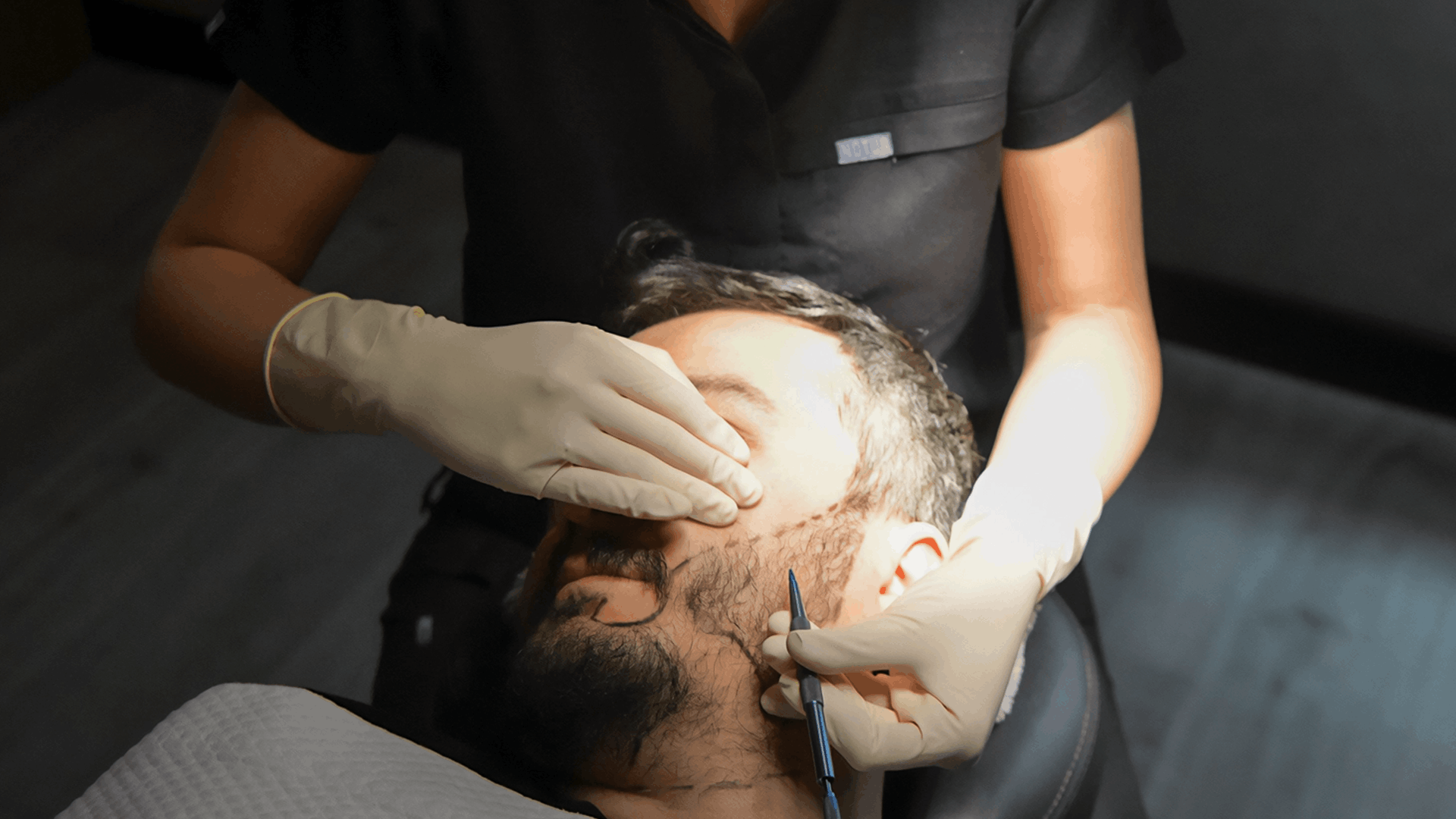
The beard, moustache and sideburn areas are assessed in detail. A personalised transplant plan is drawn up by analysing facial proportions, existing hair density and the individual’s aesthetic expectations.
- Step 02
Design
Healthy hair follicles are typically identified in the back of the head, and the distribution of grafts is planned to ensure a natural density.
- Step 03
Beard Transplant
Hair follicles harvested under local anaesthetic are implanted one by one into the beard, moustache or sideburn areas, taking into account their natural growth directions and angles. The aim is to achieve a natural, symmetrical appearance that harmonises with the facial features.
- Step 04
Follow-up & Support
Post-procedure care advice is provided, the first wash is carried out, and the healing process is monitored through regular check-ups.
Beard, Moustache and Sideburn Transplantation
A Natural-Looking Beard Starts with Proper Planning
The key to a successful beard transplant lies not only in the technical procedure, but also in the correct analysis process. This is because the anatomical structure of every face is different; consequently, the beard design must be tailored to the individual. Prior to the procedure, the beard, moustache and sideburn areas are assessed in detail. The hair density, facial symmetry, skin texture and capacity of the donor area are analysed to draw up a transplant plan. This ensures that both natural density and the overall aesthetic balance of the face are preserved. In particular, pre-existing scars, uneven beard growth or areas that have been naturally sparse from birth are assessed individually during the planning stage. The aim is not to create sharp transitions that give away the fact that a transplant has been carried out, but to achieve a natural result that blends in with the existing beard structure.How is a beard transplant carried out?
The beard transplant process begins, first and foremost, with the identification of healthy hair follicles to be harvested from the donor area. The grafts, which are usually taken from the nape of the neck, are carefully prepared using specialised microsurgical techniques and planned for the area to be transplanted. Each graft is then implanted individually, taking into account the natural direction, angles and density of the beard. Millimetre-precise planning is particularly important in the moustache and sideburn areas, as even a slight error in the angle in these areas can directly affect the natural appearance. At Dr Terziler Exclusive Clinic, the aim of the procedure is not merely to fill in sparse areas. Ensuring that the beard harmonises with the facial features, planning the right and left sides in a balanced manner, and preserving the natural beard line are also key aspects of the procedure.Subtle Touches to Complete Facial Aesthetics
Although density is the first thing that comes to mind when considering a beard transplant, a successful result involves much more than that. A natural look is achieved through the harmony between the direction and distribution of the hairs and the overall appearance of the face. For this reason, prior to the procedure, it is not only the area to be transplanted that is assessed, but also the jawline, the transitions at the cheeks, the length of the sideburns and the shape of the moustache. In this way, a design is created that is suited to the individual’s age, face shape and natural beard characteristics. Whilst some patients may wish for a more defined jawline, others may simply request that sparse areas be thickened. A personalised treatment plan, tailored to these differing expectations, is the key to achieving natural and balanced results.The Most Important Criteria for a Successful Beard Transplant
The success of a beard transplant is not determined by the technique used alone. The combination of accurate analysis, aesthetic planning and a meticulous procedure is of great importance in terms of long-term satisfaction.| Planning Criterion | The Dr Terziler Approach |
| Facial Analysis | Beard styling is tailored to each individual based on their facial proportions. |
| Donor Site Assessment | The healthy graft capacity is analysed in detail. |
| Graft Placement | Each graft is positioned taking into account the natural direction and angles of growth. |
| Symmetry Planning | The right and left sides of the face are designed to be balanced. |
| Natural Density | Grafts are distributed in a controlled manner according to regional requirements. |
| Post-operative Follow-up | The recovery process is supported by regular check-ups. |
The Benefits of Beard Transplantation
Beard transplantation is not merely a cosmetic procedure aimed solely at increasing beard density. When properly planned, it can help to create a more balanced appearance of the facial features, assist in correcting irregularities in the beard and moustache areas, and bring out a person’s facial expression more effectively. One of the key advantages is that the treatment is entirely personalised. As every individual’s face shape, hair texture and aesthetic expectations differ, an individualised approach based on a natural appearance is adopted rather than a standard design. The aim is therefore to achieve a look that is in harmony with the existing structure of the beard and which, when viewed from the outside, does not appear to have been added later. Thanks to beard transplants;- Areas of the beard that are naturally sparse can be made denser.
- Gaps in the moustache and sideburn areas can be filled in naturally.
- The appearance of hair can be restored in areas affected by trauma or scarring.
- A more balanced beard style that complements the facial features can be planned.
- The aim is to achieve aesthetic harmony whilst preserving the natural direction of hair growth.
Who is Suitable for Beard, Moustache and Sideburn Transplants?
Beard transplantation is a procedure that may be considered for individuals who wish to enhance the appearance of their beard in line with their aesthetic expectations and who have a sufficient number of healthy hair follicles in the donor area. A detailed assessment carried out prior to the procedure enables the individual’s needs to be identified and a suitable treatment plan to be drawn up. Beard, moustache and sideburn transplants, in particular;- Those who are genetically predisposed to having a sparse beard,
- People with a congenital gap in the beard or moustache area,
- People experiencing hair loss due to trauma, burns or surgical scars,
- Anyone wishing to reshape their beard line,
- Aimed at highlighting the favori region,
- It may be a suitable option for those who want a more symmetrical and natural-looking beard.
Post-operative Care
The recovery process following a beard transplant is one of the key stages that contributes to the success of the procedure. In the first few days, mild redness, scabbing or tenderness may be observed in the treated areas. These symptoms usually subside within a short time and the recovery process continues as planned. Following the procedure, the initial aftercare and washing are carried out by a specialist team. Subsequently, the patient is provided with detailed aftercare advice to help ensure the grafts take root successfully. The temporary hair loss that may occur in the first few weeks is one of the natural stages of beard transplantation. New hairs will begin to grow back over time, and the beard’s final appearance will become apparent in the months that follow, depending on the individual’s healing process. At Dr Terziler Exclusive Clinic, patients are not left to their own devices after their operation. The recovery process is monitored through regular check-ups, and personalised support plans are drawn up should the need arise.A natural look is the most important aspect of beard styling
Achieving successful results in beard transplantation is not possible through technical application alone. The key factor that makes the real difference is the ability to analyse a person’s facial features accurately and create a design that suits them. For this reason, when planning a beard design at Dr Terziler Exclusive Clinic, it is not just the bare areas that are assessed. The jawline, transitions at the cheeks, moustache density, sideburn length and facial symmetry are analysed together. The aim is to create a balanced and aesthetically pleasing appearance that harmonises with the natural structure of the beard once the transplant is complete. A well-planned beard transplant draws people’s attention not to your beard, but to the natural balance of your face. This is the most important indicator of aesthetic success.Complete Your Natural Look with a Beard Transplant
The beard, moustache and sideburns are among the most distinctive features of male facial aesthetics. For this reason, the hair transplant plan to be implemented must be assessed not only from a technical perspective but also from an aesthetic point of view. At Dr Terziler’s Exclusive Clinic applied Beard Transplant, with its personalised planning philosophy, advanced microsurgical techniques and an approach centred on a natural appearance, is tailored to the needs of each patient. From the consultation Every stage, right through to the post-operative follow-up, is managed with the utmost care; the aim is not merely to replace missing hairs, but to create a natural and long-lasting beard that looks in harmony with your face. Because a successful beard transplant shouldn’t make you look like a different person when you look in the mirror; it should allow you to see the best version of yourself.Questions You May Have
This is a cosmetic procedure in which a person’s own hair follicles are transplanted into sparse or bald patches in the beard, moustache or sideburn areas, with the aim of achieving a natural and permanent appearance.
As the hair follicles transplanted are usually taken from a donor area where hair is resistant to shedding, the aim is to achieve permanent results.
The timing of shaving may vary depending on how the healing process is progressing. After the first few weeks, it is advisable to shave in accordance with your doctor’s recommendations.
The small scars that form in the areas where grafts are harvested and implanted become largely imperceptible as the healing process progresses.
Following the temporary shedding phase, new hair usually begins to grow from the third month onwards. The final results can be assessed within approximately 9 to 12 months.
Individuals who have congenital sparseness in the beard or moustache area, who have experienced hair loss due to scarring, or who wish to achieve a fuller beard appearance and have sufficient donor hair may be suitable candidates for this procedure following an assessment by a specialist doctor.
Your journey begins today.
Contact us for a free, personalised consultation. Our team of experts will be by your side every step of the way.