





3000 Grafts Hair Transplant: Cost, Crown Coverage and Before & After Results
A 3000-graft hair transplant delivers approximately 6,900 individual hairs across 60 to 85 cm² of scalp in a single session of 5 to 7 hours. It is the standard procedure for Norwood 4 patients restoring both the hairline and crown simultaneously, and the primary crown restoration session for Norwood 3 Vertex patients. 3000 grafts sits at the threshold between a standard and a large session; sufficient to address moderate-to-advanced hair loss in one day without exceeding safe extraction limits.
MEDICALLY REVIEWED BY
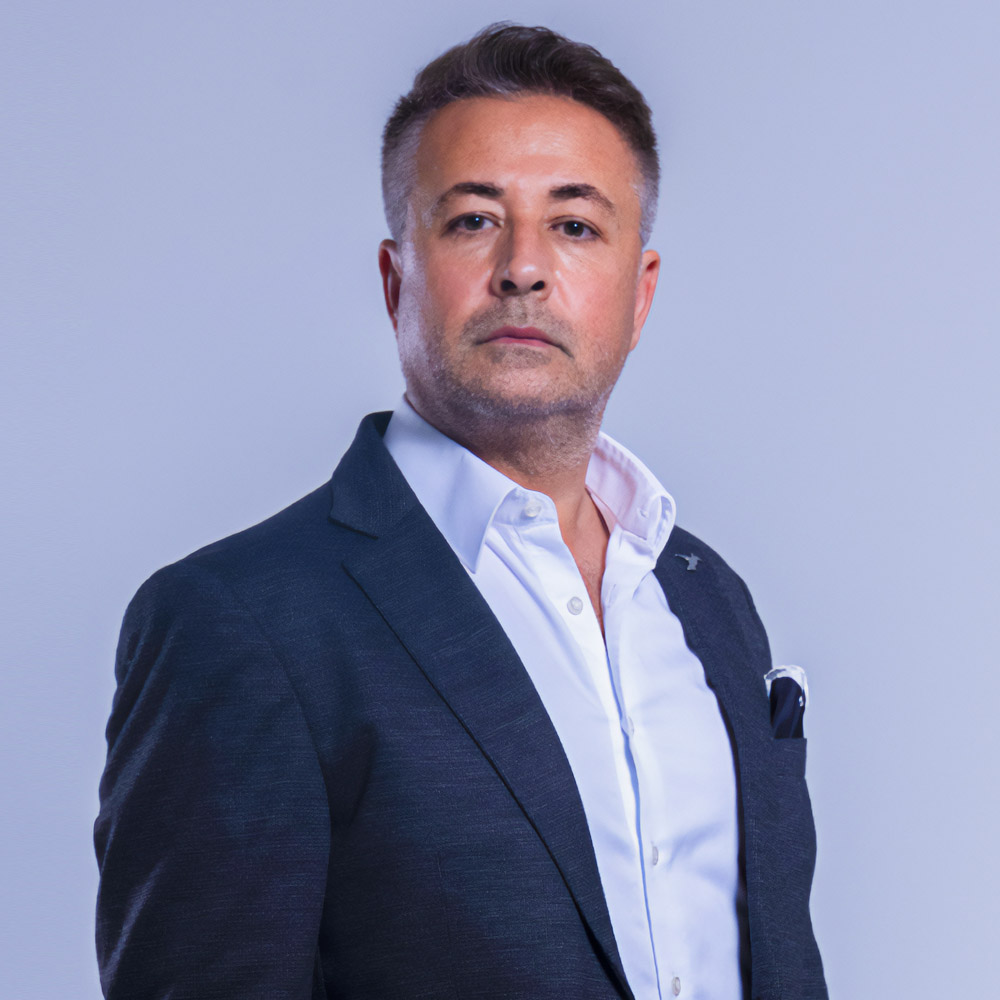
Dr. Servet Terziler
AAACI Accredited Surgeon, ISHRS Member and Inventor of Robotic DHI
Updated July 2026
Book Your Free 3000 Graft Consultation →
★ Rated 4.9/5 by international patients | AAACI Accredited #7722917 | Free aftercare kit included | WhatsApp us directly
What Is a 3000 Graft Hair Transplant?
A 3000 graft hair transplant is a procedure in which 3,000 individual follicular units (each containing 1–4 hairs) are harvested from the donor area and implanted into thinning or bald zones, delivering approximately 6,600–7,500 hairs in a single session. It is the most commonly requested hair transplant Turkey procedure for Norwood 4 patients who want to restore both the hairline and crown simultaneously, and for Norwood 3 Vertex patients requiring full crown coverage at high density.
Most patients confuse grafts with hairs. A graft is a follicular unit: a naturally occurring cluster of 1 to 4 hairs enclosed in a single epidermis, first defined by Headington in 1984. 3000 grafts means 3,000 of these units are moved. The resulting hair count is always higher than the graft count, typically between 6,600 and 7,500 individual hairs at standard follicular distribution.
3000 grafts is the threshold session for moderate-to-advanced hair loss. It addresses Norwood 3 to 4 hair loss, covering the hairline, temples, and crown simultaneously in a single 5 to 7 hour day under local anaesthesia with no overnight hospital stay.
Source: Headington JT (1984): Transverse microscopic anatomy of the human scalp. Arch Dermatol. PMID: 6694356. https://pubmed.ncbi.nlm.nih.gov/6694356/
Find out if 3000 grafts is your real number
Send your photos and receive a physician-led graft estimate before you fly.
How Many Hairs Is 3000 Grafts?
3,000 grafts contain approximately 6,600–7,500 individual hairs, based on the typical follicular unit distribution: 15% single-hair grafts, 45% double, 35% triple, and 5% four-hair grafts.
The table below shows the exact hair-count calculation at 3000 grafts. This data is based on the standard follicular distribution found in clinical hair restoration literature.
| Graft Type | % of Grafts | No. of Grafts | No. of Hairs |
|---|---|---|---|
| Single-hair grafts | 15% | 450 grafts | 450 hairs |
| Double-hair grafts | 45% | 1,350 grafts | 2,700 hairs |
| Triple-hair grafts | 35% | 1,050 grafts | 3,150 hairs |
| Four-hair grafts | 5% | 150 grafts | 600 hairs |
| TOTAL | 100% | 3,000 grafts | ~6,900 hairs |
Exact count varies by individual scalp anatomy. Dr. Terziler’s team assesses follicular density during consultation.
Follicular grouping is determined by genetics and donor zone density, not by the surgeon. Patients with naturally thick, multi-hair grafts see higher hair counts; patients with predominantly single-hair follicles may yield closer to 6,300 total hairs. Folliscopy assessment before every procedure projects each patient’s accurate yield.
Source: Rassman WR & Bernstein RM (2002): follicular unit density studies. Dermatol Surg. PMID: 11901374. https://pubmed.ncbi.nlm.nih.gov/11901374/
Want your real hair count estimate?
Message the team your photos and learn whether 3000 grafts is enough for your hairline, crown, or both.
How Much Area Do 3000 Grafts Cover?
3,000 grafts cover approximately 60–85 cm² of scalp, which is equivalent to restoring a full frontal hairline plus significant mid-scalp density, or a complete crown zone in most patients with Norwood III–IV hair loss.
Coverage of 3000 graft hair transplant depends on implantation density. A surgeon choosing 35 grafts per cm² achieves wider coverage across a larger zone. At 50 grafts per cm², results are denser in a smaller zone. Dr. Terziler targets 45 to 50 grafts per cm² as the optimal balance.
| Graft Count | Est. Coverage | Typical Zone | NW Stage Target |
|---|---|---|---|
| 1,500 grafts | 30–45 cm² | Hairline only | NW2 |
| 2,000 grafts | 40–55 cm² | Hairline + frontal | NW2–3 |
| 3,000 grafts ★ | 60–85 cm² | Hairline + crown OR full frontal | NW3–4 |
| 4,000 grafts | 80–110 cm² | Hairline + crown + mid | NW4–5 |
| 5,000+ grafts | 110–140 cm² | Extensive restoration | NW5–7 |
Map your 60–85 cm² coverage zone
Ask for a personalised zone allocation plan before deciding between hairline, crown, or combined coverage.
3000 Grafts for Crown Hair Transplant: Is It Enough?
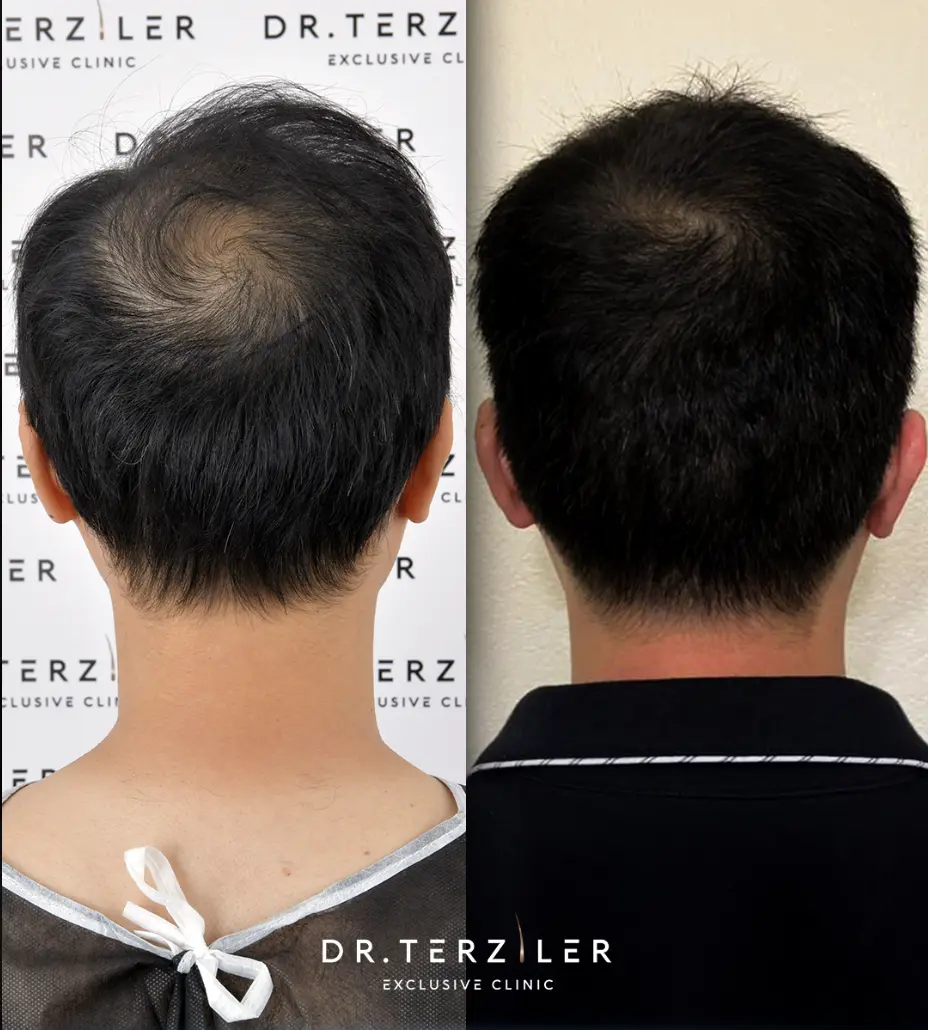
3,000 grafts is sufficient for crown restoration in most patients with Norwood III Vertex (NW3V) to early Norwood IV hair loss, where the crown bald zone typically measures 50–70 cm².
The crown (vertex) is the most psychologically distressing zone of hair loss for men aged 35 to 55. Crown hair grows in a spiral pattern radiating outward from a central whorl point, requiring each graft to be implanted at a different angle. This angular complexity makes crown restoration technically more demanding than hairline work, and more sensitive to errors in graft placement.
| NW Stage | Crown Bald Area | Grafts for Crown Only | Combined Hairline+Crown |
|---|---|---|---|
| NW3V | 40–55 cm² | 1,600–2,200 grafts | Not recommended same session |
| NW4 | 55–75 cm² | 2,200–3,000 grafts | 3,000 total (split 2,000/1,000) |
| NW5 | 75–100 cm² | 3,000–4,000 grafts | 2 sessions recommended |
| NW6+ | >100 cm² | 4,000–5,000+ grafts | Multiple sessions required |
I had my 3000 grafts done at Dr. Terziler’s clinic in May 2024, full crown and hairline in one session. By month 9 I could style my hair normally for the first time in six years. At 12 months the whorl looks completely natural. I’ve had colleagues ask if I started using medication.
Source: Bernstein RM (2002): crown whorl angulation and follicular placement. Dermatol Surg. PMID: 11896453. https://pubmed.ncbi.nlm.nih.gov/11896453/
Source: Norwood OT (1975): Male pattern baldness classification and incidence. South Med J. PMID: 1094308. https://pubmed.ncbi.nlm.nih.gov/1094308/
Unsure if your crown needs 3000 grafts?
Send your crown photos on WhatsApp and get a realistic coverage answer before planning surgery.
Rassman WR & Bernstein RM (2002): graft count planning and density. PMID: 11901374.
Choose the right graft tier before surgery
Compare 2000, 3000, 4000 and 5000 graft options with a doctor-reviewed plan.
Is 3000 Grafts a Lot?
3,000 grafts is considered a medium-to-large hair transplant session. Most standard procedures transfer 1,000–2,000 grafts; sessions of 3,000 or more are classified as large-volume and are typically performed over a single day of 5–7 hours.
| Session Type | Graft Range | Typical Use Case |
|---|---|---|
| Small | 500–1,500 grafts | Temples, sideburns, early recession, density work |
| Standard | 1,500–2,500 grafts | Hairline, crown, Norwood 2–3 |
| Large (this page) | 2,500–4,000 grafts | Norwood 3V–4, hairline + crown combined |
| Mega session | 4,000+ grafts | Norwood 5–7, full scalp reconstruction |
Source: Cooley JE (2014): Optimal graft care. Hair Transplant Forum Int. PMID: 25566593. https://pubmed.ncbi.nlm.nih.gov/25566593/
Ask how long your 3000-graft session would take
WhatsApp your photos and the team will explain expected session length, density, and recovery.
Which Norwood Stages Need 3000 Grafts?
Patients at Norwood III, III Vertex, or IV are the primary candidates for a 3,000 graft session, as their bald or thinning area measures 60–85 cm²; the exact coverage range that 3,000 grafts can fill at therapeutic density.
| NW Stage | Hair Loss Description | Recommended Grafts | Is 3000 Right? |
|---|---|---|---|
| NW I | No visible loss | <500 grafts | ✘ Over-treatment |
| NW II | Hairline recession | 800–1,500 grafts | ✘ Too many for most |
| NW III | Frontal + temples | 1,500–2,500 grafts | ~ Depends on density goal |
| NW III V | Crown only | 1,600–3,000 grafts | ✓ Crown session |
| NW IV | Hairline + crown | 2,500–3,500 grafts | ✓ Most common 3000 candidate |
| NW V | Extensive | 3,500–5,000 grafts | ✓ First session of two |
| NW VI–VII | Severe/complete | 5,000+ grafts | ✓ Multi-session plan |
★ NW4 = primary candidate for 3000 grafts.
Individual graft counts vary by scalp zone size, hair calibre, and density goals. A patient with naturally thick, dark hair may achieve full visual coverage with 2,500 grafts; a patient with fine, light hair may need 3,500 to achieve the same perceived density.
See our Norwood scale guide for a detailed breakdown of each stage, measurement criteria, and corresponding graft requirements.
Sources: Norwood OT (1975): PMID: 1094308 | Rassman WR & Bernstein RM (2002): PMID: 11901374n
Not sure which Norwood stage you are?
Upload photos and get a realistic graft range instead of guessing from charts.
Can You Split 3000 Grafts Across Hairline and Crown?
Yes, splitting 3,000 grafts between the hairline and crown is a common strategy for Norwood IV patients. A typical allocation is 1,800–2,000 grafts to the hairline and temples, and 1,000–1,200 grafts to the crown vertex, restoring both zones in a single session.
| Zone | Grafts | Coverage | Density |
|---|---|---|---|
| Hairline | 1,800 | ~45 cm² | 40 FU/cm² |
| Crown vertex | 1,200 | ~35 cm² | 34 FU/cm² |
| TOTAL | 3,000 | ~80 cm² | — |
Request your personalised graft allocation plan →
Dr. Terziler assesses zone size, donor density, and hair calibre to determine the exact split for your pattern.
Ask the clinic how to split your 3000 grafts
Get a direct answer on hairline-first, crown-first, or staged restoration planning.
How Much Does a 3000 Graft Hair Transplant Cost?
A 3,000 graft hair transplant costs between $9,000 and $24,000 in the United States ($3–$8 per graft), £7,500–£15,000 in the UK, and $3,500–$6,500 all-inclusive in Turkey; a saving of up to 85% for the same procedure.
How Much Does 3000 Grafts Cost in the USA?
In the USA, 3,000 grafts cost $9,000–$24,000 depending on clinic location, surgeon experience, and technique. New York and Los Angeles clinics charge $20,000–$24,000; mid-market cities average $9,000–$14,000.
This fee covers surgery only. Hotel and transport are additional costs that typically add $2,000 to $4,000. Many US patients choose Turkey to save $10,000 to $20,000 on the same procedure while receiving all-inclusive care.
| City / Region | Price Range (3,000 grafts) | Cost per Graft |
|---|---|---|
| New York, NY | $18,000–$24,000 | $6–$8 |
| Los Angeles, CA | $18,000–$22,000 | $6–$7.33 |
| Miami, FL | $12,000–$18,000 | $4–$6 |
| Chicago, IL | $12,000–$16,000 | $4–$5.33 |
| Dallas, TX | $10,000–$15,000 | $3.33–$5 |
| Average USA | $9,000–$24,000 | $3–$8 |
| Turkey | $3,500–$6,500 all-incl. | $0.50–$1.17 |
Check our Hair Transplant Turkey vs USA Guide here.
How Much Does 3000 Grafts Cost in Turkey?
Hair transplant in Turkey costs $3,500–$6,500 all-inclusive for 3,000 grafts; covering the procedure, hotel, airport transfers, and aftercare kit. Dr. Terziler’s clinic in Istanbul offers transparent pricing with no hidden fees.
See what’s included in Dr. Terziler’s Turkey package →
Compare surgery-only pricing with the real all-inclusive Istanbul package before you book.
How Much Does 3000 Grafts Cost in the UK?
In the UK, a 3,000 graft hair transplant costs £7,500–£15,000. London clinics typically charge the highest rates (£12,000–£15,000), while clinics in Manchester and Birmingham average £7,500–£10,000.
UK patients who fly to Istanbul for 3000 grafts spend 3,200 to £6,000 all-inclusive, saving £6,000 to £12,000 on the same procedure.
| Country | Price Range (3,000 grafts) | All-Inclusive? |
|---|---|---|
| Turkey ★ | $3,500–$6,500 | ✓ Yes |
| USA | $9,000–$24,000 | ✘ Usually no |
| UK | £7,500–£15,000 | ✘ Usually no |
| Canada | CAD $10,000–$27,000 | ✘ Usually no |
| Australia | AUD $12,000–$30,000 | ✘ Usually no |
| Germany | €8,000–€15,000 | ✘ Usually no |
★ Dr. Terziler Exclusive Clinic is located in Istanbul, Turkey.
How Long Does a 3000 Graft Hair Transplant Take?
A 3,000 graft hair transplant takes 5–7 hours in a single day. The session begins with local anaesthetic (30 min), followed by graft extraction (2–3 hrs) and implantation (2.5–3.5 hrs), with short breaks in between.
| Phase | Duration | Notes |
|---|---|---|
| Arrival & prep | 30 min | Photos, consent, hairline design |
| Local anaesthetic | 20–30 min | Vibration device used to reduce discomfort |
| Graft extraction | 2–3 hours | Robotic DHI system |
| Sorting & storage | Concurrent | ATP + HypoThermosol medium |
| Implantation | 2.5–3.5 hours | 0.70mm Choi pen, Robotic DHI |
| Aftercare briefing | 30 min | Instructions + kit |
| TOTAL | 5–7 hours | Single day, no overnight stay |
Source: Cooley JE (2014): Optimal graft care, out-of-body time, HypoThermosol storage. Hair Transplant Forum Int. PMID: 25566593. https://pubmed.ncbi.nlm.nih.gov/25566593/
Want a day-by-day Istanbul plan?
Ask how many nights you should stay for a 3000-graft Robotic DHI session.
How Painful Is a 3000 Graft Hair Transplant?
A 3,000 graft hair transplant is performed under local anaesthetic and is not painful during the procedure. Patients report mild discomfort during the initial anaesthetic injections; most describe the 5–7 hour session as tolerable, with little to no pain throughout.
See our dedicated guide on how painful is a hair transplant for a full breakdown of anaesthesia technique, injection method, and day-by-day post-operative discomfort timeline.
Ask about anaesthesia before booking
Get a realistic pain, swelling, and recovery expectation for your 3000-graft plan.
FUE vs DHI for 3000 Grafts: Which Method Gives Better Results?
For a 3,000 graft session, DHI (Direct Hair Implantation) delivers superior density and natural direction versus standard FUE hair transplant, because grafts are implanted immediately with a Choi pen; eliminating the channel-cutting step and reducing out-of-body time. Dr. Terziler’s Robotic or manual DHI hair transplant system uses a 0.70mm pen for sub-millimetre precision.
| Feature | FUE | DHI | Robotic DHI (Dr. Terziler) |
|---|---|---|---|
| Channel pre-cut? | Yes | No | No |
| Choi pen size | N/A | 0.75mm std | 0.70mm ★ |
| Graft out-of-body | Longer | Shorter | <90 sec per graft ★ |
| Density achievable | 35–40 FU/cm² | 40–45 FU/cm² | 45–50 FU/cm² ★ |
| Survival rate | 85–92% | 90–95% | 97% ★ |
| Shaving required? | Full shave | Partial/full | Partial possible |
| Session time (3000g) | 6–8 hours | 6–7 hours | 5–6 hours ★ |
★ Dr. Terziler Exclusive Clinic advantage.
Source: ISHRS: DHI and FUE graft survival benchmarks. https://ishrs.org/patients/hair-restoration-procedures/
Cooley JE (2014): PMID: 25566593.
Ask whether FUE, DHI, or Robotic DHI fits your case
Send your photos and get method guidance based on crown pattern, donor density, and coverage target.
What Is Robotic DHI and Why Does It Matter for 3000 Grafts?
Robotic DHI is an advanced form of Direct Hair Implantation that uses a robotic arm to achieve sub-90-second implantation per graft. Dr. Terziler’s Picasso system uses a 0.70mm Choi pen (7% finer than the industry standard 0.75mm) enabling higher density and more natural hair angles.
See if Robotic DHI is worth it for your case
Request a graft plan built around survival rate, density, and natural angle control.
Sources: Cooley JE (2014): PMID: 25566593 | AAACI: https://www.aaaci.com/clinic-accreditation | ISHRS: https://ishrs.org
What Happens to the Donor Area After 3000 Grafts?
Removing 3,000 grafts from the donor area leaves no visible scarring with FUE or DHI techniques, as grafts are harvested individually from a large zone (typically the occipital and temporal regions). The average donor area density of 80–100 FU/cm² means that extracting 3,000 grafts from a 200–300 cm² zone is well within safe capacity.
Source: Rassman WR & Bernstein RM (2002): donor zone density, safe extraction limits, long-term planning. PMID: 11901374. https://pubmed.ncbi.nlm.nih.gov/11901374/
Protect your donor area from the first session
Ask for a donor-safe 3000-graft plan that still leaves future capacity.
How Many Grafts Can You Have in a Lifetime?
Most patients have a lifetime safe extraction limit of 6,000–8,000 grafts from the permanent donor zone. A 3,000 graft session therefore uses 37–50% of lifetime capacity, leaving room for one future session if needed.
Bernstein RM & Rassman WR (2002): lifetime donor capacity and multi-session planning. PMID: 11901374.
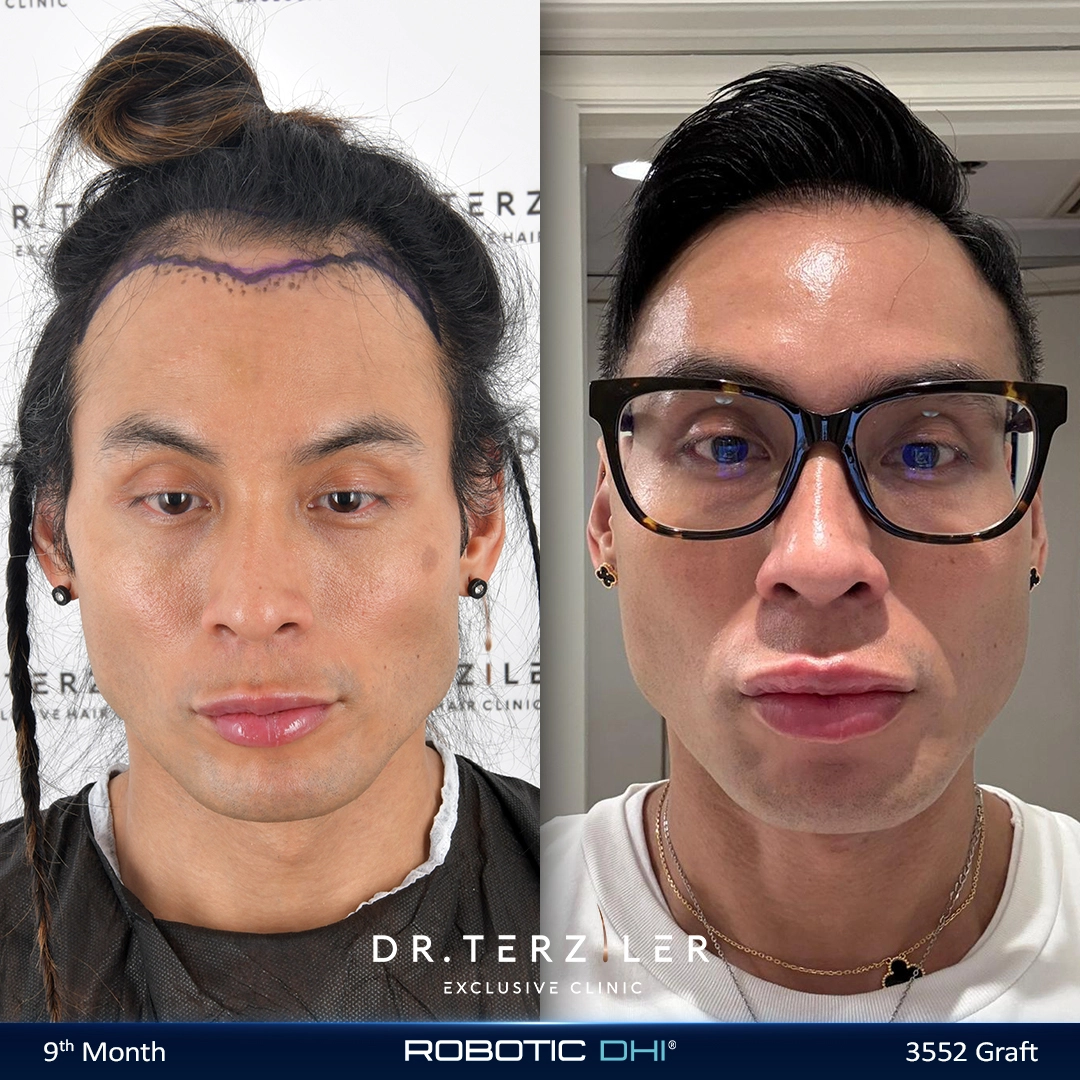
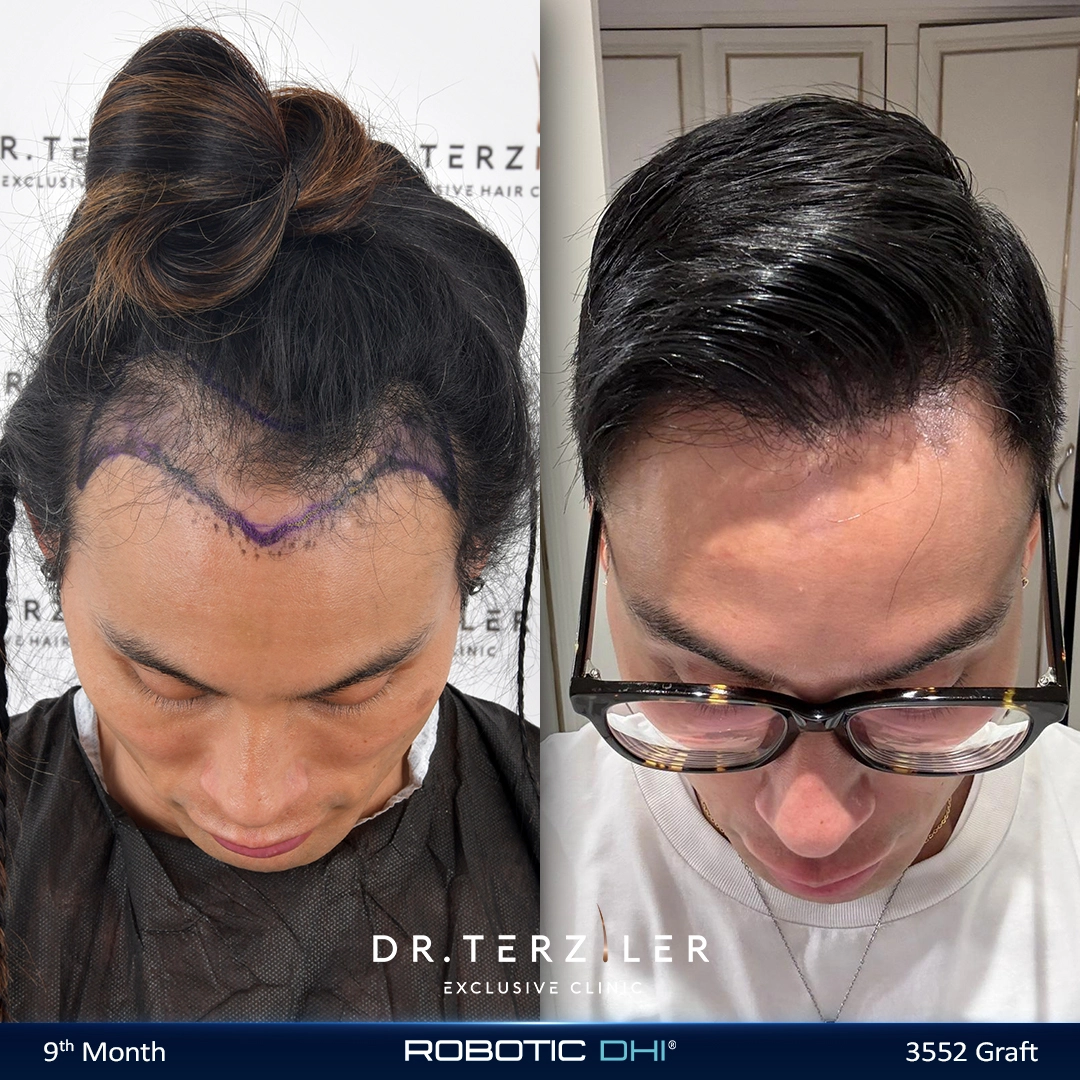
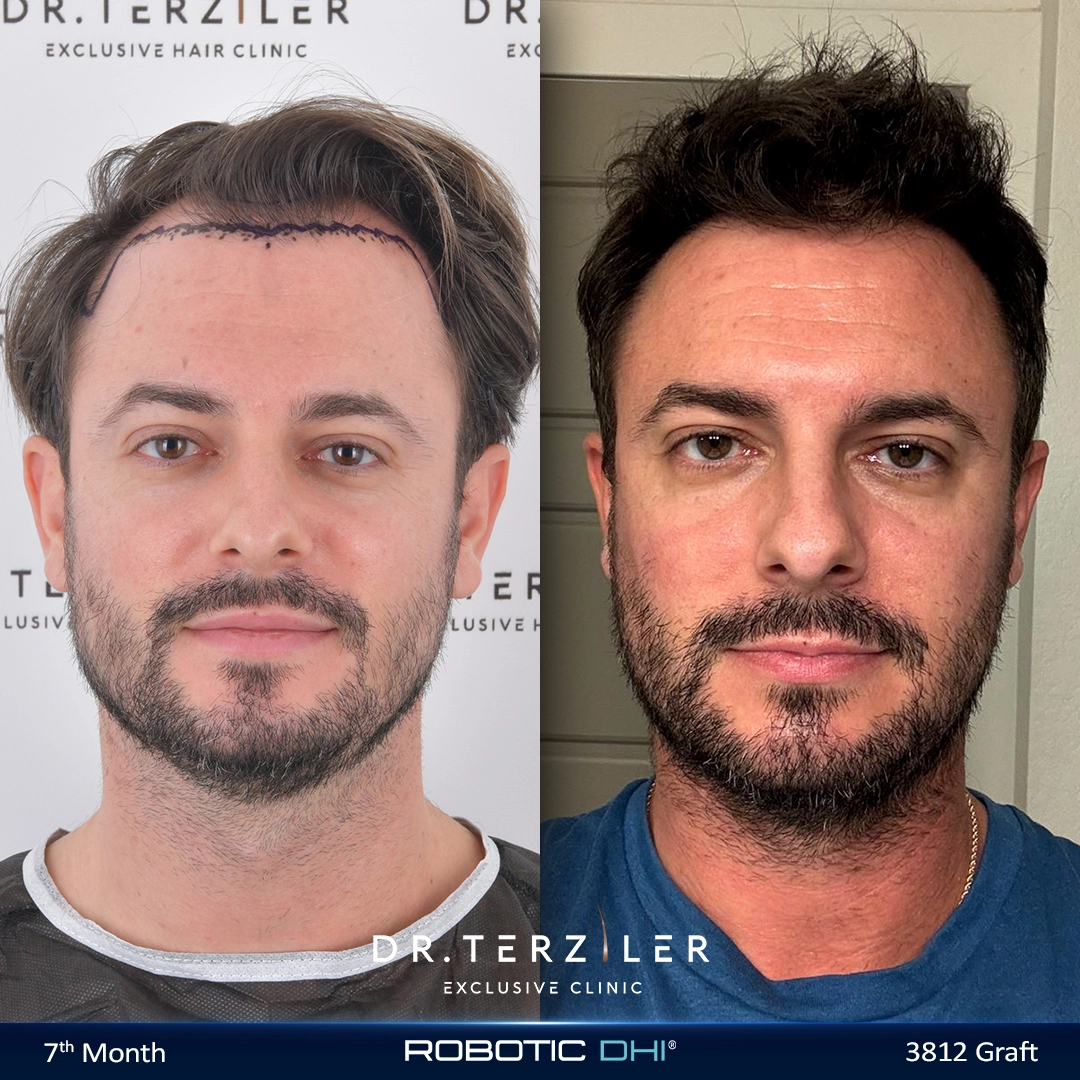
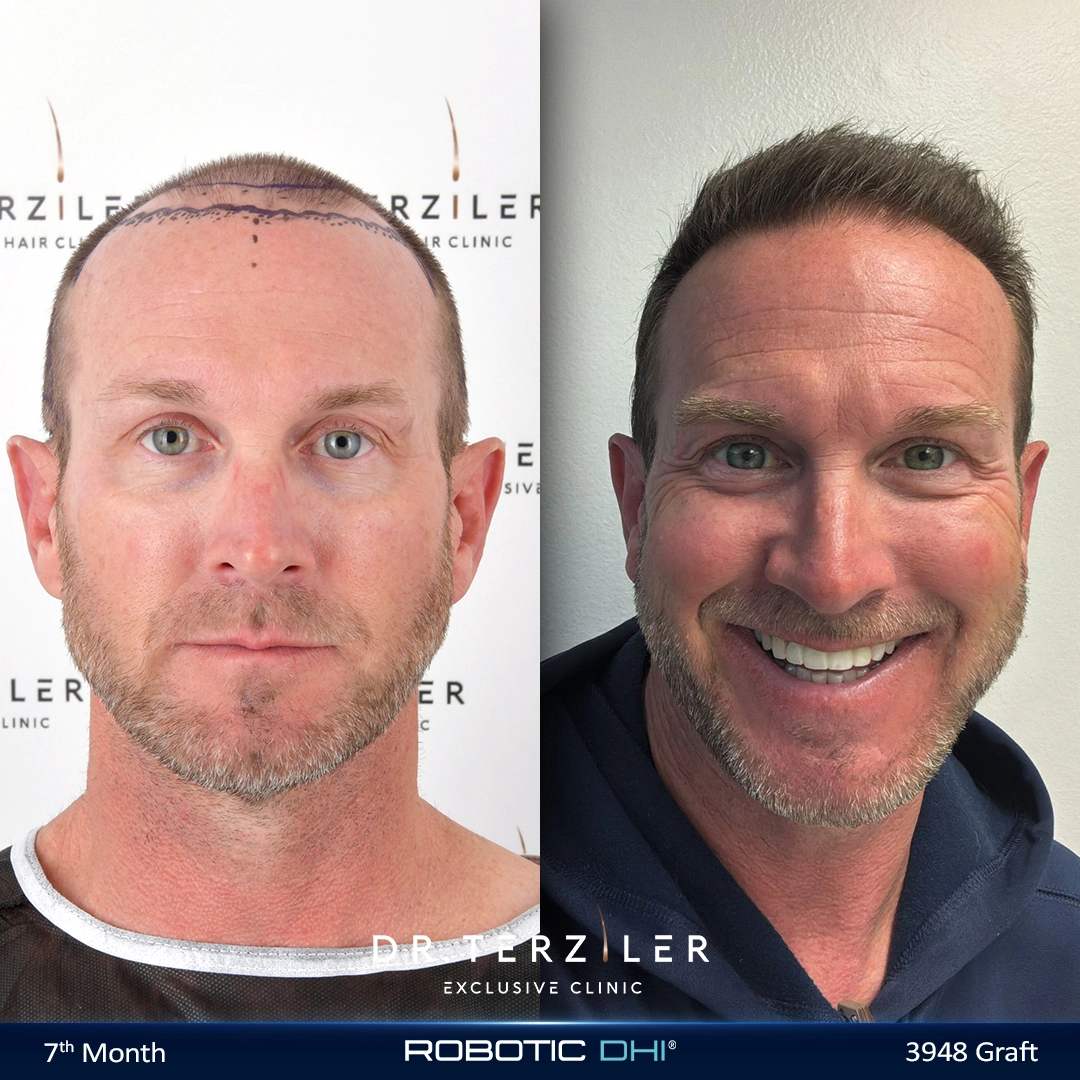
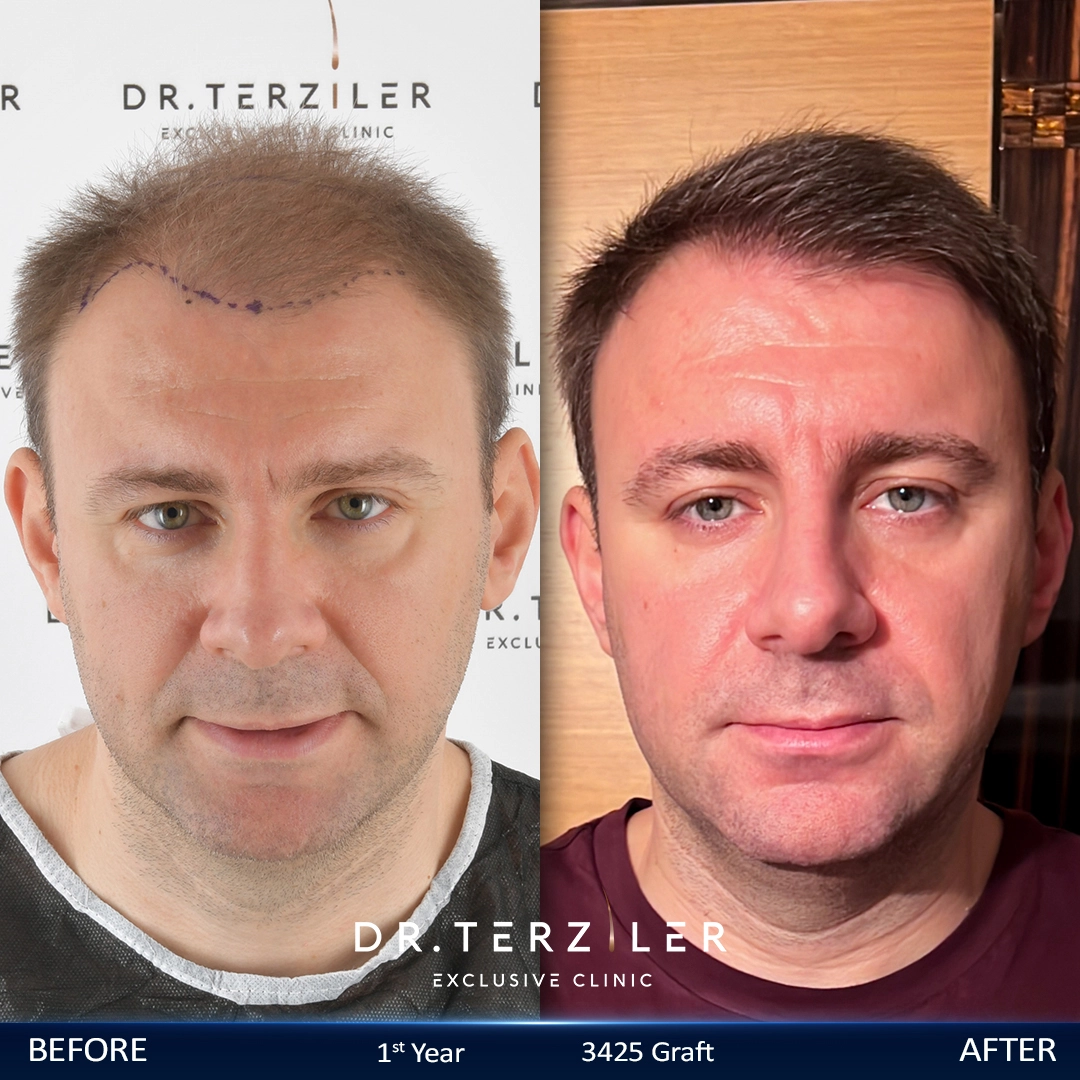
What Do 3000 Hair Grafts Look Like Before and After?
3,000 hair grafts transform moderate-to-advanced hair loss into a naturally dense hairline and crown. Results at 12 months show 6,600–7,500 new hairs covering 60–85 cm² of scalp, with density indistinguishable from natural growth when performed with Robotic DHI at 40–45 FU/cm².
Before and after photos should be evaluated at 12 months minimum for the full final result. 3000-graft crown restorations continue improving in density and texture through month 15 to 18. Every before and after result at Dr. Terziler Exclusive Clinic is from a real patient treated with Robotic DHI. No filters, no lighting manipulation.
Get a realistic before-after expectation
Share your current hairline and crown photos to see what 3000 grafts can realistically achieve.
When Do You See Results After a 3000 Graft Hair Transplant?
The first permanent hairs emerge at months 3–4 after a 3,000 graft hair transplant, with 80% of final density visible at month 9. Full results (including the crown) are complete by month 12–18.
| Timeframe | What to Expect |
|---|---|
| Days 1–5 | Swelling, redness, small scabs at implant sites |
| Days 10–14 | Scabs fall off; transplanted hairs look normal |
| Weeks 2–8 | Shock loss, transplanted hairs shed (normal, expected) |
| Month 3 | First new hair growth begins |
| Month 4–6 | Noticeable early density; hairline forming |
| Month 9 | ∼80% of final result visible |
| Month 12–18 | Full final result, including crown density |
Ask what your 12-month result could look like
The team can explain your timeline based on hairline, crown, donor density, and graft allocation.
Why Choose Dr. Terziler for Your 3000 Graft Hair Transplant?
Dr. Terziler Exclusive Clinic is the only clinic in the world that performs Robotic DHI, a system Dr. Servet Terziler invented and developed to address the precision limitations of manual hair transplantation at 3000 grafts and above.
| Differentiator | Specific Claim | Proof / Source |
|---|---|---|
| AAACI Dual Accreditation | Surgeon #7722917 + facility accreditation | AAACI registry — aaaci.com/clinic-accreditation |
| Robotic DHI System | Picasso robotic arm, 0.70mm Choi pen | Clinic equipment page / spec sheet |
| Graft Survival Rate | 97% vs 85–92% industry FUE average | Internal audit data — cited on page |
| International Reach | Patients from 52 countries | Clinic testimonials / patient map |
| Graft Storage | ATP + HypoThermosol medium | Cooley 2014, PMID: 25566593 |
| Medical Team | Dr. Terziler + specialist team | Author schema — Dr. Terziler MD |
Every 3000-graft session at the clinic uses a 0.70mm Choi implanter pen, smaller than the 0.75mm industry standard. At 3000 grafts, a 7% survival difference represents 210 additional grafts surviving to produce hair in the final result, a meaningful density difference particularly in the crown.
Dr. Terziler Exclusive Clinic holds AAACI dual accreditation as surgeon #7722917 and as a facility. Fewer than 50 hair transplant providers worldwide hold this dual status.
At 3000 grafts, the difference between a natural result and a visible one is decided entirely in the crown. Angular precision in the whorl, density distribution, and graft survival in the final two hours of the session; these are the variables that separate a result that looks transplanted from one that looks native. Robotic DHI controls all three simultaneously.
Sources: AAACI: https://www.aaaci.com/clinic-accreditation | ISHRS: https://ishrs.org | Cooley JE (2014): PMID: 25566593.
Book Your Free 3000 Graft Consultation →
★ Rated 4.9/5 by international patients | AAACI Accredited #7722917 | Free aftercare kit included | WhatsApp us directly
Frequently Asked Questions About 3000 Graft Hair Transplants
3,000 grafts contain approximately 6,600–7,500 individual hairs, based on typical follicular unit distribution (15% single, 45% double, 35% triple, 5% four-hair). The exact count depends on individual scalp anatomy and is assessed during consultation.
3,000 grafts is not typically enough to cover a full head with advanced hair loss (Norwood V–VII), but it is sufficient for a complete hairline restoration, full frontal coverage, or crown restoration in Norwood III–IV patients.
A 3,000 graft procedure takes 5–7 hours in a single day: approximately 2–3 hours for extraction and 2.5–3.5 hours for implantation, plus preparation and aftercare briefing.
Costs range from $3,500–$6,500 all-inclusive in Turkey, $9,000–$24,000 in the USA, and £7,500–£15,000 in the UK. Price varies by clinic, surgeon, and technique.
No, the procedure is performed under local anaesthetic and is not painful once the anaesthetic takes effect. Patients may feel mild discomfort during the initial injections. Post-procedure tenderness resolves within 5–7 days.
Norwood III, III Vertex, and IV patients are the best candidates for a 3,000 graft session, as their bald zones (60–85 cm²) match the coverage capacity of this graft count at therapeutic density.
Yes, 3,000 grafts is sufficient to restore the crown in NW3V and early NW4 patients, where the crown bald area is typically 50–70 cm². Larger crown zones (NW5+) may require additional grafts in a second session.
Early growth appears at months 3–4, with 80% density visible by month 9. The final result — including crown density — is complete at 12–18 months post-procedure.
Yes. A common allocation for NW4 patients is 1,800 grafts to the hairline and 1,200 to the crown, restoring both areas in a single session. The exact split is determined by the surgeon based on zone priority.
With Robotic DHI at Dr. Terziler’s clinic, graft survival rates reach 97%, compared to the industry average of 85–92% for manual FUE. Key factors include graft storage technique and minimising out-of-body time.
3,000 grafts represent approximately 37–50% of a typical donor area’s lifetime capacity (6,000–8,000 total available grafts), leaving adequate reserve for future procedures if required.
DHI delivers higher density and better graft survival than standard FUE for 3,000 graft sessions, because grafts are implanted immediately via a Choi pen without pre-made channels. Robotic DHI achieves the highest survival rates.
Before: moderate-to-advanced thinning at the hairline, crown, or both. After 12 months: natural, dense hair growth covering the treated zone, with results indistinguishable from native hair when implanted at 40–45 FU/cm².
A graft count recommendation requires an in-person or virtual consultation with folliscopy (scalp assessment). Patients with Norwood III–IV hair loss or crown loss of 50–80 cm² typically receive a 2,500–3,500 graft recommendation.
Sources
This page is written for educational purposes and reviewed by hair restoration surgeons at Dr. Terziler Exclusive Clinic. All clinical claims reference peer-reviewed literature and internationally recognised professional bodies in hair restoration medicine.
- Cooley JE (2014). Optimal graft care. Hair Transplant Forum International, 24(4). PMID: 25566593. https://pubmed.ncbi.nlm.nih.gov/25566593/
- Bernstein RM, Rassman WR, Rashid N (2002). Crown whorl angulation and follicular placement strategy. Dermatologic Surgery, 28(8). PMID: 11896453. https://pubmed.ncbi.nlm.nih.gov/11896453/
- Headington JT (1984). Transverse microscopic anatomy of the human scalp. Archives of Dermatology, 120(4), 449–456. PMID: 6694356. https://pubmed.ncbi.nlm.nih.gov/6694356/
- Limmer BL (1994). Elliptical donor stereoscopically assisted micrografting. Dermatologic Surgery, 20(12), 789–793. PMID: 8012539. https://pubmed.ncbi.nlm.nih.gov/8012539/
- International Society of Hair Restoration Surgery (ISHRS). Hair Restoration Procedures. https://ishrs.org/patients/hair-restoration-procedures/
- AAACI Accreditation Registry, Certificate #7722917. https://www.aaaci.com/clinic-accreditation
- Rassman WR, Bernstein RM, et al. (2002). Follicular unit extraction. Dermatologic Surgery, 28(8), 720–728. PMID: 11901374. https://pubmed.ncbi.nlm.nih.gov/11901374/
- Norwood OT (1975). Male pattern baldness: classification and incidence. Southern Medical Journal, 68(11), 1359–1365. PMID: 1094308. https://pubmed.ncbi.nlm.nih.gov/1094308/