


Most patients searching for '4000 grafts hair transplant' are trying to solve the same problem: moderate-to-severe hair loss across the hairline, mid-scalp, and often the crown. 4000 grafts covers Norwood 4 and 5 hair loss in a single operative day without a second procedure. This page gives you every clinical and practical answer: what 4000 grafts delivers, what it costs in the USA, UK, and Turkey, and what 4000 graft hair transplant results look like at 6, 9, and 12 months.

MEDICALLY REVIEWED BY
Dr. Servet Terziler
AAACI Accredited Surgeon, ISHRS Member and Inventor of Robotic DHI
Updated June 2026
Want to know if 4000 grafts is the right number for you?
Send your photos for a graft-count review, donor-capacity check, and realistic 4000-graft coverage plan.
What Is a 4000 Graft Hair Transplant?
A 4000-graft hair transplant moves 4,000 individual follicular units from the donor zone to thinning or bald areas. A graft is a naturally occurring bundle of 1 to 4 hair follicles. The number 4000 refers to grafts extracted and implanted, not individual hairs. Actual hairs delivered are typically 8,000 to 10,000.
How Many Hairs Is 4000 Grafts?
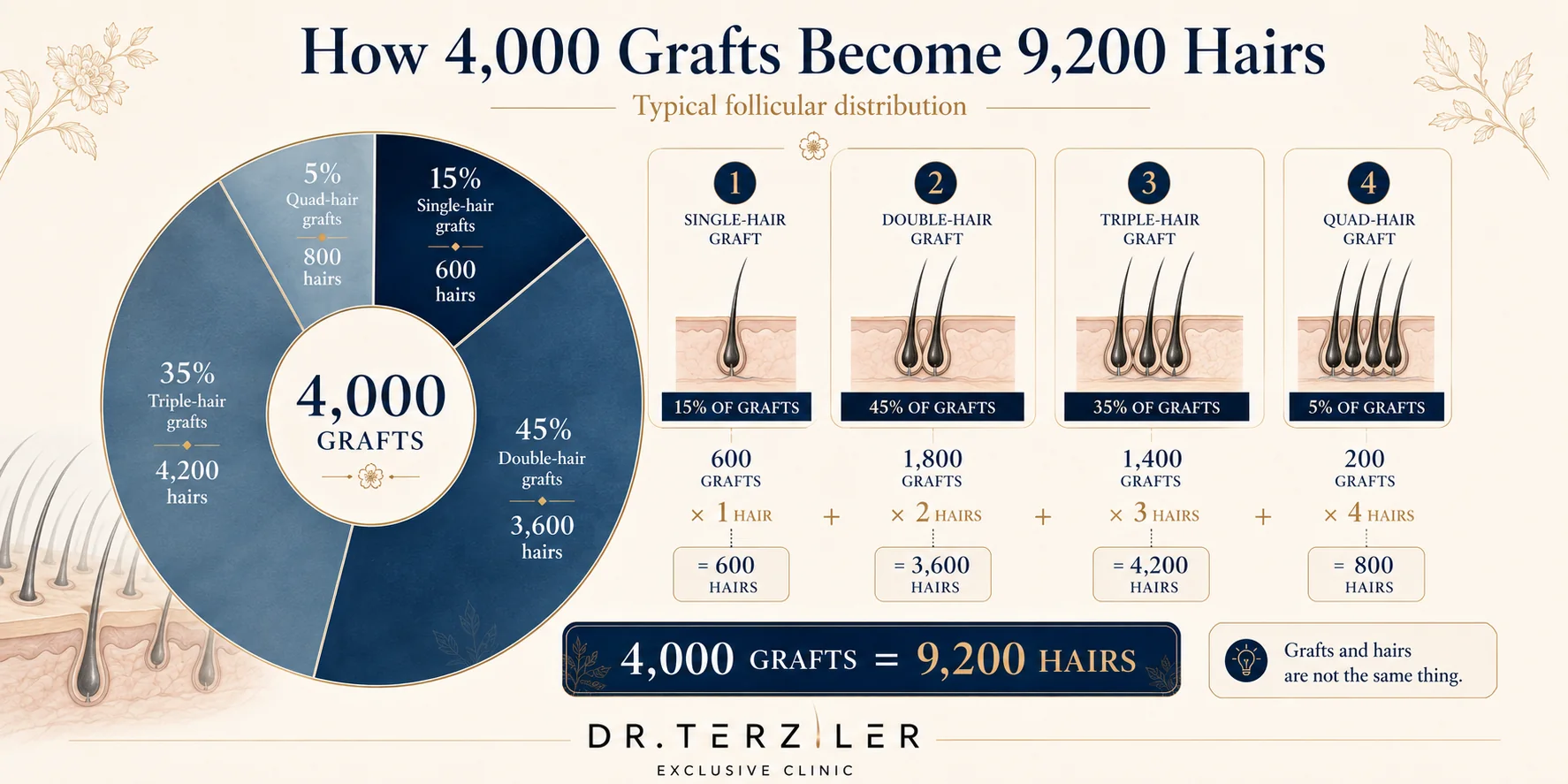
4000 grafts contain approximately 8,000 to 10,000 individual hairs. The exact count depends on follicular distribution in your donor zone, as detailed in our hair transplant guide. In a typical donor area, approximately 15% of grafts are single-hair, 45% double-hair, 35% triple-hair, and 5% four-hair units. That yields approximately 9,200 individual hairs from 4000 grafts.
| Graft Type | % of 4000 Grafts | Grafts | Hairs Delivered |
|---|---|---|---|
| Single-hair | 15% | 600 | 600 |
| Double-hair | 45% | 1,800 | 3,600 |
| Triple-hair | 35% | 1,400 | 4,200 |
| Four-hair | 5% | 200 | 800 |
| TOTAL | 100% | 4,000 | ~9,200 hairs |
How Much Area Do 4000 Grafts Cover?
4000 grafts cover approximately 80 to 130 square centimetres of scalp. At 50 grafts/cm2 (natural density), coverage is 80 cm2. At 35 grafts/cm2 (lighter density for larger zones), coverage reaches 114 cm2. Zone allocation determines where that area goes.
| Scalp Zone | Zone Size (cm2) | Grafts at 45/cm2 | 4000 Grafts Result |
|---|---|---|---|
| Frontal hairline only | 25-35 cm2 | 1,125-1,575 | Full zone, high density |
| Hairline + mid-scalp | 60-80 cm2 | 2,700-3,600 | Full coverage |
| Full scalp (NW5) | 120-150 cm2 | 5,400-6,750 | 60-75% coverage |
| Crown only | 40-60 cm2 | 1,800-2,700 | Full zone |
Is 4000 Grafts Enough for Full Coverage?
4000 grafts is enough for full coverage of Norwood 3 and 4 hair loss. For Norwood 5 and above, 4000 grafts delivers substantial coverage of the hairline and mid-scalp, but the crown may require a second session or partial coverage strategy. 'Full coverage' means different things per Norwood stage.
4000 Grafts vs 4200 Grafts: Is There a Meaningful Difference?
4200 grafts and 4000 grafts produce virtually identical results. The 200-graft difference represents approximately 440 additional hairs, which adds minimal visible density across an 80-130 cm2 treatment area. Surgeons often implant 4100-4200 grafts during a planned 4000-graft session to fully treat all recipient zones without leaving gaps. The number on the invoice matters far less than even distribution and graft survival rate.
How Much Will 2000 Grafts Cover?
2000 grafts cover approximately 40 to 55 square centimetres. This is typically sufficient for a frontal hairline restoration at Norwood 2 to 3. 2000 grafts deliver approximately 4,400 to 5,000 individual hairs.
How Much Will 3000 Grafts Cover?
3000 grafts cover approximately 60 to 85 square centimetres, addressing the hairline and mid-scalp for Norwood 3 to 4 patients. 3000 grafts deliver approximately 6,600 to 7,500 individual hairs.
How Much Will 5000 Grafts Cover?
5000 grafts cover approximately 110 to 145 square centimetres, providing full scalp coverage for Norwood 5 to 6 patients in a single session. 5000 grafts deliver approximately 11,000 to 12,500 individual hairs.
Need help choosing between 3000, 4000, or 5000 grafts?
Message the clinic team with your Norwood stage and photos; they can explain whether 4000 grafts is enough or whether the crown needs staging.
Is 4000 Grafts a Lot?
4000 grafts is a large session. Most clinics classify procedures above 3,000 grafts as mega sessions. In the USA, the average procedure is 1,500 to 2,500 grafts. A 4000-graft session requires a surgeon with demonstrated high-volume experience and a graft survival protocol designed for large extraction counts.
4000 grafts is safely achievable in one day using DHI or Robotic DHI, where simultaneous extraction and implantation eliminates the waiting period that reduces graft viability in conventional FUE.
Which Norwood Stages Require 4000 Grafts?
Norwood 4 and 4A patients typically require 3,000 to 4,000 grafts. Norwood 5 patients need 3,500 to 4,500 grafts. Individual donor density, scalp laxity, and target density all influence the precise count with the Norwood scale.
| Norwood Stage | Hair Loss Pattern | Grafts Needed | 4000 Grafts Result |
|---|---|---|---|
| NW2 | Temples receding | 800-1,500 | More than enough; dense result |
| NW3 | Deep temporal recession | 1,500-2,500 | Full coverage |
| NW3V | Crown/vertex thinning | 2,000-3,000 | Full coverage |
| NW4 | Hairline + mid-scalp | 3,000-4,000 | Full coverage in one session |
| NW4A | Extended mid-scalp | 3,500-4,500 | Near-full coverage |
| NW5 | Hairline + crown connect | 4,000-5,000 | Substantial; crown may be partial |
| NW6 | Large bald zone | 5,000-7,000 | Partial; second session likely |
| NW7 | Maximum hair loss | 6,000-9,000 | Partial; multiple sessions |
Can You Split 4000 Grafts Across Hairline and Crown?
Yes, splitting 4000 grafts across hairline and crown is a standard approach for Norwood 5 patients. A common allocation is 2,500 to 3,000 grafts for the hairline and mid-scalp, and 1,000 to 1,500 for partial crown coverage. Crown implantation works at 15 to 20% lower density than the frontal zone because crown hair grows in a spiral pattern and optical coverage at lower density is more efficient per graft.
How Much Does a 4000 Graft Hair Transplant Cost?
A 4000-graft hair transplant costs $15,000 to $35,000 in the United States and $2,000 to $8,500 Turkey hair transplant cost as an all-inclusive package. The US national average is approximately $20,000. In the UK, the same procedure costs GBP 10,000 to GBP 20,000.
How Much Does 4000 Grafts Cost in the USA?
A 4000-graft hair transplant costs $15,000 to $35,000 in the United States at $4 to $8 per graft. Prices in New York, Los Angeles, and Miami sit at the higher end. Clinics in Maryland charge approximately $15,000 to $28,000 for a 4000-graft session. For a full breakdown, see our hair transplant Turkey vs USA comparison.
How Much Does 4000 Grafts Cost in Turkey?
A 4000-graft hair transplant costs $2,000 to $8,500 in Turkey as an all-inclusive package covering clinic fees, accommodation, transfers, and aftercare. Istanbul is the primary destination. The price difference versus the USA is 80 to 85%, which is the main driver of medical travel to Turkey.
How Much Does 4000 Grafts Cost in the UK?
A 4000-graft hair transplant costs GBP 10,000 to GBP 20,000 in the United Kingdom. The London average is approximately GBP 14,000. UK patients traveling to Turkey for the same procedure typically spend GBP 2,500 to GBP 4,000 total, including flights and accommodation.
4000 Grafts Hair Transplant Cost Comparison: by Country
| Country | Avg Cost (4000 grafts) | Per Graft | All-Inclusive? |
|---|---|---|---|
| USA | $12,000 – $32,000 | $4 – $8 | Rarely |
| Canada | CAD $15,000 – $35,000 | CAD $4 – $9 | Rarely |
| UK | GBP 10,000 – GBP 20,000 | GBP 2.50 – GBP 5 | Rarely |
| Australia | AUD $18,000 – AUD $40,000 | AUD $4.50 – $10 | Rarely |
| Turkey (Istanbul) | $2,000 – $4,500 | $0.50 – $1.12 | Yes (standard) |
Want an exact 4000-graft package quote?
Share your photos and current location to compare USA, UK, and Istanbul pricing with package inclusions.
How Long Does a 4000 Graft Hair Transplant Take?
A 4000-graft hair transplant takes 6 to 9 hours in a single session. Robotic DHI with simultaneous extraction and implantation typically completes 4000 grafts in 7 to 8 hours. Standard FUE requires separate extraction and implantation phases, extending total time to 8 to 10 hours.
Is 4000 Grafts Too Much for One Day?
4000 grafts is not too much for one day for experienced surgical teams. The key constraint is graft survival, not graft count. If a clinic cannot maintain a sub-2-hour out-of-body time per graft, splitting across two days is safer. At high-volume clinics using Robotic DHI, 4000 grafts in one day is standard practice with survival rates maintained at 90 to 97%.
FUE vs DHI for 4000 Grafts: Which Method Gives Better Results?
DHI produces higher graft survival for large sessions. Survival with DHI hair transplant reaches 90 to 97% versus FUE hair transplant's 90 to 95%, because the Choi implanter pen places each graft immediately after extraction, minimising out-of-body time. For a 4000-graft session, a 2 to 7% survival advantage equals 80 to 280 additional live grafts.
| Technique | Graft Survival | Out-of-Body Time | Canals Pre-made? | Best For |
|---|---|---|---|---|
| FUE | 90-95% | 30-120 min (batch) | Yes (cut first) | High volume, limited budget |
| DHI (Choi pen) | 92-97% | Under 2 min per graft | No (direct) | Density and precision |
| Robotic DHI (Picasso) | Up to 97% | Under 90 sec per graft | No (direct) | Large sessions, angle control |
What Is Robotic DHI and Why Does It Matter for 4000 Grafts?
Robotic DHI uses robotics assistance to standardise extraction depth, punch pressure, and graft handling throughout a multi-hour session. In standard DHI, surgeon fatigue past hour 5 affects angle consistency. Robotic DHI eliminates that variable.
Curious if Robotic DHI fits your case?
Ask directly about survival rate, out-of-body time, and whether Robotic DHI is suitable for your 4000-graft plan.
What Happens to the Donor Area After 4000 Grafts?
The donor area looks normal after 4000 grafts when extractions are distributed evenly at under 80 grafts per square centimetre. Visible thinning only occurs when extraction exceeds the safe density threshold or concentrates in a small zone.
A standard male donor strip covers 100 to 120 cm2 at 80 to 100 follicles/cm2, totalling 8,000 to 12,000 follicles. Extracting 4000 grafts removes approximately 33 to 50% of available follicles. When spaced correctly, the remaining follicles provide optical coverage and the donor area heals with no visible scarring within 7 to 10 days.
Does a 4000 Grafts Hair Transplant Hurt?
A 4000-graft hair transplant does not hurt during the procedure. Local anaesthesia is applied before extraction begins. Patients feel pressure, not pain, during the injection phase, which lasts 5 to 10 minutes. Post-procedure discomfort is mild to moderate for 48 to 72 hours and is managed with standard oral analgesics. Most patients rate day-1 pain at 2 to 3 out of 10. Check our Does a hair transplant hurt? full guide here.
How Many Total Grafts Can You Have in a Lifetime?
Most patients have a lifetime scalp donor capacity of 6,000 to 10,000 grafts. A 4000-graft session uses 40 to 65% of a typical scalp reserve. Beard hair transplant adds 2,000 to 5,000 more grafts. Chest and body hair contributes a further 1,000 to 3,000. Patients undergoing a 4000-graft session at Norwood 4 typically retain enough capacity for one additional session if hair loss progresses.
Protect your donor area before committing to 4000 grafts.
Request a donor-capacity review so your first session does not compromise future hair-restoration options.
What Do 4000 Hair Grafts Look Like Before and After?
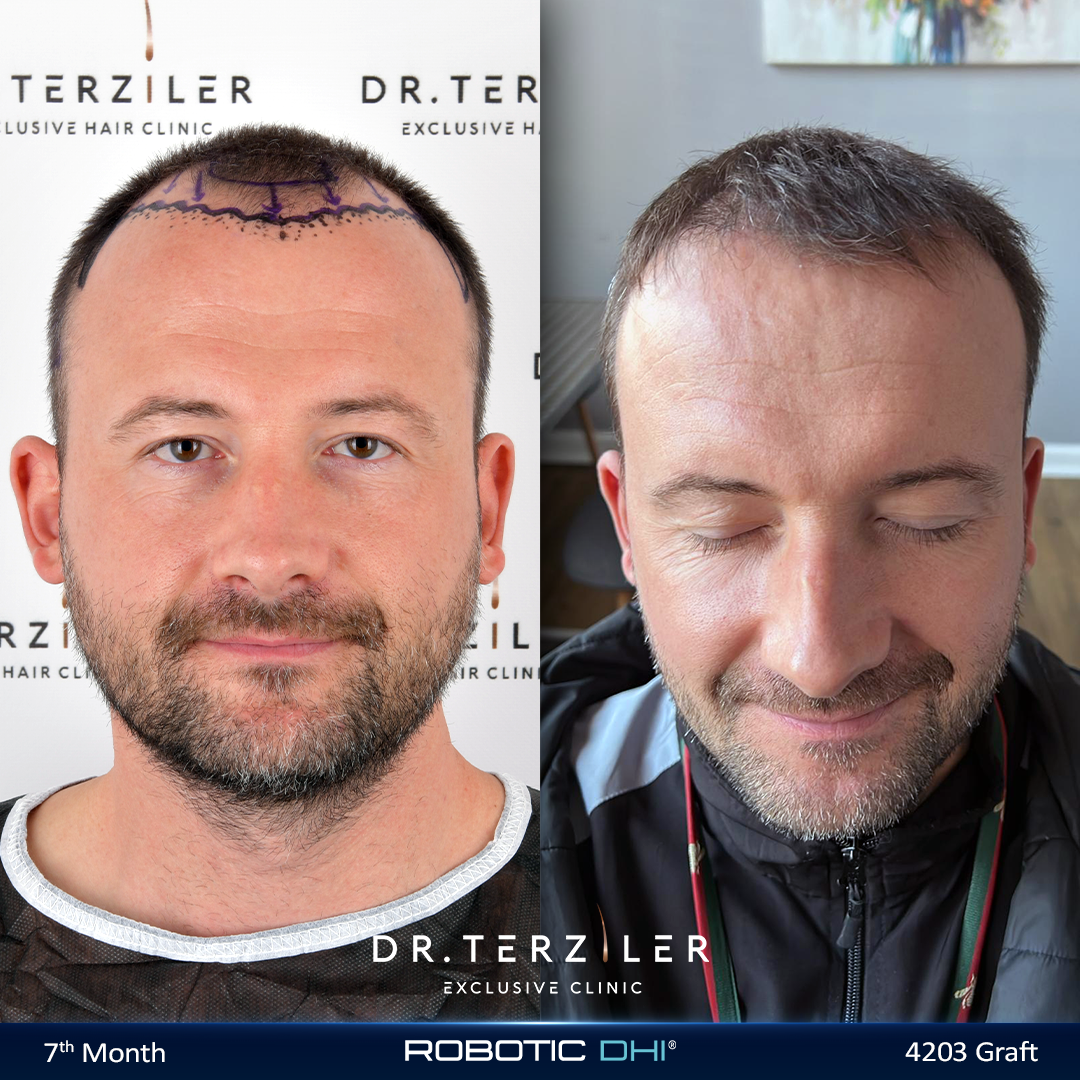
4000 hair grafts transform a thinning hairline, mid-scalp, and partial crown into a natural, full appearance by 12 months. The most dramatic change occurs between month 6 and month 12, as transplanted hairs reach terminal thickness and texture.
Month 3 to 4: first fine hairs appear, sparse. Month 6: 40 to 60% of final result visible, hairs thin. Month 9: 75 to 85% density. Month 12: full result achievable.
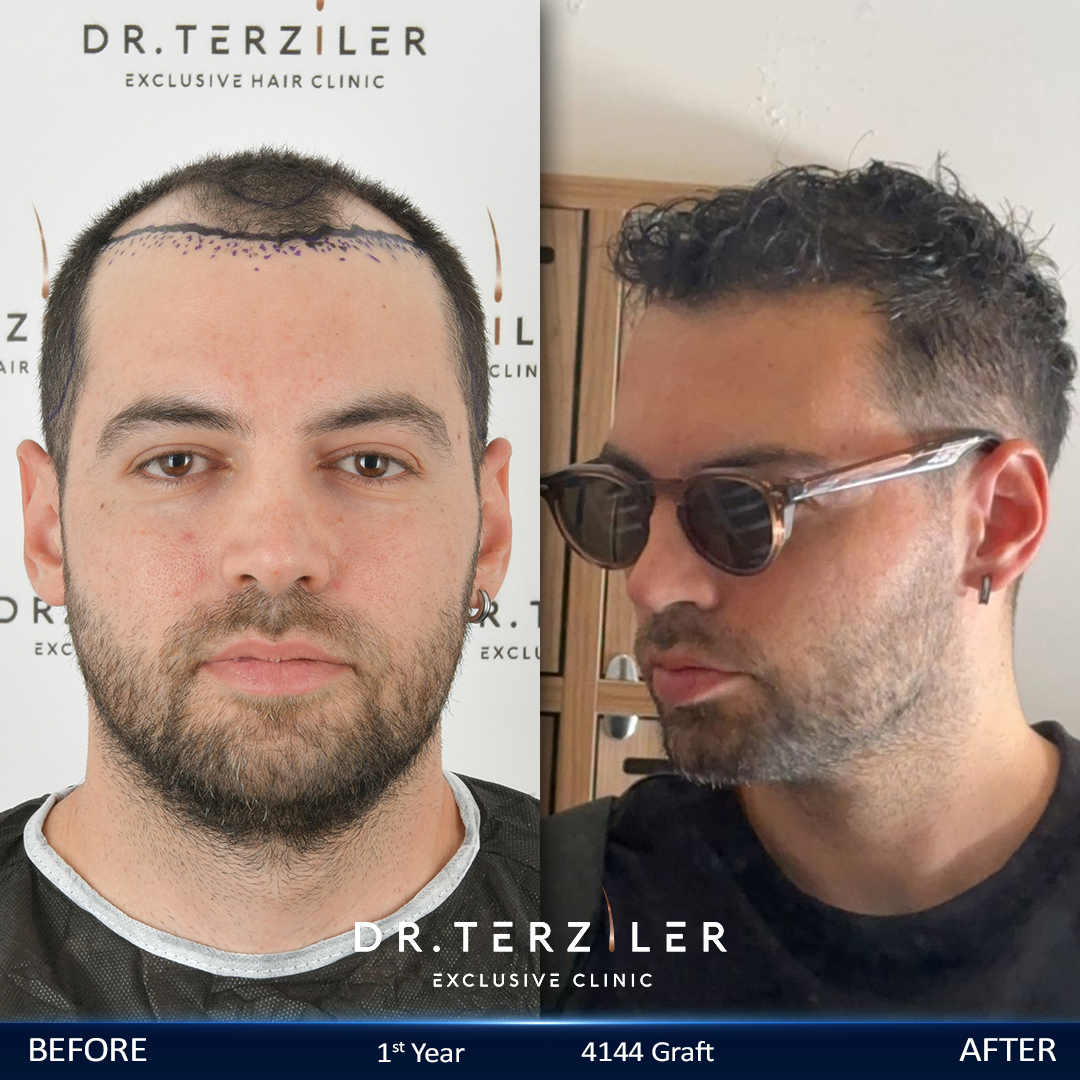
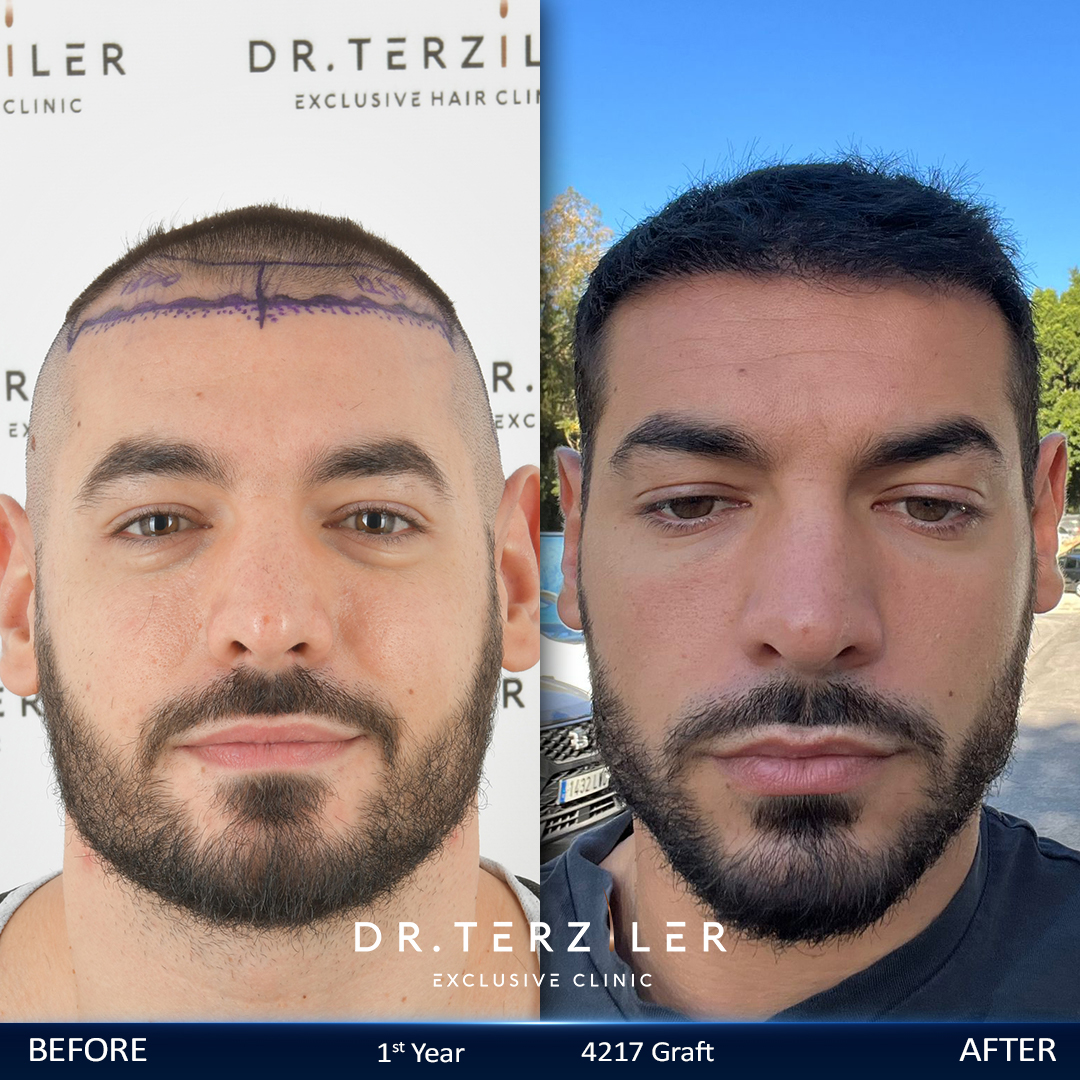
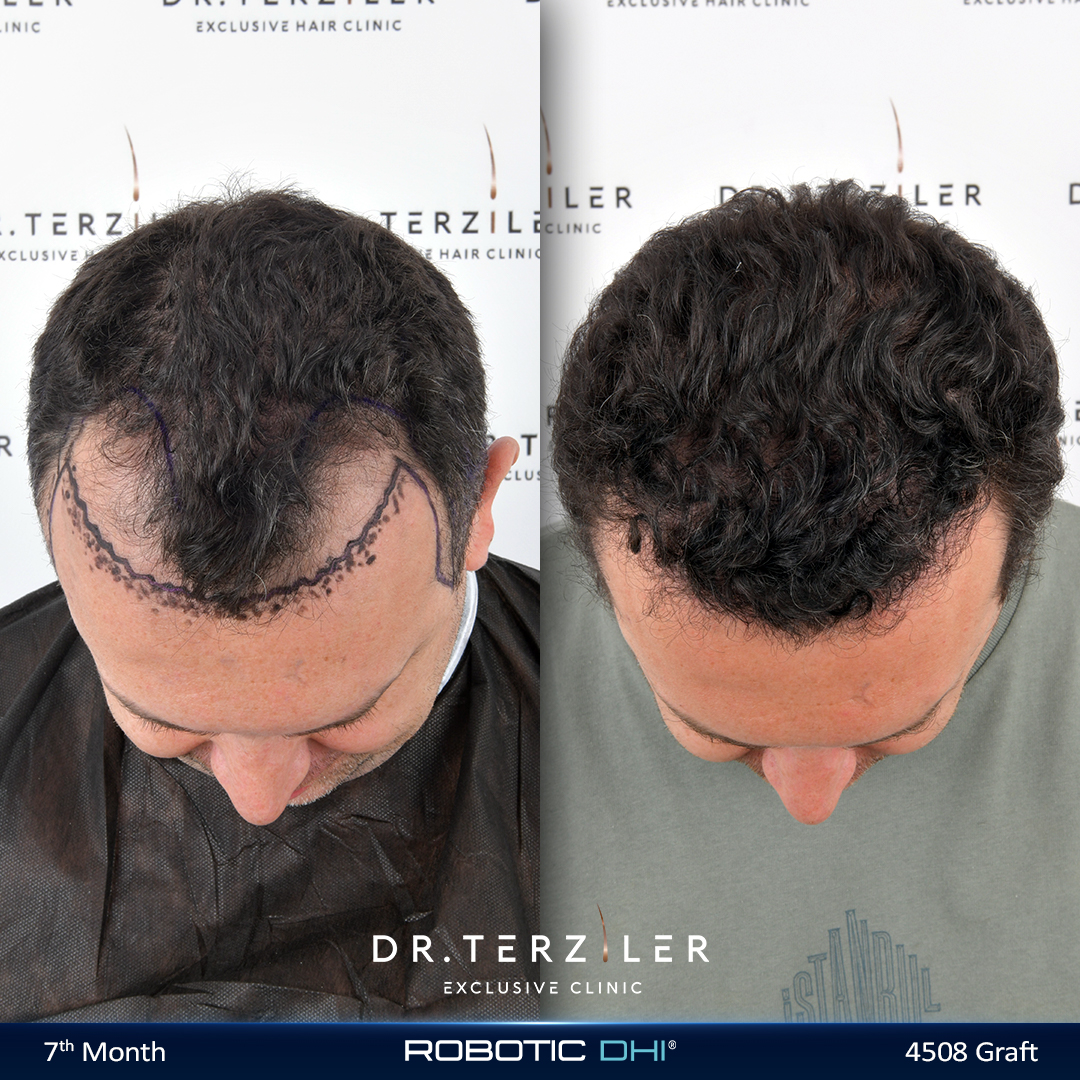
"I was quoted $24,000 in New York for 4000 grafts. Dr. Terziler's team did 4,100 grafts with Robotic DHI for less than the US deposit alone. Month 3 was rough. Month 10 I stopped wearing hats."
When Do You See Results After a 4000 Graft Hair Transplant?
You see the first visible growth at 4 to 5 months after a 4000-graft hair transplant. Approximately 80% of the final result is visible by month 9. Full terminal density is reached at 12 to 18 months.
| Month | What Happens | Patient Expectation | Dr. Terziler Protocol |
|---|---|---|---|
| 1 | Crusting, redness, shock loss begins | Normal shedding, do not panic | Saline spray, gentle cleanse |
| 2-3 | Shafts shed (telogen phase) | Sparse; 0-5% growth | Minoxidil review if indicated |
| 4-5 | First anagen hairs emerge | Thin, light-colored growth | PRP optional for acceleration |
| 6 | 40-60% of result visible | Encouraging, not final | Progress photo review |
| 9 | 75-85% density visible | Near-final appearance | Terminal texture forming |
| 12 | 90-95% of final result | Full assessment possible | Final result review |
| 18 | 100% final result | Maximum density reached | Long-term plan if needed |
Month 1-3: Why Is My Hair Falling Out After the Transplant?
Hair shedding at 1 to 3 months after a hair transplant is normal and expected. The transplanted hair shaft falls out while the follicle remains intact underground. Transplanted follicles enter telogen (resting) phase in response to surgical stress from anaesthesia, handling, and blood supply interruption. The follicle re-enters anagen at month 3 to 4. Shedding is not transplant failure.
Month 4-6: What Does Early Growth Look Like?
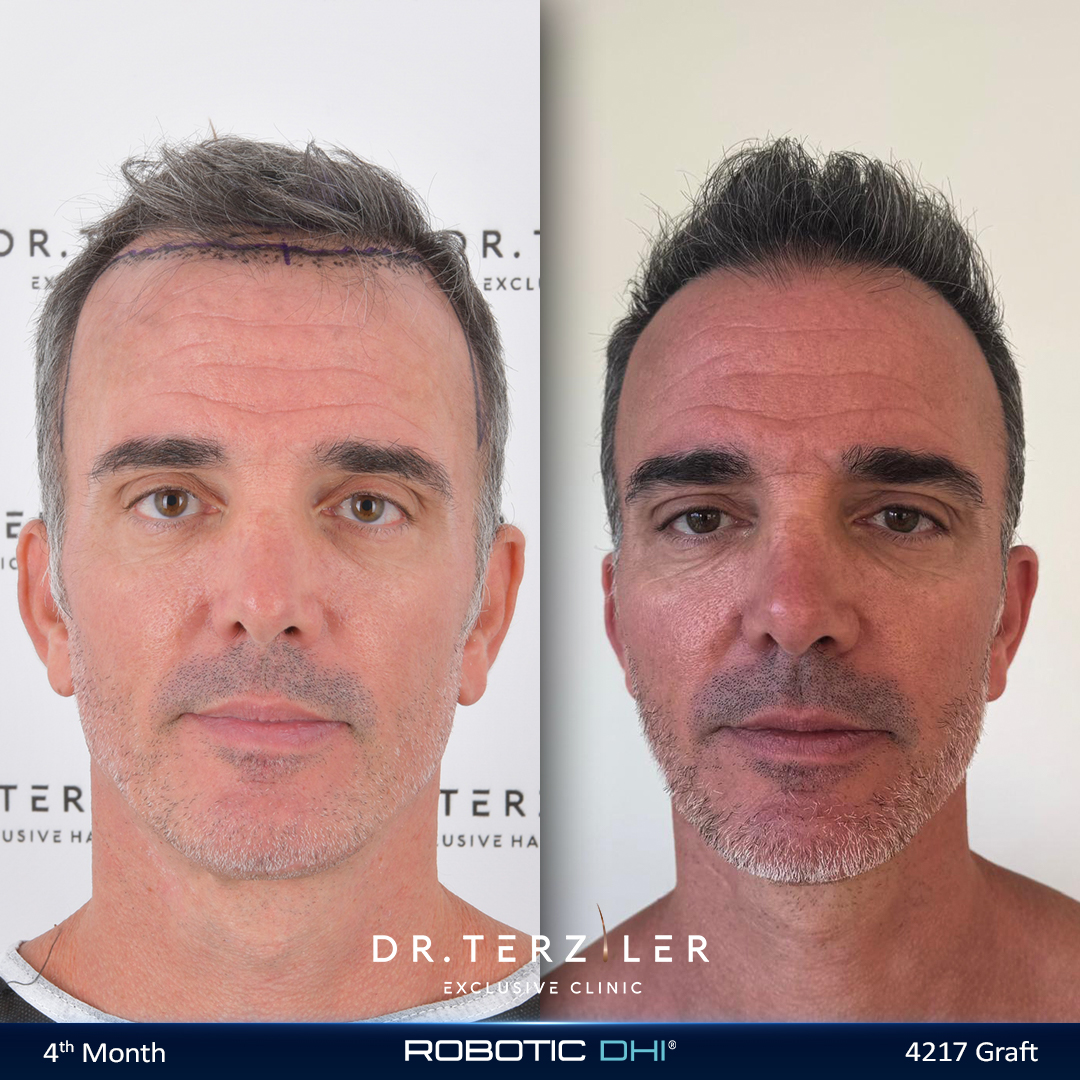
At 4 to 6 months, transplanted hair grows as thin, fine strands, often lighter in color and softer in texture than final hair. The hair shaft is in early anagen phase and has not yet reached full terminal diameter. Most patients see 40 to 60% of the final result by month 6. The appearance at this stage underrepresents the 12-month result significantly.
Month 9-12: When Is the Final Result Visible?
By month 9 to 12, approximately 80 to 95% of the final result is visible. Hair reaches full terminal thickness and natural texture. Some patients continue to see minor density improvements until month 18. The 6-month to 12-month gap is larger than most patients expect, as hairs thicken and darken throughout this window.
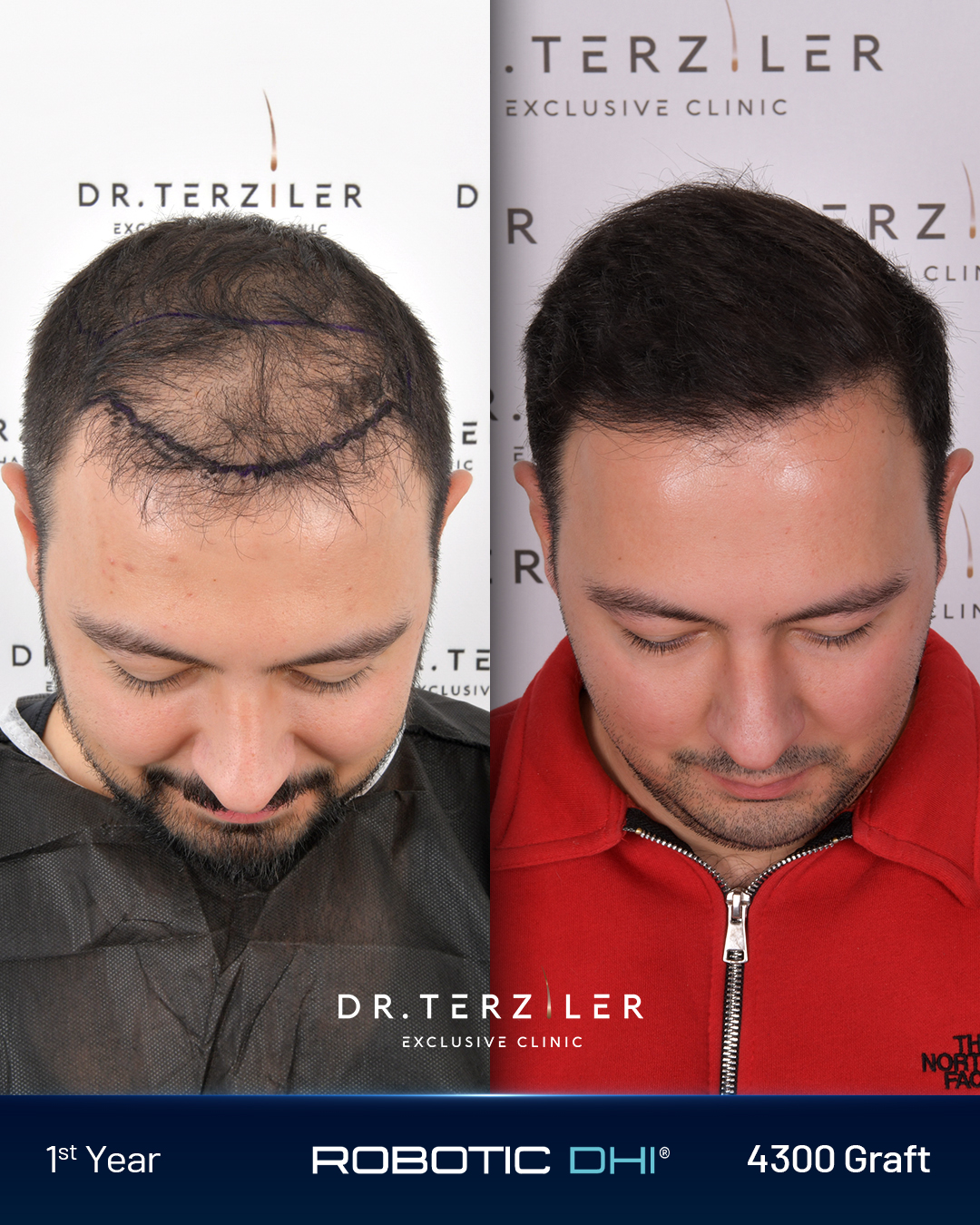
Want to know what month 6 and month 12 should look like?
Send your current timeline or photos and ask what stage of growth you should expect after a 4000-graft procedure.
Why Choose Dr. Terziler Exclusive Clinic for 4000 Grafts?
Dr. Terziler Exclusive Clinic delivers 4000-graft Robotic DHI procedures with up to 97% graft survival, dual AAACI accreditation, and the world's only Picasso Robotic DHI system. The clinic holds both surgeon-level accreditation (Dr. Servet Terziler, AAACI #7722917) and facility-level accreditation simultaneously, a combination held by fewer than 50 hair transplant providers globally.
Dr. Servet Terziler invented the Robotic DHI machine. The clinic's 0.70mm Choi implanter pen is smaller than the 0.75mm industry standard, producing 15 to 20% less recipient site trauma per graft. Every graft is implanted within 90 seconds of extraction. Grafts are stored in an ATP + HypoThermosol solution during the procedure. Research by Cooley (2014) demonstrated 72% graft survival in this solution versus 0% in saline at day 5.
Dr. Terziler is an ISHRS Workshop attender. The clinic has treated patients from 52 countries and has received European Property Awards recognition.
"The number 4000 is not what determines a result. What determines the result is how many of those 4000 grafts are still alive at 12 months. Every protocol we use, from the 0.70mm pen to the 90-second implantation rule, exists for that reason."
Ready for a Dr. Terziler 4000-graft plan?
Submit your photos for graft mapping, donor-area analysis, Robotic DHI eligibility, and a package quote.
Frequently Asked Questions About 4000 Grafts Hair Transplant
A 4000-graft hair transplant costs $12,000 to $32,000 in the United States and $2,000 to $4,500 in Turkey as an all-inclusive package. The US national average is approximately $20,000 at $4 to $8 per graft. UK prices range from GBP 10,000 to GBP 20,000.
4000 grafts contain approximately 8,000 to 10,000 individual hairs. Each graft averages 2.0 to 2.5 hairs. A typical follicular distribution of 15% single, 45% double, 35% triple, and 5% four-hair grafts yields approximately 9,200 hairs from 4000 grafts.
Yes. 4000 grafts is a large-to-mega session. Most clinics classify procedures above 3,000 grafts as mega sessions. It is safely achievable in one day by experienced teams using DHI or Robotic DHI with proven graft survival protocols.
4000 grafts cover 80 to 130 square centimetres depending on implantation density. At 50 grafts/cm2, coverage is 80 cm2. At 35 grafts/cm2, coverage reaches 114 cm2. This is sufficient for the full hairline and mid-scalp of a Norwood 4 patient.
A 4000-graft procedure takes 6 to 9 hours in a single session. Robotic DHI typically completes 4000 grafts in 7 to 8 hours due to simultaneous extraction and implantation. Standard FUE takes 8 to 10 hours.
4000 grafts provides substantial coverage for Norwood 5 but may not fully restore crown density in a single session. Most Norwood 5 patients need 3,500 to 4,500 grafts for hairline and mid-scalp, with crown coverage addressed partially or in a follow-up session.
4200 grafts is clinically identical in scope to 4000 grafts, falling within the large-to-mega session range. The 200-graft difference represents approximately 440 additional hairs, rarely visible across an 80-130 cm2 treatment area.
Norwood 4 and 4A patients most commonly need 3,000 to 4,000 grafts. Norwood 5 patients need 3,500 to 4,500 grafts. Norwood stage, donor density, and target density together determine the precise count.
The donor area looks normal after 4000 grafts when extractions are spaced evenly at under 80 grafts/cm2. Visible thinning only occurs when extraction is concentrated or exceeds the safe density threshold. The area heals with no visible scarring within 7 to 10 days.
Yes. A common approach for Norwood 5 patients is 2,500 to 3,000 grafts for the hairline and mid-scalp, and 1,000 to 1,500 for the crown. Crown implantation uses 15 to 20% lower density due to the spiral hair growth pattern.
DHI graft survival reaches 90 to 97%. FUE runs 90 to 95%. Survival depends on out-of-body time, graft storage solution, and implantation technique. Robotic DHI with ATP + HypoThermosol storage maximises survival. Research by Cooley (2014) confirms 72% survival in this solution vs 0% in saline at day 5.
DHI delivers slightly higher graft survival for large sessions. The 2 to 7% survival advantage over FUE equals 80 to 280 additional live grafts per 4000-graft session. For 4000 grafts, this difference is clinically meaningful. See the full DHI vs FUE comparison.
A 4000-graft hair transplant costs approximately $15,000 to $28,000 at clinics in Maryland. Many US patients travel to Turkey for the same procedure at $2,000 to $4,500 all-inclusive, saving $12,000 to $25,000 total.
Most patients have a lifetime scalp donor capacity of 6,000 to 10,000 grafts. A 4000-graft session uses 40 to 65% of this reserve. Beard hair adds 2,000 to 5,000 more. Chest and body hair contributes a further 1,000 to 3,000 grafts.
Still have a 4000-graft question?
Message the clinical team directly about cost, coverage, technique, donor area, timeline, or travel to Istanbul.