


Baseline & session 1
Record the diagnosis, photographs and scalp measurements before the first injection. Confirm the full plan and what would make it change.
Ask what my baseline assessment includes
PRP hair treatment injects platelet-rich plasma from your own blood into thinning areas of the scalp. Randomized trials show it can increase hair density and reduce shedding in early to moderate pattern hair loss. It works best in a series of three monthly sessions plus maintenance, and it cannot regrow hair on fully bald skin.
doctor confirms the cause of your hair loss and measures density and miniaturization with a Tricho Test.
ou get a written plan: PRP alone, ACell + PRP, or PRP combined with medication or a hair transplant.
The procedure is carried out comfortably by a team of specialists.
Progress is monitored through regular checks and the plan is updated.
Prepared by the clinic editorial team. Medically reviewed 28 October 2026. Dr. Servet Terziler is the clinic founder and developer of its Robotic DHI system. Dr. Terziler Exclusive Clinic holds AACI facility accreditation. Meet the medical team.
PRP is one of the better-studied injectable treatments for pattern hair loss. A 2025 review included 43 randomized trials and 1,877 participants. Its results support increased hair density and reduced shedding in some patients, but not a consistent improvement in hair-shaft thickness. PRP has not been shown to create new follicles in bald or scarred areas. [3] [14]
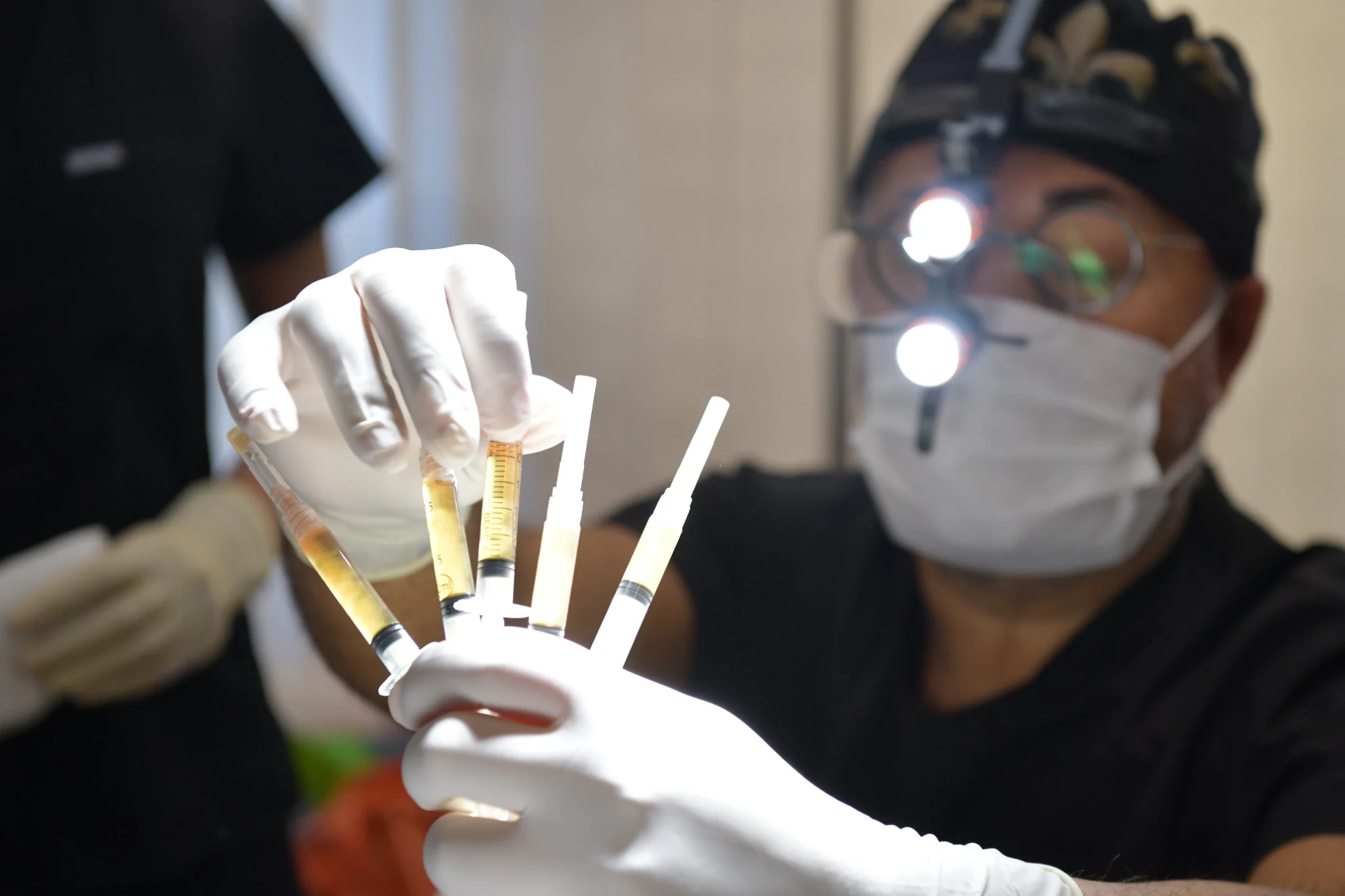
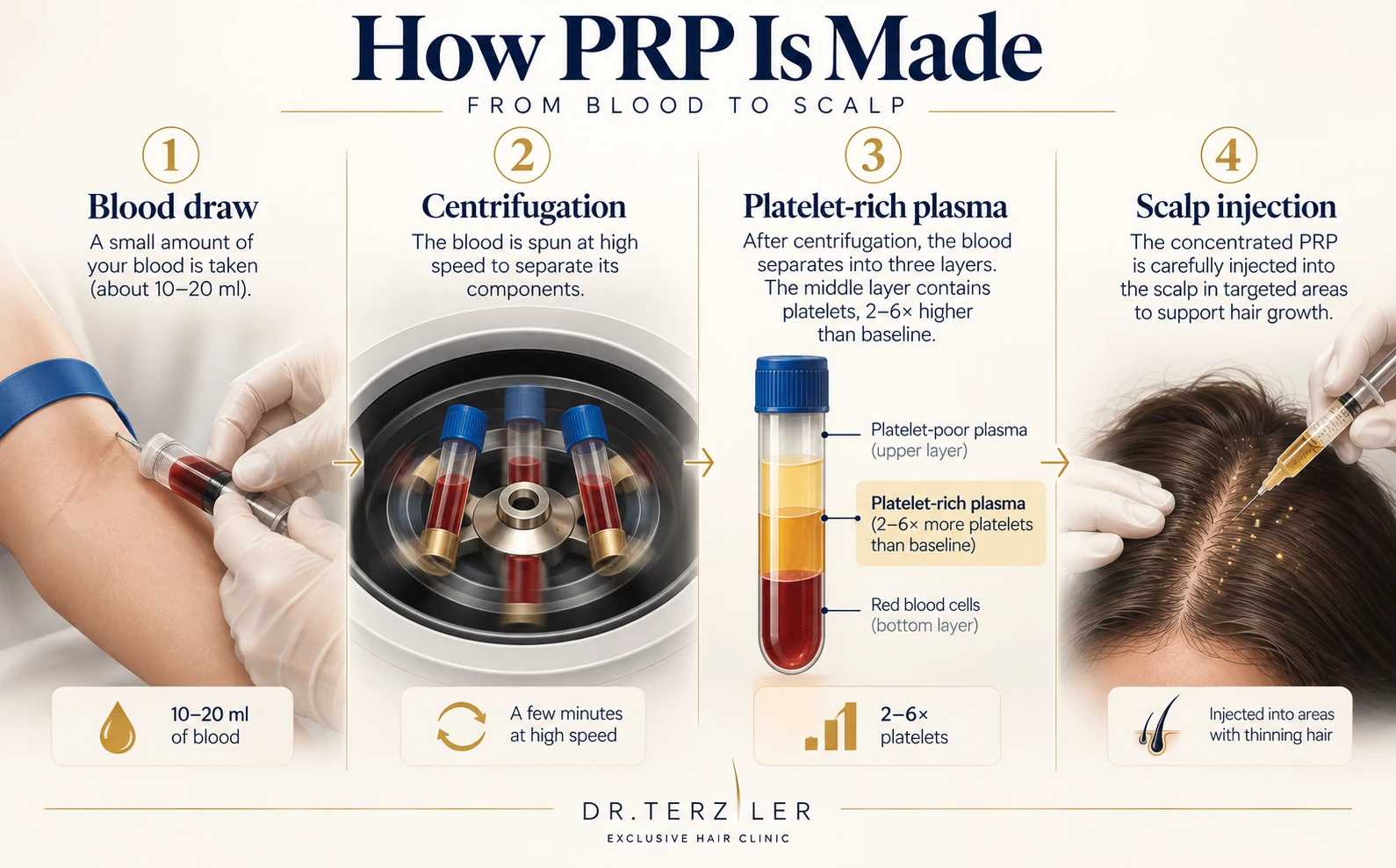
PRP hair treatment is a non-surgical injection therapy using platelet-rich plasma prepared from your own blood. A clinician draws a blood sample, concentrates the platelets in a centrifuge and injects the preparation into selected thinning areas. Its growth factors may influence existing follicles and the growth cycle. The most consistent trial outcome is improved density, rather than reliably thicker individual hairs. [12] [14]
PRP stands for platelet-rich plasma. Normal platelet counts are commonly around 150,000 to 450,000 per microlitre, with laboratory reference ranges varying. Hair PRP protocols may aim for roughly two to six times the starting concentration, but there is no agreed ideal dose. Using your own blood reduces donor-related risks; it does not remove injection, handling, anaesthetic or additive-related risks. [12] [13]
PRP is a supportive treatment aimed at existing follicles, which is why early to moderate thinning is usually a more relevant discussion than restoration of a completely bare area. A smooth-looking scalp does not by itself establish the diagnosis. PRP is not established as a way to generate new follicles or reverse destroyed, scarred follicles. A hair transplant may be considered after the cause, donor supply and scalp health have been assessed. [14] [19]
PRP works by delivering a concentrated dose of your own growth factors directly to weakening follicles. The exact mechanism is still studied, but researchers point to three effects. [1] [14]
Growth factors are released. Platelets contain PDGF, VEGF, TGF-beta, IGF-1 and EGF. Laboratory findings suggest that these proteins can influence cells and tissue-repair pathways around follicles. Finding a growth factor in a preparation does not, on its own, prove a better clinical result. [1] [14]
Blood-vessel support is one proposed mechanism. VEGF is involved in small-vessel development. In the 2026 trial of platelet concentrates in women, VEGF levels correlated with hair-count improvement. That association does not establish a personal response test or an ideal PRP formula. [8]
The growth phase may be influenced. Research suggests effects on pathways associated with anagen, the active growth phase. Changes in shedding or cycle measurements do not guarantee visible regrowth for every patient. [3]
In the 2015 randomized, placebo-controlled half-head trial, biopsies taken two weeks after the final session showed increased epidermal thickness, follicle counts and cell-proliferation markers compared with baseline. These tissue findings support a possible biological effect; they do not prove that PRP creates an unlimited supply of new follicles or treats every form of hair loss. [1]
Yes, PRP can improve hair density in some people with androgenetic alopecia, but the result varies. A 2024 meta-analysis estimated about 27.55 additional hairs per cm² compared with placebo. The evidence was low quality, with substantial differences between studies. That group average is not a forecast of your own result. [2]
Choose a topic to focus the table and see what to ask next.
Five selected studies cover density, preparation, schedules and female hair loss. They do not all answer the same question.
Ask what applies to my hairThe 2024 pooled estimate is versus placebo. The 2015 trial’s quoted gains are versus baseline. Keep those comparisons separate.
Discuss a measurable starting pointAsk for the recorded preparation, dose and review method. The review did not demonstrate that activation status alone predicts the better result.
Ask about the clinic protocolEvidence in female pattern loss cannot be transferred automatically to iron deficiency, thyroid disease, traction or a scarring disorder.
Discuss a diagnosis-first assessment| Study | What it included | What was measured or found | How to interpret it |
|---|---|---|---|
| Gentile et al., 2015 | Randomized, placebo-controlled half-head trial; 23 enrolled, 20 evaluated; 3 sessions 30 days apart | Mean gains versus baseline: 33.6 hairs in the target area and 45.9 hairs/cm². Four men reported renewed loss at 12 to 16 months after the last treatment. | Small trial; these are not placebo-adjusted pooled effects. |
| Kieling et al., 2024 | 14 randomized studies in the review, 13 in the meta-analysis; 431 patients | Estimated density difference: +27.55 hairs/cm² versus placebo (95% CI 14.04 to 41.06). No clear diameter benefit. | Low-quality evidence; high heterogeneity and publication bias. |
| Anitua et al., 2025 | 43 randomized trials; 1,877 participants across the full review | Density and shedding outcomes favored PRP in some analyses; no consistent thickness benefit. | Outcome-specific samples differ. Activation subgroup findings do not prove a superior recipe. |
| Gupta et al., 2019 | Meta-analysis and protocol review | Evidence favored PRP versus baseline and placebo; recommended an initial monthly series followed by maintenance. | A commonly used schedule, not a fixed prescription for everyone. |
| Yuan et al., 2024 | 21 studies; 628 participants in the female-hair-loss review | Density and thickness improved; adverse effects were generally mild and temporary. | Protocols, populations and outcome measurements varied. |
The honest summary: PRP can be a density and anti-shedding option for appropriately selected pattern hair loss. It is not a cure, and repeat treatment is commonly considered. Preparation differs between clinics, but the evidence does not identify one universally best method. In the 2025 review, the activated subgroup showed a statistically significant density effect while the non-activated subgroup did not. The difference between activation subgroups was not statistically significant. This does not prove that activation is superior or that unactivated PRP must fail. Platelet composition and dose were inconsistently reported, so those variables could not be compared confidently. [3]
For additional review methods and trial selections, see the meta-analyses by Papakonstantinou et al. and Evans et al..
There is no single reliable PRP success rate. Trials use different outcomes, such as hair density, shedding, photographs and satisfaction. ISHRS patient information gives a broad estimate of at least 30 to 50% experiencing some benefit. That is not a pooled probability of a cosmetically meaningful result, and it should not be presented as your personal chance of success. [12]
ISHRS describes a broad estimate of some benefit rather than a guaranteed or precisely measured clinical success rate. An improvement in a hair count may be modest in the mirror. Factors to discuss with the clinician include the diagnosis, remaining density, treatment history, chosen protocol and ability to return for review. The following points help frame that discussion; they are not a validated prediction score. [12]
A Tricho Test can document baseline density, miniaturization and scalp findings, then support a repeat comparison. It cannot guarantee PRP responsiveness or supply a validated personal success percentage. Ask which measurable change would make continuing treatment worthwhile. [19]
Explore Tricho Test assessment or ask the team how to document your baseline.
A common PRP starting course is three sessions about four weeks apart, followed by maintenance often spaced three to six months apart. This is a commonly used framework, not a universal prescription. Three sessions may start a response, but they do not guarantee one or establish the right long-term schedule for every patient. [4] [12]
Is one session of PRP worth it? A single standalone session should not be expected to reproduce a multi-session trial. Repeated treatments are common in the evidence. One session may be used as a maintenance top-up or a transplant adjunct, depending on the plan. The clinic guide describes a different possible single-application ACell + PRP protocol, which should not be assumed equivalent to a full standard-PRP course. [1] [4]
A calendar should explain the decisions, as well as count the visits.
Record the diagnosis, photographs and scalp measurements before the first injection. Confirm the full plan and what would make it change.
Ask what my baseline assessment includesA common starting series spaces appointments about four weeks apart. Review any side effects and whether the agreed course still fits.
Ask about the starting courseComplete the agreed initial course, rather than judging the whole treatment from a single visit. Three appointments do not guarantee a response.
Discuss my review planCompare the same scalp areas and lighting. Changes in shedding may be discussed, but density can take longer to assess. New or worsening symptoms need review.
Ask how progress will be measuredRepeat photographs and scalp measurements. Discuss visible benefit, cost and whether continuing or changing treatment makes sense.
Ask what would justify continuingMaintenance is individualized. One or two boosters are an illustration, not a requirement for every patient; timing may be earlier or different.
Request a written maintenance plan| Month | What happens |
|---|---|
| Month 0 | Tricho Test / assessment, photographs and session 1 |
| Month 1 | Session 2 in a common monthly starting course |
| Month 2 | Session 3; review tolerance and the agreed plan |
| Month 3 | Early review; a reduction in shedding may be discussed |
| Month 6 | Repeat images and measurements; evaluate density and value |
| Months 6 to 12 | One or two possible maintenance visits; timing depends on response |
The illustrative "3 + 2" first year means three starting sessions and two possible boosters. It is a budgeting and discussion example. The clinician may recommend a different number or timing. In the 2015 trial, four of the 20 evaluated men reported renewed loss after 12 months, becoming more evident by 16 months after the last treatment. That observation supports discussing durability; it does not prove an exact two-booster schedule. [1] [4]
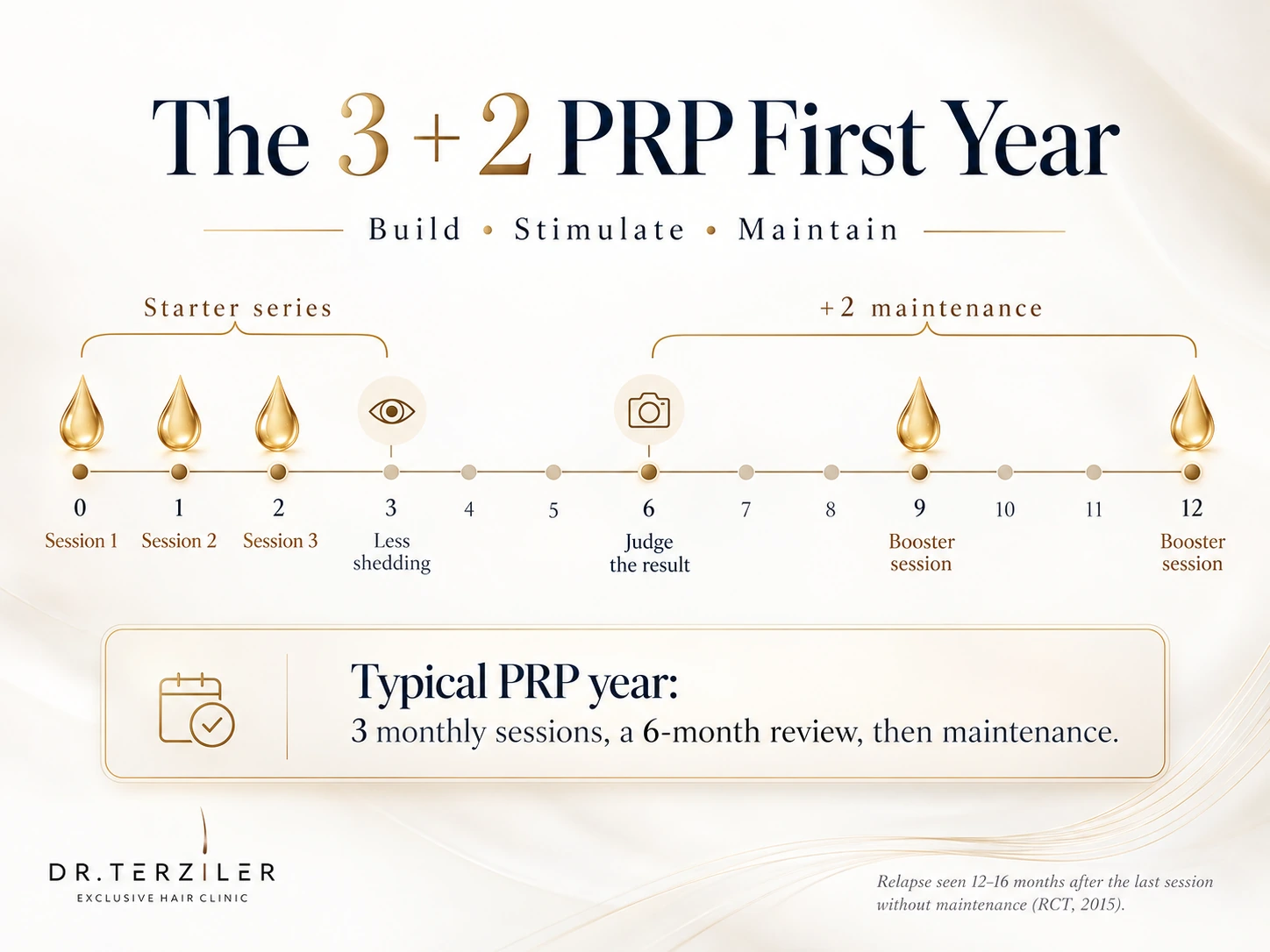
PRP results are usually assessed over months. Reviews at about three and six months can help compare shedding and density with baseline photographs and scalp measurements. Duration varies. Some patients in a small trial reported renewed loss 12 to 16 months after the last treatment, so a fixed six- or twelve-month result cannot be promised. [1] [13]
Johns Hopkins Medicine notes that scalp PRP results take about six months and are not permanent. Hair grows about 1 cm a month, so new or thicker hair needs months to reach a length you can see in a mirror. [13]
How long does hair grow after PRP? Hair continues through its normal growth cycle. PRP is not established as a way to make hair grow faster each day. A change in density or shedding can take time to become cosmetically noticeable, and consistent photographs are more useful than daily mirror checks. [3] [13]
ACell + PRP combines platelet-rich plasma with an animal-derived extracellular matrix product in a physician-selected protocol. The proposed aim is to support the tissue environment around existing follicles or a surgical site. Evidence for hair restoration is much more limited than the standard-PRP trial literature, and a clinically superior result has not been established. [16] [20]
ACell is associated with extracellular matrix products derived from porcine urinary bladder tissue. Such matrices are used as wound-care scaffolds. Hair-restoration use and the route of application require a separate discussion of the exact product, evidence and consent. The marketing phrase "hair vaccine" is inaccurate: ACell + PRP is not a vaccine and does not train the immune system. [16]
How it differs from standard PRP: conventional PRP commonly uses a starting series and later maintenance. The clinic patient guide describes ACell + PRP as typically a single initial application, with subsequent checks. The number of applications and the exact method must be confirmed in the individual written plan. A single-application protocol is not proof of a longer or better result. [16]
What the evidence says, honestly: published ACell hair-restoration reports and clinical experience do not establish it as a proven upgrade for everyone. Importantly, the MicroMatrix manufacturer instructions describe wound management and explicitly state that it is not indicated for alopecia. Wound-device clearance does not validate mixing the product with PRP or injecting it for hair regrowth. Ask which product and route are proposed, what is outside its labeling, what evidence supports that use and what alternatives are available. [16] [20]
Why it may be discussed: a physician may consider it in relation to weakening hair, recipient-area preparation, a transplant site or donor-area care. These proposed roles are different from established hair-regrowth indications. Suitability, animal origin, allergies and the uncertain benefit should be discussed before a decision. [16]
The clinic guide illustrates treatment at month zero, scalp and hair-quality checks at months one to three, evaluation at months three to six and further review beyond month six. This is the clinic guide’s follow-up illustration, not a guaranteed response timeline.
A short clinic video illustrates an ACell + PRP application. It is not a controlled study or proof of a hair-growth result.
Published 7 November 2022. The original title uses the marketing phrase “hair vaccine”; ACell + PRP is not a vaccine. The individual product and method must be discussed with the treating clinician.
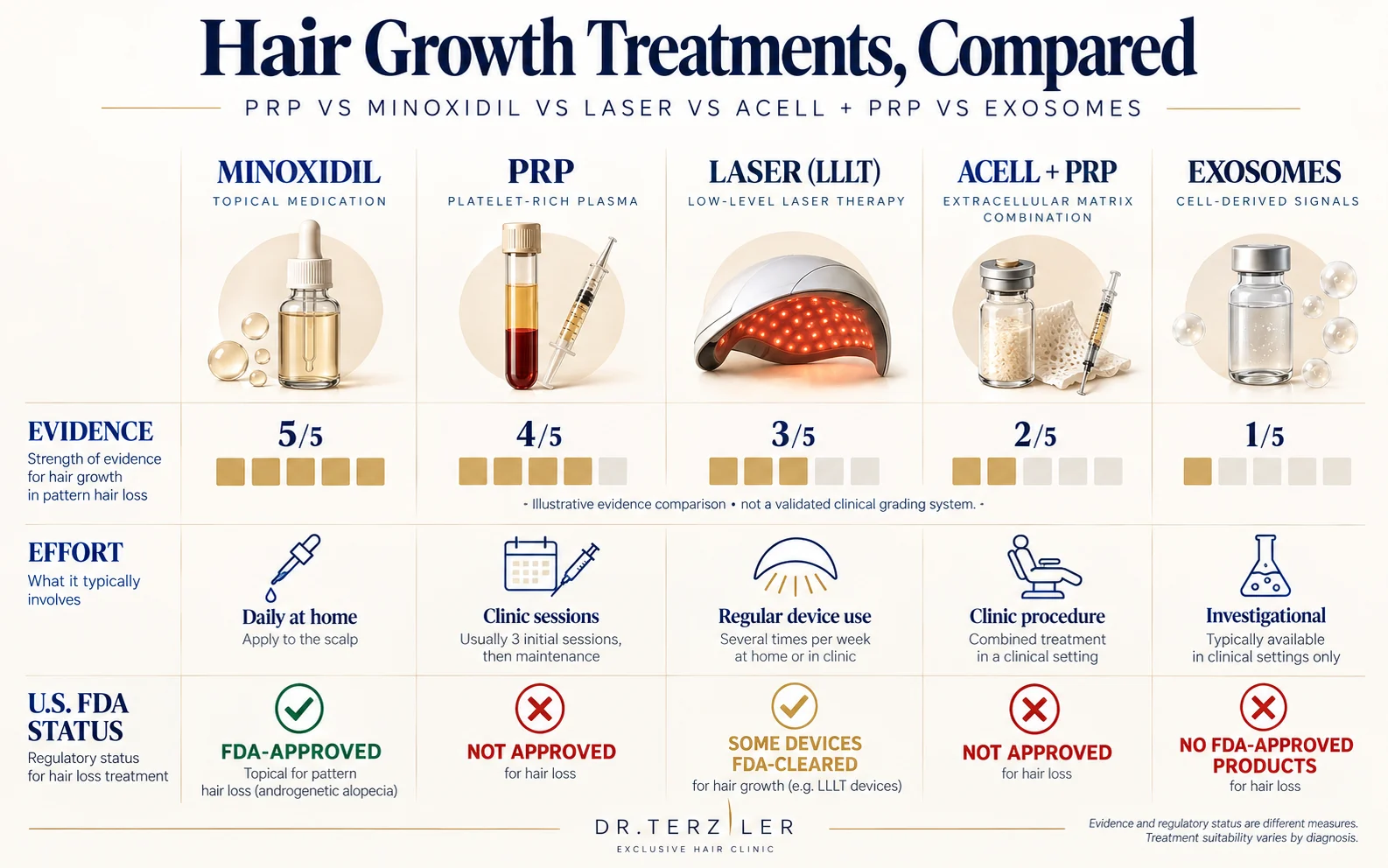
Open the original YouTube ShortPRP has not shown a clear hair-density advantage over topical minoxidil in head-to-head evidence. A meta-analysis of nine randomized trials found higher satisfaction and more negative hair-pull tests with PRP, but no established advantage in several main growth outcomes. Separate evidence suggests that adding PRP to minoxidil may improve density, with low to very low certainty. [5] [6]
| Treatment | Evidence | US regulatory context | Effort | A relevant discussion |
|---|---|---|---|---|
| PRP | Multiple randomized trials and meta-analyses; variable protocols | No FDA approval for hair regrowth; device clearance has a specified scope | Commonly an initial series, then individualized maintenance | Selected early to moderate pattern thinning |
| ACell + PRP | Limited hair-restoration reports and clinical experience | MicroMatrix wound-care labeling does not indicate alopecia treatment | Clinic guide describes a possible single initial application plus checks | A separately assessed, product-specific discussion, not a proven upgrade |
| Topical minoxidil | Longstanding trial evidence for pattern hair loss | FDA-approved formulations for specified populations and labeled uses | Regular use; continued treatment is usually needed to maintain benefit | An established medical option when suitable |
| Finasteride for appropriate adult men | Longstanding evidence for male pattern loss | FDA-approved prescription 1 mg formulation for male pattern hair loss | Regular use with an individual risk-benefit discussion | Slowing androgen-driven loss in suitable men |
| Low-level laser | Randomized studies versus sham devices | Some specific devices are FDA-cleared for specified hair-growth uses | Regular device use; frequency depends on the device | A needle-free option for suitable pattern thinning |
| Exosomes | Early, heterogeneous evidence; major uncertainties remain | No FDA-approved exosome products | No established universal hair-treatment course | An evidence and regulatory discussion, not an established substitute |
Is PRP better than minoxidil? Not clearly on density. The nine-trial review reported negative hair-pull tests in 82.75% of PRP participants versus 52.94% of minoxidil participants. This is a shedding-test outcome, not a regrowth success rate or proof that PRP works faster. In a separate five-trial review, adding PRP to minoxidil improved density by an estimated 21.81 hairs/cm² at three months versus minoxidil alone. That evidence was rated low to very low and the protocols differed. [5] [6]
Which is better, PRP or laser? Both have clinical studies in pattern thinning, but a universal winner cannot be inferred from separate trials. Laser can involve regular home or clinic use without injections; PRP involves appointments, a blood draw and scalp injections. Some plans combine options. Diagnosis, the exact device or protocol, effort, cost and individual preferences matter. [14]
PRP is sometimes used around hair transplantation as an adjunct intended to support healing and early growth. Small controlled studies report benefits, but the evidence is limited. It should not be presented as necessary for every transplant or as a guarantee of graft survival. [11] [14]
A 2026 prospective randomized study enrolled 60 men undergoing FUE, with 30 in each group. At six months, 100% of the PRP group reached the study’s threshold of at least 75% regrowth, compared with 40% of controls. That does not mean 100% graft survival. It was a small study, and its result cannot be transferred directly to every technique or clinic. The American Hair Loss Association also describes a limited controlled transplant-adjunct evidence base, including three studies and 217 patients, rather than a settled universal protocol. [11] [14]
At Dr. Terziler Exclusive Clinic, the Robotic DHI and Picasso Robotic DHI packages include PRP and Growth Factor support during the operation. ACell + PRP can be planned:
PRP does not replace a hair transplant, generate a new donor supply or guarantee prevention of shock loss. Transplant planning still depends on diagnosis, donor management and the technique. Compare DHI and see the written inclusions in our hair transplant packages. Unshaven and female transplant approaches may be relevant in selected plans. [14]
PRP uses your own blood and is often well tolerated, but no injection is risk-free. Temporary pain, tenderness, redness, swelling, pinpoint bleeding, headache and lightheadedness can occur. Infection and other complications are possible. Sterile preparation, appropriate patient selection and an individual medical assessment remain important. [12] [13]
Using your own plasma avoids exposure to another donor’s blood and reduces certain donor-related concerns. It does not eliminate contamination, injection injury or reactions to an anaesthetic, antiseptic or additive. ACell is animal-derived and should be discussed separately from autologous PRP. [13] [16]
The real downsides: costs accumulate across appointments, any benefit may fade, response varies and maintenance may be needed. Preparation and treatment protocols are not standardized, so comparing clinic offers requires more than counting sessions. [14]
Who may need to defer treatment or have a specialist review: people with low platelet counts or platelet-function disorders, significant anaemia, active scalp infection, active cancer or chemotherapy, pregnancy, or other relevant medical conditions. Blood thinners and antiplatelet medicines require an individual assessment. Do not stop a prescribed medicine on your own. [12] [13]
Is PRP FDA-approved for hair loss? No. Certain preparation systems have FDA clearance for specified uses, but that is not approval of a PRP hair-regrowth treatment. ACell wound-device clearance is also not a hair-loss indication. FDA status describes the United States and should not be confused with Turkish or UK authorization. [12] [16] [20]
PRP scalp injections can cause brief stinging, pressure and tenderness. The experience varies with the injection method, treatment area and the patient. A clinician can discuss suitable numbing or other comfort measures. Mild soreness may settle over one or two days; severe or worsening symptoms need medical advice. [12] [13]
Agree the comfort plan before treatment, including whether topical numbing, a local injection, cooling or another measure is suitable. A particular numbing method is not assumed for every clinic appointment. Aspirin, anti-inflammatory medicines and blood thinners may affect the plan, but the prescribing clinician should decide what to continue or change. Ask which pain relief is appropriate; do not pause prescribed treatment yourself. [12]
Why am I losing more hair after PRP? Some people report increased shedding around a course, but its frequency and mechanism are not well established. Do not automatically treat it as a normal "working" sign. Persistent, heavy, patchy or worsening loss needs review for the original diagnosis, scalp inflammation, telogen effluvium, thyroid disease or iron deficiency. Do not wait three months if symptoms are concerning. [19]
Reasons to review a disappointing PRP result include:
| A reason to discuss PRP | A reason to pause or consider another plan |
|---|---|
| Early to moderate male pattern thinning; Norwood II to IV may be discussed | Advanced bare areas, including Norwood VI to VII, need donor and restoration assessment; a transplant is not automatically appropriate. |
| Female pattern thinning, sometimes described as Ludwig I to II | A sudden shedding episode needs its cause investigated before assuming PRP is the answer. |
| Existing thinning hairs and a cause established on examination | Active scarring, inflammation or scalp infection needs cause-specific care. |
| A possible adjunct before, during or after transplantation | Platelet or blood disorders, significant anaemia, cancer treatment or pregnancy require a medical suitability decision. |
| A person who cannot tolerate a medicine may wish to discuss alternatives | A one-time cure, new follicles or a guaranteed result are unrealistic expectations. |
For adult alopecia areata, evidence does not allow the German S3 guideline to recommend for or against PRP. The same guideline says children and adolescents should not be offered PRP for alopecia areata. Those recommendations concern AA, not every kind of thinning. See our guides to hair loss causes and types and the receding hairline. [17]
A 2024 meta-analysis of 21 studies and 628 participants reported improved density and thickness in women with hair loss, with generally mild, temporary adverse effects. Results varied by protocol. This supports a discussion for selected female pattern loss, not treating every cause of female shedding with PRP. [7]
A 2026 randomized multicentre trial compared four monthly sessions of PRP, injectable platelet-rich fibrin (i-PRF) and concentrated growth factors (CGF). Seventy-four women completed the study. At 24 weeks, non-vellus target-area hair count rose by 14.53% with PRP, 26.54% with i-PRF and 27.11% with CGF. Hair-diameter gains did not differ significantly between groups. This is one trial, not proof of a universal preferred concentrate. A doctor may request ferritin, thyroid or hormone tests when the history and examination indicate them. Read more about female hair restoration. [8] [19]
14.53%PRP
26.54%i-PRF
27.11%CGF
Mean change in non-vellus target-area hair count in this study. These are not personal success rates or interchangeable product claims. [8]
ISHRS patient information gives a US reference of about $400 to $1,500 or more per PRP session. A five-session example, three starting sessions plus two boosters, therefore totals $2,000 to $7,500 or more. This is arithmetic using a published guide range, not a national average or a Dr. Terziler quote. Turkish clinic pricing is confirmed after assessment. [12]
| Budget question | United States guide reference | Dr. Terziler, Turkey |
|---|---|---|
| Per session | $400 to $1,500 or more | Quoted after assessment |
| Five-session illustration: 3 initial + 2 possible boosters | $2,000 to $7,500 or more | Written plan and individual price |
| During a hair transplant | May be billed separately; check the quote | Clinic-provided package information lists PRP and Growth Factor support with Robotic DHI and Picasso Robotic DHI |
| Insurance / payment | Commonly self-pay; confirm your policy | Confirm payment terms and inclusions in writing |
What changes the price: the preparation system, whether ACell or another additive is used, the number of sessions and whether PRP is part of a transplant plan. A higher price does not mean better PRP. Ask what platelet concentration the clinic achieves and who performs the injections. See the full hair transplant Turkey cost guide.
Use the US reference for arithmetic, or ask for the clinic’s own plan.
4 × the ISHRS reference of $400 to $1,500 or more per session. This is a US guide calculation, not a Dr. Terziler price or a recommendation for 4 sessions.
5 × the ISHRS reference of $400 to $1,500 or more per session. This is a US guide calculation, not a Dr. Terziler price or a recommendation for 5 sessions.
6 × the ISHRS reference of $400 to $1,500 or more per session. This is a US guide calculation, not a Dr. Terziler price or a recommendation for 6 sessions.
The PRP or ACell + PRP plan, number of appointments, product, follow-up and any transplant-package inclusions are confirmed after assessment. No clinic price is generated from the US range.
The “+” preserves the source’s open-ended upper price. Travel, accommodation and unrelated treatments are not included. The number of sessions is a discussion example, not medical advice.
PRP is easy to offer and hard to do well. Before you book PRP in Turkey or anywhere else, ask:
Your selection creates a short list to copy or include in a WhatsApp draft.
At Dr. Terziler Exclusive Clinic, the PRP plan starts with a Tricho Test and a doctor’s consultation. The AACI accreditation applies to the clinic, whose founder is Dr. Servet Terziler, developer of the clinic’s Robotic DHI system. The medical team includes Dr. Kürşat Yalvaç. Ask what is appropriate for your diagnosis and what would make the team recommend another option. Explore before and after results or book a free consultation. [18]
All hair treatments: compare every non-surgical option
Exosome treatment: explore the evidence, uncertainties and regulatory status of cell-derived signaling products.
Growth factor therapy: learn what the term means and which product or protocol is proposed.
Hair follicle stem cell therapy: review the evidence and status of cell-based approaches.
Laser hair treatment: low-level light therapy
When PRP is not enough: explore Hair transplant in Turkey, Picasso Robotic DHI, Robotic DHI and DHI after a suitability assessment.
Clinical studies, society guidance, manufacturer instructions and regulatory records answer different questions. No source establishes an individual guarantee. The clinic provides hair-restoration services; this commercial interest is disclosed. This page supports an informed discussion and does not replace an examination or prescription.
PRP treatment for hair is a supportive treatment involving the application of platelet-rich plasma, derived from the patient’s own blood, to the scalp.
For those experiencing hair loss, thinning hair or hair that is becoming finer, a treatment plan can be drawn up following a consultation with a specialist.
The level of comfort experienced during the procedure may vary from person to person. Where necessary, measures may be taken prior to the procedure to enhance comfort.
The number of sessions may vary depending on the individual’s hair type, the extent of hair loss and the treatment plan drawn up.
No. PRP treatment and hair transplantation are different procedures. Which treatment is suitable is determined following a hair analysis.
Where deemed appropriate, PRP may be included as part of the post-hair-transplant care programme.
Yes, for many people with early to moderate pattern hair loss. Meta-analyses of randomized trials show an average gain of about 27 hairs per cm² compared with placebo. PRP thickens and keeps existing follicles. It cannot regrow hair on smooth bald skin.
In the United States, PRP costs about $400 to $1,500 or more per session, so a first year of five sessions often totals $2,000 to $7,500. Prices in Turkey are usually lower, and PRP can be included in hair transplant packages.
Most protocols use three sessions about four weeks apart, then a maintenance session every three to six months. The doctor adjusts the schedule after comparing photos and scalp scans at month six.
Three sessions are enough to start a response, but not to keep it. Pattern hair loss continues, so most people need one or two maintenance sessions a year to hold the result.
The effect of a full course usually lasts six to twelve months. In a placebo-controlled trial, some men began losing hair again 12 to 16 months after their last session, which is why maintenance is recommended.
Most people notice less shedding after about three months. The clearest density change appears around six months, which is the right time to judge the result.
Not on hair density alone. Trials show similar density gains, with higher satisfaction and less shedding on PRP. Using PRP and minoxidil together gives better results than minoxidil alone.
It is mildly to moderately uncomfortable. Local numbing keeps it tolerable, and soreness usually fades within one to two days.
PRP is low-risk because it uses your own blood, but no injection is 100% risk-free. Side effects are usually temporary pain, redness, swelling and minor bleeding. People with platelet disorders, active infection, cancer treatment or pregnancy should not have it.
PRP needs repeat sessions, the result fades without maintenance, response varies between people, and it is not FDA-approved for hair. It also cannot replace a transplant in fully bald areas.
Some weak hairs that were already about to fall can shed early in the first weeks after injections. This is usually temporary. Shedding that lasts more than three months needs a medical check for another cause.
The most common reasons are a wrong diagnosis, too little living hair in the area, low platelet concentration, ongoing DHT-driven loss without medication, and stopping before the full course or maintenance.
For standard PRP, one session is rarely enough, because positive trials used three or more. One session works as a maintenance top-up or during a hair transplant. The ACell + PRP protocol is typically applied in a single session.
ACell + PRP combines platelet-rich plasma with ACell, an extracellular matrix powder that acts as a scaffold for tissue repair. It is used to support weakening hair, the scalp before a transplant, and grafts and the donor area after surgery. Evidence is still limited to case reports.
Both have moderate evidence for thinning hair. Laser is a needle-free home routine used several times a week, and PRP is a clinic treatment with fewer visits. Many patients combine them.
No. There is no cure for pattern baldness in 2026. New drugs such as clascoterone solution and an extended-release oral minoxidil are in late-stage trials, but none regrows hair on bald skin. A hair transplant remains the only permanent fix for bald areas.
Contact us for a free, personalised consultation. Our team of experts will be by your side every step of the way.