Beard Transplant in Turkey: Cost, Grafts, Techniques & Real Results
A beard transplant in Turkey transfers DHT-resistant donor follicles from the back of the scalp to the facial zones using micro-FUE extraction and robotic or manual implantation. At Dr. Terziler Exclusive Clinic in Istanbul, patients receive Robotic DHI facial mapping, AACI-accredited clinical protocols, and 90–97% graft survival at 12 months. In Turkey, a 2026 all-inclusive beard restoration price starts at €3,500. For Dr. Terziler Exclusive Clinic pricing, contact the Dr. Terziler team for detailed information and a personalized treatment plan.
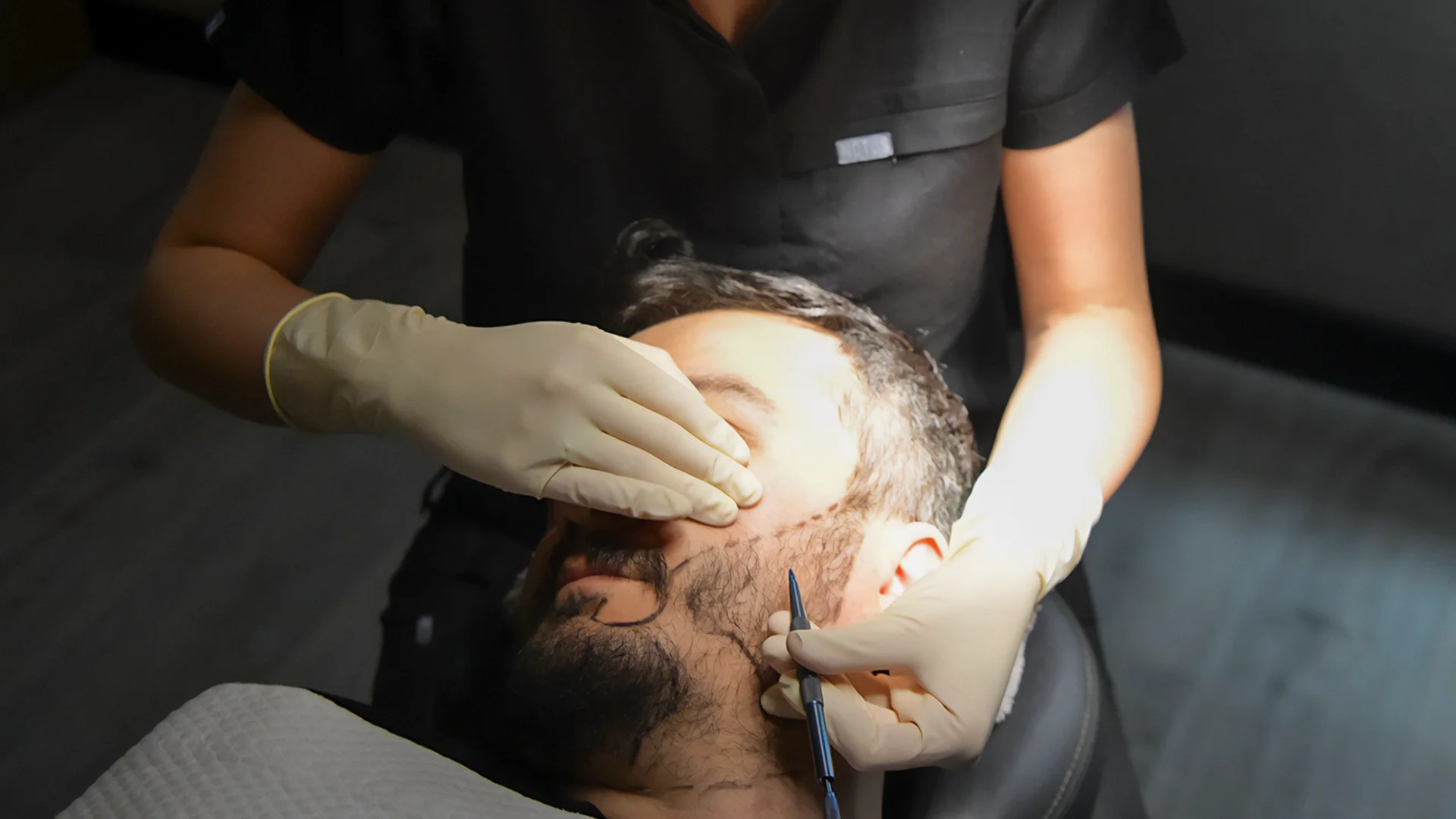
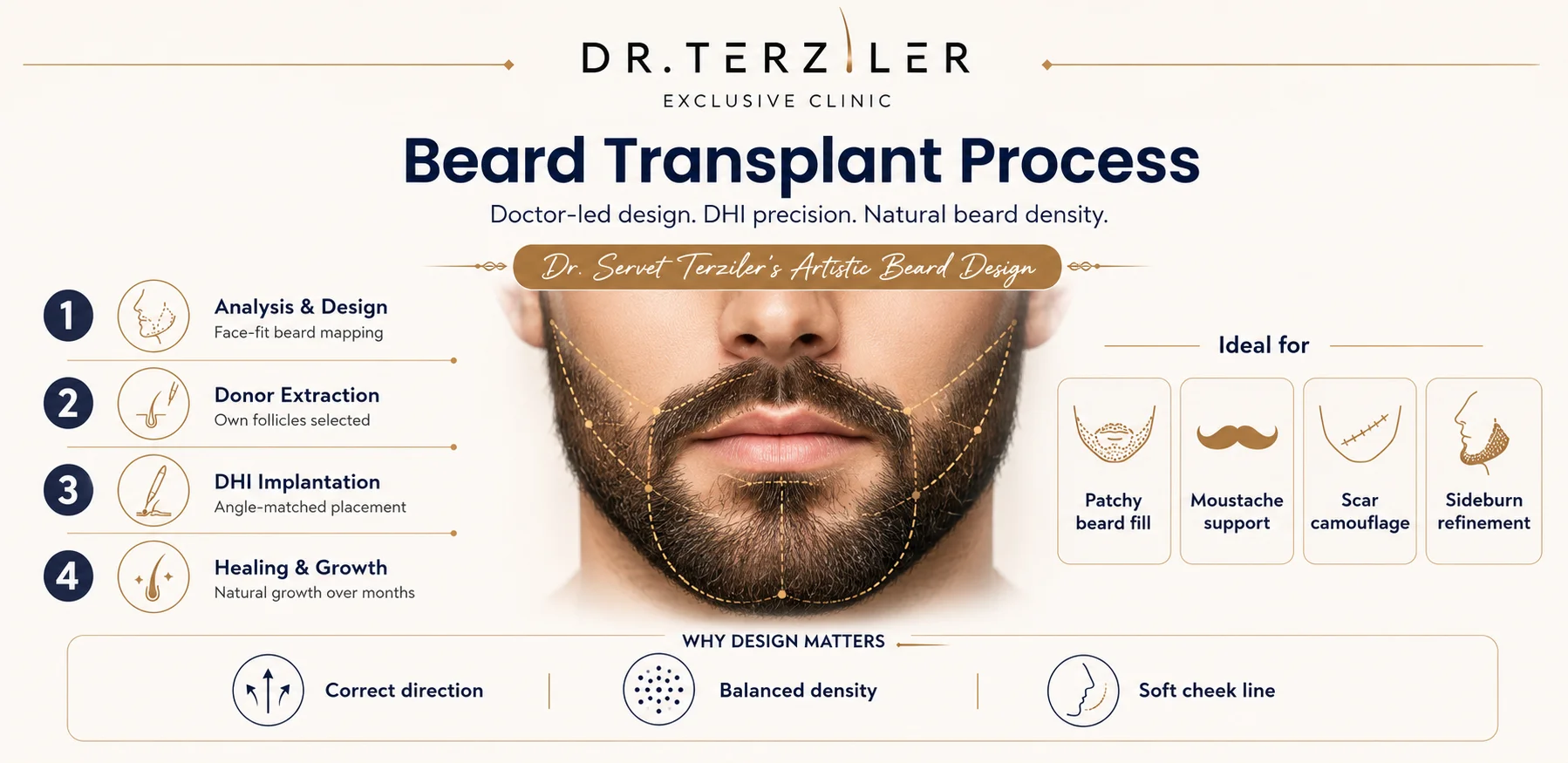
The beard, moustache and sideburn areas are assessed in detail. A personalised transplant plan is drawn up by analysing facial proportions, existing hair density and the individual’s aesthetic expectations.
ADIM 02
Design
Healthy hair follicles are typically identified in the back of the head, and the distribution of grafts is planned to ensure a natural density.
ADIM 03
Sakal Ekimi
Hair follicles harvested under local anaesthetic are implanted one by one into the beard, moustache or sideburn areas, taking into account their natural growth directions and angles. The aim is to achieve a natural, symmetrical appearance that harmonises with the facial features.
ADIM 04
Follow-up & Support
Post-procedure care advice is provided, the first wash is carried out, and the healing process is monitored through regular check-ups.
TL;DR
A beard transplant in Turkey costs from €3,500 all-inclusive in 2026, depending on graft count and technique. For your exact all-inclusive price at Dr. Terziler Exclusive Clinic, the clinic reviews your photos and quotes you on WhatsApp or the contact page.
A full beard usually needs 2,500 to 4,500 grafts; a mustache, goatee, or sideburn needs far fewer. Donor follicles come from the DHT-resistant lower occipital scalp.
The best technique is Robotic DHI: it controls depth (1.5–2.5 mm on the face) and angle (10–20° on the cheek line, 25–35° on the mustache) on every single graft.
Graft survival is 90–97% at 12 months on healthy skin, with a documented cobblestoning rate under 0.5% across 850+ facial cases (2023–2025).
Patchy beards are the single most common reason for surgery (about 62% of 2025 facial-hair cases); acne scars, burn scars, and trans-masculine patients (12+ months on testosterone) are also treated.
Real, consented results matter more than promises: this page documents Joze's beard transplant case study plus verified before-and-after patients.
Dr. Terziler Exclusive Clinic is AACI-accredited and surgeon-led; Dr. Servet Terziler is an ISHRS member and the inventor of the Robotic DHI Machine.
MEDICALLY REVIEWED BY
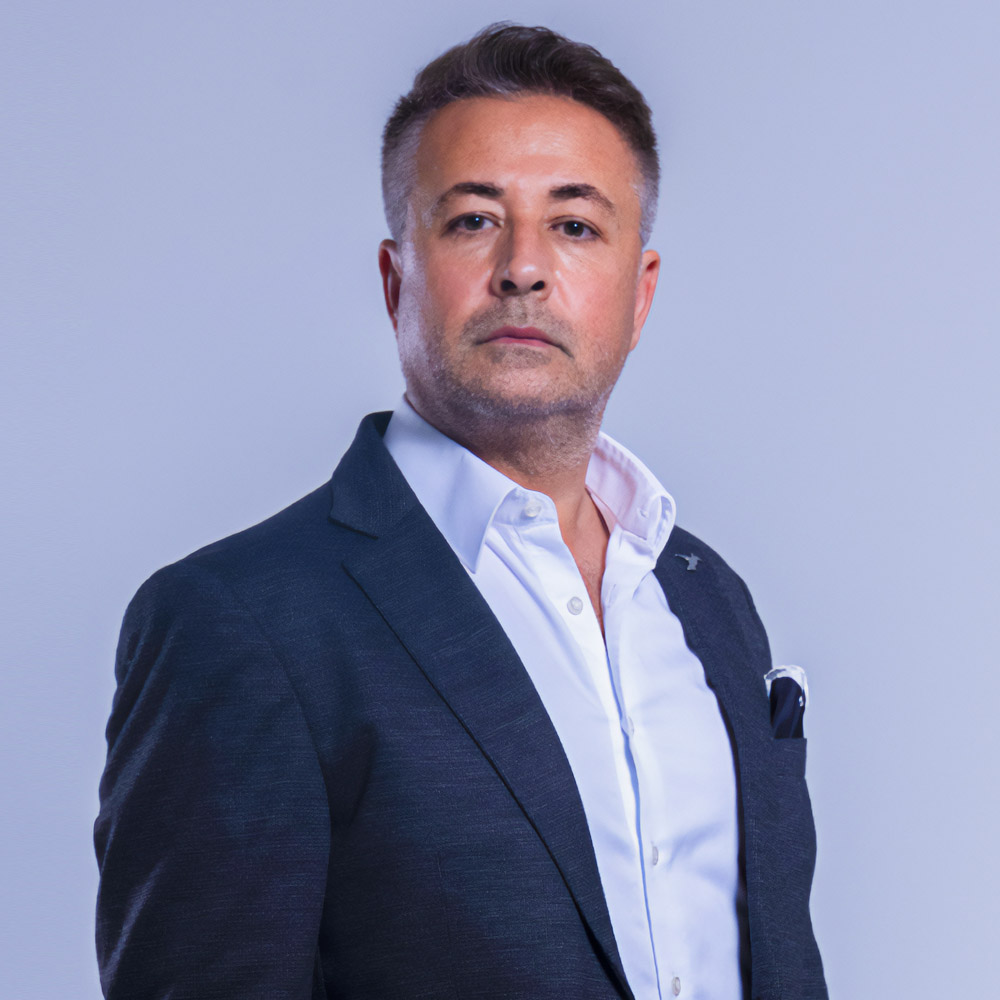
Dr. Servet Terziler
AACI-accredited hair restoration surgeon | ISHRS member | Founder & President, TUSATDER | Inventor, Robotic DHI Machine | Creator, Picasso Robotic DHI | European Property Awards Best Hair Transplant Clinic in Europe | Updated for beard transplant patients in 2026.
Updated in 2026, August
Beard transplant case studies and photos are published with patient consent. Individual results vary. Clinical figures reflect Dr. Terziler's surgeon-led facial-hair protocols and 850+ facial cases in 2023–2025.
What Do Real Beard Transplant Results Look Like? Joze's Case Study
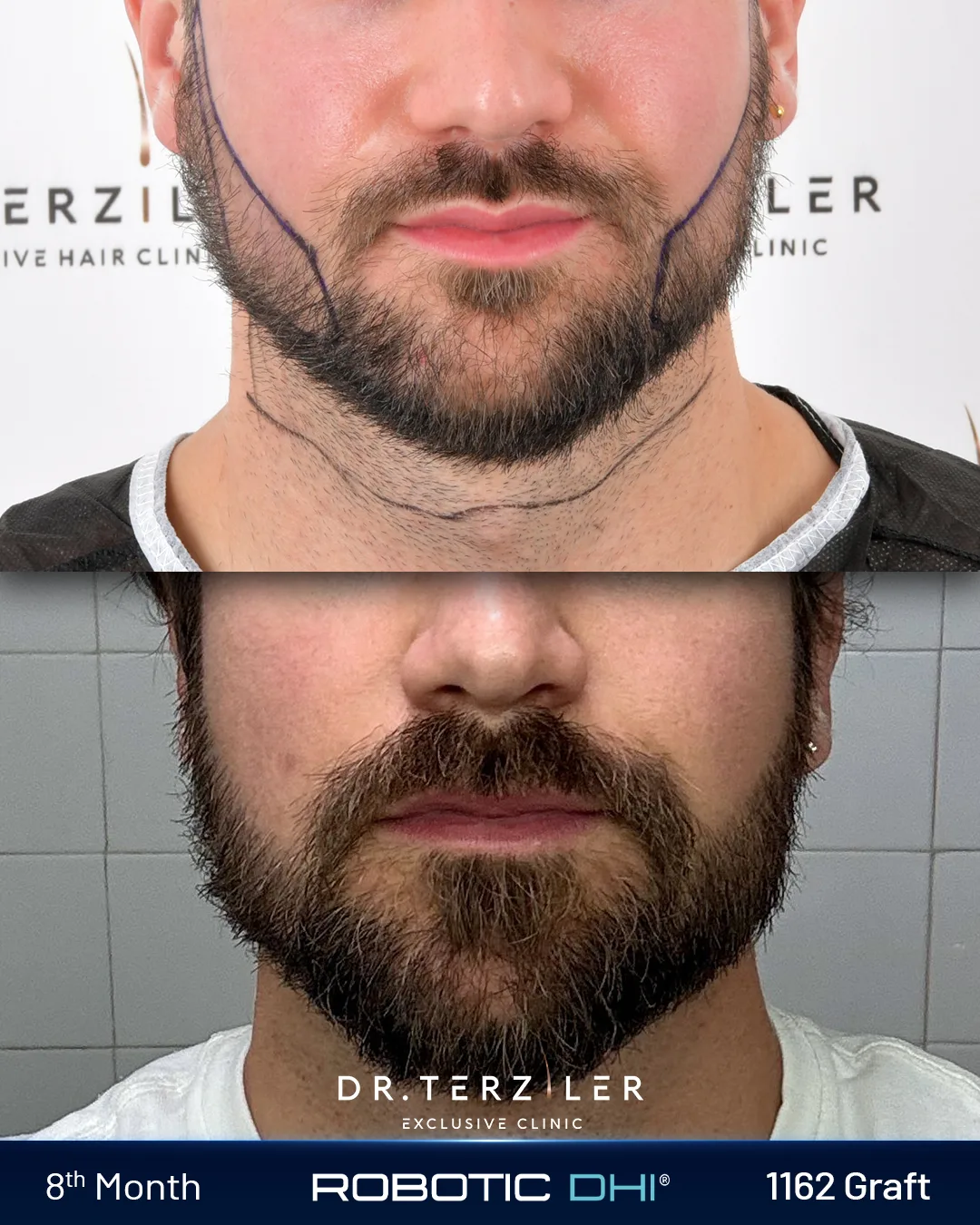
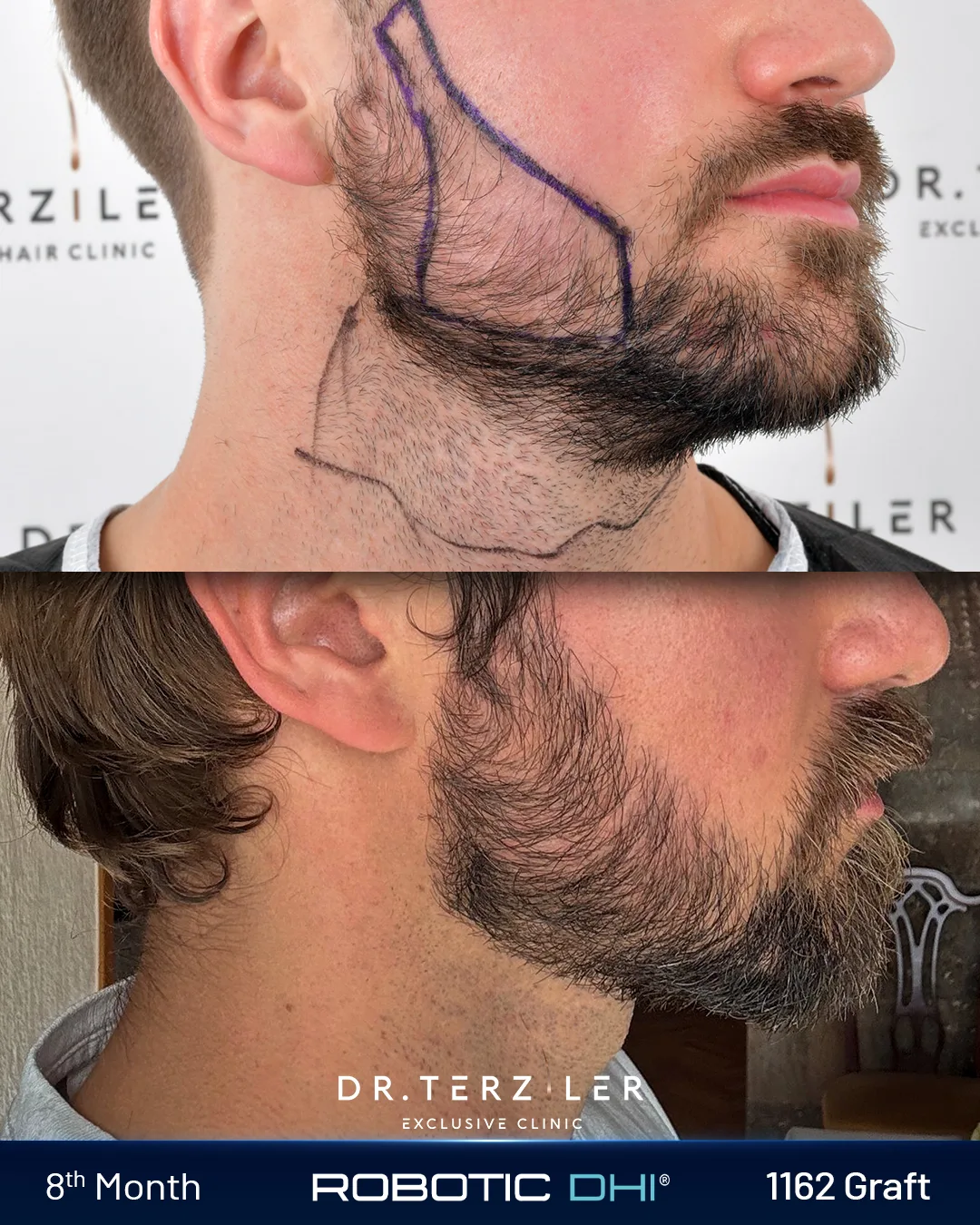
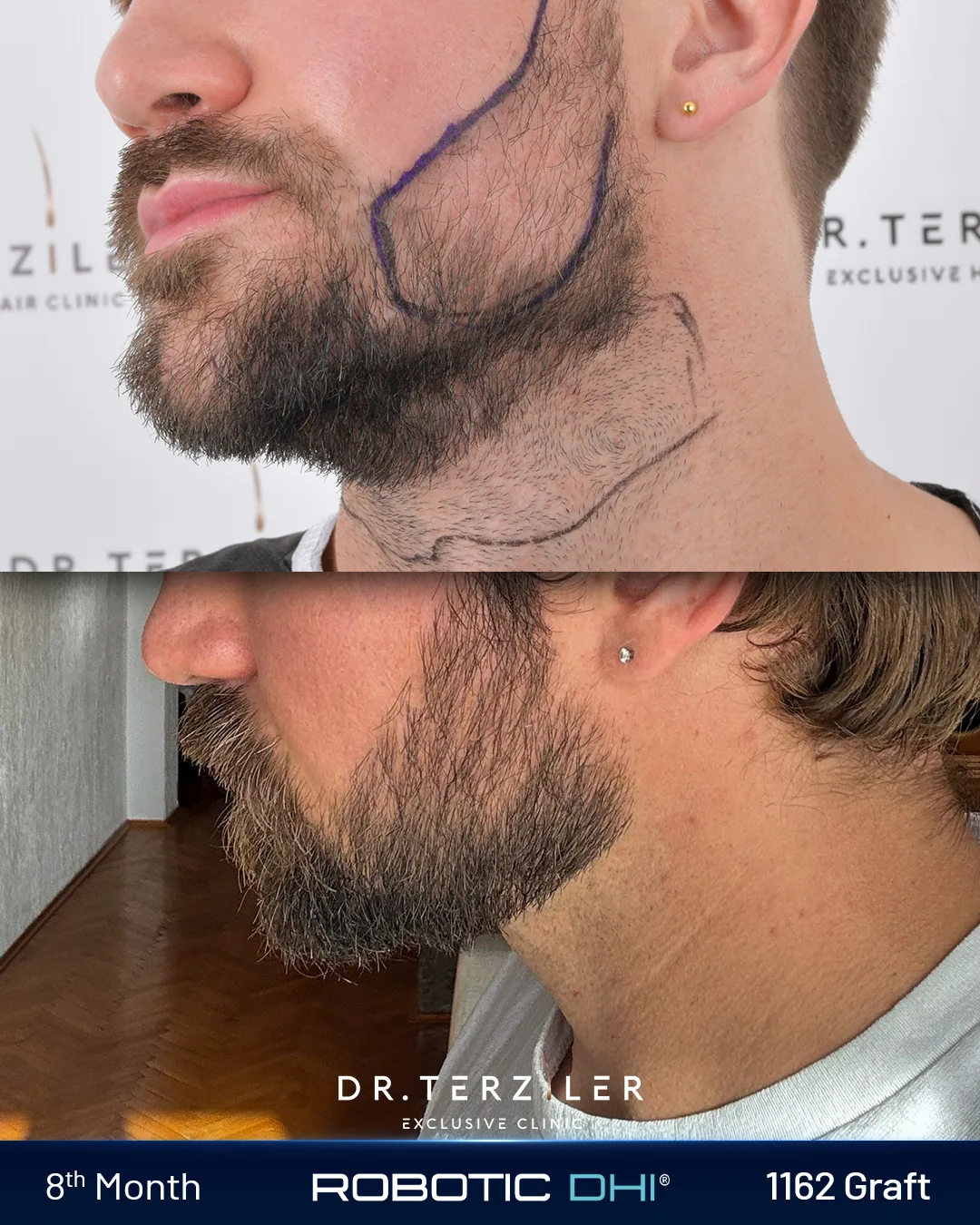
Real beard transplant results look most convincing when they are documented from multiple angles over time with the patient's consent, showing the day-of-surgery design, the early healing, and the mature growth. Joze's case below shows how a surgeon-led, Robotic DHI beard transplant in Turkey rebuilds a patchy cheek line and jaw into a dense, natural border.
Front view: Joze's beard transplant before and after, a 1,162-graft Robotic DHI result at 8 months, with a rebuilt cheek line and mustache border.
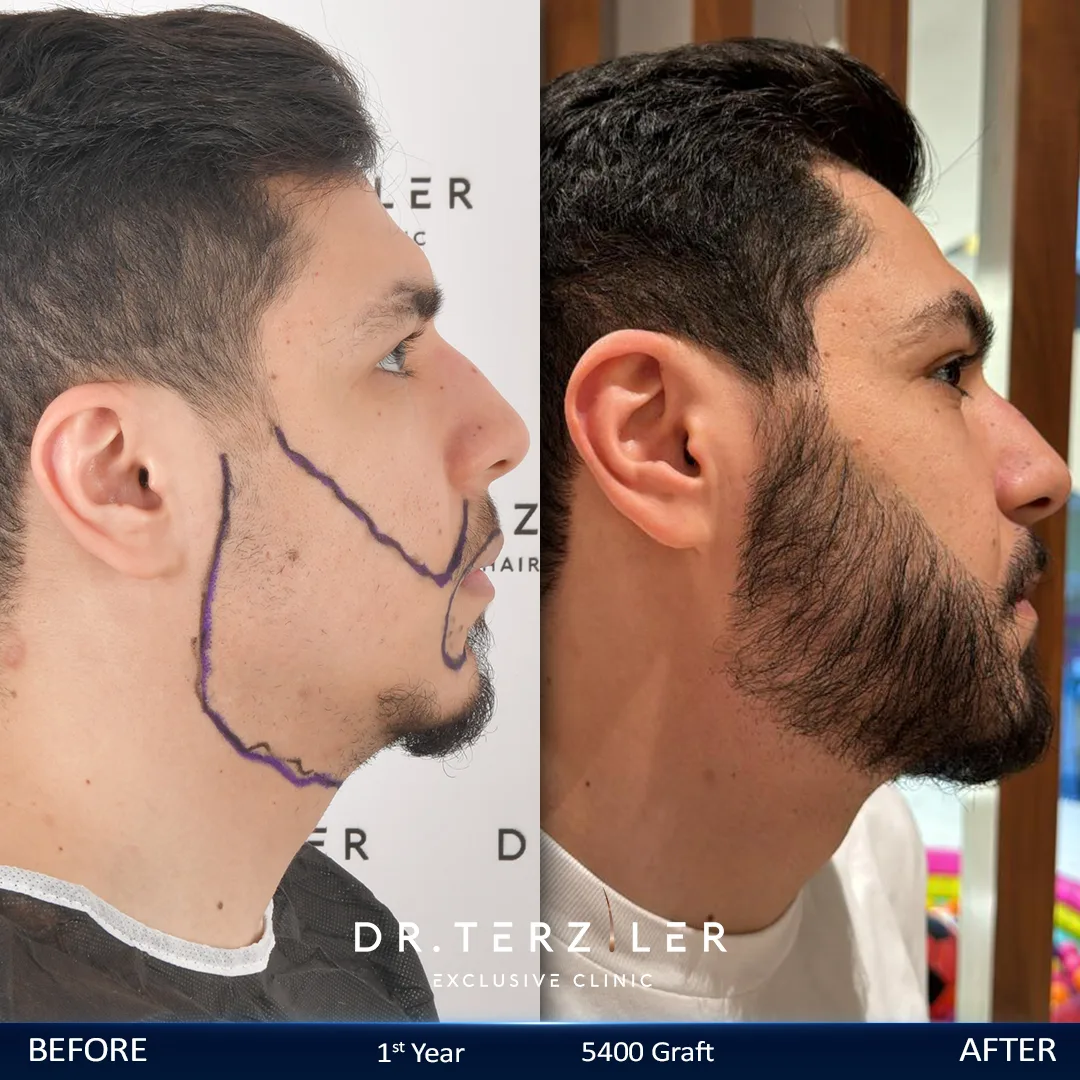
Right profile: density and a defined jawline angle after a surgeon-led facial hair transplant.Left profile: symmetrical beard restoration in Turkey with natural exit angles on the cheek.
What Did Joze's Beard Transplant Journey Look Like?
Joze's goal was to close a patchy cheek line and add a defined, denser jaw and mustache border while keeping the result natural from every angle. The plan used micro-FUE donor extraction and Robotic DHI implantation so each graft matched his native growth direction.
Grafts: 1,162 grafts — single-hair units to the cheek and mustache border, denser 2-hair units to the goatee and chin
Angles: 10–20° on the cheek line, 25–35° on the mustache
Documented: front, right, and left views at the 8-month mark for an honest, multi-angle result
Because the 1,162 grafts were placed flush to the skin at facial depth (1.5–2.5 mm) and matched by follicle calibre, Joze's border reads as native beard rather than a transplanted line. At 8 months the density is already natural, and texture continues to mature toward month 12.
“My cheeks never connected to my jaw before. Eight months later it looks like the beard I always should have had, and nobody can tell it was transplanted.”
Joze, beard transplant patient at Dr. Terziler Exclusive Clinic
Joze's photos are published with patient consent. Individual results vary depending on donor supply, skin condition, and aftercare.
What Is a Beard Transplant?
A beard transplant is a hair restoration procedure that moves individual follicular units from a donor area, usually the lower occipital scalp, to the facial regions where beard hair is missing, patchy, or scarred. It restores the mustache, cheek line, chin, goatee, jawline, and sideburns with the patient's own DHT-resistant hair.
Clinically referred to as “facial follicular unit transplantation (FUT-F)” in the ISHRS 2024 practice bulletin, a facial hair transplant leverages the genetic DHT resistance that travels with each follicle. A “follicular unit” here means 1–4 hairs growing together from one exit point. Facial hair restoration has grown over 100% against its 2010 baseline according to the ISHRS Practice Census. It is a specialised branch of hair transplant in Turkey, and the technique of choice is DHI — specifically Robotic DHI — because facial skin demands shallower, more precise angle and depth control than the scalp.
How a beard transplant works in Turkey: from micro-FUE extraction and Robotic DHI implantation to the Day 0–Month 12 recovery timeline.
What Is Facial Hair Transplantation?
Facial hair transplantation extracts healthy hair follicles from the scalp and relocates them into the facial skin to establish permanent growth in the beard, mustache, or sideburns using the patient's own tissue.
Because the relocated follicles keep their DHT-resistant genetics, the new facial hair grows, can be shaved and styled, and lasts for life once it matures.
What Does a Beard Transplant Do?
A beard transplant populates inactive facial zones with living follicles that grow for life, physically filling empty patches, covering acne or burn scars, and creating a dense, permanently defined facial hair border.
Is “Beard Implants Turkey” the Same as a Beard Transplant?
Yes, “beard implants Turkey” refers to the exact same surgical procedure as a beard transplant. While “implant” can imply an artificial material, a natural beard transplant in Turkey implants your own living biological tissue, not a synthetic fibre.
How Does a Beard Transplant Work Step by Step?
A beard transplant at Dr. Terziler Exclusive Clinic follows five steps: trichoscopic consultation, donor extraction by micro-FUE, graft sorting by follicle calibre, Robotic DHI implantation at 10–20° on the cheek line and 25–35° on the mustache, and a 48-hour observation and washing protocol.
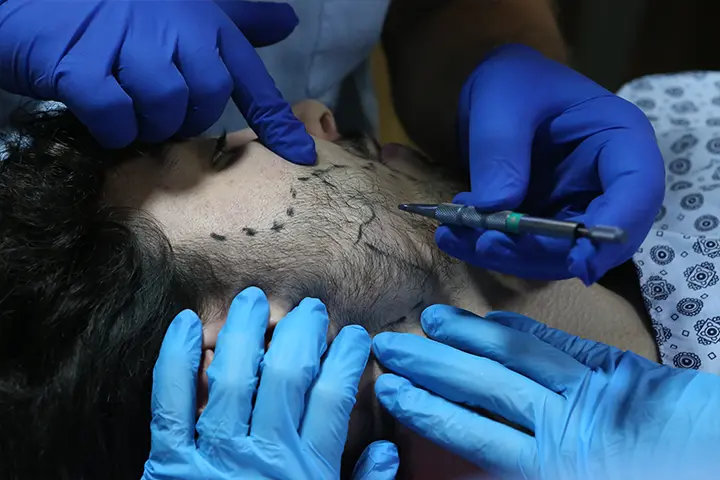
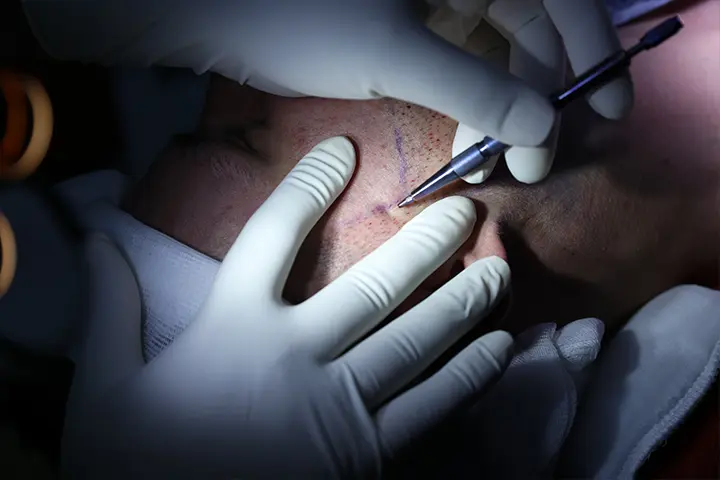
Micro-FUE donor extraction during a beard transplant operation at Dr. Terziler Exclusive Clinic.
1
Trichoscopic consultation and facial hair design
Dr. Terziler maps the patient's facial zones, natural growth direction, and the calibre match between donor scalp and native beard hair under trichoscopy, then draws the cheek line, mustache, and jaw border.
2
Donor extraction
The surgeon uses micro-FUE with a 0.7–0.8 mm punch. Single-follicle units are prioritised because the beard reads most natural with 1-hair grafts along the border.
3
Graft sorting under microscope
Nurses route fine, single-hair grafts to the cheek line and mustache, and send denser 2-hair units to the goatee and chin, so density follows the natural beard map.
4
Robotic DHI implantation
The Terziler-engineered machine places each graft at the angle, depth, and direction mapped in step 1. Depth on the face is shallower (1.5–2.5 mm) than on the scalp (3.5–4.5 mm), which is what prevents cobblestoning and unnatural angles.
5
48-hour wash and protection protocol
The clinic performs the first wash on day 2, crust release happens on day 7–10, and shock-loss shedding starts by day 14 before regrowth from month 3.
What Are the Best Techniques for a Beard Transplant?
The best technique for a beard transplant is Robotic DHI, because facial skin is thin and unforgiving and Robotic DHI controls the depth and angle of every graft, which is exactly what makes a beard look native rather than transplanted.
Manual DHI with a Choi implanter is the next-best option and is used when a case suits a fully hand-placed approach. Sapphire FUE is reserved for large sessions or specific donor situations, because opening channels first gives the surgeon less real-time depth control on the face. Classic FUE extraction is still used for the donor step in every method.
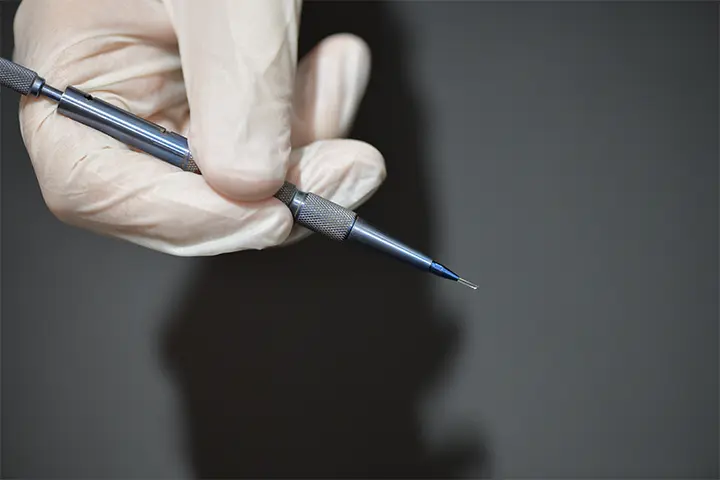
The implanter pen used for beard transplant Robotic DHI placement, controlling depth and angle on the facial skin.
Beard transplant techniques compared for facial-hair precision.
Beard transplant technique comparison Robotic DHI manual DHI Sapphire FUE
Technique
Depth & angle control on face
Best for
Cobblestoning risk
Robotic DHI
Highest — every graft placed flush at a mapped angle
Cheek line, mustache, natural single-hair borders
Lowest (<0.5%)
Manual DHI (Choi pen)
High — direct implantation, no pre-made channels
Hand-placed cases, smaller zones
Low
Sapphire FUE
Moderate — channels opened before placement
Large sessions, specific donor situations
Higher if depth not controlled
Who Is a Good Candidate for a Beard Transplant?
A good candidate for a beard transplant is an adult with a healthy occipital donor area who wants to correct genetically sparse growth, zone-specific patchiness, burn scars, acne scars, or congenital sparse growth on the face.
Dr. Terziler Exclusive Clinic also treats trans-masculine patients after a minimum of 12 months on gender-affirming testosterone, once facial-hair response to hormones has stabilised. The one requirement every candidate shares is a stable, DHT-resistant donor at the back of the scalp.
Patchy or uneven beard: the single most common reason for surgery.
Scarred zones: acne scars, burn scars, or surgical scars that never grew hair.
Congenital sparse growth: genetically thin cheeks, mustache, or jaw.
Trans-masculine patients: after 12+ months on gender-affirming testosterone.
Not yet suitable: under 22, unstable donor, or active skin infection at the recipient site.
Are You Too Young for a Beard Transplant at 20 or 22?
22 is the practical minimum for a beard transplant, because beard follicles finish androgen-driven maturation between 20 and 25, and younger patients risk mismatched density as their native hair thickens later.
Can a Beard Transplant Fix a Patchy Beard?
Yes, patchy beards are the single most common reason for a beard transplant at Dr. Terziler Exclusive Clinic, accounting for around 62% of all facial-hair cases in 2025.
Because single-hair grafts are placed between existing beard hairs at native angles, a patchy beard restoration blends the new density into the hair you already have instead of creating a visible line.
Can You Get a Beard Transplant If You Have Acne Scars or Burn Scars?
Yes, scarred skin is a strong indication for a beard transplant. Graft survival on scar tissue drops to 70–80% versus 90–97% on healthy skin, which the clinic compensates for directly with 15–20% over-grafting.
What Do Beard Transplant Before and After Results Look Like?
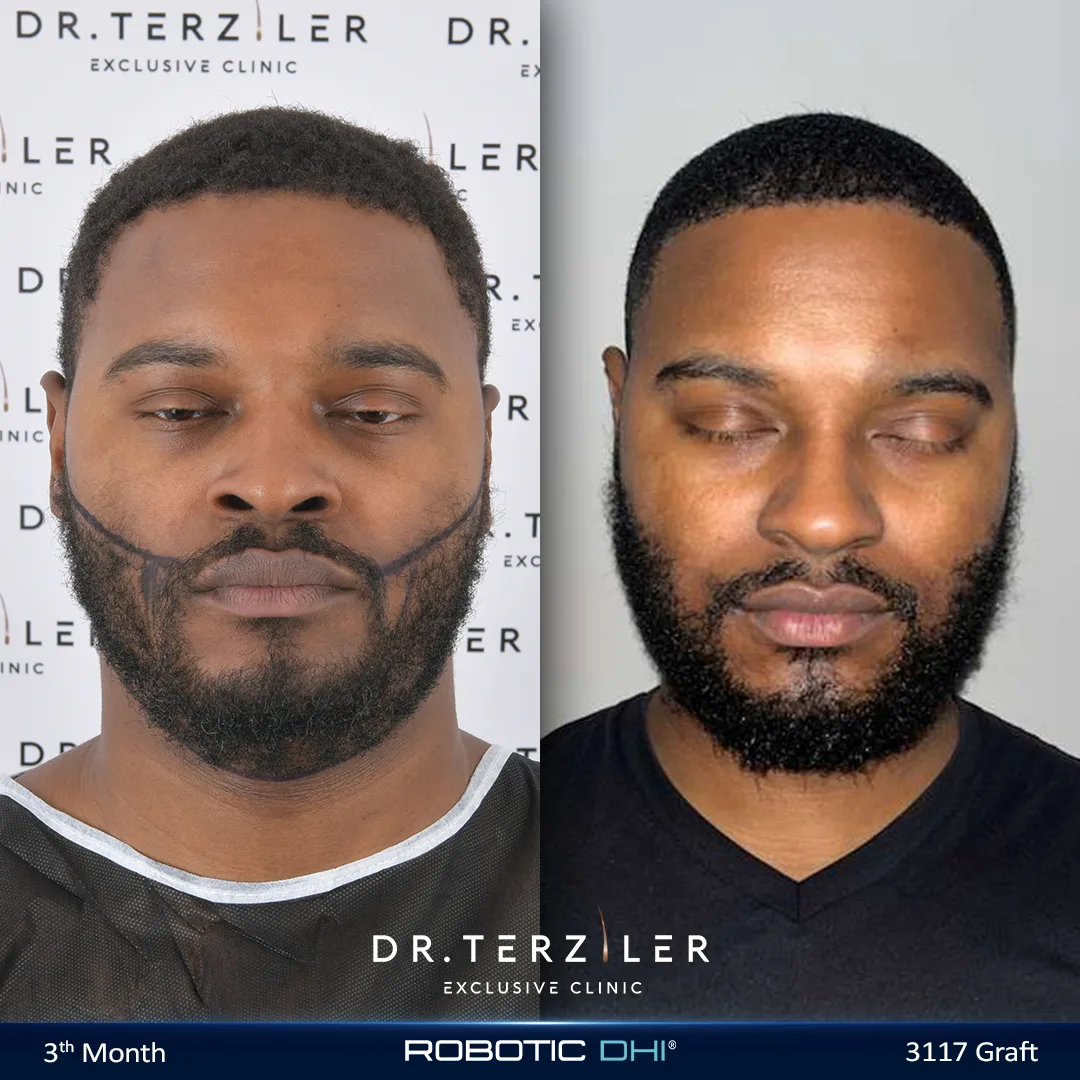
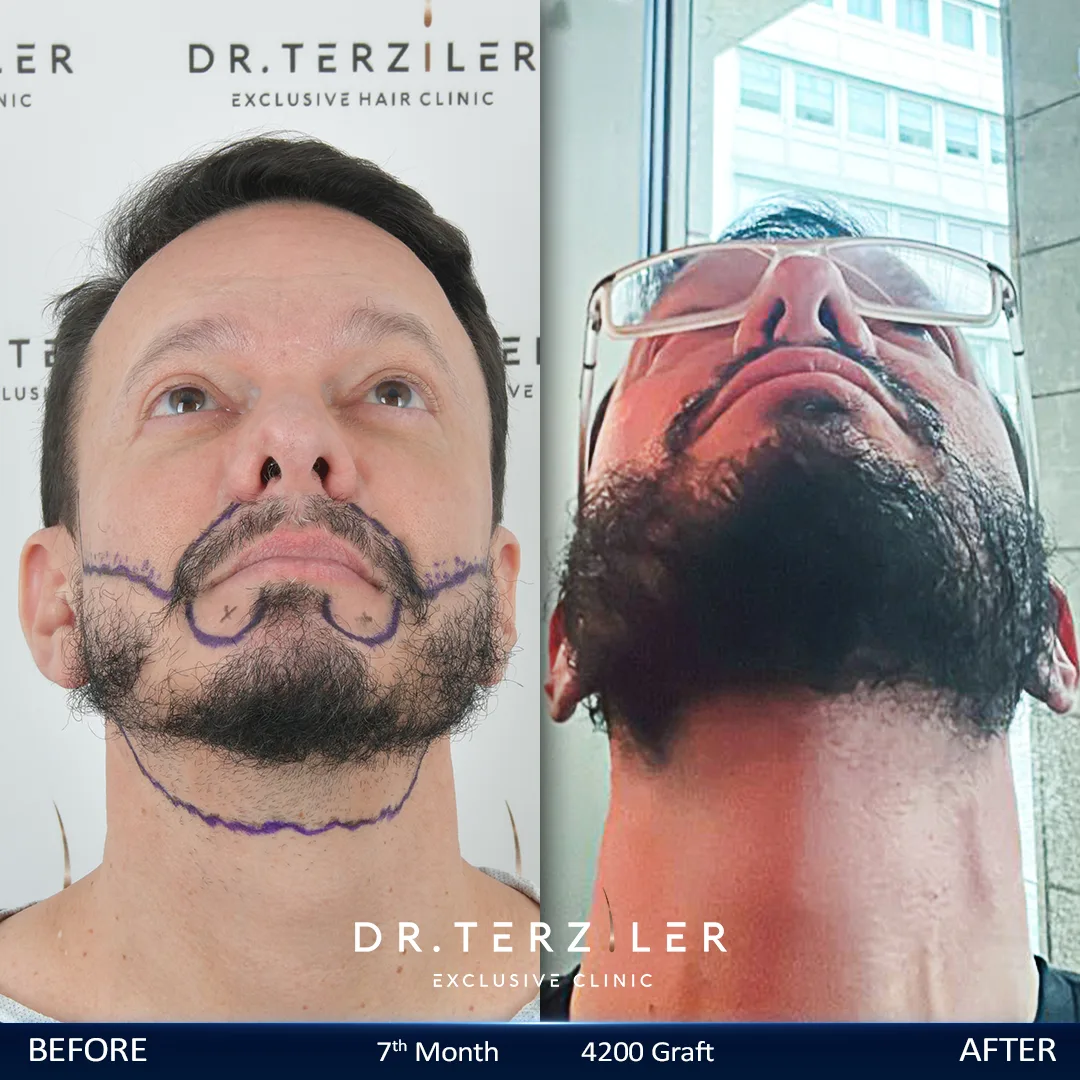
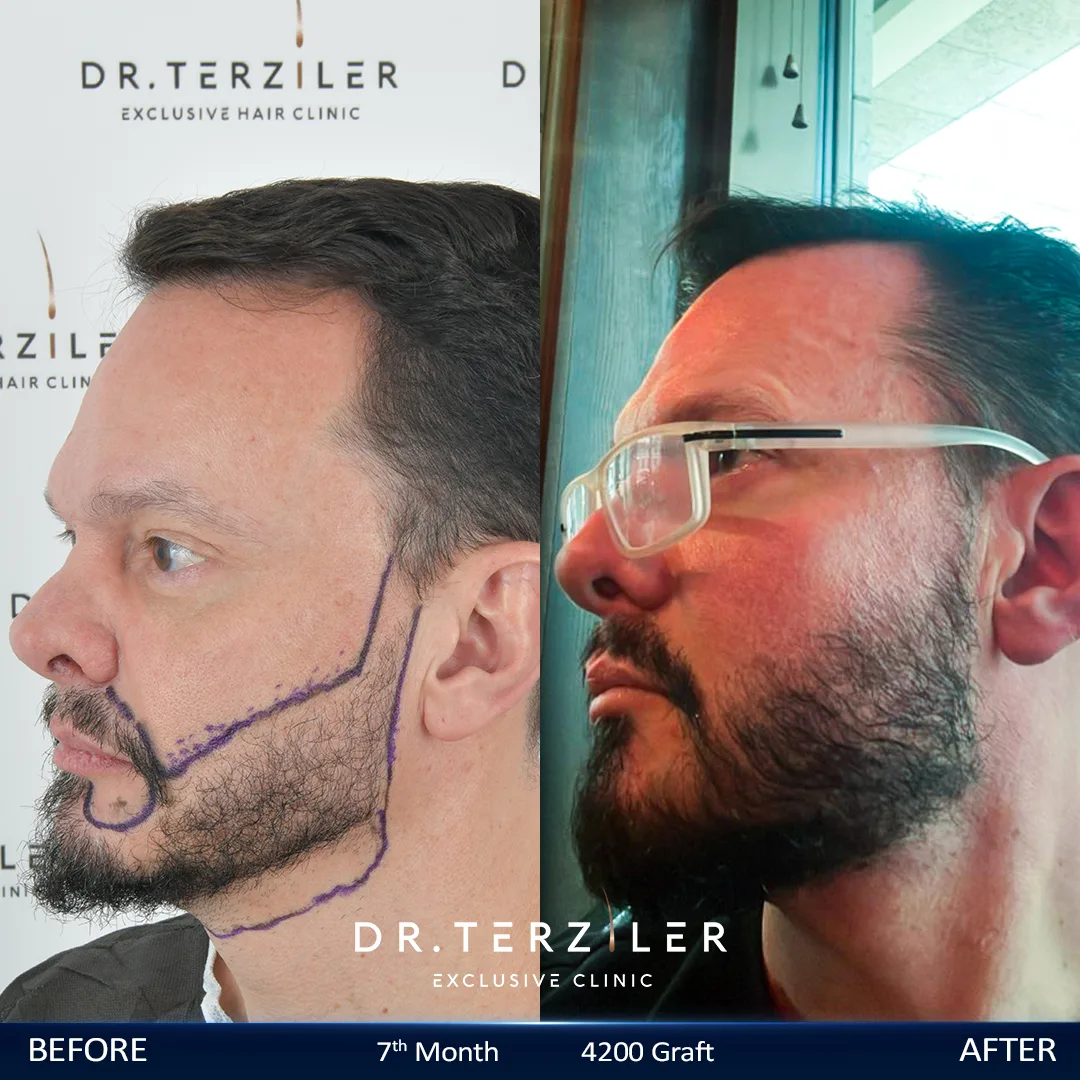
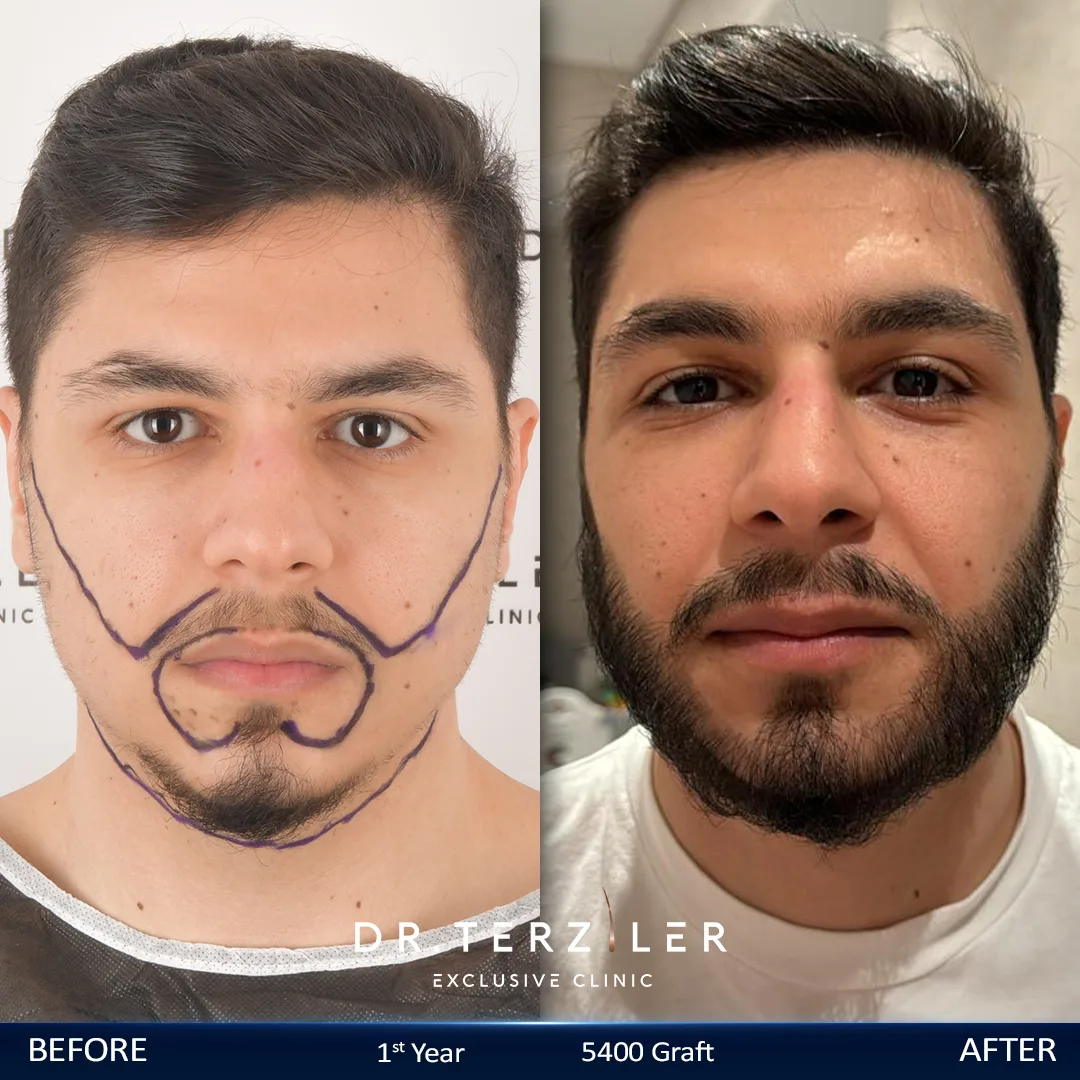
Honest beard transplant before and after results show a patchy or sparse starting point and a fuller, naturally angled beard once the transplanted follicles mature at 6–12 months. The patients below were treated at Dr. Terziler Exclusive Clinic and are shown with consent.
Patient 1: afro-textured beard transplant before and after in Turkey, a 3,117-graft Robotic DHI result with a rebuilt cheek line and jaw.
Want to see more? We document beard, mustache and sideburn results from every angle, at real time points.
Patient 2: beard transplant before and after from two angles, showing mustache and cheek-line density.Patient 3: beard restoration before and after, same patient shown from two angles for an honest result.
All before-and-after photos are published with patient consent. Individual results vary depending on donor supply, skin condition, and aftercare.
How Much Does a Beard Transplant Cost in Turkey in 2026?
A beard transplant in Turkey costs from €3,500 all-inclusive in 2026, depending on graft count, technique, and the number of facial zones treated.
This beard transplant cost in Turkey includes the surgery, 3 nights at a 5-star hotel, VIP transfers, a translator, pre-op blood work, a Mesenchymal Stem Cell booster post-op kit, and a 12-month follow-up. A comparable procedure in the USA or UK costs two to four times more and rarely includes travel or aftercare. Because a fair price depends on your graft count and beard zones, the clinic confirms the exact figure after reviewing your photos rather than quoting a flat per-graft rate.
Beard transplant cost comparison in 2026 (all-inclusive vs surgery-only abroad).
Beard transplant cost Turkey vs USA UK Dubai Mexico India comparison 2026
Variable quality; check accreditation and surgeon experience
Is a Beard Transplant in Turkey Better Than the USA, UK, Dubai, Mexico or India?
Turkey is a better option for beard transplants in terms of surgeon experience, technological access, and comprehensive package value, when you choose an accredited, surgeon-led clinic rather than a high-volume mill.
A beard transplant in Turkey at Dr. Terziler Exclusive Clinic costs significantly less than an equivalent procedure in New York or Los Angeles, is performed by ISHRS and AACI-credentialed surgeons, and includes hotel and transfers the US clinic does not.
What Is the Difference Between Beard Transplant Turkey vs the UK (London, Manchester, Birmingham)?
Choosing Turkish medical infrastructure over London means accessing the proprietary Robotic DHI machine and a fully managed medical tourism experience for less than half the peak £10,000 UK clinic price.
What Is the Difference Between Beard Transplant Turkey vs Dubai (UAE)?
While Dubai offers luxury, an Istanbul beard transplant provides a higher density of facial-hair-specific surgical experience at a drastically lower cost than the AED 42,000 peak pricing in the UAE.
What Is the Difference Between Beard Transplant Turkey vs Mexico, India, or Thailand?
Compared to Tijuana or Delhi, Turkey guarantees strict European-standard healthcare (AACI accreditation) and top-tier aesthetic refinement, avoiding the variable quality found in cheaper arbitrage markets.
How Many Grafts Do You Need for a Beard, Mustache or Sideburn?
A full beard transplant at Dr. Terziler Exclusive Clinic typically requires 2,500 to 4,500 grafts, while a mustache, goatee, or sideburn needs far fewer because each covers a smaller zone.
The exact number depends on how much native hair you already have, how dense you want the border, and which zones you are filling. The table below shows the usual ranges by facial zone.
Typical beard transplant graft counts by facial zone.
Beard transplant graft count by zone full beard mustache goatee sideburn cheek
Zone
Typical grafts
Notes
Full beard
2,500 – 4,500
All zones combined for a complete, dense border
Cheek line
600 – 1,500
Mostly single-hair grafts for a natural edge
Goatee & chin
600 – 1,500
Denser 2-hair units for fullness
Mustache
300 – 800
Single-hair grafts at 25–35° for a soft top lip
Sideburns
200 – 600 per side
Match native angle and connect to the cheek
Jawline definition
800 – 2,000
Sharpens the border and connects the beard zones
What Are the Side Effects and Risks of a Beard Transplant?
The main beard transplant side effects are temporary redness and swelling at the graft site, shock loss, mild folliculitis, and — only when punches are too large or depth is not controlled — cobblestoning, scarring, or an unnatural angle. All of these are preventable with 0.7–0.8 mm punches and precise depth control.
What Is Cobblestoning and How Is It Prevented?
Cobblestoning is raised, bumpy scar tissue at the recipient site caused by grafts that sit above skin level. Prevention requires punches smaller than the follicle shaft, depth-controlled implantation that is exactly flush with the dermis (never above), and avoiding overly large multi-hair grafts.
Robotic DHI at Dr. Terziler Exclusive Clinic hits the flush-depth target on every graft, maintaining a cobblestoning beard transplant rate of under 0.5% across 850+ facial cases (2023–2025).
What Is Shock Loss and Does Every Patient Get It?
Shock loss is the temporary shedding of transplanted hairs 14 days to 6 weeks after surgery. About 80–90% of grafts shed while 5–10% skip this phase in “immediate growth”, and the follicle root survives and regrows the hair from month 3 onward.
Can a Beard Transplant Cause Acne or Ingrown Hairs?
Mild, temporary folliculitis or small pimples are common in the first 6–8 weeks as new hairs push through the skin, and ingrown hairs become rare after month 3 when the angle was implanted correctly.
Does a Beard Transplant Leave Scars?
FUE micro-punches leave 0.7–0.8 mm round marks in the donor area that fade to invisible within 3 months, and the recipient area shows no visible scars once the crusts heal.
What Is Included in a Beard Transplant Package in Turkey?
A beard transplant package in Turkey at Dr. Terziler Exclusive Clinic is fully all-inclusive: it covers the surgery, 3 nights at a 5-star hotel, VIP airport and clinic transfers, a translator, pre-op blood work, a Mesenchymal Stem Cell booster post-op kit, and a 12-month follow-up.
The beard transplant process at Dr. Terziler Exclusive Clinic: Robotic DHI implantation at mapped facial angles.
What Is the Beard Transplant Recovery Timeline?
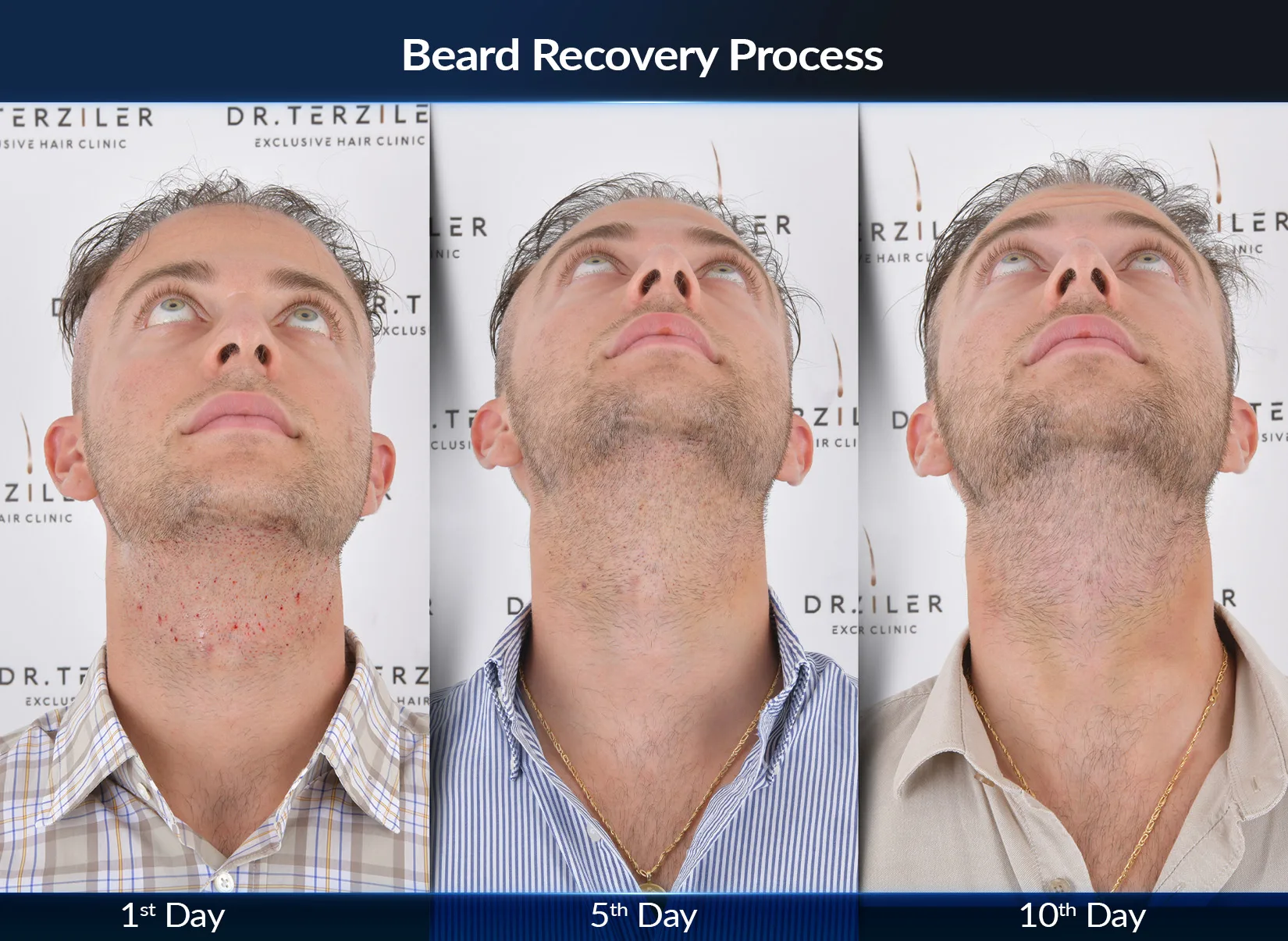
The beard transplant recovery timeline runs from the first wash on day 2 to full density at month 12, with crust release at day 7–10, shock-loss shedding by day 14, and new growth from month 3.
Day 0 — Surgery: micro-FUE extraction and Robotic DHI implantation; you cannot shave yet.
Day 2 — First wash: performed at the clinic before discharge.
Day 7–10 — Crust release: crusts fall away and the redness settles.
Day 14–6 weeks — Shock loss: 80–90% of transplanted hairs shed; the roots survive.
Month 3 — New growth: the transplanted follicles start producing new beard hair.
Month 6 — Fill-in: density and coverage become visibly natural.
Month 12 — Final density: the mature, shave-and-style-ready result.
Month 18 (if needed): optional density touch-up — fewer than 8% of patients request one.
Beard transplant recovery process: healing stages from the first days to new growth.
What Is the Standard 3-Day Beard Transplant Itinerary?
The standard beard transplant itinerary in Turkey takes three days: arrival and consultation on day 1, surgery on day 2, and the first wash and discharge on day 3.
Day 1: arrival and trichoscopic consultation.
Day 2: surgery day.
Day 3: first wash and discharge.
What Does the Package Exclude, and What Does the Guarantee Cover?
The package excludes flights, travel insurance, food outside the hotel breakfast, and optional density revisions requested at 18+ months, and it is backed by a strict lifetime graft guarantee.
Under that guarantee, any graft that fails to take inside the protected donor area at 12 months is re-grafted free.
Why Is a Beard Transplant in Turkey Cheaper Without Being Worse?
A beard transplant in Turkey is cheaper without being worse because Turkey benefits from lower clinical overhead, a concentrated cluster of ISHRS-trained surgeons in Istanbul, and medical-tourism-scale economics — not from cutting clinical corners.
The quality-cost gap exists because US and UK clinics build surgery, consultation, premises, and legal insurance into a per-graft price, while Turkish packages subsidise overhead through volume and run 500+ facial-hair cases per year per senior clinic. The packages at Dr. Terziler Exclusive Clinic contain no hidden costs: no consultation fee, no anaesthesia upcharge, and no re-dressing fee.
A beard transplant usually takes 4 to 7 hours depending on graft count. Most patients are awake and comfortable throughout under local anaesthesia, with short breaks for food and rest.
+Is a beard transplant painful?
No. The procedure is performed under local anaesthesia, so you feel pressure rather than pain. Mild tightness or tenderness in the first 2–3 days is easily managed with the prescribed pain relief.
+When can I shave after a beard transplant?
You can trim with scissors from around week 3–4, and shave with a razor from about month 2 once the grafts are fully anchored and the skin has healed. Your surgeon confirms the exact date at follow-up.
+Is a beard transplant permanent?
Yes. The transplanted follicles come from the DHT-resistant occipital scalp, so once they mature they grow for life and can be shaved, trimmed, and styled like native beard hair.
+Can I fly home the day after a beard transplant?
Yes. The grafts are anchored within 24–48 hours, so flying home after the day-3 first wash is safe. Avoid touching the recipient area and keep it protected from wind and direct sun during travel.
+Will my transplanted beard look natural?
Yes, when angle, depth, and calibre are controlled. Single-hair grafts at 10–20° on the cheek line and 25–35° on the mustache, placed by Robotic DHI, reproduce natural growth direction so the border reads as native beard.
+When can I return to work after a beard transplant?
Most patients return to work within 3–5 days. Redness and tiny crusts are visible in the first week, so patients in client-facing roles often take 5–7 days until the crusts have released.
+What is the success rate of a beard transplant in Turkey?
Graft survival is 90–97% at 12 months on healthy skin at Dr. Terziler Exclusive Clinic, with a cobblestoning rate under 0.5% across 850+ facial cases. Scarred skin runs lower (70–80%) and is compensated with over-grafting.
+Can a beard transplant be combined with a scalp hair transplant?
Often, yes, if your donor supply supports both. Because both procedures use the same occipital donor, the surgeon plans graft numbers carefully so neither the beard nor the scalp hair transplant depletes your long-term reserve.
+How should I care for my beard after the transplant?
Follow the clinic's wash protocol from day 2, sleep so nothing rubs the grafts, avoid steam, sun, and heavy sweating for the first 2 weeks, and do not pick crusts. New hairs shed before regrowing from month 3.
+Does a beard transplant use only scalp hair as the donor?
The primary donor is the lower occipital scalp because it is DHT-resistant and calibre-matches beard hair well. In selected cases, body hair can supplement the donor, but scalp remains the first choice for a natural facial result.
+How many sessions does a full beard usually take?
Most full beards are completed in a single session of 2,500–4,500 grafts. A second session is only needed for very sparse starting density or an extra-high target density, and is planned after the first result matures.
Sources
This beard transplant guide is medically reviewed by Dr. Servet Terziler and cross-checked against the following authorities and peer-reviewed literature:
This page is for information only and is not a substitute for a personal medical consultation. Clinical figures reflect Dr. Terziler Exclusive Clinic's internal facial-hair outcome data (850+ cases, 2023–2025); individual results vary.