

Shedding after a hair transplant can be unsettling, especially when transplanted hair and existing hair seem to fall out together. People use “shock loss” for several different events. This guide separates them, explains what published numbers actually measure, follows recovery week by week and identifies the signs that need a medical review.
The hair shaft can shed while the follicle remains able to grow. Expected graft shedding and loss of your existing hair are different events.
- Native-hair shock loss affects a minority; published estimates vary and cannot predict your own risk.
- Miniaturized native hairs may not recover. An individual examination distinguishes temporary shedding from other problems.
- Pus, spreading redness, fever, worsening pain or dark skin changes need prompt clinical advice.
What Is Shock Loss After a Hair Transplant?
Shock loss is temporary shedding of existing hair following the stress of hair transplant surgery. Doctors also call it post-operative effluvium. Patients and clinics often use the term more broadly to include expected shedding of transplanted hair shafts. The 2021 review in the Indian Journal of Plastic Surgery discusses both types of shedding [1]. Planning a hair transplant in Turkey should include a clear explanation of which hairs may shed and how follow-up will work.
In temporary shedding, the visible hair shaft falls out while the follicle remains capable of regrowth. That is why a thin appearance at week 6 does not establish graft failure. Some miniaturized native hairs may not recover, and infection, scarring or poor graft growth require a different assessment [1][2].
Shock loss vs normal daily shedding
The American Academy of Dermatology describes shedding 50 to 100 hairs a day as normal [9]. Post-operative shedding is different because of its timing and location: it may concentrate around the recipient or donor area within weeks of surgery. A hair count on your pillow cannot, by itself, distinguish expected shedding from a complication.
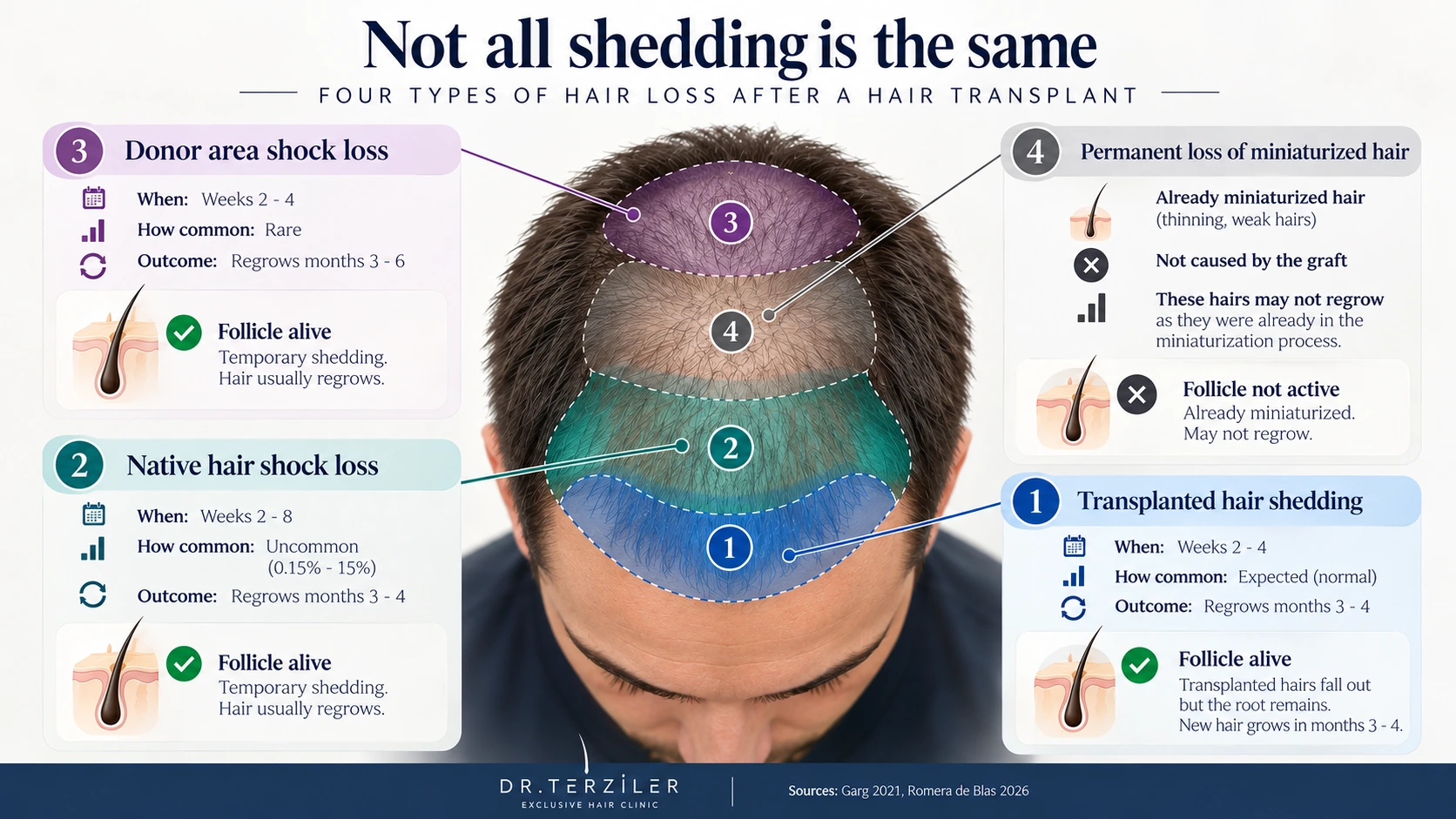
What Are the 4 Types of Hair Loss After a Hair Transplant?
Most confusion online comes from one word covering four events. Each one has its own timing, cause and outcome. Read this table first, then the rest of the guide makes sense.
| Type | Where | Usually starts | How common | Grows back? |
|---|---|---|---|---|
| 1. Transplanted hair shedding | Recipient area (the new grafts) | Weeks 2 to 4 | Expected in most patients. Implanted hair "usually falls within 3 to 4 weeks" [1] | Yes, from month 3 to 4 |
| 2. Native hair shock loss (recipient effluvium) | Existing hair between and around grafts | Weeks 2 to 8 [2] | Uncommon: 0.15% to 15% in published estimates [2]; 3 of 2,896 patients in one series [1] | Yes, around month 3 to 4 [1][2] |
| 3. Donor area shock loss | Back and sides of the head | Weeks 2 to 4 [2][3] | Rare. 1 of 2,896 patients [1] | Yes, within 3 to 6 months [2] |
| 4. Permanent native hair loss | Vulnerable miniaturized hair near the recipient area | Variable | No reliable universal rate | May not recover; assess the cause [1][2] |
Is transplanted hair falling out the same as shock loss?
Expected transplanted-hair shedding and native-hair shock loss are related but distinct. In the first, the transplanted shaft releases as its follicle adapts after surgery. In the second, hair that was not transplanted sheds following stress around the operated area. When a patient asks “does transplanted hair fall out?”, the useful distinction is the hair shaft versus the living follicle [1][2].
Why Does Shock Loss Happen?
Shock loss happens because surgery briefly disturbs the follicle environment. Three triggers stand out in the literature: direct trauma to existing follicles when the surgeon opens recipient sites, swelling (edema), and damage to small blood vessels [1]. A 2021 case series in Skin Appendage Disorders adds a fourth: short-term ischemia, meaning a temporary drop in blood and oxygen supply [4].
The 2026 review of FUE complications in Frontiers in Medicine lists the factors that raise the risk: high implantation density, local trauma, too much tumescent fluid (the saline-anesthetic mix injected into the scalp), and psychological stress [2]. In the donor area, the same review points to high extraction density and strong vasoconstriction [2].
Is shock loss telogen effluvium or anagen effluvium?
Post-operative shedding is not always a simple telogen-effluvium process. Telogen effluvium typically appears a few months after a stressor; the AAD describes this delayed pattern [9]. Earlier shedding after scalp surgery has also been described with anagen-effluvium features [4].
Contin and colleagues reported three cases after therapeutic scalp surgery in 2021. Their early timing and trichoscopic findings supported an anagen-effluvium explanation [4]. These were not three routine hair-transplant patients. The paper’s reference to 85% anagen hairs is background hair-cycle context, not a measured 85% shock-loss rate in transplant patients. The 2026 review describes overlapping mechanisms in donor shedding [2].
For a patient, timing helps frame the discussion but does not make the diagnosis. Shedding around week 2 can fit an expected recovery pattern. Pain, discharge, spreading redness or a new patch still deserve assessment, regardless of the week [1][2].
Shock Loss Timeline: Week by Week After a Hair Transplant
Hair transplant shock loss timeline: Shedding starts at weeks 2 to 4 and can continue to week 8. Months 2 to 3 are the thinnest, called the ugly duckling phase. New fine hairs appear at months 3 to 4. Visible density builds from month 6. Most results show at month 9 to 12, and the crown can take 12 to 18 months.
| When | What you see | What is happening | Normal? |
|---|---|---|---|
| Days 1 to 7 | Small crusts around each graft. Grafts look like short stubble. | Grafts are anchoring. This is the fragile window. | Can fit expected recovery; assess any warning signs |
| Days 7 to 14 | Crusts fall off. Some hairs come out with them. | Hair shafts may release as crusts loosen; follow the prescribed washing plan. | Can fit expected recovery; assess any warning signs |
| Weeks 2 to 4 | Transplanted hairs shed. Some native hair may thin. | Shedding phase. Implanted hair usually falls by week 3 to 4 [1]. | Can fit expected recovery; assess any warning signs |
| Weeks 4 to 8 | Peak thinness. Native shock loss shows here if it happens. | Recipient effluvium window is weeks 2 to 8 [2]. | Can fit expected recovery; assess any warning signs |
| Months 2 to 3 | You may look like before surgery, or worse. | Ugly duckling phase. Follicles are resting. | Can fit expected recovery; assess any warning signs |
| Months 3 to 4 | Fine, soft, sometimes curly or wiry hairs appear. | Follicles restart. Native shock loss regrows around now [1]. | Can fit expected recovery; assess any warning signs |
| Months 4 to 6 | Patchy growth, uneven lengths. | New hairs thicken. About 1 cm of growth per month. | Can fit expected recovery; assess any warning signs |
| Months 6 to 9 | Clear visual change. Friends notice. | Shafts mature and gain diameter. | Can fit expected recovery; assess any warning signs |
| Months 9 to 12 | Most of the final density. | Texture settles. | Can fit expected recovery; assess any warning signs |
| Months 12 to 18 | Final result. Crown and dense packing finish last. | Maturation. | Can fit expected recovery; assess any warning signs |
When does shock loss start after a hair transplant?
Shock loss usually starts 2 to 4 weeks after surgery. The 2021 Indian Journal of Plastic Surgery review places recipient effluvium "mostly after 3 to 4 weeks" [1]. Some patients see the first shafts leave at day 10 to 14, when the crusts come off.
How long does shock loss last?
The active shedding often lasts several weeks. The visible thin phase can continue until new growth appears around months 3 to 4, because the new shafts need time to reach the surface. There is no guaranteed day on which every patient is past this stage.
How long after shock loss does hair grow back?
Native hair lost to shock loss usually regrows in about 3 to 4 months [1]. Donor area shock loss resolves within 3 to 6 months [2]. Transplanted hair starts to show at months 3 to 4 and keeps improving for a year or more.
Where are you in your recovery?
Choose a stage, drag the slider or select your surgery date.
Expected shedding window
Transplanted shafts may shed around weeks 2 to 4. Native-hair shedding can appear around weeks 2 to 8. Timing alone does not establish graft survival.
- What to do
- Follow your washing plan and compare consistent photographs. Do not pick crusts or start a medicine without your clinician’s advice.
- Next milestone
- Months 3–4: look for early new growth.
Hairline growth may remain uneven for several months.
Any stage: pus, spreading redness, fever, increasing pain or dark skin changes need prompt medical advice. Do not wait for a marketing enquiry or an online reply if symptoms are severe. This tool describes common timing; it does not diagnose your scalp or confirm graft survival.
What Is the Ugly Duckling Phase?: Months 2 to 4
The ugly duckling phase is the temporary thin-looking period after transplanted shafts shed and before new growth becomes visible, often around months 2 to 4. Appearance at this stage does not reliably predict the final density.
This period can be emotionally difficult. Before surgery, ask what your own recipient area may look like after shedding and how the clinic will review progress. Counselling and realistic expectations are part of follow-up; the 2021 review emphasizes preparing patients for this stage [1].
What helps in this phase:
- Take a consistent photo set about every 2 weeks: the same lighting, angles and dry-hair condition. A sequence is more useful than repeatedly checking different mirrors.
- Use camouflage only when your surgical team says the scalp has healed enough. Ask specifically about a loose cap, hair fibers and styling products rather than treating a calendar date as clearance.
- Keep a short haircut. Short native hair makes the contrast smaller.
- Avoid judging the final result at month 4. Newly emerging hairs may still be short, fine and uneven. Discuss changes at the planned check-ups and ask earlier if you notice warning signs.
In the 2025 ISHRS Practice Census, members reported that 44% of their patients treated in 2024 planned to tell others about their transplant [8]. This describes disclosure plans; it does not show why the remaining patients preferred privacy or how they experienced the ugly duckling phase. Planning a natural hairline and a manageable recovery appearance are separate discussions.
Does Everyone Get Shock Loss After a Hair Transplant?
No. Most patients shed transplanted hair shafts, but true native-hair shock loss affects a minority. The numbers online look contradictory because they measure different things. Here they are side by side.
| Number you see online | What it actually measures | Source |
|---|---|---|
| "Almost everyone sheds" | Type 1: transplanted shafts falling at weeks 2 to 4. This is the normal graft cycle, not a complication. | Garg & Garg 2021 [1] |
| 0.10% (3 of 2,896 patients) | Clinically significant recipient-area effluvium in one surgeon series, 2009 to 2020. Donor effluvium: 1 patient. | Garg & Garg 2021 [1] |
| 0.15% to 15% | Range of recipient-site effluvium estimates across published studies. The authors call the estimates heterogeneous. | Romera de Blas et al. 2026 [2] |
| "5% to 95%" | Mixes all four types and all severities. Not a clinical incidence figure. | Clinic blogs, no primary source |
| No documented rate | ISHRS authors noted in 2005 that shock loss is common in practice but lacks scientific documentation of rates. | True & Dorin 2005 [5] |
So the honest answer to "does shock loss always happen?" is this: you will probably see your new hairs fall out, and that is part of the plan. Losing a visible amount of your own existing hair is less likely, and when it happens it usually comes back.
Is it bad if I have no shedding after my hair transplant?
No shedding is not, on its own, a warning sign or proof of better graft survival. Some grafts retain their shafts. A small 40-patient study reported more early graft-density retention with intra-operative PRP, but that does not establish what an individual patient’s final result will be [6].
Who Is Most at Risk of Shock Loss? 9 Risk Factors
Shock loss risk depends on your hair, your health on surgery day, and the surgical plan. These factors come from the published reviews and case series.
| Risk factor | Why it matters | Source |
|---|---|---|
| Miniaturized native hair in the recipient area | Miniaturized follicles may be more vulnerable and may not fully recover. | [1][10] |
| Female pattern or diffuse hair loss | Women often have native hair spread through the thinning zone, so more hair sits next to new grafts. | [2] |
| Older age | Listed as a risk factor for recipient effluvium. | [2] |
| High implantation density | More sites per cm² means more trauma and swelling around native follicles. | [2] |
| Too much tumescent fluid or vasoconstrictor | Can reduce local blood flow. Linked to both recipient and donor effluvium. | [2] |
| Fever in the week before surgery | 2 of the 3 recipient-effluvium patients in a 2,896-patient series had a fever 1 week before surgery. | [1] |
| Smoking | Listed as a donor effluvium risk factor. Nicotine narrows small vessels. | [1] |
| Diabetes | Listed as a donor effluvium risk factor. Affects small-vessel healing. | [1] |
| Psychological stress | Listed as a recipient effluvium risk factor. | [2] |
Which topics should you discuss?
Select anything that applies. The result is a question list, not a medical risk score.
Selections stay in your browser. The WhatsApp link opens an editable draft; nothing is sent automatically. A count of selected topics is not a prediction of shock loss.
What Is the Donor Area Shock Loss: Thin Patches at the Back of the Head
Donor area shock loss is temporary shedding in the zone where grafts were harvested. It is rare. In the 2,896-patient series it occurred in 1 patient [1]. The 2026 Frontiers review says its true incidence is unknown but "considerably less frequent" than recipient shock loss. It typically starts 2 to 4 weeks after surgery and resolves within 3 to 6 months [2].
It can look alarming. Kerure, Agrawal and Dhurat described four FUE patients who developed round, non-scarring patches at the donor site 2 to 3 weeks after surgery [3]. Under the trichoscope, the patches looked like alopecia areata, with exclamation-mark hairs and black dots. Biopsies showed something else: dilated blood vessels and the pattern of a healing wound [3]. The authors linked it to compromised blood supply and trauma to existing hairs [3].
A new round donor-area patch should be shown to your surgeon. Do not diagnose or treat alopecia areata yourself from a photograph. Temporary donor effluvium often recovers over months, while persistent donor thinning, inflammation or scarring needs examination [1][2][3]. Minoxidil may be considered by the treating clinician; do not start treatment simply because a patch appears.
Shock Loss vs Graft Failure: Normal Signs and Red Flags
Shedding alone does not prove graft failure. Use the signs below to decide when to contact a clinician. Suspected infection, tissue damage or a bleeding displaced graft needs prompt advice; delayed growth at month 6 is a reason to arrange review, rather than an emergency solely because of its timing.
- Hair shafts shed within weeks 2–8 without fresh bleeding or worsening symptoms.
- Stubble releases as crusts loosen under the prescribed washing plan.
- A thin appearance around months 2–3.
- Fine, wiry or uneven new growth around months 3–6.
- Itchy bumps or persistent redness.
- A new localized donor-area patch.
- Unexpectedly increasing shedding.
- Very little or no new growth around month 6.
- Pus, yellow discharge or a bad smell.
- Spreading redness with increasing pain or a hot scalp.
- Fever or black/dark, painful skin changes.
- Fresh bleeding or suspected graft displacement after trauma in the early days.
Redness deserves one extra sentence. In a cohort of 1,090 patients summarized in the 2026 Frontiers review, more intense redness around the grafts was associated with more post-op shedding and lower graft survival. Mild redness affected 16.3%, moderate 5.1% and severe 0.9% [2]. Mild pink skin for a few weeks is common. Strong redness that does not fade after month 3 is worth a photo to your doctor.
How to tell shock loss from graft failure
You cannot reliably identify a living or failed graft from the appearance of a shed hair alone. Fresh bleeding or tissue after trauma in the first days should be reported promptly. In a study of 42 patients, graft anchoring became more secure during the first week, with no dislodgement in the study’s tests by day 9 [12]. That finding is not permission to pull hairs, pick crusts or comb aggressively; follow your own surgical team’s washing protocol.
What Does Shock Loss Look Like? Photo Guide
Shock loss looks like general thinning around and between the new grafts, rarely like bald patches. In the hairline, the stubble from surgery thins out and the scalp shows through again. Around the crown, native hair can look see-through for a few weeks. In the donor area, it can appear as a small round thin patch [3].
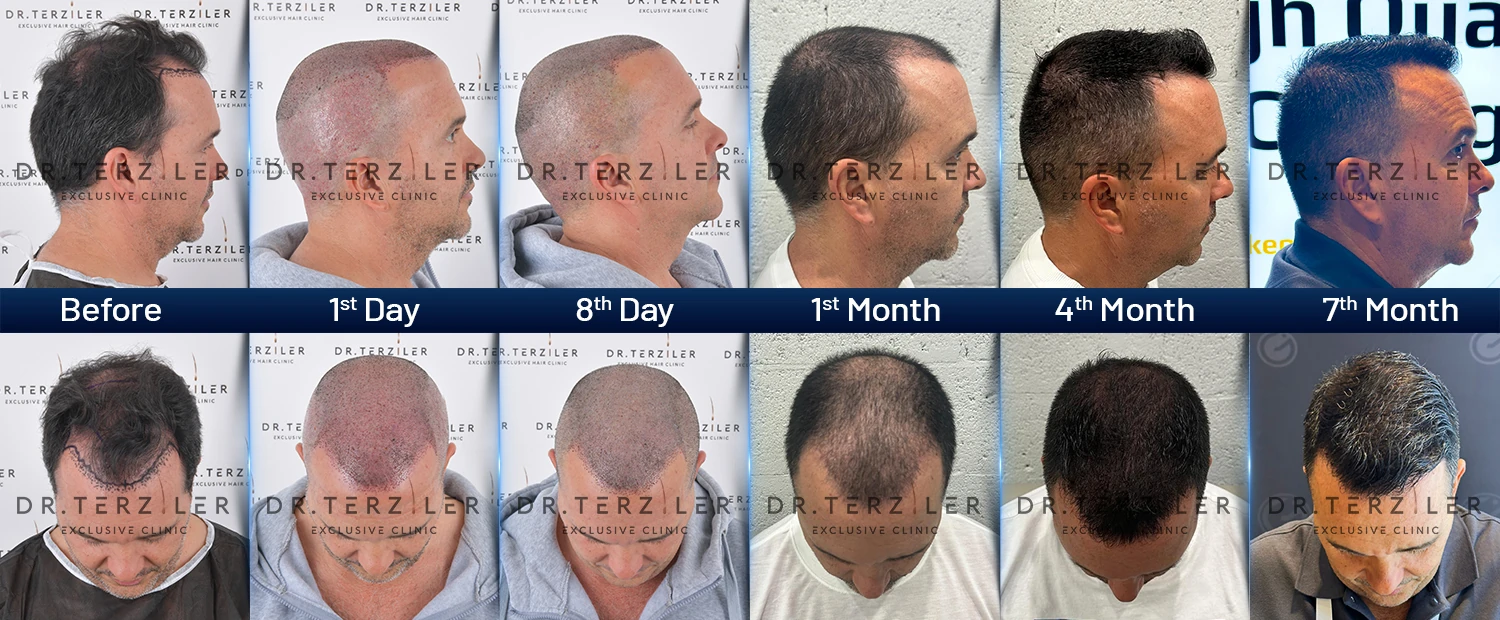
See more documented examples in the hair transplant before and after gallery. Compare the stated follow-up stage, not just two photographs.
How to Reduce Shock Loss: What the Evidence Supports
Risk cannot be eliminated. Gentle surgery, donor planning and aftercare matter, while medication and supportive-treatment studies measure different outcomes. Improved hair counts or faster early growth should not be presented as a proven percentage reduction in native-hair shock loss.
Before surgery
Finasteride, when prescribed for an appropriate patient. In a randomized trial of 79 men with androgenetic alopecia, 1 mg daily from 4 weeks before until 48 weeks after surgery improved surrounding hair counts. Visible increases in superior/frontal scalp hair were recorded in 94% versus 67% with placebo at follow-up [7]. These are hair-growth outcomes, not shock-loss-prevention rates. Discuss adverse effects, contraindications and whether the medicine is appropriate with your doctor; do not start it based on this article.
Stabilize ongoing hair loss where appropriate before adding grafts. Surgery does not stop future loss of non-transplanted hair [1]. A clinician should assess the diagnosis, donor capacity and miniaturization before deciding on medical treatment or additional testing, including whether a Tricho Test would be relevant to your case.
Report fever, flu, infection and smoking or nicotine use before surgery [1]. The medical team should decide whether the date needs to change and give you an individualized pre-operative plan.
During surgery
Moderate density and gentle sites. High implantation density and local trauma are listed risk factors [2]. Density should match your hair, not a brochure number.
Careful tumescence and low vasoconstrictor doses. The 2026 review advises avoiding excessive tumescent fluid and high vasoconstrictor concentrations [2].
Short out-of-body time and careful graft handling. Prolonged out-of-body time is a listed cause of poor growth, and minimizing ischemia time is a listed prevention step [2].
After surgery
Minoxidil may be used to support regrowth when the treating clinician recommends it [1][2]. A 2002 expert consensus discussed its role around transplantation [11]. The start or restart date depends on scalp healing and the prescribed formulation. Do not apply it to open wounds or change a prescription without your clinician’s instructions.
PRP. A prospective 40-patient FUE study, described by its author as randomized but using alternating allocation, reported greater early graft-density retention and faster regrowth in the PRP group [6]. At week 4, 12 of 20 PRP patients versus none of 20 controls retained more than 75% graft density; at month 6 the reported regrowth category exceeded 75% in 20 versus 4 patients. These small-study endpoints are not a validated native-hair shock-loss prevention rate. Ask whether Hair PRP is appropriate for your plan.
Low-level laser therapy (LLLT). Listed as an adjuvant that may speed donor regrowth [2]. Evidence after transplants is limited.
Follow the written aftercare plan: avoid scratching or picking crusts, wash as instructed, and ask when hats, exercise and styling products are appropriate. Contact the surgical team if the recovery pattern changes.
Nutrition: correct deficiencies, do not megadose. No study shows that a supplement prevents shock loss. Low iron, vitamin D or protein can worsen shedding in general, so check them with a blood test if you diet strictly. More is not better.
| Measure | What the evidence measures | Timing / suitability |
|---|---|---|
| Finasteride | Trial in 79 men: surrounding hair counts, not a shock-loss prevention rate [7] | Prescription and individual assessment; the trial started 4 weeks before surgery |
| Minoxidil | Expert consensus and reviews describe support for regrowth [1][2][11] | Only when prescribed or cleared after healing |
| PRP | Small prospective study, n=40; early density and regrowth endpoints [6] | Suitability and schedule require assessment |
| Low-level laser | Limited supporting data mentioned in a review [2] | Ask the treating team |
| Gentle technique, controlled density, graft handling | Review recommendations [2] | Surgical planning and execution |
| Recent illness and nicotine review | Case series and clinical risk assessment [1] | Before surgery; no universal postponement period |
| Biotin or “anti-shock” shampoos | No established evidence here for preventing shock loss | Correct a diagnosed deficiency; avoid unnecessary supplements |
How Dr. Terziler Exclusive Clinic Plans Around Shock Loss
At Dr. Terziler Exclusive Clinic, planning considers the hair a patient already has as well as the area to be restored. Dr. Servet Terziler developed the clinic’s proprietary robotic hair transplant system. The clinical model described here is clinic-provided information, rather than independent proof that a technique prevents shock loss.
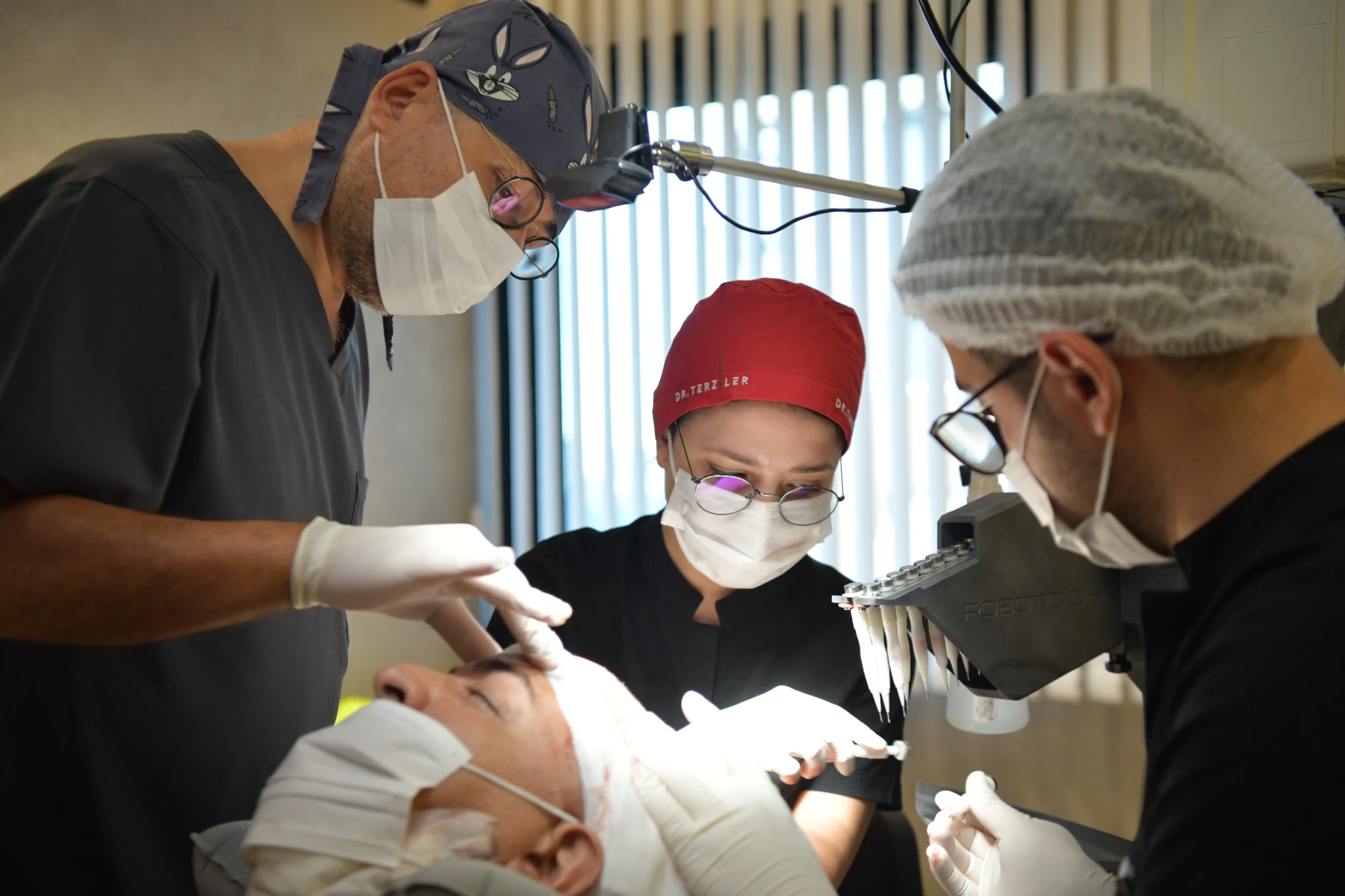
Consultation and hairline design. The assigned physician, Dr. Servet Terziler or Dr. Kürşat Yalvaç, assesses native hair, miniaturization and donor supply within the confirmed treatment plan. Where existing hair is vulnerable, the plan may involve adjusted density, medical treatment first or a staged approach.
Picasso Robotic DHI. The clinic describes implanter-based placement with a 0.70 mm Choi pen and controlled planning around placement angle and depth. Device settings and suitability depend on the case. Careful graft handling and recipient-site planning matter, but no comparative study cited here establishes that Picasso Robotic DHI eliminates or always reduces shock loss versus other methods [1][2].
Graft handling. The clinic reports short out-of-body handling intervals and use of HypoThermosol with ATP within its preservation protocol. Ask the team to explain the actual handling workflow for your case. These clinic-described process details are not an independently verified shock-loss prevention rate.
Boutique scheduling. The clinic states that it treats a maximum of four hair-transplant patients per day, to support named-physician involvement and clinical oversight.
Follow-up on WhatsApp. Patients can share progress photographs with the clinic team at agreed milestones or when concerns arise. Confirm who reviews them, expected contact hours and the urgent-care pathway before travelling.
Written records and follow-up terms. Request the surgical record, graft count and current written guarantee or repair policy, including eligibility, exclusions and any travel costs. A written policy does not guarantee regrowth of every native hair.
Clinic-reported outcome: the clinic’s internal 12-month audit of 120 Picasso Robotic DHI cases recorded 98.1% graft survival. This is not a peer-reviewed comparative trial or a shock-loss incidence study, and it does not predict an individual patient’s outcome.
Why Are There No Results 4 Months After My Hair Transplant?
At month 4, some patients have only early, fine growth, so the appearance can still be thin or uneven. Timing varies between people and scalp areas. A photograph cannot establish the number of surviving grafts at this stage; use the scheduled follow-up to review the trend.
| Month | Possible appearance | How to interpret it |
|---|---|---|
| 3 | First fine hairs may emerge | Early growth is variable |
| 4 | Short, fine or uneven growth | A thin appearance alone does not prove failure |
| 6 | Coverage may become more noticeable | Arrange review if there is very little or no growth |
| 9 | Hair can thicken and mature | Compare consistent photographs |
| 12 | More mature appearance | Review density and ongoing native hair loss |
| 12–18 | Later maturation, especially the crown | Individual assessment; no fixed percentage complete |
These are descriptive recovery stages, not validated percentages of a final result. Age, hair characteristics, scalp area, surgical factors and ongoing hair loss can change the pace.
If there is very little or no new growth around month 6, arrange a review rather than waiting silently until month 12. Your clinician can assess photographs, donor and recipient areas, ongoing hair loss and possible reasons for delayed growth. Seek help earlier for painful, inflamed or infected areas.
Hair Loss After Other Surgery: Is It the Same as Shock Loss?
Hair loss after general surgery is usually telogen effluvium, and it is different from transplant shock loss. The AAD lists having an operation as a trigger for excessive shedding and notes that most people notice it a few months after the event [9]. Shedding is spread over the whole scalp, not one area, and stops as the body readjusts [9].
Physical stress, illness, blood loss or reduced nutrition around an operation can contribute to later diffuse shedding. Anaesthesia alone should not automatically be blamed. If hair thins throughout the scalp a few months after another operation, seek a dermatology assessment; tests may be appropriate for suspected nutritional or thyroid problems [9][10].
What Happens 2 Years After a Hair Transplant?
By year 2, a transplant is usually beyond its early growth phase, while native hair may continue to thin. Donor hair is selected for relative resistance to androgenetic loss, but no graft is guaranteed to last for life. New or progressive hair loss needs assessment of both transplanted and native hair.
The 2,896-patient series reported 26 patients who were unhappy because of loss of non-transplanted, androgen-dependent hair [1]. This illustrates one explanation for a changing result; it does not prove that every late loss is native hair. Discuss the diagnosis and a suitable long-term plan through the clinic’s hair treatments service.
Is 4,000 or 5,000 Grafts Overharvesting?
A count of 4,000 or 5,000 grafts does not, by itself, establish overharvesting or safety. Donor density, usable area, extraction distribution, hair characteristics and future hair loss determine what can be removed. A smaller session can also be excessive for a limited donor area.
Overharvesting is persistent donor depletion from excessive or poorly distributed extraction. It can produce a moth-eaten appearance and should be distinguished from temporary donor effluvium [2]. Ask for measured donor density and a lifetime donor plan before agreeing to a large session. A graft calculator can support a discussion, but it does not establish your safe donor capacity.
Shock Loss FAQ
Does shock loss always happen after a hair transplant?
No. Most patients shed transplanted hair shafts at weeks 2 to 4, which is expected. Visible loss of native hair is less common. Published estimates range from 0.15% to 15%, and one 2,896-patient series recorded only 3 recipient-area cases.
How long does the shock phase last after a hair transplant?
Shedding lasts about 2 to 6 weeks and usually ends by week 8. The thin look lasts until new hair surfaces at months 3 to 4. Donor area shock loss resolves within 3 to 6 months.
How long after shock loss does hair grow back?
Native hair lost to shock loss usually grows back in about 3 to 4 months. Transplanted hair starts to appear at months 3 to 4, shows clearly at month 6, and reaches its final look at 12 to 18 months.
How can I reduce shock loss after a hair transplant?
Discuss the plan with your surgeon: protect vulnerable native hair, avoid excessive implantation or extraction density, report recent illness and follow aftercare. Finasteride or minoxidil may be appropriate for selected patients, but the prescription and timing require individual medical advice.
How do I help transplant shock?
Follow your aftercare plan, avoid scratching or picking and take comparable progress photographs. Ask the treating team before starting or restarting minoxidil or adding PRP. Most temporary shedding improves over time, but new patches, inflammation or unexpectedly delayed growth should be reviewed.
Is shock loss permanent?
Usually not. Healthy follicles regrow. Permanent loss mainly affects native hairs that were already heavily miniaturized and close to the end of their life before surgery.
Can transplanted hair fall out permanently?
Yes, poor graft growth or permanent loss can occur. Expected shaft shedding in the first weeks is different from losing a graft. Donor selection, surgical handling, healing and underlying scalp disease affect long-term growth; hair loss later on also needs assessment of native hair.
What does shock loss look like?
Shock loss looks like diffuse thinning around and between new grafts, so the scalp shows through again. In the donor area, it can look like a small round thin patch at weeks 2 to 4.
Does FUE or DHI cause less shock loss?
The cited evidence does not establish that one technique always causes less shock loss. FUE describes harvesting and DHI describes implantation, so they are not mutually exclusive alternatives. Diagnosis, donor planning, surgical trauma, density and blood flow matter alongside the technique. Ask about the proposed DHI hair transplant plan for your own scalp.
Can I use minoxidil to prevent shock loss?
Minoxidil may support regrowth in selected patients, but it does not guarantee prevention. Ask your prescriber when it is appropriate to start or restart after healing. Do not apply it to open wounds or alter treatment based on a general online timeline.
Does finasteride prevent shock loss?
A trial in 79 men found improved surrounding hair counts with finasteride taken from 4 weeks before to 48 weeks after surgery; visible increases were reported in 94% versus 67% with placebo. The trial did not establish a shock-loss prevention percentage. It is a prescription decision that requires discussion of suitability and adverse effects.
Why is my new hair curly or wiry?
New hairs often grow fine, curly or wiry at months 3 to 5. The follicle is restarting and the shaft is still thin. Texture usually normalizes by month 9 to 12.
Is it normal to have no shedding after a hair transplant?
Yes. Some grafts retain their shafts, so no shedding is not automatically a warning. A small PRP study reported early density retention, but absence of shedding alone cannot confirm final graft survival.
When should I worry about shedding after a hair transplant?
Contact a clinician promptly for pus, spreading redness, fever, worsening pain, dark skin changes or a suspected displaced graft with fresh bleeding. Arrange a planned review for very little growth around month 6. Shedding within an expected time window should still be assessed if accompanied by other symptoms.
Can I get shock loss from PRP or minoxidil?
Minoxidil can cause an initial shedding phase, which is different from surgical shock loss. If shedding starts after PRP, medication or another intervention, tell the treating clinician rather than assuming the cause or stopping a prescribed treatment yourself.
References and evidence notes
Sources are linked so you can distinguish reviews, small studies, historical expert opinion and general patient guidance. Study estimates are not a personalized risk calculation.
- Garg AK, Garg S. Complications of Hair Transplant Procedures—Causes and Management. Indian J Plast Surg. 2021;54:477–482.
- Romera de Blas C, Vega Díez D, Ricart Vayá JM, Gómez Zubiaur A. Complications in follicular unit excision hair transplantation: current evidence and practical approaches. Front Med. 2026;13:1750989.
- Kerure AS, Agrawal SM, Dhurat R. Donor Area Acute Effluvium following Follicular Unit Extraction: Trichoscopic Simulator of Alopecia Areata. Series of Four Cases. J Cutan Aesthet Surg. 2020;13:31–34.
- Contin LA, Santos LDN, Pereira IJN, Rocha VB. Anagen Effluvium after Therapeutic Scalp Surgery: Unreported Phenomenon. Skin Appendage Disord. 2021;7:311–314.
- True RH, Dorin RJ. A Protocol to Prevent Shock Loss. Hair Transplant Forum International. 2005;15:197–199. Historical expert discussion.
- Garg S. Outcome of Intra-operative Injected Platelet-rich Plasma Therapy During Follicular Unit Extraction Hair Transplant: A Prospective Randomised Study in Forty Patients. J Cutan Aesthet Surg. 2016;9:157–164.
- Leavitt M et al. Effects of finasteride (1 mg) on hair transplant. Dermatol Surg. 2005;31:1268–1276.
- International Society of Hair Restoration Surgery. 2025 ISHRS Practice Census Results. Physician survey, not a shock-loss incidence study.
- American Academy of Dermatology. Do you have hair loss or hair shedding? Patient guidance.
- National Library of Medicine, MedlinePlus. Hair loss. General patient information.
- Avram MR et al. The potential role of minoxidil in the hair transplantation setting. Dermatol Surg. 2002;28:894–900. Expert consensus.
- Bernstein RM, Rassman WR. Graft anchoring in hair transplantation. Dermatol Surg. 2006;32:198–204. Study in 42 patients.
This guide is for education and does not replace your own surgical team’s instructions or a medical examination. For severe or rapidly worsening symptoms, seek prompt local medical care.
Dr. Terziler Exclusive Clinic
Discuss your donor supply, existing hair and recovery concerns with the clinic team. An individual assessment can clarify whether the next step is observation, treatment or an in-person review.
Share your concerns with the team and confirm the follow-up plan for your own case.