





Copper Peptides (GHK-Cu): The Regenerative Molecule Behind Skin and Hair Repair
Your body makes GHK-Cu, then it stops. Between age 20 and 60, plasma levels of this copper peptide fall by about 60%, from roughly 200 ng/mL to 80 ng/mL. Skin loses firmness. Follicles miniaturize. Wounds close slower. GHK-Cu is the repair signal your body quietly runs out of. Copper peptides are short amino acid chains bonded to a copper ion (Cu²⁺) that tell cells to rebuild, repair, and protect tissue. GHK-Cu is the most studied one. It is a biological signal that reactivates repair pathways you already have. At the Dr. Terziler Youngevity program, we map around 750,000 variants on the standard panel, or the full 3-billion-letter genome on the Ultimate Longevity tier, trace three generations of lineage, and build a one-year reset plan from there.
Table of Contents
TL;DR
- GHK-Cu is a copper-bound tripeptide (glycine, histidine, lysine).
- Copper peptides rebuild collagen, calm inflammation, grow new capillaries, activate antioxidant enzymes, and modulate over 4,000 genes.
- Copper peptides for skin: firmness, scars, tone.
- Copper peptides for hair: follicle environment support, especially after microneedling, PRP, or transplant.
- GHK-Cu addresses at least 4 of the 12 Hallmarks of Aging described by López-Otín and colleagues (Cell, 2013 and 2023).
- Copper peptides are not a DHT blocker.
- Use copper peptides topical at 1 to 3%, pH 5.0 to 6.0.

MEDICALLY REVIEWED BY
Dr. Servet TerzilerAACI-accredited surgeon | Inventor of the Picasso Robotic DHI device | Founder & President, TUSATDER | Lead, Dr. Terziler Youngevity program | Collaborates with geneticist Prof. Hakan Cangül (Nature Genetics, Lancet, JCI) | ISHRS workshops | Updated: April 2026
Updated in 2026, April
What Are Copper Peptides?
Copper peptides are short amino acid chains bonded to a copper ion (Cu²⁺) that signal cells to repair, rebuild, and protect tissue.
GHK-Cu is a tripeptide made of glycine, histidine, and lysine bound to copper (Cu²⁺), naturally present in human blood plasma, saliva, and urine. It was first identified in 1973 by biochemist Loren Pickart, who noticed that young plasma healed old liver tissue faster than old plasma. The reason was this molecule. The same molecule also goes by copper tripeptide-1, Cu-GHK, and copper peptide GHK-Cu. CAS number: 49557-75-7.
Plasma GHK-Cu falls from roughly 200 ng/mL at age 20 to about 80 ng/mL (60%) by age 60. Reduced hepatic synthesis, lower bioavailable copper, and slower peptide turnover all contribute. The drop shows up as thinner skin, slower wound healing, and follicle miniaturization. Putting the signal back topically is the cosmetic workaround.
Are All Copper Peptides the Same Molecule?
No. GHK-Cu is the most studied, but the category also includes copper peptide complexes like AHK-Cu (alanine-histidine-lysine, marketed for hair) and larger blue copper peptide blends. When you read a serum label, look at the INCI: copper tripeptide-1 is the clinically validated ingredient.
How Do Copper Peptides Work?
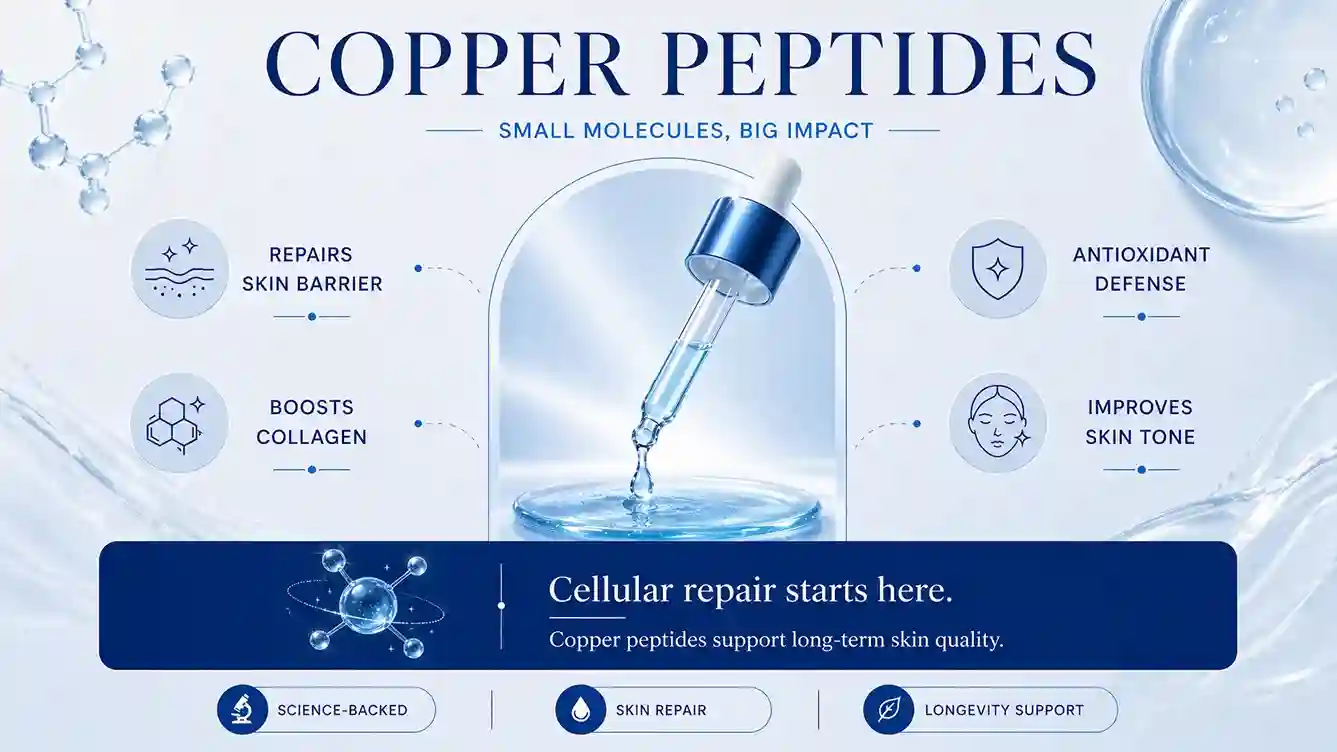
Copper peptides act through five linked mechanisms. Each one maps to a clinical outcome.
GHK-Cu stimulates collagen, elastin, and glycosaminoglycan (GAG) production, rebuilding the dermal matrix that gives skin firmness and anchors follicles. A follicle is only as healthy as the tissue it grows in. When the matrix degrades, skin loosens and hair shafts thin.
Copper peptides lower inflammatory cytokines IL-6 and TNF-α and activate superoxide dismutase (SOD), a key antioxidant defense enzyme. Chronic low-grade inflammation, sometimes called inflammaging, drives most visible aging. Fewer free radicals means less DNA and collagen damage over time.
Copper peptides upregulate VEGF, the master growth factor for new capillary formation in the dermis and scalp. More capillaries deliver more oxygen and nutrients to cells that were coasting. Starved follicles and dull skin respond to circulation, not just surface hydration.

Do Copper Peptides Really Modulate 4,000+ Genes?
A 2010 Broad Institute expression analysis showed GHK modulates over 4,000 human genes, including Wnt signaling, growth factor, and collagen genes. Around 2,000 were activated, another 2,000 suppressed, many of them linked to inflammation and fibrosis. This is why GHK-Cu has effects across skin, hair, wound healing, and tissue repair.
Pickart's original work showed GHK-Cu accelerates re-epithelialization and reduces scarring. Wound-healing action is why it helps acne scars, stretch marks, and post-procedure recovery. Dermatology uses it after microneedling, laser resurfacing, and hair transplants for the same reason.
How Copper Peptides Map to the 12 Hallmarks of Aging
In 2013, Carlos López-Otín and colleagues published The Hallmarks of Aging in Cell, identifying nine cellular pathways that drive aging. A 2023 update (Hallmarks of Aging: An Expanding Universe) extended the list to twelve. The Dr. Terziler Youngevity program works against these twelve pathways. GHK-Cu acts on at least four of them, and possibly more.
| Hallmark | What it means | GHK-Cu's role |
|---|---|---|
| Chronic inflammation (inflammaging) | Persistent low-grade inflammation damages tissue | Lowers IL-6 and TNF-α. Direct anti-inflammatory action. |
| Epigenetic alterations | Age-related mis-regulation of gene expression | Modulates 4,000+ genes including Wnt and collagen pathways. |
| Mitochondrial dysfunction | ROS rise, cellular energy falls | Activates SOD antioxidant defense. Reduces free radicals. |
| Altered intercellular communication | Cells stop talking to each other efficiently | Restores VEGF signaling, wound-healing cytokine cascade. |
| Loss of proteostasis | Damaged proteins accumulate | Supports MMP rebalancing. Removes damaged collagen, builds new. |
No single molecule fixes all twelve hallmarks. And no generic supplement stack fits every patient. The Dr. Terziler Youngevity program starts with a genetic panel of roughly 750,000 variants, or the full 3-billion-letter genome on the Ultimate Youngevity tier, and traces lineage back three generations. From that map, we personalize the stack: topical GHK-Cu for matrix and inflammaging, microneedling or PRP for delivery, targeted oral antioxidants and senolytic molecules for hallmarks topicals cannot reach (mitochondrial dysfunction, cellular senescence, telomere attrition), nutrition from a gene-literate dietitian, and training from a sports coach briefed on your polygenic profile. Each lever hits a different pathway, and the plan is rebuilt for your genome.
What Do Copper Peptides Do for Your Skin?
Copper peptides help anti-aging, improving firmness, texture, tone, and skin barrier quality across 8 to 16 weeks of consistent topical use.
Fine lines, wrinkles and skin firmness: Copper peptides improve skin firmness, fine lines, and texture by stimulating new collagen and elastin in the dermis. Expect accumulating subtle changes, not overnight smoothing. Most users see visible improvement around week 12.
Under eyes, bags and jowls: Copper peptides support the thin periorbital skin where collagen thins fastest. Peptide eye creams and hydrogel patches use GHK-Cu to firm the area and soften fine lines. They will not drain true structural under-eye fluid bags.
Acne scars, stretch marks and keloids: Copper peptides support wound healing and may reduce the visibility of acne scars, stretch marks, and surgical scars. The effect is strongest on fresh scars still remodeling, usually within the first 12 months. Keloids respond less reliably and need dermatology input.
Hyperpigmentation, melasma and uneven tone: Copper peptides lighten post-inflammatory hyperpigmentation indirectly by calming inflammation and accelerating cell turnover. They are not a tyrosinase inhibitor. For active melasma, combine with azelaic acid or tranexamic acid under dermatology guidance.
Rosacea, sensitive and reactive skin: Copper peptides are well tolerated on rosacea-prone skin because they reduce, rather than trigger, inflammatory pathways. Start at 1%. Patch-test for a week. Stop if flushing worsens.
What Do Copper Peptides Do for Hair?
Copper peptides do not reliably regrow hair as a standalone treatment. They support the follicle environment and can amplify results from proven therapies like minoxidil, finasteride, microneedling, PRP, or a transplant. Treat GHK-Cu as a scalp-environment optimizer, not a regrowth drug.
Copper peptides are not meaningful DHT blockers. Some in-vitro data suggest weak 5-alpha reductase modulation, but no clinical trial matches finasteride-level suppression. For genetic pattern hair loss driven by DHT, GHK-Cu is support, not replacement.
Copper Peptides After Microneedling, PRP or a Hair Transplant
Topical GHK-Cu applied post-microneedling reaches the follicle at roughly 3× the depth of standalone application, based on 2023 ionic-liquid microemulsion research. After PRP, wait 48 hours, then layer topical GHK-Cu through the regenerative window. After a hair transplant, day 0 to 10 is off-limits. From around day 10 to 14, once grafts are fixed and crusting resolves, GHK-Cu can support matrix repair and quiet residual inflammation. Follow your surgeon's protocol.
Can Copper Peptides Help Beard or Eyelash Growth?
Evidence is anecdotal. The same matrix and angiogenesis logic that helps scalp follicles should theoretically apply to facial and lash follicles, but no controlled trial confirms beard- or lash-specific benefit.
Can Copper Peptides Reverse Grey Hair?
There is no solid clinical evidence that copper peptides alone reverse grey hair. Anecdotal reports exist. Controlled studies do not confirm repigmentation. Treat the claim as unproven.
How Should You Use Copper Peptides?
Look for 1 to 3% GHK-Cu (copper tripeptide-1) at pH 5.0 to 6.0 in an opaque, airless bottle when you use copper peptides. Below 1% underperforms. Above 3% copper peptide adds no proven benefit and can irritate. Stable formulation matters more than chasing higher percentages.
Should I Apply Copper Peptides Morning or Night?
Daily is enough. Most users apply at night to avoid overlap with vitamin C or active sunscreens. Apply on clean, slightly damp skin or scalp, one to two pumps, leave on, follow with moisturizer. Do not rinse.
How Long Until Results Show?
Skin tone, hydration, and fine line changes usually show at 8 to 12 weeks after regular use of copper peptides. Firmness and scar improvements stack over 3 to 6 months. Hair cycle changes take longer because follicles move in phase, so judge at 6+ months.
Topical, Injectable or Oral Copper Peptides, Which Route Works?
Topical is the validated route. Injectable GHK-Cu is off-label in most countries and not a consumer category. Oral peptides are degraded in the gut, so bioavailability of an intact GHK-Cu signal is very low. Stick to topical.
What Should You Not Mix With Copper Peptides?
Copper binds aggressively. That is the point. It also means some actives destabilize it when layered in the same routine. Alternate, do not abandon.
| Ingredient | Same routine? | How to layer |
|---|---|---|
| Hyaluronic acid, niacinamide, bakuchiol, matrixyl | Yes | Any order, layer freely |
| Sunscreen | Yes (AM) | Apply last, SPF 30+ |
| Vitamin C (L-ascorbic) | No | Vitamin C AM, GHK-Cu PM |
| Retinol, retinal, tretinoin | No | Alternate nights or split AM/PM |
| AHA (glycolic, lactic) / BHA (salicylic) | No | Exfoliate 2x/week, skip GHK-Cu that evening |
| Benzoyl peroxide | Avoid same day | Oxidizes copper, separate days |
| Azelaic acid | Cautious | Alternate days |
| Microneedling, PRP, mesotherapy | Recommended post | Apply immediately or 48 hrs after |
| Minoxidil (hair) | Yes | Minoxidil first, GHK-Cu 20 min later |
Are Copper Peptides Safe?
Topical copper peptides are generally well tolerated. Most side effects are mild and temporary.
What Are "Copper Uglies"?
"Copper uglies" is the slang name for a 2 to 4 week purging phase after starting copper peptides. Skin looks dull, flaky, or breaks out as cell turnover speeds up and matrix metalloproteinases clear damaged tissue. It usually resolves with continued use. Persistent acne after 6 weeks is not typical purging. Stop and review your routine.
Why Does Copper Peptide Sometimes "Ruin" Skin?
Copper peptides rarely "ruin" skin on their own. The usual culprits are too-high concentration above 3%, layering with L-ascorbic vitamin C or strong retinoids in the same routine, or applying over a compromised barrier. Scale back to 1%, alternate actives, and repair the barrier first.
Are Copper Peptides Safe During Pregnancy or Breastfeeding?
Topical cosmetic-grade copper peptides are generally considered low risk in pregnancy because skin absorption is minimal, though safety data is limited. Injectable GHK-Cu is not recommended during pregnancy or breastfeeding. Clear any new active with your OB/GYN.
Who Should Avoid GHK-Cu Entirely?
Avoid if you have Wilson's disease or another copper metabolism disorder, an active scalp or skin infection, or a known copper allergy. Injectable use is off-label in most countries. Copper peptides are not FDA-approved as a drug.
What Is Proven About Copper Peptides and What Is Not?
Established. Wound healing, dermal matrix remodeling, antioxidant defense via SOD activation, angiogenesis, anti-inflammatory cytokine suppression, and broad gene modulation. Decades of research, mostly led by Pickart and colleagues.
Emerging. Hair regrowth as a standalone intervention, wrinkle reversal, DHT modulation, deep follicle penetration without needling, and grey hair repigmentation. Promising signals, small studies, no large randomized controlled trials. A 2025 open-label pilot reported 26.5% hair regrowth with copper peptide microneedling over 5 monthly sessions. Small N. Needs replication.
How Copper Peptides Fit the Dr. Terziler Youngevity Protocol
The Youngevity program does not start with a serum. It starts with a swab and a blood draw. Before we prescribe anything topical, we sequence.
Step 1: Genetic mapping. A buccal swab and a blood panel. We analyze around 750,000 variants on the standard tier, or the full ~3-billion-letter genome on the Ultimate Longevity tier. We map lineage across three generations, because inherited risk rarely sits inside a single gene.
Step 2: Clinical interpretation instead of an algorithm output. Prof. Dr. Hakan Cangül reviews the panel personally. We do not issue machine-generated reports that claim to summarize eleven organs through 131 parameters. Biology does not work that way. No honest clinician tells a patient "you have a 65% brain cancer risk" from raw SNP data. Realistic genetic relative risk usually sits closer to 15%, and only with strong family history. In biology, nothing hinges on a single variant.
Step 3: A one-year reset, then lifelong follow-up. Initial results return at month one, adjustments at month two, and the first year is where the baseline moves. Patients stay in the program for life.
Where GHK-Cu Fits Inside That Protocol
GHK-Cu is a topical lever, not the plan. Apply 1 to 3% GHK-Cu serum daily for inflammaging, matrix repair, and broad gene modulation. Apply immediately after microneedling to exploit roughly 3× deeper delivery through fresh microchannels. Layer 24 to 48 hours after mesotherapy or PRP to extend the regenerative window. After a Robotic DHI transplant, start around day 10 to 14 under surgeon clearance to support graft integration and calm residual inflammation.
GHK-Cu does not touch every hallmark. For mitochondrial dysfunction, cellular senescence, and telomere attrition, the program layers oral antioxidants and senolytic molecules (NMN, trans-resveratrol, quercetin, fisetin, astragaloside IV, cycloastragenol, NAC, CoQ10, plus supporting vitamins), chosen against your variant profile instead of pulled off a shelf.
Use Copper Peptides Inside a Real Protocol
Book a Free Consultation
AACI-accredited hair transplant surgeon, inventor of the Picasso Robotic DHI device, lead of the Dr. Terziler Youngevity program, ISHRS workshops, regular contributor to regenerative surgical protocol literature.
Collaborates with geneticist Prof. Hakan Cangül (Nature Genetics, Lancet, JCI publications on disease-gene discovery and precision medicine).