




Beard Transplant in Turkey 2026: Cost, Grafts, Techniques & Results
A beard transplant in Turkey transfers DHT-resistant donor follicles from the back of the scalp to patchy or scarred facial zones using micro-FUE extraction and manual or Robotic DHI implantation. At Dr. Terziler Exclusive Clinic in Istanbul, patients receive Robotic DHI facial mapping, AACI-accredited clinical protocols, and a 2026 all-inclusive package starting from €2,500.
A beard transplant is a facial hair restoration procedure that moves individual follicular units from the donor scalp to the beard, mustache, chin, cheek line, jawline or sideburns. The goal is not only more hair. The real target is a natural facial border, correct growth direction and permanent density that can be trimmed, shaved and styled like native beard hair.
Facial hair work is technically more delicate than scalp work because the skin is thinner, the hair lies flatter, and even small angle errors are visible. This is why Dr. Terziler uses micro-FUE extraction, single-hair border planning and DHI-style implantation for facial zones.
Key Takeaways
- Beard transplant surgery uses your own DHT-resistant follicles, not artificial implants.
- Robotic DHI is especially valuable on facial skin because it regulates depth, angle and direction more consistently than channel-based methods.
- The most natural facial border uses mostly single-hair grafts. Multi-hair grafts at the cheek edge are the main reason transplanted beards look fake.
- Healthy facial skin usually reaches 90-97% graft survival in clinic-reported data. Scar tissue survival is lower at roughly 70-80% and is planned with over-grafting.
- Turkey's value comes from specialist volume, package infrastructure and lower clinical overhead, not from accepting lower medical standards.
MEDICALLY REVIEWED BY
Dr. Servet Terziler
AACI-accredited surgeon, founder of TUSATDER, inventor of the Robotic DHI Machine and internationally recognized hair restoration specialist known as the "Picasso of Hair."
Updated May 2026
What Is a Beard Transplant?
A beard transplant is a hair restoration procedure that moves individual follicular units from a donor area, usually the lower occipital scalp, to facial regions where beard hair is missing, patchy or scarred. It restores the mustache, cheek line, chin, goatee, jawline and sideburns with the patient's own living hair. The International Society of Hair Restoration Surgery describes facial follicular unit transplantation as an established option for improving beard and mustache density when performed by qualified medical teams.
The medical principle is simple: the donor follicle keeps its genetic behavior after relocation. When DHT-resistant scalp follicles are transplanted into the beard zone, they continue to grow as real hair. Once matured, the transplanted beard can be trimmed, shaped, shaved and grown long. The American Academy of Dermatology also notes that hair transplantation can create permanent, natural-looking growth in suitable candidates.
What Does a Beard Transplant Do?
A beard restoration procedure populates inactive facial zones with living follicles. It physically fills empty patches, covers acne or burn scars, creates a denser mustache, sharpens the jawline and builds a permanently defined facial hair border.
Are Beard Implants and Beard Transplants the Same?
Yes, in search language, "beard implants Turkey" usually refers to the same procedure as a beard transplant. The important distinction is that a natural beard transplant does not use synthetic material. It implants your own biological follicular units.
Get Your Free Beard Graft Count Estimate
Send front, left, right and under-chin photos. Within 24 hours you receive a written graft count, technique recommendation and package range.
Get My EstimateHow Does a Beard Transplant Work Step by Step?
A beard transplant at Dr. Terziler Exclusive Clinic follows a controlled five-step protocol: trichoscopic consultation, donor extraction by micro-FUE, graft sorting by follicle calibre, Robotic DHI implantation and a 48-hour wash and protection protocol.
Trichoscopic consultation and facial hair design
Dr. Terziler maps your cheek line, jawline, mustache density, native direction and donor-to-beard calibre match under trichoscopy.
Donor extraction
The surgical team uses micro-FUE with a 0.7-0.8 mm punch. Single-follicle units are prioritized for borders because they look most natural on the face.
Microscopic graft sorting
Fine single-hair grafts go to the mustache and cheek edge. Denser 2-hair units are saved for the goatee, chin and inner density zones.
Robotic DHI implantation
Each graft is implanted at the mapped angle and depth. Facial depth is shallower than scalp implantation, usually 1.5-2.5 mm.
48-hour wash and protection protocol
The clinic performs the first wash on day 2. Crusts release around day 7-10, and shock shedding typically begins from day 14.
What Are the Best Techniques for a Beard Transplant?
The best technique for a beard transplant is the one that controls facial angle, facial depth and graft type. Robotic DHI is the premium option for this reason. Manual DHI and Sapphire FUE can also work in selected cases, but facial skin is less forgiving than scalp skin. Peer-reviewed FUE literature emphasizes punch alignment, transection control and graft handling as core quality factors in follicular unit surgery; see this clinical review on follicular unit extraction technique and limitations.
| Technique | Best For | Key Advantage | Main Limitation |
|---|---|---|---|
| Robotic DHI | Cheek line, mustache, jawline, high precision cases | Automated depth and angle control on thin facial skin | Premium cost and specialist availability |
| Picasso Robotic DHI | Patients needing artistic border design and maximum naturalness | Facial mapping matched to bone structure and growth direction | Limited availability at Dr. Terziler Exclusive Clinic |
| Manual DHI | Smaller zones and moderate-density work | No pre-made channels, controlled Choi pen placement | Operator fatigue can affect consistency in long sessions |
| Sapphire FUE | Large-volume inner density cases | Efficient coverage with refined channel opening | Less ideal for facial borders where angle precision is everything |
| FUT | Rarely appropriate for facial hair restoration | High graft yield in older scalp methods | Linear donor scar and poor fit for modern facial work |
How Is Robotic DHI Different for a Beard vs a Scalp Hair Transplant?
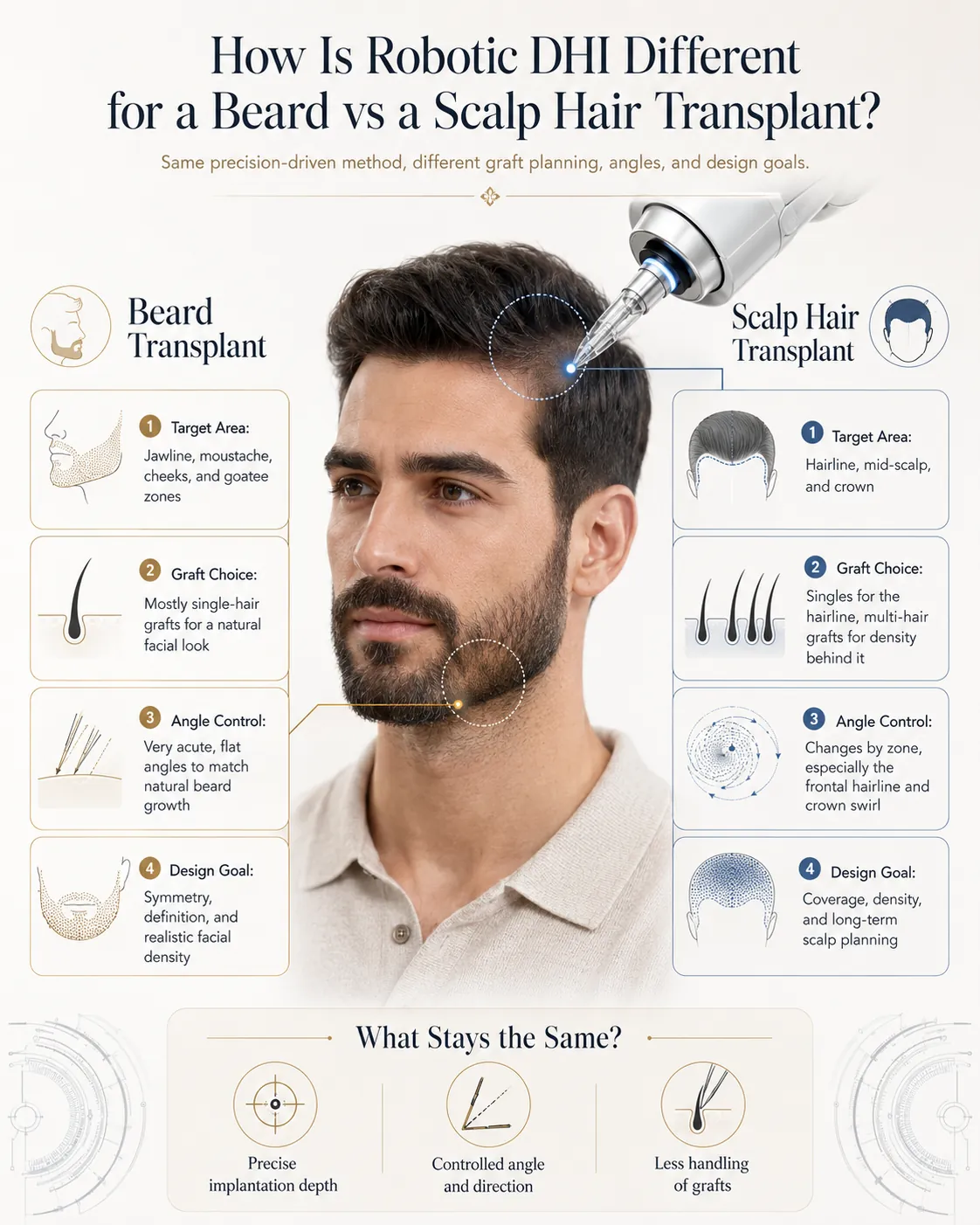
Robotic DHI for a beard requires flatter implantation angles: 10-20 degrees on the cheek line, 25-35 degrees on the mustache and 35-45 degrees on the goatee. Facial implantation depth is also shallower, usually 1.5-2.5 mm, compared with 3.5-4.5 mm on the scalp.
Why facial angles matter
A small angle error on the face is much more visible than the same error on the scalp. This is why generic channel-based work can create the "doll hair" effect, while DHI-style implantation gives the surgeon tighter control over direction and depth.
Who Is a Good Candidate for a Beard Transplant?
A good candidate is usually a male aged 22 or older with stable beard maturation, sufficient occipital donor density and clear areas of patchiness, scarring or congenital sparse growth. Beard growth is androgen-sensitive, and medical literature on hormonal effects on hair follicles explains why testosterone and DHT influence terminal facial hair. Dr. Terziler Exclusive Clinic also treats trans masculine patients after a minimum of 12 months on gender-affirming testosterone, when clinically appropriate; dermatology research on hair care in transgender patients supports the need to consider hormone timeline and individual hair response.
5-Point Candidate Check
Tick the points that describe you. If you score 3 or more, a photo review is worth doing.
Find Out If You Are a CandidateCan a Beard Transplant Fix a Patchy Beard?
Yes. Patchy beards are the single most common reason for a beard transplant at Dr. Terziler Exclusive Clinic. The procedure fills empty zones such as goatee gaps, cheek-line notches, mustache thin spots and jawline asymmetry with calibre-matched follicular units.
Can You Get a Beard Transplant If You Have Acne Scars or Burn Scars?
Yes. Scarred skin is a strong indication, but the plan must be honest: graft survival in scar tissue is usually lower than healthy skin. Healthy facial skin typically achieves 90-97% survival, while scar tissue often achieves 70-80%, so the surgeon may plan 15-20% over-grafting.
How Much Does a Beard Transplant Cost in Turkey in 2026?
A beard transplant at Dr. Terziler Exclusive Clinic starts from €2,500 in 2026, depending on graft count, facial zones and technique. This includes surgery, 3 nights at a 5-star partner hotel, VIP airport and clinic transfers, translator, pre-op blood work, Mesenchymal Stem Cell booster, post-op kit and 12-month follow-up.
| Country / City | Typical All-In Price | Usually Included |
|---|---|---|
| Turkey (Istanbul) | From €2,500 | Surgery, hotel, VIP transfers, Mesenchymal Stem Cell, translator, follow-up |
| USA (NYC, LA, Miami) | $8,000-$22,000 | Usually surgery only, consults may be extra |
| UK (London, Manchester) | £4,000-£10,000 | Usually surgery only |
| Dubai (UAE) | AED 18,000-42,000 | Usually surgery only |
| Mexico | $2,500-$5,000 | Surgery, sometimes hotel |
| India | INR 60,000-210,000 | Usually surgery only |
| Thailand | $2,800-$5,200 | Usually surgery only |
Call to Ask About Pricing & Packages
Send your face photos and desired beard style. The team will estimate graft count, technique, package cost and travel timeline before you book anything.
Request My QuoteWhy Is a Beard Transplant in Turkey Cheaper Without Being Worse?
Turkey's advantage is structural. Istanbul has a mature medical tourism system, lower clinical overhead and a high concentration of experienced hair restoration teams. Premium clinics perform a higher annual volume of facial hair cases than many Western clinics, so fixed costs are distributed across more procedures while hotel and transfer logistics are standardized. Because any surgery abroad still requires due diligence, the CDC Yellow Book medical tourism guidance recommends assessing the destination, facility and treating healthcare professional before traveling for care.
How Many Grafts Do You Need for a Beard, Mustache or Sideburn?
A full beard transplant usually requires 2,500-4,500 grafts. The exact number depends on your native density, facial surface area, target thickness and whether the goal is a full beard or a sharper border.
Interactive Beard Graft Estimator
Select the zones you want to restore. This is a planning estimate, not a medical quote.
| Facial Zone | Typical Graft Range | Follicle Mix | Session Time |
|---|---|---|---|
| Full beard | 2,500-4,500 | 70% 1-hair, 30% 2-hair | 6-8 hours |
| Goatee only | 600-900 | Mostly 1-hair grafts | 2-3 hours |
| Cheek line per side | 700-1,000 | 100% 1-hair at border, 2-hair inside | 3-4 hours |
| Mustache | 350-500 | 100% 1-hair | 1.5-2 hours |
| Sideburns per side | 200-400 | 1-hair and 2-hair mix | 1-1.5 hours |
| Soul patch | 80-120 | 100% 1-hair | 30-45 minutes |
| Jawline definition per side | 500-900 | 1-hair at border line | 2-3 hours |
What Is Included in a Beard Transplant Package in Turkey?
The Dr. Terziler beard transplant package is designed as a 3-day medical journey, not a surgery-only quote. It includes pre-op consultation, blood screening, the beard transplant under local anaesthesia, Mesenchymal Stem Cell booster, medication pack, post-op kit, 3 nights in a partner 5-star hotel, VIP transfers, translator and 12-month virtual follow-up.
Included in the package
Pre-op consultation, trichoscopic facial assessment, local anaesthesia, surgery, post-op kit, 3 nights at a 5-star hotel, VIP airport transfers, translator and 12-month virtual follow-up.
Not included
International flights, travel insurance, food outside hotel breakfast and optional density revisions requested after the standard follow-up window.
What Does the Beard Transplant Recovery Timeline Look Like?
Beard transplant recovery unfolds over 12 months. The face looks most visibly treated during the first 7-10 days, then enters the shedding phase. New growth starts around month 3 and builds gradually until the final result.
Surgery lasts 6-8 hours. Tiny scabs form over each graft. Same-day discharge.
First medicated foam wash at the clinic. No rubbing and no face-down sleeping.
Most international patients fly home after clinical sign-off.
Around 95% of scabs are gone. Facial skin may still be pink.
Shock loss occurs. Most transplanted hairs shed while roots remain alive.
First new hairs emerge. They may look fine, lighter and uneven at first.
About 70-80% of final density is usually visible.
Full result. Beard hair grows, trims and styles like native facial hair.
When Can I Shave After a Beard Transplant?
Most patients can use an electric trimmer from day 14 to day 21 and a blade from day 28 onward, once the grafts are anchored and the skin has settled. For the first 3 months, shaving along the grain is recommended.
What Are the Real Risks of a Beard Transplant?
Real risks include cobblestoning, ingrown hairs, temporary pimples, shock loss, scarring if punches are too large and unnatural direction if the angle is wrong. The good news is that the main facial risks are technical, which means they can be reduced with proper planning and execution. For broader surgical risk context, see the peer-reviewed review on complications in hair transplantation and the 2026 evidence review on FUE complications and prevention.
| Risk | What It Means | How Dr. Terziler Reduces It |
|---|---|---|
| Cobblestoning | Raised, bumpy scar tissue from grafts placed too high | Flush-depth Robotic DHI implantation and 0.7-0.8 mm punch planning |
| Fake border | Visible multi-hair plugs at the cheek line | 100% single-hair graft strategy at facial borders |
| Ingrown hairs | Hairs trapped under the skin during early growth | Correct implantation direction and early aftercare monitoring |
| Scar tissue survival drop | Lower graft survival in acne or burn scars | 15-20% planned over-grafting when blood supply allows |
| Shock loss anxiety | Temporary shedding from day 14 to week 6 | Clear timeline education and month 3 regrowth tracking |
What Is Cobblestoning and How Is It Prevented?
Cobblestoning is raised, bumpy skin at the recipient site caused by grafts that protrude above skin level or by poor depth control. Prevention requires small punches, flush implantation and avoidance of overly large multi-hair grafts in visible facial zones.
Clinic safety signal
Dr. Terziler reports a cobblestoning rate below 0.5% across 850+ facial cases from 2023 to 2025. Always ask any clinic for its facial complication methodology, not only its best before-after photos.
Is a Beard Transplant in Turkey Better Than the USA, UK, Dubai, Mexico or India?
Turkey is often the stronger choice for beard transplantation when you compare surgeon experience, facial-hair-specific volume, technology access and all-inclusive medical tourism value. The clinical filter is not the country alone. It is whether the clinic is accredited, surgeon-led and transparent about technique, graft survival and aftercare.
Turkey vs UK and USA
Istanbul gives access to Robotic DHI, hotel and transfers for less than many peak UK or US surgery-only prices.
Turkey vs Dubai, Mexico, India, Thailand
Lower-cost markets can be attractive, but quality variance is wider. Accreditation, surgeon accountability and facial precision should decide the shortlist.
Can You Use Beard Hair for a Scalp Hair Transplant?
Yes. Beard hair can be used as donor hair for scalp restoration when scalp donor density is insufficient. It is most useful in advanced Norwood VI-VII cases, especially for crown and mid-scalp coverage. Because beard hair is coarser, it is usually not ideal for the immediate frontal hairline. Published clinical experience with body hair transplantation by FUE supports beard donor use as a supplemental strategy in selected advanced cases.
For beard transplant itself, Dr. Terziler usually uses occipital scalp hair for facial work because calibre and growth behavior can be matched more consistently than beard-to-beard transfer. Read more about body to head hair transplant.
What Are the Other Facial Transplants?
Mustache, sideburn, goatee, soul patch, chin strap and jawline restorations are specialized facial transplant techniques. Each has its own angle, depth and graft mix.
| Procedure | What It Restores | Typical Grafts |
|---|---|---|
| Mustache transplant | Hair above the lip, including thin spots and cleft lip scars | 350-600 |
| Sideburn transplant | Vertical facial framing beside the ears | 200-400 per side |
| Goatee transplant | Chin and lower lip density | 600-900 |
| Eyebrow transplant | Missing or over-plucked brows using fine single-hair grafts | 150-400 per brow |
For brows, see Eyebrow Transplant Turkey.
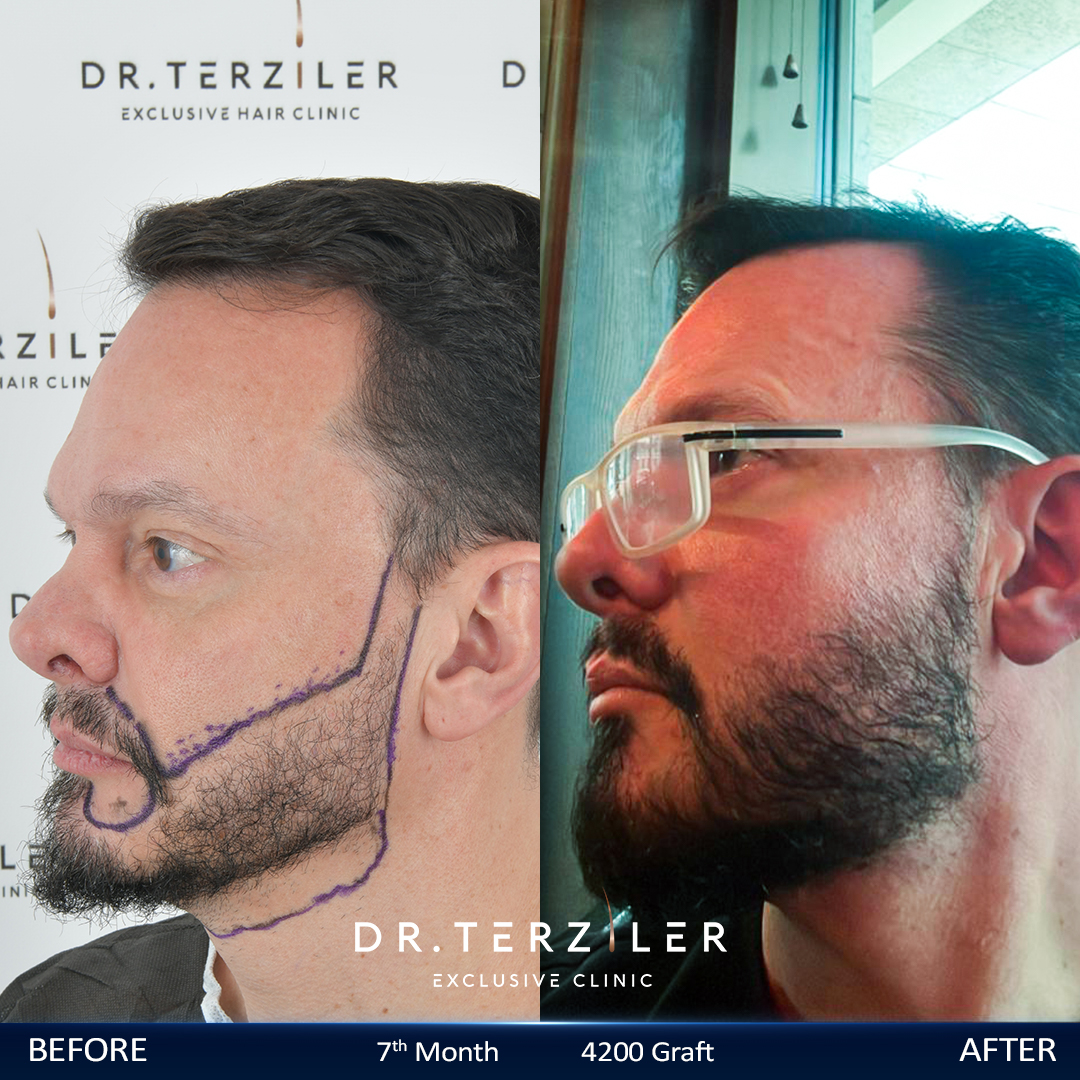
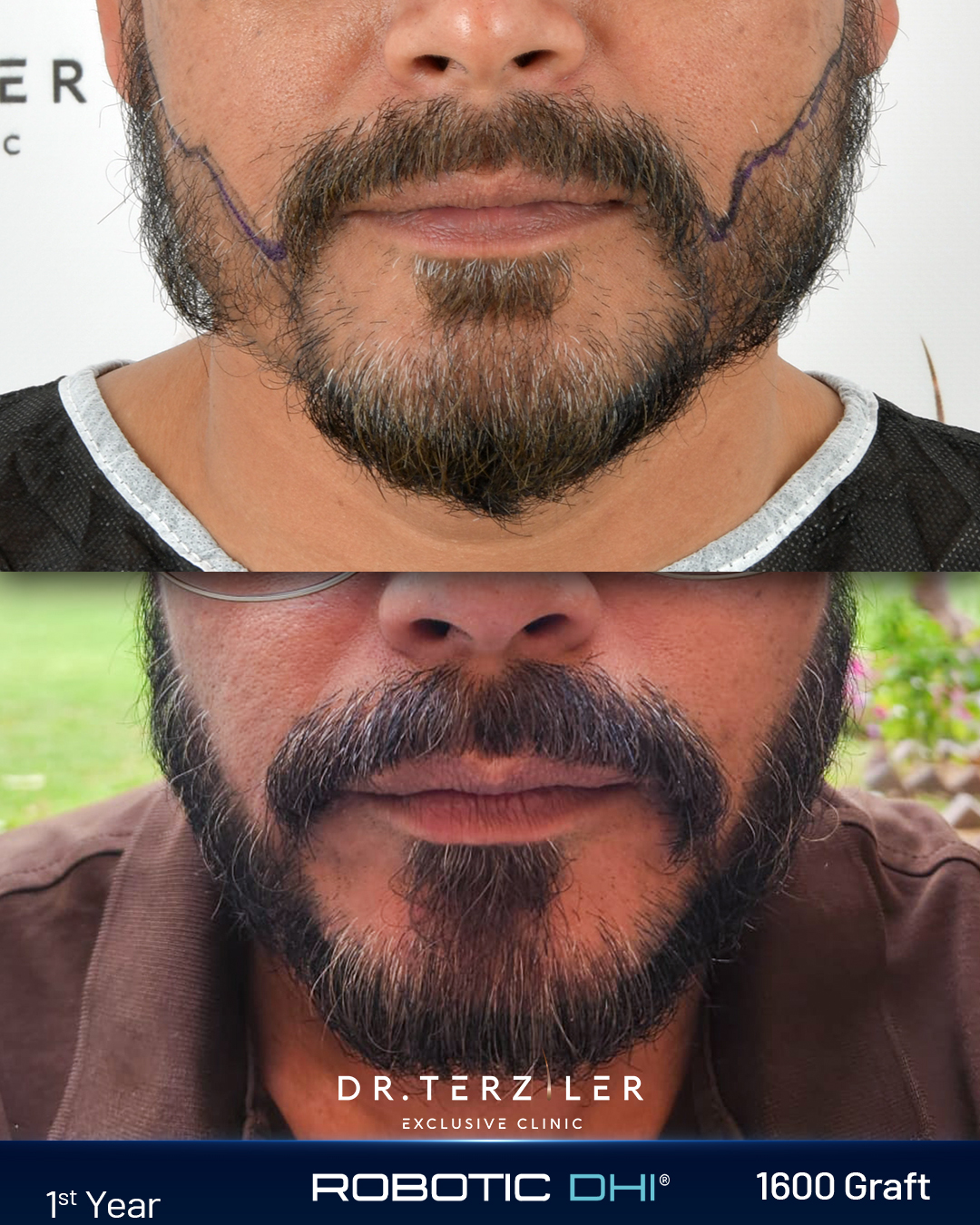
What Does a Beard Transplant Look Like Before and After?
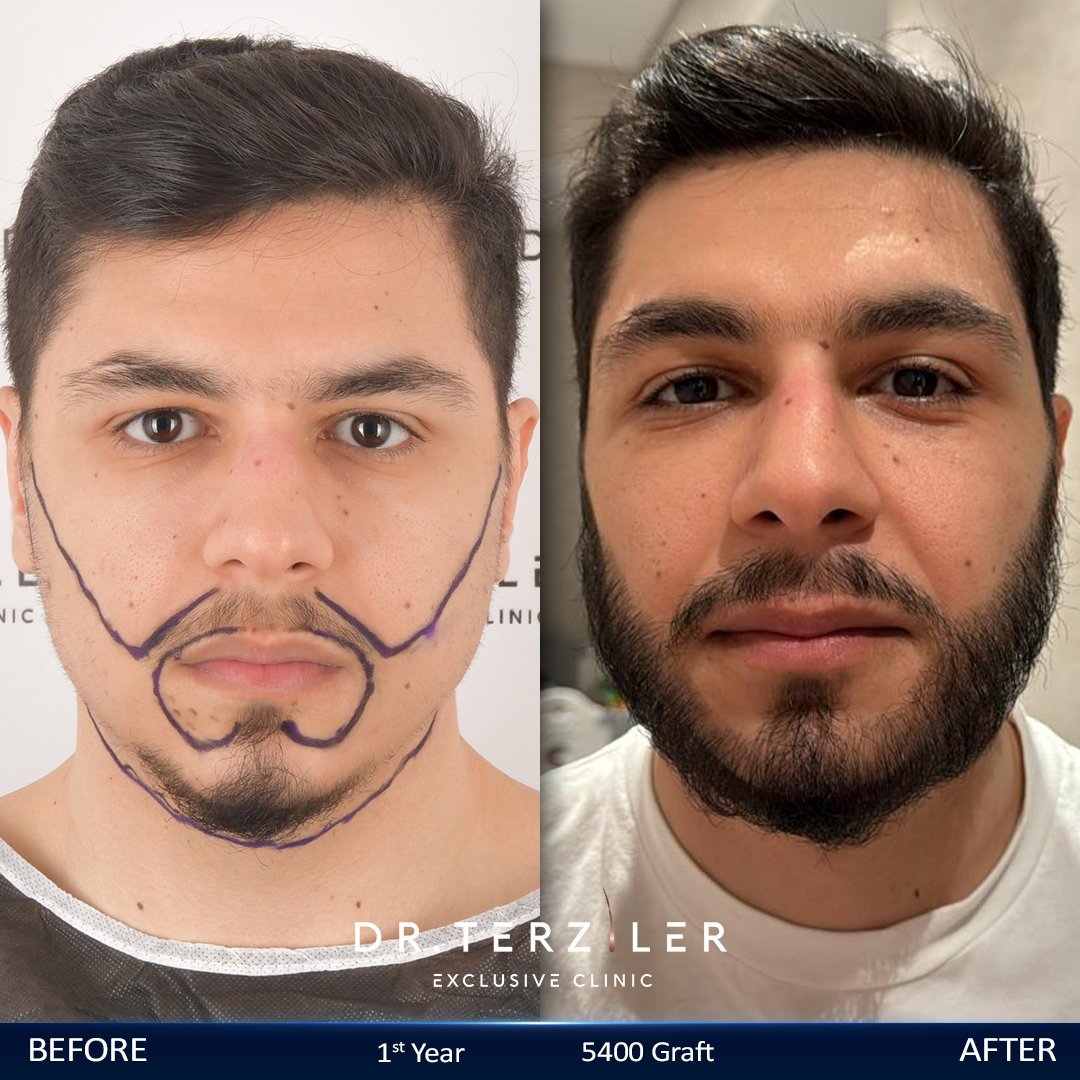
Authentic before-after evaluation should show the exact post-operative month, similar lighting and close facial borders. The most important signs are a soft cheek transition, no pluggy multi-hair border, no raised cobblestoning and a mustache angle that lies flat against the skin.
Result Quality Checklist
Why Choose Dr. Terziler Exclusive Clinic for a Beard Transplant?
Dr. Terziler Exclusive Clinic performs beard transplants with the Robotic DHI system designed and built by Dr. Servet Terziler. Every beard case is personally designed by Dr. Terziler or by a surgeon he trained, with an emphasis on single-hair border work, flush facial implantation and long-term naturalness.
Patients comparing clinics should also read the ISHRS consumer alert on unlicensed hair restoration surgery, which explains why physician involvement and transparent surgical responsibility matter.
Book Your Free Beard Transplant Consultation
Choose how to start: instant photo review on WhatsApp, or a structured form for a written consultation report within 24 hours.
Book ConsultationMedical References and Further Reading
These outbound references support the medical, safety and technique points discussed above. They are included for patient education and clinical context.
- International Society of Hair Restoration Surgery: Beard and Mustache Transplant
- International Society of Hair Restoration Surgery: Everything You Need to Know About a Beard Transplant
- ISHRS Consumer Alert on false advertising and unlicensed hair restoration surgery
- American Academy of Dermatology: Hair transplant and permanent natural-looking results
- CDC Yellow Book: Medical tourism safety guidance
- Journal of Cutaneous and Aesthetic Surgery: Complications in Hair Transplantation
- Evidence review: Complications in follicular unit excision hair transplantation
- Follicular Unit Extraction Hair Transplant: Curves Ahead
- Body Hair Transplant by Follicular Unit Extraction: clinical experience with 122 patients
- Hormonal Effects on Hair Follicles
- Dermatologic Care of Hair in Transgender Patients: Systematic Review
Frequently Asked Questions About Beard Transplant Turkey
Yes. Transplanted follicles are genetically DHT-resistant and continue growing for life. Final density appears at month 12-18.
At Dr. Terziler Exclusive Clinic, a beard transplant starts from €2,500 all-inclusive in 2026, depending on graft count, facial zones and technique.
Scabs disappear by day 10. Social downtime is usually 7-10 days. Full density arrives between month 9 and month 12.
Electric trimming is usually possible from day 14-21. Blade shaving starts from day 28 onward, with gentle shaving along the grain for the first 3 months.
Yes, when performed in an accredited, surgeon-led clinic with controlled depth and angle. Poor planning increases the risk of cobblestoning, ingrown hairs and unnatural direction.
The procedure is painless after local anaesthesia takes effect. Mild tenderness for 48-72 hours after surgery is normal.
Most full beard cases need 2,500-4,500 grafts. The exact number depends on facial size, native density and target style.
Dr. Terziler's clinical minimum is usually 22 because beard density can continue maturing until age 25.
Oversized punches, wrong angle, too-deep implantation, poor graft sorting and inexperienced facial design are the most common causes.
Not always. Beard transplants often use fewer grafts but require finer 1-hair work and more skill per graft, so price per graft can be higher than scalp work.
Yes, especially for crown and mid-scalp coverage in advanced hair loss. Beard hair is usually too coarse for the immediate hairline.
Yes. Scar survival is lower than healthy skin, so the surgeon may plan 15-20% over-grafting.
Yes, depending on donor capacity. Some combined sessions can deliver up to 5,500 grafts across scalp and facial zones in one long operating day.
Minoxidil can thicken existing vellus hair but cannot create new follicles in empty zones. A transplant physically adds living follicles.
Natural, fragrance-free beard oil can usually start from week 5. Essential-oil blends should wait until month 3.
Located in Istanbul, Turkey, Dr. Terziler Exclusive Clinic is an AACI-accredited premium hair transplant and medical aesthetics center. Founded by the "Picasso of Hair," Dr. Servet Terziler, the clinic specializes in Robotic DHI, Picasso Robotic DHI and facial hair restoration for international patients from more than 40 countries.