




Mustache Transplant in Turkey 2026: Cost, Techniques & Results for the Upper Lip
A mustache transplant in Turkey at Dr. Terziler Exclusive Clinic relocates DHT-resistant scalp follicles to the upper lip using Robotic DHI; a system invented by Dr. Servet Terziler himself. Mustache hair transplant prices start from €2,500 for a single-zone mustache. The clinic is AAACI-accredited, delivers 90-97% 12-month graft survival, and includes hotel, transfers, PRP, and a 12-month virtual follow-up in the package price.
A mustache transplant permanently moves 250-700 DHT-resistant follicular units from the occipital scalp to the upper lip. The procedure is ambulatory, takes 2-3 hours under local anaesthesia, and delivers a fully styled, permanent mustache within 12 months. Demand has surged; the ISHRS 2022 Practice Census recorded a 184% increase in facial hair transplantation between 2010 and 2022, with Turkey now handling the largest volume of international cases globally.
What makes upper-lip transplantation technically distinct is anatomy. Upper-lip skin measures only 1.1-1.6 mm thick: roughly half the thickness of cheek skin (1.8-2.2 mm) and a third of scalp skin (3.0-4.5 mm). This demands depth precision below 0.2 mm tolerance on every single graft. Standard manual instruments drift 0.3-0.5 mm under normal hand pressure. Robotic DHI eliminates that drift entirely, which is why it is the only technique used at Dr. Terziler Exclusive Clinic.
Key Takeaways
- A mustache transplant in Turkey at Dr. Terziler Exclusive Clinic relocates DHT-resistant scalp follicles to the upper lip using Robotic DHI; a system invented by Dr. Servet Terziler himself.
- A mustache transplant permanently moves 250-700 DHT-resistant follicular units from the occipital scalp to the upper lip.
- What makes upper-lip transplantation technically distinct is anatomy.
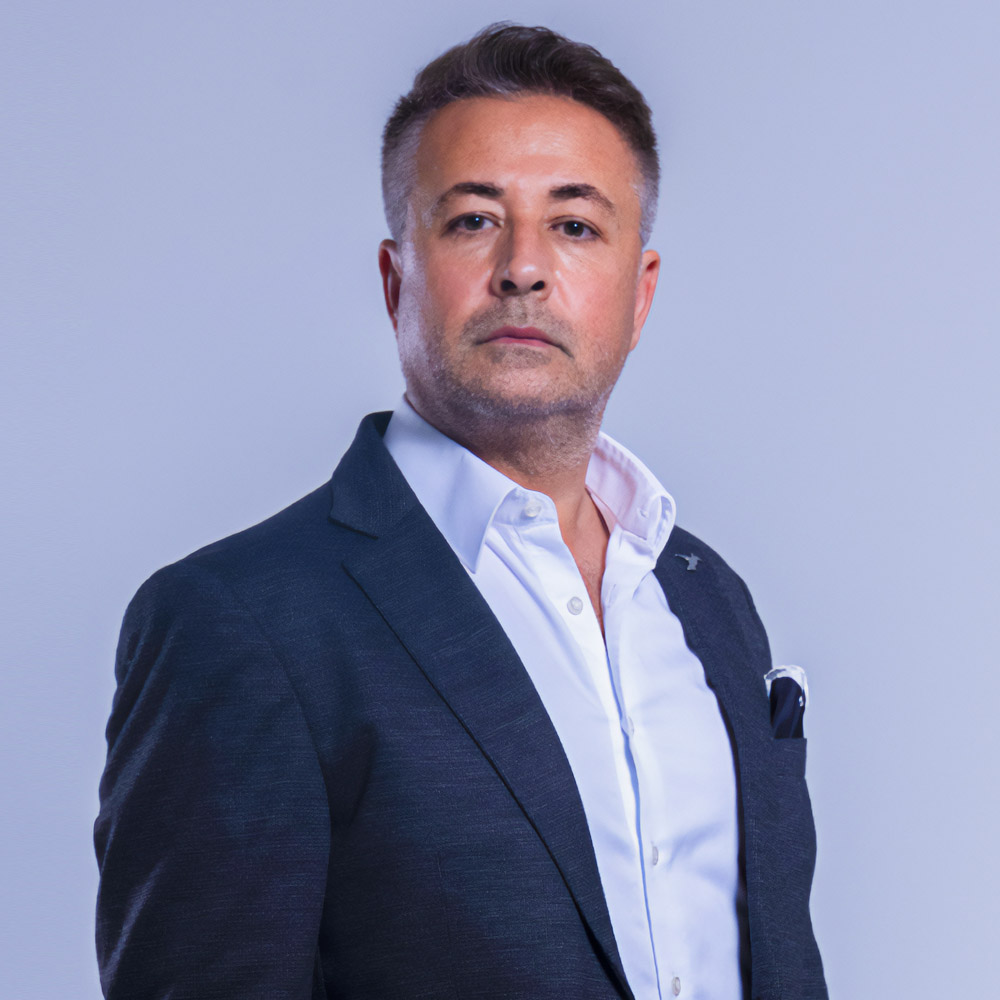
MEDICALLY REVIEWED BY
Dr. Servet Terziler
AACI-accredited surgeon, European Property Award recipient, founder of TUSATDER, and internationally recognized hair restoration specialist often referred to as the "Picasso of Hair."
Updated May 2026
What Is a Mustache Transplant?
A mustache transplant is a surgical hair restoration procedure that moves follicular units from the back of the scalp to the upper lip. It restores density, shape, or symmetry in men whose mustaches never grew fully, grew unevenly, or were lost through scarring or injury.
The procedure is classified as upper-lip follicular unit transplantation (FUT-UL) by the International Society of Hair Restoration Surgery (ISHRS). A follicular unit is a naturally occurring bundle of 1-4 hairs from a single skin opening. For the upper lip, surgeons must isolate 95-100% single-hair units; placing multi-hair grafts on the thin, mobile upper-lip skin creates a "doll plug" cobblestone effect that is both unnatural and difficult to reverse.
The most common reason men seek this procedure is a failed vellus-to-terminal transition. Normal puberty converts fine vellus hairs into thick terminal hairs under androgen influence. Some men have normal systemic testosterone but low 5-alpha-reductase enzyme activity specifically in the upper-lip dermal papilla, meaning the mustache never thickens regardless of age. Surgery is the only permanent solution.
What Does a Mustache Transplant Actually Do to the Face?
A mustache transplant directly populates the upper lip with permanent, DHT-resistant follicles.
Read more
It reconstructs the aesthetic profile of the mid-face, corrects left-right asymmetry, covers cleft lip repair scars, acid-injury scars, and establishes density in zones where genetics never delivered it.
Is FUE Mustache Transplantation the Same as Standard FUE?
FUE mustache transplantation uses micro-punches sized at 0.7 mm (smaller than the 0.8-1.0 mm punches used on scalp cases) to extract individual follicles without linear incisions.
Read more
Healing is faster and there is zero linear scarring on the donor zone. However, mustache FUE requires a significantly higher calibre rejection rate: 18-24% of extracted grafts are discarded during sorting because they contain more than one hair. Scalp FUE typically discards under 5%. This is an industry figure almost never disclosed publicly.
Is a Mustache Hair Transplant the Same as a Beard Transplant?
No. Both procedures use similar extraction technology, but a mustache transplant demands distinct trichoscopic angulation mapping and fine-calibre graft sorting.
Read more
Upper-lip skin is thinner and more mobile than cheek or jawline skin. Implantation depth on the upper lip is 1.2-1.8 mm versus 1.5-2.5 mm on the cheek. The two procedures can be combined in one session. For full facial restoration, explore our beard transplant Turkey guide.
How Does a Mustache Transplant Work Step by Step?
A mustache transplant at Dr. Terziler Exclusive Clinic follows five stages in 2-3 hours: (1) trichoscopic philtrum and lip-line mapping, (2) donor extraction by 0.7 mm micro-FUE, (3) single-follicle sorting under stereo microscope, (4) Robotic DHI implantation at 25-35° below the nostril with 1.2-1.8 mm depth, and (5) a 48-hour medicated wash protocol with silicone splash-guard fitting.
Trichoscopic Philtrum and Lip-Line Design
Dr. Terziler maps the philtrum width, Cupid's bow symmetry, vermilion border, and target mustache style: chevron, handlebar, horseshoe, pencil, walrus, or bespoke. The angle of emergence is pre-drawn across four distinct quadrants around the philtrum. This design phase takes 45-60 minutes and is non-negotiable; rushed design is the primary cause of asymmetric results seen at lower-tier clinics.
Donor Extraction at 0.7 mm
The surgical team extracts follicles from the occipital scalp using a 0.7 mm micro-FUE punch. The occipital zone provides the best hair-calibre match for upper-lip placement. The team collects 18-24% more grafts than the target count to compensate for the calibre rejection that happens at the sorting stage.
Microscopic Sorting of Single-Hair Grafts
Every extracted follicle is evaluated under a stereo microscope. Fine single-hair grafts route to the philtrum edges and Cupid's bow for a natural border. Slightly thicker single-hair grafts are allocated to the lateral mustache body to build central density. Any multi-hair unit is discarded entirely.
Robotic DHI Implantation with Depth Lock
The Terziler-engineered Robotic DHI implanter places each graft at 25-35° inward and downward from the nostril base, at a depth of 1.2-1.8 mm. A 0.5 mm depth drift on the upper lip causes visible pitting and scarring. The robotic system implements a mechanical hard-stop at 1.8 mm on the mustache preset, completely eliminating drift. The orbicularis oris muscle sits just 2-3 mm below the surface; over-penetration risks micro-injury and temporary lip twitching. The hard-stop prevents this entirely.
48-Hour Wash and Splash-Guard Protocol
Patients receive a medicated-foam wash on day 2 at the clinic. A custom silicone splash-guard is fitted to protect new grafts from toothpaste spray, soup splatter, and drinking-glass contact during days 3-7. This is a Dr. Terziler-specific protocol; most clinics send patients home without splash protection at all.
Why Is Robotic DHI Technically Different for a Mustache Versus a Beard or Scalp Transplant?
Upper-lip skin is the thinnest hair-bearing facial skin at 1.1-1.6 mm. According to the Journal of Investigative Dermatology (2019), cheek skin reaches 1.8-2.2 mm and scalp skin measures 3.0-4.5 mm. Mustache implantation depth is 1.2-1.8 mm versus 1.5-2.5 mm for the cheek and 3.5-4.5 mm for the scalp. The facial angle map is equally demanding: philtrum columns grow straight down at 10-15° inward, the lateral mustache body grows at 25-35° outward, and Cupid's bow grows at 5-10° downward with a slight fan effect. No manual instrument can maintain these angles consistently across 300-600 grafts. The robotic system executes each placement to the same spec as the first.
What Is the Best Technique for a Mustache Transplant in 2026?
Robotic DHI is the best mustache transplant technique in 2026. It guarantees exact depth control and angular precision on the highly mobile, ultra-thin upper lip. Older methods like standard FUE and FUT are clinically obsolete for this indication.
What Is Robotic DHI for Mustache Transplant?
Robotic DHI integrates the world's thinnest Choi implanter pen with robotic depth and angle control.
Read more
At Dr. Terziler Exclusive Clinic, the surgeon uses the DHI system refined specifically for facial hair cases. The robotic arm eliminates hand drift, which is the number-one cause of cobblestoning on the upper lip. Every graft lands at flush depth; never above skin level.
What Is Picasso Robotic DHI and Why Does It Matter for Mustache Design?
Picasso Robotic DHI combines robotic depth-lock with Dr. Terziler's artistic angulation methodology: the same approach used on the clinic's signature hairline designs.
Read more
For complex mustache styles like the handlebar, imperial, or Fu Manchu, where angulation must change across millimetre intervals, Picasso Robotic DHI executes those transitions without a single graft placed at the wrong angle.
How Does Manual DHI Compare for Mustache Transplant?
Manual DHI uses the world's thinnest Choi pen operated directly by the surgeon's hand.
Read more
It offers excellent density control and simultaneous channel opening and graft insertion. The limitation is hand drift: 0.3-0.5 mm under standard hand pressure is unavoidable on extended sessions. For small philtrum-only gap fills under 150 grafts, an experienced surgeon using manual DHI hair transplant can achieve acceptable results. For full mustache procedures above 300 grafts, robotic precision is clinically superior.
Is Sapphire FUE Suitable for Mustache Transplant?
Yes, Sapphire FUE uses ultra-sharp sapphire blades to open micro-channels before graft insertion.
Read more
It causes less tissue trauma and crusting than steel blades, but it does not offer the simultaneous extraction-implantation workflow of DHI. The pre-channel step of Sapphire FUE means grafts spend extra time outside the body, and depth control depends entirely on the surgeon's hand; the same drift problem as manual DHI, without the implanter's built-in angle registration.
Is Standard FUE Still Acceptable for Mustache Transplants?
No. Standard micro-FUE uses steel blades for channel creation and is now considered outdated for delicate facial work.
Read more
The steel blades increase cobblestoning risk, prolong redness, and produce less natural growth angles on the upper lip. No ISHRS-trained mustache specialist recommends standard FUE hair transplant for upper-lip cases in 2026.
Is FUT Used for Mustache Transplants Anymore?
No. FUT requires a linear strip excision from the scalp and leaves a permanent scar.
Read more
It is entirely obsolete for mustache restoration. Its only remaining niche is high-volume scalp cases where donor supply is extremely limited; a situation that does not apply to mustache procedures requiring just 250-700 grafts.
Get a mustache graft estimate
Share your upper-lip photos and preferred style. The team reviews graft count, technique and package price before you book.
Start my quoteWho Is a Good Candidate for a Mustache Hair Transplant?
A good candidate for a mustache transplant is a male aged 22 or older with stable androgen levels, at least 60 follicles per cm² of donor density on the occipital scalp, and a clear aesthetic goal: patchy mustache, cleft lip repair, burn scar coverage, asymmetry correction, or style completion. Trans masculine patients qualify after a minimum 12 months on gender-affirming testosterone are suitable candidates for a mustache hair transplant.
Can You Get a Mustache Transplant at 20 or 21?
No. 22 is the absolute practical minimum at Dr. Terziler Exclusive Clinic.
Read more
Upper-lip follicles continue terminal maturation until age 25 in most men. Transplanting dense scalp follicles before the native mustache finishes maturing creates a permanent density mismatch in years 3 to 5; a problem that requires corrective surgery to fix. Waiting until 22 costs nothing; correcting a premature result costs significantly more.
Can a Mustache Transplant Fix a Cleft Lip Scar?
Yes. Transplanted follicles successfully camouflage cleft lip repair scars in 85-90% of cases.
Read more
Graft survival on scar tissue averages 72-80% versus 90-97% on healthy skin. Dr. Terziler compensates with 20-25% over-grafting and a two-pass implantation protocol spaced 6 months apart. The best candidates have a fully healed cleft lip repair at least 18 months post-primary surgery.
Does a Mustache Transplant Work on Fitzpatrick V-VI Skin?
Yes. The 0.7 mm FUE punch leaves no visible donor scarring across all Fitzpatrick phototypes.
Read more
Post-operative hyperpigmentation prevention is adjusted for darker phototypes: SPF 50 for 8 weeks and a specialized tyrosinase-inhibitor topical from week 4 onward.
Can Trans Masculine Patients Get a Mustache Transplant?
Yes, after a minimum of 12 months on gender-affirming testosterone and documented facial vellus response.
Read more
Transplanted follicles are androgen-sensitive from the donor zone and respond normally to systemic testosterone. Results are excellent and permanent. Dr. Terziler Exclusive Clinic follows an inclusive clinical intake protocol with full counselling support.
Can I Get a Mustache Transplant If I Am on Blood Thinners or Aspirin?
Patients on blood thinners must pause anticoagulants under physician guidance for 7-14 days pre-surgery and 7 days post-surgery.
Read more
Aspirin alone requires a 7-day pause. Patients on medically essential anticoagulation (warfarin, rivaroxaban, apixaban) require a haematologist clearance letter before surgery is approved. This is not a blanket exclusion; it is a case-by-case clearance process.
Can I Get a Mustache Transplant Alongside a Rhinoplasty?
Not simultaneously. The upper lip and nasal base share vascular and nerve supply.
Read more
Combining rhinoplasty with mustache transplantation in one session significantly increases the risk of graft ischaemia and post-operative oedema around the grafts. Dr. Terziler requires a minimum 6-month interval between the two procedures; rhinoplasty first, mustache transplant second once swelling fully resolves.
Check your mustache transplant suitability
Age, donor density, scars, hormones and medications all matter. A quick photo review gives you a clear next step.
Check my candidacyHow Much Does a Mustache Transplant Cost in Turkey in 2026?
A mustache transplant at Dr. Terziler Exclusive Clinic in Istanbul starts from €2,500 for a philtrum-only or minimal gap-fill procedure and for a high-density full mustache with PRP and advanced post-op protocol. A combined beard-plus-mustache transplant is €3,500-€8,500. The equivalent procedure costs $10,000-$22,000 in the USA and £7,000-£15,000 in the UK: without hotel, transfers, or 12-month follow-up included.
Turkey prices for hair transplant procedures (including mustache work) are not cheaper because of lower quality. They are lower because of clinical volume, lower overhead, favourable exchange rates, and a dense cluster of ISHRS-trained surgeons in Istanbul. For a full breakdown of all price factors, visit the hair transplant Turkey cost page.
| Country / City | Typical Price | What's Included | Notes |
|---|---|---|---|
| Turkey - Istanbul, Antalya | from €2,500 | Surgery, hotel, transfers, PRP, translator, 12-mo virtual follow-up | Robotic DHI - AAACI-accredited |
| USA - NYC, LA, Miami, Dallas | $8,000-$22,000 | Surgery only - consult extra | PRP + hotel always extra |
| UK - London, Manchester | £4,000-£10,000 | Surgery only, VAT included | NHS does not cover |
| Dubai - UAE | AED 9,500-25,000 | Surgery only | Licensed clinics only |
| India - Delhi, Mumbai | ₹35,000-₹1,20,000 (~$420-$1,400) | Surgery only | Quality highly variable |
| Philippines - Manila, Cebu | ₱55,000-₱1,40,000 (~$990-$2,500) | Surgery only | Limited DHI availability |
| Canada - Toronto, Vancouver | CAD 7,500-20,000 | Surgery only | Few mustache-only specialists |
Why Is a Mustache Transplant in Turkey Cheaper Without Being Worse?
Leading premium hair transplant clinics in Turkey such as Dr. Terziler Exclusive Clinic performs over 150 mustache-only cases per year. A US clinic completing 20 cases per year cannot amortise its per-graft costs to the same level. Clinical overhead in Istanbul is structurally lower than in New York or London; not because of inferior technology or staffing, but because of real estate, utilities, and labour economics. The guarantee is also better: the most rated hair transplant clinics like Dr. Terziler offers a lifetime re-graft policy for any mapped-zone graft that fails at month 12. No US competitor offers this commitment in writing for mustache-only procedures.
What Is Included in the Mustache Transplant Package in Turkey?
The Dr. Terziler Exclusive Clinic mustache transplant package covers: 60-minute trichoscopic consultation, blood screening, the 2-3-hour procedure under local anaesthesia, PRP scalp booster, medication pack, silicone splash-guard, 3 nights in a partner 5-star Istanbul hotel, VIP airport and clinic transfers, English/Arabic/German/Russian translator, and 12-month virtual follow-up. Flights and travel insurance are not included.
The standard 3-day Istanbul itinerary:
arrival and trichoscopic consultation
afternoon surgery
first medicated-foam wash followed by evening departure.
Return rhythm: Most patients return to desk work by day 4 from home.
Package note: The package explicitly does NOT include flights, travel insurance, meals outside hotel breakfast, or optional revisions after month 18.
Lifetime Re-Graft Guarantee
Any graft within the pre-mapped design zone that fails to survive at the 12-month mark is re-transplanted at zero cost. This guarantee is written into the clinic's patient contract; it is not a verbal promise. No other Turkish clinic offers this in writing specifically for mustache-only procedures.
Ask what your package would include
Confirm hotel, transfers, translator support, PRP, splash-guard care and follow-up before planning your trip.
Ask on WhatsAppHow Many Grafts Do You Need for Each Mustache Style?
A full mustache transplant needs 350-600 grafts. Specific counts: chevron 400-500, handlebar 450-600, horseshoe 550-700, walrus 500-650, pencil 250-350, Fu Manchu 400-550, soul-patch-plus-mustache 450-600, philtrum-only gap fill 80-150, and cleft lip scar coverage 120-250 over two passes.
| Style | Grafts | Follicle Mix | Time | Angle |
|---|---|---|---|---|
| Chevron | 400-500 | 100% single-hair, fine tips | 2-2.5 hr | 30° outward from philtrum |
| Handlebar | 450-600 | 95% single, 5% 2-hair deep body | 2.5-3 hr | 30° body, 45° upturn at tips |
| Horseshoe | 550-700 | 100% single at border, mixed body | 3-3.5 hr | 35° outward + downward |
| Walrus | 500-650 | 90% single, 10% 2-hair central | 2.5-3 hr | 25° inward-downward |
| Pencil | 250-350 | 100% single fine-calibre | 1.5-2 hr | 20° tight to vermilion |
| Imperial | 400-500 | 100% single, lateral emphasis | 2-2.5 hr | 30° out + 40° upturn at corners |
| Fu Manchu | 400-550 | 100% single, bar placement | 2-2.5 hr | Vertical descent 70-80° |
| Soul Patch + Mustache | 450-600 | 100% single soul patch, mixed body | 2.5-3 hr | Varies by zone |
| Philtrum-Only Gap Fill | 80-150 | 100% single fine-calibre | 45-60 min | 10-15° vertical descent |
| Cleft Lip Scar Coverage | 120-250 (two-pass) | 100% single + 20-25% over-graft | 1-1.5 hr per pass | Varies with scar tissue |
One critical note
donor scalp follicles retain their 5-7 year growth cycle. Transplanted mustache hair will grow 4-6 inches if left uncut. Regular trimming keeps it mustache-length, this is not a drawback, it is proof the follicles are alive and cycling normally.
What Does Mustache Transplant Recovery Look Like Day by Day?
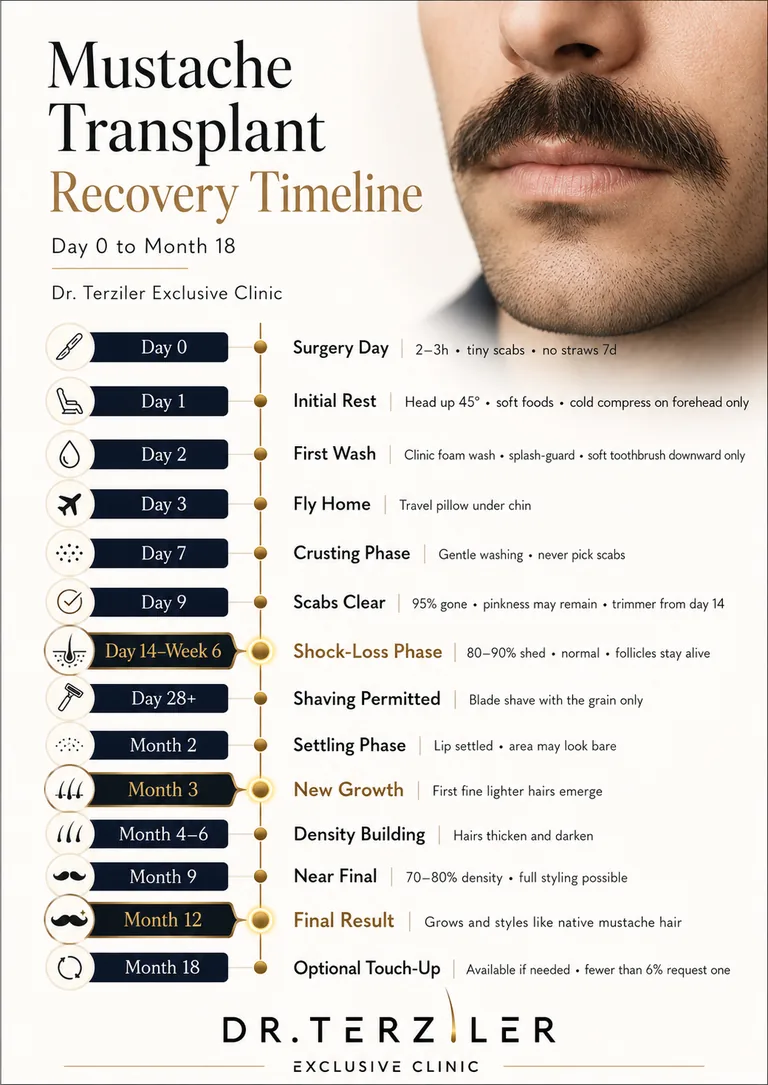
Mustache transplant recovery runs 12 months to final result. Crusts fall off by day 9. Shock loss starts between day 14 and week 6. New terminal hair emerges at month 3. Final density appears between month 9 and 12. Fewer than 6% of Dr. Terziler patients request a touch-up at month 18.
One thing no other clinic tells you about shock loss
The 80-90% shedding phase feels alarming, but the follicle root does not leave the dermis. What sheds is the hair shaft; not the follicle. The root stays anchored and re-enters anagen phase from month 3. About 5-10% of grafts skip the shock-loss phase entirely and grow straight through; these are your first visible results at month 3 alongside the re-growing majority.
Plan your recovery before you book
Get clear timing for travel, the day 2 wash, work return, shaving and trimming after a mustache transplant.
Ask for recovery guidanceWhat Are the Real Risks of a Mustache Transplant?
Real risks of a mustache transplant include cobblestoning (under 0.4% at Dr. Terziler), cold sore (HSV-1) reactivation (3-5% of seropositive patients without prophylaxis, under 2% with), temporary upper-lip numbness (4-8 weeks in most cases), folliculitis, ingrown hairs, and asymmetry from rushed surgical design. Permanent complications are below 0.2% at Dr. Terziler Exclusive Clinic across 150+ mustache cases from 2023-2025.
What Is Cobblestoning and How Is It Prevented on the Upper Lip?
Cobblestoning is raised, bumpy scar tissue caused by grafts implanted above skin level.
Read more
The upper lip is at higher risk than the cheek because its skin is thinner. Prevention requires three things: 0.7 mm punches during extraction, depth-controlled implantation at flush level with the dermis, and strict single-hair graft selection. Robotic DHI hits flush-depth on every graft. The cobblestoning rate at Dr. Terziler Exclusive Clinic is under 0.4% for mustache cases.
Can a Mustache Transplant Trigger a Cold Sore?
Yes, in patients with latent HSV-1 antibodies; roughly 60-80% of adults worldwide carry this virus asymptomatically.
Read more
Upper-lip surgical trauma can reactivate it. Without prophylaxis, reactivation rates run 8-12% in seropositive patients. Dr. Terziler Exclusive Clinic offers a 48-hour valaciclovir prophylaxis window for known seropositive patients, reducing reactivation to under 2%. Patients are screened for HSV-1 serostatus during pre-op blood panels.
What Is Shock Loss After a Mustache Transplant and Does Everyone Get It?
Shock loss is the 2-6-week post-operative shedding of transplanted hairs.
Read more
About 80-90% of grafts shed on the mustache; 5-10% skip this phase and grow immediately. The follicle root survives securely and regrows from month 3. Shock loss is temporary and fully reversible: it is a normal phase of the follicle's adjustment from a dormant to active growth cycle.
Can a Mustache Transplant Cause Upper-Lip Numbness?
Mild numbness along the infraorbital nerve distribution is common for 4-8 weeks.
Read more
Full sensation returns in 95% of patients by month 3. Permanent numbness is below 0.2% at Dr. Terziler Exclusive Clinic across 150+ mustache cases (2023-2025). The primary risk factor for prolonged numbness is over-deep implantation, which the robotic hard-stop at 1.8 mm mechanically prevents.
Does a Mustache Transplant Leave Visible Scars?
No. The 0.7 mm FUE donor punches fade to invisible on the scalp within 3 months.
Read more
The upper-lip recipient site shows no visible scarring once initial crusts heal; surgical damage exists strictly at sub-follicle scale. Patients with Fitzpatrick V-VI skin types receive an additional post-operative hyperpigmentation protocol as a precaution.
Have a medical concern?
Ask about HSV-1 history, scarring, numbness, blood thinners or any risk factor before choosing a date.
Ask a medical coordinatorCan You Combine a Beard and Mustache Transplant in One Session?
Yes. A combined beard-and-mustache transplant at Dr. Terziler Exclusive Clinic delivers 2,000-3,500 total grafts in a single 5-7 hour operating day. The combination is more economical per graft and reduces total recovery time to one 10-12-day window. Adding a mustache to a beard plan costs €500-€1,000 incrementally; roughly 50% less than a standalone mustache procedure.
A typical combined session dedicates 350-500 grafts to the mustache and 1,500-3,000 grafts across the cheeks, goatee, and jawline. Dr. Terziler enforces a 4,500-graft single-day donor safety limit to protect long-term donor density. Combined package pricing runs €3,500-€8,500 all-inclusive. For everything about the beard procedure, visit the beard transplant Turkey guide.
Can a Mustache Transplant Cover a Cleft Lip, Burn or Surgical Scar?
Yes. Dr. Terziler Exclusive Clinic performs mustache transplantation over cleft lip repairs, burn scars, acid-injury scars, and prior surgical scars. Survival on scar tissue averages 72-80% versus 90-97% on healthy skin. The compensation is 20-25% over-grafting and, for dense or poorly vascularised scars, a two-pass protocol spaced 6 months apart.
Patients are not candidates for scar-coverage mustache transplantation if they have active infections, uncontrolled diabetes (HbA1c above 7.5%), or a documented history of keloid formation without a pre-operative suppression plan in place.
The Two-Pass Protocol
Pass 1 places 60% of the target density into the better-vascularised scar zones. Pass 2, at month 6, fills remaining gaps with the final 40% plus any necessary compensation over-graft. This staged approach prevents vascular overload in hypoperfused scar tissue and consistently delivers superior density compared to a single-session attempt.
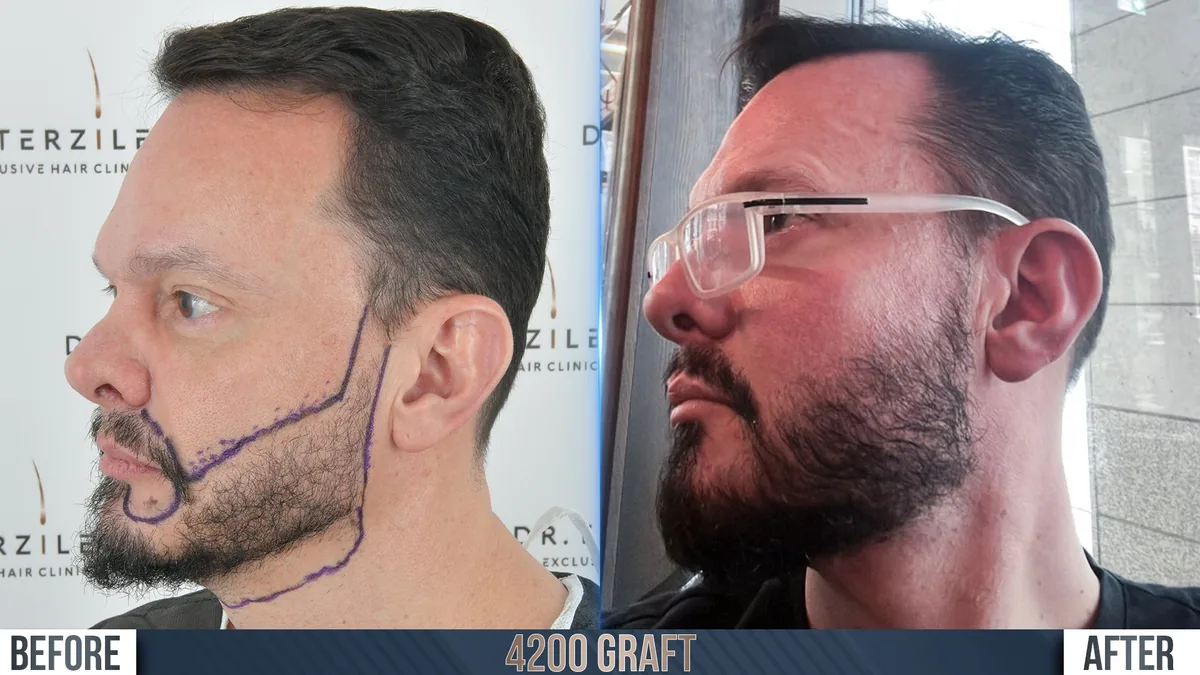
What Does a Mustache Transplant Look Like Before and After?
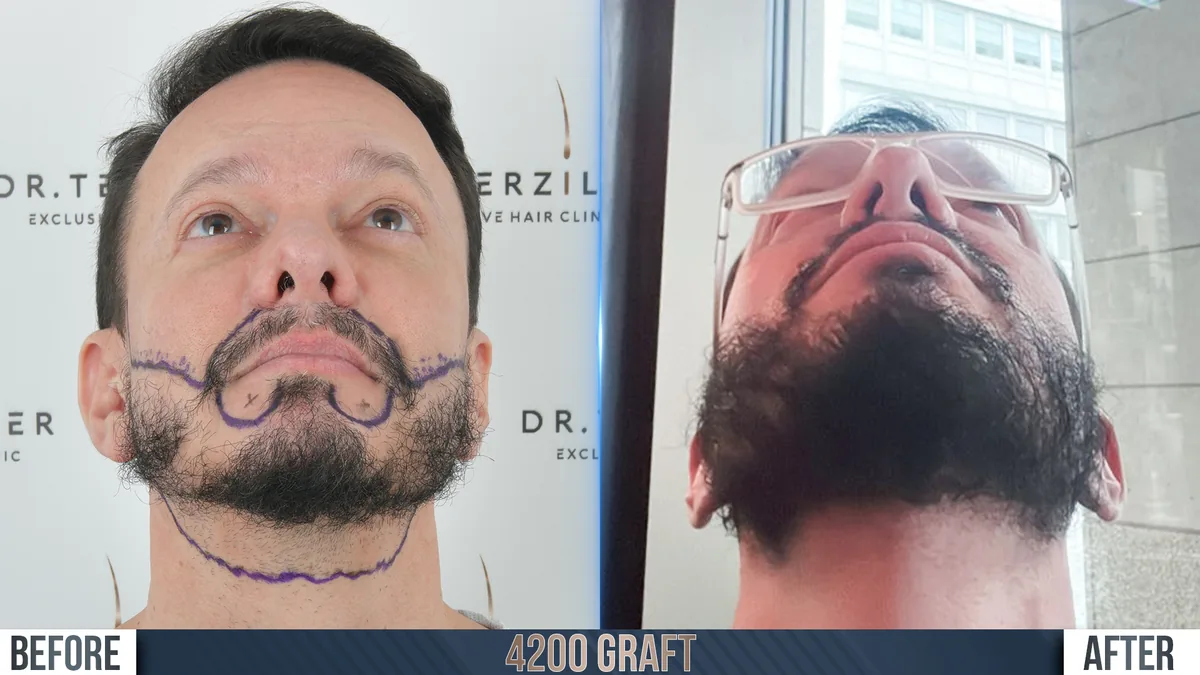
Transformation stabilises at the 12-month mark. The before state is typically characterised by visible philtrum gaps, uneven density across the upper lip body, or a thin pencil-line mustache that cannot hold a defined shape. The after state delivers permanent, fully groomed facial hair that integrates seamlessly with native hair patterns.
How Does a Mustache Transplant Compare to an Eyebrow Transplant?
Both procedures are facial follicular unit transplantation, but the technical demands differ significantly. Eyebrow transplantation requires the shallowest implantation depth of any hair restoration procedure (0.8-1.2 mm) because eyebrow skin is even thinner than the upper lip. Angulation is more extreme: eyebrow hairs must lie almost flat at 10-15° to the skin surface, which demands a finer Choi pen tip than mustache work. Graft counts for eyebrows run 150-350 per brow, and session time is shorter at 1.5-2 hours.
Many patients combine a mustache transplant with an eyebrow restoration in one visit; it is clinically safe and economical. For full technical and pricing details, visit the eyebrow transplant Turkey page.
Can You Get a Sideburn Transplant at the Same Time as a Mustache Transplant?
Yes. Sideburn transplantation uses the same Robotic DHI technique as a mustache procedure and runs 1.5-2 hours alongside a mustache session within the 4,500-graft single-day safety limit. Typical sideburn graft counts are 200-500 per side, depending on whether the goal is a natural taper, a defined sideburn-to-beard connection, or scar coverage from face-lift surgery.
Combining a mustache and sideburn transplant in one session reduces total recovery time to a single 10-day window, saves on package costs, and allows the surgical design team to balance the overall mid-face and lower-face aesthetic in one plan. The sideburn transplant page with full pricing and case examples is coming soon; contact the clinic directly for current availability.
Why Should You Choose Dr. Terziler Exclusive Clinic for a Mustache Transplant?
Dr. Terziler Exclusive Clinic performs every mustache transplant using a Robotic DHI system invented and engineered by Dr. Servet Terziler, a device no other clinic uses. The clinic is AAACI-accredited, Dr. Terziler is an ISHRS member and workshop instructor, and every mustache case is personally designed by Dr. Terziler or a surgeon he trained directly.
Inventor credential
Dr. Servet Terziler designed and built the Robotic DHI implanter used in every procedure at the clinic.
Read more
This is not a licensed technology from a third-party manufacturer: it is proprietary equipment that exists nowhere else. The depth-lock hard-stop on the mustache preset is a direct result of Dr. Terziler's clinical engineering decisions based on 150+ upper-lip cases.
AAACI Accreditation
The American Accreditation Association Commission International (AAACI) clinical accreditation is held by a small minority of Turkish hair transplant clinics.
Read more
It requires independent audits of surgical protocols, sterilisation standards, and patient safety documentation; the same standards applied to internationally certified hospitals.
ISHRS Membership and Workshop Instruction
Dr. Terziler is an active ISHRS member and has presented workshops at international ISHRS conferences (2023, 2024).
Read more
ISHRS represents the global peer body for hair restoration surgery; membership is not automatic, it requires peer validation of surgical outcomes and scientific contribution.
The 'Picasso of Hair' Design Methodology
Dr. Terziler's artistic angulation approach (used across the clinic's scalp hairline work) is applied directly to the philtrum, Cupid's bow, and lateral mustache body.
Read more
The result is a transplanted mustache that looks designed, not planted. This matters on the upper lip more than anywhere else on the face.
Volume and safety data
150+ mustache-specific cases (2023-2025).
Read more
850+ facial hair cases overall. Internal audit figures: cobblestoning under 0.4%, HSV-1 reactivation under 2% with prophylaxis, permanent numbness under 0.2%. Fewer than 6% of mustache patients requested a touch-up at month 18. These numbers are not marketing claims, they are internal audit figures from 150+ documented cases.
Get your mustache design plan
Choose the style, density and package details you want reviewed. You receive a written consultation plan.
Request my planFrequently Asked Questions About Mustache Transplant in Turkey
Yes. Transplanted follicles are DHT-resistant and continue growing for life. Final density appears at month 12-18 and does not regress with age.
From €2,500 for a philtrum-only or minimal gap-fill procedure. A full-density mustache ranges €2,500-€8,500 at Dr. Terziler Exclusive Clinic, all-inclusive. A combined beard-plus-mustache runs €3,500-€8,500.
Crusts fall off by day 9. Social downtime is 10 days. First new terminal hairs emerge at month 3. Final density arrives between month 9 and 12.
Electric trimmer from day 14. Blade shave along the grain from day 28. Upward blade strokes only from month 3 onward.
Yes, at AAACI-accredited clinics using Robotic DHI. 90-97% graft survival. Cobblestoning under 0.4%, HSV-1 reactivation under 2% with prophylaxis, permanent numbness under 0.2% at Dr. Terziler Exclusive Clinic.
The procedure is painless after the initial local anaesthetic injection. Tenderness for 24-48 hours post-op is normal and manageable with paracetamol. The injection itself is a brief 30-45 second discomfort.
350-600 depending on style and native density. Dr. Terziler calculates the exact number in the pre-op trichoscopic consultation.
400-500 grafts. 100% single-hair units from the occipital scalp, implanted at 30° outward from the philtrum.
450-600 grafts including the curl tips. Tip grafts are implanted at 45° upturn to train the handle shape. The tips require the most angular precision of any mustache style.
550-700 grafts. The horseshoe extends beyond the lip corners toward the chin line, adding 150-200 grafts over a classic chevron.
Yes. 22 is our minimum. Upper-lip follicles continue maturing until 25; earlier procedures risk density mismatch as native hair thickens independently later.
Yes. Survival on cleft lip scar tissue averages 72-80%. We over-graft by 20-25% and run a two-pass protocol 6 months apart for dense scars.
Yes. Donor scalp follicles retain their 5-7 year growth cycle. Transplanted mustache hair grows 4-6 inches uncut. Regular trimming keeps it mustache-length.
Slightly more than native mustache hair. Scalp follicles preserve their original waviness. Patients with curly scalp donors may notice a gentle kink at the lip line, which flattens with waxing or pomade from month 4.
Yes. A combined beard-plus-mustache in one day uses 2,000-3,500 grafts, takes 5-7 hours, and costs €3,500-€8,500 all-inclusive at Dr. Terziler Exclusive Clinic.
Yes, after 12 months on testosterone with documented facial vellus response. Results are excellent because donor follicles are androgen-sensitive.
Most patients return to desk work on day 4. Visible redness and small crusts fade between day 7 and 10. Physical labour requires a 14-day pause.
Yes. International patients typically fly home on day 3 after the first medicated-foam wash at the clinic.
Shock loss is the temporary shedding of transplanted hair shafts between day 14 and week 6. About 80-90% of grafts shed; the follicle root survives anchored in the dermis and regrows from month 3.
Yes, lukewarm coffee from a wide-mouth cup from day 1. Avoid hot coffee, straws, and foam that touches the upper lip for 10 days.
Avoid pressure on the upper lip for 10-14 days. After day 14, normal contact is safe for the grafts.
Yes. Dr. Servet Terziler designed and engineered the Robotic DHI implanter used in every procedure at the clinic. No other clinic uses this device. It is proprietary clinical technology, not a licensed or off-the-shelf product.
The protected-zone re-graft policy covers free re-transplantation at 12 months for any graft that fails within the mapped design area. This is written into the patient contract.
No. Minoxidil thickens existing vellus hair but cannot create new follicles in empty zones. A mustache transplant permanently populates empty areas. The two combine well: minoxidil from month 3 can support early density perception while the transplanted hairs complete their anagen cycle.
Robotic DHI. FUE requires pre-made channels and separate graft placement, adding a depth-inconsistency risk on thin upper-lip skin. DHI opens the channel and places the graft simultaneously, eliminating that risk entirely.
Avoid trumpet, saxophone, clarinet, and oboe for 4 weeks. Reed pressure on the upper lip physically stresses graft settling. String and percussion instruments are unrestricted from day 1.
Yes, but use a nasal pillow mask (not a full-face mask) for the first 14 days. Full-face CPAP straps press directly on the upper lip and can displace grafts during sleep.
Waxing is safe from month 4 onward. Before that, the follicle anchor is still consolidating and waxing can dislodge immature grafts.
Yes, timing matters. Existing lip filler before surgery is fine if it was injected more than 4 weeks prior. New filler or perioral Botox should wait until month 3 post-transplant to avoid interference with graft vascularisation. Existing Botox above the lip (for lip flip) should be at least 4 weeks old at the time of surgery.
From day 10 on the vermilion border only, never smeared into the graft zone. Petroleum-free, fragrance-free formulations only for the first 6 weeks.
Yes. Transplanted follicles follow the donor zone's melanin programming and will grey on the same genetic timeline as the occipital scalp hair.
Yes. Stop 2 weeks before and 2 weeks after surgery. Nicotine vasoconstricts dermal capillaries and reduces upper-lip graft survival by 15-20% in active smokers. Vaping has the same vasoconstrictive effect.
Yes, gradually. Once density builds fully at month 12, facial recognition algorithms may flag a mismatch with older passport photos. Update your passport photo at month 12 if the change is significant.
Yes, via diode or alexandrite laser hair removal. Transplanted follicles respond to laser identically to native hair. Full removal typically requires 6-8 sessions spaced 6 weeks apart.
Alopecia areata is an autoimmune condition that targets anagen-phase follicles. In theory it can affect transplanted mustache follicles if they are in active growth phase during a flare. In practice, the reported rate of alopecia areata affecting transplanted facial follicles is extremely low: under 1% based on available case literature. It is not a reason to avoid transplantation, but patients with diagnosed AA should discuss immune status during the pre-op consultation.
Yes, positively. A defined mustache changes midface perception on front-facing cameras, which compress facial proportions. The philtrum zone appears shorter and the mid-face more balanced. Most patients report that video-call confidence was an unexpected secondary benefit they did not anticipate before surgery.
Yes, after 6 months. Most national blood services treat follicular transplantation under elective-surgery deferral rules.
"Mustache" (US) and "moustache" (UK) refer to the same upper-lip hair transplantation procedure. Dr. Terziler Exclusive Clinic treats patients from both markets.
Medical Disclaimer: All statistics and clinical data cited in this article are drawn from internal audit records (Dr. Terziler Exclusive Clinic, 2023-2025), ISHRS Practice Census data, and peer-reviewed literature including the Journal of Investigative Dermatology. This content is informational and does not constitute medical advice. Individual results vary. A formal trichoscopic evaluation is required to determine personal candidacy.
Sources
Primary Studies (Peer-Reviewed)
- Epstein JS. Facial Hair in Hair Restoration Surgery: Beard Transplantation and Beard-To-Scalp Hair Restoration. Facial Plastic Surgery Clinics of North America. 2024. (700+ primer sakal transplantı deneyimli cerrahtan teknik + estetik ilkeler - en güncel makale)
- Manodh P, Velmurugan P, Deepanjali M, Manikandhan R. Macro Photography-Based Comparison of FUE and FUT Techniques for Correction of Mustache Alopecia in Cleft Lip Patients. Journal of Maxillofacial and Oral Surgery. 2025. DOI: 10.1007/s12663-024-02408-w (Doğrudan mustache alopecia - FUE vs FUT karşılaştırması, 2025)
- Civaş E, Aksoy B, Aksoy HM, Çalıkoğlu E. Follicular unit extraction as a valuable method for the restoration of beard: Retrospective case series study. Journal of Cosmetic Dermatology. 2020. DOI: 10.1111/jocd.13448 (Türk araştırmacılar - FUE ile sakal ve bıyık restorasyonu, retrospektif vaka serisi)
- Noori A, Rabiee M, Mehrabani D, Namazi MR. Head and Neck Restoration in Scar Alopecia: Hair Transplantation in Scalp, Eyebrows, Beard and Mustache. World Journal of Plastic Surgery. 2021. DOI: 10.29252/wjps.10.3.90 (Skar kaynaklı bıyık kaybında transplant sonuçları - özellikle "nedenleri" bölümü için)
- Epstein J. Facial hair restoration: hair transplantation to eyebrows, beard, sideburns, and eyelashes. Facial Plastic Surgery Clinics of North America. 2013. DOI: 10.1016/j.fsc.2013.05.004 (Sakal, bıyık, sideburn transplantasyonuna kapsamlı genel bakış - teknik referans)
- Reed ML, Grayson BH. Single-follicular-unit hair transplantation to correct cleft lip moustache alopecia. The Cleft Palate-Craniofacial Journal. 2001. (İlk mustache-specific vakalardan - tek graft tekniği ile doğal bıyık restorasyonu)
Donor Area & Technique
- Gupta J, Chouhan K, Kumar A, Chandrasegaran A. A Comparative Study on the Rate of Anagen Effluvium and Survival Rates of Scalp, Beard, and Chest Hair in Hair Restoration. Journal of Cutaneous and Aesthetic Surgery. 2019. DOI: 10.4103/JCAS.JCAS_49_18 (Saçlı deri vs sakal vs göğüs tüyü survival rate karşılaştırması - sayısal veri için)
- Umar S. Body Hair Transplant by Follicular Unit Extraction: Experience With 122 Patients. Aesthetic Surgery Journal. 2016. (122 hastalık büyük seri - non-scalp donor kullanımı ve sonuçları)
- Umar S. Use of body hair and beard hair in hair restoration. Facial Plastic Surgery Clinics of North America. 2013. DOI: 10.1016/j.fsc.2013.05.003 (Sakal tüyünü donor olarak kullanmak - teknik ve kısıtlamalar)
- Garg AK, Garg S. "Combination Grafting" of Scalp and Body Hair to Enhance Visual Density. Journal of Cutaneous and Aesthetic Surgery. 2020. DOI: 10.4103/JCAS.JCAS_89_18 (Scalp + sakal karışık greft kullanımı - yoğunluk ve kapsama)
General Hair Loss & Biology
- Barrera A. The use of micrografts and minigrafts in the aesthetic reconstruction of the face and scalp. Plastic and Reconstructive Surgery. 2003. (Facial reconstruction için mikro/mini greft kullanımı - temel referans)
Authoritative Organisations
Located in Istanbul, Turkey, Dr. Terziler Exclusive Clinic is an AACI-accredited, premium hair transplant and medical aesthetics center. Founded by Dr. Servet Terziler, the clinic specializes in advanced facial hair transplantation, Robotic DHI and the proprietary Picasso Robotic DHI method for international patients from over 40 countries.