




Sideburn Hair Transplant Turkey: Safety, Techniques, Results
For those facing thinning or missing facial hair, a sideburn hair transplant is a 3–7 hour procedure utilizing 200–600 grafts to restore natural density using advanced FUE or DHI techniques. Choosing a sideburn hair transplant Turkey ensures access to world-class expertise. Whether you require targeted sideburn implants, a full sideburn regrowth transplant, or comprehensive sideburn hair restoration, achieving a seamless look is paramount.
Quick Summary
Sideburn transplants require 200–600 grafts placed at 25–45° exit angles to match natural follicular direction. Under the guidance of the AAACI-accredited Dr. Terziler Clinic, patients benefit from unparalleled precision through our exclusive Robotic DHI technology. We meticulously plan every sideburn transplant to guarantee flawless integration with your existing facial features. Learn more about our comprehensive approach to hair transplant Turkey.
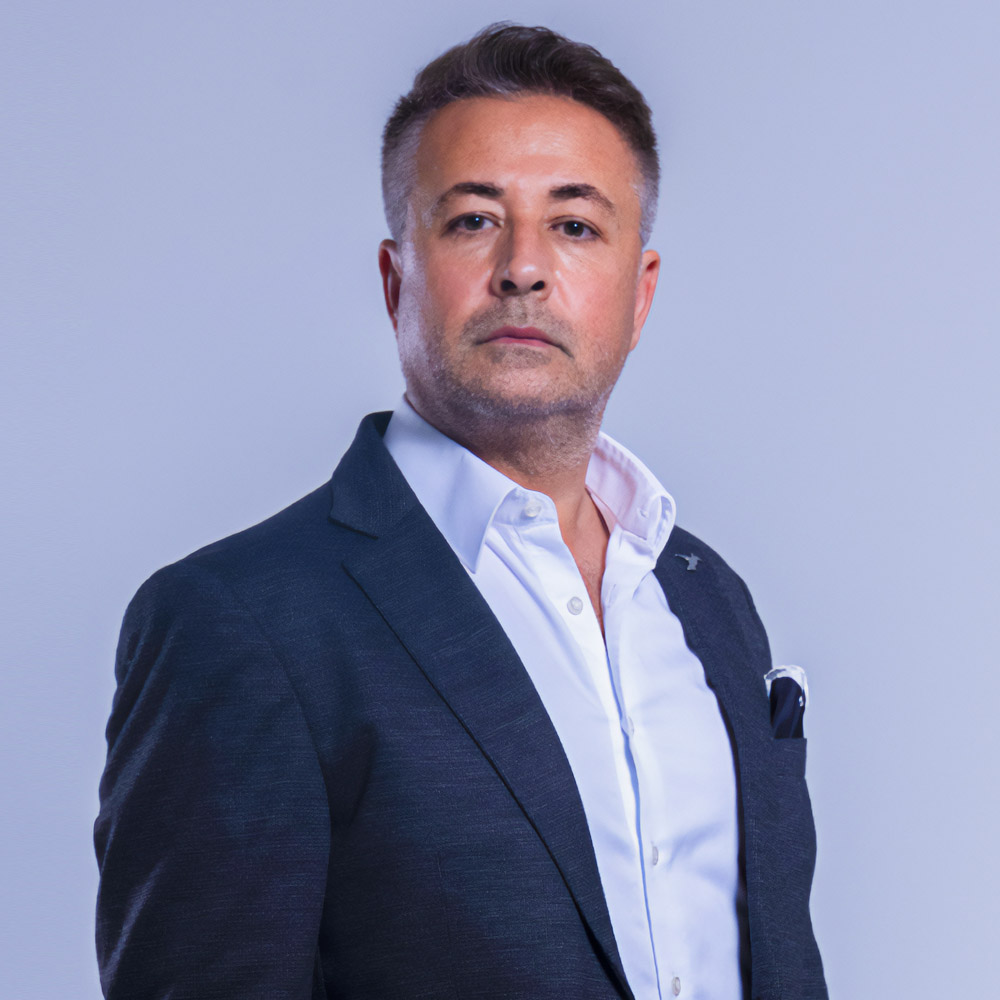
Medically Reviewed By
Dr. Servet Terziler
Founder and Lead Hair Restoration Surgeon, Dr. Terziler Exclusive Clinic
Updated June 2026
What Is a Sideburn Hair Transplant?
A sideburn hair transplant is a surgical procedure that moves hair follicles from the donor area (typically the back of the scalp) to the sideburn zone. Sideburn follicles require 25–45° exit angles to produce natural results. (Epstein JS. Hair Restoration to the Sideburn, Eyebrow, Eyelash, and Beard Areas. Facial Plastic Surgery Clinics of North America. 2013;21(3):457–467. https://doi.org/10.1016/j.fsc.2013.05.001)
This sophisticated procedure effectively treats a variety of sideburn hair loss causes, including genetic thinning, complete absence, recession due to aging, and scarring alopecia sideburn conditions. The standard graft count range is 200–600 follicles, carefully implanted to ensure a sideburn transplant natural hairline. The session duration is 3–7 hours, utilizing the most advanced hair transplant options available to achieve dense, permanent results.
Could a Sideburn Hair Transplant Fit Your Facial Profile?
Share your photos and restoration goals for a private candidacy and graft assessment.
Request My Sideburn AssessmentWho Is a Candidate for Sideburn Transplant?
Ideal candidates include men seeking thicker facial hair profiles, transgender individuals desiring a transgender sideburn transplant Turkey for facial masculinization or feminization, and patients seeking a woman sideburn transplant to address post-facelift recession. It is also a viable restorative option for patients needing a sideburn transplant after chemotherapy.
What Areas Can Be Treated in Sideburn Transplant?
The sideburn transplant procedure is highly customizable. Common treatment areas include hairline extension (connecting the temple hair smoothly into the beard), the creation of a full sideburn where none exists, and targeted scar zone reconstruction for complete sideburn transplant scar concealment.
Not Sure Whether You Are a Candidate?
Send your concern privately and ask which sideburn restoration approach may fit your facial structure and hair-loss pattern.
Ask the Hair Restoration TeamWhich Sideburn Areas Would You Like to Restore?
Upload your photos for a treatment-area review covering hairline extension, full sideburn creation, or scar concealment.
Review My Treatment AreasWhat Are the Sideburn Transplant Techniques?
The best technique for sideburn transplant is the one that guarantees absolute control over graft angulation and density. Sideburn follicles exit the scalp at 25–45° angles with a specifically curved growth direction that mirrors the natural posterior-to-anterior sweep.
Correct follicular direction is critical for sideburn aesthetics. (Jiménez F, Alam M, Vogel JE, Avram M. Hair Transplantation: Basic Overview. Journal of the American Academy of Dermatology. 2021;85(4):803–814. https://doi.org/10.1016/j.jaad.2021.03.124) Standard FUE punches placed at wrong angles cause unnatural, "planted" appearance. Robotic DHI or Picasso System corrects exit angle to within ±2° precision, vs. ±8–12° manual variation.
Is Robotic DHI Good for Sideburn Transplant?
Positioned as the definitive premium option globally, a robotic DHI sideburn procedure offers unmatched aesthetic control. Dr. Terziler invented this machine, making our facility the only clinic worldwide to offer the Robotic DHI. Delivering an unprecedented angle precision of ±2°, Robotic DHI ensures a 95–98% natural result, flawlessly mimicking the natural sweep of facial hair. DHI graft survival in facial hair restoration reaches 92–97%. (Epstein JS. Hair Transplantation: Art and Science. 2024.)
Dr. Terziler also performs Picasso Robotic DHI; where every hairline is drawn by hand before the procedure begins. No algorithm. No template. Each result is singular.
Is Manual DHI Hair Transplant Good for Sideburn Transplant?
A manual DHI sideburn transplant uses a pen-based implantation method (Dr. Terziler uses the world’s thinnest Choi implanter with 75mm) that requires no prior incision phase. Because no shaving is required in the recipient area, this unshaven hair transplant approach is highly preferred for small sessions, targeted touch-ups, and female patients seeking maximum discretion and a rapid sideburn transplant recovery.
Is Sapphire FUE Good for Sideburn Transplant?
A Sapphire FUE sideburn transplant utilizing Sapphire blades significantly reduces tissue trauma compared to traditional steel slits. This method is the ideal choice for larger, combined procedures. If you require a comprehensive facial hair transplant Turkey, such as a beard and sideburn transplant, scheduling a sideburn and beard transplant same session with Sapphire FUE ensures maximum graft survival and unified healing.
Is FUE Good for Sideburn Transplant?
FUE is the standard method for sideburn transplants. It extracts individual follicles from the donor area without a linear incision, leaving no visible scar. This matters for sideburn patients who wear short hair or keep the sides closely trimmed. FUE achieves 88–95% follicle survival in facial zones. (Civaş N et al., Turkiye Klinikleri Journal of Dermatology. 2020;30(2):112–119.) The limitation is precision: standard FUE transplant tools cannot guarantee consistent implantation angles in the curved sideburn zone, which affects natural direction and density.
Is FUT Good for Sideburn Transplant?
FUT is rarely used for sideburn transplants. The technique removes a strip of scalp tissue, leaving a linear scar that is difficult to conceal in the temporal region. Graft quality from strip harvesting is comparable to FUE, but the recovery is longer and the scarring risk is higher in a visible facial zone. Most surgeons performing sideburn restoration do not recommend FUT transplant as the primary method.
| Feature | Robotic DHI (Picasso) | Manual DHI | Sapphire FUE | FUE | FUT |
|---|---|---|---|---|---|
| Angle Precision | ±2° (Machine-guided) | ±8–12° (Manual) | ±8–12° (Manual) | ±10–15° (Manual) | ±10–15° (Manual) |
| Graft Survival | 95–98% | 90–95% | 88–95% | 85–93% | 75–87% |
| Recovery | Very Fast (Minimal trauma) | Fast | Fast (Reduced blade trauma) | Moderate (Multiple extraction wounds) | Slow (Linear incision, sutures required) |
| Who It Suits | Premium results, ultra-precision | Small sessions, female patients, unshaven | Larger combined sessions (beard + sideburn) | Budget-conscious patients, larger donor areas | High-volume sessions, patients with high scalp laxity |
Ready to Restore Your Facial Profile?
Contact Dr. Terziler Clinic for a free, customized sideburn transplant consultation and guidance on the most suitable technique.
Start My Sideburn ConsultationHow Many Grafts for a Sideburn Transplant?
Determining the exact sideburn transplant graft count is a crucial step in achieving a dense, natural-looking facial profile. The precise number of follicles required depends heavily on the extent of hair loss, the size of the target area, and the patient's existing facial hair structure.
200–350 grafts are typically required for a hairline sideburn correction or minor temple recession.
350–600 grafts are necessary for a full sideburn reconstruction due to genetic absence or thinning.
150–300 grafts are utilized for targeted sideburn transplant scar concealment in the temporal region.
600–1,200 grafts are deployed for a comprehensive, combined beard and sideburn transplant session.
To ensure seamless integration, density targeting must be carefully calculated, aiming for 35–55 grafts/cm² depending on the specific zone.
| Sideburn Zone | Avg Grafts Required | Density Goal (grafts/cm²) | Session Duration |
|---|---|---|---|
| Hairline sideburn extension | 200–350 grafts | 35–45 grafts/cm² | 3–4 hours |
| Full sideburn reconstruction | 350–600 grafts | 40–55 grafts/cm² | 4–6 hours |
| Scar concealment sideburn | 150–300 grafts | 30–45 grafts/cm² | 2–4 hours |
| Combination beard + sideburn | 600–1,200 grafts | Zone-specific | 5–7 hours |
| Transgender/gender-affirming sideburn | 300–600 grafts | 40–50 grafts/cm² | 4–6 hours |
Source: Dr. Servet Terziler clinical experience, aligned with Epstein JS (2013, 2024) facial hair restoration methodology.
How Many Grafts Could Your Sideburns Need?
Receive a precise graft-count assessment and customized treatment plan from Dr. Terziler's medical team.
Get My Personalized Graft EstimateHow Much Does a Sideburn Transplant Cost?
When evaluating facial hair transplant cost, comparing regional pricing and package inclusions is essential. An all-inclusive sideburn transplant cost Turkey package in Istanbul starts from €1,500.
In sharp contrast, the UK average for the procedure alone ranges from £3,500 to £8,000, while the USA average spans from $4,000 to $10,000, excluding any administrative or aftercare fees.
The premium sideburn transplant cost at Dr. Terziler Clinic covers a comprehensive, all-inclusive package designed for medical tourists. This includes:
VIP airport transfers
A 3-night luxury hotel stay
A specialized medical aftercare kit
Free lifetime follow-up consultations
The final sideburn transplant cost is influenced by the required graft count, the chosen technique (with Robotic DHI commanding a premium due to its advanced engineering), and potential multi-zone discounts when arranging a sideburn and beard transplant same session.
| Market | Sideburn Transplant Cost | What's Included | Currency |
|---|---|---|---|
| Istanbul (Turkey) | €1,500 – €3,300 | Procedure + hotel + transfers + aftercare kit in Dr. Terziler | EUR |
| UK (London clinics) | £3,500 – £8,000 | Procedure only | GBP |
| USA (average clinic) | $4,000 – $10,000 | Procedure only | USD |
| Germany | €4,000 – €9,000 | Procedure only | EUR |
| Istanbul (budget clinics) | €800 – €1,200 | Procedure only, no AAACI | EUR |
Dr. Terziler's all-inclusive package costs less than the cheapest UK sideburn transplant, before including the substantial flight saving of £1,500–£2,500 vs. London prices.
Want a Transparent Sideburn Transplant Price?
Request a no-obligation, all-inclusive cost breakdown tailored to your graft needs, technique, and restoration goals.
Request My Free Price QuoteWhat Are the Causes of Sideburn Hair Loss?
Understanding the underlying sideburn hair loss causes is the first step in determining the right restorative treatment. Whether the thinning is gradual or sudden, several distinct factors contribute to facial hair loss in the temporal region.
Genetic: The most common cause is androgenetic alopecia, which frequently affects the temporal region and causes the hairline to recede away from the sideburns.
Alopecia areata: This is an unpredictable autoimmune condition that creates circular, bald patches directly in the sideburn zone.
Scarring: Post-surgical trauma (especially from facelift procedures), burns, or physical accidents can lead to scarring alopecia sideburn conditions, permanently destroying local follicles.
Hormonal: Thyroid disorders or the significant post-pregnancy hormonal shifts experienced by women can trigger thinning in the facial frame.
Chemotherapy: Systemic medical treatments can cause temporary or permanent follicle damage. A sideburn transplant after chemotherapy is an excellent option once a patient is medically cleared.
Trauma: Direct physical injury to the temporal scalp zone often prevents natural hair from regrowing.
What May Be Causing Your Sideburn Hair Loss?
Describe whether the change was gradual, sudden, scar-related, hormonal, or treatment-related and ask the clinic team what should be assessed first.
Ask About My Hair LossHow Is the Sideburn Transplant Procedure Step by Step?
The sideburn transplant procedure is a meticulously staged, minimally invasive microsurgery designed to extract, preserve, and implant healthy follicles into the temporal region.
Consultation: The journey begins with a detailed photo analysis, hairline design, and precise graft count estimation. This can be done virtually or in-person in Istanbul.
Design: The surgeon carefully maps the natural sideburn angle, growth direction, and the hairline curve using a surgical marker to ensure perfect facial symmetry.
Donor extraction: Healthy follicles are extracted from the posterior scalp (occipital zone) utilizing an FUE punch or DHI extraction tool. This advanced method ensures no linear scar is left behind.
Graft preparation: A specialized technician team separates the extracted follicles under a high-powered stereomicroscope into 1- and 2-hair units for optimal blending.
Channel creation or direct implantation: Depending on the technique, channels are opened (FUE) or grafts are directly implanted (DHI / Robotic DHI). The crucial step here is ensuring follicles are placed exactly at 25–45° exit angles to match natural growth.
Closure: No stitches are required for FUE/DHI procedures. The donor site naturally heals through microbleed coagulation within 48–72 hours.
Post-operative care: Patients must follow a strict saline spray protocol for days 1–14. It is critical to avoid sun exposure for 4 weeks and to strictly avoid touching the transplanted zone for the first 3 days.
Shock loss phase (weeks 2–6): Transplanted hairs will shed. This is completely normal; the vital follicles remain firmly intact beneath the skin.
Growth phase (months 3–12): New sideburn hairs grow progressively. Roughly 50% of the result is visible at 6 months, culminating in a full, final result at 10–14 months.
Want Your Sideburn Procedure Planned Step by Step?
Share your photos so the team can map the design, donor extraction, graft placement, and recovery plan around your facial structure.
Build My Procedure PlanHow Long Is Recovery From Sideburn Transplant?
If you are wondering how long is recovery from sideburn transplant, the initial physical healing takes about 10 to 14 days, but the complete timeline for hair maturation extends up to 14 months. A successful sideburn transplant recovery requires patience and strict adherence to post-operative guidelines.
| Phase | Timeframe | What Happens | Patient Restrictions |
|---|---|---|---|
| Immediate post-op | Day 0–3 | Redness, scabbing, mild swelling | No touching, no bending forward |
| Scab shedding | Day 4–14 | Scabs fall with saline spray washing | No shaving, no sun, no gym |
| Shock loss | Week 2–6 | Transplanted hairs shed (normal) | Patience; follicles are alive |
| Dormancy | Month 2–3 | Little visible growth | Normal activity resumes at month 1 |
| Early growth | Month 3–6 | 30–50% of grafts visible | Can style normally |
| Maturation | Month 6–12 | Density increases, texture normalizes | Full trimming, shaving OK at month 4 |
| Full result | Month 12–14 | Final sideburn density and direction | Permanent result |
Have Questions About Sideburn Transplant Recovery?
Ask about scab care, shock loss, washing, shaving, sun exposure, and the expected growth timeline before you travel.
Ask About RecoveryWhat Are the Special Cases for Sideburn Transplant?
Modern facial hair restoration addresses unique patient needs through highly specialized applications, including a dedicated woman sideburn transplant, post-facelift scar concealment, post-chemotherapy regrowth, gender-affirming modifications, combined beard procedures, and stable alopecia areata treatments.
Does Sideburn Transplant Work for Women?
Yes, thinning or patchy hair loss along the female facial frame caused by hormonal shifts or genetics is effectively corrected with sideburn transplant. Dr. Terziler utilizes a highly discreet, unshaven DHI technique that requires no shaving of the recipient area for women sideburn transplant, ensuring completely natural results that beautifully restore female patients natural facial profile.
Does Sideburn Transplant Work After Facelift Surgery
Yes, this specialized restorative application achieves complete sideburn transplant scar concealment by hiding post-rhytidectomy scars located in the temporal hairline. The procedure requires full scar maturity, meaning patients should wait at least 12+ months post-surgery before undergoing the hair transplant.
Does Sideburn Transplant Work After Chemotherapy
Yes, chemotherapy results in temporary or permanent patchy facial hair loss, including the sideburns, and sideburn transplant is one of the best options for getting your hair back.
An unshaven DHI sideburn transplant is highly preferred post-chemo because it eliminates the need to shave the surrounding area once hair loss has stabilized for 12 months.
What Is the Gender-Affirming Sideburn Transplant?
Creating a distinct, male-pattern sideburn structure serves as a primary masculinization step in FTM transitions. Choosing a sideburn transplant Istanbul package at our facility allows patients to meet their gender-affirming goals at a 60–75% lower cost than UK gender transition clinics, backed by a dedicated, private consultation.
Can Sideburn Transplant Combined with Transplant?
Yes, Dr. Terziler offers an efficient, single-session option covering up to 1,200 grafts to treat both the beard and sideburn zones in one procedure day. Opting for a sideburn and beard transplant same session significantly reduces the total cost compared to arranging two separate surgical appointments. Moustache transplant and eyebrow transplants are also available as combined sessions, allowing patients to address multiple facial hair zones under a single anaesthesia and recovery window.
What Is an Alopecia Areata Sideburn Transplant?
When patchy alopecia areata affects the sideburn zone, a hair transplant can be a viable solution provided the disease has reached a completely stable state. Patients must show no active patches for at least 12+ months before a transplant can be safely considered, following a rigorous clinical evaluation by Dr. Terziler.
Considering a Sideburn Transplant as a Woman?
Request a discreet photo review for temporal thinning, facial framing, or post-facelift scar restoration.
Request My Private ReviewDoes Your Case Need a Specialized Sideburn Plan?
Ask privately about post-facelift scars, post-chemotherapy restoration, gender-affirming design, combined facial-hair sessions, or stable alopecia areata.
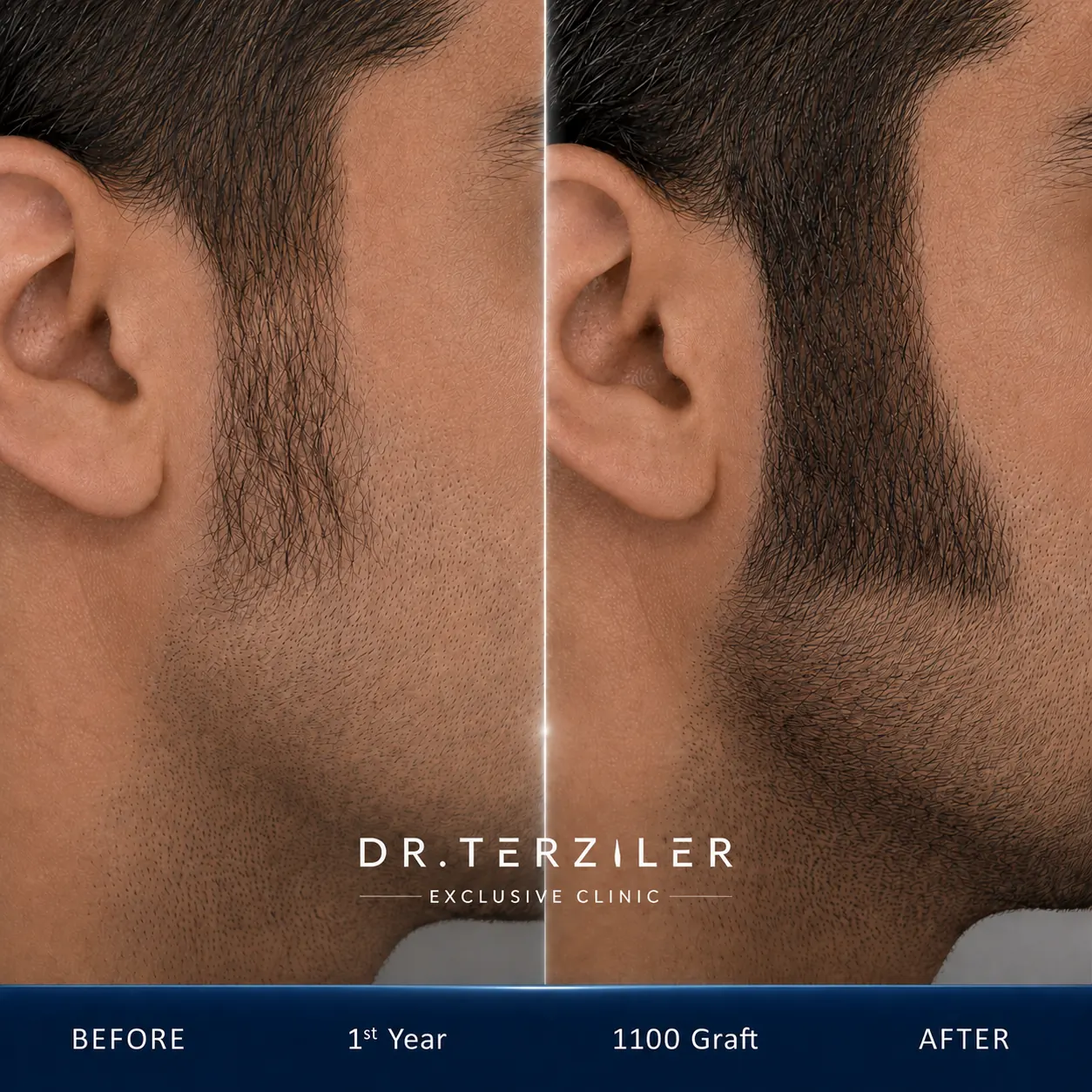
Discuss My Special CaseHow Does a Sideburn Transplant Before & After Results Look Like?
Most patients see a natural sideburn line within 8–12 months.
Why Dr. Terziler Exclusive Clinic for a Sideburn Transplant?
Choosing Dr. Terziler Exclusive Clinic ensures world-class medical care backed by over 30 years of clinical experience, a prestigious AAACI accreditation, our groundbreaking Robotic DHI system, and an all-inclusive medical tourism package.
Robotic DHI (Picasso System): Dr. Servet Terziler invented this proprietary system, making ours the only clinic in the world to offer it. The technology utilizes algorithm-assisted angle mapping to achieve an unmatched ±2° precision for a flawless sideburn transplant natural hairline.
AAACI Accreditation: Our medical center holds official AAACI facility accreditation, and Dr. Terziler holds individual AAACI surgeon accreditation, representing the most rigorous international surgical quality and safety standards.
ISHRS Workshops: Dr. Terziler routinely attends annual International Society of Hair Restoration Surgery workshops and has personally educated global hair transplant surgeons in advanced DHI implantation methodologies.
"Picasso of Hair" Designation: Recognized by international media for his precision artistry, Dr. Terziler specializes in the complex architectural design required for natural-looking hairlines and facial framing.
700+ Facial Hair Restoration Cases: Our clinical data from 2019–2024 includes more than 700 successful facial hair restorations utilizing an elite, Epstein-aligned technique.
+30 Years of Experience: Decades of pioneering leadership in the hair restoration field guarantee exceptional medical oversight and aesthetic mastery.
All-Inclusive Medical Tourism Package: International patients receive an all-inclusive experience that combines VIP airport transfers, luxury hotel accommodations, the surgical procedure, and a dedicated medical aftercare kit into a single transparent price.
Comprehensive Guarantee System: Every patient benefits from our official quality assurance and graft survival guarantee system.
Want Dr. Terziler's Team to Review Your Sideburn Goals?
Submit your photos for a personalized design, graft estimate, technique recommendation, and all-inclusive treatment plan.
Request My Clinic ReviewFAQs
Yes, you can transplant hair to sideburns to successfully restore missing, patchy, or thinning facial hair caused by genetics, scars, or medical treatments.
You need a sideburn transplant graft count of 200 to 600 grafts for standard bilateral restoration, though combined beard sessions may require up to 1,200 grafts.
A sideburn transplant costs between €1,500 and €3,500 for an all-inclusive package at Dr. Terziler Clinic in Turkey, which is significantly more affordable than UK or US rates.
A sideburn transplant lasts for a lifetime because the hair follicles extracted from the donor zone are genetically resistant to thinning and hair loss.
A sideburn transplant is not painful because the entire procedure is performed under local anesthesia, often utilized alongside needle-free comfort injection techniques.
The best technique for sideburn transplant is the Picasso Robotic DHI sideburn procedure because its automated system maps growth direction with an ultra-precise ±2° angle tolerance.
The physical recovery from sideburn transplant takes 10 to 14 days for scabs to shed completely, while the full aesthetic growth cycle requires 12 to 14 months.
Genetics, alopecia areata, post-facelift scarring, hormonal shifts, chemotherapy, and physical trauma cause sideburn hair loss.
Yes, women can get a sideburn transplant to correct temporal hair thinning or achieve complete sideburn transplant scar concealment following a facelift procedure.
The shock loss phase lasts between 2 and 6 weeks after the procedure, during which the temporary hair shafts shed while the vital follicles remain safely intact.
The graft survival rate for a sideburn transplant with DHI ranges from 90% to 98% depending on whether you choose a manual or a robotic-assisted implementation method. According to Epstein (2024), DHI graft survival in facial restoration reaches 92–97%.
The AAACI-accredited Dr. Terziler Clinic in Istanbul, Turkey, is the premier place for a sideburn transplant because it combines world-class surgical expertise with exclusive Robotic DHI technology and comprehensive all-inclusive packages.