Afro Hair Transplant in Turkey for 4A, 4B and 4C Hair
An Afro hair transplant in Turkey is a specialised hair restoration procedure for 4A, 4B and 4C hair that protects curved follicles, preserves natural curl direction, and screens keloid risk before surgery. In 2026, standard packages usually cost $3,000 to $5,500, while advanced Robotic DHI or repair cases reach about $8,500.
- Processing Time 6–8 saat
- Anesthesia Sedation
Operational Process
-
ADIM 01
Consultation
The suitability of a person for a hair transplant is determined by analysing the condition of the hair follicles in the donor area.
-
ADIM 02
Design
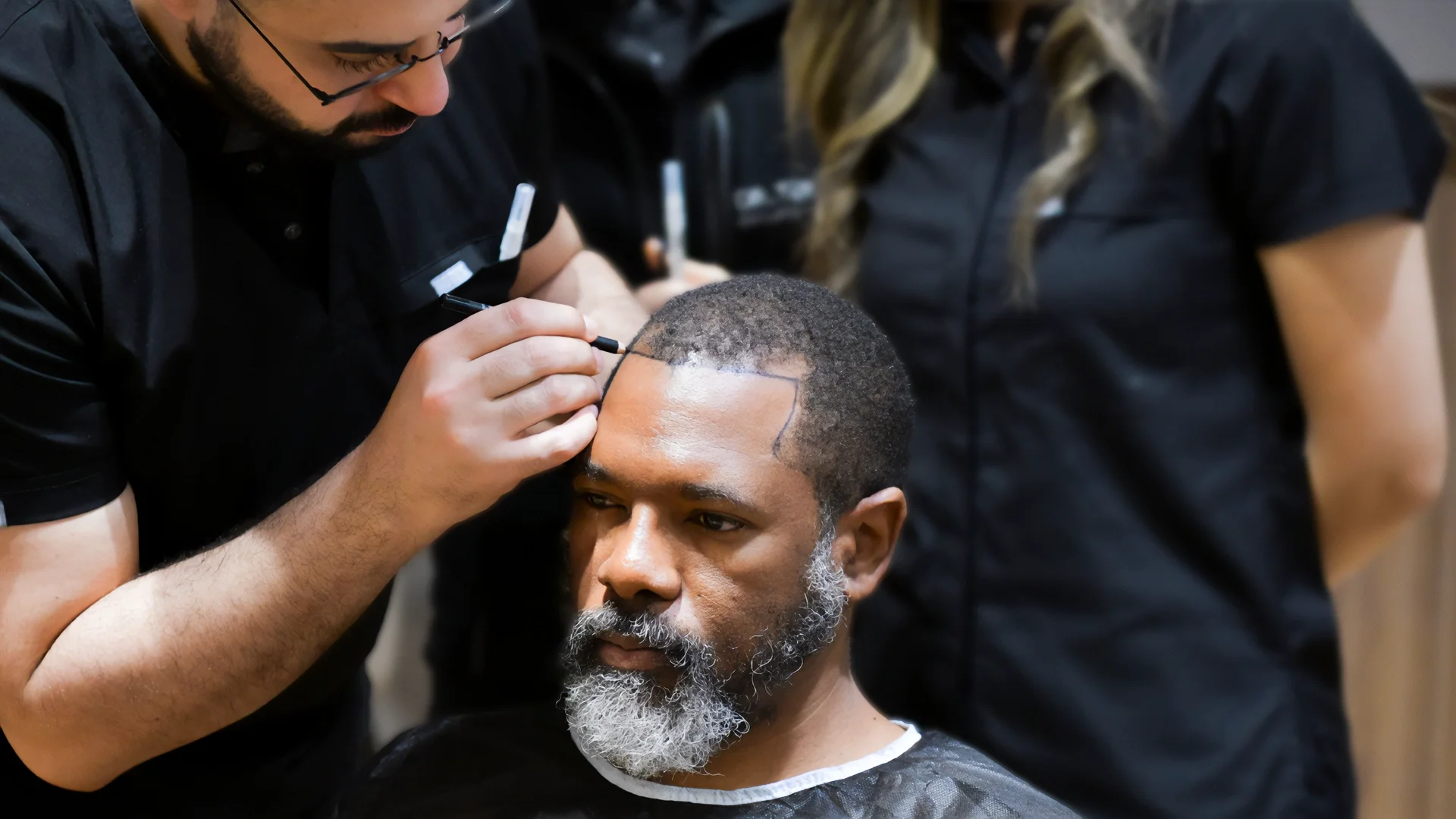
The technique to be used, the application method and the hairline are determined by assessing the structure of the follicles and the natural direction of hair growth.
-
ADIM 03
Afro-American Hair Transplants
The grafts are carefully implanted by a team of specialists using state-of-the-art technology.
-
ADIM 04
Follow-up & Support
Regular check-ups and regenerative support over a 12-month period.
MEDICALLY REVIEWED BY
Dr. Servet TerzilerHair transplant surgeon | AACI-accredited clinic leadership | ISHRS education attendance | Founder & President, TUSATDER | Inventor of the Robotic DHI Machine | Creator of Picasso Robotic DHI | European Property Awards Best Hair Transplant Clinic in Europe | Updated for Afro hair transplant patients in 2026.
Last medically reviewed:
Why Does Afro Hair Need Specialist Hair Transplant Planning?
Afro hair needs specialist hair transplant planning because the curl you see above the scalp often continues below the skin, which means the follicle may curve before the extraction punch reaches the bulb.
Most clinics use tools designed for straight hair. Afro-textured hair is not straight. Beneath the scalp, Afro follicles can curve in C-shaped, J-shaped, and helical paths at depths of about 3 to 4 mm. Standard rotary punches enter the skin and cut straight down. If the follicle curves away from that path, the punch can slice through it. The result is transection: the follicle is severed, the graft dies, and the donor reserve is wasted.
That is why a serious Afro hair transplant in Turkey should never be treated as a generic FUE booking. The plan should start with donor-zone mapping, 4A/4B/4C curl assessment, scalp thickness evaluation, keloid history screening, and a conversation about how the patient actually wears their hair. The best-looking Afro result is not only dense; it looks believable when the hair is short, grown out, braided later, shaped up, or styled naturally.
Quick answer for Afro hair transplant Turkey patients
- Afro hair transplant in Turkey usually costs $3,000 to $5,500 for standard primary packages in 2026; advanced Robotic DHI, large sessions, or repair cases can reach about $8,500.
- Afro follicles often curve beneath the skin, so extraction must protect the follicle path instead of assuming straight-hair anatomy.
- 4A, 4B, and 4C hair need different planning; tighter coils usually need more conservative extraction, smaller-gauge work, and more frequent transection checks.
- Keloid screening matters for patients with African ancestry, prior raised scars, AKN, CCCA, or family history of abnormal scarring.
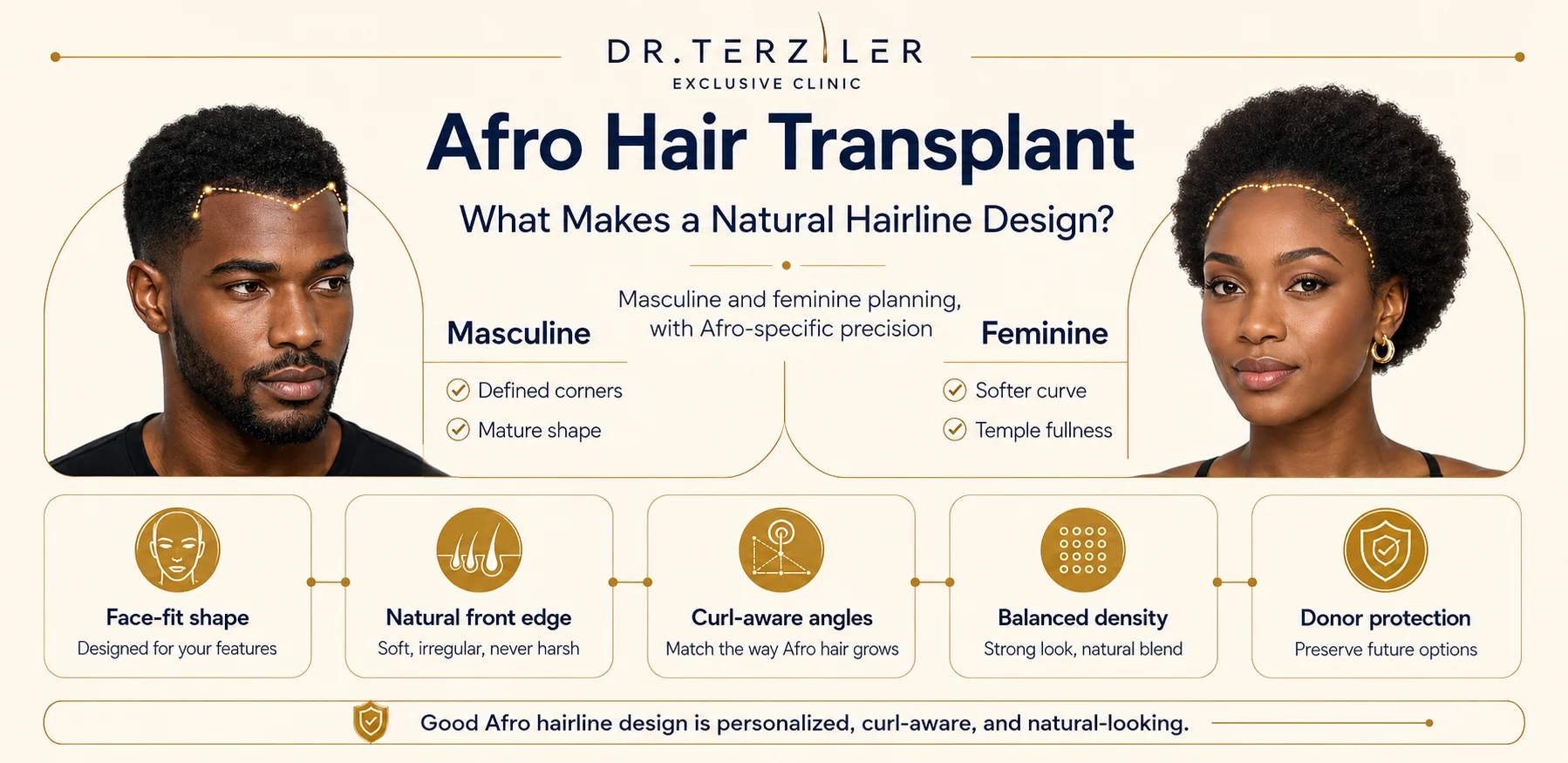
- Afro hairline design is its own skill; masculine, feminine, and soft-balanced hairlines need different temple, corner, density, and edge-design decisions.
- Dr. Terziler Exclusive Clinic is positioned for Afro patients because the consultation focuses on surgeon-led planning, curl-class mapping, keloid-aware technique choice, Robotic DHI, and long-term follow-up.
What Is an Afro Hair Transplant and How Is It Different From a Standard Hair Transplant?
An Afro hair transplant is a specialised hair restoration procedure for tightly curled or coiled Type 4 hair that uses curl-aware extraction, angle-controlled implantation, and keloid-aware planning.
It is performed for patients with 4A, 4B, and 4C patterns, including Black, African American, Afro-Caribbean, African, and mixed-heritage patients. The main difference from a standard hair transplant in Turkey is that Afro follicles often curve under the scalp. The surgical tool must respect that curve, or the graft can be damaged before it is ever implanted.
Afro hair also behaves differently visually. It may have lower follicular density per square centimetre than straight hair, but each follicular unit can contain multiple hairs, and the curl creates a coverage effect. This is why an Afro patient with the same visible baldness pattern as a straight-haired patient may need fewer grafts for cosmetic fullness, but more skill per graft during extraction and placement.
| Feature | Afro / Type 4 Hair | Straight / Type 1 to 2 Hair |
|---|---|---|
| Subcutaneous follicle path | C-shaped, J-shaped, or helical; curve may appear 3 to 4 mm under the scalp | Usually more linear and easier to follow with standard punches |
| Visual density effect | Curl creates wider visual coverage and can reduce the number of grafts needed in selected areas | Often needs higher graft density for the same visible coverage |
| Extraction risk | Higher transection risk if straight rotary tools are used without curl mapping | Lower transection risk with standard tool assumptions |
| Hairline planning | Needs rounded, irregular, curl-direction-aware design; shape-up habits matter | Often planned with straighter hairline geometry and different temple density |
| Skin and scar planning | Fitzpatrick V to VI skin, keloid history, AKN, traction alopecia, and CCCA must be considered | Scarring risk still matters, but baseline planning is often less complex |
| Recovery expectations | Final curl expression may take 12 to 18 months | Texture may appear mature earlier, often around 9 to 12 months |
What Makes Afro Hair Transplants More Technically Demanding?
Afro hair transplants are more technically demanding because the surgeon must protect curved follicles, plan for darker skin healing, and place grafts so the new hair grows in a natural curl direction.
The difficulty is not the patient's hair; the difficulty is using the wrong protocol. A strong Afro protocol adjusts the extraction angle, checks transection during surgery, avoids overharvesting, uses smaller incisions where suitable, and designs the recipient area with the patient's natural hairline and future styling choices in mind.
What Is the Best Technique for an Afro Hair Transplant?
The best Afro hair transplant technique is the technique that protects the curved follicle path during extraction and controls curl direction during implantation.
For many Afro and Black hair transplant patients, DHI-based techniques such as Manual DHI, Robotic DHI, and Picasso Robotic DHI are strong options because they support precise angle control, minimal graft handling, and direct placement. Sapphire FUE can also be suitable for looser 4A or mixed 3B to 4A patterns when performed by an Afro-experienced surgeon. The weak option is not FUE as a category; it is conventional straight-hair FUE logic applied to tightly coiled follicles.
How Does DHI Help Afro Hair Transplant Results?
DHI helps Afro hair transplant results by giving the surgeon direct control over implantation angle, curl direction, density, and graft handling time.
In DHI hair transplant, the implanter pen allows follicles to be placed without a separate channel-opening stage. For Afro hair, that matters because hairline direction and exit angle are visible immediately when the hair grows short, curls, or is shaped up. The recipient angle must match the native curl pattern, otherwise the result can look pluggy, raised, or directionally wrong.
How Does Robotic DHI Reduce Transection in Curly Follicles?
Robotic DHI reduces transection in curly follicles by combining donor mapping, controlled entry angle, depth control, and a surgical plan built around the follicle's hidden curve.
At Dr. Terziler Exclusive Clinic, the Robotic DHI and Picasso Robotic DHI workflow is presented around three practical goals: map the donor before extraction, follow the follicle rather than forcing a straight path, and implant with small controlled openings. This is especially relevant for 4B and 4C hair, where the follicle may bend sharply beneath the surface.
When Is Sapphire FUE Suitable for Afro Hair Transplant?
Sapphire FUE is suitable for some Afro hair transplant patients when the curl pattern is looser, the donor zone maps well, and the surgeon can keep transection low.
It can be a good option for 4A hair and some mixed-heritage curl patterns because sapphire blades create clean recipient openings and can support fast healing. For tighter 4B and 4C hair, the extraction tool strategy matters more than the marketing label. The patient should always ask which punch will be used, how transection is checked, and whether the same surgeon is responsible for the critical surgical steps.
Why Do Standard FUE Techniques Fail on Afro-Textured Hair?
Standard FUE techniques can fail on Afro-textured hair when they use a straight punch path on a follicle that bends under the scalp.
The failure mechanism is simple but expensive. The punch enters the skin, assumes the follicle continues straight down, and cuts through a curved follicle. The extracted graft is damaged, and the patient permanently loses donor reserve that could have been used for density. This is why a low-price hair mill can become expensive: the lost grafts cannot be recovered.
What Are the Red Flags for Afro Hair Transplant Clinics?
The biggest red flag is a clinic that quotes an Afro hair transplant without asking about curl class, keloid history, scalp disease, donor photos, or previous traction styles.
| Red flag | Why it matters for Afro hair | What a stronger clinic should do |
|---|---|---|
| Same FUE tool for every patient | 4B and 4C follicles may curve too sharply for straight-hair assumptions | Map curl class and choose curved, hybrid, nonrotary, or skin-responsive extraction when needed |
| No keloid history questions | Raised scarring risk changes incision size, staging, and aftercare | Ask about family scars, ear-piercing scars, chest scars, AKN, and prior surgery scars |
| Technician-only procedure | Critical angle decisions happen during extraction and implantation | Document surgeon involvement and who performs each surgical step |
| No Afro before-and-after cases | Stock photos do not prove 4A, 4B, or 4C experience | Show consented cases with curl class, month, graft count, and technique |
| Instant high-graft promise | Overharvesting is harder to hide in short Afro hairstyles | Protect donor density and plan conservative extraction where needed |
Who Is a Good Candidate for an Afro Hair Transplant?
A good candidate for an Afro hair transplant is a healthy adult with stable hair loss, enough donor reserve, no active scalp inflammation, and a clear scarring-risk profile.
The most common candidate groups are Black men with androgenetic hair loss or temple recession, Black women with traction alopecia or stable CCCA, mixed-heritage patients with variable curl classes, and patients seeking repair after a failed transplant elsewhere. The right plan depends on diagnosis first, not on graft count first.
Can Black Men With Temple Recession Get a Hair Transplant?
Yes, Black men with temple recession can get a hair transplant when the cause of recession is diagnosed before surgery.
Temple recession can be androgenetic, traction-related, or both. Waves, durags, tight braids, fades, and repeated edge tension can create a pattern that looks like male pattern baldness but behaves differently. A trichoscopic scalp examination helps separate DHT-driven loss from mechanical traction, and that distinction changes the design, density, medication plan, and aftercare.
Can Black Women With CCCA, Traction Alopecia, or Scarring Hair Loss Get Transplanted?
Yes, Black women with traction alopecia or stable scarring hair loss may be transplant candidates, but active inflammation must be controlled before surgery.
For female hair transplant patients, the consultation should explore braids, weaves, wigs, relaxers, loc tension, postpartum shedding, CCCA symptoms, and family history. CCCA should be treated carefully because active inflammation can destroy new grafts. Stable fibrotic areas may be transplantable, but survival expectations are usually more conservative than non-scarring alopecia.
A genetic dimension is also relevant. A 2019 New England Journal of Medicine paper identified PADI3 variants associated with CCCA, which means styling practices are not the whole story for every patient. For patients with family history, early diagnosis and scalp stabilisation can be just as important as surgery.
What Is Test Grafting and When Is It Recommended?
Test grafting is a small trial transplant used to check healing, scar response, and graft survival before a full Afro hair transplant session.
It may be recommended for patients with personal or family keloid history, CCCA, prior abnormal scars, uncertain scalp elasticity, previous failed surgery, or any case where biology should be tested before a large session. A small number of grafts are placed in a discreet area, then the clinic evaluates survival, texture, scar behavior, and inflammation before committing to a larger plan.
How Many Grafts Do You Need for an Afro Hair Transplant?
Most Afro hair transplant patients need about 1,500 to 2,500 grafts for moderate hairline, frontal, or mid-scalp restoration, but the exact graft count depends on curl class, hairline design, donor reserve, and crown involvement.
Afro hair can create strong visual coverage because each curl occupies more visual space than a straight shaft of the same length. This volume effect is helpful, but it does not mean every patient should receive fewer grafts automatically. A conservative plan protects the donor area first, especially for patients who wear short fades, shape-ups, or close-cropped styles where overharvesting can become visible.
| Treatment Area | Graft Range for Afro Hair | Typical Straight-Hair Equivalent | Planning Note |
|---|---|---|---|
| Hairline only | 800 to 1,500 | 1,200 to 1,800 | Precise curl direction, temple angle, and edge softness are critical |
| Frontal + mid-scalp | 1,500 to 2,500 | 2,500 to 3,500 | Most common range for moderate Afro hair transplant Turkey cases |
| Full coverage including crown | 2,500 to 3,500+ | 3,500 to 5,000 | May need staged surgery if scarring or donor limits exist |
| Temple restoration | 600 to 1,200 | 800 to 1,400 | Important for masculine, feminine, and soft-balanced hairline design |
| Crown / vertex only | 1,200 to 2,000 | 1,800 to 2,800 | Whorl direction matters because curls can expose directional mistakes |
How Does 4A vs 4B vs 4C Hair Change the Surgical Approach?
4A, 4B, and 4C hair change the surgical approach because tighter curl classes usually have sharper bends beneath the scalp and need more specialised extraction control.
4A hair may sometimes be extracted with optimised dull rotary or hybrid punches by experienced teams. 4B hair often requires curved, nonrotary, or skin-responsive extraction. 4C hair usually requires the most conservative approach: smaller-gauge tooling, careful depth control, frequent graft inspection, and a patient-specific donor map. Mixed-heritage patients may have more than one curl class across the same scalp, which means a single tool setting may not be enough.
How Should Afro Hairline Design Be Planned for Masculine and Feminine Results?
Afro hairline design should be planned around the patient's face, gender expression, curl pattern, temple structure, styling habits, and donor supply rather than a fixed masculine or feminine template.
This is a major information-gain opportunity because many competitors talk about graft count but not hairline identity. Afro hairlines are often judged in real life through short styles, edge styling, shape-ups, twist-outs, braids, wigs, locs, and close social visibility. A technically successful transplant can still look wrong if the hairline is too straight, too sharp, too low, too rounded, too sparse at the temples, or placed at an angle that fights the patient's curl pattern.
What Makes a Masculine Afro Hairline Look Natural?
A masculine Afro hairline usually looks natural when it preserves age-appropriate temple structure, avoids an overly low straight line, and supports the patient's preferred short or shaped style.
For many men, the goal is not a teenage hairline. It is a stronger frame that still looks believable in a fade, lineup, waves, twists, curls, or a grown-out style. Temple points should be rebuilt carefully, because too much density in the wrong direction can look artificial. The frontal row should include micro-irregularity; a ruler-straight edge may photograph dramatically on day one but age badly when the hair grows.
What Makes a Feminine Afro Hairline Look Natural?
A feminine Afro hairline usually looks natural when it softens recession, supports temple coverage, and respects how the patient wears braids, wigs, ponytails, natural curls, or protective styles.
For many women, the temples and edges matter emotionally because they are visible in pulled-back styles and can be affected by traction alopecia. The plan should avoid excessive tension later, rebuild softness around the frontal-temporal area, and preserve a natural transition into existing hair. Feminine design does not mean one shape for every woman; it means the design should serve the patient's face, identity, hair practices, and long-term scalp health.
How Should Nonbinary or Soft-Balanced Afro Hairlines Be Designed?
Soft-balanced Afro hairlines should be designed through direct conversation about the patient's desired presentation rather than assuming masculine or feminine goals.
Some patients want a cleaner temple frame without a traditionally masculine edge. Some want softness without lowering the hairline too much. Some want the transplant to support both natural curls and occasional protective styles. The consultation should include reference photos and lifestyle questions so the design feels like the patient, not like a clinic template.
| Design variable | Masculine-leaning plan | Feminine-leaning plan | Soft-balanced plan |
|---|---|---|---|
| Frontal contour | Mature, structured, not overly low | Softer curve with recession camouflage | Natural frame based on face shape and identity |
| Temple work | Defined but age-appropriate temple points | Temple fill for ponytails, braids, wigs, and edge styling | Moderate temple restoration without strong gender coding |
| First-row density | Irregular enough to avoid a painted-on lineup | Soft transition into baby hair and existing edges | Balanced irregularity and flexible styling |
| Curl exit angle | Must work with short styles, fades, and shape-ups | Must work with pulled-back and protective styles | Must work across multiple styling modes |
| Risk to avoid | Too straight, too low, too sharp | Too rounded, too dense, or tension-prone | Too generic or disconnected from patient preference |
How Much Does an Afro Hair Transplant Cost in Turkey vs USA vs UK in 2026?
An Afro hair transplant in Turkey usually costs $3,000 to $5,500 for standard primary packages in 2026, while complex Robotic DHI, high-graft, or repair cases can reach about $8,500.
In approximate currency terms, that places the full range around €2,800 to €8,150 or £2,400 to £7,800 depending on exchange rate and package scope. The same surgeon-led procedure can cost $8,000 to $25,000 or more in the USA and £5,000 to £15,000 in the UK. For a full breakdown of Turkey pricing logic, see our hair transplant Turkey cost guide.
| Location | Price Range (USD) | Approx. EUR | Approx. GBP | Package Notes |
|---|---|---|---|---|
| Turkey - Istanbul | $3,000 to $8,500 | €2,800 to €8,150 | £2,400 to £7,800 | Can include hotel, transfers, consultation, keloid screening, PRP, medication kit, and follow-up |
| USA | $8,000 to $25,000+ | €7,400 to €23,200+ | £6,300 to £19,800+ | Usually surgery only; travel, hotel, and aftercare vary |
| UK - London | $6,250 to $18,750+ | €5,800 to €17,400+ | £5,000 to £15,000+ | Premium pricing; ask whether Afro hair adds a surcharge |
| Canada - Toronto | $7,000 to $20,000 | €6,500 to €18,500 | £5,500 to £15,800 | Limited Afro-specialist availability |
| Germany | $7,500 to $18,000 | €7,000 to €16,700 | £5,900 to £14,200 | Ask specifically about curved-path extraction experience |
| France - Paris | $7,000 to $17,000 | €6,500 to €15,800 | £5,500 to £13,400 | Comparable to UK pricing in many premium clinics |
What Is Included in Dr. Terziler's Afro Hair Transplant Package?
Dr. Terziler's Afro hair transplant package is designed to cover the clinical and travel needs that matter most for 4A, 4B, and 4C hair patients.
- Airport pickup and VIP transfer from Istanbul Airport
- Accommodation near the clinic, depending on package selection
- Pre-op consultation, scalp analysis, curl-class mapping, and donor-zone assessment
- Hairline design discussion for masculine, feminine, or soft-balanced Afro hairline goals
- Keloid risk screening, scar history review, AKN screening, and CCCA/traction alopecia evaluation where relevant
- Technique selection across Robotic DHI, Picasso Robotic DHI, Manual DHI, or Sapphire FUE where clinically suitable
- Small-gauge implantation planning, PRP or regenerative aftercare where included, medication kit, and washing instructions
- Remote follow-up with scheduled photo reviews through the growth and curl-maturation timeline
- Interpreter support for international patients
Usually not included: flights, travel insurance, long-term hair-loss medication, and any medical treatment needed before surgery if active scalp inflammation is found.
What Does Recovery Look Like Month by Month After an Afro Hair Transplant?
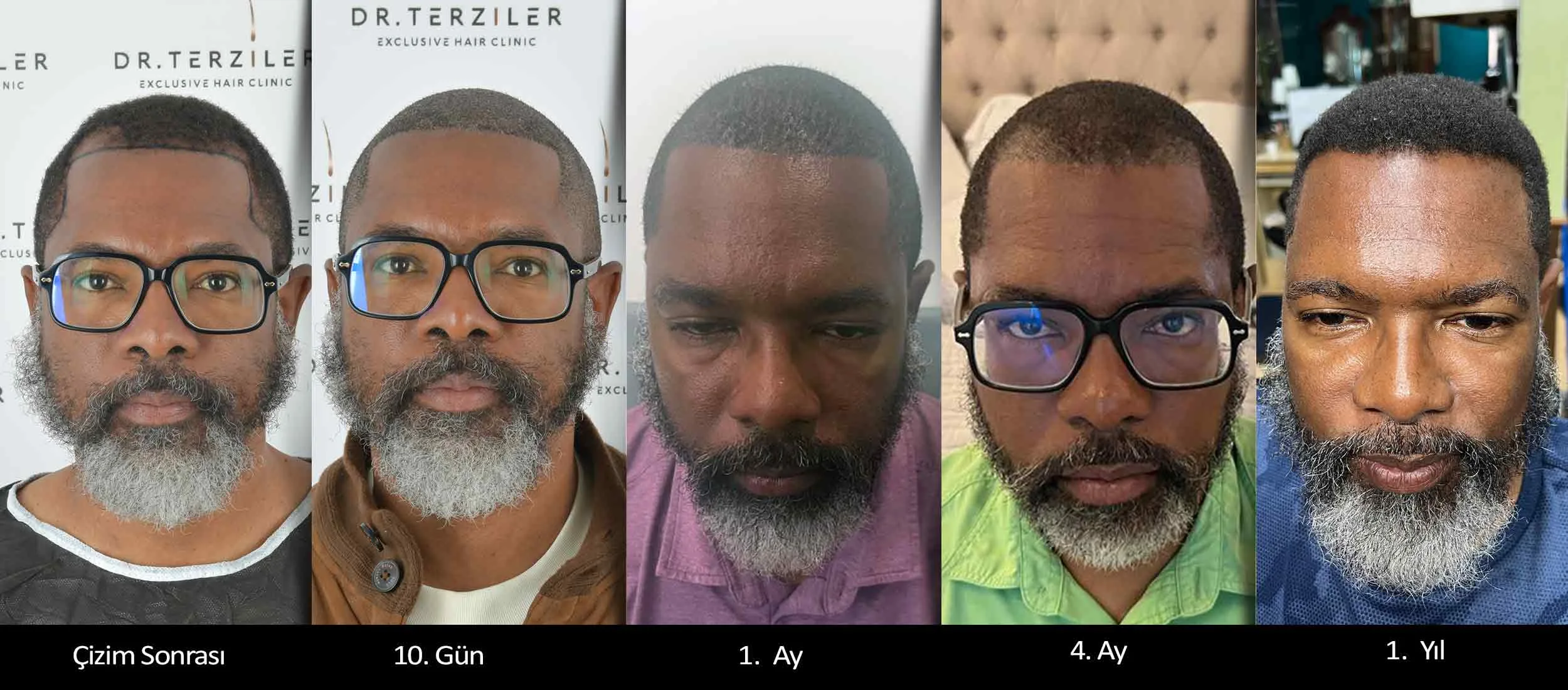
Afro hair transplant recovery usually takes 7 to 14 days for initial healing, 3 to 4 months for early growth, 6 to 9 months for visible density, and 12 to 18 months for mature curl expression.
The recovery biology is similar to other hair transplants, but the visual timeline can feel slower because the curl pattern often matures after the first visible growth appears. Early hair can look finer, softer, or straighter than expected. That does not mean the transplant failed. Afro curl texture usually declares itself gradually as the shaft thickens and the follicle cycles mature.
| Phase | Timeline | What Happens | Afro-Specific Note |
|---|---|---|---|
| Healing | Days 1 to 14 | Scabs form and shed; grafts anchor | Small incisions and careful washing matter for Fitzpatrick V to VI skin |
| Shedding | Weeks 2 to 6 | Transplanted hairs shed while follicles remain alive | This is normal and should not be read as failure |
| Quiet phase | Months 2 to 3 | Little visible growth | Patients often feel anxious here; scheduled follow-up helps |
| Early growth | Months 3 to 4 | Fine new hairs appear | Early Afro regrowth may look less curly at first |
| Density build | Months 4 to 9 | Hair thickens and coverage improves | Low-tension styling may be discussed, but tight tension should wait |
| Curl return | Months 9 to 12 | Curl pattern becomes more visible | Crown and temples may mature at different speeds |
| Final result | Months 12 to 18 | Mature density, texture, and styling potential | This is the fairest point to judge full Afro curl outcome |
Does an Afro Hair Transplant Hurt?
An Afro hair transplant should not hurt during the operation because local anesthesia is used, but injections, pressure, tightness, and early soreness can happen.
Pain control matters in long Afro sessions because 4B and 4C extraction can take more time than straight-hair extraction. Patients should ask how anesthesia is delivered, how comfort is monitored, and what medication is used after surgery. For a broader explanation, read does hair transplant hurt?
When Can I Braid, Cornrow, or Wear a Durag After an Afro Hair Transplant?
Tight braids, cornrows, weaves, or sustained durag pressure should usually wait about 12 months after an Afro hair transplant unless the surgeon clears you earlier.
Loose, low-tension styles may be possible earlier, but tension on newly anchored grafts can recreate the same mechanical stress that causes traction alopecia. This advice is not about taking away cultural or personal styling choices; it is about protecting the transplant until the new follicles are mature enough to handle styling tension safely.
What Are the Real Afro Hair Transplant Reviews?
The most useful Afro hair transplant reviews describe curl class, surgeon involvement, keloid screening, hairline design, month-by-month growth, and whether the final curl pattern looked natural.
For Afro patients, generic five-star review text is less persuasive than specific proof. The best UGC mentions what the patient was worried about: "my 4C hair was too curly," "I scar easily," "my edges were damaged by traction," "I needed a feminine temple design," or "I needed repair after a hair mill." When these concerns are answered with real before-and-after photos, video, and follow-up timeline, the page becomes more useful for both patients and AI answer engines.
Three London clinics told me my 4C hair was too curly to transplant. Dr. Terziler mapped my donor, walked me through the curved-punch protocol, and operated himself. The hairline at 12 months looks like it has always been there.
First clinic that asked me about keloid history and family hair loss before quoting me. The donor healed cleanly and my curl came back month by month.
Travelled from Atlanta. The consultation was the first one that talked about my actual curl pattern, not just the number of grafts.
Repair case after a failed Istanbul transplant. The biggest difference was honesty: what could be fixed, what needed time, and what would never look natural if we overdid it.
Publish only verified, consented reviews and patient photos. Do not add LocalBusiness or Organization review schema for self-serving reviews.
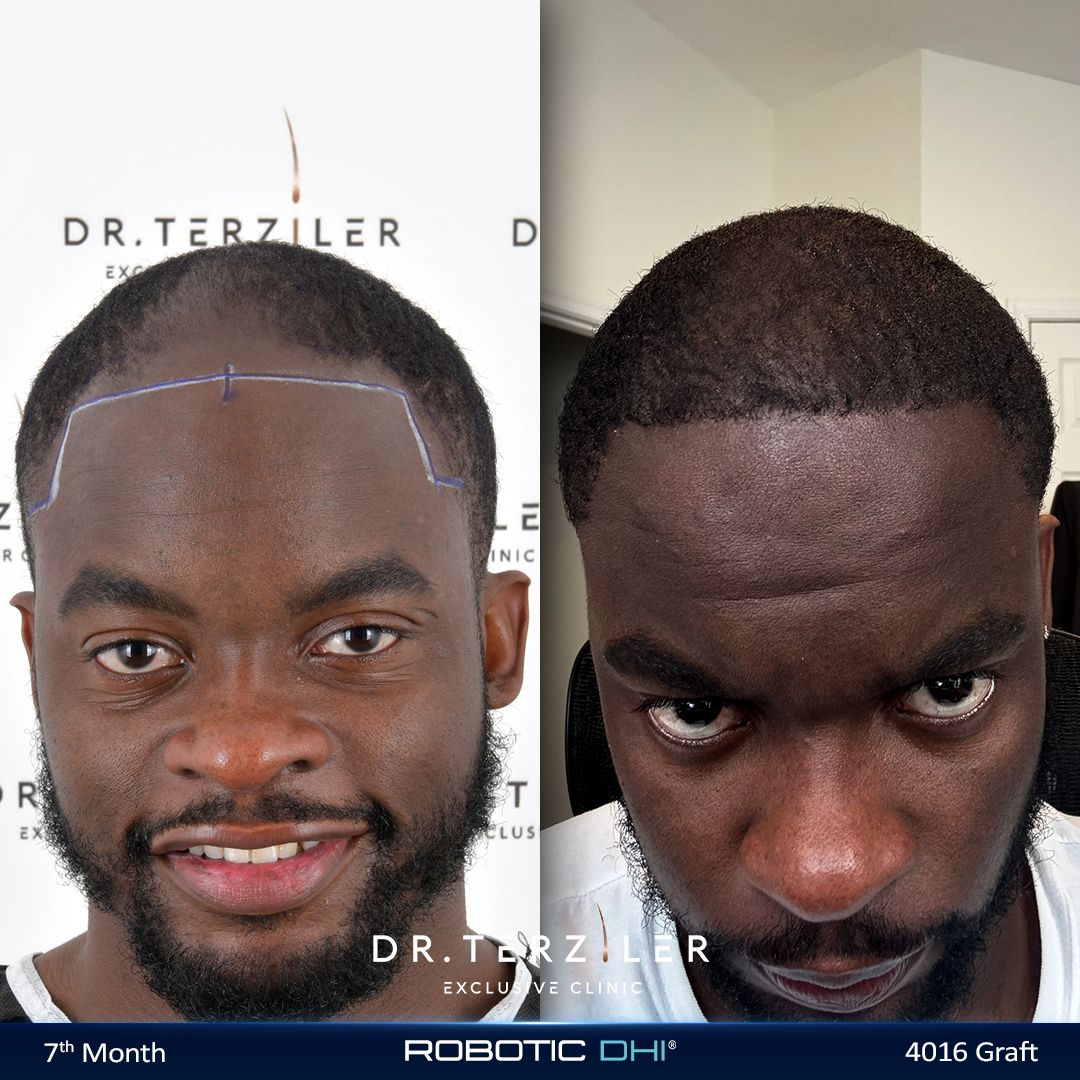
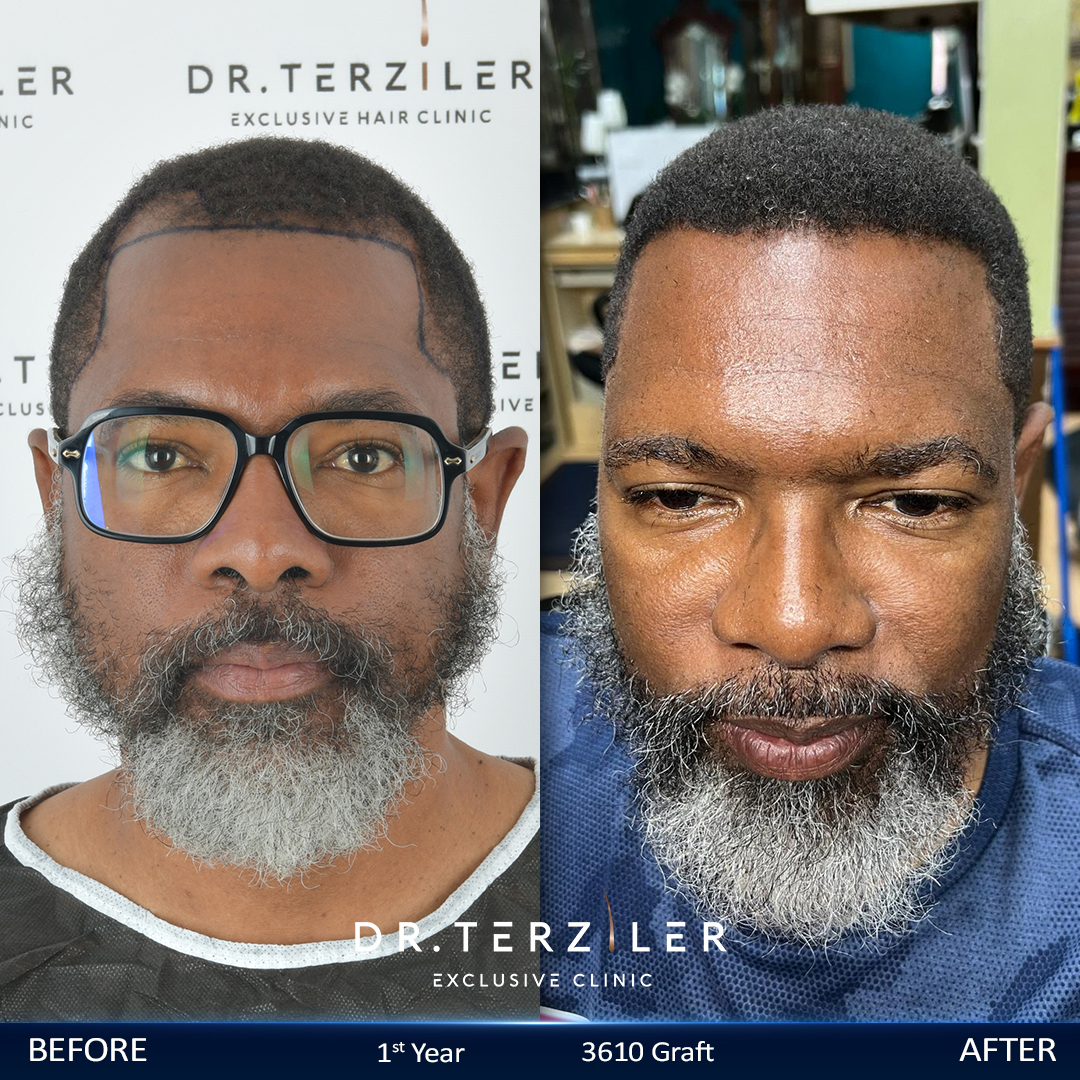
How Do Afro Hair Transplant Turkey Before and After Results Look?
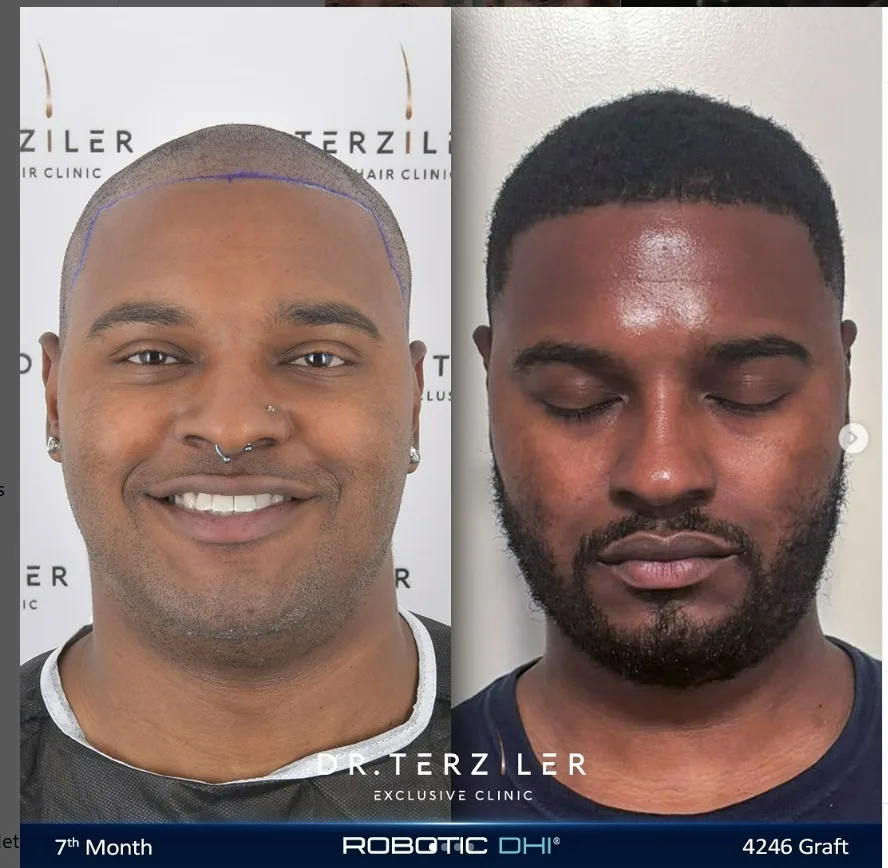
Afro hair transplant before-and-after results should show natural density, correct curl direction, clean donor healing, and a hairline that still looks real at 12 to 18 months.
The strongest before-and-after gallery for Afro hair should not only show day-of-surgery drama. It should include patient consent, curl class, graft count, technique, month of result, primary vs repair status, donor-zone closeups, and different angles. That is the proof Afro patients need before travelling to Turkey.
Why Is Dr. Terziler One of the Best Clinics for Afro Hair Transplant in Turkey?
Dr. Terziler Exclusive Clinic is one of the best Afro hair transplant options in Turkey because its strongest differentiators match what Afro patients actually need: surgeon-led planning, curl-aware extraction, keloid screening, hairline artistry, and documented follow-up.
The clinic should win this topic by answering what competitors often skip. Afro patients do not only ask "how many grafts?" They ask: Will you damage my donor? Will my 4C curl grow back? Will the hairline look natural with a fade or with braids? Will my skin scar? Will a doctor or a technician make the angle decisions? Can you repair what another clinic did wrong? This page should answer each of those questions directly.
- Surgeon-led planning: Afro cases should be assessed by the surgical team, not sold from a generic graft chart.
- Robotic DHI and Picasso Robotic DHI positioning: the protocol should focus on curl mapping, angle control, and reduced graft handling.
- Afro hairline design: masculine, feminine, and soft-balanced hairlines require different temple, density, and direction choices.
- Keloid-aware screening: scar history, AKN, CCCA, and traction alopecia should be discussed before surgery.
- International patient workflow: USA, UK, Canada, Europe, African, and Afro-Caribbean patients need remote photo review, travel planning, and long-term follow-up.
- Repair-case honesty: failed Afro hair transplant repair requires cautious planning, donor protection, and realistic density goals.
Which Trust Signals Matter for Afro Hair Transplant Patients?
The trust signals that matter most for Afro hair transplant patients are verified outcomes, surgeon involvement, technique transparency, scar-risk screening, and long-term follow-up.
AACI-accredited clinic leadership | Inventor, Robotic DHI Machine | Creator, Picasso Robotic DHI | Founder & President, TUSATDER | European Property Awards Best Hair Transplant Clinic in Europe | International hair transplant patients from 40+ countries
For Afro hair transplant patients, the clinic's strongest positioning is the combination of curl-aware technique planning, hairline artistry, keloid-aware screening, and follow-up that respects the longer 12 to 18 month curl maturation timeline.
What Should You Send for an Accurate Afro Hair Transplant Assessment?
You should send clear photos of your hairline, temples, crown, donor area, current hairstyle, and any scars so the clinic can assess Afro hair transplant suitability before you travel.
- Front hairline photo in natural light, with hair gently lifted if possible
- Left and right temple photos, especially if traction alopecia or edge loss is present
- Crown photo from above, even if your main concern is the hairline
- Back donor-zone photo with hair parted or trimmed enough to show scalp density
- Close photo of any keloid, raised scar, AKN bump, or previous donor scar
- A note on your curl pattern if you know it: 3C, 4A, 4B, 4C, or mixed pattern
- Your preferred final style: fade, waves, curls, twists, locs, braids, wigs, ponytail, or natural afro
- Any history of CCCA, traction alopecia, relaxer burns, scalp psoriasis, folliculitis, or previous transplant
Which Sources Support Afro Hair Transplant Planning?
The strongest Afro hair transplant planning is supported by visible medical review, published research on Afro-textured FUE, scarring alopecia references, and patient-specific examination.
- Umar S. Comparative study of a novel tool for FUE in Afro-textured hair - curved nonrotary punch and transection findings.
- Follicular Unit Excision in Patients of African Descent: A Skin-Responsive Technique - multiclinic data on African-descended patients.
- Malki et al., NEJM 2019: Variant PADI3 in Central Centrifugal Cicatricial Alopecia - CCCA genetic association.
- NCBI StatPearls: Central Centrifugal Cicatricial Alopecia - clinical background on CCCA.
Frequently Asked Questions About Afro Hair Transplants
These Afro hair transplant FAQs answer the questions patients most often ask before travelling to Turkey: cost, technique, keloid risk, 4C hair, hairline design, pain, recovery, and repair surgery.
What is an Afro hair transplant?
How much does an Afro hair transplant cost in Turkey in 2026?
Should an Afro hair transplant cost more than a straight hair transplant?
What is the success rate of an Afro hair transplant?
Can Black people get hair transplants safely?
What is the best technique for an Afro hair transplant?
How many grafts do I need for an Afro hair transplant?
What is a curved punch and why does it matter for Afro hair?
What is transection in a hair transplant?
What is CCCA and can it be transplanted?
What is traction alopecia?
Is Afro hair the same as curly hair for transplant purposes?
Do hair transplants cause keloid scars in Black patients?
Why do Afro hair transplants fail?
How long does Afro hair transplant recovery take?
Will my transplanted Afro hair grow back curly?
What is folliculitis keloidalis nuchae or AKN?
Can I braid my hair after an Afro hair transplant?
Does 4C hair need different transplant tools than 4A hair?
Can I get an unshaven Afro hair transplant?
How does scalp thickness affect Afro hair transplant outcomes?
What is the safe donor area for Afro hair transplants?
Are there genetic factors that affect Afro hair transplant suitability?
Why is keloid risk higher in patients of African descent?
Is there a link between keloid formation and hypertension?
Can I get a beard or eyebrow transplant if I have Afro hair?
Should I take finasteride or minoxidil after an Afro hair transplant?
Can biracial or mixed-heritage patients get an Afro hair transplant?
What is the best hair transplant clinic in Turkey for Afro hair?
How do I know if a clinic is genuinely qualified for Afro hair transplants?
Can an Afro hair transplant fix a previously failed transplant?
What is the youngest age for an Afro hair transplant?
Are there any hair transplant techniques that do not work well on Afro hair?
How long should I stay in Turkey for an Afro hair transplant?
What questions should I ask in my Afro hair transplant consultation?
Does an Afro hair transplant hurt?
How should masculine and feminine Afro hairlines be designed?
Questions You May Have
Yes, we offer several payment and installment plans, and your patient coordinator will walk you through the options.
We plan the entire journey for you, including VIP airport transfers and hotel accommodation.
Your journey begins today.
Contact us for a free, personalised consultation. Our team of experts will be by your side every step of the way.