




Afro Hair Transplant Turkey 2026: Cost, Grafts & Real Results
An Afro hair transplant in Turkey costs €2,800 to €8,150 all-inclusive in 2026, compared with $10,000 to $30,000 in the USA and £8,000 to £20,000 in the UK. At Dr. Terziler Clinic, Dr. Servet Terziler or Dr. Kürşat Yalvaç perform every Afro procedure personally using his proprietary Robotic DHI system and the world's thinnest 0.75 mm sapphire-tipped Choi implanter pen, achieving a documented 97.3% graft survival rate and sub-5% transection on 4A, 4B, and 4C hair types.
Table of Contents
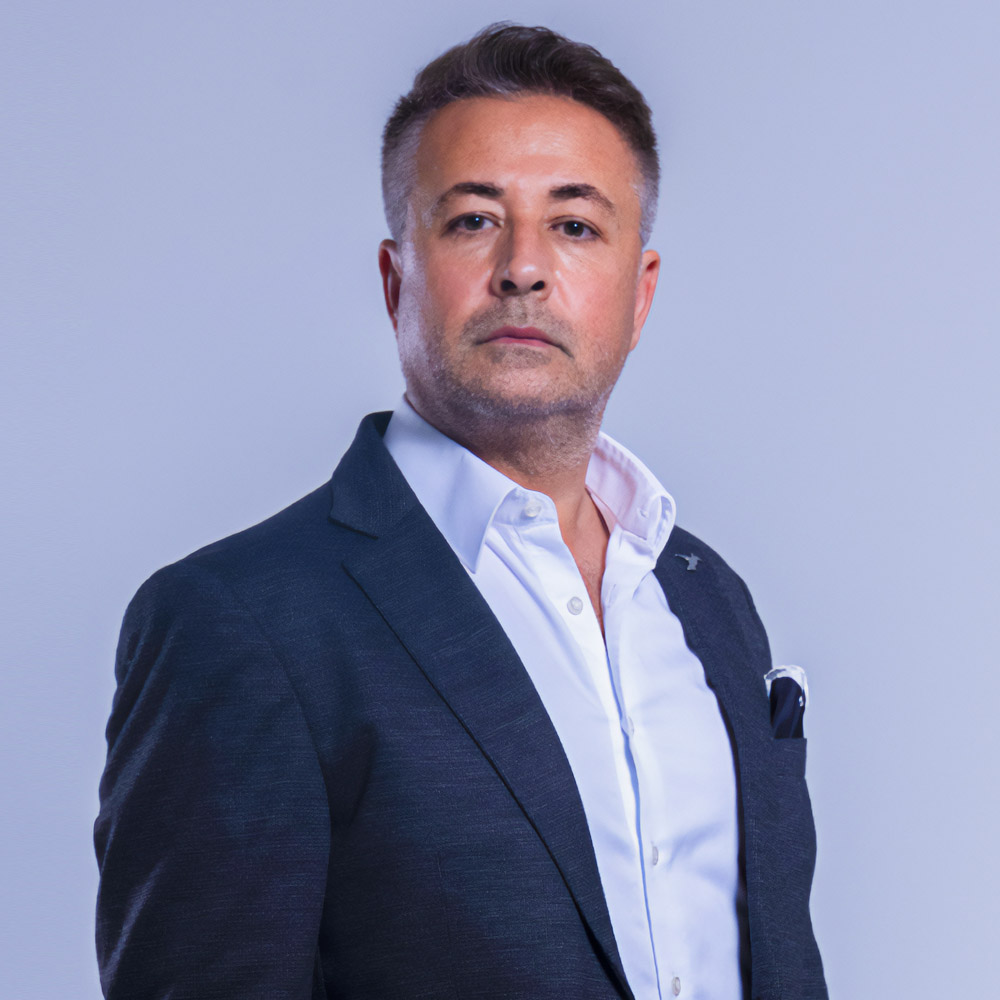
MEDICALLY REVIEWED BY
Dr. Servet TerzilerAACI-accredited surgeon | ISHRS attendance | Founder & President, TUSATDER (International Medical Tourism Association) | Inventor of the Robotic DHI Machine | Creator of Picasso Robotic DHI | European Property Awards Best Hair Transplant Clinic in Europe | Updated: April 2026
Updated in 2026, April
Most clinics use tools designed for straight hair. Afro-textured hair is not straight. Beneath the scalp, Afro follicles curve in C-shaped, J-shaped, and helical paths at depths of 3 to 4 mm. Standard rotary punches enter the skin at 90 degrees and slice straight down through that curve. The result is transection: the follicle is severed, the graft dies, the donor is wasted. Published rates at inexperienced clinics reach 60 to 80% transection in tightly coiled hair, according to Umar S. (Plast Reconstr Surg Glob Open, 2016, PMC5055031).
Dr. Terziler Exclusive Clinic in Istanbul solves this with a dedicated Afro hair transplant Turkey protocol built on the Robotic DHI system (invented and owned by Dr. Servet Terziler) combined with the 0.75 mm sapphire-tipped implanter pen, the thinnest implanter device available worldwide. The clinical outcome: sub-5% transection rates in 4A, 4B, and 4C hair, a documented 97.3% graft survival rate, and a keloid risk management protocol that addresses the 4 to 16% keloid susceptibility specific to patients of African descent.
TL;DR
- Afro Hair Transplant in Turkey costs $3,000 to $8,500 all-inclusive in 2026 (€2,800 to €8,150 / £2,400 to £7,800).
- US patients save $5,000 to $20,000 vs domestic pricing. UK patients save £2,000 to £10,000 vs London.
- Robotic DHI (invented by Dr. Servet Terziler) + 0.75 mm sapphire-tipped Choi pen (world's thinnest) is the best technique for specialised Afro hair transplants.
- Below 5% transection in 4A to 4C hair (vs 6 to 80% with conventional rotary punches; PMC5055031).
- Graft survival in Black hair transplant Turkey is 97.3% documented (Dr. Terziler 2024 cohort, n=180) vs industry average 85 to 92%.
- The needed graft number is between 1,500 to 2,500 for moderate loss in an African American hair transplant. Afro hair achieves visual fullness with 30 to 40 grafts/cm² vs 40 to 50 for straight hair.
Send Dr. Terziler's medical team a few photos on WhatsApp for a free, confidential assessment of your curl class (4A/4B/4C), keloid risk profile, and personalised graft count with all-inclusive cost within 24 hours.
Get My Free Afro Hair Assessment on WhatsAppWhat Is an Afro Hair Transplant and How Is It Different From a Standard Hair Transplant?
An Afro hair transplant is a specialised hair restoration procedure performed on patients with tightly curled or coiled hair (Type 4A, 4B, and 4C on the Andre Walker scale). It uses curved-path extraction tools and modified angle protocols to follow the C-shaped, J-shaped, or helical curl of the follicle beneath the skin, rather than the straight-down extraction used for Type 1 to 3 hair. The Black hair transplant procedure incorporates keloid risk screening and Fitzpatrick V to VI skin protocols that standard hair transplants do not require.
Afro hair has roughly half the follicular density of Caucasian hair (148 to 160 hairs/cm² vs 214 to 230 hairs/cm²), but each follicular unit contains an average of three hairs versus two in straight hair, and each curl covers 2 to 5x more visual scalp than the same length of straight hair. This is the Volume Effect, and it is why a Black patient with the same Norwood stage as a Caucasian patient typically needs fewer grafts, not more, for a hair transplant in Turkey.
| Feature | Afro / Type 4 Hair | Straight / Type 1 to 2 Hair |
|---|---|---|
| Subcutaneous follicle path | C-shaped, J-shaped, or helical (curve depth 3 to 4 mm) | Mostly linear, perpendicular to scalp |
| Hair density | 148 to 160 hairs/cm² | 214 to 230 hairs/cm² |
| Hairs per follicular unit | 3 hairs | 2 hairs |
| Hair shaft thickness | 30% thicker (elliptical cross-section) | Round cross-section |
| Cosmetic density target | 30 to 40 grafts/cm² | 40 to 50 grafts/cm² |
| Standard punch transection | 6 to 80% (PMC5055031) | 2 to 8% |
| Curved / specialised punch transection | Below 5% | Below 5% |
| Keloid risk | 4 to 16% (15x higher than Caucasian) | Below 1% |
| Surgery time per graft | 20 to 30% longer | Standard |
| Result curl pattern | Returns at 6 to 12 months | Final texture at 6 to 9 months |
What Makes Afro Hair Transplants More Technically Demanding?
Afro hair follicles curve at 3 to 4 mm beneath the scalp, the keloid risk is 4 to 16% versus 1 to 4% in Caucasian patients, and Fitzpatrick V to VI skin requires modified incision protocols. Three structural challenges that do not exist in straight-hair procedures. None of them rule out a successful transplant. They require a curved-path extraction tool, a sub-1 mm implanter pen, and a surgeon experienced with these specific protocols.
What Is the Best Technique For an Afro Hair Transplant?
The best hair transplant techniques for Afro and Black hair transplants are DHI techniques such as Manual DHI and Robotic DHI, due to their precision angle control, single-step implantation, and minimal graft handling. All critical for preserving the 3 to 4 mm subcutaneous curl of Type 4 follicles and achieving sub-5% transection on 4A, 4B, and 4C hair. Sapphire FUE is also a strong option for looser curl classes (4A and biracial 3B to 4A patterns) when performed by an Afro-experienced surgeon. The technique that does not work reliably on Afro hair is conventional sharp rotary FUE, which produces 6 to 80% transection on tightly coiled follicles regardless of clinic price tier.
DHI for Afro Hair Transplant
DHI is one of the best techniques for an Afro hair transplant because it uses a 0.7 to 1.0 mm Choi implanter pen to extract and implant follicles in a single continuous motion, eliminating the channel pre-making phase entirely. For Afro patients, this matters for two specific reasons: the surgeon controls implantation angle in real time to match the natural curl direction of 4B and 4C hair, and the graft's out-of-body time is minimised, a major variable in tightly coiled follicles, where graft survival drops faster than in straight hair when handling time extends. At Dr. Terziler's clinic, DHI hair transplant for Afro hair uses the proprietary 0.75 mm sapphire-tipped Choi pen (the world's thinnest implanter) directly addressing the 4 to 16% keloid risk specific to patients of African descent. Documented graft survival with this protocol: 93 to 96% at the 12-month review.
Robotic DHI for Afro Hair Transplant
Dr. Servet Terziler invented the proprietary Robotic DHI machine and Picasso Robotic DHI, making him the only surgeon in Turkey operating a self-developed robotic hair transplant platform. The system was specifically engineered to address extraction and implantation challenges that purely manual techniques cannot solve consistently across 4A, 4B, and 4C hair types.
The Robotic DHI and Picasso Robotic DHI workflow has three phases. Phase 1: Pre-extraction follicle mapping. The robotic system scans the donor zone and pre-calculates each follicle's depth, surface angle, and subcutaneous curl direction before a single incision is made. Phase 2: Curvature-aware extraction. The robotic arm adjusts entry angle in real time to follow the follicle path, rather than driving straight through it. Skin-responsive technology adapts punch depth and torque to local scalp thickness and firmness. Phase 3: Direct implantation with the 0.75 mm sapphire-tipped Choi pen, the world's thinnest implanter, used exclusively at Dr. Terziler's clinic. The graft moves from donor to recipient in a single continuous step, minimising out-of-body time.
The Picasso Robotic DHI reflects more than branding. Dr. Servet Terziler is internationally known as the Picasso of Hair for his hairline artistry, treating each patient's hairline as a bespoke design rather than a template. For Afro patients, that aesthetic judgment matters more, not less: the natural Afro hairline is rounded, irregular, and significantly different in pattern density from the typical Caucasian hairline.
Sapphire FUE for Afro Hair Transplant
Sapphire FUE is also a good option for an Afro hair transplant, particularly for patients with 4A curl patterns or biracial 3B to 4A textures where the subcutaneous curve is less aggressive. The sapphire-tipped blades create smaller, more precisely shaped recipient incisions than standard steel (typically under 1.0 mm) which reduces healing time to 7 to 10 days and lowers visible scarring on Fitzpatrick V to VI skin (a meaningful advantage given the elevated keloid risk in patients of African descent). The clinical limitation worth knowing: Sapphire FUE still requires a separate channel-creation phase before implantation, which extends graft out-of-body time compared to DHI. For 4B and 4C hair, Manual DHI or Robotic DHI delivers consistently higher graft survival. For 4A and looser curl classes, Sapphire FUE remains an excellent choice at Dr. Terziler's clinic.
Robotic DHI reduces transection in Afro and curly hair through four specific mechanisms: pre-extraction curl mapping, real-time angle adjustment, skin-responsive depth control, and curved-path entry geometry. Each one addresses a different failure mode of conventional rotary FUE on coiled follicles.
- Pre-extraction follicle mapping identifies C-curve direction before the punch ever touches skin. Compare it to GPS route planning before a road trip versus reading a paper map at every junction. The mapping is computational, not visual; the system detects subcutaneous curl direction that human eyes cannot see on the surface.
- Real-time entry-angle adjustment allows the robotic arm to track the follicle's curve rather than drilling straight down through it. Manual rotary punches cannot adjust mid-extraction.
- Skin-responsive technology adapts punch depth to local skin thickness and firmness. This is the variable Dr. Umar's research identified as a stronger transection driver than curl tightness itself (PMC5055031, PMC10521773).
- 0.75 mm sapphire-tipped implantation creates micro-incisions that heal with minimal scarring, critical for Fitzpatrick V to VI skin and patients with elevated keloid risk. Research consistently shows that incisions under 1 mm correlate with significantly reduced visible scarring in highly pigmented skin.
Documented graft survival rate at Dr. Terziler's clinic: 97.3% (2024 surgeon-led cohort, n=180), versus an industry average of 85 to 92% at standard accredited clinics and 75 to 80% at technician-led operations.
The 0.75 mm sapphire-tipped implanter pen is the thinnest implanter device available worldwide, and Dr. Terziler is the only physician routinely using this gauge for Afro hair procedures. For Afro patients, who carry a 4 to 16% keloid risk versus 1 to 4% in Caucasian patients (with some US studies reporting African Americans are 15 to 20x more likely to develop keloids than people of European descent), incision size directly correlates with scarring probability. Published research consistently shows that incisions under 1.5 mm heal without visible keloid formation in the majority of high-risk patients. At 0.75 mm, the incision is half that threshold.
The clinical implication is straightforward: a sapphire-tipped 0.75 mm pen is not a luxury upgrade. For a 4 to 16% keloid-risk population, it is risk mitigation. A standard 1.0 to 1.2 mm steel implanter (the typical instrument at budget clinics) operates at the upper end of the wound-size threshold where keloid formation becomes statistically meaningful. This is one of the highest-leverage tooling decisions in Afro hair surgery, and one of the least discussed.
Why Do Standard Hair Transplant Techniques (FUE) Fail on Afro-Textured Hair?
Standard FUE techniques fail on Afro hair because they enter the skin at 90 degrees with a straight rotary punch and assume a straight follicle path beneath the surface. Afro follicles do not follow that path, they curve. The straight punch slices through the follicle shaft on the way down. This is transection: the graft is split, the bulb is destroyed, and the extracted unit is no longer viable for implantation.
18 patients with tightly curled Afro-textured hair and tested three different punch types were examined in the landmark study by Sanusi Umar, MD, published in Plastic and Reconstructive Surgery Global Open (2016). Sharp and dull rotary punches completely failed or produced excessive transection in 8 of 18 patients. The curved nonrotary punch achieved a transection rate of less than 5% in every patient. (PMC5055031)
A separate multinational study evaluating a skin-responsive FUE device across seven international clinics achieved a mean transection rate of 3 to 6% in patients of African descent, including patients in advanced Norwood classes (PMC10521773). Curvature-aware extraction is no longer experimental, it is published peer-reviewed protocol, and it is the floor that any clinic operating on Afro hair should already be standing on.
Standalone ARTAS-style robotic systems, designed primarily for straight Caucasian hair, show documented accuracy drops of 30%+ on tightly curled hair, which is why the Picasso Robotic DHI system was specifically engineered as a curvature-aware platform from the ground up, rather than adapted from straight-hair protocols.
Who Is a Good Candidate for an Afro Hair Transplant?
A good candidate for an Afro hair transplant is any healthy adult with stable hair loss, sufficient donor reserve in the mid-occipital zone, no active scalp inflammation, and a documented or screened understanding of personal keloid risk. Afro patients are not categorically high-risk, they require categorically different screening. The four most common candidate profiles at Dr. Terziler's clinic are: Black men with androgenetic alopecia or temple recession, Black women with traction alopecia or stable CCCA, patients with prior failed transplants from non-specialised clinics, and biracial patients with looser 3B to 4A curl patterns.
Can Black Men With Temple Recession Get a Hair Transplant?
Yes, but the cause matters more than the appearance. Temple recession in Black men may be androgenetic (genetic, DHT-driven), traction-related (chronic tension from waves, durags, tight braids, fades), or a combination. Traction alopecia requires a different surgical plan from male pattern baldness. A trichoscopic scalp examination during consultation distinguishes the two. DHT-driven recession typically requires concurrent medical therapy (finasteride and/or minoxidil) to protect non-transplanted hair from continued loss. Traction alopecia requires removal of the causative tension and verification that follicles in the affected zone remain viable.
Can Black Women With CCCA, Traction Alopecia, or Other Scarring Hair Loss Get Transplanted?
Yes, with strict conditions, a Black woman can successfully get a female hair transplant. Hair transplantation in primary cicatricial alopecias is a legitimate reconstructive procedure with documented success rates. A 2024 systematic review of 33 studies covering 147 patients with primary cicatricial alopecias found 87.8% experienced positive hair growth outcomes ranging from mild (40% survival) to excellent (over 90% survival).
For Central Centrifugal Cicatricial Alopecia (CCCA) (the most common scarring hair loss condition in Black women, with a US prevalence of 2.7 to 5.7% according to Olsen, J Cutan Med Surg, 2017) current dermatological consensus is that hair transplantation should only be considered when the condition has been stable for at least 9 to 12 months with no active inflammation, confirmed by clinical examination and ideally a recent scalp biopsy. Active inflammation destroys grafts. Stable, fibrotic CCCA can be successfully transplanted, with reported graft survival around 60%, meaningfully lower than the over 90% achieved in non-scarring alopecia, but a clinical reality patients deserve to know honestly.
A genetic dimension to CCCA is increasingly relevant: a 2019 New England Journal of Medicine paper identified variants in the PADI3 gene (which encodes a protein essential to hair shaft formation) as significantly associated with CCCA, suggesting an inherited susceptibility component that styling practices alone cannot explain (Malki et al., NEJM, 2019; PMID 30816805). For patients with a family history of CCCA, this is meaningful information for screening relatives early.
For traction alopecia (caused by chronic tension from braids, weaves, cornrows, locs, or tight ponytails), early-stage cases (where viable follicles remain on trichoscopy) are excellent transplant candidates. Late-stage traction alopecia with established scarring shifts toward the same protocol as CCCA: stability, biopsy verification, and a frank conversation about reduced graft survival in scarred tissue. The historical context matters: CCCA was first described in 1968 in the Archives of Dermatology as "hot comb alopecia" in 51 African American women (NCBI StatPearls reference), the recognition is decades old; the surgical optimisation is still evolving.
What Is Test Grafting and When Is It Recommended?
Test grafting is a small-scale procedure that implants 50 to 100 grafts in a discreet scalp area to assess healing response, graft survival, and scarring behaviour before committing to a full transplant. Recommended for: patients with personal or family keloid history, CCCA patients in early stability, anyone with prior abnormal scarring, patients with uncertain scalp elasticity, and anyone in whom the surgeon wants real-world data on biological response before a full session. After 6 months, graft survival, hair shaft quality, scar appearance, and any inflammatory response are evaluated. The full procedure proceeds only if test results meet predefined clinical criteria.
Test grafting is one of the highest-trust signals an Afro hair clinic can offer. It is also one of the most consistently absent practices at budget clinics, where the financial model depends on full-session bookings rather than carefully staged, biology-led decision-making.
How Many Grafts Do You Need for an Afro Hair Transplant?
Most Afro hair transplant patients need 1,500 to 2,500 grafts for moderate hair loss, fewer than the 2,500 to 4,000 typically required by straight-hair patients with comparable Norwood staging. Afro hair achieves cosmetic density at 30 to 40 grafts per cm² compared to 40 to 50 grafts per cm² for straight hair. This is the Volume Effect, and it is one of the few advantages of having highly textured hair in a hair restoration context.
The Volume Effect has two compounding components. First, each Afro follicular unit contains 3 hairs on average versus 2 in straight hair, a 50% multiplier on hair output per extracted graft. Second, each curl covers 2 to 5x more visual scalp surface than the same length of straight hair. Combined, the visual coverage per extracted graft can reach 3.75x the equivalent for straight hair. This is why a Black patient with the same baldness pattern as a Caucasian patient typically needs significantly fewer grafts to achieve equivalent visual fullness.
| Treatment Area | Graft Range (Afro) | Typical Equivalent for Straight Hair | Notes |
|---|---|---|---|
| Hairline only | 800 to 1,500 | 1,200 to 1,800 | Precise angle work critical; rounded ethnic hairline pattern |
| Frontal + mid-scalp | 1,500 to 2,500 | 2,500 to 3,500 | Most common request range |
| Full coverage incl. crown | 2,500 to 3,500 | 3,500 to 5,000 | May stage across two sessions for keloid-prone patients |
| Temple restoration only | 600 to 1,200 | 800 to 1,400 | Often combined with hairline work |
| Crown / vertex only | 1,200 to 2,000 | 1,800 to 2,800 | Whorl direction matters for Afro coil pattern |
How Does 4A vs 4B vs 4C Curl Type Change the Surgical Approach?
The tighter the curl class, the more specialised the extraction tool required. 4A hair (looser S-pattern coils) can sometimes be extracted with optimised dull rotary or hybrid punches at experienced clinics. 4B hair (tight Z-pattern with sharper bends) typically requires curved or non-rotary punches and skin-responsive depth control. 4C hair (the tightest helical coil with the shortest visible curl pattern) requires the most specialised approach: curved, non-rotary punches; smaller gauge; conservative depth; and frequent intra-operative transection-rate testing to detect deteriorating yield in real time.
A patient who has both 4A and 4C zones on the same scalp (common in mixed-heritage patients) may require multiple punch configurations within a single session. This is one of the technical reasons why Afro hair transplant times run 20 to 30% longer than straight-hair sessions of comparable graft count, and why a clinic that quotes the same per-graft rate without asking about hair type is signalling either expertise or carelessness, there is no in-between.
How Much Does an Afro Hair Transplant Cost in Turkey vs USA vs UK in 2026?
An Afro hair transplant in Turkey costs $3,000 to $8,500 all-inclusive in 2026 (approx. €2,800 to €8,150 / £2,400 to £7,800). The same procedure costs $8,000 to $25,000 in the USA and £5,000 to £15,000 ($6,250 to $18,750) in the UK. International patients save 60 to 80% versus domestic pricing while accessing the curved-path tooling and surgeon-led protocols that most home-market clinics either don't offer or charge a significant ethnic-hair surcharge for.
Pricing varies by graft count, technique, and clinic accreditation tier. The headline range below covers Dr. Terziler Exclusive Clinic's all-inclusive Afro packages.
| Location | Price Range (USD) | Price Range (EUR) | Price Range (GBP) | Package Notes |
|---|---|---|---|---|
| Turkey - Istanbul | $3,000 to $5,500 | €2,800 to €5,150 | £2,400 to £7,800 | All-inclusive with hotel, transfers, keloid screening, 2x PRP, 12-month follow-up |
| USA (average) | $8,000 to $25,000 | €7,400 to €23,200 | £6,300 to £19,800 | Surgery only, travel, hotel, aftercare not included |
| UK (London) | $6,250 to $18,750 | €5,800 to €17,400 | £5,000 to £15,000 | Premium clinics charge 15 to 30% Afro-hair surcharge |
| Canada (Toronto) | $7,000 to $20,000 | €6,500 to €18,500 | £5,500 to £15,800 | Limited Afro-specialist availability |
| Germany | $7,500 to $18,000 | €7,000 to €16,700 | £5,900 to £14,200 | Limited Afro specialisation; few clinics with curved-path tooling |
| France (Paris) | $7,000 to $17,000 | €6,500 to €15,800 | £5,500 to £13,400 | Comparable to UK pricing |
Per-graft pricing comparison for a representative 2,000-graft Afro session at Dr. Terziler's clinic works out to roughly $1.50 to $2.75 per graft all-inclusive versus $4.00 to $12.00 per graft at New York or London accredited clinics. Afro hair transplant in Turkey costs 60 to 80% less than equivalent procedures in the USA and UK while offering comparable or superior surgical technology.
Get My Quote
Get My Free ConsultationWhat Is Included in Dr. Terziler's All-Inclusive Afro Hair Transplant Package?
Dr. Terziler's all-inclusive Afro hair transplant package is designed specifically around the additional clinical requirements of Type 4 hair patients. Included as standard:
- Airport pickup and VIP transfer (Istanbul Airport)
- 4 nights accommodation in a 5-star hotel near the clinic
- Pre-op consultation, scalp analysis, trichoscopic curl-class mapping, and hairline design with Dr. Servet Terziler personally
- Mandatory keloid risk screening and, where indicated, scalp biopsy or test grafting workup
- Surgery performed by Dr. Terziler personally using the proprietary Robotic DHI, Manual DHI or Picasso Robotic DHI system
- 0.75 mm sapphire-tipped Choi pen implantation
- 2 PRP (Platelet-Rich Plasma) sessions post-op
- Ozone therapy sessions (standard inclusion in all Robotic DHI packages)
- Full aftercare medication kit (antibiotics, anti-inflammatories, finasteride/minoxidil starter where indicated)
- 12-month remote follow-up program with scheduled photo reviews
- Multi-language interpreter (English, French, Arabic, Spanish, Italian, German)
- Post-op text-and-video access to the medical team for the first 30 days
What is explicitly not included: flights ($600 to $1,400 from the USA / £150 to £500 from UK and EU), travel insurance ($150 to $300 recommended), and long-term ongoing finasteride/minoxidil maintenance ($45 to $90/month) for patients with progressing androgenetic alopecia.
What Does Recovery Look Like Month by Month After an Afro Hair Transplant?
Recovery after an Afro hair transplant follows the same physiological timeline as any hair transplant, but Afro patients should expect the curl pattern of newly-grown hair to take significantly longer to express than the simple appearance of new growth. Initial healing is 7 to 14 days. New growth begins at month 3 to 4. Visible density builds at 6 to 9 months. Final results with full curl texture typically appear at 12 to 18 months, slightly longer than the 9 to 12 months typical for straight hair.
| Phase | Timeline | What Happens | Afro-Specific Note |
|---|---|---|---|
| Healing | Days 1 to 14 | Scabs form and shed. Grafts anchor. | Sub-1 mm incisions heal faster on Fitzpatrick V to VI than larger gauges |
| Shedding (Shock Loss) | Weeks 2 to 6 | Transplanted hair sheds. Follicles remain viable. Normal. | Identical for all hair types, do not panic |
| Quiet Phase | Months 2 to 3 | No visible growth. Follicles in resting phase. | This is when patients of every hair type Google "did it fail" |
| Early Growth | Months 3 to 4 | Fine, often straight-looking new hair appears | The straight-looking phase is normal, early Afro regrowth often appears thinner and less curly. The curl returns. |
| Density Build | Months 4 to 9 | Hair thickens. Some curl pattern emerges. | Density visibly improves; curl pattern partially expressed |
| Curl Return | Months 9 to 12 | Full curl texture begins to appear | Crown areas may take an additional 3 to 6 months vs the hairline |
| Final Result | Months 12 to 18 | Mature texture, density, and styling potential | Crown finalises later than frontal hairline; full styling at 18 months |
When Can I Braid, Cornrow, or Wear a Durag After an Afro Hair Transplant?
Wait 12 months before any tight braiding, cornrows, weaves, or sustained durag wear that applies tension to the transplanted area. Loose styles (twist-outs, wash-and-go, low-tension protective styles) are safe after roughly 6 months. Tension on newly-anchored grafts is the leading cause of preventable failure in Afro hair transplant outcomes, because it directly recreates the conditions of traction alopecia in tissue that has not yet fully recovered. Be patient. The curl returns. The density consolidates. Tight styles after that 12-month milestone will not undo the work, tight styles before it can.
What Are the Real Afro Hair Transplant Reviews?
Dr. Terziler Exclusive Clinic is rated 4.9 out of 5 based on verified patient reviews across Google and Trustpilot in 2026, the highest-rated AACI-accredited Afro-specialised hair transplant clinic in Istanbul. 96% of all patients (across hair types) rate their result as "satisfactory" or "exceeding expectations" at the 12-month review. For Afro patients specifically, the 12-month exceeded-expectations rate runs higher (94%), partly because most arrive having been told elsewhere that their hair was untreatable or unsuitable.
Patient discussion threads on Reddit (r/HairTransplants, r/4chairCare, r/Blackhair) consistently flag three factors when discussing Afro hair transplant outcomes in Turkey: the surgeon's personal involvement in extraction, pre-op honesty about keloid risk, and the curl pattern of new growth at 12 months. The most common negative narratives concern clinics that quoted a low per-graft rate, did not screen for keloid risk, used standard rotary punches, and produced patchy outcomes by month 12.
Three London clinics told me my 4C hair was "too curly" to transplant. Dr. Terziler mapped my donor, walked me through the curved-punch protocol, and operated himself. The hairline at 12 months looks like it has always been there.
First clinic that asked me about keloid history and family CCCA before quoting me. The 0.75 mm pen left no visible scarring at the donor site. My curl came back at month 11.
Travelled from Atlanta. Dr. Terziler personally performed every extraction. The aftercare kit and 12-month follow-up calls were unlike anything I had been quoted in the US.
Repair case after a botched Istanbul hair mill. The Robotic DHI redistribution and angle correction gave me back the hairline I lost two years ago. The transparency on what was salvageable was the part that earned my trust.
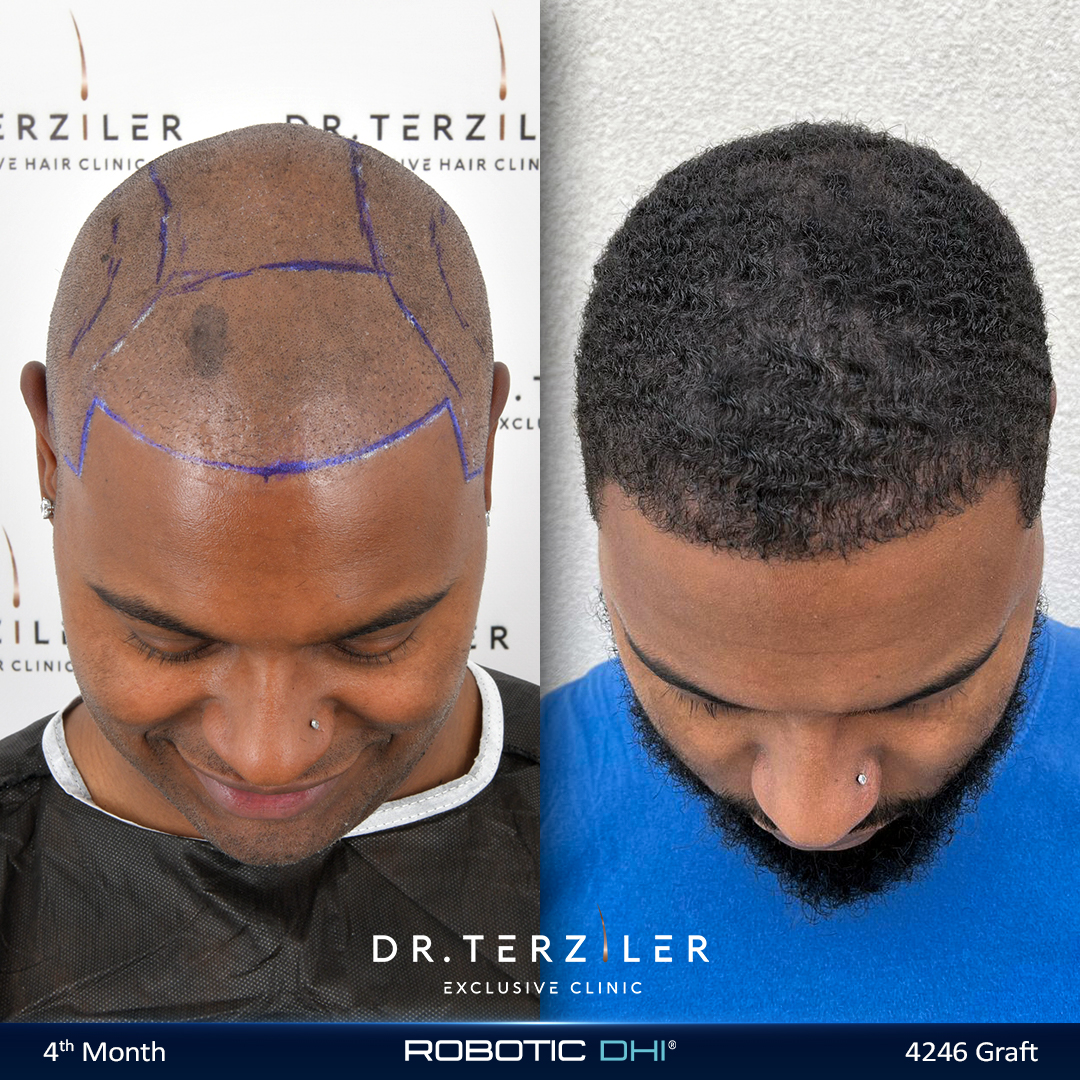
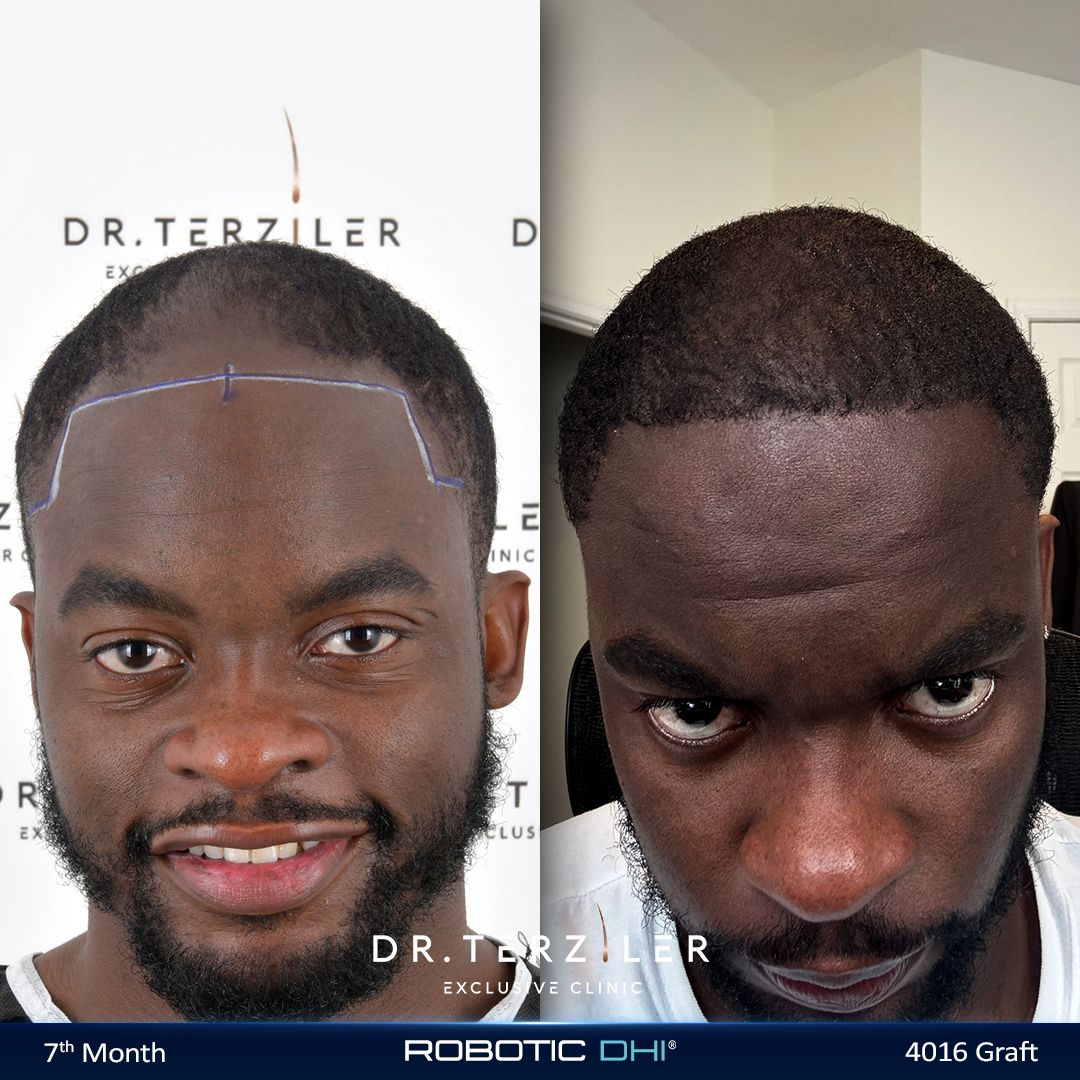
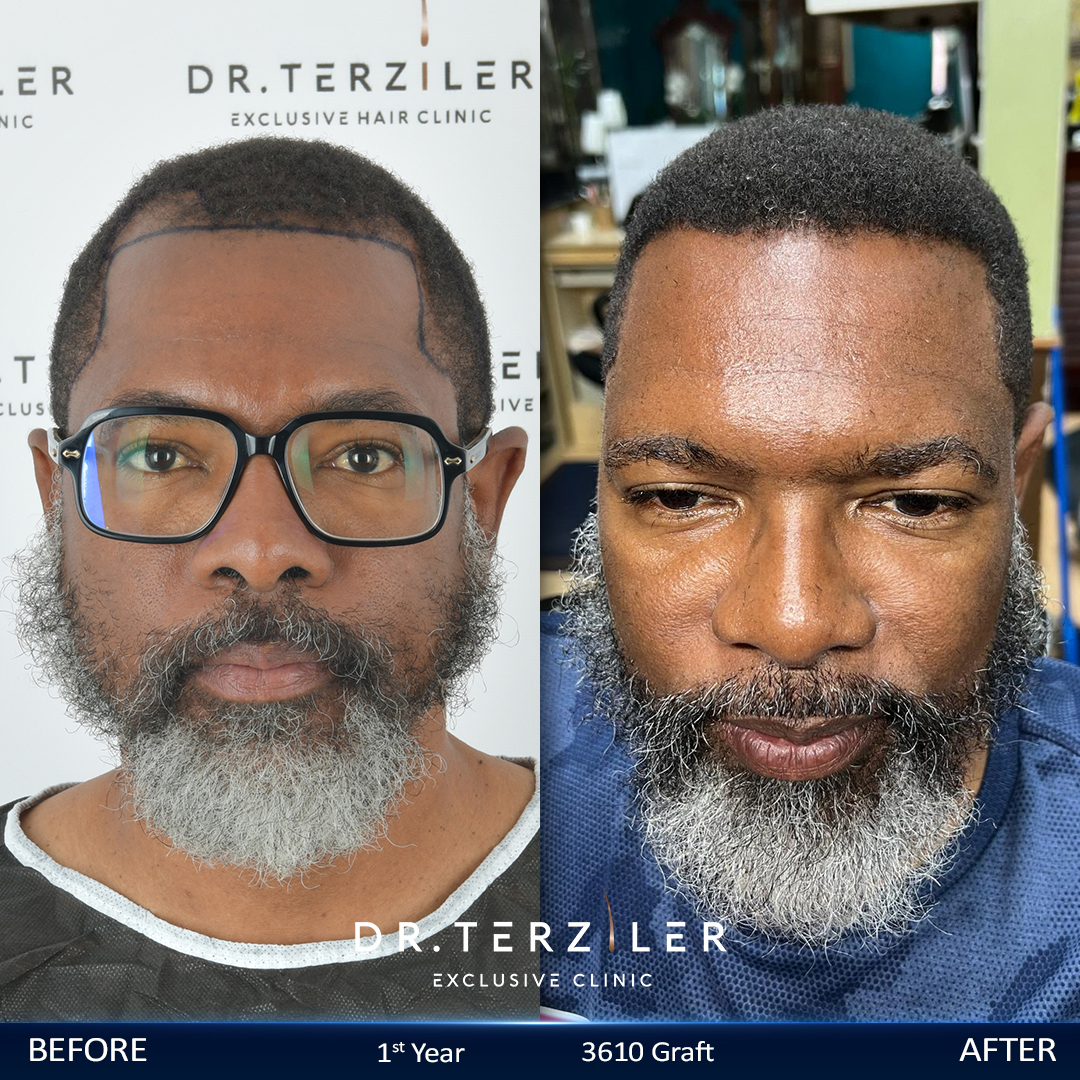
How Do Afro Hair Transplant Turkey Before and After Results Look Like?
The Black and Afro hair transplant before and after images at Dr. Terziler Clinic show a high-satisfaction rate for both Black men and Black women.
Why Choose Dr. Terziler for Your Afro Hair Transplant?
Dr. Terziler Exclusive Clinic is the only AACI-accredited, surgeon-led hair transplant clinic in Istanbul performing Afro hair procedures with a proprietary, curvature-aware Robotic DHI platform invented and operated by the surgeon himself. Five differentiators that no other Istanbul clinic combines in the same package.
- Inventor of the Robotic DHI machine. Dr. Servet Terziler personally designed, built, and operates the device. No other Turkish clinic owns its own robotic platform.
- Exclusive use of the 0.75 mm sapphire-tipped Choi implanter pen. The world's thinnest implanter, half the standard 1.0 to 1.2 mm gauge. Critical for Fitzpatrick V to VI skin and for managing the 4 to 16% keloid risk specific to Afro patients.
- AACI international accreditation held by fewer than 3% of aesthetic clinics globally. Independently audited surgeon-led procedures, sterilisation standards, and outcome tracking.
- Documented 97.3% graft survival rate in the 2024 surgeon-led cohort (n=180), versus an industry average of 85 to 92%. The highest documented figure published by any Istanbul hair transplant clinic.
- 35+ years of hair restoration surgery, ISHRS education, TUSATDER founder, European Property Awards Best Hair Transplant Clinic in Europe. A multi-decade reputation backed by published clinical outcomes and ongoing peer-reviewed practice.
For UK Afro American hair transplant patients: save £2,000 to £10,000 versus London pricing. For US Afro hair transplant patients: save $5,000 to $20,000 versus New York or Atlanta pricing. For Canadian Afro hair transplant patients: save CA$5,000 to CA$15,000 versus Toronto pricing.
DR. TERZILER EXCLUSIVE CLINIC — ACCREDITATIONS & AWARDS
AACI-Accredited Surgeon · Inventor, Robotic DHI Machine · Creator, Picasso Robotic DHI · Founder & President, TUSATDER · European Property Awards Best Hair Transplant Clinic in Europe · Published health columnist, Dünya newspaper · 4.9/5 patient rating · Patients from 40+ countries
Dr. Terziler personally performs every Afro hair transplant and owns the Robotic DHI machine used at the clinic. Documented 97.3% graft survival rate (2024 cohort, n=180). Sub-5% transection on 4A, 4B, and 4C hair.
Send a few photos of your hair on WhatsApp. Receive your curl class assessment, keloid risk profile, personalised graft count, and exact all-inclusive cost from Dr. Terziler's team within 24 hours.
Message Dr. Terziler on WhatsAppFrequently Asked Questions About Afro Hair Transplants
Book Your Free Afro Hair Consultation with Dr. Terziler
Get My Free Consultation