





Picasso Robotic DHI: The Artistic Hairline Method by Dr. Terziler
Picasso Robotic DHI is the artistic hairline package at Dr. Terziler Exclusive Clinic in Turkey, Istanbul. The package combines three things: the Robotic DHI machine that Dr. Servet Terziler invented, a 0.75 mm Choi implanter pen (the world's thinnest in clinical use), and a hairline that Dr. Terziler hand-draws on each patient before surgery. The clinic targets up to 60 grafts per cm² at the hairline, 35° to 45° angulation, 3.5 to 4.5 mm depth, average graft out-of-body time under 90 seconds, and a 98.1% graft survival rate at month 12 (internal audit, n=120). Dr. Terziler clinic holds AACI international accreditation (Cert No. C150-2022-ACC-TR-IEEA, Standards V5.0) and a Turkish Ministry of Health International Health Tourism Authorization (Cert No. ST-1905).
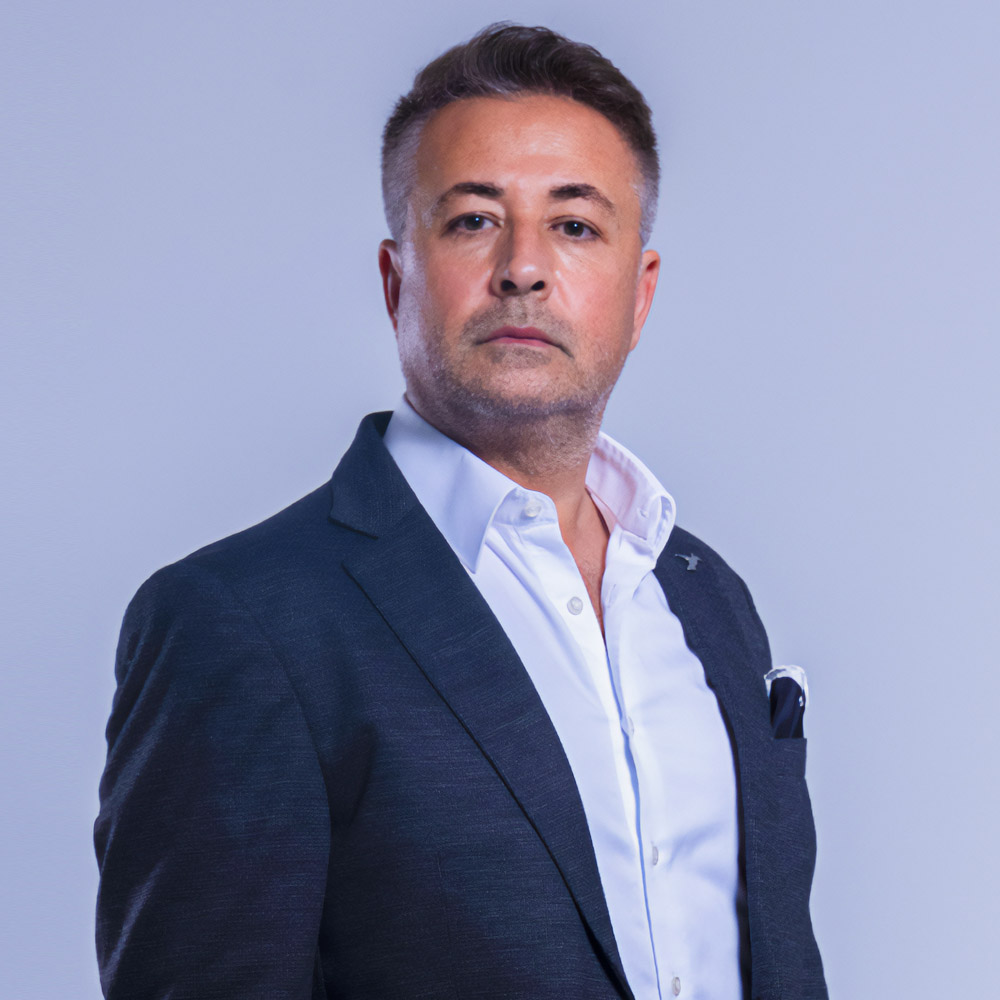
MEDICALLY REVIEWED BY
Dr. Servet Terziler
AACI-accredited surgeon, inventor of the Robotic DHI machine, founder and president of TÜSATDER, ISHRS workshop alumnus (34.55 AMA PRA Category 1 credits), and the surgeon internationally referred to as the "Picasso of Hair."
Updated in 2026, April
- Picasso Robotic DHI is the artistic hairline package at Dr. Terziler Exclusive Clinic in Beşiktaş, Istanbul. It pairs the Robotic DHI machine that Dr. Servet Terziler invented with a 0.75 mm Choi implanter pen and a hairline drawn by Dr. Terziler personally.
- Average graft survival is 98.1% at month 12 (internal audit, n=120). Hairline density targets up to 60 grafts/cm². Implantation depth 3.5 to 4.5 mm, angulation 35° to 45°, average out-of-body time under 90 seconds.
- The 0.75 mm Choi pen used in Picasso is currently the thinnest implanter pen in clinical use; smaller channel scar profile, lower hyperpigmentation risk in Fitzpatrick V to VI skin types, and tighter packing without crossing the scalp's vascular budget.
- Dr. Terziler runs a 7-stage hairline design protocol (face shape, frontotemporal triangle, mid-frontal point, transition zone, single-graft micro-irregularity, whorl-respect mapping, aging projection) before any anaesthetic is given.
- The clinic holds AACI International Accreditation (Cert No. C150-2022-ACC-TR-IEEA, Standards V5.0) and Turkish Ministry of Health International Health Tourism Authorization (Cert No. ST-1905).
- Robotic DHI starts at €3,500 in 2026. The premium Picasso Robotic DHI tier sits above and is priced case by case after consultation. Comparable artistic packages run £10,000 to £18,000 in the UK and $15,000 to $25,000 in the US.
What Is Picasso Robotic DHI?
Picasso Robotic DHI is a premium hair transplant package that combines robotic implantation, the world's thinnest 0.75 mm Choi implanter pen, and a hairline drawn by hand by Dr. Servet Terziler. The procedure runs at Dr. Terziler Exclusive Clinic in Beşiktaş, Istanbul. The package upgrades the standard Robotic DHI by adding doctor-led artistic hairline design and tighter density targets at the front row.
Three things make Picasso Robotic DHI different. First, the Robotic DHI machine itself was invented by Dr. Servet Terziler. Second, the implanter pen used in the package has a 0.75 mm tip, which is currently the thinnest Choi pen in clinical use and creates a smaller channel than 1.0 mm or 1.2 mm tips. Third, Dr. Terziler personally draws the hairline on the patient before any incision is made and stays hands-on through the design and implantation phases.
The package is built for patients who care about more than coverage. They want a hairline that looks drawn, not stamped. They want angulation that follows the native hair flow. They want a result that ages with them, not against them. The Picasso package is considered as the best hair transplant in Turkey and targets up to 60 grafts per cm² at the hairline, 35° to 45° hair angulation, and 3.5 to 4.5 mm implant depth.
Picasso Robotic DHI is the artistic hairline upgrade of Robotic DHI offered at Dr. Terziler Exclusive Clinic in Istanbul. It pairs Dr. Servet Terziler's hand-drawn hairline with a 0.75 mm Choi implanter pen and the Robotic DHI machine he invented. Average graft survival reaches 98.1% at month 12.
Why Dr. Servet Terziler Is Called the Picasso of Hair
Dr. Servet Terziler has spent more than 35 years in surgical hair restoration. Peers and patients call him the Picasso of Hair because of how he treats the hairline as a drawing. He maps the frontotemporal triangle by hand. He works with face shape, native hair direction, and aging projection at the same time. He does not run a tape measure across a patient's forehead and call it a hairline.
His credentials are documented and verifiable. He attended the International Society of Hair Restoration Surgery (ISHRS) workshop and earned 34.55 AMA PRA Category 1 credits. He is the founder and current president of TÜSATDER (Turkish Health Tourism Association). He invented the Robotic DHI machine that the clinic uses today, which is why the clinic's Robotic DHI procedure carries a clear inventor claim.
The clinic he leads is a fully accredited surgical facility. It holds the Accreditation Association for Credentialing International (AACI) International Accreditation Standards V5.0, certificate number C150-2022-ACC-TR-IEEA. It holds a Turkish Ministry of Health International Health Tourism Authorization, certificate number ST-1905. The clinic interior in Beşiktaş won two European Property Awards in 2022-23 (Best Public Service Interior Europe and Best Retail Interior Europe). The 2023 Quality of Magazine recognition adds a third independent peer signal.
Talk to Dr. Terziler's Team on WhatsApp
Message Us on WhatsAppPicasso Robotic DHI vs Standard Robotic DHI
Both procedures use the same Robotic DHI machine. The package is what changes. Standard Robotic DHI hair transplant is the base technique. The Picasso upgrade adds Dr. Terziler's hand-drawn hairline, tighter density targets at the front row, and longer one-on-one design time.
| Factor | Standard Robotic DHI | Picasso Robotic DHI |
|---|---|---|
| Robotic DHI machine | Yes (invented by Dr. Servet Terziler) | Yes (same machine) |
| Hairline design | Drawn by senior surgeon or trained team | Drawn by Dr. Servet Terziler personally |
| Choi implanter pen tip | 0.75 mm (thinnest in clinical use) | 0.75 mm (thinnest in clinical use) |
| Front-row composition | Mixed singles and small doubles | Single-graft only, micro-irregular |
| Hairline density target | 40 to 50 grafts/cm² | Up to 60 grafts/cm² |
| Aging projection model | Standard reference | 5-year and 10-year personalised |
| Pre-op design time | 10 to 15 minutes | 25 to 40 minutes (7-stage protocol) |
| Graft survival (month 12, internal) | 90 to 97% | 98.1% (n=120) |
Picasso Robotic DHI vs Manual DHI Hair Transplant
DHI stands for Direct Hair Implantation. Classic DHI uses a Choi implanter pen but no robotic guidance. The surgeon and the technicians control angle, depth, and direction by feel and by experience. Manual DHI hair transplant Turkey is a strong technique on its own, and the clinic still offers it for selected cases.
Picasso Robotic DHI is different on three axes. First, the Robotic DHI machine measures graft caliber, angle, and density in real time and reduces the variance you get with a fully manual approach. Second, the Picasso package uses the 0.75 mm Choi pen which is thinner than the 1.0 mm pen used in most classic DHI clinics. Dr. Terziler uses the thinnest Choi pen for manual DHI procedures too. Third, the hairline in Picasso is drawn by Dr. Terziler personally, while many classic DHI workflows delegate the drawing to a senior technician.
Classic DHI is a manual system, Picasso Robotic DHI adds a robotic guidance layer, and a doctor-drawn hairline (both use the thinnest 0.75 mm pen). The graft survival ceiling is higher and the hairline reads more natural under barber-light.
Picasso Robotic DHI vs Sapphire FUE
Sapphire FUE uses sapphire blades to open recipient channels before the grafts are placed. The blades create cleaner, smaller channels than steel. Sapphire FUE is a respected technique and the clinic offers it as a stand-alone option.
The technical split is simple. Sapphire FUE is a two-step technique: open channels first, place grafts second. Picasso Robotic DHI is a one-step implantation: the Choi pen creates the channel and places the graft in the same motion. That single motion shortens out-of-body time for the graft, which raises the survival ceiling. The Picasso package targets average graft out-of-body time under 90 seconds. With the two-step Sapphire FUE workflow, that number is structurally higher.
Patients who already have channels marked or who prefer a separated channel-and-place rhythm may still pick Sapphire FUE. Patients who want the highest density at the hairline, the artistic doctor-drawn line, and the lowest channel size pick Picasso.
Picasso Robotic DHI vs Classic FUE
Classic FUE (Follicular Unit Extraction) extracts grafts with micro-punches and places them with forceps into pre-opened channels. It is the technique that built modern hair transplantation. The clinic continues to perform it for specific indications.
Picasso Robotic DHI replaces forceps placement with Choi-pen direct implantation. Forceps grip the graft body and can compress the bulb. Choi pens hold the graft in a hollow needle and release it on a depth-set plunger, which reduces compression. For the Picasso package the pen tip is 0.75 mm. That tip size leaves a smaller channel scar profile than the 0.9 to 1.1 mm tips common in many FUE clinics.
What Is The 7-Stage Hairline Design Protocol for Picasso Robotic DHI?
Most clinics decide a hairline in 3 minutes with a curved ruler. Dr. Terziler runs a 7-stage protocol that takes 25 to 40 minutes and finalises the line before any anaesthetic is given. Each stage feeds the next.
Face Shape Audit
Dr. Terziler classifies the face as oval, round, square, oblong, heart, or diamond. The hairline curve and frontotemporal triangle aperture change with face shape. An oval face takes a softer concave line. A square face takes a slightly higher mid-frontal point and wider temples. The audit also checks for facial asymmetry, which is more common than patients realise.
Frontotemporal Triangle
The frontotemporal triangle is the V-shaped recess between the front row and the temple. Dr. Terziler positions the apex of this triangle so the line frames the eye, not the eyebrow. Apex placement decides whether the hairline reads young or aged.
Mid-Frontal Point
The mid-frontal point sits in the middle of the front row. Standard reference is 7 to 9 cm above the glabella in adult males, adjusted for face length. Dr. Terziler sets it lower for round faces and slightly higher for oblong faces to balance proportion.
Transition Zone
The transition zone is the irregular band of single grafts at the very front. The zone is not flat. It is built from soft peaks and valleys so the line reads broken under direct light, the same way a real hairline reads. A flat transition is the single fastest way to look transplanted.
Single-Hair Micro-Irregularity
Dr. Terziler places single-graft units in the front row only. Doubles and triples sit behind them. Roughly 250 to 400 single grafts go into the first 1 cm strip, depending on Norwood stage. The placement is intentionally non-uniform so the line never reads as a printed row.
Whorl-Respect Mapping
If the patient has a whorl on the crown or a cowlick on the front, Dr. Terziler maps the native swirl direction first. The new grafts follow that vector. Forcing grafts against an existing whorl is what produces the rotated-disk look that flags a transplant from across the room.
Aging Projection
The hairline is drawn so it still reads natural at age 50 and 60. Dr. Terziler models the patient's likely future Norwood stage and pulls the line back accordingly. He does not chase a teenage hairline on a 38-year-old. The aging model is the part of the protocol most patients have never been offered before.
What Is The Science Behind 98.1% Graft Survival?
The 98.1% figure is from an internal audit of 120 Picasso package patients evaluated at month 12. The number is high because the clinic controls the four variables that decide whether a graft lives or dies.
Out-of-body time per graft: under 90 seconds on average. Longer ischemia kills follicles silently.
Holding solution: HypoThermosol with adenosine triphosphate (ATP) supplementation keeps grafts metabolically alive between extraction and implantation.
Channel size match: a 0.75 mm channel for a 0.06 to 0.08 mm hair shaft minimises bulb compression and channel necrosis.
Angle and depth control: implantation at 35° to 45° at 3.5 to 4.5 mm depth keeps the bulb inside its native vascular lake.
These are not branding numbers. They are the variables that the ISHRS, the American Academy of Dermatology, and peer-reviewed dermatology literature point to as the determinants of hair transplant survival. Dr. Terziler's contribution is the operational discipline that hits all four every time.
Who Is a Candidate for a Picasso Robotic DHI Hair Transplant?
The Picasso package is built for five patient profiles.
The package is not the right pick if the patient is under 25 with active progressive loss, if the donor zone is exhausted, or if the patient is looking purely for the lowest price.
Picasso Robotic DHI for Women
Women's hair transplant work is a specialty inside the clinic. The hairline drops lower, the curvature is softer, and the front row is built almost entirely from single grafts. The artistic line is what separates a feminine result from a masculinised one.
The clinic published a 2,922-graft female hair transplant in Turkey case as a reference outcome. The case shows the Ludwig-stage shift the patient reached at month 12 with the Picasso package. PRP and exosome therapy are typically added 8 to 12 weeks post-op to support new shaft maturation.
Most women prefer the no-shave hair transplant option in the Picasso Robotic package.
Picasso Robotic DHI for Afro-Textured Hair
Afro-textured hair has a curved follicle below the skin. Standard punches snap the curve and damage the bulb. The clinic uses curved punches and adjusted angle mapping for Afro hair transplant cases.
The Picasso package handles Fitzpatrick V to VI skin types safely. The 0.75 mm channel size reduces post-op hyperpigmentation risk in deeper skin tones. Trichoscopy is run before any extraction to confirm follicle curvature and graft count per unit.
Picasso Robotic DHI for Repair Cases
Repair cases are patients who had a hair transplant elsewhere and want it corrected. Common problems are flat hairlines, plug-look fronts, wrong angulation, and over-harvested donor zones.
Dr. Terziler designs an artistic line on top of the existing one. He pulls bad-angle grafts and re-implants them at 35° to 45°. He fills the transition zone with single-graft micro-irregularity. Repair work is slower than primary work and the package is priced accordingly.
Same-Session Add-Ons: Eyebrow & Beard
Patients can add eyebrow or beard work to the same Picasso session if donor capacity allows. Beard donor can also feed scalp coverage in late-Norwood cases. Dedicated pages: Eyebrow transplant and Beard transplant.
Eyebrow grafts run 200 to 400 per side at acute angles between 5° and 15°. Beard grafts target the cheek line, moustache, or goatee with 800 to 2,500 grafts depending on density target. Both add-ons share the 0.75 mm Choi pen.
What Are the Post-Op Support Stack for Picasso Robotic DHI?: PRP, Exosome, Hair Care Products
The package includes a structured post-op support plan. Platelet-Rich Plasma (PRP) injects autologous growth factors at month 3 and month 6. Exosome therapy delivers signalling vesicles to the follicle environment and is offered around month 4. Hair care products keep the scalp's micronutrient and vitamin profile high during the early growth phase.
Adjuncts the clinic discusses with each patient: finasteride for native-hair preservation in selected men, minoxidil topical 5% for early shock-loss recovery, and biotin only when serum levels demand it.
What's Inside the Picasso Package?
Check what Picasso Robotic DHI hair transplant package includes below.
Picasso Robotic DHI Package
Built around Dr. Servet Terziler's invented Robotic DHI machine, the world's thinnest 0.75 mm Choi pen, and a hand-drawn hairline. Every item below is included in the package.
What Is the Picasso Robotic DHI Cost in 2026?
Robotic DHI starts at €3,500 in 2026. The premium Picasso Robotic DHI hair transplant tier sits above and includes extended VIP services and additional post-op sessions. Comparable artistic hairline packages run £10,000 to £18,000 in the United Kingdom, $15,000 to $25,000 in the United States, and AED 30,000 to AED 60,000 in the United Arab Emirates. Full pricing context: hair transplant cost in Turkey.
| Market | Comparable Artistic Hairline Package | Accommodation Included? | Picasso Robotic DHI Available? |
|---|---|---|---|
| Istanbul, Turkey (Dr. Terziler) | Robotic DHI from €3,500; Picasso tier above | Yes, all-inclusive package | YES, exclusively |
| London, United Kingdom | £10,000 to £18,000 | No | No |
| United States | $15,000 to $25,000 | No | No |
| Dubai / UAE | AED 30,000 to AED 60,000 | No | No |
| Germany | €8,000 to €13,000 | No | No |
Get Your Picasso Robotic DHI Exact Price
Contact Us for Exact PricesRecovery Timeline after Picasso Robotic DHI (Day 0 to Month 18)?
Recovery follows a predictable arc. The clinic provides a written post-op protocol and supervises the first wash on Day 3 inside the clinic. Most international patients fly home on Day 4.
| Timeline | What Happens |
|---|---|
| Day 0 | Procedure day. Hairline design, extraction, robotic implantation. 6 to 9 hours total. |
| Day 1 to 2 | Mild scalp tenderness. Light forehead swelling possible. Sleep elevated at 45° on a travel pillow. |
| Day 3 | First supervised wash at the clinic. Most patients can fly home from Day 3 onward. |
| Day 5 to 7 | Crusts shed gradually under the prescribed wash routine. Office work resumable for most patients. |
| Week 2 to 3 | Initial shock-loss shedding of transplanted hair shafts. Follicles remain intact below the scalp. |
| Month 3 | New hair begins to emerge. PRP support session. |
| Month 4 | Exosome therapy session. Visible early density change. |
| Month 6 | Approximately 50 to 60% of final density visible. Second PRP session. |
| Month 12 | Around 80 to 85% of results visible. Internal audit checkpoint (98.1% graft survival, n=120). |
| Month 18 | Full results. Hair fully matured. Barber-light read indistinguishable from native. |
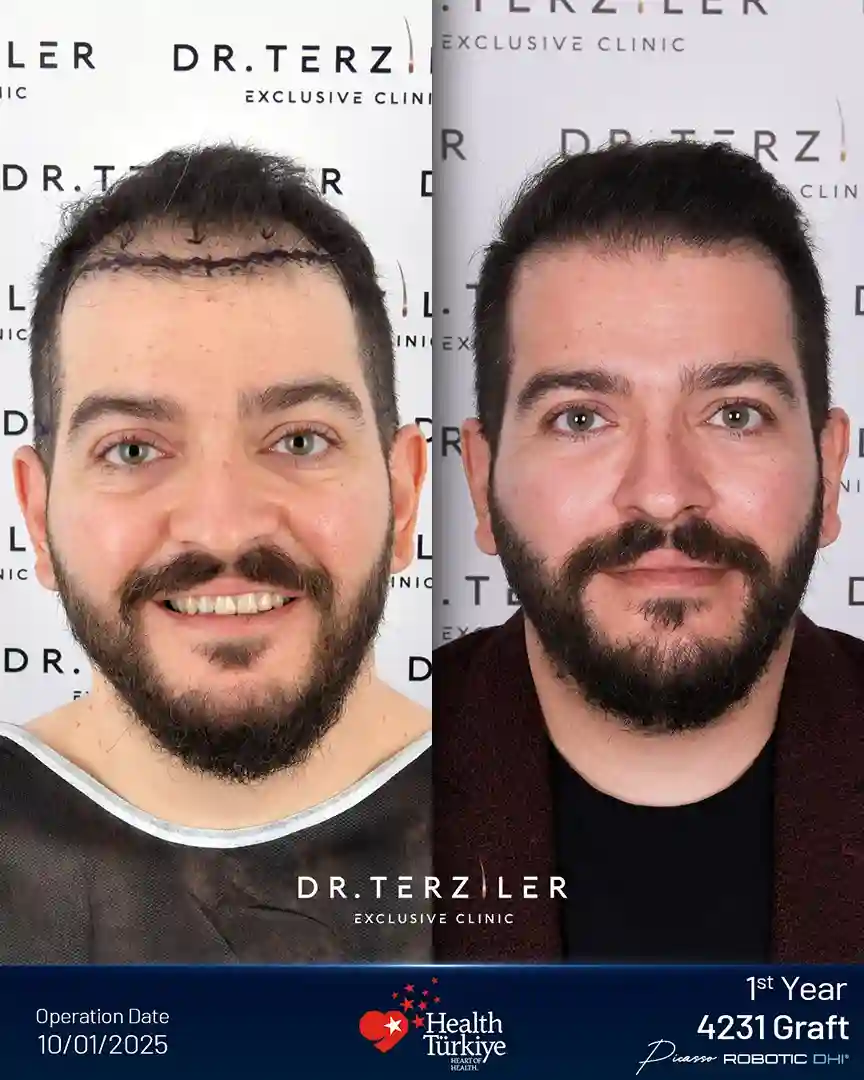
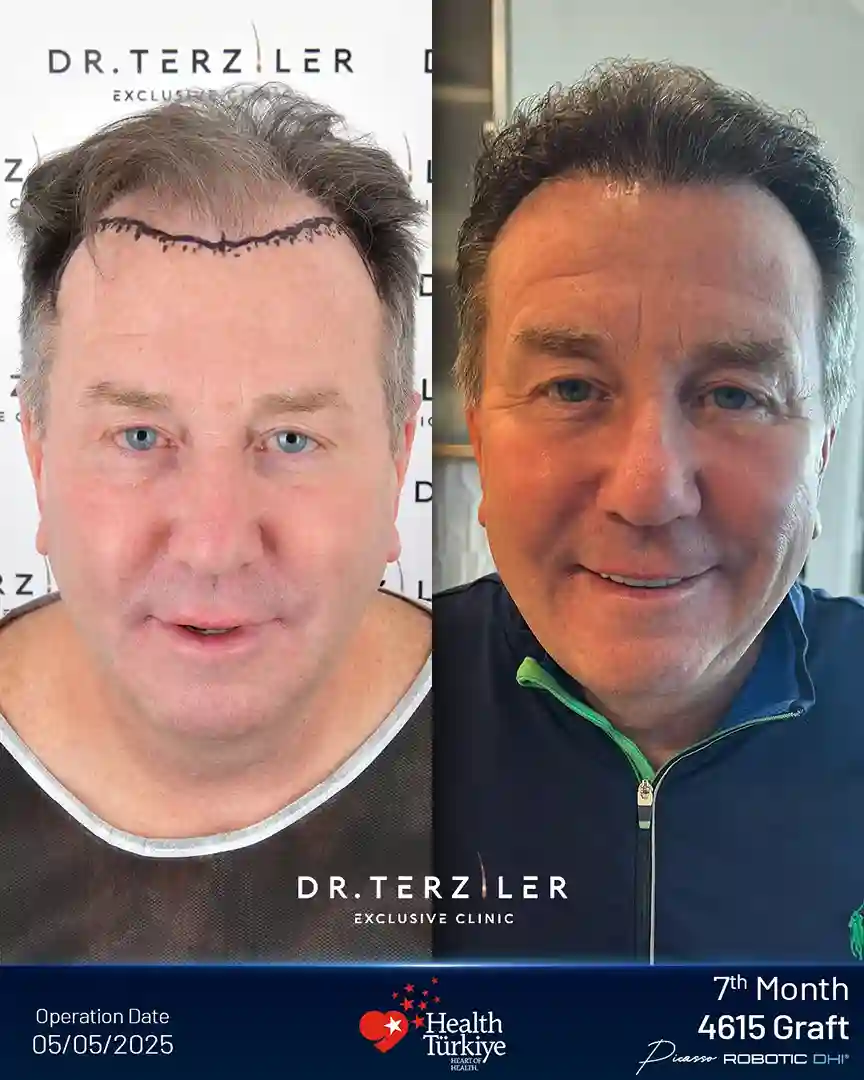
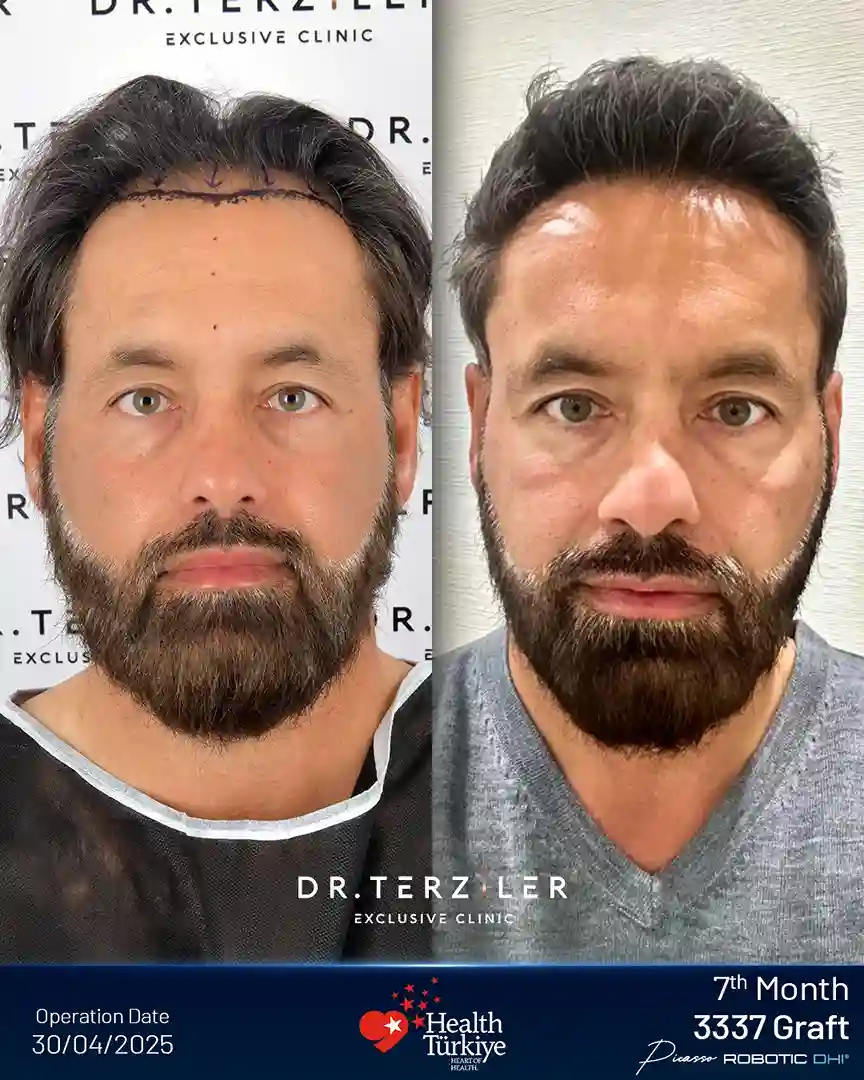
How Do the Picasso Robotic DHI Hair Transplant Before and After Results Look Like?
Picasso Robotic DHI hair transplant before and after results show a visible high satisfaction for patients in Dr. Terziler Exclusive Clinic.
What Are the Patient Reviews & Outcomes for Picasso Robotic DHI?
The clinic publishes verified reviews and before-and-after sets across men, women, repair, and afro-textured cases.
“I flew to Istanbul because I wanted Dr. Terziler himself to draw the line, not a technician. He spent more than half an hour on the design alone, talking through where my line would sit at 50, not just at 35. The result at month 12 looks like the hair I had at 25 but more controlled. My barber asked me what I was using.”
— Daniel R., London, United Kingdom — Picasso Robotic DHI, 3,400 grafts — ⭐⭐⭐⭐⭐
“I had a botched transplant in 2021 from another country. Flat, plug-looking front. Dr. Terziler designed an artistic line over the old work, pulled the bad-angle grafts, and rebuilt the transition zone with single grafts. I have my face back. The 0.75 mm pen scarring is invisible under buzz-cut.”
— Marco S., Milan, Italy — Picasso Robotic DHI Repair, 2,600 grafts — ⭐⭐⭐⭐⭐
“As a woman researching this, the no-shave option mattered most. The clinic isolated a small donor strip and the rest of my hair covered it during recovery. My Ludwig II thinning at the front is gone. The single-graft front row is what makes it look feminine instead of harsh.”
— Aisha K., Toronto, Canada — Picasso Robotic DHI Female, 2,922 grafts — ⭐⭐⭐⭐⭐
“I went through five clinics on consultation calls. Dr. Terziler was the only one who asked about my future hair loss instead of selling me a teenage line. The aging projection conversation alone made the decision. At month 14, the density at the temples reads dense without looking placed.”
— Christopher A., New York, United States — Picasso Robotic DHI, 3,100 grafts — ⭐⭐⭐⭐⭐
“Fitzpatrick V skin and tight curl pattern. Most clinics I called had no honest answer about the curved follicle problem. Dr. Terziler explained the curved punch protocol, the trichoscopy step, and the 0.75 mm channel for hyperpigmentation control. The result at month 12 is exactly what I asked for.”
— Kemi O., Houston, United States — Picasso Robotic DHI Afro, 2,800 grafts — ⭐⭐⭐⭐⭐
About Dr. Terziler Exclusive Clinic
Dr. Terziler Exclusive Clinic operates from Beşiktaş, Istanbul. The facility is a fully accredited surgical clinic, not a brokered hospital placement. Dr. Terziler Exclusive Clinic publishes its surgeon, its accreditations, and its certificates by name.
Accreditations & Awards
Start Your Picasso Robotic DHI Journey
Book My Free Picasso AssessmentFAQ
Located in Beşiktaş, Istanbul, Dr. Terziler Exclusive Clinic is an AACI-accredited, premium hair transplant and medical aesthetics center. Founded by the "Picasso of Hair," Dr. Servet Terziler, the clinic specialises in the proprietary Picasso Robotic DHI method, providing high-density, natural hair restoration and world-class medical safety to international patients from over 40 countries.