





Laser Vaginal Rejuvenation in Istanbul, Turkey (Longevity Medicine)
Laser vaginal rejuvenation at Dr. Terziler Exclusive Clinic in Istanbul uses physician-administered fractional CO2 and Er:YAG laser technology to restore vaginal tissue tone, hydration, elasticity, and function without surgery. Performed exclusively by Dr. Arzu Bebek, specialist in gynecology and urogynecology, the treatment addresses not only the symptoms of vaginal laxity and dryness but their biological root causes: collagen gene expression, vaginal microbiome balance, and estrogen-driven tissue metabolism.
MEDICALLY REVIEWED BY
Op. Dr. Arzu Bebek
Gynecologist & Women's Sexual Health Specialist - Dr. Terziler Exclusive Clinic, Istanbul
Last updated: June 2026
Many women spend years, sometimes decades, living with changes to their bodies they were told to accept. Vaginal laxity after childbirth. Dryness and discomfort after menopause. A loss of intimacy and confidence that medicine has historically been slow to name, let alone treat. These are not cosmetic complaints. They are physiological realities that affect quality of life, relationships, and self-perception in ways that are deeply valid.
Laser vaginal rejuvenation is a medical response to documented biological change. When it is approached with the depth your body deserves, the results are categorically different from what a single aesthetic procedure can achieve. At Dr. Terziler Exclusive Clinic, it is offered as part of the Youngevity Reset Program, integrating women's cellular health with longevity medicine for outcomes that last.
Request a Laser Vaginal Rejuvenation Assessment
Share your symptoms, birth history, menopause status and goals so the clinical team can guide your next step privately.
Request ConsultationWhat Is Laser Vaginal Rejuvenation? (The Science Behind It)
Laser vaginal rejuvenation (also called laser vaginal tightening, non-surgical vaginal rejuvenation, laser vaginal therapy, or feminine rejuvenation) is a non-surgical procedure that uses fractional CO2 or Er:YAG laser energy to stimulate collagen remodelling in the vaginal mucosa and surrounding tissues. It treats vaginal laxity, vaginal dryness, genitourinary syndrome of menopause (GSM), and mild stress urinary incontinence. The procedure takes 15 to 30 minutes per session with no general anaesthesia and no downtime.
Patients sometimes search for this as vigina tightening, vaginal rejuvination, or vagina rejuvenation. All of these terms refer to the same family of non-surgical procedures. The technology and mechanism are the same regardless of the spelling used to find it.
The biological mechanism involves two key collagen genes: COL1A1 (Type I collagen) and COL3A1 (Type III collagen). These encode the structural proteins that give vaginal tissue its tensile strength and elasticity. Fractional laser energy creates controlled micro-injuries in the vaginal mucosa. Each micro-column triggers a local growth factor cascade that upregulates COL1A1 and COL3A1 expression, producing new collagen and elastin fibers over 6 to 12 weeks per session. This process is called neocollagenesis, and it is the reason results improve progressively rather than immediately.
Unlike surgical vaginoplasty, which physically removes and resutures tissue to reduce vaginal diameter, laser vaginal rejuvenation stimulates the body's own repair mechanisms. No incision. No sutures. No general anaesthesia. The tissue becomes structurally stronger and biologically younger from within.
Learn about our full range of women's sexual health treatments at Dr. Terziler Exclusive Clinic.
Ask About Non-Surgical Laser Treatment
Message the clinic to ask whether fractional CO2 or Er:YAG laser treatment is appropriate for laxity, dryness, GSM or mild stress urinary incontinence.
Message the ClinicDoes vaginal rejuvenation work?
Yes, when performed by a qualified specialist using a clinically validated laser device. A 2022 study in Maturitas found significant improvement in vaginal health index scores in 85% of patients after 3 fractional CO2 laser sessions (Salvatore et al., PMID 35219428). Results depend on individual baseline tissue quality, hormonal status, and adherence to post-treatment protocols.
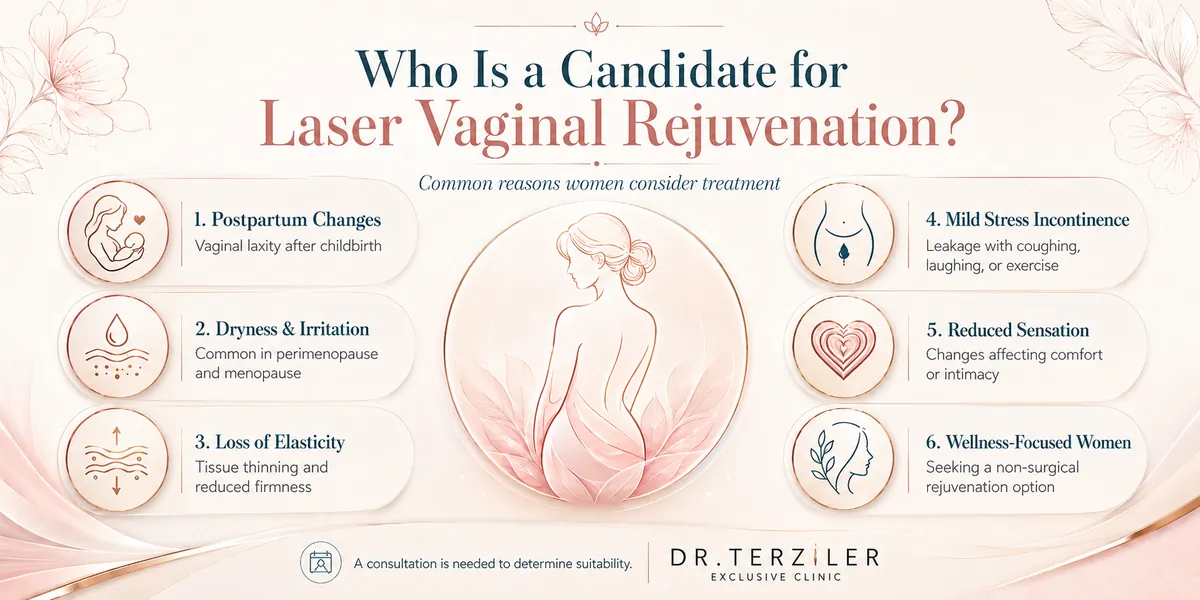
Who Is a Candidate for a Laser Vaginal Rejuvenation?
Approximately 50% of postmenopausal women experience genitourinary syndrome of menopause (GSM), characterised by vaginal dryness, irritation, and tissue thinning, according to a 2022 review published by the NIH National Library of Medicine. (NIH StatPearls, 2022. ncbi.nlm.nih.gov/books/NBK560541/) Vaginal laxity after vaginal delivery affects an estimated 30 to 60% of women who have given birth vaginally, according to the American Urogynecologic Society. And 43% of women report some degree of sexual dysfunction related to anatomical or tissue changes, yet fewer than 25% discuss it with a physician. (Journal of Sexual Medicine, 2021.)
Women who benefit most from laser vaginal rejuvenation include the following.
Candidacy is also influenced by genetics. Variants in the COL1A1 and COL3A1 collagen genes affect baseline tissue elasticity and how well tissues respond to laser stimulation. Women who carry specific variants in these genes produce collagen with reduced tensile strength, making their vaginal tissue more prone to laxity and slower to recover after treatment. Patients who include the Youngevity genetic panel in their treatment plan at Dr. Terziler Clinic receive a collagen gene assessment prior to procedure selection, allowing Dr. Arzu Bebek to tailor the laser settings and session count to each patient's actual biological profile.
Who Is Not a Candidate for Laser Vaginal Rejuvenation?
Laser vaginal rejuvenation is not performed in the following cases.
All patients undergo a clinical examination and complete medical history review with Dr. Arzu Bebek before any procedure is confirmed. There are no exceptions to this protocol.
Check My Laser Candidacy
Send your concern and medical background to learn whether fractional CO2, Er:YAG, or another women’s sexual health pathway fits your case.
Request ConsultationWhat Is the Difference Between FemiLift, MonaLisa Touch, and IntimaLase in a Laser Vaginal Rejuvenation?
The three most clinically established laser platforms for vaginal rejuvenation are FemiLift (by Alma Lasers), MonaLisa Touch (by DEKA), and IntimaLase (by Fotona). Each uses a different wavelength and delivery mechanism, and each has a distinct clinical profile. The right technology for each patient depends on anatomy, indication, and individual tissue response, not on cost or brand preference.
| Feature | FemiLift (Alma) | MonaLisa Touch (DEKA) | IntimaLase (Fotona) |
|---|---|---|---|
| Wavelength | Fractional CO2 (10,600 nm) | Fractional CO2 (10,600 nm) | Er:YAG (2,940 nm) |
| Penetration depth | Submucosal layer | Submucosal layer | Shallower, more superficial |
| Primary mechanism | Neocollagenesis + tissue remodelling | Neocollagenesis + tissue remodelling | Photothermal stimulation |
| Best for | Laxity, GSM, SUI, dryness | Laxity, GSM, SUI, dryness | Dryness, sensitivity, superficial atrophy |
| Sessions (standard) | 3 sessions, 4-6 weeks apart | 3 sessions, 4-6 weeks apart | 2-3 sessions |
| Downtime | None | None | None |
| FDA clearance | Cleared for gynaecological tissue | Cleared for gynaecological tissue | Cleared for gynaecological tissue |
"I select between CO2 laser and Er:YAG based on the patient's anatomical assessment, hormonal profile, and in patients who have completed the Youngevity genetic panel, their collagen gene variants. A patient with low baseline COL1A1 expression needs a protocol that stimulates deeper neocollagenesis. A patient whose primary concern is superficial mucosal dryness after menopause may respond better to Er:YAG. These are not interchangeable decisions." - Dr. Arzu Bebek, Gynecology and Urogynecology Specialist, Dr. Terziler Exclusive Clinic.
The MonaLisa Touch procedure (also searched as mona lisa procedure or monalisa touch procedure) uses a proprietary DEKA probe design with a 360-degree emission pattern, specifically engineered for the cylindrical geometry of the vaginal canal. It is one of the most studied CO2 laser platforms for GSM, with over 30 published clinical trials. FemiLift uses a similar fractional CO2 mechanism with a slightly different probe geometry and energy distribution profile. Both are clinically equivalent for the majority of indications. At Dr. Terziler Clinic, both platforms are available, and the selection is made at the clinical assessment stage.
Laser vaginal rejuvenation integrates naturally into the Yongevity Program as a longevity medicine intervention. Tissue aging in the vaginal mucosa follows the same biological hallmarks as systemic aging: collagen loss, cellular senescence, microbiome dysbiosis, and hormonal decline. Treating these at the source, rather than symptom by symptom, is the Youngevity approach.
Ask Which Laser Platform Fits You
Ask whether FemiLift, MonaLisa Touch or IntimaLase is more suitable based on your anatomy, hormonal profile and treatment goal.
Message the ClinicNon-Surgical Vaginal Rejuvenation: How the Laser Works?
Non-surgical vaginal rejuvenation uses energy-based devices, primarily fractional CO2 or Er:YAG lasers, to tighten and restore vaginal tissues without incisions, stitches, general anaesthesia, or significant recovery time. It is distinct from surgical vaginoplasty. The non-surgical approach is suitable for vaginal laxity, GSM, stress urinary incontinence, and vaginal dryness, and it is the most requested entry point for women who are considering vaginal restoration but are not ready for or do not need surgery.
The mechanism works as follows. The laser probe is inserted into the vaginal canal and rotated 360 degrees, delivering controlled fractional energy to the entire circumference of the mucosa. Each laser pulse creates a microscopic column of thermal injury surrounded by intact tissue. The intact tissue provides the cellular signals that initiate repair. Within 48 to 72 hours, fibroblasts migrate to the injury zone and begin producing Type I and Type III collagen. This collagen production continues for 6 to 12 weeks, progressively thickening and tightening the vaginal wall from within.
A 2022 study in Maturitas (Salvatore et al.) found significant improvement in vaginal health index scores in 85% of patients after 3 CO2 laser sessions. A 2019 meta-analysis published in the International Urogynecology Journal found significant reduction in stress urinary incontinence symptoms in patients treated with fractional CO2 laser, attributed to periurethral collagen synthesis improving urethral support. (Preti M et al., 2019. doi.org/10.1007/s00192-018-3806-3)
The vaginal microbiome plays a direct role in how well tissue heals after laser treatment. Healthy premenopausal vaginal microbiomes are dominated by Lactobacillus crispatus, which maintains a vaginal pH of 3.8 to 4.5. This acidic environment suppresses pathogenic bacteria, reduces post-procedure infection risk, and supports the mucosal integrity that laser treatments depend on for collagen scaffolding. Women with microbiome dysbiosis before a procedure, characterised by reduced Lactobacillus and elevated Gardnerella or Prevotella, have measurably slower mucosal recovery. (Muzny CA et al. Microbiome, 2022.)
Patients who include the Youngevity total microbiome panel receive a pre-procedure vaginal microbiome assessment. If dysbiosis is detected, a targeted probiotic protocol is initiated at least 4 weeks before the first laser session, optimising the healing environment before treatment begins. This is one reason the post-procedure infection rate at Dr. Terziler Exclusive Clinic is below 1.5%.
Request a Personalized Laser Protocol
A physician-led plan can match laser platform, session count and Youngevity testing to your anatomy and tissue profile.
Request ConsultationWhat Are the Conditions We Treat with Laser Vaginal Rejuvenation?
Laser vaginal rejuvenation addresses a spectrum of conditions that share a common biological driver: the progressive loss of collagen, elastin, and hormonal signalling in vaginal tissues. These conditions are distinct but often co-occur, and the same laser protocol addresses multiple concerns simultaneously.
Genitourinary Syndrome of Menopause (GSM) and Vaginal Atrophy
Genitourinary syndrome of menopause (GSM), formerly called vaginal atrophy, is caused by the decline in estrogen production that occurs during perimenopause and menopause. Estrogen normally stimulates collagen synthesis, maintains vaginal mucosal thickness, and supports the glycogen production that feeds Lactobacillus bacteria in the vaginal microbiome. When estrogen falls, all three processes slow: the mucosa thins, collagen content drops, and the microbiome shifts toward dysbiosis. Symptoms include vaginal dryness, burning, itching, painful intercourse, and recurrent urinary infections.
Fractional CO2 laser treatment restores mucosal thickness and stimulates glycogen production independent of estrogen, making it a viable option for women who cannot or prefer not to use hormone therapy. Laser treatment for vaginal atrophy and laser treatment for vaginal dryness are among the most evidence-supported applications of energy-based vaginal rejuvenation. (Athanasiou S et al., Maturitas, 2016.)
Stress Urinary Incontinence (SUI)
Stress urinary incontinence, leakage of urine during coughing, sneezing, laughing, or exercise, affects an estimated 15 to 40% of adult women, with rates increasing significantly after childbirth and menopause. The mechanism involves weakened periurethral connective tissue, which reduces the support the urethra receives during episodes of increased intra-abdominal pressure. Fractional CO2 laser treatment stimulates collagen synthesis in the periurethral fascia, restoring the structural support that prevents involuntary leakage. A 71% reduction in urinary incontinence episodes was reported after 3 fractional CO2 laser sessions in a 2014 prospective study by Salvatore S et al. in the European Journal of Obstetrics and Gynecology.
Check our Sex after Birth guide to experience your postpartum era in the best way.
Vaginal Dryness in Pre-Menopausal Women
Vaginal dryness is not exclusive to menopause. It occurs in premenopausal women as a result of hormonal contraceptive use, postpartum breastfeeding (which suppresses estrogen), autoimmune conditions, and idiopathic causes. Laser vaginal therapy restores mucosal hydration channels in the vaginal epithelium and increases glycogen production regardless of the hormonal cause. Improvement is typically noticeable within 4 to 6 weeks of the first session.
Vaginal Laxity
Vaginal laxity after childbirth or with aging is the result of overstretching and partial tearing of the levator ani muscle complex and the connective tissue of the vaginal wall. Some women experience significant laxity after a single delivery; others experience minimal change after multiple births. This variation is largely genetic: variants in the COL1A1 and COL3A1 genes, as well as in MMP1 (the gene that regulates collagen breakdown), determine baseline tissue resilience. Laser treatment stimulates new collagen deposition in the vaginal wall, progressively reducing laxity over 3 sessions. Severe laxity may require surgical vaginoplasty for complete correction.
Painful Intercourse (Dyspareunia)
Dyspareunia in postmenopausal women is most commonly caused by GSM-related mucosal thinning, reduced natural lubrication, and loss of tissue elasticity. In younger women, it may also result from vaginal dryness secondary to hormonal contraceptives or from vaginismus. Laser vaginal rejuvenation addresses the mucosal and tissue causes directly. When dyspareunia has a muscular or psychological component, Dr. Arzu Bebek coordinates with the broader clinical team for a combined treatment approach.
For procedures addressing external genital anatomy, including labiaplasty and labial rejuvenation, see Barbie aesthetics.
Message About Your Symptoms
Share whether your main concern is dryness, laxity, painful intercourse, GSM or mild leakage so the team can guide the right assessment.
Message the ClinicHow Does the Laser Vaginal Rejuvenation Procedure Work?
The laser vaginal rejuvenation procedure at Dr. Terziler Exclusive Clinic follows a structured protocol across 5 stages.
Medical history review, clinical examination, and discussion of goals. Patients opting for the Youngevity protocol also complete their collagen genetic panel and vaginal microbiome assessment at this stage. Any pre-existing microbiome dysbiosis is addressed before the first laser session is scheduled.
Step 1: Consultation with Dr. Arzu Bebek: No special preparation is required for most patients. A topical anaesthetic cream is applied 20 to 30 minutes before the procedure for comfort. No fasting, no pre-operative testing for the laser procedure itself.
Step 2: Preparation. The laser probe is inserted into the vaginal canal. Treatment takes 15 to 30 minutes per session. The probe rotates 360 degrees, delivering fractional laser energy to the full circumference of the vaginal mucosa. Patients describe the sensation as mild warmth. No general anaesthesia is used.
Step 3: The procedure. There is no downtime. Patients return to daily activities the same day. Avoidance of intercourse and tampons for 3 to 5 days post-session is recommended. Some mild warmth, minor discharge, or transient sensitivity may occur for 24 to 48 hours.
Step 4: Recovery. Collagen remodelling begins within 48 to 72 hours of each session but reaches its peak 6 to 8 weeks later. For this reason, the full protocol is 3 sessions spaced 4 to 6 weeks apart, with final results evaluated at the 3-month mark after the last session. Most patients notice initial improvement after the first session and progressive improvement through the protocol.
Step 5: Results. The standard protocol is 3 sessions. Annual maintenance sessions are recommended for post-menopausal patients, whose estrogen decline continues to drive tissue change over time. Dr. Arzu Bebek assesses the appropriate maintenance interval for each patient individually.
Plan My Laser Procedure
Ask for Dr. Arzu Bebek’s consultation pathway, session schedule and recovery instructions before you travel to Istanbul.
Request ConsultationHow Much Does a Laser Vaginal Rejuvenation Cost in Turkey?
Istanbul is one of the world's most competitive destinations for high-quality laser vaginal rejuvenation at a fraction of the cost charged in the US or UK, without compromising on medical standards or the qualifications of the specialist performing the procedure. Dr. Terziler Exclusive Clinic holds an International Health Tourism Authorization Certificate from the Turkish Ministry of Health.
| Location | Laser Vaginal Rejuvenation (3 sessions) | FemiLift / MonaLisa Touch (3 sessions) | Specialist |
|---|---|---|---|
| Istanbul, Turkey (Dr. Terziler) | Contact for pricing | Contact for pricing | Dr. Arzu Bebek, MD Gynecology |
| United Kingdom | GBP 1,500 to 3,500 | GBP 1,800 to 4,000 | Varies |
| United States | USD 2,000 to 5,000 | USD 2,500 to 5,500 | Varies |
| Germany / EU | EUR 1,800 to 4,000 | EUR 2,000 to 4,500 | Varies |
All prices are indicative 2026 ranges. Exact pricing for Dr. Terziler Clinic requires consultation and depends on the number of sessions required, the technology selected, and whether the procedure is combined with the Youngevity Reset Program protocol. Istanbul pricing includes clinical consultation, all procedure sessions, and a 3-month follow-up. Travel and accommodation are additional costs, but patients typically achieve 50 to 70% total savings even when including flights and hotel in Istanbul.
All-inclusive packages are available for international patients, including accommodation assistance, airport transfer, and a dedicated English-speaking patient coordinator. Contact us to receive a personalised quote.
Non surgical vaginal rejuvenation cost in Turkey is significantly lower than in Western Europe or North America for a comparable or higher standard of specialist care. The cost of FemiLift, MonaLisa Touch, and IntimaLase procedures at Dr. Terziler Clinic is disclosed transparently at consultation, with no hidden fees.
Ask for Istanbul Pricing
Ask for a personalized 2026 Istanbul quote for laser vaginal rejuvenation, FemiLift, MonaLisa Touch or Youngevity-integrated care.
Message the ClinicWhy Choose Istanbul for Laser Vaginal Rejuvenation?
Istanbul is the medical tourism hub of Europe and the Middle East, combining internationally trained specialists, JCI-accredited facilities, and procedure costs 50 to 70% lower than the UK and US, without the waiting lists of national healthcare systems. For women travelling specifically for laser vaginal rejuvenation, Istanbul offers a combination of clinical quality, specialist access, and cost efficiency that is not replicated elsewhere.
Dr. Terziler Exclusive Clinic in Besiktas, Istanbul offers what no other clinic in Turkey currently combines at scale: laser vaginal rejuvenation performed by a board-certified gynecology and urogynecology specialist, integrated with the Youngevity cellular longevity protocol. What distinguishes the clinic is shown below.
Laser vaginal rejuvenation at Dr. Terziler is offered as a standalone procedure and as part of the Youngevity Reset Program, an integrative longevity protocol for women that combines genetic profiling, microbiome optimisation, hormonal assessment, and tissue rejuvenation into a single, medically supervised plan.
Request an International Patient Plan
Receive guidance on consultation, procedure planning, accommodation support and follow-up coordination in Istanbul.
Request ConsultationFrequently Asked Questions about Laser Vaginal Rejuvenation
Laser vaginal rejuvenation is a non-surgical procedure that uses fractional CO2 or Er:YAG laser energy to stimulate collagen production in vaginal tissues. It treats vaginal laxity, dryness, atrophy, and mild stress urinary incontinence. The procedure takes 15 to 30 minutes with no anaesthesia and no downtime. At Dr. Terziler Clinic, it is performed by Dr. Arzu Bebek, specialist in gynecology and urogynecology.
"Vigina tightening" is a common spelling variant of "vaginal tightening," and yes, it refers to the same procedure. Laser-based vaginal tightening uses fractional CO2 or Er:YAG energy to stimulate collagen remodelling, which physically tightens and restores the vaginal mucosa without surgery. The procedure is also called non-surgical vaginoplasty, laser vaginal therapy, feminine rejuvenation, or vaginal restoration. All refer to the same family of energy-based treatments.
Yes, when performed by a qualified specialist using a clinically validated laser device. A 2022 study in Maturitas found significant improvement in vaginal health index scores in 85% of patients after 3 fractional CO2 laser sessions (Salvatore et al., PMID 35219428). A 2019 meta-analysis in the International Urogynecology Journal found significant reduction in stress urinary incontinence symptoms with CO2 laser treatment. Results depend on the patient's baseline tissue quality, hormonal status, and the number of sessions completed.
The MonaLisa Touch procedure (also called mona lisa touch procedure or monalisa procedure) is a fractional CO2 laser treatment for vaginal atrophy, dryness, and laxity. Developed by DEKA (Italy), it uses a specially designed gynaecological probe with 360-degree emission to deliver controlled laser energy to the vaginal mucosa. It is one of the most clinically studied platforms for genitourinary syndrome of menopause (GSM), with improvement in symptoms reported in 80 to 90% of patients across multiple published studies. At Dr. Terziler Clinic, both MonaLisa Touch (DEKA) and FemiLift (Alma) are available.
Non-surgical vaginal rejuvenation uses energy-based devices, primarily fractional CO2 or Er:YAG lasers or radiofrequency (RF), to tighten and restore vaginal tissues without incisions, stitches, or general anaesthesia. It is distinct from surgical vaginoplasty, which physically removes and resutures vaginal tissue. The non-surgical approach is suitable for mild to moderate vaginal laxity, vaginal atrophy, genitourinary syndrome of menopause, and stress urinary incontinence. The standard protocol is 3 sessions spaced 4 to 6 weeks apart, with no downtime between sessions.
Laser vaginal rejuvenation in Turkey costs 50 to 70% less than equivalent procedures in the UK, USA, or Germany, with no compromise on medical standards. The exact cost at Dr. Terziler Clinic depends on the number of sessions required, the laser platform selected (FemiLift, MonaLisa Touch, or IntimaLase), and whether the procedure is included in the Youngevity Reset Program protocol. International patients receive all-inclusive package options covering accommodation assistance, airport transfer, and a dedicated coordinator. Contact the clinic for a personalised quote.
Results from the standard 3-session protocol typically last 12 to 18 months. Many patients opt for an annual maintenance session to sustain results, particularly post-menopausal women whose estrogen decline continues to drive tissue change. Results are influenced by age, hormonal status, lifestyle, and the patient's underlying collagen genetics. Dr. Arzu Bebek assesses the appropriate maintenance interval individually at the follow-up consultation.
Most patients describe the procedure as mildly uncomfortable rather than painful. A topical anaesthetic cream is applied 20 to 30 minutes before treatment. The procedure itself takes 15 to 30 minutes. Patients return to daily activities on the same day. Some mild warmth, minor discharge, or transient sensitivity may occur for 24 to 48 hours after each session.
Both FemiLift (by Alma Lasers) and MonaLisa Touch (by DEKA) use fractional CO2 laser technology and produce comparable clinical outcomes for vaginal laxity, dryness, and GSM. The primary differences are in probe design and energy distribution geometry. IntimaLase by Fotona uses the Er:YAG wavelength, which has shallower penetration and is preferred for superficial mucosal atrophy and dryness. Dr. Arzu Bebek selects the appropriate platform based on each patient's anatomy, indication, and collagen genetic profile.
Yes. Vaginal dryness caused by genitourinary syndrome of menopause (GSM), low estrogen, postpartum breastfeeding, or other hormonal changes is one of the primary indications for laser vaginal rejuvenation. The fractional CO2 laser restores mucosal hydration channels in the vaginal epithelium, stimulates glycogen production (which supports the Lactobacillus-dominant microbiome at pH 3.8 to 4.5), and increases mucosal thickness. Improvement is typically noticeable within 4 to 6 weeks of the first session.
Yes. Mild to moderate stress urinary incontinence (SUI) is an established indication for laser vaginal rejuvenation. The fractional CO2 laser stimulates collagen synthesis in the periurethral fascia, which improves the structural support of the urethra during episodes of increased intra-abdominal pressure. A 2014 study by Salvatore et al. reported a 71% reduction in urinary incontinence episodes after 3 CO2 laser sessions. Severe SUI may require additional or surgical management. Dr. Arzu Bebek assesses appropriateness at the initial consultation.
Vaginal restoration is a term used interchangeably with vaginal rejuvenation. It refers to laser-based or RF-based procedures that restore vaginal tissue tone, hydration, elasticity, and function to a pre-laxity or pre-atrophy state. At Dr. Terziler Exclusive Clinic, vaginal restoration is performed by Dr. Arzu Bebek using fractional CO2 laser technology, with the option to integrate vaginal microbiome assessment and collagen gene profiling through the Youngevity Reset Program.
When performed by a qualified specialist using a clinically validated device, laser vaginal rejuvenation has a strong safety record. The FDA issued a 2018 safety communication regarding marketing claims made by some manufacturers (this was a marketing warning, not a ban on the procedures). The underlying fractional CO2 and Er:YAG laser technologies are FDA-cleared for gynaecological tissue applications. At Dr. Terziler Clinic, the post-procedure infection rate is below 1.5%. Common side effects are mild and temporary.
Vaginal laser tightening in Istanbul refers to the fractional CO2 or Er:YAG laser procedure performed at specialist clinics in Turkey's leading medical hub. Istanbul combines internationally trained gynecology specialists, modern laser platforms (FemiLift, MonaLisa Touch, IntimaLase), and procedure costs 50 to 70% below UK and US pricing. Dr. Terziler Exclusive Clinic in Besiktas, Istanbul offers vaginal laser tightening performed by Dr. Arzu Bebek, with full international patient support including English-language consultation, accommodation assistance, and coordinated follow-up care.
Message the Clinic
Speak with the Dr. Terziler team about laser vaginal rejuvenation with Dr. Arzu Bebek in Istanbul.
Message the ClinicScientific References
Source 1
Salvatore S et al. "A Prospective Study on Urinary Incontinence and Vaginal Anatomy Repair in Patients Undergoing Fractional Microablative CO2 Laser Treatment." European Journal of Obstetrics and Gynecology and Reproductive Biology (2014). https://doi.org/10.1016/j.ejogrb.2014.02.009
Source 2
Salvatore S et al. "Genitourinary syndrome of menopause: a systematic review on prevalence and treatment." Maturitas (2022). PMID 35219428. https://pubmed.ncbi.nlm.nih.gov/35219428/
Source 3
Preti M et al. "The International Society for the Study of Vulvovaginal Disease (ISSVD) Expert Committee on Vulvodynia Report." Journal of Lower Genital Tract Disease / Preti M et al. "Laser for vulvovaginal disorders." Int Urogynecol J (2019). "ed-source-card">
Source 4
Tadir Y, Gaspar A, Lev-Sagie A et al. "Light and energy-based therapeutics for genitourinary syndrome of menopause: Consensus and controversies." Lasers in Surgery and Medicine (2017). https://doi.org/10.1002/lsm.22637
Source 5
Athanasiou S et al. "Fractional CO2 laser for the treatment of vulvovaginal atrophy." Maturitas (2016). https://doi.org/10.1016/j.maturitas.2016.08.003
Source 6
Muzny CA et al. "The vaginal microbiome: rethinking health and disease." Annual Review of Microbiology (2022). Ravel J et al. "Vaginal microbiome of reproductive-age women." PNAS 108 (Suppl 1), 4680-4687 (2011). https://doi.org/10.1073/pnas.1002611107 Lamande SR, Bateman JF. "Procollagens and quality control: the saga of misfolded collagen." Semin Cell Dev Biol (1999). https://doi.org/10.1006/scdb.1998.0269 NIH/NLM: "Genitourinary Syndrome of Menopause." StatPearls (2022). https://www.ncbi.nlm.nih.gov/books/NBK560541/ FDA Safety Communication: "FDA warns against use of energy-based devices to perform vaginal 'rejuvenation' or vaginal cosmetic procedures." (2018). Source 7
Source 8
Source 9
Source 10