




When people think about a hair transplant, they naturally focus on the final destination: the new, sharp hairline or a completely filled crown. However, the true unsung hero of any hair restoration journey is the donor area.
Without a healthy, well-managed donor site, permanent hair restoration is simply impossible. The donor zone is your limited financial account of hair follicles; how it is treated during surgery determines not only the success of your new hair but also how clean and undetectable your head looks from the back.
If you are wondering exactly what the donor area is, why it is so special, and how it heals after surgery without leaving you with a patchy scalp, this comprehensive beginner’s guide has the answers.
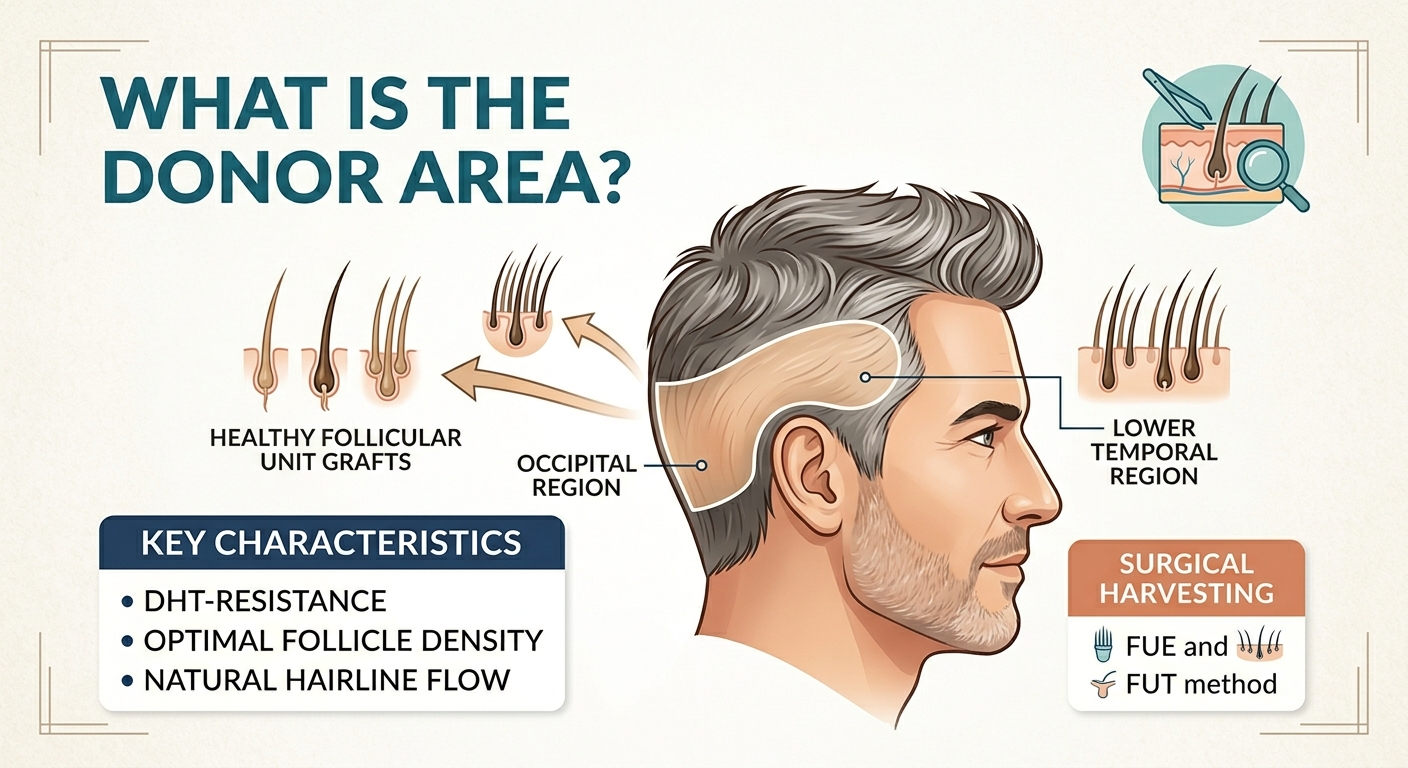
What Exactly is the Donor Area?
In hair transplant surgery, the donor area refers to the specific region of the scalp from which healthy hair follicles are harvested. This is almost always located at the back and sides of the head.
Why can’t we use hair from someone else? Your immune system would immediately reject it. You have to be your own donor.
Why do we use the back and sides instead of the top? This comes down to a medical principle known as donor dominance. The hair follicles on the top and front of your head are genetically sensitive to DHT (dihydrotestosterone), the hormone responsible for pattern baldness.
Conversely, the hair follicles on the back and sides are genetically programmed to be entirely resistant to DHT. When these robust follicles are relocated to a balding area, they retain their genetic memory. They keep growing naturally for a lifetime, completely immune to future thinning.
How Does the Donor Site Heal? (FUE vs. FUT)
How your donor area heals depends entirely on the surgical method your doctor uses to harvest the hair. Modern hair restoration utilizes two main techniques, and each leaves a vastly different signature on your scalp.
1. Follicular Unit Extraction (FUE) Healing
FUE is the modern global standard. The surgeon uses a tiny, microscopic circular punch tool (typically between 0.7mm and 0.9mm in diameter) to isolate and pull out individual follicular units one by one.
- The Immediate Aftermath: Right after surgery, your donor area will look like a collection of thousands of tiny, red pinpricks. It will look raw, but it does not require stitches.
- The Healing Process: Within 48 hours, these tiny holes close up completely. Over the first week, small scabs form over each point and gradually flake off during daily, gentle washes.
- The Final Result: FUE leaves behind microscopic, point-like white scars. Once your surrounding hair grows out even a few millimeters, these tiny dots are completely invisible, allowing you to wear very short haircuts or fades without anyone noticing.
2. Follicular Unit Transplantation (FUT) Healing
FUT, also known as the traditional “strip method,” involves the surgeon cutting a single, horizontal strip of skin containing hair follicles from the active donor zone.
- The Immediate Aftermath: The surgeon carefully closes the gap using surgical stitches or staples.
- The Healing Process: The stitches stay in place for roughly 10 to 14 days before being removed at the clinic. The area must be kept clean to ensure the skin edges fuse smoothly.
- The Final Result: FUT leaves a permanent linear scar across the back of the head. While it can easily be hidden by keeping the hair at the back at a medium-to-long length, it will likely be visible if you choose to shave your head or get a high skin fade.
The Post-Op Donor Healing Timeline
Healing is a step-by-step process. Here is what a typical, healthy FUE donor area recovery looks like week by week:
- Days 1 to 3: The donor area may feel tight, tender, or slightly swollen. You might notice minor oozing or bleeding, which is completely normal. The local anesthetic will wear off, leaving a sensation similar to a mild sunburn.
- Days 4 to 7: The puncture wounds turn into tiny scabs. This is when the infamous post-op itch kicks in. Itching is a great sign that the nerves and skin are healing, but you must absolutely resist the urge to scratch.
- Days 10 to 14: The scabs completely wash away. The heavy redness fades into a light pink hue. Your existing hair begins to grow long enough to cover the harvested zones.
- Month 1 and Beyond: The skin is fully recovered. You might experience temporary numbness as micro-nerves regenerate, but full sensation returns completely over the coming weeks.
Can the Donor Area Grow Back?
This is one of the most common misconceptions among beginners. No, the individual hair follicles extracted from the donor area do not grow back.
Once a hair follicle is removed from the root, that specific spot will never produce hair again. This is precisely why strategic planning is so critical. A skilled medical team will practice “overharvesting prevention.” They do not clear out an entire patch of hair; instead, they harvest evenly in a diffuse, checkerboard pattern.
By leaving plenty of healthy native hair surrounding each extraction point, the overall density drops slightly, but the remaining hair seamlessly covers the tiny gaps. To the naked eye, the back of your head will look exactly as dense and full as it did before surgery.
Final Thoughts: The Importance of Expert Hands
Your donor area is a finite, non-renewable resource. You only have a set number of lifetime grafts available, and if an inexperienced clinic overharvests or damages the area, it cannot be undone. Choosing a world-class team ensures your donor zone remains healthy, pristine, and perfectly preserved.
At Dr. Terziler Clinic, we treat your donor area with the absolute highest level of medical reverence and microscopic precision. By utilizing advanced harvesting protocols, we guarantee that you achieve the most natural, dense look up front while leaving your donor site looking completely flawless, healthy, and untouched from behind.
Frequently Asked Questions (FAQ)
How do I sleep without damaging my donor area after surgery?
For the first 10 days, you should sleep on your back with your head elevated at a 45-degree angle using a travel neck pillow. While you want to avoid direct friction on the recipient grafts at the front, resting the back of your head gently on a soft pillow is perfectly safe for the donor area, as the extraction holes close up within a couple of days.
Why does my donor area itch so badly, and how can I stop it?
Itching is a standard side effect of skin tissue and microscopic nerves healing. To soothe the itch safely without scratching—which can introduce bacteria—you can apply a doctor-approved moisturizing aloe vera gel, use a saline hydration spray, or take an over-the-counter antihistamine recommended by your clinic.
What is “overharvesting” and how do I avoid it?
Overharvesting happens when an unqualified technician extracts too many hair grafts from a single, concentrated spot rather than spreading the extractions evenly across the entire donor zone. This results in permanent patchy spots, thinning, or a “moth-eaten” appearance at the back of the head. You can avoid this by avoiding low-cost “hair mills” and choosing a certified, reputable clinic.
When can I get a haircut or shave the back of my head?
You can gently trim the hair in your donor area with scissors about 2 weeks after the procedure once the skin is fully closed and the scabs are gone. However, you should strictly avoid using electric clippers or razors on the donor site for at least 1 month to prevent irritating the healing tissue.
Is it possible to use body hair as a donor source if my scalp donor area is too thin?
Yes. If a patient has severe advanced baldness and a weak scalp donor area, modern FUE allows surgeons to harvest follicles from the beard, chest, or back. Beard hair is particularly robust and serves as an excellent secondary donor source to add density to the crown, though scalp hair always remains the first and most natural choice.