




For many people struggling with hair loss, the biggest hurdle to getting a hair transplant isn’t the surgery itself, the cost, or even the fear of pain. It is the thought of having to completely shave their head.
Shaving your scalp bare acts as an immediate giveaway to colleagues, friends, and the public that you have undergone a procedure. If you work a corporate job, maintain a high public profile, or simply feel incredibly uncomfortable showing a bare, post-op scalp, a traditional transplant can feel like a major lifestyle disruption.
Fortunately, modern medical technology has solved this dilemma. An unshaven hair transplant is absolutely possible.
Known in the medical world as a U-FUE (Unshaven Follicular Unit Extraction) or a Non-Shaven Hair Transplant, this highly specialized procedure allows you to restore your hair discreetly, keeping your surgery completely confidential from day one.
What is an Unshaven Hair Transplant?
In a traditional FUE or DHI hair transplant, the entire head is typically shaved down to a zero-buzz cut. This allows the medical team to see every single follicle clearly, map out extraction angles easily, and implant hairs smoothly without existing strands getting in the way.
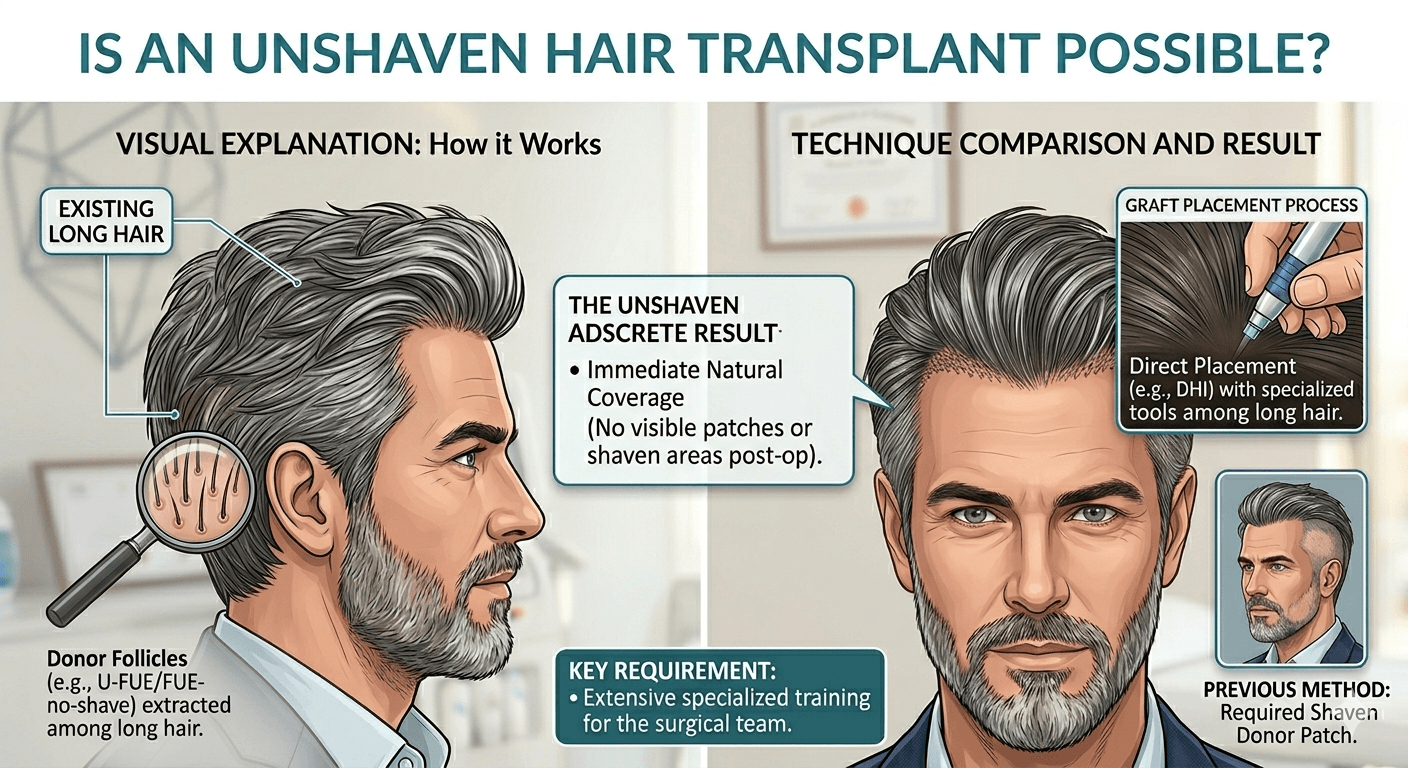
An unshaven hair transplant flips this script. It allows the patient to keep their existing hair at its current length throughout the entire procedure.
Depending on your pattern of hair loss and the clinic you choose, there are two primary variations of this discreet method:
1. Partially Unshaven (Flap / Hidden Strip)
This is the most common option. The medical team shaves a small, horizontal window or “flap” across the back of your head within the donor area. The hair above the window is left long. Once the grafts are extracted, the long hair falls naturally over the shaved zone, completely concealing it. The recipient area at the front is left untouched.
2. Fully Unshaven (U-FUE / Direct Extraction)
This is the most complex, premium tier of hair restoration. Absolutely zero hair is shaved. The surgeon extracts individual hair strands at full length from the donor area and implants them directly between your long, existing hairs in the thinning zones.
Who is a Good Candidate for an Unshaven Procedure?
While the idea of keeping your hair long sounds perfect to everyone, an unshaven transplant is a highly technical procedure that is not suitable for every stage of baldness.
You are a GREAT candidate if:
- You have localized thinning or a high hairline: If you only need to lower a slightly recessed hairline, fill in your temples, or patch up a small scar, an unshaven transplant is ideal.
- You are a woman: Women rarely suffer from complete baldness; instead, they experience diffuse thinning or a high forehead. Unshaven techniques are the gold standard for female hair restoration.
- Your job requires strict discretion: Executives, public figures, actors, or individuals who cannot afford weeks of downtime or conspicuous head wraps are perfect fits.
- You need a small to moderate number of grafts: It is an excellent match for sessions requiring fewer than 2,000 to 2,500 grafts.
You are NOT a good candidate if:
- You have extensive, advanced baldness: If you are a Norwood Scale 5, 6, or 7 (meaning you have a completely bare crown and top of the head), an unshaven transplant is physically impossible. You need a massive volume of grafts (4,000+), which requires full scalp visibility to extract and place safely.
- Your donor hair is incredibly weak: If the back of your head is already very thin, hiding extraction zones becomes incredibly difficult without a uniform shave.
Pros and Cons of Going Unshaven
The Advantages
- Maximum Discretion: You can return to work, social events, or Zoom meetings within days without anyone noticing you had a procedure.
- No “Ugly Duckling” Shock: You bypass the awkward phase of waiting months for a shaved head to grow back to a normal, uniform length.
- Immediate Blueprint: Keeping your hair long allows the surgeon to see exactly how your current hair flows, waves, and parts, allowing them to match the new grafts to your natural style flawlessly.
The Disadvantages
- Lower Graft Limits per Session: Because the process is so intricate, a surgeon can typically only transplant a maximum of 2,000 to 2,500 grafts in a single day, compared to 4,500+ in a standard shaved FUE.
- Extremely Labor-Intensive: Sorting through long hairs to extract and plant follicles is tedious. The surgery takes significantly longer.
- Higher Financial Investment: Because of the advanced skill, specialized tools (like Choi Implanter Pens), and extended time required from the surgeon, unshaven transplants carry a premium price tag.
- Meticulous Aftercare: Cleaning crusts and washing a scalp that is covered in long hair requires far more patience and care to avoid accidentally dislodging the new grafts.
Final Thoughts: The Ultimate Test of Skill
An unshaven hair transplant is not a standard procedure that just any clinic can execute. It requires a surgeon with elite technical precision, steady hands, and an incredible eye for detail to navigate between long hair strands without damaging your existing native roots.
At Dr. Terziler Clinic, we specialize in delivering the ultimate level of discretion through our advanced unshaven transplant protocols. By combining world-class clinical precision with a deep understanding of your privacy needs, we ensure you achieve the absolute best, most natural-looking results while keeping your lifestyle, routine, and transformation entirely your own secret.
Frequently Asked Questions (FAQ)
Can I really go back to work the next day without anyone knowing?
While the long hair will completely hide the extraction and implantation sites, you should still expect mild redness and slight swelling around your forehead or temples for the first 3 to 5 days. Most patients take a long weekend off and return to the office on day 4 or 5 completely undetected.
Is the graft survival rate lower for an unshaven hair transplant?
If performed by an inexperienced technician, yes, because long hairs can snag on fresh grafts or cause entanglement. However, when performed by a highly trained, specialized medical team using tools like the DHI Choi Pen, the graft survival rate is identical to a standard shaved transplant, consistently exceeding 90–95%.
How do I wash my hair after an unshaven transplant?
Washing requires extra patience. For the first 10 days, you cannot rub or massage your scalp normally. Instead, you will apply a special clinic-provided foam or shampoo, let it sit to dissolve oils and crusts, and gently rinse it off with lukewarm, low-pressure water poured from a cup, allowing your long hair to dry naturally without brushing near the graft zones.
Can I use the unshaven method to fix a balding crown?
It is possible but highly dependent on the size of the thinning area. If your crown is just slightly thinning (diffuse thinning), a non-shaven DHI technique can inject new hairs between the long strands. If the crown is completely bare and smooth, the area itself must be shaved to establish a clean, accurate implantation pattern.
Why is the unshaven method more expensive?
A standard shaved transplant allows a team of technicians to work rapidly. An unshaven transplant requires the principal surgeon to meticulously sort, separate, extract, and plant hair by hair around long strands. This doubles the time in surgery and requires a massive amount of clinical focus, justifying the premium cost.