





The world of hair restoration moves incredibly fast. Just as the global medical community perfected the traditional FUE (Follicular Unit Extraction) method, a new technological advancement emerged to raise the bar for precision, healing speed, and natural results: the Sapphire FUE Hair Transplant.
Despite the premium-sounding name, Sapphire FUE is not a completely different surgery from standard FUE. Instead, it represents a massive upgrade in the actual surgical tools used during the most critical part of the procedure.
If you are looking for the absolute cutting edge in hair restoration and want to know why top clinics are moving away from traditional steel instruments, this guide breaks down exactly what a Sapphire FUE transplant is and why its distinct advantages are turning it into the gold standard of the industry.
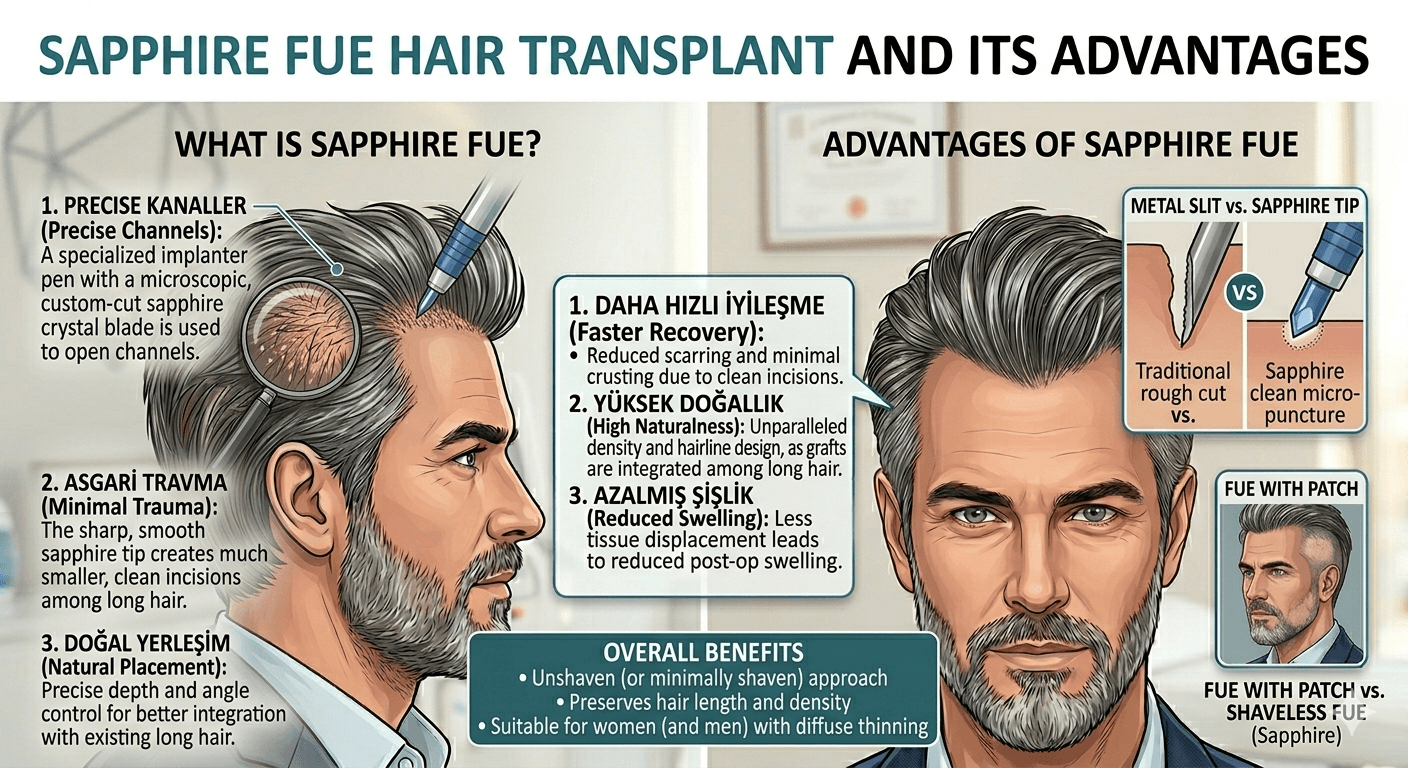
What is a Sapphire FUE Hair Transplant?
To understand the Sapphire upgrade, we have to look closely at how a standard FUE surgery is executed. The procedure happens in two main phases: extraction and implantation.
During the implantation phase, the surgeon must manually create thousands of microscopic incisions (channels) in the balding area where the harvested hair grafts will be placed.
- In Traditional FUE: The surgeon utilizes sharp steel or titanium blades to slit open these tiny channels.
- In Sapphire FUE: The surgeon swaps out standard metal blades for specialized micro-blades made entirely from gemstone sapphire—a ultra-hard, incredibly smooth crystalline gemstone.
This shift from steel to gemstone might sound simple, but on a microscopic scale, it completely changes how the skin reacts to the surgery.
The Core Advantages of Sapphire FUE
Using blades forged from gemstone sapphire introduces a wave of clinical benefits that directly impact your recovery comfort and your final aesthetic look.
1. Superior Precision and Natural Density
Steel blades have a flat, V-shaped tip. Sapphire blades, however, are cut with a precise, ultra-sharp V-shape that allows for a much cleaner, sharper puncture point. Because the cuts are so crisp and micro-sized, surgeons can open channels incredibly close to one another without the risk of tearing the skin tissue. This allows the medical team to plant hair grafts at a much higher density, creating a thicker, richer, and completely natural-looking hairline.
2. Drastically Less Tissue Trauma
Metal blades naturally create minor microscopic friction and jagged tears as they slit the skin. Sapphire is naturally smooth and perfectly rigid, slicing through the scalp like butter. This drastically minimizes the trauma to the surrounding skin cells, meaning there is less bruising, far less bleeding during surgery, and vastly reduced post-op swelling around your forehead and eyes.
3. Accelerated Post-Op Healing
Because the incisions created by a sapphire blade are clean, uniform, and much smaller than those left by steel, your body can knit the skin back together much faster. The tiny scabs that form over the graft sites will be smaller, less noticeable, and will flake off significantly sooner—usually within 7 to 10 days—allowing you to return to your normal life and routine ahead of schedule.
4. Reduced Risk of Infections
Sapphire is a non-porous crystalline gemstone. Unlike steel, it naturally resists bacterial buildup, and its perfectly smooth surface ensures that no micro-fragments alter the tissue during the incision process. Combined with its single-use nature for each patient, it provides an exceptionally sterile environment, driving post-surgical infection rates down to nearly zero.
5. No Displacement of Grafts
When a steel blade cuts an incision, the tissue can sometimes lift or lose its shape slightly. Sapphire blades preserve the exact angle and direction of the channel flawlessly. This ensures that when the graft is placed inside, it remains firmly anchored in position at the perfect angle calculated by the surgeon, preventing the hairs from shifting or growing in odd, stray directions later on.
Final Thoughts: Investing in Excellence
A hair transplant is a permanent change to your appearance. The tools used to craft your new look matter just as much as the hand holding them. Choosing a Sapphire FUE procedure means opting for an ultra-refined medical experience that treats your scalp with maximum care while setting the stage for maximum hair density.
At Dr. Terziler Clinic, we refuse to compromise on the tools or the techniques used to build your confidence. By utilizing advanced Sapphire FUE protocols, our elite medical specialists ensure that your channels are opened with absolute, gemstone-grade precision—offering you a beautifully comfortable recovery and the most dense, flawless, and completely natural results achievable today.
Frequently Asked Questions (FAQ)
Is a Sapphire FUE hair transplant more painful than a regular transplant?
No, it is actually the opposite. Just like a standard transplant, the entire procedure is performed under local anesthesia, meaning your scalp is completely numb and you will not feel any pain during the surgery. Furthermore, because sapphire blades cause significantly less tissue trauma than steel, patients generally report much less soreness and a highly comfortable post-operative recovery phase.
Why does Sapphire FUE cost more than traditional FUE?
The higher price tag is due to the advanced technology and manufacturing required to produce genuine, ultra-sharp sapphire blades. These gemstone tips are costly, highly delicate, and used exclusively for a single patient to ensure perfect sterility and sharpness, unlike steel blades which can lose sharpness over long surgical sessions.
When do the scabs heal after a Sapphire FUE procedure?
Because the micro-channels created by sapphire blades are exceptionally clean and small, the crusts and scabs that form around the new grafts are minimal. With proper, gentle daily washing as directed by your clinic, these small scabs typically heal, dry up, and wash away entirely within 7 to 10 days post-surgery.
Does Sapphire FUE guarantee a 100% graft survival rate?
While no surgical procedure can promise an absolute 100% survival rate due to individual biological factors, Sapphire FUE yields some of the highest survival rates in the medical industry (often above 95%). The clean incisions cause minimal tissue damage, creating an exceptionally healthy, well-oxygenated channel for the new follicle to thrive in immediately after placement.
Can Sapphire FUE be used for a completely bald crown?
Absolutely. Sapphire FUE is an ideal option for covering extensive baldness, including a bare crown or vertex. Because it allows the surgeon to open a high number of channels safely and tightly packed together, it is an excellent technique for delivering deep visual density to larger balding zones in a single surgical session.