





For the vast majority of people undergoing hair restoration, the traditional path is simple: hair is harvested from the permanent donor zone at the back of the head and moved to the balding zones at the front or crown.
But what happens when you have severe, advanced baldness, and the back of your head is already completely depleted, thin, or scarred from a previous poorly executed surgery?
In the past, patients with limited scalp donor hair were simply turned away and told they were not candidates for hair restoration. Today, thanks to advancements in Follicular Unit Extraction (FUE) technology, surgeons have a powerful alternative: Body Hair Transplant (BHT).
BHT expands the boundaries of hair restoration by allowing specialists to harvest healthy hair follicles from areas like the beard, chest, back, or abdomen and successfully transplant them onto the scalp.
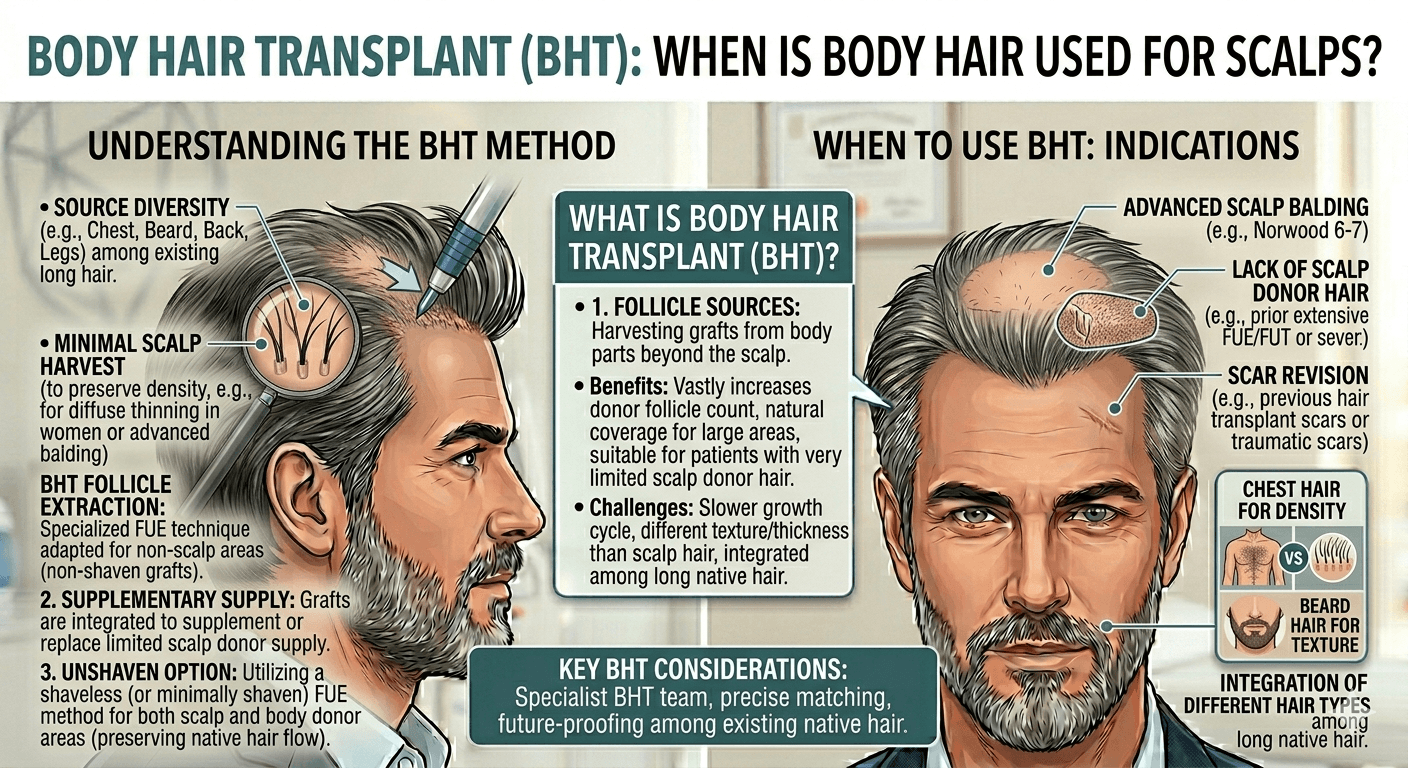
What is a Body Hair Transplant (BHT)?
A Body Hair Transplant is a specialized variation of the FUE technique. Instead of extracting hair from the scalp, the surgeon uses micro-punch tools to harvest individual follicular units directly from body tissue.
However, body hair is biologically different from scalp hair. Scalp hair usually grows in natural groups of 1 to 4 hairs per follicle, grows continuously for years, and can reach significant lengths. Body hair, conversely, typically grows as single strands, has a much shorter growth phase (anagen phase), stays relatively short, and often possesses a different texture or curl pattern.
Because of these differences, body hair is rarely used to build a brand-new front hairline. Instead, it serves as an excellent, high-volume “filler” to add bulk, depth, and density behind an existing hairline or within a thinning crown.
When is Body Hair Used for the Scalp?
BHT is not a first-choice procedure; it is a highly strategic solution deployed under specific clinical circumstances. You might be an ideal candidate for body hair harvesting if you fall into one of the following categories:
1. Severe, Advanced Baldness (Norwood Scale 6 or 7)
Patients with extreme hair loss require a massive number of grafts (often 6,000 to 8,000+) to achieve meaningful coverage across their entire head. If their scalp donor zone can only safely yield 3,000 grafts without looking overly thinned out, body hair is brought in to bridge the gap and provide the extra volume needed.
2. Depleted or Overharvested Scalp Donor Areas
Unfortunately, many patients fall victim to low-cost “hair mills” that aggressively overharvest the back of the head, leaving behind patchy spots, visible thinning, or extensive scarring. When a patient needs a corrective or secondary surgery but has zero usable scalp hair left, BHT offers a clean slate to repair the damage.
3. Camouflaging Linear FUT Scars
Patients who previously underwent an old-school FUT “strip” surgery are often left with a long, horizontal scar across the back of the head. Coarse body hair—particularly beard hair—is exceptionally good at being implanted directly into scar tissue to camouflage the mark, allowing the patient to wear shorter hairstyles comfortably.
The Best Body Hair Sources: Ranked
Not all body hair is created equal. Surgeons categorize and rank body donor sites based on graft survival rates, thickness, and growth characteristics:
Tier 1: The Beard (The Gold Standard of BHT)
Beard hair is by far the best and most reliable source of body hair.
- Why it works: Beard follicles are thick, robust, and have a highly active growth cycle. They boast an incredibly high survival rate (often exceeding 85–90%) when moved to the scalp. Because a single beard hair can be twice as thick as a standard scalp hair, it provides unparalleled visual volume and shadow coverage in the crown or mid-scalp areas.
- Healing: The tiny extraction points under the jawline heal beautifully and become completely invisible within a matter of days.
Tier 2: The Chest and Back
If the patient does not have a beard or needs even more volume, chest and back hair are the next options.
- Why it works: These hairs are generally finer and have shorter maximum growth lengths. They are ideal for blending into areas where a softer texture is required.
- Considerations: The survival rate is lower than beard hair, and the extraction process requires a highly delicate touch to avoid creating minor pigment changes on the chest skin.
Tier 3: Abdomen, Arms, and Legs
Follicles from the stomach, arms, or legs are considered a last resort. These hairs have a very long resting phase and stay very short, meaning their cosmetic contribution to scalp volume is minimal compared to beard or chest hair.
Final Thoughts: A Specialized Technical Feat
Body Hair Transplantation is a highly technical, meticulous procedure that demands an immense amount of clinical experience. Extracting a follicle from the soft, mobile skin of the neck or chest is significantly more difficult than harvesting from a firm scalp.
At Dr. Terziler Clinic, we pride ourselves on pushing the technological boundaries of hair restoration to ensure no patient is left without hope. Through our masterfully executed Body Hair Transplant protocols, our elite specialists can artistically utilize alternative donor sources like robust beard hair to restore deep density, repair prior scars, and deliver the most natural, full-looking results—even when traditional options seem exhausted.
Frequently Asked Questions (FAQ)
Will transplanted beard hair look weird or stiff on my head?
When coarse beard hair is implanted, it naturally softens over time. As it spends months embedded in the scalp and adapts to the local blood flow, its texture begins to mimic the surrounding scalp hair, blending in beautifully. Furthermore, an experienced surgeon will always mix body hair with native scalp hair rather than planting it in isolated clumps, ensuring a completely seamless visual blend.
Does body hair continue to grow long like normal head hair after a transplant?
Body hair will grow slightly longer than it originally did on your face or chest due to a phenomenon called “recipient dominance,” where the hair adopts some characteristics of its new location. However, it will likely never grow as long as your original head hair. For this reason, patients who receive a BHT are usually advised to maintain a medium-to-short hairstyle for the best aesthetic integration.
Will harvesting beard hair leave visible scars on my face or neck?
No. Surgeons extract beard grafts strictly from the underside of the jawline and the upper neck area—never from the middle of the cheeks. Because the extraction tools used are under 1mm in diameter, the tiny micro-wounds heal exceptionally fast. Within a week, the skin recovers completely, leaving zero visible marks or patches, even when you shave your beard completely clean.
Is the recovery time different for a Body Hair Transplant?
The healing timeline for your scalp remains exactly the same (7 to 10 days for scabs to shed). The body donor areas actually tend to heal even faster than the scalp. The tiny red points on your neck or chest typically close up within 24 to 48 hours and fade away into your natural skin tone within a week, requiring only basic moisturizing and sun protection during the initial phase.
Can anyone get a Body Hair Transplant?
No. A patient must possess a high-density, healthy supply of body hair to be a candidate. If your chest or beard hair is incredibly sparse, fine, or downy, it will not provide enough cosmetic benefit to justify the extraction. A comprehensive, in-person clinical evaluation is always required to assess the quality and viability of your body hair follicles.