





The surgery is officially over, and you are finally heading home with your new hair follicles carefully positioned in their new zones. But as the initial excitement settles, reality kicks in: Now what?
The first 10 days following a hair transplant are undeniably the most critical phase of your entire hair restoration journey. During this brief window, your newly implanted grafts are incredibly delicate. They do not have a secure blood supply yet; they are simply resting in their micro-channels, anchored only by natural tissue adhesion.
Any accidental bump, scratch, or incorrect wash can permanently dislodge a graft and impact your final density.
To take the guesswork out of your recovery, this day-by-day timeline outlines exactly what to expect, how to protect your investment, and how to heal flawlessly during the first crucial week and a half.
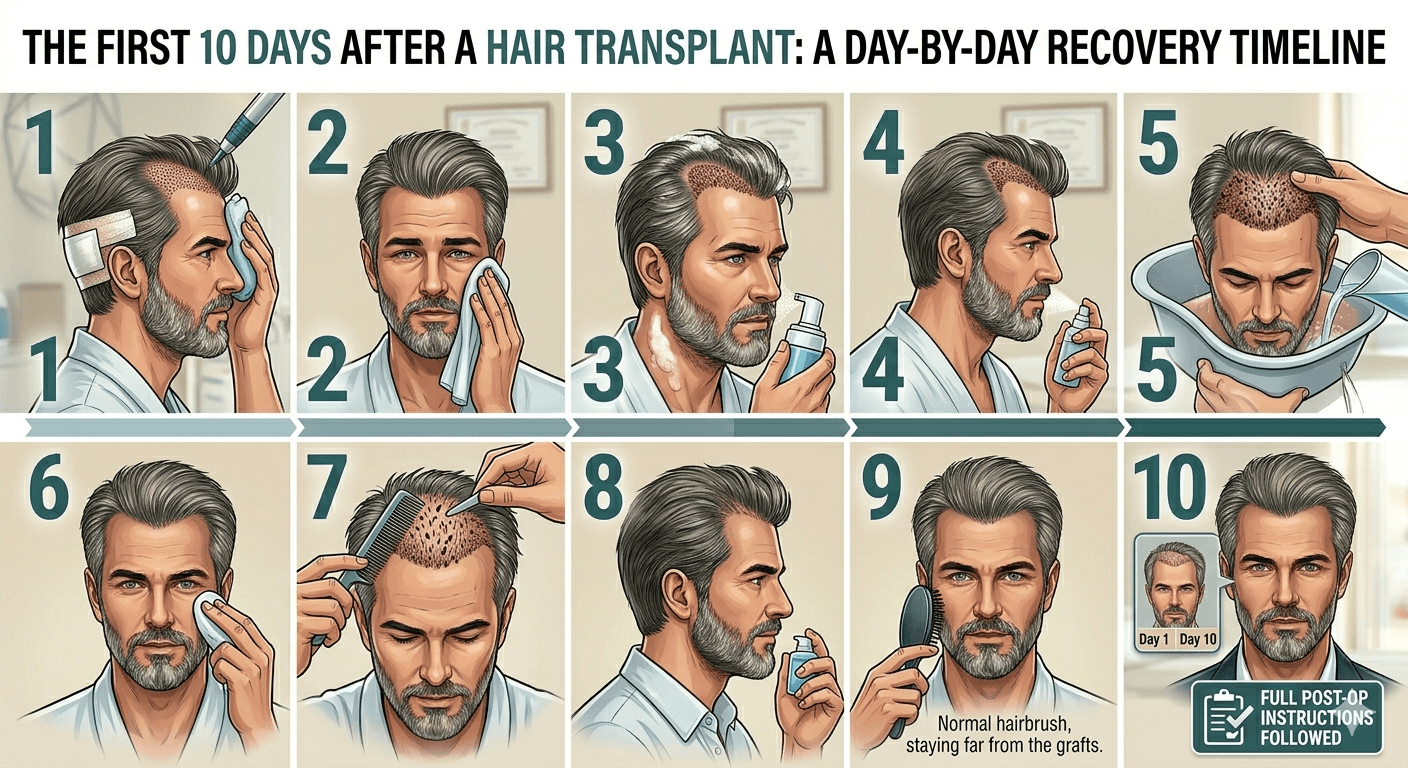
Day 1: The Day After Surgery (The Check-Up)
When you wake up on the first morning after your procedure, your scalp will likely feel tight, slightly sore, or numb from the lingering local anesthesia.
- What happens: You will return to the clinic for your first official follow-up. The medical team will gently remove your surgical bandages, check the health of both your donor and recipient areas, and give your scalp its first professional rinse.
- Key Action: Do not touch, scratch, or pick at your scalp. Your primary job is to rest, drink plenty of water, and stay indoors to avoid dust, direct sunlight, and wind.
Days 2 & 3: The Peak of Swelling & The Arrival of Scabs
Around the second or third day, you might look in the mirror and notice your forehead or the bridge of your nose looks unusually puffy. Do not panic—this is a completely normal response as the sterile fluids injected during surgery naturally drain downwards.
- What happens: Micro-scabs will begin to form around each individual transplanted hair graft, looking like tiny dark dots on the skin.
- Key Action: You must continue to sleep with your head elevated at a 45-degree angle using a travel neck pillow. This uses gravity to safely push the swelling down away from your eyes and prevents your fresh grafts from rubbing against your bedsheets.
Days 4 & 5: The Infamous Post-Op Itch
As the swelling in your face begins to subside, a new sensation will take its place: a deep, intense itch across both your donor and recipient zones.
- What happens: Itching is a brilliant clinical sign that your microscopic nerves are awakening and the skin tissue is actively healing. However, scratching now can instantly rip out a graft and cause bleeding.
- Key Action: You will begin washing your hair at home using the specific, gentle tapping protocol demonstrated by your clinic. To soothe the itch safely, apply a doctor-approved moisturizing spray or a light saline mist rather than using your fingernails.
Days 6 & 7: The Scabs Solidify
By the end of the first week, your donor area at the back of your head will feel significantly stronger and less tender. The extraction points will have closed up completely, and your native hair will start growing out to cover the area.
- What happens: The scabs in the recipient area are now fully formed, firm, and securely bound to the dead hair shafts.
- Key Action: Your daily gentle washes will slowly begin to soften these scabs. Do not try to pick them off prematurely; let the water pressure do the heavy lifting naturally.
Days 8 to 10: The Great Shedding of Scabs
This is the milestone you have been waiting for. By day 10, the hair grafts are considered safely anchored and embedded beneath the skin surface, meaning the risk of accidentally knocking them out drops to nearly zero.
- What happens: During your daily showers, you will notice the scabs are gently rolling off your skin. Some fine, short hair shafts might fall out right along with the scabs. This is completely normal; the root remains safe and sound under the skin.
- Key Action: By the tenth day, your scalp should be completely clean, free of crusts, and looking remarkably pink and healthy. You can finally transition back to sleeping in a normal position and wearing loose, comfortable hats if you step outside.
Golden Rules for the First 10 Days
To ensure your timeline runs smoothly, commit these four absolute rules to memory:
- Say No to Sweat: Avoid all heavy exercise, gym sessions, sex, and saunas. Increased blood pressure can push the delicate grafts right out of their incisions.
- Ditch the Pullover: Wear button-down shirts or zip-up hoodies exclusively. Pulling a tight T-shirt over your head can catch on your new hairline and cause massive graft loss.
- Avoid Direct Shower Pressure: Never let a heavy, high-pressure shower head blast your recipient area directly. Use a clean cup to gently pour lukewarm water over your scalp instead.
- Stay Out of the Sun: UV rays can damage healing skin cells and cause permanent hyperpigmentation (dark staining) on a fresh scalp.
Final Thoughts: The Foundation of Your Results
The first 10 days require a healthy dose of discipline, patience, and meticulous care. It might feel tedious to sleep elevated or wash your hair with a cup, but this brief investment of effort lays the entire foundation for a lifetime of thick, rich hair growth.
At Dr. Terziler Clinic, we do not just leave you to navigate this critical recovery phase alone. We partner with you every single day, providing comprehensive post-operative kits, precise washing tutorials, and dedicated medical tracking. This meticulous, elite care ensures your first 10 days are completely stress-free, setting the stage for the most dense, flawless, and perfectly natural-looking final result.
Frequently Asked Questions (FAQ)
I accidentally bumped my head on day 4, and it bled slightly. Did I ruin my transplant?
If a graft zone bleeds after being bumped during the first 5 days, there is a high probability that a few hair follicles were dislodged. If this happens, apply gentle pressure with a clean, sterile gauze pad to stop the bleeding immediately and contact your clinic right away with a clear photograph so your surgeon can assess the area.
Why are some of the short transplanted hairs falling out with the scabs?
Do not worry—this is a perfectly healthy biological process known as shock loss. The physical trauma of surgery causes the hair shaft to enter a temporary resting phase and shed. The actual living factory of the hair—the follicle bulb—is safely anchored deep under your skin and will begin sprouting brand-new, permanent hair in about 3 to 4 months.
When can I go out in the sun or wear a baseball cap?
You can safely wear a loose-fitting, adjustable baseball cap or a bucket hat after day 10 once the scabs have completely shed, making sure the fabric doesn’t tightly compress the graft zone. However, you should strictly avoid exposing your bare, healing scalp to direct, intense sunlight or sunburns for at least 1 to 2 months post-op.
Can I use regular anti-dandruff or styling shampoo during the first 10 days?
Absolutely not. Regular commercial shampoos contain harsh chemicals, parabens, and heavy perfumes that can severely irritate your healing skin and damage the delicate grafts. You must strictly use the specialized, pH-neutral medical shampoo and moisturizing foam provided directly by your clinic for the first two weeks.
Is it normal to feel a random shooting pain or numbness at the back of my head?
Yes, this is completely normal. As the local anesthesia fully leaves your system and the microscopic nerves in your donor area begin to regenerate, you may experience temporary numbness, a “wooden” sensation, or occasional quick, sharp shooting pains. This is a standard part of nerve recovery and resolves completely on its own over the coming weeks.