




After successfully completing a hair transplant, your scalp enters a highly active phase of cellular repair. As the tiny micro-wounds from the extraction and implantation zones begin to heal, you will notice hundreds of small, firm crusts forming over your new grafts.
For many beginners, looking in the mirror and seeing a head covered in scabs can be unsettling. It is incredibly tempting to want to peel, scratch, or pick them off to make your scalp look clean again.
However, these scabs serve a critical biological purpose, and managing them incorrectly can permanently damage your new follicles.
Understanding the precise, medical protocol for the crust-shedding process ensures you can clear your scalp safely without compromising your final density.
Why Do Scabs Form After a Hair Transplant?
Scabbing is a completely natural, healthy sign that your body is repairing itself.
During a hair transplant, thousands of microscopic incisions are created to plant the new hair grafts. In the first 24 to 48 hours, these tiny puncture points ooze small amounts of blood and tissue fluid. As this fluid dries, it hardens into protective crusts over each individual graft site.
Think of these scabs as nature’s bandages. Their primary job is to shield the newly embedded, highly delicate hair roots from external bacteria, dust, and physical friction while the follicles establish a permanent connection to your scalp’s blood supply.
The Natural Timeline of Crust Shedding
Patience is your best ally during the first two weeks of recovery. The scabs follow a highly predictable, step-by-step chronological loop:
- Days 1 to 3 (Formation): The micro-channels close up, and the initial red or dark brown scabs begin to appear around the hair shafts.
- Days 4 to 7 (Solidification): The scabs tighten and dry completely. This is usually when the infamous post-op itch begins as the skin underneath starts contracting and healing.
- Days 8 to 10 (Softening): Thanks to your daily gentle washing routine, the crusts slowly lose their grip on the scalp and start to soften significantly.
- Days 10 to 14 (Shedding): The scabs naturally detach and roll off the skin during your daily shampoo routines, leaving behind a smooth, healthy, pink scalp.
How to Remove Scabs Safely: The Step-by-Step Medical Protocol
The Golden Rule: You must never under any circumstances pick, scratch, or force a dry scab off your scalp during the first 9 days. Doing so will rip the living follicle bulb right out of the skin, causing permanent graft loss and bleeding.
By Day 10, the grafts are safely anchored beneath the skin surface, and you can actively help the stubborn scabs shed by following this precise clinical protocol:
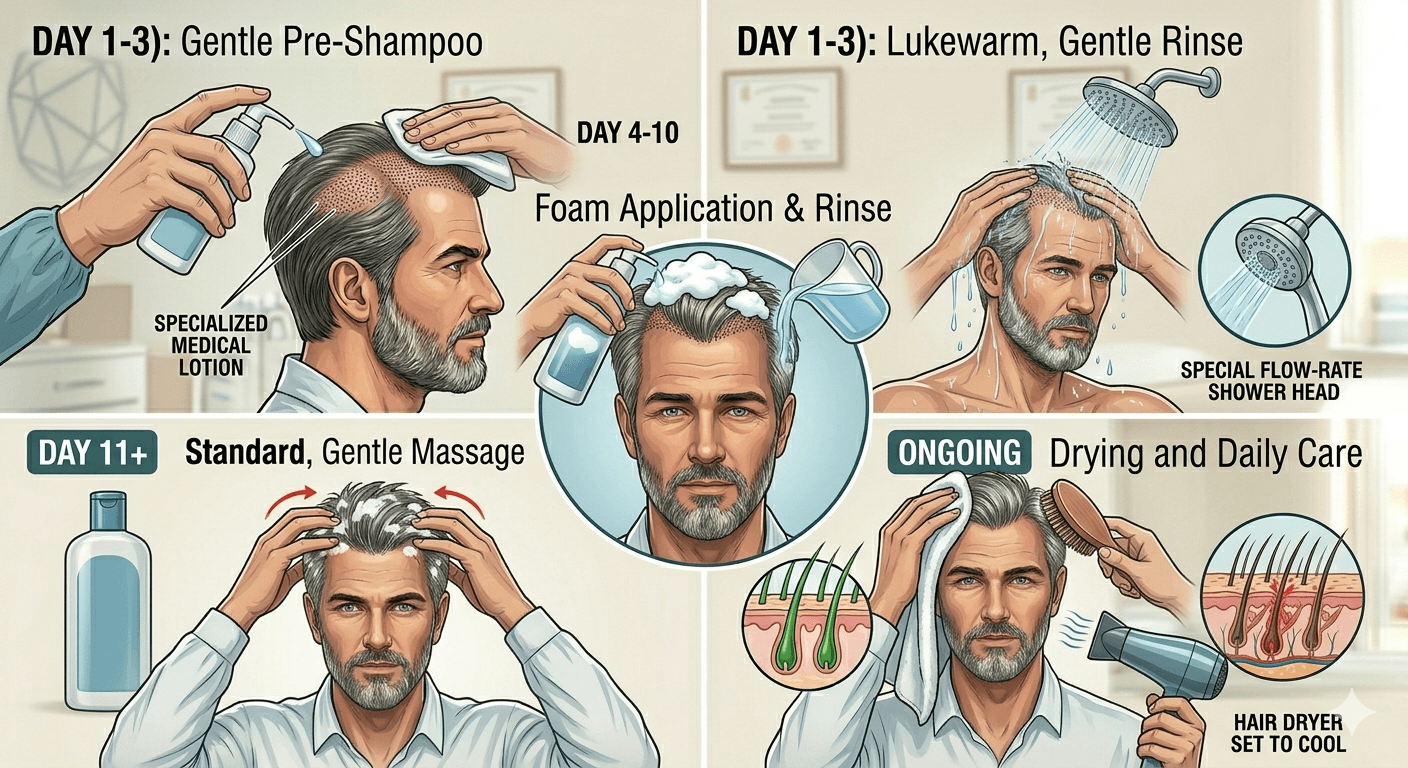
Step 1: Extended Softening (The Lotion Phase)
Before attempting to remove any crusts, you must thoroughly hydrate them to break down their firm structure.
- The Action: Apply a generous layer of the moisturizing foam or lotion provided by your clinic over the entire graft zone.
- The Wait: Instead of the usual 20 minutes, let the lotion sit on your scalp for 45 to 60 minutes on Day 10. This extended soak deeply saturates the scabs, making them soft, gooey, and ready to detach.
Step 2: The Soft Circular Massage (The Shampoo Phase)
Once the crusts are completely softened, you will use the power of a gentle, friction-free massage to dislodge them.
- The Action: Rinse away the lotion with lukewarm water using a cup, then lather your specialized medical shampoo in your palms.
- The Execution: Apply the thick foam to your head. Using strictly the pads of your fingers (never your fingernails), begin massaging the scabbed areas in very soft, slow, circular motions.
- The Result: You will feel the softened crusts naturally crumble and slide away from your skin under your fingertips.
Step 3: The Final Rinse and Inspection
- The Action: Gently pour lukewarm water over your head to wash away the loose scabs and shampoo completely.
- The Clean: Pat your head dry with a clean paper towel. If a few stubborn scabs remain, do not force them. Simply repeat the process the following day. By Day 14, your scalp should be completely clear.
What If Hair Falls Out With the Scabs?
When the scabs finally slide off your scalp, you will likely notice that many of them have tiny, short hairs trapped inside them. This sight can cause instant panic, making patients think they have accidentally washed away their new grafts.
Rest assured, this is completely normal.
This process is known as shock loss. The stress of the surgery causes the temporary hair shaft to break away and shed, but the vital, living “factory” of the hair—the root bulb—remains safely embedded deep under your skin tissue. It will rest for a few months before sprouting brand-new, permanent hair around month 3 or 4.
Final Thoughts: A Clean Canvas
Clearing your scalp of scabs by the end of the second week marks the successful completion of your primary recovery phase. It transitions your scalp from a post-surgical state into a clean, healthy environment where your new roots can thrive without obstruction.
At Dr. Terziler Clinic, we treat your aftercare journey with the exact same meticulous precision as the surgery itself. We walk you through every stage of the crust-shedding process, providing specialized, deeply hydrating formulas and tailored medical guidance. This ensures your scabs are eliminated comfortably and safely, protecting your delicate grafts perfectly to deliver the most dense, flawless, and completely natural results possible.
Frequently Asked Questions (FAQ)
What happens if I don’t remove the scabs by Day 14?
If scabs are left on the scalp for longer than two weeks, they can harden excessively, forming a thick layer that traps sebum, sweat, and bacteria underneath. This can block oxygen from reaching the healing tissues, clog the pores, and potentially delay the growth of the new hair follicles, which is why active, gentle removal around Day 10 to 12 is highly recommended.
How do I know if I accidentally pulled out a graft while removing a scab?
If you pull out a living hair graft during the first few days of recovery, it will always be accompanied by immediate, distinct bleeding at that specific spot, because the root is connected to the scalp’s blood vessels. If a scab falls off on Day 10 with a short hair inside but there is absolutely no blood, your root is perfectly safe and sound beneath the skin.
My scalp looks very pink or red after the scabs came off. Is this normal?
Yes, this is completely normal. Once the crusts clear away, the fresh skin underneath will often display a light pink or red hue. This redness is simply a sign of increased blood circulation and active cellular healing in the area. The pinkness will gradually fade back into your natural skin tone over the coming weeks.
Can I use a comb or a soft brush to help remove the crusts?
Absolutely not. You should never use combs, hairbrushes, sponges, or washcloths on your recipient area during the first 14 days. The rigid teeth or fibers can easily catch on a delicate graft and pull it out entirely. Stick strictly to the soft pads of your fingertips during your daily shampoo routine.
Can I go swimming or use a sauna once the scabs are completely gone?
Even though your scabs may be gone by Day 14, your healing skin pores are still highly sensitive. You should continue to avoid public swimming pools, oceans, hot tubs, and heavy saunas for at least 1 month post-surgery to protect your scalp from harsh chlorine, salt irritation, and potential bacterial infections.