





You have successfully completed your hair transplant surgery, the initial redness is starting to settle, and you are well on your way to a full recovery. Then, around the fourth or fifth day, a new, intense sensation creeps up across your scalp: a deep, unrelenting itch.
For many patients, the post-operative itch is the most mentally challenging part of the entire hair restoration journey. It can keep you awake at night and test your willpower to the absolute limit.
The absolute golden rule during this phase is simple: you must not scratch your scalp. Scratching with your fingernails during the first two weeks can easily tear out your delicate, newly implanted hair grafts, causing bleeding, permanent gaps in your density, or local infections.
Understanding the biological reasons behind this itch and learning the medically approved ways to safely soothe it will help you navigate this brief, uncomfortable phase completely stress-free.x
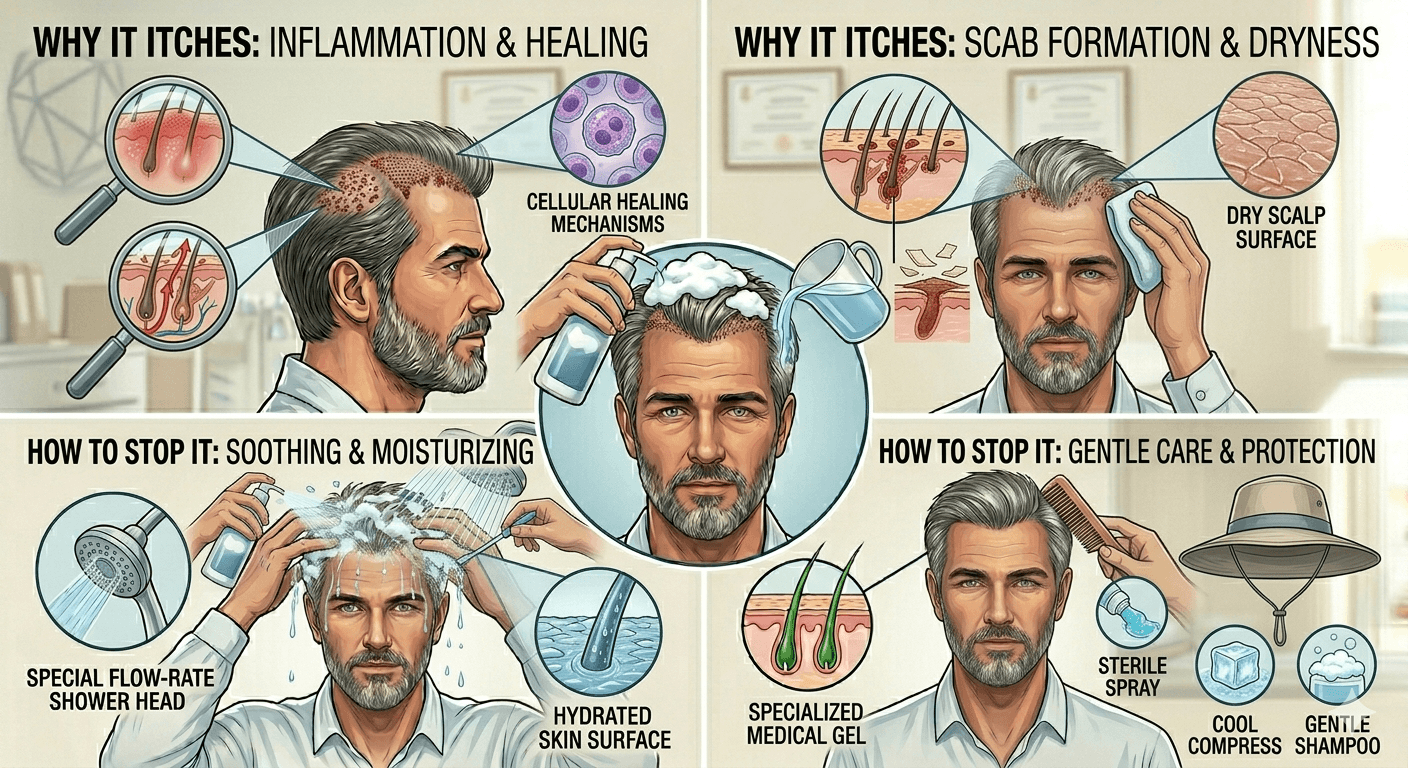
Why Does My Scalp Itch So Badly After a Hair Transplant?
An itchy scalp is not a sign that something is wrong with your surgery. In fact, it is a brilliant clinical indicator that your body is actively working to repair itself.
The itch is triggered by four primary biological mechanisms:
1. Regeneration of Micro-Nerves
During the extraction and implantation phases, thousands of microscopic incisions are made across your scalp. These incisions temporarily disrupt the tiny, delicate nerve endings in your skin tissue. As your body heals over the first few weeks, these micro-nerves begin to wake up, misfiring signals to your brain that are interpreted as a deep, intense itch.
2. Histamine Release
As your skin tissue repairs itself, your immune system releases histamines—the same chemical compound your body floods your system with during an allergic reaction. This histamine release induces localized inflammation and an immediate urge to scratch the healing zones.
3. Dryness and Crust Formation
As the tiny puncture points close up, fluid and minor bleeding dry out to form micro-scabs (crusts) around each graft. As these scabs dry up and harden, they cause the surrounding skin to contract, tighten, and become excessively dry, creating a flaky environment that naturally itches.
4. Shaving and Hair Regrowth
If your head was shaved for the procedure, the tiny hair shafts will begin sprouting back through the skin surface around day 5 to 7. Just like shaving your beard or legs, the blunt edges of the newly growing hairs piercing the skin cause a prickly, itchy sensation.
When Does the Itching Start and How Long Does It Last?
The timeline for the post-op itch is highly predictable:
- The Onset (Days 4–5): The itching typically begins as the swelling subsides and scabs solidify.
- The Peak (Days 7–10): The intensity reaches its maximum right before the scabs are ready to flake off.
- The Relief (Days 14+): Once the crusts are completely washed away during your day-10 shampoo routines, the itch drops significantly, resolving entirely for most patients within 3 to 4 weeks.
How to Stop the Itch Safely: 5 Medically Approved Strategies
Since you cannot use your fingernails, you need safe, non-invasive methods to trick your nervous system and soothe the skin tissue.
1. Use a Saline Hydration Spray
Whenever you feel a sudden wave of itching, grab the sterile saline spray or hydration mist provided by your clinic. Spray a generous layer over the itchy zones from a safe distance of 10–15 centimeters. The cool moisture instantly hydrates the tight skin, breaking down the itch signal without you ever touching the scalp.
2. Take Over-the-Counter Antihistamines
If the itch is keeping you awake at night, contact your clinic for a recommendation on a standard, non-drowsy oral antihistamine (such as Cetirizine or Loratadine). Because these medications directly block the histamine compounds your body is releasing, they stop the itch from inside out.
3. The Gentle “Pads of the Fingers” Tapping Technique
If the urge to scratch becomes entirely unbearable and you feel like you are losing control, you can apply very light, vertical pressure. Using strictly the soft, fleshy pads of your fingers—never your nails—gently tap or press down on the itchy area. Do not drag, rub, or slide your fingers. This mild pressure satisfies the brain’s itch receptors without pulling on the hair roots.
4. Apply Pure Aloe Vera Gel (Only on the Donor Area)
The donor area at the back of your head can often itch even more aggressively than the front due to the sheer volume of extractions. After Day 7, you can safely apply a thin layer of pure, organic aloe vera gel to the donor area only. Aloe vera cools the skin, reduces inflammation, and eliminates dryness instantly. Do not apply this to the recipient area without your doctor’s explicit approval.
5. Stick to Your Daily Shampoo Routine
Diligently washing your head once a day with the specialized medical shampoo provided by your clinic is the ultimate cure. Shampooing breaks down sebum, clears oils, and softens the crusts. As the scabs roll off your head between days 10 and 12, the primary trigger of your itch disappears completely.
Final Thoughts: A Test of Discipline
The post-hair transplant itch is a brief rite of passage that almost every patient must face. It requires a healthy dose of mental discipline and patience, but keeping your hands off your scalp during this critical two-week window ensures that your new hair roots remain perfectly protected and anchored.
At Dr. Terziler Clinic, we understand that a premium hair restoration experience requires keeping you comfortable throughout your entire recovery, not just during the surgery. By providing tailored post-op kits equipped with advanced soothing sprays, precise medical shampoos, and direct, 24/7 access to our medical tracking specialists, we ensure that your healing phase is as peaceful, itch-free, and comfortable as possible—paving the way for the most dense, flawless, and completely natural results.
Frequently Asked Questions (FAQ)
Q1: What should I do if I accidentally scratch my head while sleeping?
To prevent subconscious scratching during the night, we highly recommend continuing to sleep with a travel neck pillow for the first 10 days to restrict your head movement. Additionally, keeping your fingernails clipped incredibly short or wearing soft, clean cotton gloves to bed during the first week acts as a highly effective insurance policy against accidental graft damage.
Q2: Can I apply an anti-itch hydrocortisone cream to my new hairline?
Absolutely not. You must strictly avoid applying any thick, heavy, commercial anti-itch creams, petroleum jelly, or ointments to your recipient area during the first 14 days. These heavy substances can clog the healing pores, suffocate the delicate grafts, block oxygen flow, and significantly increase your risk of local infections or folliculitis.
Q3: Why does the back of my head itch more than the front?
The donor area at the back of your head typically experiences a higher concentration of tissue intervention, as thousands of individual hair follicles are extracted across a broad zone. As the thousands of micro-wounds close up and heal simultaneously, the nerve endings and histamine responses in the back can create a much more intense, widespread itch than the front.
Q4: Could severe itching be a sign of a scalp infection?
While mild-to-moderate itching is completely normal, a severe, burning itch accompanied by intense local pain, localized swelling that worsens after day 5, oozing yellowish pus, or a foul odor is a strong indicator of a skin infection. If you notice any of these abnormal symptoms, take a clear photograph and contact your clinic immediately.
Q5: When can I return to using my normal commercial shampoo to help soothe my scalp?
You should completely avoid commercial shampoos containing heavy perfumes, sulfates, or harsh chemicals for at least 2 to 3 weeks post-surgery. Stick exclusively to the medical, pH-neutral shampoo provided directly by your clinic until your scalp has fully recovered and all pinkness has completely faded away.