





The surgery is a success, your custom hairline is perfectly drawn, and you are finally back home. You are likely feeling physically exhausted and ready for a deep night of rest. However, as you approach your bed, a wave of anxiety hits: How am I supposed to sleep without destroying my new hair?
Sleeping after a hair transplant is undeniably one of the trickiest parts of the immediate post-operative recovery.
During the first 7 to 10 days, your newly implanted hair grafts are extremely vulnerable. They have not established a secure root structure or blood supply yet; they are simply sitting delicately inside micro-channels. Any friction, rubbing, or compression against a pillow can easily dislodge a graft, causing immediate bleeding and a permanent gap in your final density.
Learning the proper medical sleeping positions and preparation techniques will protect your investment and allow you to sleep soundly without fear.
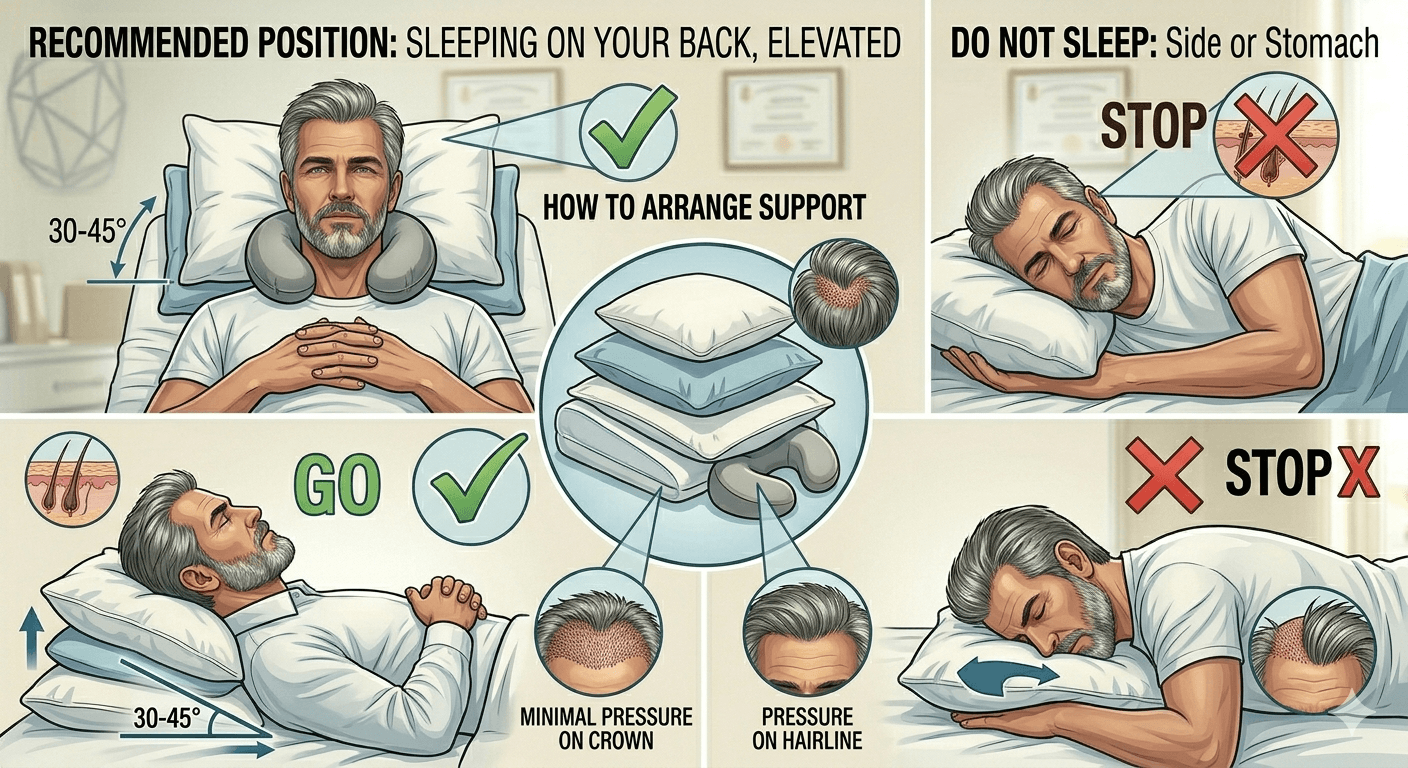
The Ultimate Rule: Sleep Elevated on Your Back
From the very first night after your surgery up until Day 10, you must strictly follow one specific sleeping posture: sleeping on your back with your head and torso elevated at a 45-degree angle.
[45° Elevation]
/
/ <- Head supported by travel pillow (No contact with recipient area)
/
/____ <- Body flat on back
This specific position is non-negotiable for two critical reasons:
1. Eliminates Graft Friction
When you sleep flat or on your side, your face and the top of your head inevitably press into the pillow. This contact creates physical friction that can rip out the delicate grafts. Keeping your torso elevated and remaining flat on your back ensures the recipient zone (usually the front and crown of your head) never touches a single surface.
2. Reduces Facial Swelling
During surgery, your medical team injects local anesthesia and sterile fluids into your scalp. If you sleep completely flat, gravity will cause these fluids to pool forward into your face, leaving you with severe swelling around your forehead, eyes, and bridge of the nose by morning. An elevated angle uses gravity to naturally and safely drain these fluids down toward your neck and lymphatic system.
How to Set Up Your Bed for Perfect Protection
To make this elevated position comfortable and structurally secure throughout the night, follow this simple setup guide:
- The Travel Neck Pillow (Your MVP): Slide a firm, U-shaped memory foam travel neck pillow around your neck. This is the ultimate tool for hair transplant recovery. It cradles the base of your skull and keeps your head locked in a straight, forward-facing position, physically preventing you from rolling over onto your stomach or sides during deep sleep.
- The Wedge Pillow Strategy: Place a firm wedge pillow or stack 3 to 4 standard pillows underneath your upper back and shoulders. You want your entire upper torso elevated, not just your neck bent forward, which can restrict blood flow.
- The Puppy Pad Layer: Your donor area at the back of your head will naturally ooze a small amount of tissue fluid, sterile solution, and minor blood during the first 48 hours. Place a clean, disposable absorbent pad (or a soft, old towel you don’t mind staining) over your pillows to keep your bedding pristine and sterile.
What Positions are Strictly Banned?
To avoid catastrophic graft loss, commit these forbidden sleeping habits to memory for the first 10 days:
- Strictly No Stomach Sleeping: Sleeping face-down is the most dangerous position. It places direct pressure on your forehead and hairline, guaranteeing massive graft destruction and severe facial swelling.
- Strictly No Side Sleeping: Sleeping on your side presses the temporal areas (the sides of your head) directly into the mattress. If grafts were placed near your temples or crown, they will be instantly crushed or dislodged.
- Do Not Toss and Turn: Moving aggressively during the night is highly risky. If you are a naturally restless sleeper, setting up heavy pillows or rolled-up blankets on both sides of your torso will create physical barriers that lock your body into place.
When Can You Return to a Normal Sleeping Routine?
The recovery timeline moves quickly if you remain disciplined:
- Days 1 to 7: Absolute restriction. Sleep strictly on your back, elevated at 45 degrees, using your travel neck pillow.
- Days 8 to 10: The grafts are becoming highly secure. If your facial swelling has completely subsided, you can gradually lower your elevation angle to a more comfortable, semi-flat position, but you must remain on your back.
- Day 11 and Beyond: The milestone of safety. By Day 10, the hair grafts are considered completely anchored and integrated beneath the skin tissue. You can officially ditch the travel pillow, sleep flat on your mattress, and return to side or stomach sleeping without any risk of losing your new hair.
Final Thoughts: Rest Easy, Protect Your Investment
Sacrificing your favorite sleeping position for just 10 days is a remarkably small price to pay for a lifetime of thick, permanent hair growth. It requires a bit of adaptation, but setting up your environment correctly turns an intimidating recovery phase into a smooth, stress-free routine.
At Dr. Terziler Clinic, we treat your post-operative comfort with elite medical precision. We provide every patient with a premium, specialized aftercare kit that includes protective sleeping materials, clear ergonomic guidance, and direct 24/7 medical tracking. This meticulous attention to detail removes all guesswork from your recovery—ensuring your nights are perfectly peaceful, your delicate grafts remain flawless, and your final results are beautifully dense and natural.
Frequently Asked Questions (FAQ)
What should I do if I wake up and realize I accidentally rolled onto my side or stomach?
Do not panic. Turn on a bright light and look directly into a mirror. Check your recipient zone for any signs of fresh, active bleeding. If the scalp is completely dry and intact, you got lucky and your grafts are safe. If you see active bleeding, it means a graft may have been lost; apply gentle pressure with sterile gauze and contact your clinic with a clear photo right away.
Doesn’t resting the back of my head on the pillow damage the donor area?
No, it will not. The hair follicles in the donor area have been extracted, meaning there are no delicate grafts left on the surface to be dislodged. The remaining extraction points close up incredibly fast (usually within 48 hours). While the back of your head may feel tender or numb, resting it directly against a pillow or a travel neck pillow is completely safe and will not harm your recovery.
Can I take a sleeping pill or a sedative to help me sleep during the first week?
You should strictly avoid heavy, over-the-counter sleeping pills or strong sedatives during the first 5 to 7 days. These medications can plunge you into an unnaturally deep, heavy sleep where your body completely loses its natural defensive reflexes. If you shift or rub your head against the headboard while heavily sedated, you will not wake up to correct yourself, which can lead to severe graft damage.
When can I sleep without a travel pillow or a specialized head wrap?
You can safely stop using the travel neck pillow on Day 11 post-surgery. By this point, the micro-incisions have completely closed up, the scabs have shed, and the roots are deeply anchored into the scalp’s internal tissue layers, rendering them completely immune to normal sleep friction.
Can I wear a loose skullcap or a beanie to bed to protect the grafts while sleeping?
Absolutely not. You must never wear beanies, nightcaps, bandanas, or loose hats to bed during the first 10 days. The fabric will directly compress the fresh grafts, trap heat and sweat (which breeds bacteria), and can easily catch on the scabs, ripping the grafts out completely when you take the hat off in the morning. Keep the recipient area completely open to the air.