





Discovering that your hair transplant has failed is a deeply frustrating and emotional experience. You invested time, financial resources, and emotional trust into a procedure meant to restore your confidence, only to be left with unnatural results, patchy thinning, or severe scarring.
The rise of unlicensed “hair mills” has made bad hair transplants an increasingly common problem globally. The good news is that a poor outcome does not mean you are out of options. Revision hair transplant surgery is a highly specialized corrective medical procedure designed to repair poor aesthetic results, restore density, and reconstruct damaged hairlines.
However, executing a successful repair requires an entirely different level of precision compared to a first-time transplant. Here is an analytical look at why hair transplants fail and the advanced surgical pathways used to fix them.
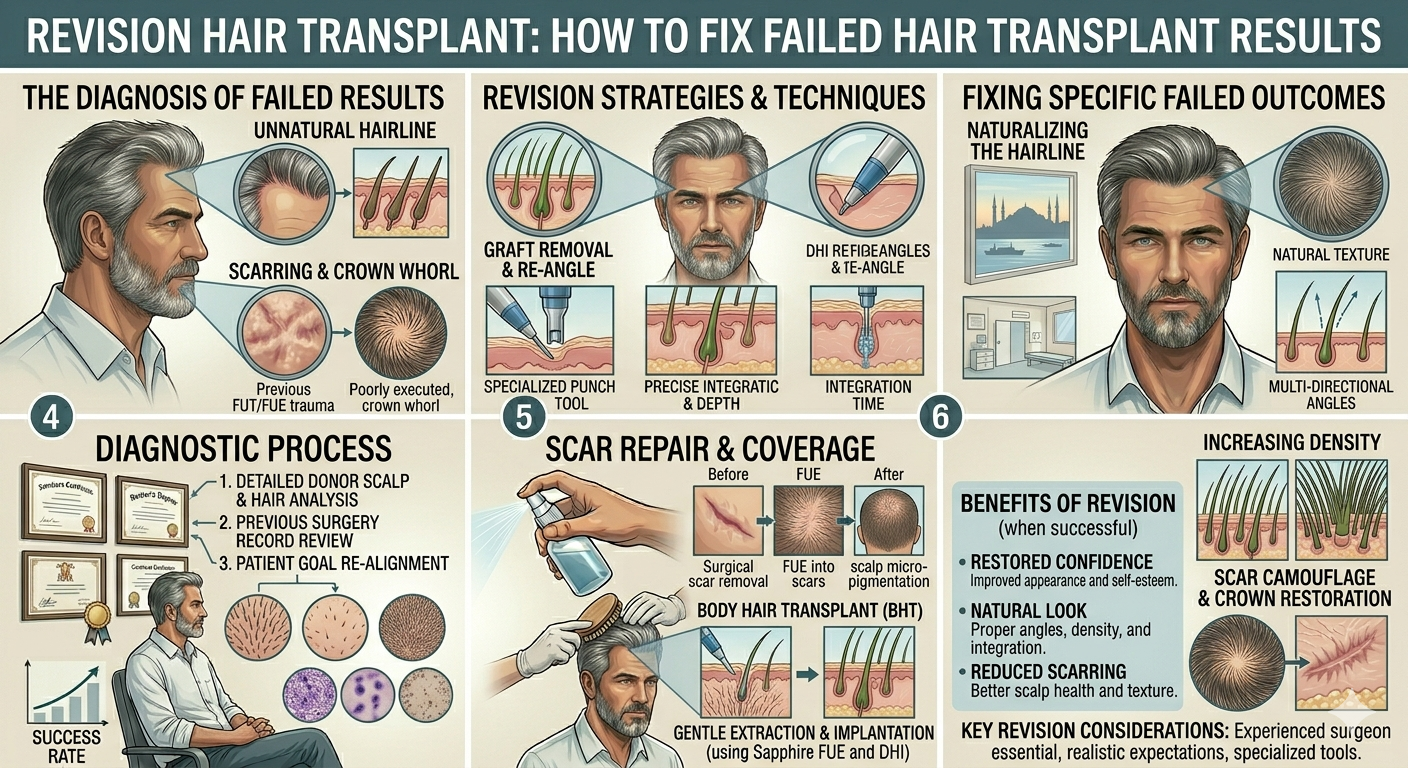
What Does a Failed Hair Transplant Look Like?
A hair transplant “failure” is rarely a complete medical rejection where no hair grows. Instead, failures typically manifest as severe aesthetic or structural errors:
- The “Doll’s Hair” / Pluggy Appearance: This occurs when thick, multi-hair grafts (containing 3 to 4 hairs) are mistakenly implanted directly along the front hairline instead of soft, single-hair grafts.
- Incorrect Growth Angles: When grafts are implanted at unnatural, perpendicular angles, the hair grows straight up or sideways (looking like “cornrows”), making it impossible to style naturally.
- Poor Density and Patchiness: Due to poor graft handling, poor hydration, or prolonged “out-of-body” time during the initial surgery, the follicles die before taking root, resulting in survival rates below 50%.
- An Overharvested Donor Zone: Aggressive over-extraction leaves the back and sides of the scalp looking completely depleted, see-through, or covered in tiny moth-eaten white spots.
Advanced Surgical Techniques for Hair Transplant Repair
Fixing a botched procedure is a multi-step restorative process. Depending on the specific errors made during your first surgery, an elite repair surgeon will deploy a combination of three specialized correction techniques:
1. Graft Excision and Redistribution (The Reset)
If your primary issue is a pluggy, unnaturally low, or poorly angled hairline, the surgeon cannot simply pack more hair around it.
- The Process: Using microscopic punches (0.8mm or smaller), the surgeon carefully extracts the misplaced, pluggy grafts from your hairline.
- The Salvage: These extracted grafts are placed under a microscope, meticulously separated into single-hair units, hydrated in a chilled physiological solution, and re-implanted at the correct natural angle and depth.
2. The Camouflage Technique
When the old grafts are positioned at a reasonably acceptable angle but lack natural softness, the camouflage method is utilized.
- The Process: The surgeon harvests ultra-fine, single-hair follicular units from your remaining donor reserves.
- The Adjustment: These delicate single hairs are strategically packed directly in front of and between the larger, pluggy grafts. This creates a soft, micro-irregular transition zone that completely hides the old work.
3. Body Hair Transplantation (BHT) to Rescue Depleted Donors
The greatest constraint in any revision surgery is a depleted donor bank. If your first clinic overharvested the back of your head, there may not be enough traditional scalp hair left to create density.
- The Process: Elite repair clinics bypass this limitation by harvesting healthy follicular units from the beard area (under the jawline) or chest.
- The Application: Beard hair is remarkably thick and robust, making it the perfect filling material to add immense volumetric density to the mid-scalp and crown, or to fill in the patchy gaps left in an overharvested donor area.
Primary Surgery vs. Revision Surgery
Understanding why revision procedures require specialized clinical settings comes down to comparing the surgical realities:
| Operational Variable | Primary Hair Transplant | Revision Hair Transplant |
| Scalp Tissue State | Clean, flexible, healthy skin with normal blood supply. | Fibrotic scar tissue under the skin, which restricts blood flow. |
| Donor Supply | Pristine, untouched, predictable follicle reserves. | Severely depleted or asymmetric donor zones. |
| Surgical Complexity | Standardized execution based on a clean blueprint. | High-level reconstruction requiring graft extraction, repair, and camouflage. |
| Follicle Survival Goal | Achieving standard 90%–95% baseline growth. | Salvaging and preserving every single remaining graft left. |
The Critical Timeline: When Can You Get a Revision?
You cannot rush into a repair surgery. If you are unhappy with your recent transplant, you must wait a minimum of 12 to 15 months before undergoing a revision procedure.
There are two vital medical reasons for this waiting window:
- Delayed Growth Cycles: Follicles grow at highly irregular rates after trauma. A patch that looks completely bald at month 6 or 8 may naturally sprout and thicken by month 12. Operating too early risks destroying follicles that were simply slow to wake up.
- Tissue Healing: The scalp requires a full year for the underlying vascular networks to rebuild and for post-surgical scar tissue to soften. Attempting surgery on an unhealed, inflamed scalp will result in poor blood supply and cause the new revision grafts to fail.
Final Thoughts: Choosing Your Repair Wisely
A revision hair transplant is your second—and often final—chance to achieve the look you originally wanted. Because your remaining donor hair is a limited, non-renewable resource, you cannot afford another mistake. This is not the time to look for budget discounts; it requires booking with an advanced, certified medical specialist who looks at your scalp through a reconstructive lens.
At Dr. Terziler Clinic, we treat revision hair transplantation as a high-stakes art form. We do not use general, one-size-fits-all surgical plans for repair cases. Every revision patient undergoes an exhaustive digital trichoscopic analysis to map out remaining donor density, subsurface scar tissue, and tissue health. By utilizing premium DHI Choi Implanter technology, advanced body hair extraction (BHT), and intensive postoperative tissue therapies, we safely reverse old mistakes—giving you back a natural hairline and the peace of mind you deserve.
Frequently Asked Questions (FAQ)
Is a revision hair transplant more painful than the first procedure?
No, the discomfort level is virtually identical to your initial surgery. Modern localized anesthesia completely numbs the scalp before the extraction and implantation phases begin. The only noticeable difference is that the surgeon must work slowly and delicately when navigating areas with existing scar tissue.
Can you fix a wide, linear scar left behind by an old FUT (strip) surgery?
Yes. Linear scars from old Follicular Unit Transplantation (FUT) methods can be repaired using two primary approaches. The most permanent method is to transplant active FUE or beard grafts directly into the scar tissue to camouflage it with real hair. Alternatively, the clinic can pair the surgery with Scalp Micropigmentation (SMP)—a specialized medical tattooing technique that blends the scar color with your hair stubble.
What happens if my scalp donor area is completely destroyed and empty?
If your traditional scalp donor zone is entirely depleted due to past overharvesting, a revision can still be achieved using Body Hair Transplantation (BHT). Follicles extracted from beneath the jawline (beard hair) display excellent survival rates and provide fantastic, thick visual coverage when blended into thin zones on the top of the head.
Are the survival rates of grafts lower in a revision surgery?
Graft survival can be slightly lower in a repair zone due to the presence of subcutaneous scar tissue, which naturally has less blood circulation than undamaged skin. However, by choosing an expert surgeon who uses precision micro-blades, reduces “out-of-body” graft time, and spaces out the grafts carefully, survival rates can be maintained at a highly successful 85% to 90% range.
Is a revision hair transplant more expensive than a primary procedure?
Yes, in almost all cases, a revision transplant carries a higher cost than a standard first-time procedure. This price difference reflects the intense complexity of the surgery. The surgeon must spend significant operating time carefully punching out old, misplaced grafts, dissecting them under microscopes to salvage them, and meticulously working around preexisting scar structures.