





When planning a hair restoration journey, one of the first major metrics you will encounter is the “graft count.” Patients frequently ask, “How many grafts do I need to get my full hair back?“ or try to compare their estimated numbers with friends or online forums.
However, determining the ideal graft count is not a game of guesswork or arbitrary calculations.
A hair transplant graft is a living tissue unit containing one, two, three, or four individual hair follicles. The total number of grafts required to restore your hair depends entirely on a clinical assessment of your specific hair loss pattern, your facial anatomy, and your long-term styling goals.
Understanding how elite clinics calculate graft requirements will help you approach your consultation with realistic expectations and protect you from marketing traps.
The Primary Estimation Tool: The Norwood Scale
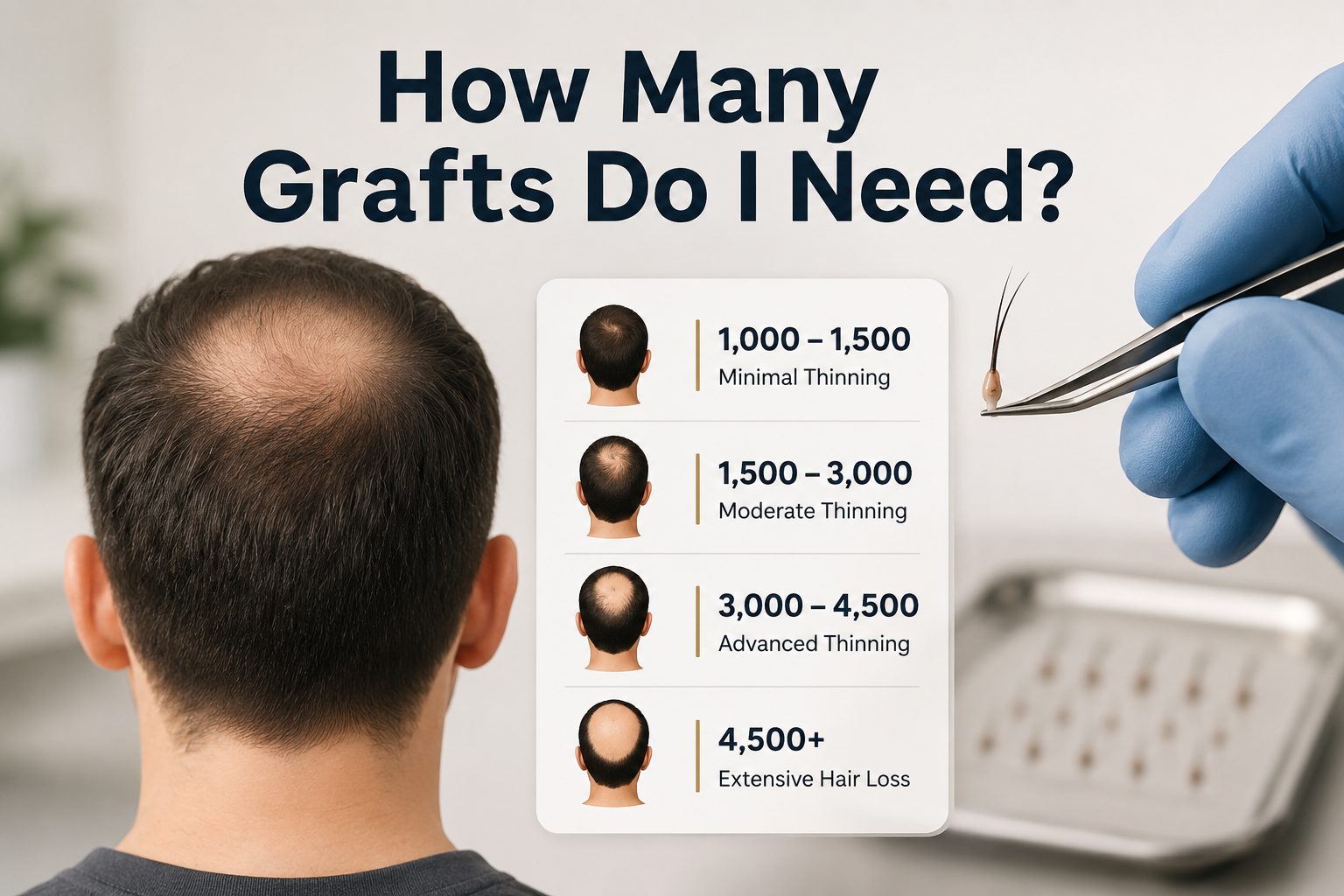
For men experiencing androgenetic alopecia (male pattern baldness), the global clinical standard for staging hair loss and starting a graft estimation is the Norwood Scale. This scale categorizes progressive hair loss into seven distinct stages, allowing surgeons to map out baseline graft requirements:
- Stages 2 & 3 (The Receding Hairline): Hair loss is concentrated heavily around the temples and the frontal hairline. Restoring this zone to a youthfully dense appearance typically requires 1,500 to 2,500 grafts.
- Stages 4 & 5 (The Mid-Scalp & Thinning Crown): The hairline has receded deeper, and an isolated bald or thinning patch has formed at the vertex (the crown at the back of the head). Bridging these zones cleanly requires 3,000 to 4,500 grafts.
- Stages 6 & 7 (Advanced Baldness): The bridge of native hair separating the front hairline from the crown has completely disappeared, leaving the entire top of the head bare. Achieving comprehensive coverage across this vast surface area requires 5,000 to 6,500+ grafts, often split across two separate surgical sessions.
4 Critical Factors Beyond the Norwood Scale
Two patients can sit at an identical Norwood Stage 4, yet one may require 3,000 grafts while the other needs 4,500. This variance exists because raw surface area is only one part of the clinical equation. Surgeons must weigh four additional biological factors:
1. Hair Caliber and Thickness
The diameter (thickness) of your individual hair strands drastically impacts visual coverage. Coarse, thick, or wiry hair blocks light from reflecting off the scalp far better than fine, thin hair. A patient with fine hair will inherently require a higher number of grafts to achieve the same visual density as someone with thick hair.
2. Hair Texture (Straight vs. Curly)
Curly and wavy hair bends and overlaps naturally as it grows out of the scalp. This creates a mechanical layering effect that blankets the skin, providing maximum visual density. Straight hair stands perpendicular, meaning more grafts must be packed tightly together to prevent the scalp from showing through under bright lighting.
3. Hair-to-Graft Ratio
A graft is not a single hair; it is a follicular unit. If your donor area contains an abundance of multi-hair grafts (units with 3 or 4 hairs), you will get significantly more volumetric coverage out of 3,000 grafts than a patient whose grafts yield mostly 1 or 2 hairs.
4. Facial Architecture and Age
Designing a hairline requires artistic and developmental foresight. If a surgeon places a thick, flat, teenage hairline on a 45-year-old man, it will require an excessive number of grafts and look completely unnatural as he ages. Elite clinics utilize a conservative, mature hairline placement that preserves grafts for future loss while looking perfectly age-appropriate.
Clinical Graft Density Matrix
To help you visualize how these numbers translate to physical placement across the distinct zones of your head, look at this standard distribution breakdown:
| Scalp Target Zone | Desired Density (Grafts per cm²) | Average Graft Range Needed |
| Frontal Hairline (The Frame) | 45 – 55 grafts / cm² | 1,500 – 2,500 grafts |
| Mid-Scalp (The Bridge) | 35 – 45 grafts / cm² | 1,000 – 2,000 grafts |
| Crown / Vertex (The Spiral) | 30 – 40 grafts / cm² | 1,500 – 2,500 grafts |
The Concept of Illusions: Human skin naturally has a baseline density of roughly 60–100 grafts per square centimeter. In hair transplantation, medical science works via the illusion of density. Replanting just 50% of your original native density (around 40–50 grafts/cm²) is clinically sufficient to give the human eye the appearance of a completely full, solid head of hair.
Beware of the “Maximum Grafts” Marketing Trap
One of the most dangerous trends in low-cost “hair mills” is using massive graft numbers as a competitive sales gimmick, promising things like “Unlimited grafts up to 6,000 for a flat fee.”
Your donor area at the back and sides of your head contains a finite, non-renewable supply of hair follicles. Harvesting too many grafts in a single session creates two catastrophic clinical issues:
- Donor Depletion: It leaves the back of your head looking patchy, see-through, or scarred, making it impossible to wear short haircuts.
- Graft Desiccation (Death): Packing 6,000 grafts into a single session extends the surgical time dramatically. Grafts sitting outside the body for too long starve of oxygen and die before implantation, resulting in a very low overall survival rate.
Final Thoughts: Prioritizing Quality Over Numbers
When it comes to a hair transplant, the focus should always be on efficiency and survival rate, not just the raw graft count. A masterfully executed procedure using 3,000 perfectly preserved, highly viable grafts will yield a significantly thicker, more natural look than an aggressive 5,000-graft session where half the follicles fail to grow due to poor handling.
At Dr. Terziler Clinic, we approach graft estimation with absolute scientific and mathematical rigor. We reject the generic guesswork of assembly-line clinics. Using high-magnification trichoscopic analysis and digital densitometry, we measure your exact hair caliber, donor capacity, and hair-to-graft ratios before drawing a single line. This allows our specialized surgeons to map out an exact, conservative, and high-survival blueprint—maximizing your visual density while strictly protecting your precious donor supply for a lifetime of natural results.
Frequently Asked Questions (FAQ)
Can a single graft contain more than one hair?
Yes, absolutely. Naturally occurring follicular units grow in microscopic families. A single graft harvested from your donor area can contain anywhere from 1 to 4 (and rarely 5) individual hairs. Elite clinics meticulously separate these units under microscopes, saving the single-hair grafts for the very front edge of your hairline and using the multi-hair grafts deeper inside the scalp to build volumetric thickness.
What happens if my donor area doesn’t have enough grafts to cover my baldness?
If your scalp donor area is limited but you have extensive hair loss, an advanced clinic can perform a Body Hair Transplant (BHT). Follicles can be safely extracted from the beard area (under the jawline) or the chest. Beard hair is remarkably robust and thick, making it an excellent filler material to add density to the crown and mid-scalp.
How do I know if a clinic’s graft estimate is honest or exaggerated?
An honest clinic will always explain their math clearly. They will show you your hair loss stage on the Norwood Scale, outline the square centimeter area that needs coverage, and explain the exact graft density they plan to plant. If a clinic immediately throws out a massive number like 5,000 grafts without performing a digital scalp analysis or checking your donor capacity, they are likely using sales tactics.
Will transplanted hair grafts eventually fall out over time?
No, they will not. The hair follicles harvested from the back and sides of your head (the donor zone) are genetically immune to the hormone DHT (dihydrotestosterone), which causes male pattern baldness. When these follicles are relocated to the front or crown, they retain their genetic resistance, meaning they will continue to live and grow naturally for the rest of your life.
Can I get 5,000 grafts done in a single day safely?
While it is technically possible to harvest and plant 5,000 grafts in a single day, it is highly demanding on both the patient and the grafts. Large sessions over 4,000 grafts are often much safer and more successful when split over a two-day consecutive session. This prevents the grafts from sitting outside the body for too long, ensuring they remain highly hydrated and viable for a maximum survival rate.