





The global demand for hair restoration has soared, turning what was once a highly guarded cosmetic secret into a mainstream medical phenomenon. Thanks to modern techniques, creating a dense, undetectable hairline is more achievable than ever.
However, because the internet is saturated with outdated forum posts, aggressive marketing pitches, and well-meaning but inaccurate advice from friends, the world of hair transplantation has become clouded by misconceptions.
Believing these myths can cause unnecessary anxiety, push people toward dangerous, cheap “hair mills,” or prevent individuals from getting a procedure that could genuinely restore their self-confidence.
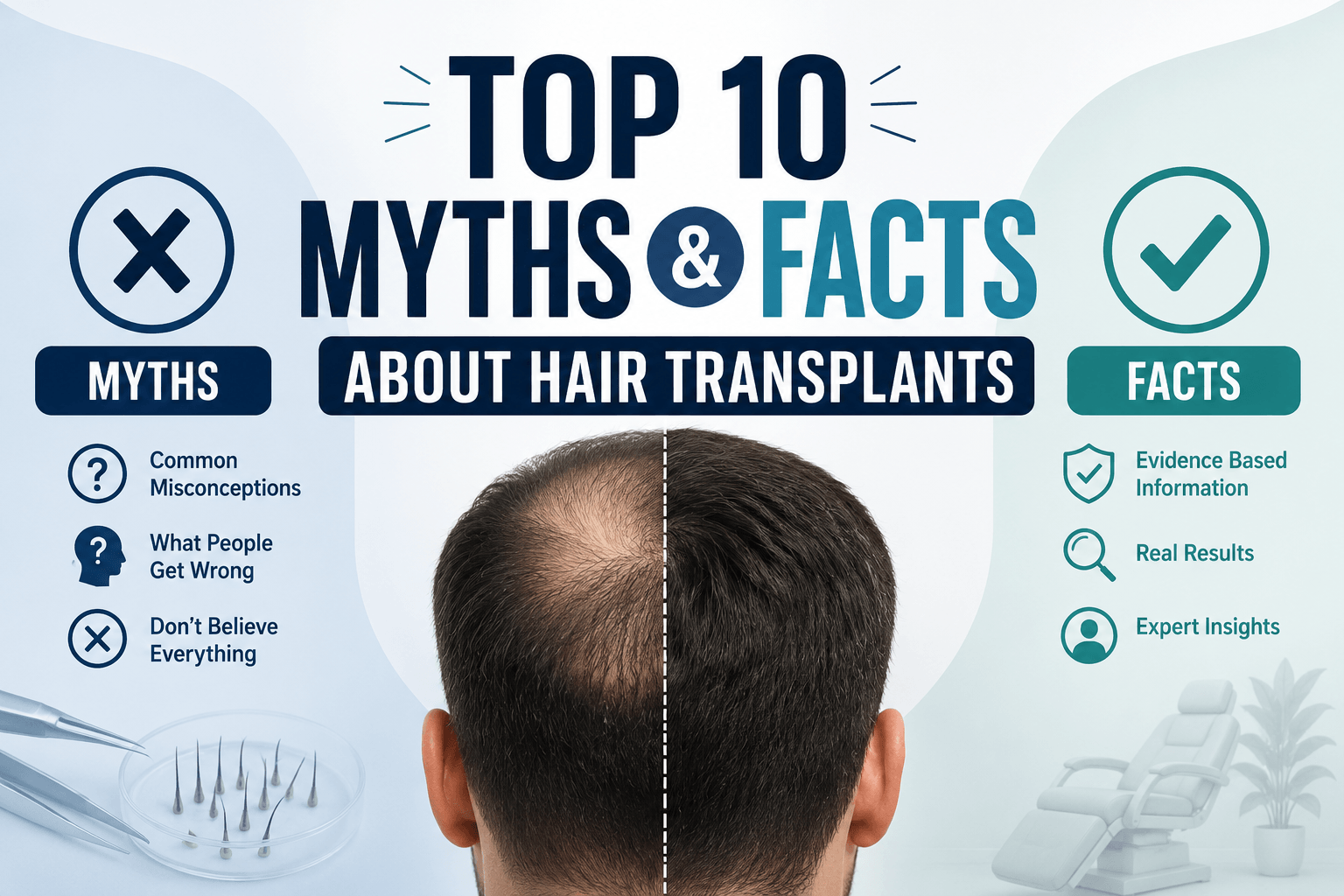
To help you separate science from fiction, we have compiled the top 10 most common myths and facts about modern hair transplants.
1. The Timeline and Rejection Myths
Myth 1: “A hair transplant delivers instant, immediate results.”
- The Fact: When you walk out of the clinic, you will see a beautifully drafted blueprint of your new hairline, but you will not have immediate length or density. In fact, around week 3 or 4, you will experience shock loss—a completely mandatory biological phase where the relocated hair shafts shed as the roots enter hibernation. True, visible regrowth begins around month 4, with your final, maximum density revealing itself between months 12 and 15.
Myth 2: “Your body can reject a hair transplant like an organ transplant.”
- The Fact: Organ rejections happen when the immune system attacks foreign tissue. Because a hair transplant utilizes an autologous graft model—meaning you are your own donor—your immune system instantly recognizes the follicles as your own cellular tissue. There is an absolute 0% risk of biological rejection.
2. Who Can Get a Transplant?
Myth 3: “You can use hair from another person if you are completely bald.”
- The Fact: You cannot use hair from a friend, family member, or spouse. If you attempt to implant someone else’s hair, your immune system will immediately recognize the tissue as foreign and attack it, causing severe inflammation, deep scarring, and complete graft failure. You can only use active, healthy follicles harvested from your own body.
Myth 4: “Hair transplants are exclusively for men.”
- The Fact: While male pattern baldness is more visually prominent, millions of women suffer from female pattern hair loss (traction alopecia or diffuse thinning). Women make fantastic candidates for modern hair restoration. Using advanced methods like Direct Hair Implantation (DHI), elite clinics can pack high-density grafts between existing hairs without needing to shave the woman’s head.
3. Technology and Aesthetics
Myth 5: “The final results look fake, unnatural, or ‘pluggy’.”
- The Fact: The unnatural, toothbrush-like look of old-school “hair plugs” is a relic of the 1980s. Modern Sapphire FUE and DHI techniques extract individual follicular units containing only 1 to 4 hairs. Surgeons use microscopic blades to place these units at precise angles and directions that match your native growth, creating a seamless transition that is completely invisible to the naked eye.
Myth 6: “Advanced robots and machines are always better than a human surgeon.”
- The Fact: While automated extraction tools can assist with harvesting grafts quickly, designing a human hairline is a high-level art form. A machine cannot judge your facial expressions, calculate how your hair will frame your face as you age, or adapt to subtle changes in your scalp’s thickness. The best results always come from a highly skilled, artistic human surgeon.
Technical Performance Breakdown: Myths vs. Clinical Realities
To understand how modern hair restoration operates on a purely scientific level, compare these common societal expectations with actual clinical realities:
| Popular Myth / Belief | Core Clinical Reality | Scientific Explanation |
| “The results are temporary and fall out.” | Permanently Immune to Balding | Grafts are harvested from the “safe zone” (back of the head), which is genetically resistant to the hair-loss hormone DHT. |
| “The surgery is incredibly painful.” | Minimal to No Discomfort | Clinics utilize advanced localized anesthesia. Once the scalp is numb, you feel no pain and can comfortably watch movies or read. |
| “A higher graft count always means better density.” | Overharvesting Destroys Donors | Raw numbers do not matter if the grafts die out of the body. Efficiency, gentle handling, and strategic placement yield the best look. |
| “You can clone hair for unlimited grafts.” | Finite, Non-Renewable Supply | Hair cloning is still in early laboratory phases. Your current donor area contains a limited number of seeds—protecting it is vital. |
4. Maintenance and Longevity
Myth 7: “Transplanted hair requires lifelong specialized medications to survive.”
- The Fact: The hair relocated from the back and sides of your head is genetically coded to resist DHT, meaning it will live and grow naturally for the rest of your life without requiring chemical assistance. However, your native, non-transplanted hair on top remains vulnerable to genetic balding. Surgeons may recommend supplements or therapies (like Finasteride or PRP) to protect your surrounding native hair from thinning over the next decade.
Myth 8: “You have to be completely bald before you can get a hair transplant.”
- The Fact: Waiting until you are completely bald is actually counterproductive because you may exhaust your donor reserves. If you have lost roughly 30% to 50% of your native density in a specific zone, you can safely proceed with a transplant. Intervening during the thinning phase allows the surgeon to weave new grafts between existing strands, maintaining a natural look throughout your hair loss journey.
5. Surgical Realities
Myth 9: “A hair transplant leaves a giant, permanent linear scar across your head.”
- The Fact: The long, horizontal scar associated with hair transplants belongs to the outdated FUT (Follicular Unit Transplantation) “strip” method. Modern Follicular Unit Extraction (FUE) harvests follicles individually using micro-punches that are less than 1.0mm wide. These tiny dots heal cleanly within days and become completely invisible to the naked eye, even if you choose to wear a short buzz cut.
Myth 10: “A hair transplant is a quick, cheap afternoon procedure.”
- The Fact: While a transplant is minimally invasive, it is a highly meticulous micro-surgery that takes between 4 and 8 hours to complete. It requires an entire medical team consisting of a primary surgeon and specialized technicians working under high-magnification stereomicroscopes. Treating it like a cheap, fast-food service at a low-cost “hair mill” often leads to overharvested donor zones and poor graft survival rates.
Final Thoughts: Ground Your Journey in Science
When navigating the complex world of hair restoration, your greatest asset is accurate, clinically proven information. By filtering out outdated myths and anchoring your expectations around real biological timelines, you can approach your surgery with absolute confidence and peace of mind.
At Dr. Terziler Clinic, we build our entire practice around absolute medical transparency, scientific rigor, and elite surgical integrity. We reject the assembly-line tactics of low-cost operations that rely on deceptive marketing gimmicks and inflated graft counts. By utilizing advanced digital densitometry diagnostics, state-of-the-art DHI Choi Pen systems, and a fully managed 12-month postoperative medical tracking program, we ensure that every phase of your journey is safe, structured, and results in a permanent, high-density masterpiece of natural hair growth.
Frequently Asked Questions (FAQ)
Can I get a hair transplant if my hair loss is caused by alopecia areata or chemotherapy?
No. A hair transplant is exclusively designed to treat androgenetic alopecia (male and female pattern baldness). Conditions like alopecia areata are autoimmune diseases where the immune system attacks the hair roots uniformly; performing a transplant will simply cause the new grafts to be attacked and shed. Hair loss from chemotherapy is temporary, and the hair will naturally grow back once treatments conclude.
What actually causes a hair transplant to “fail”?
The primary drivers behind a failed hair transplant are human error and poor clinical standards. If a low-skill technician handles the grafts aggressively, cuts into neighboring native roots (transection), fails to keep the grafts properly hydrated while they are outside the body, or implants them too deep, the follicles will die before establishing a blood supply—resulting in a low survival rate.
Will my transplanted hair turn gray as I get older?
Yes, absolutely. Because the transplanted hair retains its original genetic coding from the back of your head, it will behave exactly like your native hair. As you age, the pigment cells inside those specific follicles will naturally stop producing melanin, causing your transplanted hair to gray gracefully and uniformally alongside the rest of your hair.
Is there an absolute age limit for getting a hair transplant?
There is no strict upper age limit; patients in their 70s can safely get a hair transplant provided they are in good overall health and have strong donor hair. However, there is a conservative lower age limit. Reputable surgeons generally discourage young men under the age of 21 or 22 from getting a transplant, as their hair loss patterns have not fully stabilized yet, making long-term growth unpredictable.
How soon after my hair transplant can I go back to working out?
You must follow a phased return to physical activity to protect your fresh grafts. You can go for light walks by Day 3. You can return to moderate, non-contact gym routines (like light lifting or cycling) on Day 14, once your incisions have completely sealed. However, you must avoid heavy, intense powerlifting, combat sports, and swimming for a full 30 days to prevent high blood pressure or bacterial infections from affecting your scalp.