





When making the emotional and financial investment in a hair transplant, you want to know one thing above all else: Is this a permanent fix, or will I be right back where I started in a few years?
Seeing your hair thin out over time makes it easy to worry that any newly implanted hair will suffer the exact same fate.
The short, clinically proven answer is this: Yes, a properly executed hair transplant is permanent. The relocated hair follicles are genetically coded to grow for the rest of your life.
However, there is a massive difference between a follicle being genetically permanent and your overall head of hair looking permanent as you age. While the transplanted grafts themselves are built to last, they are surrounded by your original, native hair, which is still vulnerable to ongoing hair loss.
Understanding the science behind graft permanence helps you keep your high-density results looking flawless for decades to come.
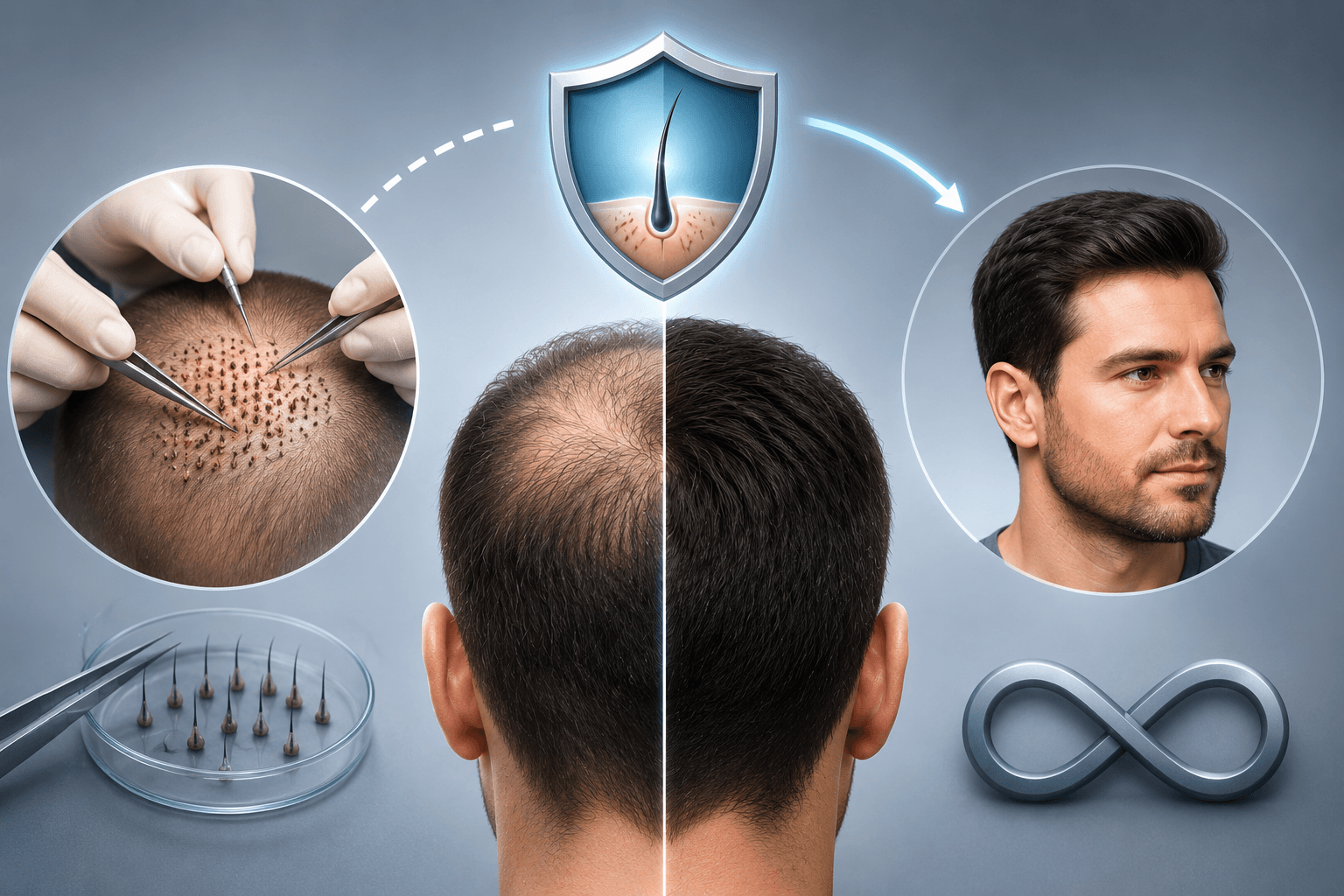
The Science of Permanence: Donor Dominance
The reason a hair transplant works permanently comes down to a biological principle discovered in the 1950s called Donor Dominance.
Hair loss on the top of the head is not a disease of the scalp skin itself; it is an inherited genetic sensitivity within the individual hair follicles to a hormone called DHT (Dihydrotestosterone). DHT binds to vulnerable hair roots, causing them to shrink, weaken, and eventually stop producing hair entirely (a process known as miniaturization).
- The Vulnerable Zone: The hair follicles located on your hairline, temples, and crown contain a high number of genetic receptors for DHT.
- The Safe Zone: The hair follicles located on the lower back and sides of your head are biologically unique. They lack DHT receptors, making them genetically immune to the hormone that causes male pattern baldness.
During a modern hair transplant, a surgeon relocates these immune follicles from the back of your head into your thinning areas. Crucially, the follicle keeps its genetic memory. No matter where it is moved on your body, it retains its lifelong immunity to DHT, allowing it to take root, thrive, and grow permanently.
The Shedding Timeline: What to Expect After Surgery
While the roots are permanent, the hair shafts inside them are not. To avoid panic during your initial recovery, it is vital to understand the difference between temporary shedding and permanent graft loss:
Phase 1: The Initial Anchor (Days 1–10)
During the first few days post-op, your body builds a network of microscopic blood vessels to supply your new roots with oxygen. By Day 10, the grafts are fully anchored and integrated into your scalp tissue. They can no longer be pulled or washed out.
Phase 2: Shock Loss (Weeks 2–8)
Around week 3, almost every patient experiences a phase known as shock loss. The trauma of the surgery forces the newly relocated follicles to abruptly enter a resting phase, causing the temporary hair shafts to shed.
Important: Your hair is falling out, but the root is perfectly safe under the skin. This shedding is a mandatory part of the biological regeneration cycle.
Phase 3: Permanent Regrowth (Months 4–12+)
Starting around month 4, the deeply anchored roots wake back up and begin producing fresh, healthy new hair strands. These are the permanent hairs that will continue to thicken and grow for the rest of your life.
Can Transplanted Hair Ever Thin or Fall Out?
While the grafts are naturally resistant to genetic balding, there are a few specific medical and environmental factors that can cause transplanted hair to thin out or fail over time:
- Poor Surgical Execution (Graft Damage): If an inexperienced clinic leaves the follicles out of the body for too long, or damages the delicate root structure during extraction or implantation, the grafts will die before they can establish a blood supply. This causes a low survival rate, which looks like a failed transplant.
- Ongoing Native Hair Loss: This is the most common reason a hair transplant appears to “fail” years down the road. While your transplanted hairline remains dense and permanent, the original, native hair right behind it may continue to thin out. If left unmanaged, this can create an awkward, unnatural gap behind your transplant, requiring a second procedure to fill in the new hair loss.
- Natural Senescent Alopecia (Aging): As you enter your 70s and 80s, your entire body undergoes natural aging. Just like the hair on the back of your head naturally thins out slightly as you get older, your transplanted hair will mirror that same natural aging process, losing a small amount of its youthful thickness over time.
Technical Comparison: Permanent Grafts vs. Temporary Alternatives
To see how a permanent hair transplant stacks up against non-surgical hair loss treatments, look at this quick performance breakdown:
| Treatment Option | Longevity / Permanence | Primary Mechanism | Ongoing Long-Term Costs |
| Sapphire FUE / DHI Transplant | Lifetime / Permanent | Relocates DHT-immune hair follicles from the safe zone. | Zero (One-time investment). |
| Minoxidil (Rogaine) | Temporary (Reverses if stopped). | Widens blood vessels to artificially prolong the growth phase. | High (Must be purchased and applied daily for life). |
| Finasteride (Propecia) | Temporary (Reverses if stopped). | Systematically blocks the enzyme that creates DHT. | High (Requires a continuous daily prescription). |
| PRP / Mesotherapy | Temporary (Requires maintenance). | Injects growth factors to stimulate weak, thinning follicles. | Moderate (Requires 2–3 maintenance sessions every year). |
Final Thoughts: Protecting Your Investment for Life
A hair transplant is a permanent biological solution to hair loss, built on the rock-solid foundation of donor dominance. By moving DHT-immune follicles to your thinning areas, modern science allows you to grow your own natural hair for a lifetime. However, keeping your overall look dense and full requires an experienced surgeon who can anticipate your future hair loss patterns and design a hairline that ages gracefully with you.
At Dr. Terziler Clinic, we do not design temporary fixes—we engineer lifelong masterpieces. We recognize that your donor hair is a finite, non-renewable resource, which is why our procedures prioritize absolute graft preservation. By combining advanced digital hair analysis to map your future hair loss with ultra-precise DHI Choi Pen and Sapphire FUE techniques, we achieve an elite graft survival rate. Supported by our comprehensive 12-month post-op medical tracking program, we ensure your permanent hair transplant transitions beautifully over the decades, delivering dense, natural confidence that lasts a lifetime.
Frequently Asked Questions (FAQ)
Can a hair transplant be undone if I don’t like the final look?
No, a hair transplant cannot simply be reversed or undone, because the relocated hair follicles permanently anchor themselves into their new locations within the first 10 days. If you are unhappy with an unnatural hairline design from a low-quality clinic, the look can only be corrected through a specialized “repair transplant.” This involves extracting the misplaced hairs individually or adding high-density grafts around them to camouflage and soften the hairline.
What happens if I keep losing my native hair after getting a transplant?
If your genetic hair loss continues to progress after your surgery, the transplanted hair will remain completely intact, but the native hair behind it will thin out. To prevent this, our medical team analyzes your balding trajectory before surgery. We may recommend preventative therapies, such as low-dose medications, laser therapy, or routine PRP sessions, to lock your native hair in place and preserve a seamless look.
Is it possible to completely run out of donor hair for future transplants?
Yes, your donor zone contains a limited, finite number of hair follicles. If a low-cost clinic overharvests your donor area by extracting too many grafts at once, they can permanently thin out the back of your head and exhaust your reserves. At Dr. Terziler Clinic, we practice strict donor management, ensuring we harvest only what is safely needed while protecting your donor area for any future touch-ups you might want down the road.
Does stress cause transplanted hair grafts to permanently fall out?
No. Extreme psychological or physical stress can trigger a temporary shedding condition called telogen effluvium, which causes hair across your entire scalp to shed rapidly. However, this condition does not destroy the actual hair roots. Once the underlying stress factor is resolved, both your native and your transplanted hair follicles will naturally enter the growth phase again and grow back completely.
If I go entirely gray, will my transplanted hair stay its original color?
No, your transplanted hair will eventually turn gray. Because the grafts retain their original genetic coding from the back of your head, they will behave exactly like your native hair as you age. When the pigment cells inside those specific follicles naturally stop producing melanin over time, your transplanted hair will turn gray gracefully and uniformly alongside the rest of your hair.