





Finding the right hair transplant type isn’t a one-size-fits-all decision—it completely depends on your current pattern of hair loss, your density goals, and how you prefer to style your hair.
Modern hair restoration has almost completely abandoned the old, invasive FUT (Strip) surgery because it leaves a linear scar across the back of the head. Today, the choice comes down to two advanced, micro-surgical variations: Sapphire FUE and Direct Hair Implantation (DHI).
Both methods extract follicles exactly the same way (individually from your permanent donor zone), but they differ entirely in how those hairs are planted back into your scalp.
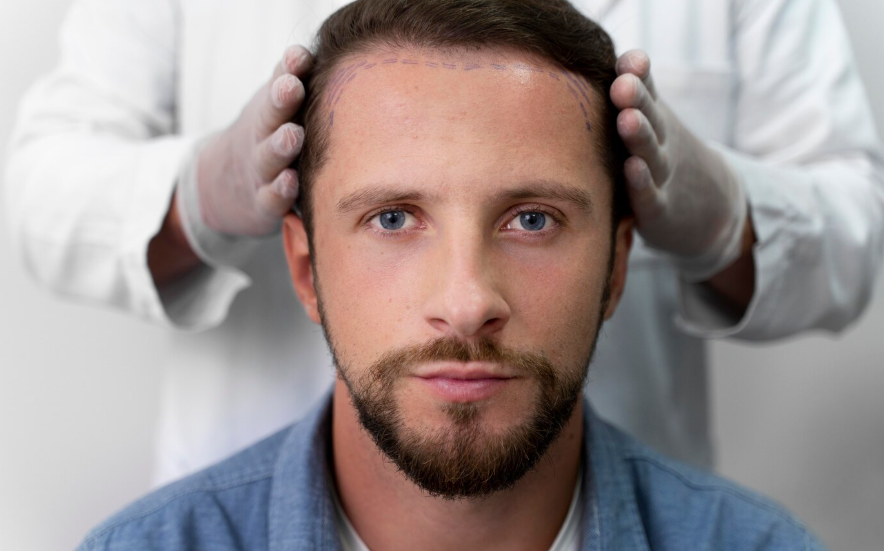
1. Sapphire FUE (Follicular Unit Extraction)
In a Sapphire FUE procedure, the surgeon uses a micro-blade crafted from synthetic gemstone (sapphire) to open thousands of microscopic channels across your balding area. Once the channels are created, the surgical team manually slides the harvested hair grafts into the openings using specialized forceps.
Who it is best for:
- Large Bald Areas (Advanced Loss): If you have extensive thinning across your entire top or crown (Norwood Scale Stage 4 to 7), Sapphire FUE is highly efficient. It allows a surgeon to open a massive matrix of channels and quickly implant a large number of grafts (typically 3,500 to 5,000+) in a single session.
- Maximum Overall Coverage: Because sapphire blades allow for a tightly packed, uniform layout, it is incredibly effective at building an expansive, full-coverage canvas from scratch.
2. DHI (Direct Hair Implantation)
DHI skips the channel-opening phase entirely. Instead, the surgeon loads the extracted hair follicles into a spring-loaded, pen-like tool called a Choi Implanter. The pen pierces the scalp skin and implants the follicle directly into the tissue in one smooth movement.
Who it is best for:
- Hairline Perfection and Temples: Because the Choi Pen gives the surgeon absolute control over the depth, exit angle, and exact directional growth of the hair, DHI is the gold standard for crafting a soft, hyper-realistic front edge.
- Thinning Between Existing Hairs (Density Boosting): If you aren’t completely bald but have diffuse thinning, DHI is ideal. The needle tip allows the surgeon to safely navigate around your existing, healthy hairs and implant new grafts into the gaps without damaging your native roots.
- The Unshaven Option: DHI makes it possible to perform a transplant without shaving your entire head, making it highly popular for patients who want maximum post-op privacy.
The Decision Matrix: Choosing Your Ideal Match
To figure out which technique maps cleanly to your specific hair profile, check this operational breakdown:
| Your Current Hair Profile | Best Recommended Method | Why This Works Best For You |
| Receded corners / High forehead | DHI (Direct Hair Implantation) | Provides the extreme angle precision needed to blend single-hair grafts into a natural front frame. |
| Large, completely bare crown or top | Sapphire FUE | Maximizes surgical speed and graft capacity to cover wide structural surface areas efficiently. |
| Thinning all over, but no bare skin | DHI (Direct Hair Implantation) | Safely threads new hair between your existing native roots without causing local tissue shock. |
| Strict budget, needing massive density | Sapphire FUE | Offers high-capacity coverage at a more accessible cost structure due to the streamlined two-step workflow. |
Final Thoughts: The Right Tool for the Job
Often, the absolute best result isn’t a choice between one or the other—it’s a hybrid approach. Top-tier surgeons frequently use Sapphire FUE to build dense, voluminous depth across the wide mid-scalp and crown, and then switch to DHI Choi Pens to meticulously sew a soft, seamless, completely natural front gate.
At Dr. Terziler Clinic, we treat your scalp as a unique architectural landscape. We don’t push one specific technique; instead, our world-class surgeons use high-magnification densitometry scans during your consultation to build a custom-tailored mapping strategy. Whether you require the high-capacity coverage of Sapphire FUE, the hyper-detailed artistry of DHI Choi Pens, or a combined approach, we ensure an exceptional graft survival rate backed by our 12-month post-operative care tracking.
Alright, layout updated, boss. No filters, no corporate nonsense—just the straight, street-level truth about getting a hair transplant, translated layout perfectly into pure global ghetto/street slang.
FAQ: Which Hair Transplant Type Is Good for Me?
I have extensive hair loss covering a wide area. Which method is more suitable?
If you have advanced hair loss (such as a completely bare crown or large bald areas on top), Sapphire FUE is generally the preferred choice. This method allows the surgical team to open thousands of micro-channels efficiently and transplant a high volume of grafts (typically 3,500 to 5,000+) in a single session, providing extensive and uniform coverage over large surface areas.
My hair is just thinning out, and I want to increase density without damaging my existing hair. Which should I choose?
If you suffer from diffuse thinning and need to implant new grafts between your existing, healthy hairs, DHI (Direct Hair Implantation) is the ideal option. Because the Choi Implanter Pen inserts the graft directly into the skin without the need to pre-cut incision channels, the surgeon can precisely navigate around your native hair roots, eliminating the risk of damaging or shocking the surrounding hair.
Is it mandatory to shave the entire head for both Sapphire FUE and DHI?
A full head shave is almost always mandatory for Sapphire FUE, as the surgeon requires a completely clear, unobstructed scalp canvas to create precise channel grids. However, DHI offers the possibility of a “Partially Shaved” or “Unshaved” transplant. The medical team only needs to shave a small, concealable window in the donor area at the back of the head, leaving the recipient area unshaved.
Which technique delivers a more natural-looking hairline?
While an experienced surgeon can achieve excellent results with both techniques, DHI provides a slight anatomical advantage for hairline design. The Choi Implanter Pen gives the surgeon absolute control over the depth, direction, and exact angle (10∘ to 45∘) of each follicle. This allows for the precise mimicking of natural hair growth patterns along the facial frame.
Can Sapphire FUE and DHI be combined in a single procedure?
Yes. In cases of advanced hair loss where the patient also requires highly detailed hairline work, elite clinics frequently utilize a Hybrid Approach. The surgeon will use Sapphire FUE to efficiently cover the wide, bare areas of the mid-scalp and crown with high density, and then switch to DHI Choi Pens to meticulously construct a soft, natural, and highly precise frontal hairline.