

Some people freeze their eggs. Some freeze their embryos. Since 2019, some people have been freezing a few dozen hair grafts from the back of their head, paying a yearly storage fee, and waiting for science to catch up. In October 2026 the idea went viral again, with US coverage framing frozen follicles as a future alternative to hair transplants.
We get the question every week now: "Should I bank my hair?" Here is the honest answer, step by step. Banking follicles is real and available today. Turning those frozen follicles into thousands of new, permanent hairs is not. The gap between those two sentences is where your money goes, so this guide measures it.
Sources: [1]
Banking follicles is available. Reliable future hair growth from banked cells is a separate, unresolved question.
- Providers describe about 100–120 follicles, roughly 40–50 grafts, extracted and frozen at around −180°C to −196°C. [1][11]
- Extraction and storage are available. HairClone’s proposed future cell treatment is still described as experimental. [1]
- Japanese dermal sheath cup studies are different from HairClone’s program. In a 36-person study, 30% improved on photographic assessment; an earlier trial found a temporary effect through 9 months. [4][5]
- Published UK provider prices are £2,300 alongside a transplant or £2,900 standalone, plus about £150 a year. At unchanged fees, 20 years totals £5,900 before treatment. [11]
- Proof-of-concept follicle induction does not establish a routine, scalable hair-cloning treatment for bald scalp. [2][3]
- Protecting donor supply and treating suitable cases of ongoing hair loss are decisions available today.
What Is Hair Banking?
Hair banking, also called hair follicle banking, is the frozen storage of your own healthy hair follicles for possible future treatment. A doctor removes about 100 to 120 follicles from the back of the scalp using a small FUE punch. That equals roughly 40 to 50 grafts. The follicles travel to a licensed tissue facility and are frozen in liquid nitrogen conditions.
The idea borrows from egg freezing: young cells are stored before age and hair loss weaken them. HairClone, the UK company that launched the service, says frozen cells "do not age" while stored. The plan is to thaw them years later, multiply the cells that control hair growth, and inject them back into thinning areas.
Sources: [1]
Banking is not a hair loss treatment. Nothing grows after banking. You are paying to store raw material for a treatment that does not yet exist as an approved product. A hair transplant in Turkey or anywhere else works differently: it moves living, DHT-resistant follicles that start growing new hair within months.
Sources: [1]
Why Is Hair Banking in the News in October 2026?
Hair banking returned to the headlines in mid-October 2026. The New York Post covered it on 13 October and The Daily Beast followed on 16 October, describing extraction of about 100 follicles, costs above $2,000 in the UK plus yearly storage fees, and availability at about 10 US clinics. The Daily Beast also reported that HairClone "started clinical testing in March 2026" and that the technique is not FDA-approved.
Sources: [12]
HairClone reports that its cell-manufacturing facility and clinical testing are operating in Guatemala City. Its current FAQ describes the treatment as experimental and says outcomes cannot be assured. Media reports differ on the exact start month in 2026, so the location and experimental status matter more than a claimed launch date. [1][13]
HairClone’s public information still describes protocol optimization and the need for clinical trials and marketing licences. The sources reviewed for this guide do not establish peer-reviewed outcomes from its banked-follicle treatment program. Conference discussion or early patient reports should not be treated as a published controlled trial. [1]
How Does Hair Banking Work? Step by Step
| Step | What happens | Numbers reported by providers |
|---|---|---|
| 1. Consultation | A partner clinic checks your age, hair loss pattern and family history. | Providers usually target adults under about 45 with early thinning. |
| 2. Extraction | FUE under local anesthesia from the back of the head. No shaving of the whole donor area. | 100 to 120 follicles, about 40 to 50 grafts, under 1 hour. |
| 3. Transport | Follicles go to a licensed tissue bank in a controlled container. | Same or next day. |
| 4. Cryopreservation | Follicles are frozen with cryoprotectants and stored in liquid nitrogen vapor or liquid. | About -180°C to -196°C; storage quoted up to 20 to 25 years. |
| 5. Future treatment (not approved) | A few follicles are thawed, dermal papilla cells are multiplied in a lab, and the cells are injected into thinning areas. | HairClone reports more than 1,000-fold cell multiplication in the lab. |
Steps 1 to 4 describe the extraction and storage service. They do not, by themselves, establish the success of the future treatment. Step 5 still needs convincing clinical evidence for the particular cells, processing method and outcomes being offered. [1][3]
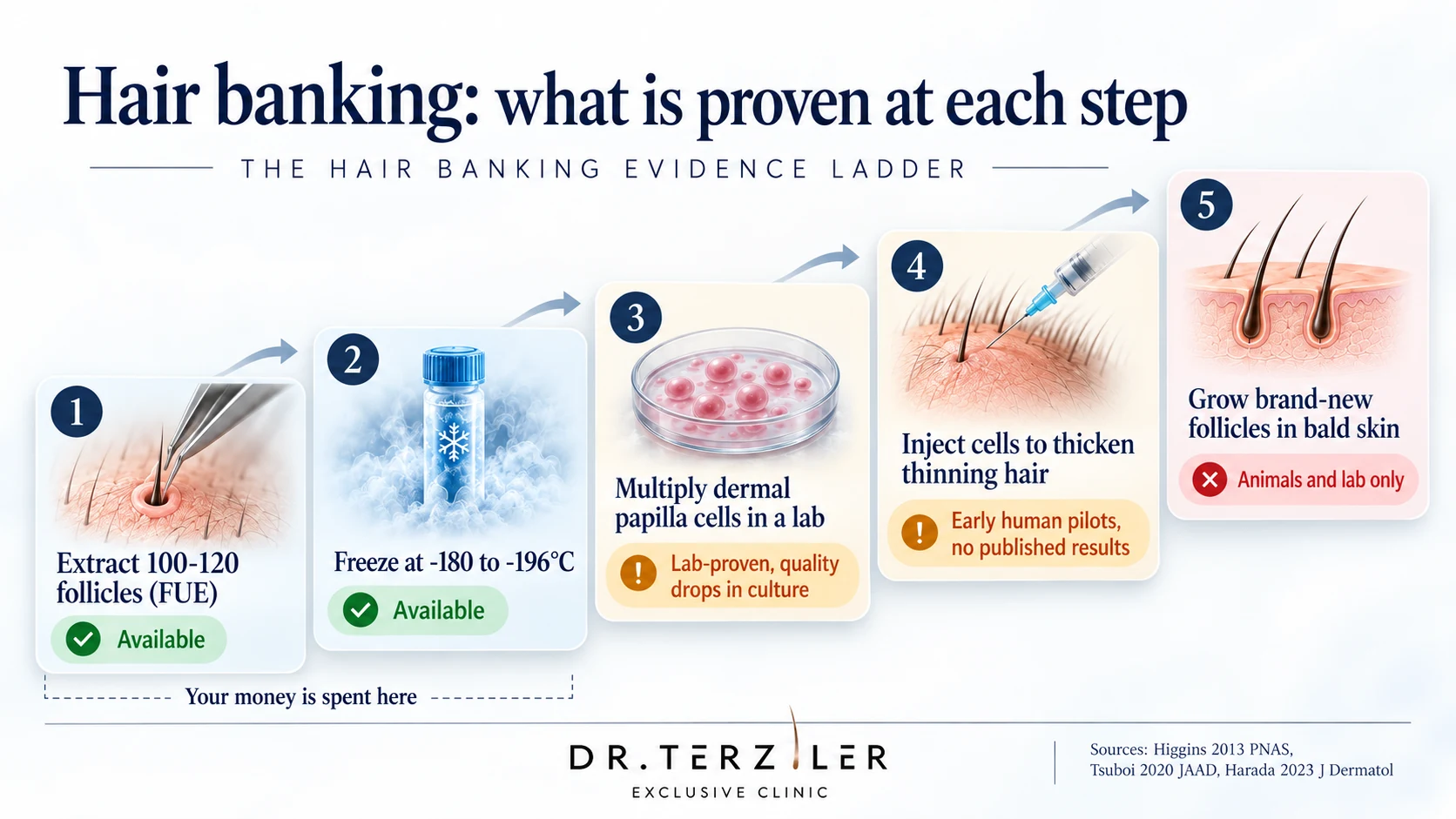
The Hair Banking Evidence Ladder: What Is Proven at Each Step
Hair banking is only as good as its weakest step, and the weakest step is the future treatment. We graded each step against published, peer-reviewed research.
- 01Established extraction
Extracting healthy follicles
Proven. Routine FUE. Like any FUE session, it can rarely cause temporary shedding around the extraction sites, known as donor area shock loss. This usually starts 2 to 4 weeks later and regrows within 3 to 6 months.
Evidence: Standard hair transplant technique.
- 02Storage service available
Freezing whole follicles
Proven in animals. Mouse follicles frozen in DMSO grew extensive hair over 8 weeks after transplant [6]. We found no published human study of thawed follicles regrowing hair.
Evidence: Cao et al., PLoS One 2015 [6]
- 03Laboratory evidence
Multiplying dermal papilla cells
Works in the lab, with a catch. Human dermal papilla cells lose their hair-inducing power when grown flat in a dish. Growing them as 3D spheroids partly restores it [3].
Evidence: Higgins et al., PNAS 2013 [3]
- 04Early human evidence
Injecting cells to thicken thinning hair
Early human evidence from different cell preparations. The 2023 Japanese study reported 30% photographic improvement; the earlier trial found temporary benefit through 9 months. These are not results from HairClone’s banked-follicle program. [4][5]
Evidence: Tsuboi et al., JAAD 2020 [4]; Harada et al., J Dermatol 2023 [5]
- 05Routine treatment unproven
Growing new follicles in bald skin (true "cloning")
No established routine scalp treatment. A small 1999 human proof-of-concept exists [2]; the 2013 human-skin-on-mouse, 2022 mouse follicloid and 2026 mouse organoid studies do not establish scalable clinical hair cloning [3][7][8].
Evidence: Higgins 2013 [3]; Kageyama 2022 [7]; Wang 2026 [8]
Hair Banking vs Hair Cloning vs Stem Cell Hair Treatment
These three terms are often used as if they mean the same thing. They do not.
| Term | What it means | Available today? |
|---|---|---|
| Hair banking | Freezing your own follicles for future use. | Yes, at licensed partner clinics. |
| Hair multiplication / cell therapy | Multiplying cells from your follicles and injecting them to strengthen thinning hairs. | Experimental pilots only. |
| Hair cloning | Creating brand-new, permanent follicles from a few cells, to grow hair where none exists. | No established routine, scalable bald-scalp treatment; laboratory, animal and limited proof-of-concept research. |
| "Stem cell hair transplant" (as marketed) | Usually injections of fat-derived cells, cell secretions or exosomes. Not a transplant of new follicles. | Some products are marketed, but availability does not establish evidence or approval. Check the exact product and jurisdiction. [10] |
| Hair transplant (FUE, DHI) | Moving your own DHT-resistant follicles from the donor area to thinning areas. | Established surgery, with individual suitability, risks and long-term limitations. |
Is Hair Cloning Available in 2026?
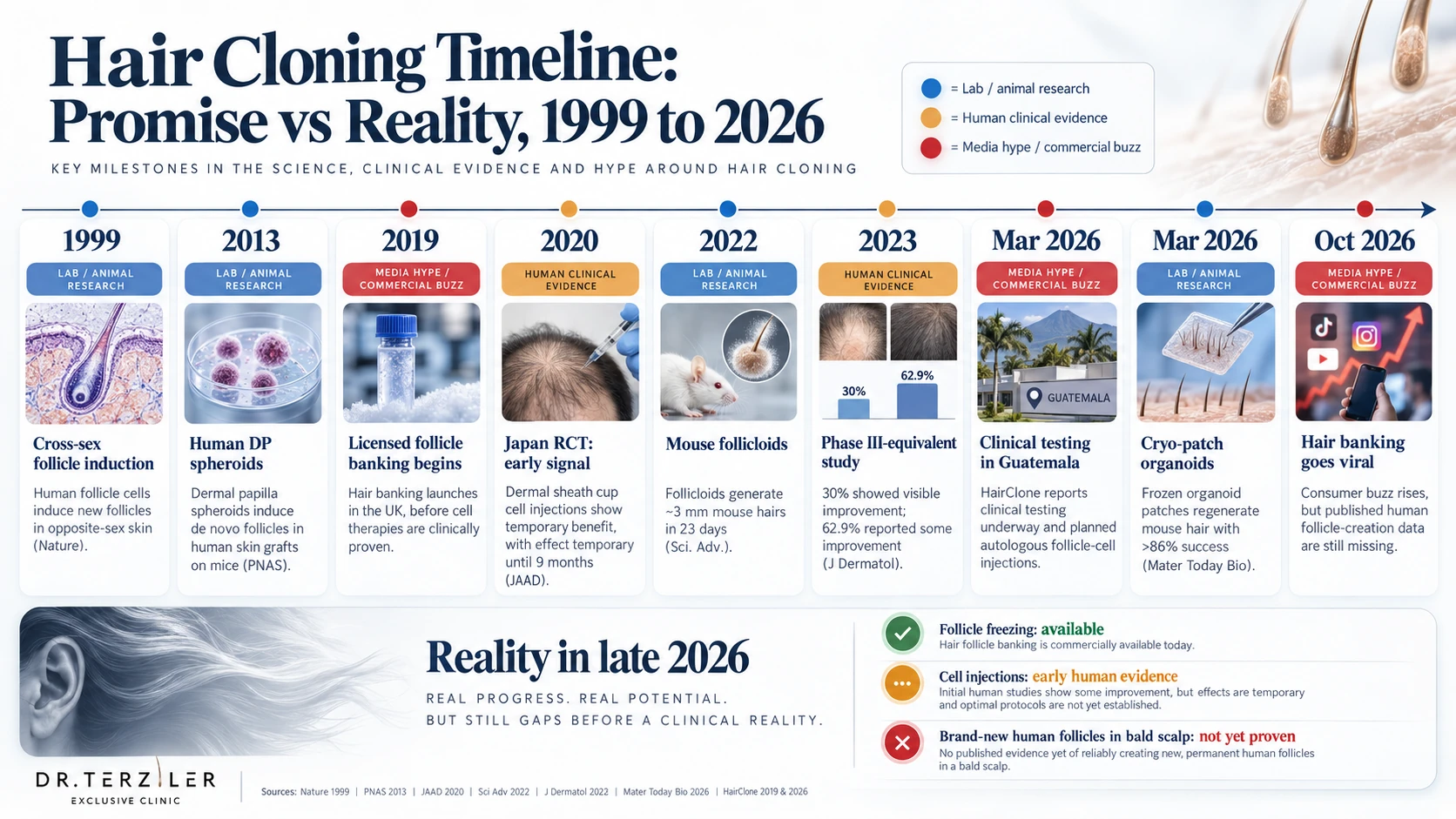
No proven routine treatment currently offers scalable, brand-new follicle creation for bald scalp in the sources reviewed here. Banking services and experimental cell injections are different from a validated cloning treatment. Historic proof-of-concept experiments do not establish routine clinical availability.
What did the Japanese cell therapy trials show?
In a randomized, placebo-controlled study of 50 men and 15 women, dermal sheath cup cell injections increased hair density and cumulative hair diameter at the lowest tested dose, 3.0 × 10⁵ cells, at 6 and 9 months. The authors described the positive effect as temporary, through 9 months. This was a different cell approach from HairClone’s dermal papilla program. [4]
A later single-arm, multi-center study gave 36 participants two dermal sheath cup cell injections three months apart. Blinded photographic assessment found improvement in 30%, and mean hair diameter rose by 2.2% from baseline; no serious adverse events were detected in that small study. Patient-reported outcomes were followed for 12 months. It was not a controlled test of HairClone’s banked follicles. [5]
These results are early, study-specific signals. They do not establish permanent improvement, the safety of every cell product, or the result that a different clinic’s preparation will achieve. The two Japanese studies should not be combined into a universal success rate. [4][5][9]
What about HairClone in Guatemala?
HairClone’s own FAQ says that dermal papilla cells are multiplied at its Guatemala City facility and that testing has begun at the Schambach Hair Clinic. The stated aim is to rejuvenate miniaturizing hair rather than provide a proven method of generating unlimited new scalp follicles. The company describes the protocol as experimental and gives no assurance of outcome; any proposed repeat-treatment schedule remains a development plan. [1][13]
What about lab-grown follicles?
In 1999, researchers reported a small human proof-of-concept: follicular dermal sheath tissue from a man induced follicles in a woman’s skin. That was not a scalable bald-scalp treatment. Later work includes human skin grafted onto mice, mouse follicloids producing about 3 mm shafts in 23 days, and a 2026 mouse organoid cryo-microneedle study reporting more than 86% follicle growth. These models must be distinguished from an approved routine human treatment. [2][3][7][8]
How Much Does Hair Banking Cost?
How much does hair banking cost? In the UK, hair banking costs about £2,300 when done alongside a hair transplant and about £2,900 as a standalone procedure, plus about £150 a year for storage. US coverage in October 2026 reported costs above $2,000 plus yearly fees. The future cell treatment is not included and has no confirmed price.
| Years stored | Banking (standalone) | Storage at about £150/year | Total before any treatment |
|---|---|---|---|
| 5 | £2,900 | £750 | £3,650 |
| 10 | £2,900 | £1,500 | £4,400 |
| 20 | £2,900 | £3,000 | £5,900 |
| 25 (max quoted storage) | £2,900 | £3,750 | £6,650 |
Calculated from published UK clinic pricing. Excludes inflation, fee increases, travel and the cost of any future treatment. Check your provider’s current price list. For comparison, the 20-year banking total alone is in the same range as many graft-inclusive packages for a hair transplant in Turkey, which moves living follicles that grow hair now rather than storing cells for a treatment that is not yet approved.
Sources: [11]
What could storage cost over time?
Choose a provider example, explore a time horizon and compare a written quote in the same currency.
20 years at unchanged £150 annual storage fees.
- Initial banking
- £2,900
- Total storage fees
- £3,000
- Final-year storage fee
- £150
- Future cell treatment
- Not included · unknown
Use your own written quote to compare the budget with an established treatment option. No medication or transplant price is assumed.
Explore the hair transplant cost guide →The future cell treatment discussed here remains experimental. Paying for storage does not guarantee access, approval or a result.
See the year-by-year calculation
| Year | Storage fee | Storage paid to date | Banking + storage total |
|---|---|---|---|
| 20-year static example | £150 per year | £3,000 | £5,900 |
Method: one initial banking fee plus each year’s storage fee. Year 1 uses the selected annual fee; year n uses that fee × (1 + annual increase)^(n − 1), rounded to the nearest penny. Excludes future treatment, travel and other unknown charges. No live currency conversion. Inputs stay on this page unless you choose to share the summary.
The 100-Follicle Math: What Banked Hair Can and Cannot Do
Providers describe about 100 to 120 follicles as roughly 40 to 50 grafts. Against a 4,000-graft example, that is about 1% to 1.25% by graft count—not 100 follicles divided by 4,000 grafts. The banked sample is intended as a future cell source, rather than a graft supply for broad cosmetic coverage. [11]
That changes the question. You are not storing hair. You are storing a cell sample. The value of that sample depends entirely on a therapy that must still prove three things in humans: that frozen and thawed cells keep their hair-making power, that injected cells make a visible difference, and that the difference lasts.
Who Might Consider Hair Banking, and Who Should Not?
Providers tend to market banking to younger adults with early inherited thinning who want to store follicles before further miniaturization. “Under about 45” is a provider positioning guideline, not a validated medical eligibility cutoff. Suitability, donor health and the reason for hair loss need an individual assessment. [1][11]
| Might consider it | Probably should not |
|---|---|
| Under about 45, early thinning, family history of pattern hair loss | Advanced baldness (Norwood 5 to 7): cell injections aim to strengthen existing hairs, not regrow bald skin |
| Already planning a transplant and willing to add banking for a lower combined price | Anyone who needs visible results in the next 1 to 3 years |
| Comfortable paying for a long-term research bet | Alopecia areata or scarring alopecia (different diseases) |
| Already using proven treatment to stabilize hair loss | Anyone using banking instead of proven treatment |
9 Questions to Ask Before You Pay for Hair Banking
Is Hair Banking Regulated?
Tissue storage and a cell treatment are separate regulatory questions. A storage licence is not proof that a later hair-growth treatment is approved, effective or available in every country. Ask for the named facility, licence scope and treatment-specific authorization. [1][10][15]
UK: Human tissue procurement, storage and use fall within specific regulatory frameworks. HairClone’s banking launch was reported as HTA-authorised in 2019. Confirm the current named storage facility and its licence directly; do not treat a historic storage authorization as approval of a future cell medicine. [14][15]
US: The FDA warns about unapproved regenerative products, including certain cell products and exosomes. It reports serious harms across that wider product category and advises patients to check approval and FDA oversight. Those reports are not a measured complication rate for hair banking or for HairClone’s program. [10]
Guatemala: HairClone confirms experimental testing there. The existence of a local program does not establish FDA or UK marketing approval, or an equivalent regulatory standard in another jurisdiction. Ask the provider for the applicable authorization and oversight documents. [1]
Turkey: The sources reviewed here do not establish an approved routine hair-cloning treatment. Ask any provider using “hair cloning” or “stem cell hair transplant” for the exact product, evidence, licensing and treatment-specific approval. A marketing label alone does not answer those questions. [10][15]
Does Hair Banking Damage Your Donor Area?
Removing a small sample generally uses far fewer grafts than a large transplant, but its effect still depends on donor density, extraction distribution, healing and the actual number removed. Providers describe a small FUE session under local anaesthesia. Recovery instructions and risks should be confirmed with the responsible physician. [11][16]
Every extracted follicle counts toward a finite donor reserve. Tell your future transplant surgeon about any prior banking extraction and keep the written graft record. Careful donor planning supports future options; no donor area or surgical result can be guaranteed for every patient. [16]
The Proven Alternative: Protect the Hair Bank You Already Have
Follicles from a suitably assessed donor area are relatively resistant to androgen-related miniaturization; they are not immune to every cause of hair loss. Protecting donor supply and treating suitable cases of ongoing native-hair loss are established parts of long-term planning. Medication, surgery and experimental cell approaches have different indications and limitations.
| Option | Proven in humans? | When you see results | What it does |
|---|---|---|---|
| Hair banking + future cell therapy | Storage is available; future banked-follicle treatment outcomes remain unproven. | Unknown | Stores a cell sample |
| Finasteride (men) | Yes, randomized trials | 6 to 12 months | Slows or stops pattern loss |
| Minoxidil (topical or oral) | Evidence depends on formulation; oral use for hair loss requires individual prescribing. | 4 to 6 months | Thickens existing hair |
| Hair transplant (FUE, DHI) | Yes, decades of use | Visible from month 6, final at 12 to 18 | Redistributes existing donor follicles; does not stop native-hair loss. |
| PRP | Some trials, mixed quality | 3 to 6 months | May support thinning hair |
At Dr. Terziler Exclusive Clinic, lifetime donor planning comes before any graft is moved. We map donor density, estimate future loss, and plan sessions so the donor bank lasts. Every patient receives a verifiable graft count and a printed surgery record, so you always know how much of your donor bank has been used. Dr. Servet Terziler invented the Robotic DHI machine to place each graft at a consistent angle and depth, and Picasso Robotic DHI combines it with an artistic, natural hand-drawn hairline. We treat a maximum of 4 patients a day.
Sources: [16]
Why Patients Trust Dr. Terziler Exclusive Clinic With Their Donor Bank
Your donor area is finite. At Dr. Terziler Exclusive Clinic in Beşiktaş, Istanbul, a doctor plans every graft. Dr. Servet Terziler, the "Picasso of Hair", invented the Robotic DHI machine, is an ISHRS workshop alumnus with 34.55 AMA PRA Category 1 credits, and is the founder and president of TÜSATDER. The clinic holds AACI international accreditation (Cert No. C150-2022-ACC-TR-IEEA) and the Turkish Ministry of Health International Health Tourism Authorization (Cert No. ST-1905). Every patient gets a verifiable graft count, a printed surgery record and a written 2-year graft survival guarantee. The clinic’s written 2-year graft-survival policy is subject to its stated terms, eligibility and exclusions; it is not a guarantee of regrowth of every native hair.
Freezing your hair is a bet on the future. Protecting it is a decision you can make today.
Hair Banking & Hair Follicle Cloning FAQ
What is hair banking?
Hair banking is the extraction and freezing of about 100 to 120 of your own healthy hair follicles for possible use in future cell-based hair loss treatments. Banking stores cells. It does not grow hair, and the treatments it is meant for are still experimental.
Is hair cloning currently available?
Does hair banking work?
How much does hair banking cost?
Farjo publishes £2,300 when banking accompanies a transplant, or £2,900 standalone, plus about £150 a year. At unchanged fees, the standalone 20-year example totals £5,900 before any future treatment. These are that provider’s UK prices, not a Dr. Terziler hair-banking tariff. [11]
How long can hair follicles stay frozen?
Providers quote storage of up to 20 to 25 years at about -180°C. Cells frozen at these temperatures stop biological activity, but long-term human data on hair regrowth from thawed follicles does not exist yet.
How many follicles are taken for hair banking?
About 100 to 120 follicles, equal to roughly 40 to 50 grafts, are taken by FUE from the back of the scalp under local anesthesia. The procedure takes under an hour and leaves small dots that heal in days.
Can banked follicles be used for a hair transplant later?
Not in a useful way. 40 to 50 grafts are about 1% of a typical transplant and would not give visible coverage. Banked follicles are meant as a cell source for future cell therapy, not as transplant grafts.
Is hair banking worth it?
Hair banking can make sense only as a long-term research bet for younger people with early thinning who are already using proven treatment. It is not worth it as a replacement for finasteride, minoxidil or a hair transplant.
Who is the best candidate for hair banking?
What is HairClone?
HairClone is a UK biotech company that launched hair follicle banking in 2019 and began experimental dermal papilla cell injections in Guatemala in 2026. Its cell treatment is not approved by the FDA or UK regulators.
Are stem cell hair transplants real?
The marketing term is used for different products, including some cell preparations or exosomes; it does not establish that new follicles are created. Ask for the exact product, human evidence and local authorization. The FDA’s warning concerns unapproved regenerative products and should not be treated as a universal risk rate. [10]
Does hair banking hurt?
The extraction uses local anesthesia, so most people feel only the initial injections. It is similar to a very small FUE session and most people return to normal activity the same day.
References and evidence notes
Company and provider pages describe their services and claims. Research papers describe specific studies; results from different cell types and research models are not interchangeable.
- HairClone. Hair Follicle Banking. hairclone.me and FAQs hairclone.me/about-us/f-a-qs (company source).
- Reynolds AJ, Lawrence C, Cserhalmi-Friedman PB, Christiano AM, Jahoda CA. Trans-gender induction of hair follicles. Nature. 1999;402(6757):33-34. doi:10.1038/46938
- Higgins CA, Chen JC, Cerise JE, Jahoda CAB, Christiano AM. Microenvironmental reprogramming by three-dimensional culture enables dermal papilla cells to induce de novo human hair-follicle growth. PNAS. 2013;110(49):19679-19688. Columbia University. doi:10.1073/pnas.1309970110
- Tsuboi R, Niiyama S, Irisawa R, Harada K, Nakazawa Y, Kishimoto J. Autologous cell-based therapy for male and female pattern hair loss using dermal sheath cup cells: a randomized placebo-controlled double-blinded dose-finding clinical study. J Am Acad Dermatol. 2020;83(1):109-116. Tokyo Medical University. doi:10.1016/j.jaad.2020.02.033
- Harada K, Ohyama M, Niiyama S, et al. Efficacy of autologous dermal sheath cup cell transplantation in male and female pattern hair loss: a single-arm, multi-center, phase III equivalent clinical study. J Dermatol. 2023;50(12):1539-1549. doi:10.1111/1346-8138.16957
- Cao W, Li L, Tran B, et al. Extensive hair shaft growth after mouse whisker follicle isolation, cryopreservation and transplantation in nude mice. PLoS One. 2015;10(12):e0145997. UC San Diego. doi:10.1371/journal.pone.0145997
- Kageyama T, Shimizu A, Anakama R, et al. Reprogramming of three-dimensional microenvironments for in vitro hair follicle induction. Sci Adv. 2022;8(42):eadd4603. Yokohama National University. doi:10.1126/sciadv.add4603
- Wang S, Sun J, Li Y, et al. Matrix-free cryo-microneedles array patch for 3D hair follicle organoids delivery and rapid hair regeneration. Mater Today Bio. 2026;37:102997. Southeast University, Nanjing. doi:10.1016/j.mtbio.2026.102997
- Sung JH. Effective and economical cell therapy for hair regeneration. Biomed Pharmacother. 2022;157:113988. Yonsei University. doi:10.1016/j.biopha.2022.113988
- US Food and Drug Administration. Important Patient and Consumer Information About Regenerative Medicine Therapies. fda.gov
- Farjo Hair Institute. Hair Follicle Banking by HairClone (UK pricing and storage figures). farjo.com
- The Daily Beast. Bald Rich People Get a Bizarre New Treatment. 16 October 2026. thedailybeast.com (NY Post original, 13 October 2026: nypost.com)
- Hair Loss Cure 2020. HairClone begins dermal papilla cell hair multiplication in humans (updated 23 August 2026). hairlosscure2020.com
- BusinessCloud. World-first start-up HairClone launches (HTA authorisation, 31 July 2019). businesscloud.co.uk
- Human Tissue Authority (UK). Licensing for human application. hta.gov.uk
- Romera de Blas C, Vega Díez D, Ricart Vayá JM. Complications in follicular unit excision hair transplantation: current evidence and practical approaches. Front Med (Lausanne). 2026;13:1750989. doi:10.3389/fmed.2026.1750989
The 2023 Japanese study has a 2026 affiliation correction: publisher correction. It does not change the efficacy endpoints summarized here.
This article is for education and does not replace an individual consultation. Hair banking is a storage service; the future cell-based treatment discussed here remains experimental. Suitability, risks, licensing and outcomes depend on the specific intervention and patient.
Protect your donor area. Plan with a doctor.
Freezing follicles is a bet on future development. Understanding your diagnosis and donor capacity is a decision you can make today.
Ask about an individual assessment of established options. This article does not advertise a Dr. Terziler follicle-banking or hair-cloning service.