





When we think about hair transplants, the image that usually comes to mind is a man restoring a receding hairline or fixing a bald crown. Because of this, many people are surprised to learn that hair transplants are highly common, incredibly effective, and life-changing for women as well.
However, female hair loss behaves differently on a biological level compared to male pattern baldness. Consequently, the approach to a hair transplant for women requires completely different planning, specialized techniques, and distinct surgical strategies.
If you are a woman experiencing thinning and are exploring permanent restoration, this guide breaks down exactly how the process differs from men, who makes a great candidate, and what you can expect from the journey.
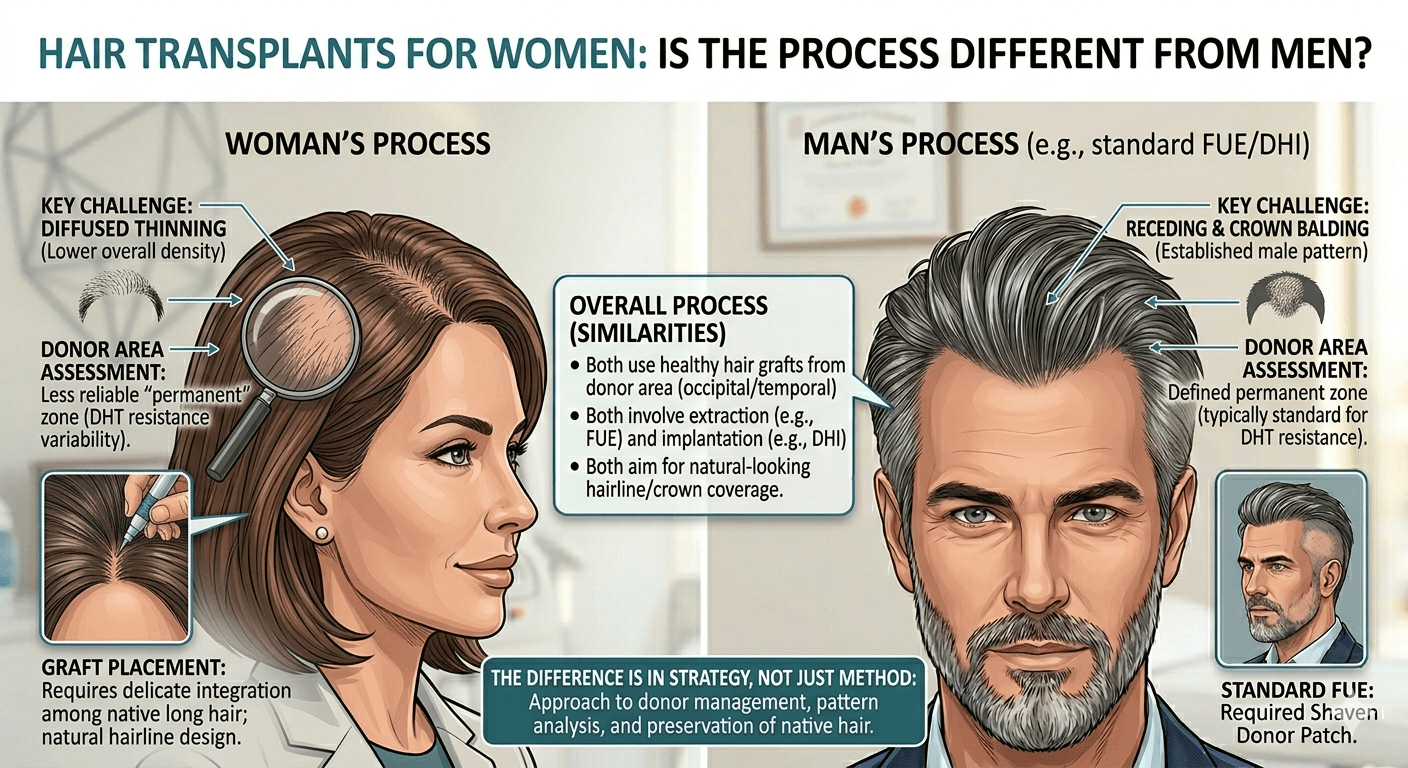
The Biological Difference: Female vs. Male Hair Loss
To understand why the surgical approach varies, we first have to look at how men and women lose hair.
Men typically experience localized baldness driven by the hormone DHT. It follows a predictable map (the Norwood Scale): the hairline recedes, temples deep-dive backward, or a bald circle forms on the crown, while the hair on the back and sides remains completely thick and healthy.
Women, on the other hand, usually experience diffuse hair loss driven by genetics, hormonal fluctuations (like pregnancy, thyroid issues, or menopause), or aging. Instead of a receding hairline, female thinning typically manifests as a general loss of density across the entire top and crown of the scalp, causing the hair part line to widen significantly while the front hairline remains largely intact.
How the Surgical Process Differs for Women
Because of these biological realities, a surgeon cannot treat a woman’s scalp the exact same way they treat a man’s. The process differs across three major pillars:
1. Donor Area Evaluation is Highly Critical
In men, the back and sides of the head are almost always genetically “permanent zones” immune to hair loss. In women suffering from diffuse thinning, the hair on the back and sides can sometimes thin out right along with the top.
A surgeon must microscopically analyze a woman’s donor site to ensure the hair there is perfectly healthy and stable. If the donor hair is also miniaturizing (shrinking), a transplant cannot be performed, as those moved hairs would eventually fall out.
2. The No-Shave Requirement (DHI Preference)
While men are usually comfortable buzzing their heads down to a zero-cut for surgery, this is a major psychological barrier for most women.
Because of this, female hair transplants are almost exclusively performed using Unshaven or Partially Unshaven techniques, heavily favoring the DHI (Direct Hair Implantation) method. The surgeon creates a tiny, hidden horizontal window at the back of the head to extract grafts, which is completely covered by the remaining long hair. The hair in the thinning areas up top is left completely long, and a specialized Choi Implanter Pen is used to inject new follicles directly between the existing long strands.
3. Hairline Design vs. Part Line Density
Men usually need an entirely new hairline built from scratch. Women rarely lose their front hairline; instead, they need density enhancement. The surgeon’s goal is to carefully pack new grafts along the center part line, the crown, or the temples to create visual volume so the white of the scalp no longer peeks through when the hair is styled.
Who is a Good Female Candidate?
Because female hair loss can sometimes be tied to temporary medical issues (like iron deficiency, stress, or sudden hormonal shifts), a thorough diagnosis is essential. You are generally an excellent candidate for surgery if:
- You have Female Pattern Hair Loss (Androgenetic Alopecia): Your thinning is genetic, has stabilized, and your donor area at the back remains dense and strong.
- You have a naturally high hairline: Some women are simply born with a high forehead or a masculine hairline shape and want to lower it for a softer, more feminine frame.
- You suffer from Traction Alopecia: This is hair loss caused by years of tight ponytails, braids, or extensions pulling on the hairline. Because the donor area is completely unaffected, traction alopecia boasts a nearly 100% success rate with transplants.
- You have scarring from plastic surgery: Women who have had facelifts or brow lifts often lose hair along the surgical incisions and use transplants to camouflage the scars.
Final Thoughts: A Masterclass in Precision
A female hair transplant is a highly sophisticated, intricate procedure that demands an artistic eye and a delicate touch. Navigating long hair strands to implant fresh grafts at high density without disrupting your native roots is an elite medical task.
At Dr. Terziler Clinic, we treat female hair restoration as a specialized art form, recognizing that your journey requires absolute privacy and unique clinical protocols. Through our advanced, completely unshaven DHI techniques, we focus on restoring your natural density and creating a beautifully feminine framing—delivering the most natural, sweeping results without ever disrupting your current style or routine.
Frequently Asked Questions (FAQ)
Will I have to shave my head for the procedure?
In the vast majority of cases, absolutely not. We understand how important your hair length is to your identity and comfort. By utilizing advanced DHI techniques, we only trim a small, easily concealable strip at the back of the head that is completely hidden by your surrounding long hair, keeping the rest of your hair fully intact.
Are the results of a female hair transplant permanent?
Yes, as long as you are a proper candidate with a healthy donor area. The follicles harvested from the stable permanent zone at the back of your head will retain their genetic resistance to thinning and will continue to grow naturally for the rest of your life.
When will I see the final results of my transplant?
The timeline for women is identical to men but requires patience. The transplanted hairs will shed roughly 2 to 4 weeks after surgery (a normal phase called shock loss). New, fine hairs will begin sprouting around month 3 or 4, with significant volume appearing by months 6 to 9. The final, fully mature, and dense result is achieved between 12 to 15 months post-op.
Can a hair transplant fix diffuse thinning if it affects my whole head?
If your hair loss is aggressively diffuse—meaning your hair is thinning equally at the back, sides, and top—you are likely not a candidate for a transplant because there is no stable, healthy donor hair to harvest. In these specific cases, non-surgical therapies like PRP (Platelet-Rich Plasma), laser therapy, and tailored medical treatments are highly recommended to thicken existing hair.
How soon after the transplant can I style, dye, or blow-dry my hair?
You must treat your scalp with absolute gentleness immediately following surgery. You can return to washing your hair normally after 10 to 14 days once the micro-scabs have naturally shed. However, you should strictly avoid harsh chemical dyes, bleaches, heat straighteners, or tight styling/pulling for at least 4 to 6 weeks to ensure the new grafts are safely anchored.