
5000 Grafts Hair Transplant: Cost, Coverage, Before and After, and Donor Safety Guide (2026)
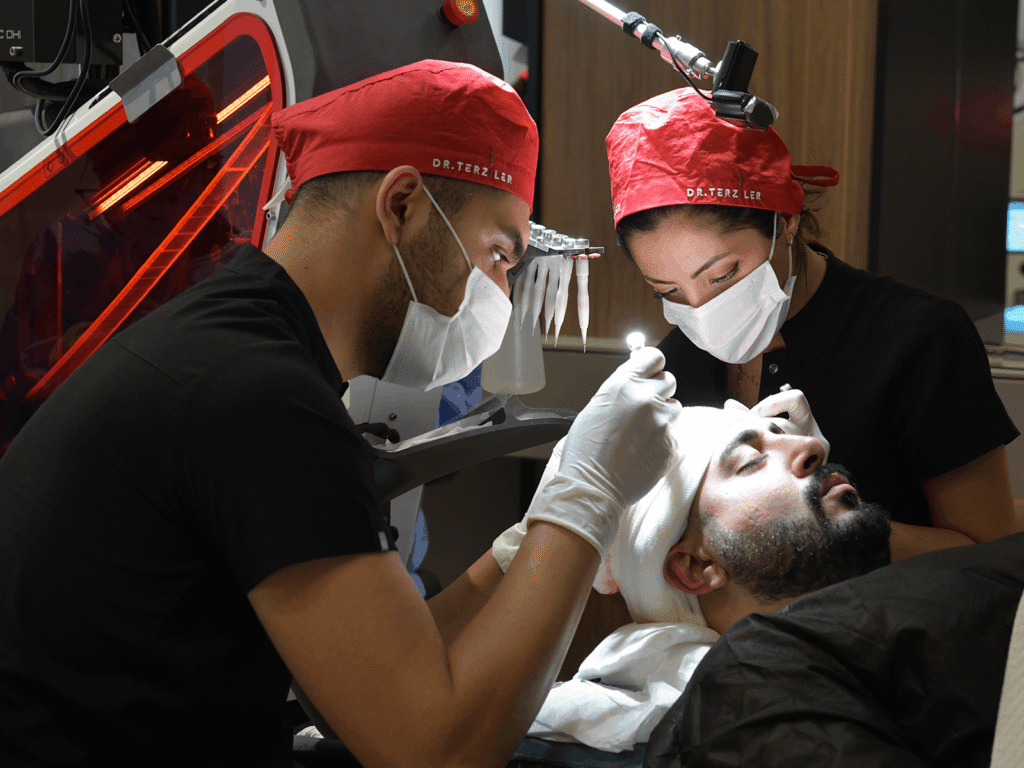
A 5000-graft hair transplant is one of the most significant procedures in hair restoration. It produces approximately 11,000-12,500 individual hairs, covers 120-150 cm2 of scalp, and addresses advanced hair loss at Norwood stages 5, 6, and 7. At Dr. Terziler Exclusive Clinic in Istanbul, the Robotic DHI system delivers this volume with a transection rate below 3%, preserving more viable grafts than any manual extraction method.
MEDICALLY REVIEWED BY
Dr. Servet Terziler
AAACI Accredited Surgeon, ISHRS Member and Inventor of Robotic DHI
Updated July 2026
This page answers every question a patient asks before a 5000-graft decision: package planning by destination, donor area safety, technique comparison, recovery timeline, and what results actually look like at 9, 12, and 18 months.
What Is a 5000 Grafts Hair Transplant?
A 5000-graft hair transplant relocates 5,000 individual follicular units from the donor area at the back and sides of the scalp to bald or thinning zones. It is classified as a mega session, the largest category of single-day hair restoration, and it delivers approximately 11,500 individual hairs on average.
Each graft is a follicular unit: a naturally occurring cluster of 1 to 4 hair shafts that share one root. Singles are placed along the hairline for a natural edge. Doubles fill the midscalp. Triples and quadruples build volume in the crown. At 5000 grafts, the math works out to roughly 10,000-12,500 hairs depending on the individual patient’s follicular distribution.
This procedure is designed for patients with advanced hair loss at Norwood stages 5, 6, or 7. It addresses the hairline, frontal scalp, midscalp, and crown in a single sitting, giving patients comprehensive restoration without a second trip.
How Many Hairs Do 5000 Grafts Produce?
5000 grafts produce between 10,000 and 12,500 individual hairs, with the average landing at approximately 11,500. This figure surprises many patients who assume grafts and hairs are the same thing. They are not.
One follicular unit (graft) contains 1 to 4 hair shafts growing from a single root. The typical distribution across a healthy donor area looks like this: approximately 30% of grafts are singles (one hair each), 50% are doubles (two hairs), 15% are triples (three hairs), and 5% are quadruples (four hairs). Applied to 5000 grafts, that gives 1,500 singles, 2,500 doubles, 750 triples, and 250 quadruples, totaling approximately 11,250 individual hairs.
| Graft Type | % of Total | Grafts at 5000 | Hairs Produced |
|---|---|---|---|
| Singles (1 hair) | ~30% | ~1,500 | ~1,500 |
| Doubles (2 hairs) | ~50% | ~2,500 | ~5,000 |
| Triples (3 hairs) | ~15% | ~750 | ~2,250 |
| Quadruples (4 hairs) | ~5% | ~250 | ~1,000 |
| TOTAL | 100% | 5,000 | ~11,250-11,750 |
Learn more about how grafts, hairs, and density interact in the complete hair transplant guide.
How Much Area Do 5000 Grafts Cover?
5000 grafts cover approximately 120-150 cm2 of scalp when placed at a density of 35-40 follicular units per cm2. For context, that is roughly the size of a spread hand: sufficient to restore a full hairline, dense midscalp, and covered crown for most Norwood 5-6 patients.
The coverage breaks down by zone. The hairline zone requires the highest precision because single-hair grafts create the natural frontal edge. The midscalp is the largest area by volume and uses double-hair grafts for density. The crown is the most variable zone, as patients differ significantly in how much surface area it covers and how deep the hair loss extends.
| Scalp Zone | Approximate Area | Grafts Allocated | Graft Type Used |
|---|---|---|---|
| Hairline (frontal edge) | 40-50 cm2 | 1,400-2,000 | Singles (1 hair) |
| Midscalp (core density) | 40-50 cm2 | 1,600-2,000 | Doubles (2 hairs) |
| Crown (volume) | 40-60 cm2 | 1,500-2,400 | Triples/Doubles |
| TOTAL | 120-150 cm2 | ~5,000 | Mixed |
At 35-40 follicular units per cm2, transplanted hair reaches 35-50% of native density. That sounds modest on paper but looks naturally full in person, especially with current styling products. Patients with coarser hair or lighter skin-to-hair contrast often exceed visual expectations.
Head size matters. A smaller scalp with a bald area under 100 cm2 achieves near-natural density from 5000 grafts. A larger scalp with a bald area approaching 160 cm2 may see slightly thinner crown results, which is where a staged second session or beard hair supplementation becomes relevant.
Which Norwood Stages Need 5000 Grafts?
5000 grafts is most appropriate for Norwood stage 5 to 6 patients. For Norwood 7, it serves as a strong first session covering the frontal two-thirds of the scalp, with a second session addressing crown density 12-18 months later.
The Norwood scale classifies male pattern baldness from stage 1 (no visible loss) to stage 7 (loss of all frontal, midscalp, and crown hair, leaving only a horseshoe band of hair). Here is how 5000 grafts maps to each relevant stage:
| Norwood Stage | Bald Area (approx) | Grafts Needed | 5000 Grafts Achieves |
|---|---|---|---|
| Norwood 4 | 80-100 cm2 | 3,000-4,000 | Full coverage with spare capacity |
| Norwood 5 | 100-120 cm2 | 3,500-5,000 | Full hairline + midscalp + crown |
| Norwood 6 | 130-160 cm2 | 4,500-5,500 | Comprehensive restoration (sweet spot) |
| Norwood 7 | 160-200+ cm2 | 6,000-9,000 total | Frontal/mid in session 1; crown in session 2 |
For Norwood 6 patients, 5000 grafts is the sweet spot. A surgeon with an accurate donor map can restore the hairline, fill the midscalp, and cover the crown in a single session. The patient wakes up post-op with every major bald zone addressed. This is why Norwood 6 is the most common indication for a 5000-graft mega session worldwide.
For Norwood 7 patients, 5000 grafts alone rarely achieves full coverage. The bald zone can exceed 180 cm2, which requires 7,000-9,000 grafts over a lifetime. The correct approach is a planned two-session strategy: 5000 grafts for the frontal hairline and midscalp in session one, then 2,000-3,000 additional grafts for crown density in session two, spaced 12-18 months apart.
Use our full Norwood scale guide to find your stage and plan your total graft requirement before your consultation.
5000 Grafts vs 4000 Grafts: What Changes in the Extra 1000?
1000 additional grafts at this scale equals approximately 2,300 more individual hairs and 25-30 cm2 of additional scalp coverage. In practical terms, the difference between 4000 and 5000 grafts is almost always the crown. At 4000 grafts, a Norwood 6 patient can fully restore the hairline and midscalp but often has an underdense or thin crown. At 5000 grafts, the crown receives 1,500-2,000 grafts instead of 500-1,000, which is the difference between a visually covered crown and a noticeable gap on top.
5000 Grafts vs 3000 Grafts: When Does the Difference Show?
The jump from 3000 to 5000 grafts addresses two different stages of hair loss. 3000 grafts suits Norwood 3-4 patients who need hairline restoration and early midscalp coverage. 5000 grafts is for Norwood 5-6 patients who have lost the hairline, midscalp, and crown simultaneously. The 2000-graft gap equals roughly 4,600 additional hairs and 50-60 cm2 more coverage. Going to 5000 when 3000 grafts would suffice means over-harvesting the donor zone unnecessarily. A pre-operative trichoscopy measurement determines the right number with precision.
5000 Grafts vs 2000 Grafts: Two Different Hair Loss Journeys
2000 grafts is a targeted procedure: it restores a specific zone (hairline, crown, or temples) for patients at Norwood 2-3 who have focal rather than diffuse loss. 5000 grafts is a comprehensive procedure for patients who have lost coverage across the entire top of the scalp. Comparing them is like comparing a single-room renovation to a full house rebuild. Both are valid, but they solve different problems. If you are at Norwood 5 or above and are considering 2000 grafts, the result will be noticeable improvement in one zone but will leave others visually mismatched.
Can 5000 Grafts Be Done in One Session?
Yes, 5000 grafts can be performed in a single session, but only for patients who meet specific donor area criteria. The quality of the technique matters enormously at this scale. A poorly equipped clinic that attempts 5000 grafts in one day risks graft desiccation, donor trauma, and inconsistent results. The right team with the right technology makes 5000 grafts in one session not only possible but optimal.
A mega session is any procedure extracting more than 3,500-4,000 grafts in a single sitting. 5000 grafts is at the upper boundary of what leading ISHRS-trained surgeons perform in a single day. Duration runs 7-10 hours. The patient remains seated or reclined throughout, under local anaesthesia with optional oral sedation.
The risks of a poorly executed mega session are real. Graft desiccation occurs when follicular units spend too long outside the body before implantation. Each hour of exposure increases cell death. A team that extracts all 5000 grafts before beginning implantation can accumulate 4-6 hours of out-of-body time for the first grafts extracted. At Dr. Terziler Exclusive Clinic, the Robotic DHI system extracts and implants in a near-simultaneous workflow using the Choi implanter pen. Grafts go from donor to recipient in minutes, not hours.
What Happens to the Donor Area After 5000 Grafts?
The donor area is temporarily red and tender for 7-14 days after a 5000-graft procedure. With correct extraction technique, it heals without visible scarring or permanent thinning. With poor technique or over-concentration of extractions, it can show patchy thinning that does not recover.
Here is the number that changes how patients think about this procedure: the average human scalp holds 6,000-8,000 harvestable follicular units across a lifetime. Extracting 5,000 in one session means spending 62-83% of your total lifetime donor supply in a single day. The remaining 1,000-3,000 grafts is all that will be available for any future session, whether driven by further natural hair loss or a desire for more density.
The overharvesting risk is real but preventable. Extracting more than 20-30% of follicles per cm2 from any localised area causes visible thinning in that patch of the donor zone. This is the ‘moth-eaten’ look that occurs when surgeons focus extraction in a small central area to maximise speed. The correct technique distributes extractions across the entire donor zone, from the occiput to the bilateral temporal areas, maintaining apparent density throughout.
FUE or DHI, Which Technique Works Best for 5000 Grafts?
For 5000 grafts, FUE is the standard technique used worldwide. DHI with robotic assistance offers superior graft survival and density control, especially in the hairline and midscalp where angle and depth precision matter most. The right answer depends on the patient’s priorities: maximum speed or maximum precision.
FUE hair transplant at 5000 grafts works like this. A motorised punch extracts follicular units one by one. Once all or a large batch are extracted, the surgeon creates recipient channels with a sapphire blade or steel tip. Then grafts are placed manually using forceps. The weakness at 5000-graft scale is timing: grafts extracted early in the session may wait 3-5 hours before implantation. Extended out-of-body time reduces graft viability. Studies show graft survival drops approximately 10% for every additional hour of ischemia time beyond two hours.
DHI hair transplant at 5000 grafts uses the Choi implanter pen. The pen holds a graft and creates the recipient channel while placing the graft simultaneously, in one motion. This eliminates the pre-made channel step and dramatically reduces the time each graft spends outside the body. The trade-off is that DHI requires more implantation passes and is slightly slower per graft. It is the preferred technique when density and hairline naturalness are the primary goals.
| Factor | FUE (Manual) | DHI (Choi Pen) | Robotic DHI |
|---|---|---|---|
| Extraction method | Manual motorised punch | Manual + Choi pen | Robotic arm + Choi pen |
| Transection rate | 8-15% | 5-10% | Below 3% |
| Graft out-of-body time | 2-5+ hours | 30-90 min | Under 30 min |
| Density achievable | Moderate | High | Highest |
| Mega session suitability | Yes, with risk | Yes | Optimal |
| Hairline precision | Good | Very good | Excellent |
Robotic DHI was developed at Dr. Terziler Exclusive Clinic by Dr. Servet Terziler. The robotic arm of the machine handles extraction with a consistent punch depth and angle across all 5,000 extractions. The transection rate below 3% means 97% of extracted grafts are viable follicular units ready for implantation. Compare that to manual FUE at 8-15%: at 5000 grafts, that gap means 250-600 additional viable grafts with robotic DHI, equivalent to the entire frontal hairline zone.
FUT (follicular unit transplantation, or strip method) is occasionally considered for Norwood 7 patients who need maximum graft yield. A strip of scalp is excised from the donor zone and follicular units are dissected under a microscope. FUT can yield 4,000-6,000 grafts in one session but leaves a permanent linear scar, limiting future hairstyle options.
“A 5000-graft session is not about volume. It is about discipline. Every follicle we extract is part of a finite lifetime supply. At Dr. Terziler Clinic, we map the next 20 years of a patient’s hair before we make a single incision. The Robotic DHI system gives us robotic precision at mega-session scale, but the strategy behind it is always human.”
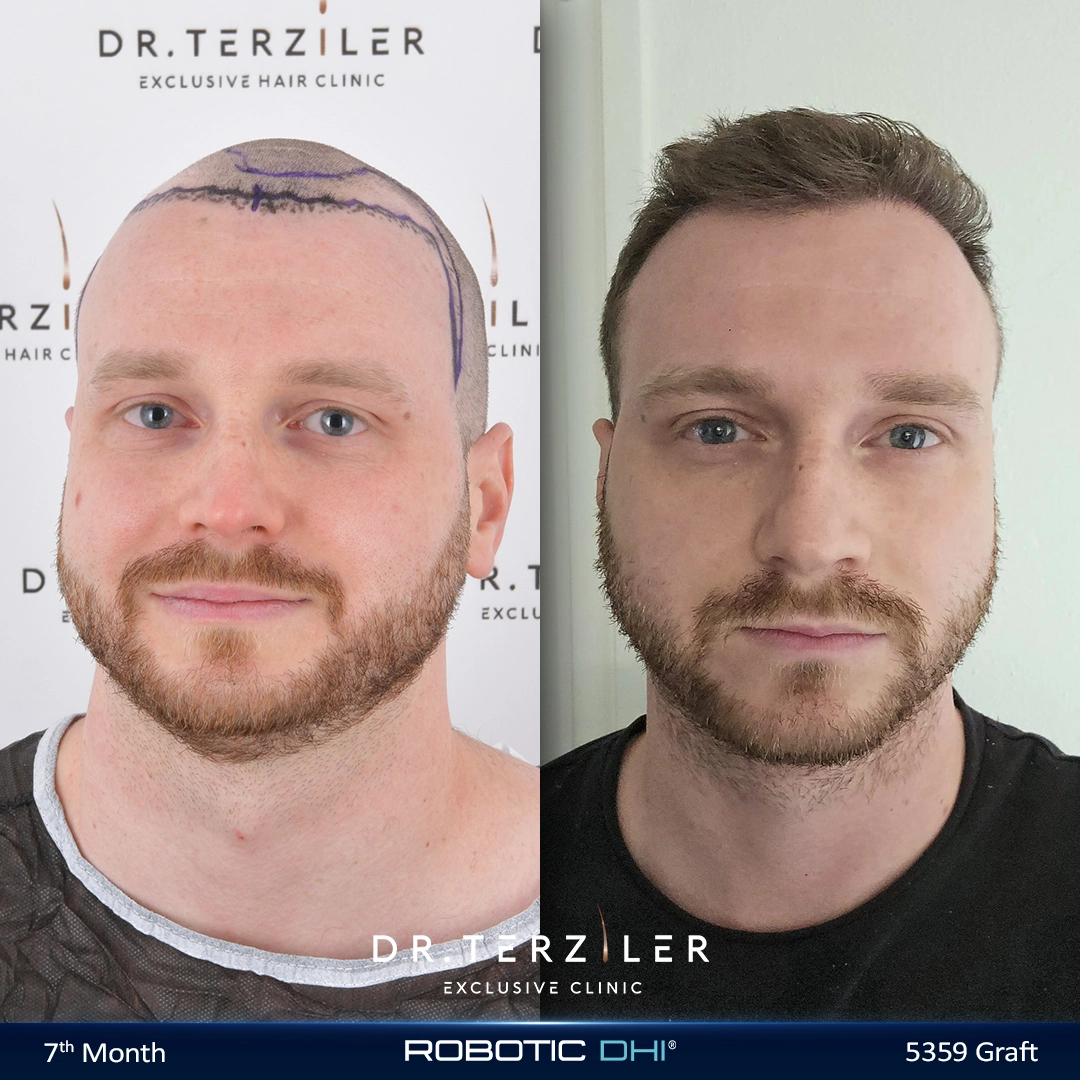
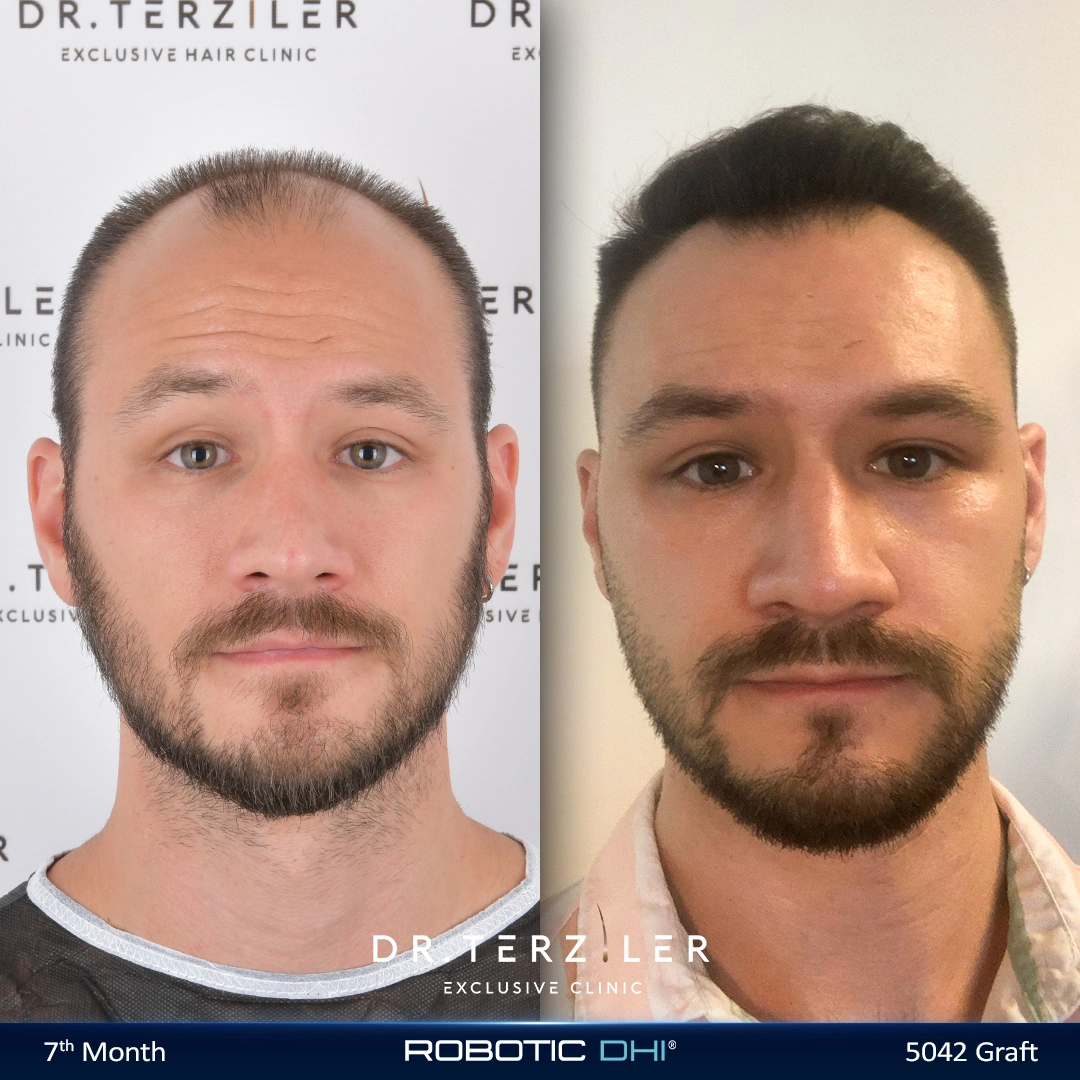
What Does a 5000 Grafts Hair Transplant Look Like Before and After?
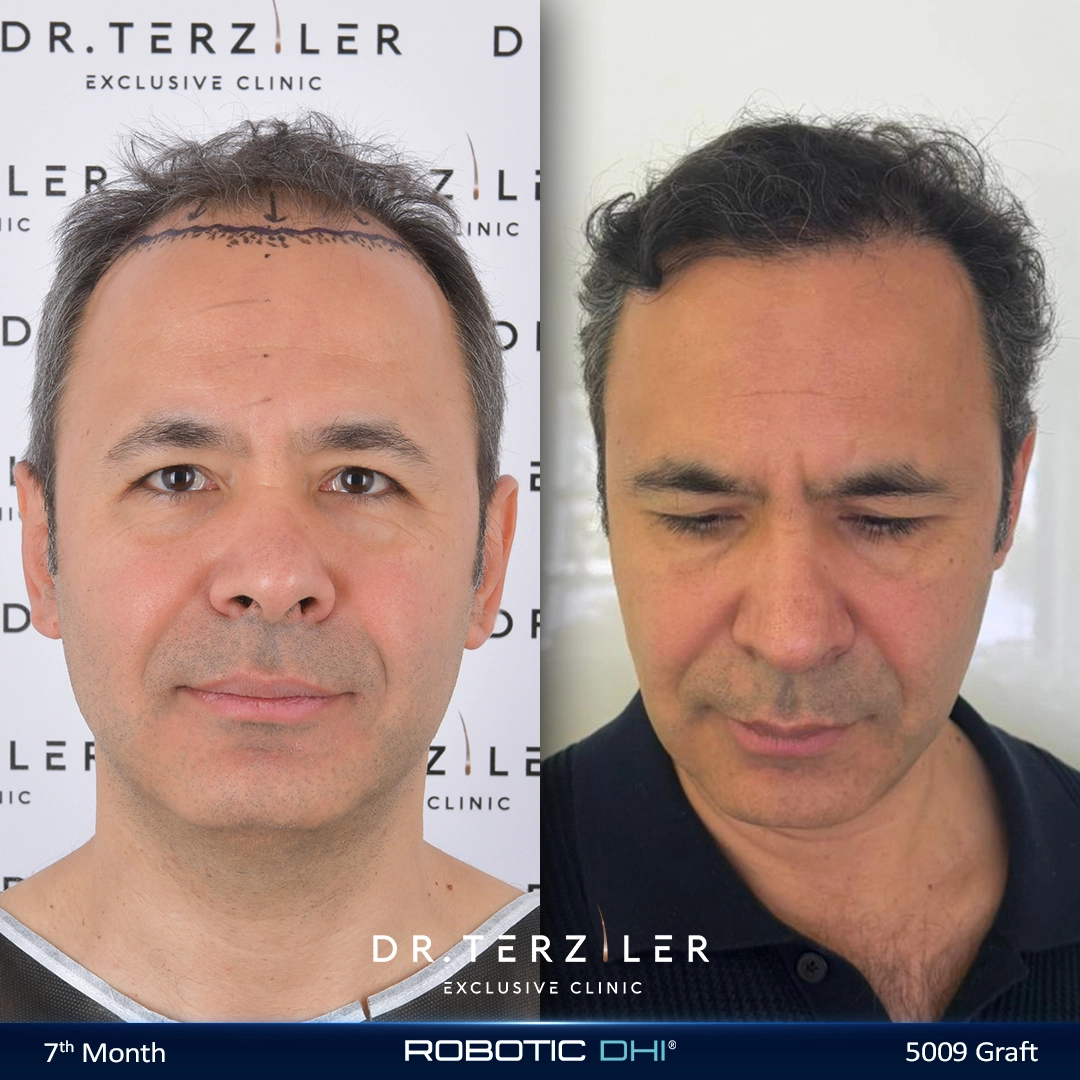
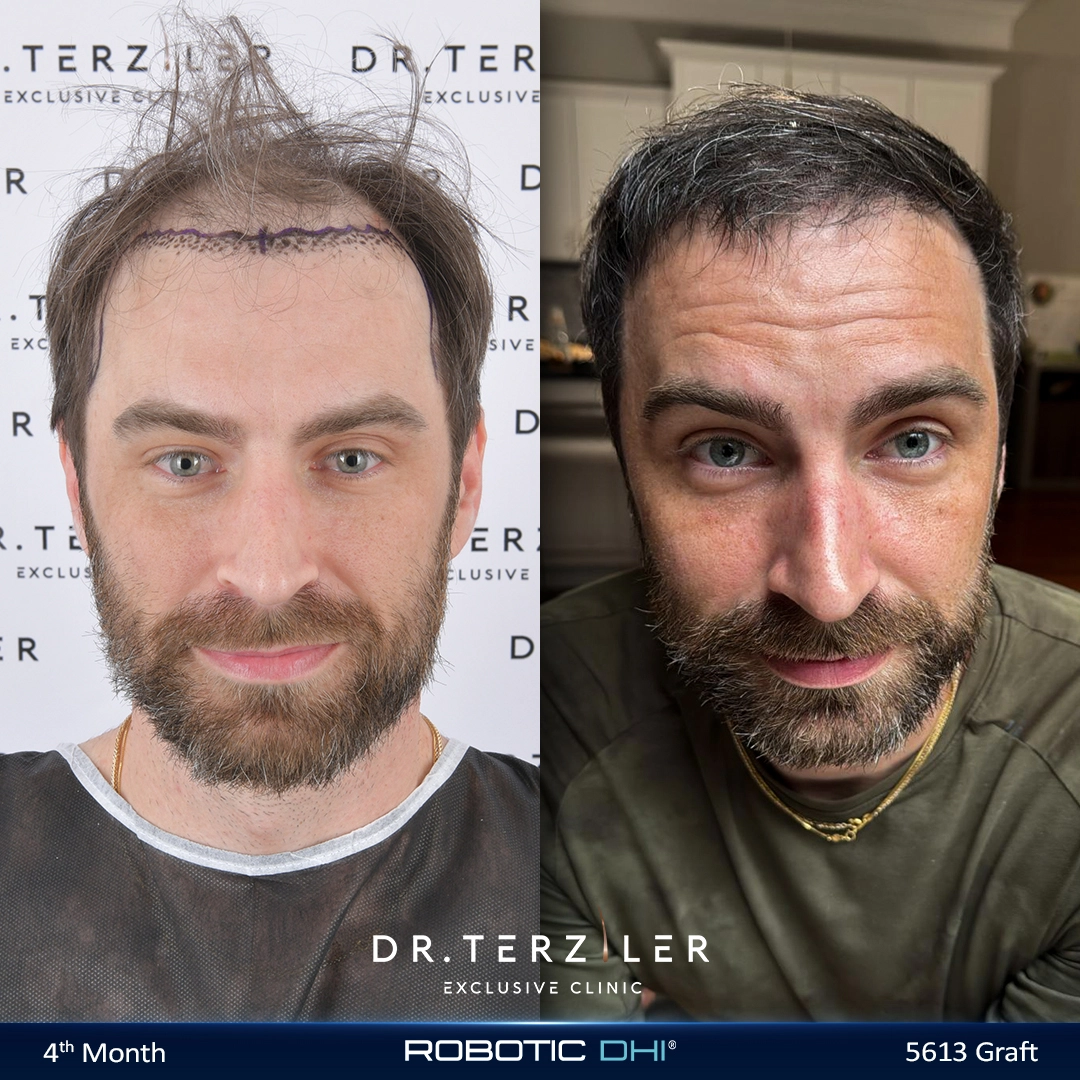
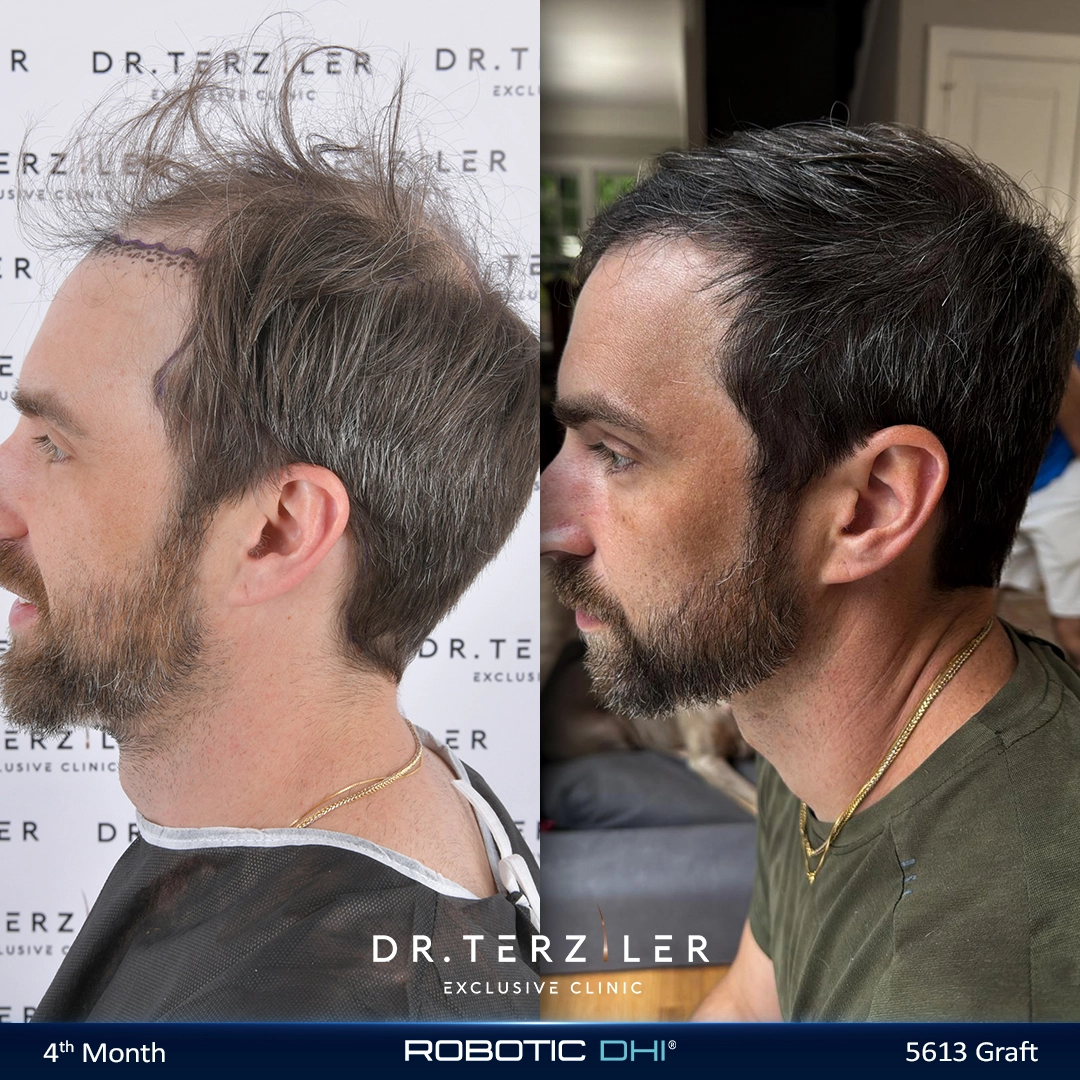
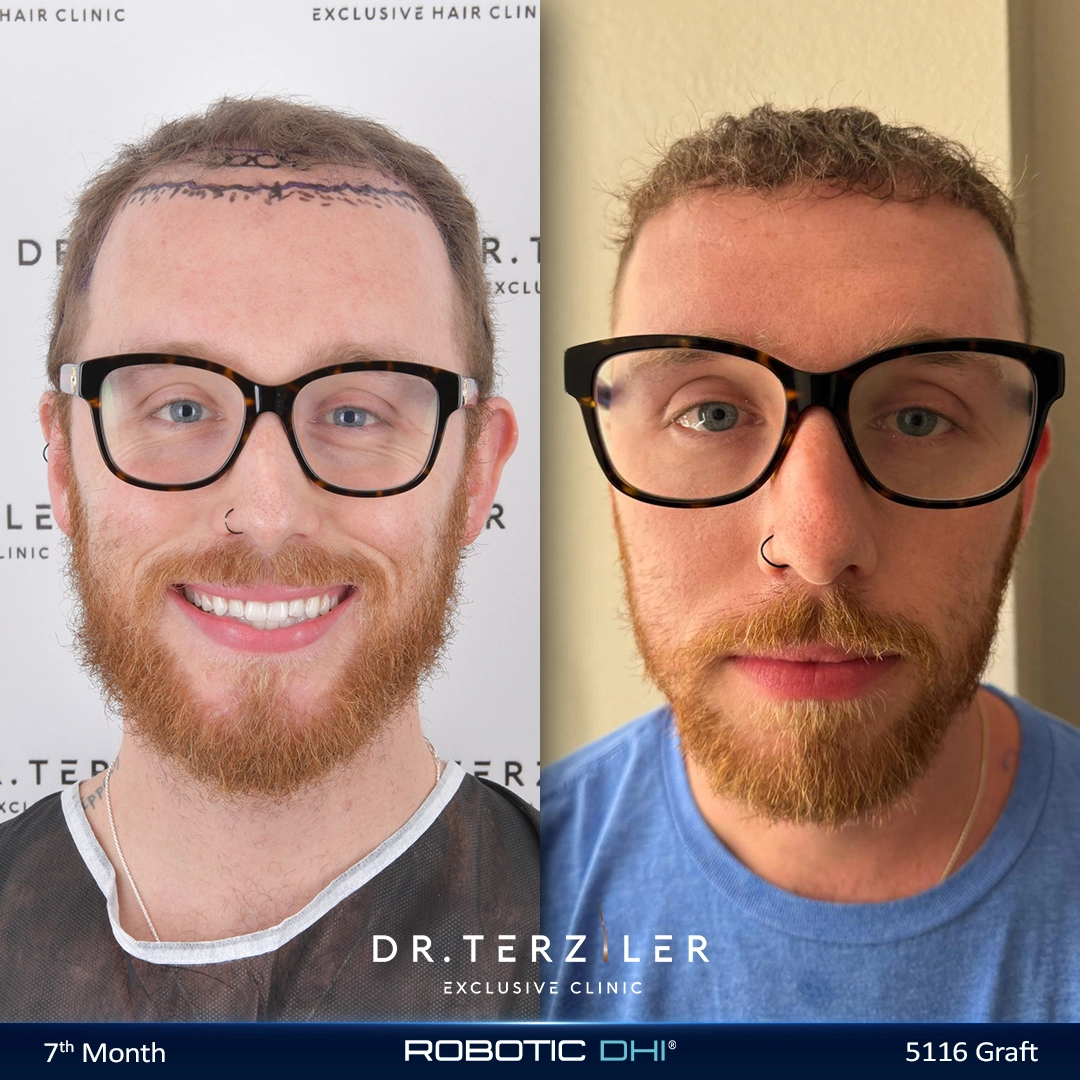
A 5000-graft hair transplant produces a fully restored hairline, dense midscalp, and covered crown. These results are visible and permanent from 12 months post-procedure, with further improvement continuing to 18 months. The transformation is most dramatic in Norwood 6 patients, where before images show extensive baldness across the entire top of the scalp.
Here is what the visual stages actually look like, month by month.
| Timeframe | Visible Change | What Patients Experience |
|---|---|---|
| Day 1-10 | Redness, tiny scabs at graft sites | Normal healing. Not visible at normal social distance. |
| Week 2 | Scabs soften and fall naturally | Scalp looks clean. Most patients return to work. |
| Month 1-3 | Shock loss: transplanted hairs shed | Expected. Not a sign of failure. Root is alive. |
| Month 3-6 | New fine hairs emerge from grafted follicles | First visible progress. Hairline starts to appear. |
| Month 6-9 | Hairs thicken and darken | Density improves noticeably. Confidence returns. |
| Month 9 | 60-70% of final density visible | Most patients stop worrying at this stage. |
| Month 12 | 80-90% of final result | Hair texture matches surrounding native hair. |
| Month 15-18 | Full maturation, crown completes last | Final result. DHT-resistant transplanted hair is permanent. |
At 35-40 follicular units per cm2, the transplanted hair looks naturally full, not model-level density but cosmetically indistinguishable from natural hair when styled. Patients with coarser or lighter hair achieve better visual coverage per graft. Patients with fine, straight, dark hair may style with volumising products to maximise the appearance of density.
The crown zone completes last. This is specific to 5000-graft mega sessions where the crown is treated at the end of a long surgical day and experiences slightly more handling time. Patients should expect the crown to show visible results 4-8 weeks after the hairline, not simultaneously. Check our 5000 grafts hair transplant before and after pictures here.
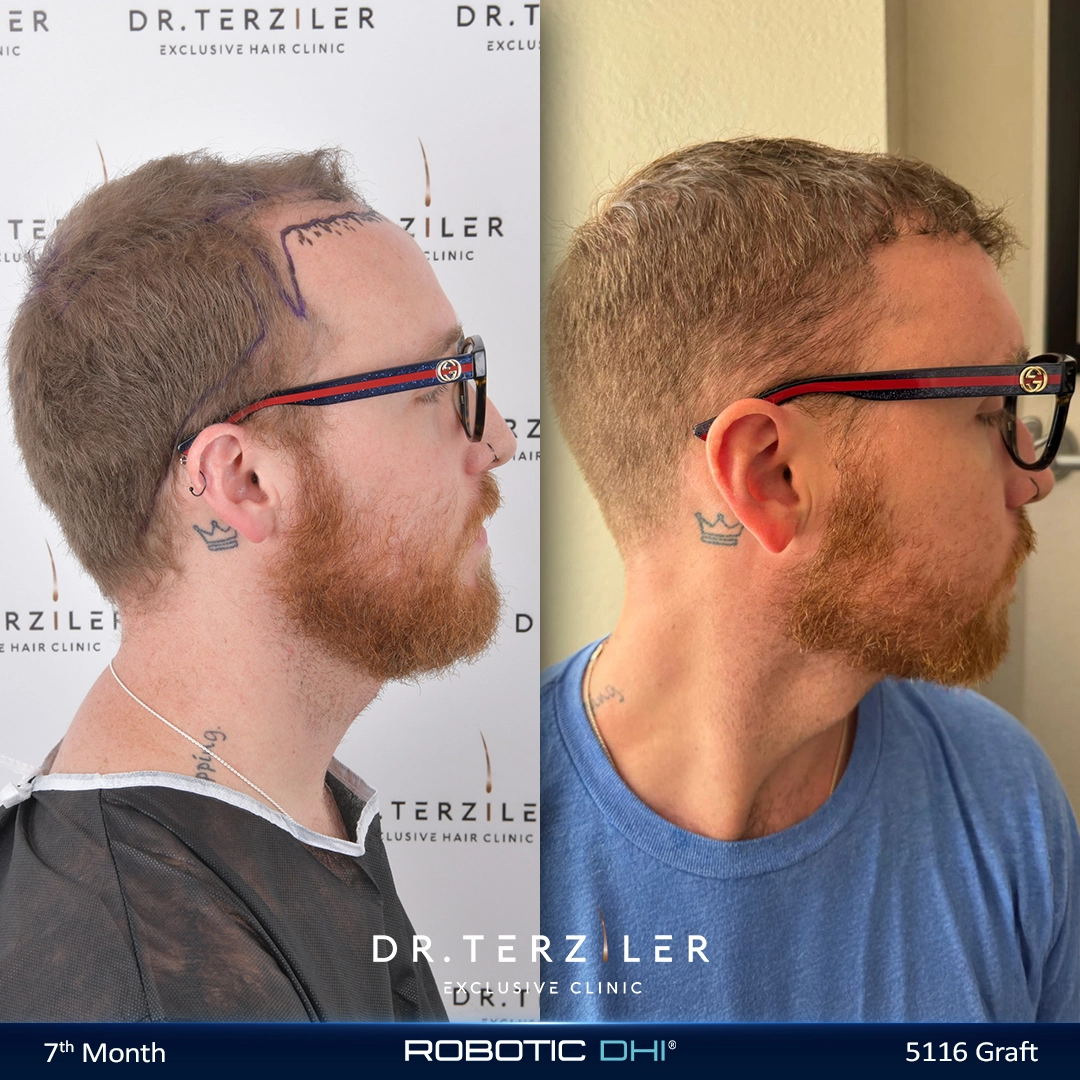
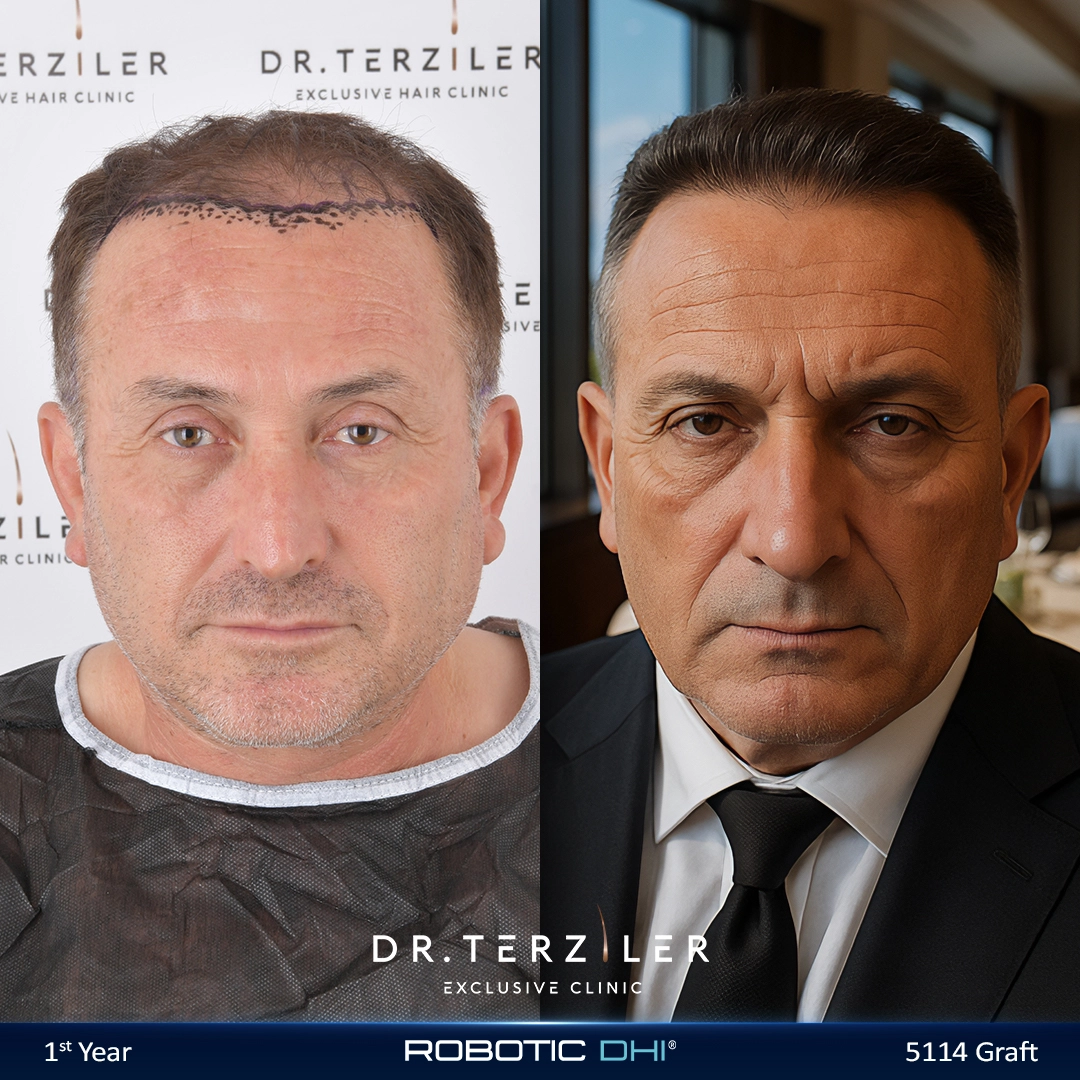
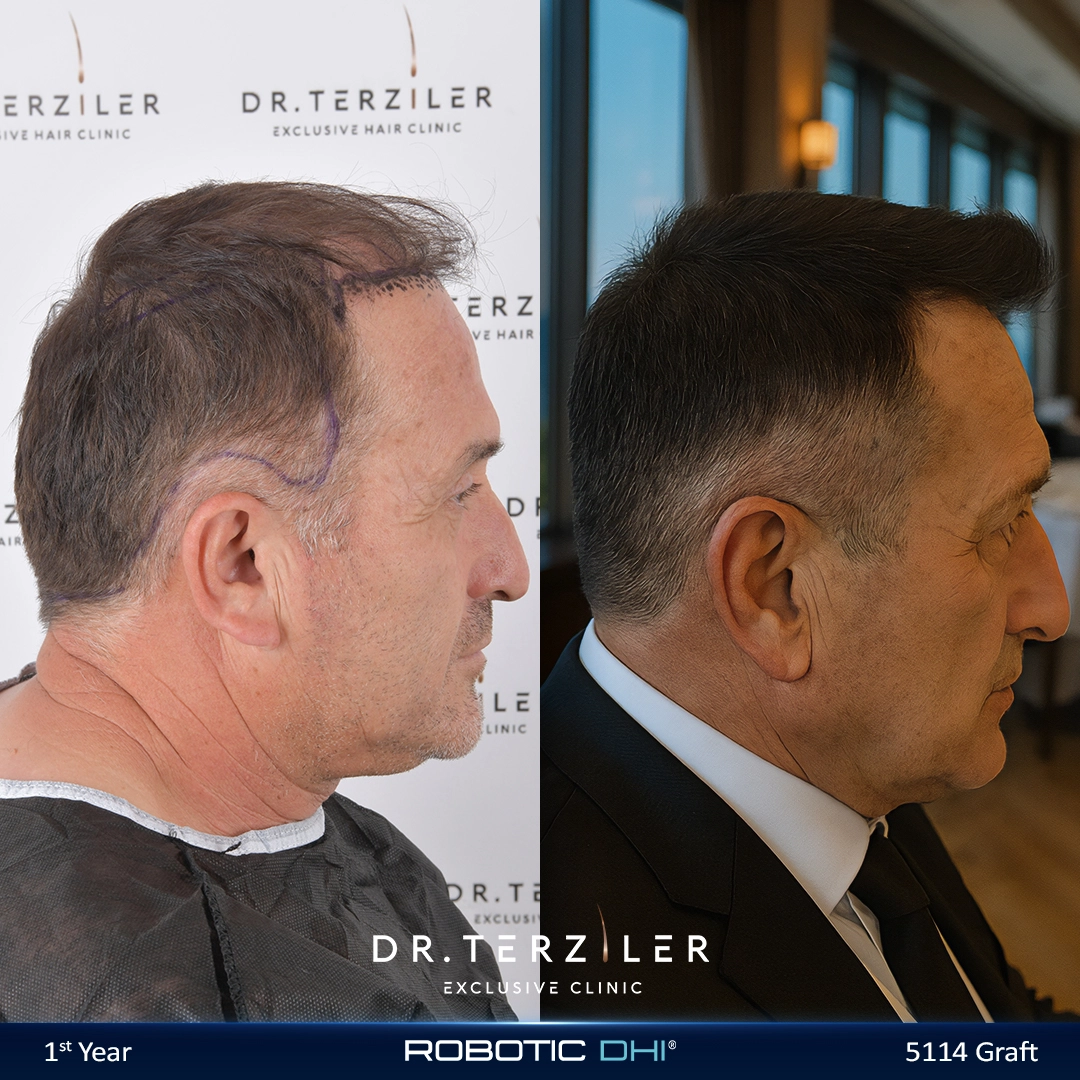
“I was Norwood 6 and spent three years researching. Dr. Terziler’s team mapped my donor area before I even booked. After 5000 grafts with the Picasso Robotic DHI, my hairline, midscalp, and crown are all restored. At 14 months post-op, nobody believes me when I mention a transplant.”
What Is the Recovery Timeline After 5000 Grafts?
Recovery after a 5000-graft hair transplant takes 7-14 days for the scalp to heal visibly. Full results develop over 12-18 months. The process is the same as smaller procedures but with slightly more swelling in the first 3-5 days due to the larger treated surface area.
Dr. Terziler Exclusive Clinic follows a structured aftercare protocol for all 5000-graft patients. Day 1 includes a dressing change and first clinical review. Day 3, the first proper wash is performed at the clinic. International patients receive remote consultation check-ins at 1 month, 6 months, and 12 months, with photo review and personalised aftercare guidance at each stage.
PRP (platelet-rich plasma) treatment on the day of surgery accelerates healing and activates the transplanted follicles. All Dr. Terziler procedures at this graft count include PRP as part of the protocol, not as an add-on.
How Much Does a 5000 Grafts Hair Transplant Cost?
There is no single safe price for a 5000-graft hair transplant. The final package is personalised after donor mapping, Norwood assessment, hair-loss diagnosis, technique selection, session planning and travel requirements. A public number without that clinical context can create false expectations, so the team confirms the appropriate plan directly with each patient.
| Planning factor | What the team reviews | Why it matters |
|---|---|---|
| Donor reserve | Density, calibre, safe extraction zone and lifetime reserve | Protects against overharvesting and helps decide whether one session or staged treatment is safer |
| Hair-loss pattern | Norwood stage, active thinning and scalp diagnosis | Sets realistic coverage priorities for the hairline, midscalp and crown |
| Technique | Manual DHI, Robotic DHI or a hybrid plan where clinically suitable | Matches extraction, implantation, density and recovery needs to the patient |
| Package scope | Procedure, medical checks, aftercare, accommodation, transfers and follow-up | Allows an international patient to compare the complete plan rather than a headline number |
Patients comparing Turkey, the USA, the UK, Canada or Australia should compare surgeon responsibility, accreditation, donor-preservation methods, medical screening, the complete package scope and documented follow-up. The clinic can review your case through the contact page or answer package questions on WhatsApp before you make a travel decision.
How Is a 5000-Graft Hair Transplant Package Planned in Turkey?
A Turkey package proposal should begin with medical assessment rather than a fixed price card. Dr. Terziler’s team reviews donor capacity, hair-loss pattern, hairline goals, suitable technique, accommodation and aftercare needs before confirming the written scope. You can review the planned inclusions on the hair transplant packages page, then request a case-specific proposal through the contact page.
How Should US Patients Compare a 5000-Graft Hair Transplant Plan?
US patients should compare the complete medical plan, not a per-graft headline. Ask who performs the extraction and implantation, how donor safety is measured, what aftercare is provided, how follow-up works after returning home, and whether travel support is included. Send your photos to the clinical team through the contact page or ask directly on WhatsApp.
How Can UK Patients Request Personalised 5000-Graft Guidance?
UK patients can request a written plan based on their own donor reserve, loss pattern, hairline design, technique suitability and travel window. This avoids comparing incomplete procedure-only figures with all-inclusive medical-travel packages. The team can explain the plan, inclusions and follow-up before booking through the contact page.
What Should Canadian and Australian Patients Ask Before Booking?
Canadian and Australian patients should ask for the same evidence as every international patient: donor mapping, the surgeon-led workflow, technique rationale, medical screening, written aftercare, transfer and accommodation details, and a realistic follow-up schedule. Request those details from the clinic before committing to travel.
Why Choose Turkey for a 5000 Grafts Hair Transplant?
Turkey performs an estimated 500,000+ hair transplant procedures annually, more than any other country in the world. That volume, combined with an established medical-tourism infrastructure and experienced surgical teams, makes Istanbul a major destination for 5000-graft planning.
Istanbul hosts more than 700 hair transplant clinics. This creates a competitive market where accreditation, surgeon involvement and evidence-based comparison matter greatly among leading providers. The challenge for international patients is identifying those leading providers within a crowded market. The most reliable filters are ISHRS membership, AAACI clinic and surgeon accreditation, and surgeon-specific (not clinic-level) before-and-after galleries.
Dr. Terziler Exclusive Clinic meets all three. Dr. Servet Terziler holds AAACI dual accreditation #7722917 for both the clinic and himself as an individual surgeon, ISHRS educator-level participation, and invented the Robotic DHI system. This is the only robotic DHI machine designed, built, and operated by the same surgeon. It is not a licensed technology from a third-party manufacturer; it is the result of Dr. Terziler’s own research and clinical development.
All-inclusive packages remove the financial unpredictability that concerns many international patients. The procedure, hotel, transfers, medications, PRP, and follow-up consultations are set out in a written package scope. Patients can understand what is included before they travel to Istanbul.
Is 5000 Grafts the Maximum? What If You Need More?
5000 grafts is not a universal maximum, but it is the practical upper limit for a single-session scalp-only procedure for most patients. Some patients need more. The solution is not to push a single session beyond what the donor area can safely provide; it is to plan additional sessions or supplemental donor sources before the first procedure begins.
When 5000 grafts is not enough: Norwood 7 patients, patients with ongoing aggressive androgenetic alopecia, and patients whose bald area exceeds 160 cm2. For these patients, 5000 scalp grafts plus a planned second session is the standard recommendation. A second session of 2,000-3,000 grafts from the remaining donor reserve, 12-18 months after the first, completes crown coverage.
Overharvesting 5000 grafts in one session is only a risk if the donor area’s safe extraction limit is below 5000. This is determined by a pre-operative trichoscopy measurement, a standard step at Dr. Terziler Exclusive Clinic. Patients who arrive expecting 5000 grafts and have a trichoscopy showing only 4,200 safe units will be advised to proceed with 4,200 grafts and plan a second session for the remainder. No ethical surgeon should promise a graft count before examining the donor area.
Frequently Asked Questions About 5000 Graft Hair Transplants
No. 5000 grafts in one session is safe for patients with donor density above 80 follicular units per cm2, a stable Norwood stage, and surgeon-led robotic or motorised extraction. It becomes problematic only when it exceeds the safe extraction limit for that individual patient. A pre-operative trichoscopy measurement determines this limit. Attempting 5000 grafts without that measurement is the actual risk factor, not the number itself.
A 5000-graft session takes 7-10 hours. The extraction phase takes 3-5 hours. Implantation takes 3-5 hours. With Robotic DHI, robotic extraction reduces session time by 30-45 minutes compared to manual FUE at this graft count, and keeps grafts viable throughout by minimising out-of-body time to under 30 minutes per batch.
Yes, if the donor area contains at least 6,000-7,000 viable follicular units. The average scalp holds 6,000-8,000 harvestable units across a lifetime. Extracting 5,000 safely requires distributing punches across the full donor zone (occiput plus lateral sides) rather than concentrating in a small area. Concentrated extraction causes visible thinning. Robotic extraction systems map and distribute punches evenly to prevent this.
Norwood stage 5 and 6 patients are the primary candidates for 5000-graft procedures. Norwood 6 is the most common indication, where 5000 grafts covers the hairline, midscalp, and crown comprehensively. Norwood 7 patients use 5000 grafts as session one for frontal and midscalp coverage, with a second session of 2,000-3,000 grafts for crown completion 12-18 months later.
There is no one-size-fits-all price for a 5000-graft procedure. The final package is personalised after donor mapping, Norwood assessment, technique selection and travel planning. Contact the clinic for a written, case-specific package proposal or message the US WhatsApp team for guidance.
5000 grafts produce approximately 11,000-12,500 individual hairs. Each follicular unit contains 1-4 hair shafts, with an average of 2.3 hairs per graft. A typical distribution: 1,500 singles (1,500 hairs) + 2,500 doubles (5,000 hairs) + 750 triples (2,250 hairs) + 250 quadruples (1,000 hairs) = approximately 11,250-11,750 total hairs. Grafts and hairs are not the same thing.
It can be appropriate for patients with advanced hair loss and adequate donor reserve, but value depends on diagnosis, graft handling, donor preservation, aftercare and the complete treatment plan. Request a personalised assessment before comparing clinics or package proposals.
No confirmed figure exists. Trichologists and hair restoration experts estimate Musk underwent 2,000-5,000 grafts based on visible hairline reconstruction photographed between the late 1990s and mid-2000s. The density and recession reversal visible in comparative photos is consistent with a large-scale FUE or DHI procedure across multiple sessions, according to published expert commentary. Musk has never confirmed the procedure or graft count.
Graft survival is 90-97% with experienced robotic or motorised extraction. The Robotic DHI system achieves below 3% transection, meaning 97% of extracted grafts are viable. Manual FUE averages 85-92% survival at this graft count due to higher transection rates and longer out-of-body time. At 5000 grafts, a 5% difference in survival rate equals 250 additional viable grafts, roughly the full frontal hairline zone.
Yes. Beard hair FUE supplements scalp donor supply by 1,000-3,000 additional grafts. Beard follicles are single-hair units with a slightly coarser texture and slower growth cycle. They integrate best in the crown and midscalp. Beard hair supplementation is the standard approach for Norwood 7 patients or patients whose scalp donor area cannot safely yield 5,000 units alone.
Permanently. Transplanted follicles from the donor zone are DHT-resistant and do not fall out due to androgenic hair loss. Results in transplanted zones last a lifetime. However, native (non-transplanted) hair surrounding the treated areas may continue to thin if hair loss is not treated medically. Combining the transplant with finasteride or equivalent DHT-blocking treatment is strongly recommended for long-term stability.
1000 additional grafts at this scale equals approximately 2,300 more hairs and 25-30 cm2 of additional coverage. The practical difference for Norwood 6 patients is the crown: 4000 grafts typically covers the hairline and midscalp but leaves the crown underdense. 5000 grafts provides 1,500-2,000 grafts to the crown zone, making the difference between a thin crown and a fully covered one.
5000-graft procedures can use either FUE or DHI. FUE is faster for high-volume extraction but risks longer graft out-of-body time. DHI with the Choi implanter pen gives superior graft survival and density by combining extraction and implantation in a near-simultaneous step. At Dr. Terziler Exclusive Clinic, Robotic DHI is the preferred approach for 5000-graft sessions, combining robotic extraction precision with DHI implantation technique.
5000 grafts cover 120-150 cm2 of scalp at 35-40 follicular units per cm2. The zone breakdown: hairline zone 40-50 cm2 (1,400-2,000 grafts), midscalp 40-50 cm2 (1,600-2,000 grafts), crown 40-60 cm2 (1,500-2,400 grafts). This is sufficient to restore all three major bald zones in a single session for most Norwood 5-6 patients.