




Does Hair Transplant Hurt? Pain Scale, Anesthesia & Recovery Guide
A hair transplant does not hurt during surgery once local anesthesia takes effect. This guide explains the real pain scale, what the anesthesia injection feels like, how recovery feels day by day, and when discomfort is normal versus when to contact your surgeon.
Quick Answer
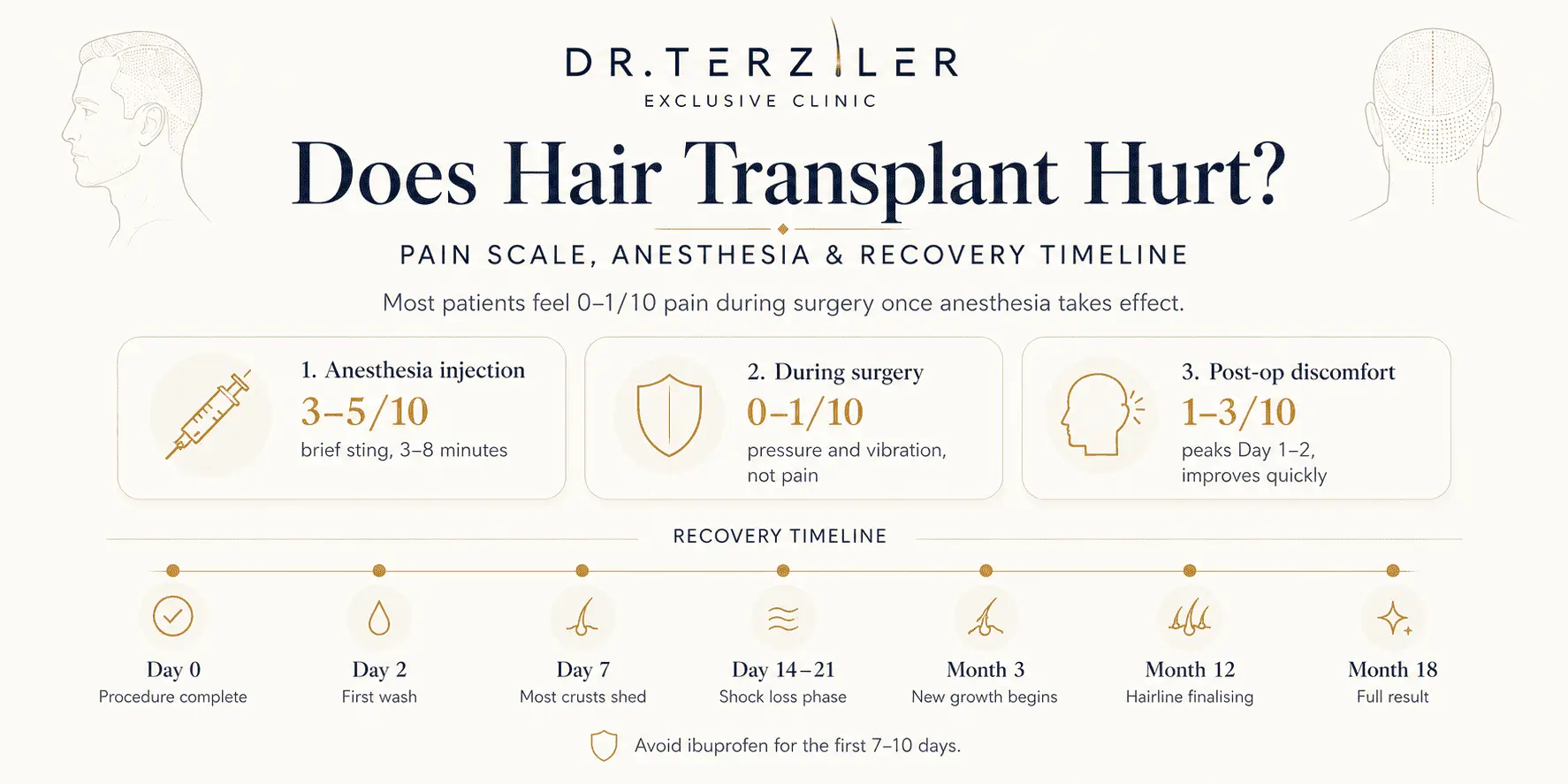
A hair transplant does not hurt during surgery. Local anesthesia numbs the scalp within 5 minutes of injection. The only significant discomfort is the anesthesia injection itself, which most patients rate 3-5/10 on a pain scale, comparable to a dental numbing shot. Post-operative soreness peaks at Day 1-2 and resolves within 7-10 days for most patients.
MEDICALLY REVIEWED BY
Dr. Servet Terziler
AAACI Accredited Surgeon, ISHRS Member and Inventor of Robotic DHI
Updated June 2026
Does a Hair Transplant Hurt During the Procedure?
Hair transplant surgery does not hurt once anesthesia takes effect. Patients feel pressure, vibration, and movement; not pain. Pain scores during extraction and implantation are 0-1/10.
Knowing what you will and will not feel makes the difference between arriving calm and arriving terrified. During FUE extraction you feel the vibration of the motorised punch and mild pressure at each extraction site; nothing sharp. During DHI implantation you feel pressure and occasional awareness of placement. No burning, no cutting, no stitching sensation.
For sessions requiring more than 3,000 grafts, anesthesia needs topping up every 3-4 hours as lidocaine metabolises. These top-ups are administered at the edge of the already-numb zone, so they are significantly milder than the initial injections. Surgeons time them at natural breaks.
Sedation is available for anxious patients. Oral diazepam or midazolam taken 30-60 minutes before the hair transplant procedure lowers anxiety without affecting pain control. Nitrous oxide (PRO-NOX) delivers 50% N₂O on demand through a mouthpiece, reducing pain perception and anxiety simultaneously; it clears within 10 minutes. For extreme needle phobia or high-sensitivity cases, nerve blocks targeting the supraorbital, infratrochlear, and greater occipital nerves provide deep, long-lasting anaesthesia across the full surgical field.
Nervous about pain before booking?
Send your concerns privately and ask which anesthesia option fits your sensitivity, graft count and travel plan.
How Painful Is a Hair Transplant on a Scale of 1 to 10?
On a 0-10 VAS pain scale: the anesthesia injection scores 3-5/10. During surgery after anesthesia: 0-1/10. Post-op Day 1-2 for FUE: 1-3/10. Post-op Day 1-2 for FUT: 2-4/10. Most patients call the overall experience 2/10.
Brief sharp sting, usually comparable to a dental numbing shot.
Pressure, vibration and movement awareness, without sharp pain.
Donor soreness and tightness that reduce quickly after 48 hours.
Most patients are fully comfortable by the second week.
| Phase | Pain Score (0-10) | What You Feel | Duration |
|---|---|---|---|
| Topical numbing cream | 0/10 | Nothing; absorbs painlessly | 30-45 min before injection |
| Anesthesia injection: first needles | 3-5/10 | Sharp sting, fades in 10-20 seconds | 3-8 minutes total |
| Anesthesia injection: subsequent | 1-2/10 | Enters the edge of numb skin; much milder | As needed |
| During extraction (FUE / DHI) | 0-1/10 | Pressure, tugging, vibration; no sharpness | Full surgery duration |
| During implantation | 0/10 | No sensation; scalp fully numb | Full surgery duration |
| Post-op Day 1 | 1-3/10 FUE / 2-4/10 FUT | Soreness, tightness, possible headache | Peaks 24-48h |
| Post-op Day 3-4 | 1-2/10 | 50% reduction; itching starts | Improving daily |
| Post-op Day 5-7 | 0-1/10 | Sensitivity mostly, itching | Near resolution |
| Post-op Day 10+ | 0/10 | Fully comfortable | Complete |
Post-operative VAS pain in FUE patients was 1.26/10 on Day 1; far lower than most patients anticipate, according to a 2019 clinical study published in Archives of Plastic Surgery (Kim et al., PMC6536877). FUT patients recorded significantly higher scores across Days 1-4. This is the most precise clinical dataset available on post-operative hair transplant pain.
At Dr. Terziler Exclusive Clinic, patients receiving Robotic DHI with needle-free anesthesia report Day 1 post-op scores averaging below 1/10. The system’s consistent ±0.1mm depth control eliminates the tissue trauma variance that accounts for most of the pain spread between patients.
Want your pain-control plan before travel?
Share your graft estimate, anxiety level and previous medical history so the team can plan your comfort protocol before surgery day.
What Is the Most Painful Part of a Hair Transplant?
The anesthesia injection is the most painful part of a hair transplant, scoring 3-5/10 on the VAS scale. Each injection lasts 10-20 seconds. Once the scalp is fully numb; within 5 minutes; the rest of the procedure scores 0-1/10.
The scalp contains dense networks of C-fibers and Aδ-fibers running through the periosteum; the thin membrane covering the skull. Needle penetration activates these fibers, producing a brief sharp sensation before lidocaine blocks transmission entirely. The mechanism is identical to a dental injection and fades within the same timeframe.
Recipient area injections at the hairline and temples tend to sting more than donor-zone injections at the back of the head. The supraorbital nerve branches running through the forehead carry higher sensory density than the greater occipital nerve at the donor site. Top-up injections along the hairline are the ones patients most frequently single out as the sharpest moments.
Needle gauge makes a measurable difference. 94% of patients report zero pain with a 33-gauge needle versus 54% with a 30-gauge needle (ISHRS Hair Transplant Forum International). Thinner needles displace less tissue on entry; substantially less sensation.
Do you worry most about the first needle?
Ask the clinic about topical cream, vibration distraction, nerve blocks and needle-free injection before you commit.
How Do Surgeons Reduce Injection Pain?
Topical numbing cream applied 30-45 minutes before injection reduces sting by approximately 40%. Ice on the scalp for 30 seconds before needle contact causes local vasoconstriction and nerve quieting. Warming the anesthetic to 37°C prevents the vasospasm that cold solutions cause. Buffering with sodium bicarbonate raises pH from 6.8 to 7.4, eliminating the acid sting standard lidocaine carries.
Vibration near the injection site works through Gate Control Theory. Faster touch fibers compete with slower pain fibers, closing the neural gate before the pain signal reaches the brain.
Each successive injection enters at the edge of the already-numb zone, so the needle meets partially anaesthetised tissue rather than fresh skin.
For patients with needle phobia, Dr. Terziler Exclusive Clinic offers needle-free jet injection for the initial anesthesia stage, removing needle contact from the first and most anxiety-inducing phase entirely.
Need extra comfort because of needle anxiety?
Tell the team before surgery so needle-free injection and optional sedation can be planned instead of improvised.
How Painful Is It After a Hair Transplant?
Post-op hair transplant pain averages 1-3/10 for FUE and 2-4/10 for FUT. Pain peaks at 24-48 hours and reduces by 50% by Day 3. Most FUE patients need no pain medication after Day 5.
| Day | Pain Score | Main Symptoms | Action |
|---|---|---|---|
| Day 1 | 1-3/10 FUE / 2-4/10 FUT | Soreness, tightness, mild throbbing, possible headache | Paracetamol 500-1000mg every 6h; sleep at 45 degrees; no ibuprofen |
| Day 2 | 2-3/10 | Peak donor soreness; forehead edema may appear | Continue paracetamol; cold compress on forehead, not scalp |
| Day 3-4 | 1-2/10 | Edema peaks then resolves; itching starts | Reduce to 1 dose paracetamol or none |
| Day 5-7 | 0-1/10 | Scabbing; itching intensifies as a healing sign; donor tender to press | Usually none; antihistamine for itch if needed |
| Day 8-14 | 0/10 | All pain resolved; donor mildly tender when pressed | None |
| Week 3+ | 0/10 | Full comfort; shock loss begins, which is normal and not painful | None |
The donor area and recipient area feel different. Donor soreness is the more noticeable: a deep ache with occasional sharp twinges when you move your neck, concentrated at the extraction zone. Recipient-area discomfort is milder; tightness in the first 24 hours, transitioning to itching from Day 3-5 as healing accelerates.
Headache on Days 2-3 comes from tumescent anesthetic fluid migrating toward the forehead over 48-72 hours, causing pressure as the fluid redistributes. It peaks around Day 3 and resolves as swelling reduces by Day 5-6. Sleeping at a 45-degree angle using a neck pillow for the first four nights slows this fluid migration and significantly reduces forehead pressure and headache intensity during the peak days.
Neck and nape soreness on Day 1-2 has nothing to do with graft anchoring. Lying still for 6-10 hours with the neck in a fixed surgical position creates postural muscle tension in the trapezius and upper cervical muscles. Gentle movement resolves it within 24-48 hours.
Want to know what recovery feels like day by day?
Ask the team for a simple Day 1 to Day 10 recovery plan before you book your flight.
Where Does It Hurt the Most After a Hair Transplant?
The donor area is the most uncomfortable zone post-surgery. The recipient area; where the grafts were implanted; rarely causes significant pain after the first 24 hours. Itching in the recipient zone from Day 3 is the dominant sensation, and it signals active healing rather than damage.
Donor soreness is concentrated at the extraction punch sites and peaks at 24-48 hours. With Robotic DHI, the consistent ±0.1mm depth precision means far less variation in extraction trauma across thousands of punches; and patients report donor soreness resolving by Day 2-3 instead of the Day 5-7 typical for manual FUE.
What Is the Difference Between Hair Transplant Pain, Swelling and Itching?
Pain, swelling, and itching are three distinct post-op experiences. Pain (nerve-mediated) peaks in the first 48 hours. Swelling (edema) peaks on Day 3-4 and resolves by Day 6-7. Itching begins Day 3-5 and signals active healing; it is a positive sign, not a problem.
| Experience | Peak Timing | Biological Cause | Normal Duration | When to Call Your Surgeon |
|---|---|---|---|---|
| Pain | Day 1-2 | Nerve response to follicle extraction micro-trauma | 3-7 days | Pain increasing after Day 3 |
| Swelling (edema) | Day 3-4 | Tumescent fluid tracking toward forehead under gravity | Resolves Day 6-7 | Swelling with fever or yellow discharge |
| Itching | Day 3-7 | Histamine from healing keratinocytes and nerve regeneration | 1-2 weeks, reducing | Spreading redness and pustules |
| Tightness | Day 1-3 | Scalp tension from graft density and wound contraction | 3-5 days | Persistent beyond Day 7 |
| Headache | Day 2-3 | Tumescent fluid pressure plus scalp tension | 2-4 days | Beyond Day 5 with fever |
The forehead swelling on Day 3-4 is not dangerous. Facial edema peaks on Day 4 and self-resolves by Days 6-7 without intervention according to a clinical review of 1,200 Dr. Terziler patients. Patients who sleep flat on the first four nights experience more pronounced forehead swelling. Sleeping elevated at 45 degrees and applying a cold compress to the forehead (not on grafts) reduces peak swelling substantially.
Itching is generated by histamine release from keratinocytes proliferating during wound repair, not by nerve damage. It uses the same C-fiber pathway as pain, which is why patients confuse them. Itching means the skin is regenerating. The correct response is saline spray mist to the area. Scratching before Day 10 risks dislodging early scabs and disrupting graft anchoring during the critical vascularisation window.
Not sure if your recovery symptom is normal?
Send your timing, symptom and surgery day details so the clinic can tell you whether it sounds expected or needs attention.
What Are the Pain Management Options and What Does Your Surgeon Do?
Surgeons use a multi-layered system: topical cream, local anesthesia with epinephrine, optional sedation, and post-op paracetamol. Advanced clinics add nerve blocks, vibration distraction, and needle-free injection for near-zero discomfort throughout the procedure.
EMLA or lidocaine cream is applied 30-45 minutes before injections and reduces the first sting by approximately 40%.
Lidocaine numbs the scalp while epinephrine constricts blood vessels, reduces bleeding, and extends numbing by 30-50%.
Diluted anesthetic creates a fluid cushion between skin and skull, making extraction cleaner and reducing bleeding.
Supraorbital, infratrochlear, greater and lesser occipital nerves can be targeted for large sessions or high-sensitivity patients.
A jet injector delivers anesthetic at high pressure without a needle. Patients anticipated 7.36/10 pain but reported 1.70/10 actual pain.
Diazepam or midazolam reduces anxiety and lowers pain perception while the patient remains conscious and communicative.
PRO-NOX uses 50% N₂O and 50% O₂ on demand, reducing pain perception and anxiety while clearing within 10 minutes.
For severe needle phobia, deeper conscious sedation can be delivered with clinical monitoring.
Dr. Servet Terziler personalises the anesthesia protocol during the pre-operative consultation. Patients with needle phobia or elevated pain sensitivity receive their customised protocol, including needle-free injection and optional oral sedation, before they enter the operating room. It is not an add-on; it is how the clinic operates.
Want a tailored anesthesia protocol?
Ask what comfort options fit your graft count, procedure type and pain sensitivity before surgery day.
FUE vs FUT vs DHI: Which Hair Transplant Technique Hurts Less?
FUE causes less post-op pain than FUT. DHI causes slightly less donor-area trauma than standard FUE. Robotic DHI causes the least post-op pain of all techniques due to precision-controlled extraction depth that minimises nerve trauma.
| Technique | During Surgery | Post-op Day 1 | Post-op Day 3-7 | Key Data |
|---|---|---|---|---|
| FUT (strip) | 0-1/10 numb | 2-4/10: suture tension, linear wound soreness | 1-3/10: donor tightness up to 2 weeks | Kim et al. 2019: significantly higher than FUE Days 1-4 |
| FUE (manual) | 0-1/10 numb | 1-3/10: cumulative micro-wound soreness | 0-1/10 by Day 5 | Kim et al. 2019: mean VAS Day 1 = 1.26/10 |
| Sapphire FUE | 0/10 | 1-2/10: consistent punch depth reduces trauma variance | 0/10 by Day 4 | Lower than manual due to depth consistency |
| Manual DHI or Unshaven Hair Transplant | 0-1/10 numb | 1-2/10: Choi pen combines channel and implant, fewer perforations | 0/10 by Day 5 | Comparable or lower than FUE |
| Robotic DHI, Dr. Terziler | 0/10 | 0-1/10: ±0.1mm depth control, minimal tissue trauma | 0/10 by Day 3-4 | 97.3% graft survival; lowest reported post-op pain scores |
FUT produces a pain pattern FUE and DHI patients never experience: a pulling tightness when turning the head laterally due to suture tension across the linear donor wound. This persists for up to two weeks. FUE patients do not experience this. FUT pain scores were significantly higher across Days 1-4 according to Kim et al. 2019.
DHI’s Choi implanter pen combines channel creation and graft implantation in one step. Standard FUE requires two separate scalp perforations per graft; one to extract, one to implant. DHI creates fewer total recipient-zone perforations, producing less cumulative tenderness in the first 24 hours.
Dr. Servet Terziler invented the Robotic DHI machine used at Dr. Terziler Exclusive Clinic. The system’s computer-guided depth control maintains ±0.1mm precision across every single graft in a session; a consistency manual technique cannot sustain over hours of surgery. This translates directly to less nerve trauma and donor-area soreness that resolves by Day 2-3 instead of Day 5-7.
Which technique is most comfortable for your case?
Send your hair loss stage and donor photos so the team can compare FUE, DHI and Robotic DHI comfort expectations.
How Bad Does a Beard, Moustache or Eyebrow Transplant Hurt?
Facial hair transplant procedures, including beard transplant, eyebrow transplant, and mustache transplant, are generally rated as more uncomfortable during the anesthesia injection phase than scalp transplants. The face has significantly higher nerve density than the scalp, particularly around the eye socket and chin.
The periorbital zone has extremely dense sensory innervation for an eyebrow transplant. Anesthesia injections around the eyebrows are rated 4-6/10 by most patients; slightly higher than scalp injections. However, the area is small, the injection phase is short, and the surgery itself is completely painless once numb.
The chin and cheeks have higher sensory nerve density than the donor scalp region. Patients typically rate beard transplant anesthesia injections at 3-5/10. Post-operative soreness in the recipient beard area is mild (1-2/10 on Day 1) and the donor scalp soreness is equivalent to standard FUE recovery.
The principles are identical to scalp transplants: topical cream, fine needles, and vibration distraction reduce injection discomfort substantially. At Dr. Terziler Exclusive Clinic, facial transplant patients such as moustache transplant receive the same personalised anesthesia protocol as scalp patients.
Considering beard, moustache or eyebrow transplant?
Ask how facial anesthesia differs from scalp anesthesia and what pain-control options are used.
What Are the Factors That Affect How Much Pain You Feel?
Pain during a hair transplant varies between individuals. Age, gender, scalp condition, anxiety levels, graft count, and medical history all influence the experience. A surgeon who personalises the protocol can minimise pain regardless of these factors.
| Factor | Effect on Pain Level | What Your Surgeon Does |
|---|---|---|
| Age | Younger patients may have more reactive nervous systems and higher injection sensitivity. Older patients may have reduced sensitivity but slower healing. | Lidocaine volume and concentration are adjusted to the patient profile. |
| Gender | Women statistically report higher pain sensitivity due to hormonal differences, though individual variation is larger than sex difference. | Topical cream and optional oral sedation are proactively offered. |
| Anxiety level | Anticipatory anxiety lowers the pain threshold and is the largest modifiable pain factor. | Pre-op counselling, oral sedative and needle-free options are offered. |
| Graft count | Sessions over 3,000 grafts require multiple anesthetic top-ups, creating more cumulative injection moments. | Nerve blocks and mandatory breaks are scheduled for large sessions. |
| Scalp laxity | Tight scalps increase tension during harvesting; FUE and DHI are preferred over FUT. | Technique is selected to minimise donor tension. |
| Medical conditions | Fibromyalgia and migraines may raise pain sensitivity. Diabetes can slow healing and extend discomfort. | Full history review is completed before surgery. |
| Previous transplants | Scar tissue can reduce local anesthetic efficacy and may need higher volume or concentration. | Scar tissue is pre-assessed and the anesthetic plan is adjusted. |
| Hair type and skin type | Afro and curly hair require modified extraction angles due to follicle curvature. | Specialised ±0.1mm depth control and adjusted punch angle are used. |
Hair and skin type affects technique selection as much as pain. Afro hair transplant and curly hair transplant require modified extraction angles to account for follicle curvature.
How painful is a hair transplant for a female?
Hair transplant pain levels are the same for women as for men; 2-3/10 overall. Women statistically benefit more from pre-op anxiolytic protocols due to hormonal differences in pain processing, but individual response varies far more than gender does. See our hair transplant women page for female-specific procedure details.
The most significant controllable factor is expectation. Patients who arrive informed about each phase consistently report lower pain scores than those who arrive unprepared; mean anticipated pain was 7.36/10 versus actual reported pain of 1.70/10, a 77% gap, according to a 2022 clinical study on needle-free anesthesia. Tell your surgeon about all factors at consultation. Pain management is personalised, not one-size-fits-all.
Want a pain plan matched to your profile?
Share your age, technique preference, graft estimate, anxiety level and medical history for a personalised comfort discussion.
What Helps With Hair Transplant Pain?
Paracetamol is the first-line pain reliever. Beyond medication, cold compress, saline spray, head elevation, and rest reduce discomfort in the first 72 hours. Regenerative treatments after Day 10 can accelerate healing and reduce residual tenderness.
| Safe to Use (Days 1-10) | Avoid (Days 1-10) | Why to Avoid |
|---|---|---|
| Paracetamol 500-1000mg every 6h | Ibuprofen (Advil, Nurofen) | COX-1 inhibitor; platelet aggregation failure |
| Tramadol (prescription only) | Aspirin | COX-1 inhibitor; platelet aggregation failure |
| Codeine (prescription only) | Naproxen (Aleve) | COX-1/COX-2 inhibitor |
| Cold compress on forehead, not on grafts | Diclofenac | COX-1/COX-2 inhibitor |
| Saline spray on recipient area | High-dose Vitamin E over 400 IU | Mild antiplatelet effect |
| Arnica gel on donor area, not recipient | Alcohol | Vasodilator and platelet inhibitor |
After Day 10, once grafts are safely anchored and skin barrier is restored, regenerative add-on treatments significantly reduce residual tenderness in the donor area and accelerate overall recovery.
Hair PRP treatment stimulates platelet-derived growth factors that accelerate tissue repair at micro-wound sites. Exosome therapy delivers extracellular vesicles that modulate inflammation and promote faster healing. Stem cell treatment supports follicle survival and scalp regeneration from Day 10 onwards.
Need a safe painkiller and aftercare list?
Ask the team what to use, what to avoid, and when regenerative add-ons are safe after Day 10.
Why Can’t You Take Ibuprofen After a Hair Transplant?
Ibuprofen is avoided for 7-10 days post-op because it inhibits COX-1 enzymes, reducing platelet aggregation. This increases bleeding at graft sites, where blood clots hold newly implanted follicles in place. Bleeding pushes grafts out of their channels before vascular connections form.
The mechanism in plain terms: NSAIDs block COX-1, which reduces thromboxane A2, which means platelets cannot aggregate, graft sites bleed more easily, the fibrin plug holding the graft in hours 0-48 is disrupted, and the graft can float out of the channel. In the first 48 hours, every implanted graft is held by a single dried plasma clot with no vascular supply. Any anticoagulation removes its only anchor.
By Day 7, early capillary loops have formed. By Day 14, full vascular integration is present. After Day 14, ibuprofen is generally safe. Aspirin carries the same risk for the same reason; but patients on cardiac aspirin must not stop it without cardiologist guidance. The surgical team manages antiplatelet therapy perioperatively.
Can Grafts Be Dislodged After 7 Days?
Graft dislodgement risk is low after Day 7 and negligible after Day 14. The highest risk window is the first 72 hours, when grafts are held only by a fibrin plug without any blood supply.
Hours 0-48: grafts held by fibrin plug (dried plasma) only. No vascular supply. Maximum vulnerability. Pressure, friction, or blood pressure spikes can dislodge a graft.
Day 3-5: inflammatory response activates. Granulation tissue begins forming around the graft base. Slightly more stable but not yet vascularised.
Day 5-7: early capillary loops, called neovascularisation, start extending into the graft base. The graft now has a developing blood supply.
Day 7-14: vascular integration matures. Mechanical dislodgement risk drops sharply.
Day 14+: full dermal integration. The graft is as secure as a native hair follicle.
Can I Masturbate After a Hair Transplant?
Yes, but not in the first 7-10 days. During orgasm, sympathetic nervous system activation raises systolic blood pressure by 30-80 mmHg temporarily. At Day 1-3, this elevation forces plasma through fresh graft channels at higher-than-resting pressure, which loosen the fibrin plug holding each graft. The mechanism is identical to heavy lifting, straining, or intense exercise; any cardiovascular spike in the first days carries the same risk.
After Day 7-10, early vascular connections have formed and the graft withstands normal circulatory pressure, including transient elevations from sexual activity. Light activity from Day 7-10 is safe. Full physical intimacy with any contact risk to the scalp: wait until Day 14. Sweating before Day 10 adds a secondary risk; scalp moisture creates a bacterial environment at graft sites before the skin barrier is fully restored.
Want a clear activity timeline after surgery?
Get guidance on sleep, sex, exercise, sweating, washing and travel after your hair transplant.
How Does Hair Transplant Pain Compare to Other Common Procedures?
Hair transplant pain is comparable to a dental procedure or a large tattoo session. It is significantly less than most surgical procedures. The anesthesia injection is the sharpest moment; identical in sensation and duration to a dentist’s numbing injection.
| Procedure | Pain Score (VAS) | Most Painful Moment | Recovery Pain |
|---|---|---|---|
| Hair transplant anesthesia injection | 3-5/10 | First needle, 10-20 seconds | 1-3/10 Days 1-2 |
| Hair transplant during surgery | 0-1/10 | None, scalp fully numb | – |
| Dental implant | 4-7/10 | Drilling into bone | 3-5/10 Days 1-3 |
| Large tattoo session | 3-5/10 | Outline versus fill; bony areas highest | 1-2/10 Days 1-2 |
| PRP hair injections | 2-3/10 | Multiple scalp needle injections | 0-1/10 |
| FUT hair transplant | 3-5/10 anesthesia | Suture tension; linear donor wound | 2-4/10 Days 1-5 |
| Knee cortisone injection | 4-6/10 | Needle entering joint space | 2-4/10 Days 1-2 |
| Rhinoplasty under general anesthesia | 2-3/10 surgery | Post-op pressure and swelling | 4-6/10 Days 2-5 |
| Liposuction | 3-5/10 tumescent | Multiple cannula entry points | 3-6/10 Days 1-7 |
Almost all hair transplant discomfort is front-loaded into the first 10-15 minutes of anesthesia injections. A patient then spends the next 6-10 hours feeling pressure and vibration; not pain. Many fall asleep. This is categorically different from procedures where discomfort is distributed across the session or peaks post-operatively. The net pain exposure of a hair transplant is lower than most procedures of equivalent complexity, because 95% of the surgery time is spent in a fully anaesthetised state.
Patients who have undergone both a root canal and a hair transplant consistently place them in the same discomfort bracket. Many describe the hair transplant as easier; because the numb phase lasts hours rather than 45 minutes, and post-operative recovery is milder than a tooth extraction.
Trying to compare hair transplant pain with dental work?
Ask the team to explain what you will feel minute by minute so the unknown part is gone.
What Do Patients Say About Hair Transplant Pain?
Reddit and forum reports consistently describe the anesthesia injection as the hardest part (3-5/10) and the rest of the procedure as ‘surprisingly easy.’ Post-op Day 1 is most often described as a tight, sunburn-like feeling that improves rapidly by Day 4.
The most consistent theme across r/HairTransplants, RealSelf, and hair transplant forums is that patients vastly overestimated how painful the surgery would be. ‘I was terrified for nothing’ appears in variation after variation. ‘The needles are the worst part and that’s done in five minutes.’ ‘Day 1 was like a bad sunburn, Day 3 I forgot I had surgery.’ ‘I fell asleep during surgery’ is a frequent post-op report that surprises people who expected hours of discomfort.
FUE patients report donor soreness as the most noticeable post-op experience; a dull ache, tender to press, fading within a week. FUT patients more frequently describe a pulling tightness when turning the head, specific to suture tension, persisting up to two weeks. Patients who have had both FUE and DHI describe DHI as ‘more comfortable on Day 1’. Robotic DHI patients at the best hair transplant clinics in Turkey consistently describe donor area soreness as ‘barely noticeable by Day 2.’
The anxiety gap has clinical validation. The needle-free anesthesia study that recorded 7.36/10 anticipated versus 1.70/10 actual pain aligns precisely with what patients report qualitatively: the procedure is far less painful than its reputation, and knowing what to expect at each phase is the most effective preparation available.
Verified patient reviews from Dr. Terziler Exclusive Clinic
Michael Poulos, Dr. Terziler Patient
I had a hair transplant and the best hair transplant in Turkey experience at Dr. Terziler’s clinic. The needle-free anesthesia was a game changer; I barely felt the injections. Day 1 was sore, by Day 3 I was back to normal. If you’re questioning does hair transplant hurt, my honest answer is nowhere near as much as you think.
Ryan McConnell, Dr. Terziler Patient
Best decision I made. I’d read so much about hair transplant pain before flying out, but the reality was nothing like the horror stories. The team walked me through every step. Surgery was painless, recovery was mild soreness for 2 days. Top hair transplant in Turkey; no question.
Antonio Izzo, Dr. Terziler Patient
I was genuinely scared about the needles going in. The nurse noticed and they used the needle-free device for the first stage; I felt almost nothing. After that I relaxed completely and honestly nearly fell asleep. The post-op was a bit tight for 2 days, nothing more. Best hair transplant experience possible with Dr. Terziler.
Mitch Holley, Dr. Terziler Patient
Had both FUE elsewhere and second correction Robotic DHI at Dr. Terziler’s. The difference in post-op comfort is real. With Robotic DHI my donor area was fine by Day 2. Previous FUE took about a week to settle. Dr. Terziler’s clinic is the real deal for hair transplant pain management.
Darin Manley, Dr. Terziler Patient
The anesthesia injections were the only uncomfortable moment, about 4 minutes of mild stinging and then nothing for the next 8 hours. I watched two films and had lunch. Post-op I took paracetamol for 2 days and that was it. If hair transplant pain is what’s stopping you, it genuinely shouldn’t be.
Want patient-style expectations for your own case?
Send your concerns and ask what patients with a similar graft count usually report on surgery day and Day 1.
When Does Post-Op Pain Signal a Problem?
Pain that increases after Day 3, rather than decreasing, is a red flag. Combined with fever above 38.5°C, yellow or green discharge, or spreading redness, it indicates possible infection and requires immediate contact with your surgeon.
| Symptom | Normal? | Action |
|---|---|---|
| Pain decreasing each day from Day 1 | Yes, expected | Continue paracetamol as needed; monitor |
| Mild redness at graft sites Days 1-3 | Yes, normal inflammation | Monitor and continue post-op care protocol |
| Forehead swelling Days 3-4 | Yes, tumescent fluid migration | Sleep elevated; cold compress on forehead only |
| Itching from Day 3 onwards | Yes, active healing | Saline spray; do not scratch |
| Scabbing at graft sites Days 3-7 | Yes, normal crust formation | Follow washing protocol; do not pick |
| Pain increasing after Day 3 | No, possible complication | Call your surgeon same day |
| Fever above 38.5°C | No, infection flag | Call your surgeon urgently |
| Yellow or green discharge | No, infection flag | Call your surgeon urgently |
| Spreading redness beyond transplant zone | No, possible folliculitis or infection | Call your surgeon urgently |
| Pus-filled bumps at graft bases | Mild can happen; spreading is not normal | Contact clinic; antibiotics may be needed |
The most common complication is folliculitis: small pus-filled bumps at graft bases appearing Days 2-6. Mild folliculitis responds to topical antibiotic spray. Spreading folliculitis requires oral antibiotics. Contact your clinic at the first sign of spreading; early intervention prevents graft loss.
Allergic reaction to local anesthetic is rare but serious: hives, severe swelling, difficulty breathing. If any of these occur in the hours after injection, go to the emergency department immediately.
Worried a symptom is not normal?
Message the clinic team with your surgery day and symptom timing so they can guide you quickly.
I’m Terrified of Needles, Can I Still Get a Hair Transplant?
Yes. Needle phobia (trypanophobia) affects approximately 25% of adults and is one of the most common concerns raised in hair transplant consultations. Surgeons accommodate it routinely, and multiple options reduce or remove needle contact from the procedure.
Topical numbing cream applied 30-45 minutes before the first needle substantially reduces sting at entry. Adding an oral sedative before the patient arrives means the most anxious phase (the waiting) is managed chemically, and the patient enters the operating room already relaxed. Needle-free jet injection for the initial anesthesia stage removes needle contact from the first and most feared moment entirely. PRO-NOX nitrous oxide provides on-demand anxiety relief during the procedure. In the most severe cases, intramuscular midazolam provides deeper conscious sedation.
At Dr. Terziler Exclusive Clinic, patients who declare needle phobia at consultation receive a customised pre-operative protocol as standard; not as a premium add-on. This typically combines topical cream, pre-op oral anxiolytic, and needle-free anesthesia for the first injection stage. Over 95% of needle-phobic patients at the clinic report the experience as ‘much easier than expected.’
Needle phobia should be planned before surgery day.
Tell the team now so your pre-op protocol can include topical cream, oral anxiolytic and needle-free anesthesia from the start.
Frequently Asked Questions
A hair transplant does not hurt during surgery. Local anesthesia numbs the scalp completely within 5 minutes. The anesthesia injection itself rates 3-5/10 on the VAS scale, similar to a dental numbing shot. Post-op soreness averages 1-2/10 and resolves within 7 days for most FUE patients.
During surgery: 0-1/10 because the scalp is numb. Anesthesia injection: 3-5/10. Post-op Day 1 FUE: 1-3/10. Post-op Day 1 FUT: 2-4/10. By Day 5: 0-1/10. By Day 10: 0/10. Most patients describe the overall experience as 2/10.
The local anesthesia injection is the most painful part, scoring 3-5/10. It lasts 10-20 seconds per injection. Once the scalp is numb, extraction, channel creation, and implantation all score 0-1/10.
Post-op pain typically lasts 3-7 days. FUE donor area soreness peaks at 24-48 hours and reduces by 50% by Day 3. Most FUE patients are pain-free by Day 5-7. FUT patients may have mild soreness up to 10 days due to suture tension.
Ibuprofen inhibits COX-1 enzymes, reducing platelet aggregation and increasing bleeding risk at graft sites. In the first 7-10 days, fresh grafts are held by blood clots; any anticoagulant effect can dislodge them before vascular anchoring forms. Paracetamol is the safe alternative.
Graft dislodgement risk drops significantly after Day 7 when early vascular connections form. Full anchoring takes 10-14 days. The highest risk is in the first 72 hours, when grafts are held only by a fibrin plug without any blood supply.
Sexual activity is safe after 7-10 days, once initial graft vascularisation has occurred. In the first 5-7 days, elevated blood pressure during physical exertion forces plasma through fresh graft channels, loosening the fibrin clot that holds the graft in place.
DHI produces slightly less post-operative donor-area soreness than FUE because the Choi implanter pen combines channel creation and implantation, reducing total scalp perforations. Robotic DHI causes the least post-op pain due to ±0.1mm precision-controlled extraction depth.
Paracetamol, 500-1000mg every 6 hours, is the recommended post-op pain medication. Ibuprofen, aspirin, and other NSAIDs should be avoided for 7-10 days because they inhibit platelet function and increase bleeding risk at graft sites.
After anesthesia, patients feel pressure, vibration, and mild tugging, not pain. Most patients read, watch videos, or fall asleep during the 6-10 hour surgery. The most common description is awareness of movement with no distress.
Ready to stop guessing and get a pain-controlled plan?
Book a consultation and receive guidance on anesthesia, technique choice, recovery timeline and aftercare before you travel.
Sources
| # | Citation | Used In |
|---|---|---|
| 1 | Kim et al. Postoperative pain after hair transplantation. Archives of Plastic Surgery. 2019. PMC6536877. | Pain scale, FUE vs FUT, recovery table |
| 2 | ISHRS Hair Transplant Forum International. Needle gauge and patient pain reports. | Injection pain reduction |
| 3 | Melzack R, Wall PD. Pain mechanisms: a new theory. Science. 1965. | Vibration distraction and Gate Control Theory |
| 4 | Clinical review of 1,200 Dr. Terziler patients. | Swelling timeline and recovery expectations |
| 5 | Dr. Terziler Exclusive Clinic patient-reported outcomes. | Robotic DHI comfort, reviews and recovery notes |
Located in Istanbul, Turkey, Dr. Terziler Exclusive Clinic is an AAACI-accredited hair restoration, medical aesthetics, longevity, regenerative medicine and sexual health clinic. The clinic offers physician-led FUE, DHI, Robotic DHI and needle-free anesthesia protocols for international patients.