





Once your hair transplant surgery is complete, the biological countdown begins. Your newly relocated hair follicles have been disconnected from their original blood supply and placed into a healing environment that requires immense cellular energy. For the first few weeks, these fragile grafts must rely on localized tissue fluids to survive until they can knit themselves into the scalp’s internal vascular network.
As you plan your postoperative recovery, your clinic will likely mention advanced clinical treatments like Platelet-Rich Plasma (PRP) therapy and Hair Mesotherapy.
While these treatments are not legally or surgically mandatory to make hair grow, they are considered highly necessary components of an elite, modern hair restoration protocol.
Relying entirely on a surgery without supporting the underlying tissue is like planting premium seeds in dry soil without fertilizer. Understanding the distinct medical mechanisms of PRP and Mesotherapy will help you maximize your graft survival rate and accelerate your path to final density.
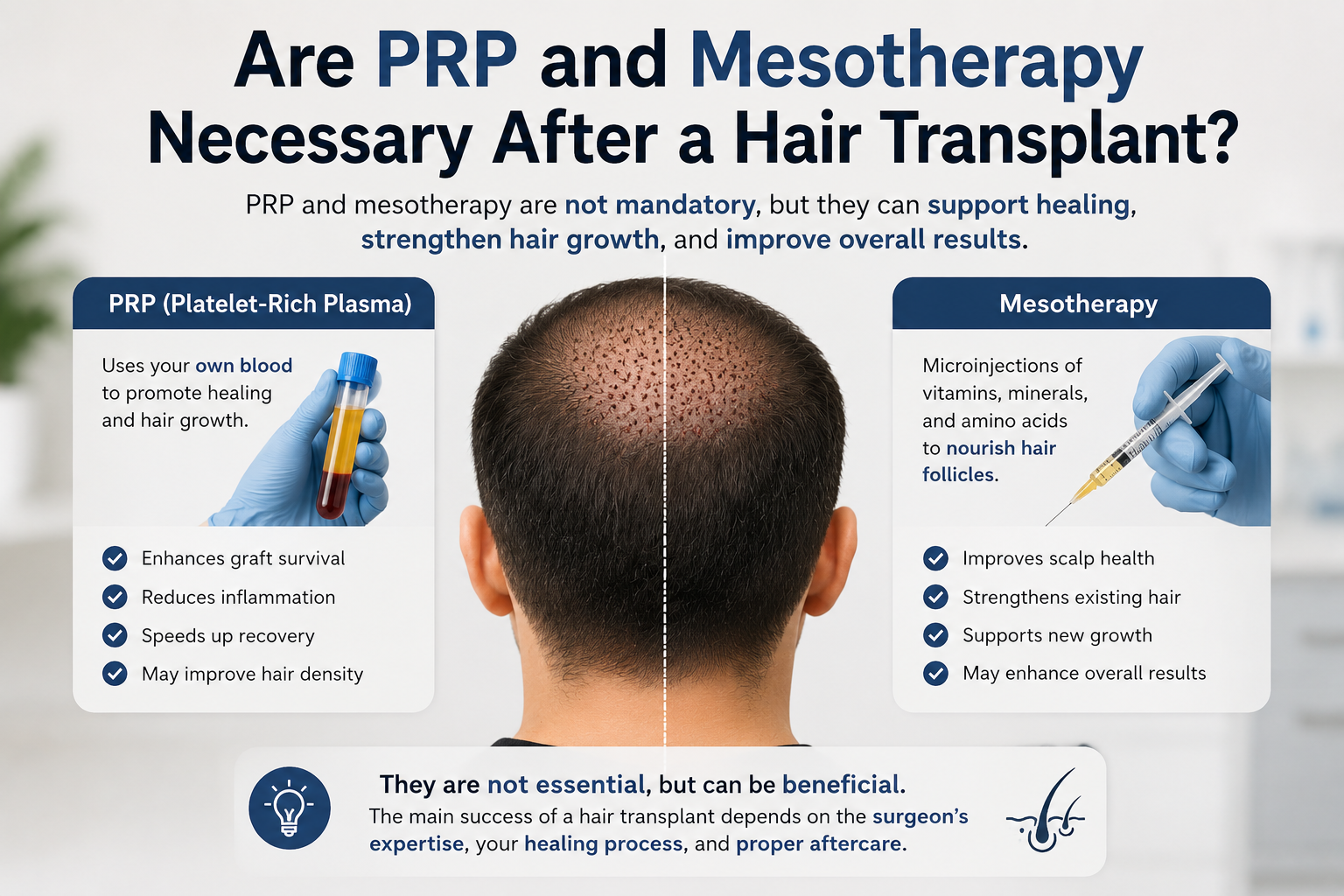
1. PRP Therapy: The Bio-Cellular Supercharger
Platelet-Rich Plasma (PRP) is an autologous treatment, meaning it is derived entirely from your own body. The process involves drawing a small sample of your blood, spinning it in a specialized medical centrifuge to separate the platelets, and injecting the concentrated plasma directly into the deep dermal layers of your scalp.
How PRP Benefits Your Transplants:
- Rapid Neo-Vascularization: Platelets are naturally packed with potent signaling molecules and growth proteins, including Vascular Endothelial Growth Factor (VEGF). When injected around fresh grafts, PRP acts like a beacon, forcing the scalp to rapidly construct brand-new microscopic blood capillaries. This shortens the time grafts spend starved of oxygen.
- Waking Up Dormant Follicles: Following surgical relocation, hair follicles enter a state of shock, causing them to shed their shafts and hibernate. PRP triggers rapid cellular division at the base of the hair bulb, pushing dormant roots out of their resting phase and into the active growth phase significantly faster than normal.
- Donor and Recipient Area Healing: The growth factors inside PRP accelerate collagen production and tissue repair, helping the micro-incisions in both your donor and recipient zones close up smoothly with minimal scarring.
2. Hair Mesotherapy: The Targeted Nutrient Cocktail
While PRP relies on your body’s internal growth proteins, Hair Mesotherapy is a customized, pharmaceutical micro-injection treatment. The surgeon drafts a tailored liquid cocktail containing medical-grade vitamins, minerals, amino acids, vasodilators, and coenzymes, injecting it directly into the exact scalp layers where your hair roots live.
How Mesotherapy Benefits Your Transplants:
- Direct Follicular Nourishment: Oral vitamin supplements must pass through your digestive system and liver, meaning only a tiny fraction ever reaches your scalp. Mesotherapy completely bypasses the digestive tract, delivering a concentrated wave of keratin-building blocks (like L-Cysteine and Biotin) straight to the hungry roots.
- Hormonal Protection (DHT Inhibition): Many premium mesotherapy cocktails include natural or pharmaceutical 5-alpha-reductase inhibitors (like Saw Palmetto or low-dose Finasteride). Injecting these compounds locally protects your surrounding native hair from ongoing genetic thinning without introducing systemic hormonal side effects to the rest of your body.
- Boosting Scalp Blood Flow: Mesotherapy blends frequently contain natural vasodilators that relax and widen existing blood vessels, keeping a steady, aggressive stream of nutrient-rich blood flowing directly to your new hairline.
Clinical Comparison Matrix
While both therapies aim to maximize your final transplant density, they serve completely distinct biological roles during your 12-month recovery journey:
| Operational Feature | Platelet-Rich Plasma (PRP) | Hair Mesotherapy |
| Primary Content | Concentrated autologous blood platelets. | Customized blend of vitamins, minerals, and vasodilators. |
| Core Clinical Goal | Rebuilding blood vessels and triggering tissue repair. | Delivering direct fuel to the hair matrix and blocking DHT. |
| Ideal Start Time | Often applied internally during surgery or at Week 2. | Typically initiated around Month 1 to 2 post-op. |
| Natural or Synthetic | 100% natural and biometric (from your own blood). | Medical-grade pharmaceutical and botanical blend. |
The Optimal Post-Op Treatment Timeline
To get the absolute maximum visual value out of these supportive therapies, you should avoid random, uncoordinated sessions. Elite hair restoration protocols merge them into a structured seasonal schedule:
- The Surgical Day (Session 1 – PRP): Top-tier clinics wash the newly harvested grafts in a cold PRP solution prior to implantation or inject PRP directly into the channels during surgery to prep the skin bed.
- Weeks 2 to 4 (Session 2 – PRP): Applied right as the post-op scabs drop off. This session focuses heavily on reducing localized inflammation, boosting cellular healing, and preparing the roots for the upcoming shock loss phase.
- Months 2 to 6 (The Mesotherapy Blocks): Administered in monthly intervals. This is the exact window where the new hair sprouts are trying to break through the surface of the skin. Regular mesotherapy delivers a continuous supply of structural nutrition, maximizing the thickness and speed of the incoming hair shafts.
Final Thoughts: Protecting Your Investment
Think of a hair transplant like a major structural investment—the surgery places the foundation, but supportive therapies like PRP and Mesotherapy construct the actual walls and roof. Investing time into these non-surgical cell therapies during your first six months guarantees that you maximize graft survival, protect your surrounding native hair, and cross the 1-year mark with the thickest results possible.
At Dr. Terziler Clinic, we do not view PRP and Mesotherapy as optional add-ons or upsells. We treat post-operative bio-stimulation as a non-negotiable medical standard. Every premium hair transplant case we manage includes fully integrated, custom-tailored PRP and Mesotherapy tracking protocols built directly into your 12-month aftercare plan. By pairing our state-of-the-art DHI Choi Pen surgeries with continuous, localized cellular nourishment, we ensure your roots thrive flawlessly—yielding a masterpiece of dense, completely permanent, and natural lifetime growth.
Frequently Asked Questions (FAQ)
Do the injections hurt or damage the fresh hair grafts?
No, when executed by an experienced medical professional, the injections are completely safe. For sessions performed during the first month, practitioners use ultra-fine mesotherapy needles (often just 4mm long) and inject at precise angles between the graft channels, ensuring the physical roots beneath the skin are never touched or disrupted. The discomfort is minimal, often described as a light, temporary pinching sensation.
What happens if I choose not to do PRP or Mesotherapy after my transplant?
If you skip these supportive therapies, your transplanted hair will still grow, provided your surgery was performed cleanly. However, your recovery timeline may be significantly prolonged. Your skin tissue will take longer to heal, your post-op shock loss phase may be more severe, and your final hair shafts may take up to 15 months to reach their true potential thickness and visual density.
Can I get PRP or Mesotherapy done at a regular local beauty spa?
It is strongly advised to avoid commercial beauty spas or non-medical salons for post-transplant care. A healing scalp that has recently undergone thousands of surgical punctures requires absolute sterile conditions and a deep understanding of trichological anatomy. Always receive these injections directly within a certified hair restoration clinic under the supervision of a medical team.
Are there any side effects or risks associated with PRP therapy?
Because PRP uses your own blood, there is an absolute zero risk of an allergic reaction, chemical rejection, or side effects. The treatment is entirely biocompatible. The only normal, short-term reactions are localized mild redness and slight tenderness at the injection sites, which completely resolve on their own within 24 to 48 hours.
How many total sessions of PRP and Mesotherapy will I need?
For optimal post-transplant acceleration, a standard clinical package consists of 2 to 3 sessions of PRP spread across the first three months, followed by a targeted block of 3 to 4 sessions of Hair Mesotherapy spaced 4 weeks apart during the peak volumetric growth surge (Months 3 to 6). Your surgeon will customize this frequency based on your specific tissue healing speed and native hair density.