
Hair health Exercise
Quick answer
No. Working out does not cause hair loss. Exercise does not damage hair follicles, and the short rise in testosterone after a workout has never been shown to cause baldness. Hair loss linked to the gym usually comes from three other things: shedding after under-eating or extreme training (telogen effluvium), androgen exposure from steroids or some “test booster” supplements, and traction from tight hairstyles or headgear. Most men who notice thinning after starting the gym have male pattern hair loss that was starting anyway.
You finally stuck to the gym for six months, and now your hairline is the one thing not making progress. Before you cancel the membership, look at what science actually blames.
At a glance:
- Normal shedding: 50 to 100 hairs a day.
- Stress shedding starts 2 to 3 months after the trigger.
- Creatine in a 2025 trial: no change in DHT or hair after 12 weeks.
Does Working Out Cause Hair Loss?
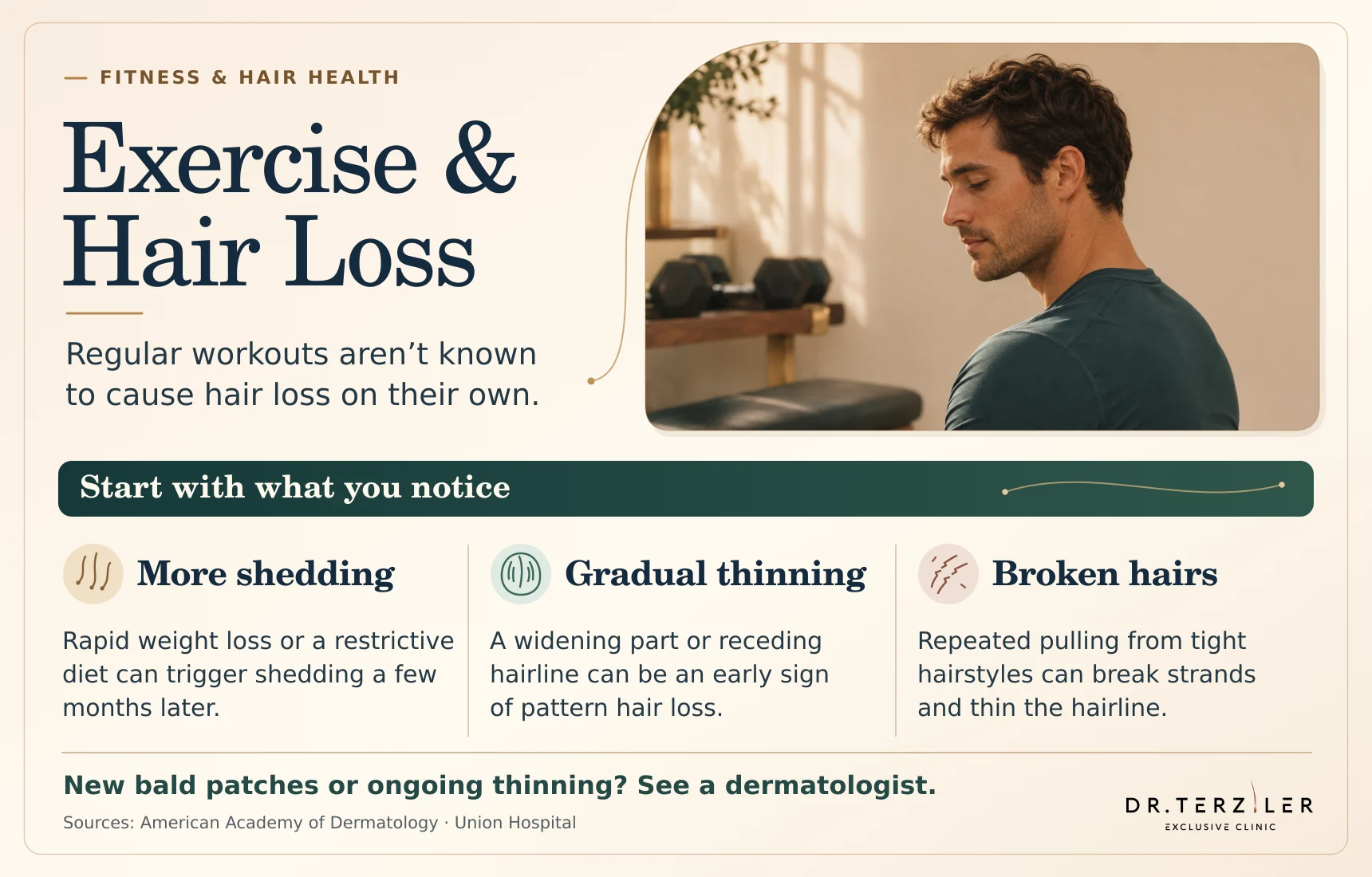
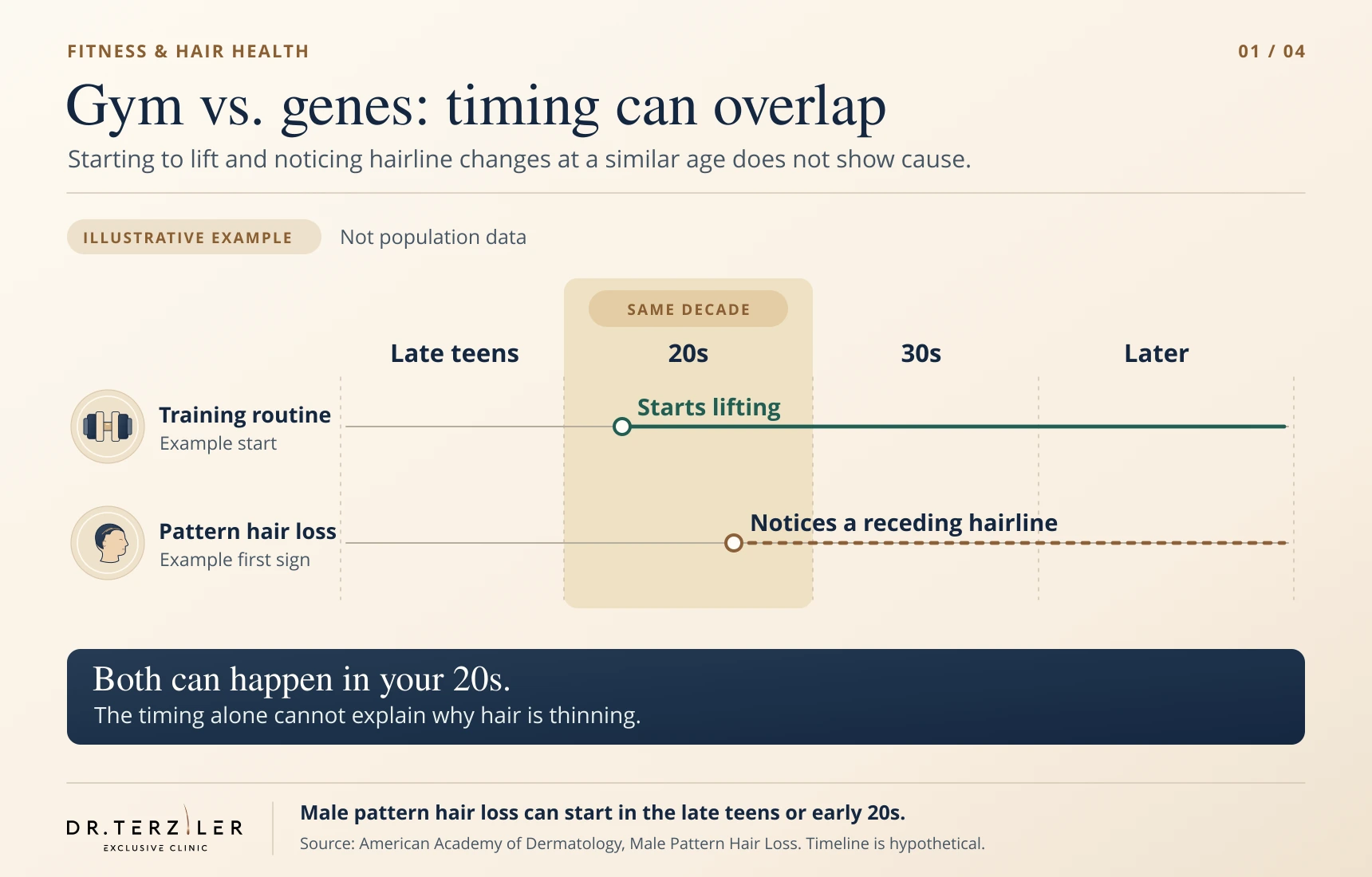
Working out does not cause hair loss. No study shows that lifting, running or any sport destroys hair follicles. The confusion comes from timing. Most men start serious training between 16 and 30, the same years male pattern hair loss starts. The American Hair Loss Association reports that two-thirds of American men have noticeable hair loss by age 35. The gym and the receding hairline arrive together, so the gym gets the blame.
The only original study on exercise and pattern hair loss is a 2017 survey of 1,182 adults in Korea. It found more total exercise in people with androgenetic alopecia, mostly at low intensity, and no link with moderate or high intensity training. The authors stated that a survey cannot prove cause, and they did not measure hormones (Choi et al., Annals of Dermatology, 2017).
Does lifting weights cause hair loss?
Lifting weights does not cause hair loss. Heavy resistance training raises testosterone for a short time after the session, but levels return to baseline within hours. No study links these short rises to balding. Men who lose hair while lifting usually carry the genes for male pattern hair loss.
Does running cause hair loss?
Running does not cause hair loss on its own. Endurance athletes can develop shedding when they eat too little for their training volume, when iron runs low, or after a race block with weight loss. The cause is the energy and nutrient gap, not the running.
Does Working Out Increase DHT and Testosterone?
Working out raises testosterone for a short time, but it does not raise DHT enough to cause hair loss. A 2026 systematic review of 15 randomized trials found that testosterone rises more after resistance training than after cardio and returns to baseline after the session, while long, very intense training can suppress testosterone for up to 72 hours. Hair loss depends on how sensitive your follicles are to DHT, which is genetic, not on how hard you train.
DHT (dihydrotestosterone) is made from testosterone by the enzyme 5-alpha reductase. In men with a genetic sensitivity, DHT shrinks scalp follicles over years. Your baseline hormone levels and follicle sensitivity matter. A 45-minute bump after squats does not. Read more about the role of DHT in hair loss, including what blocking DHT can and cannot do.
When Can Exercise Lead to Hair Loss?
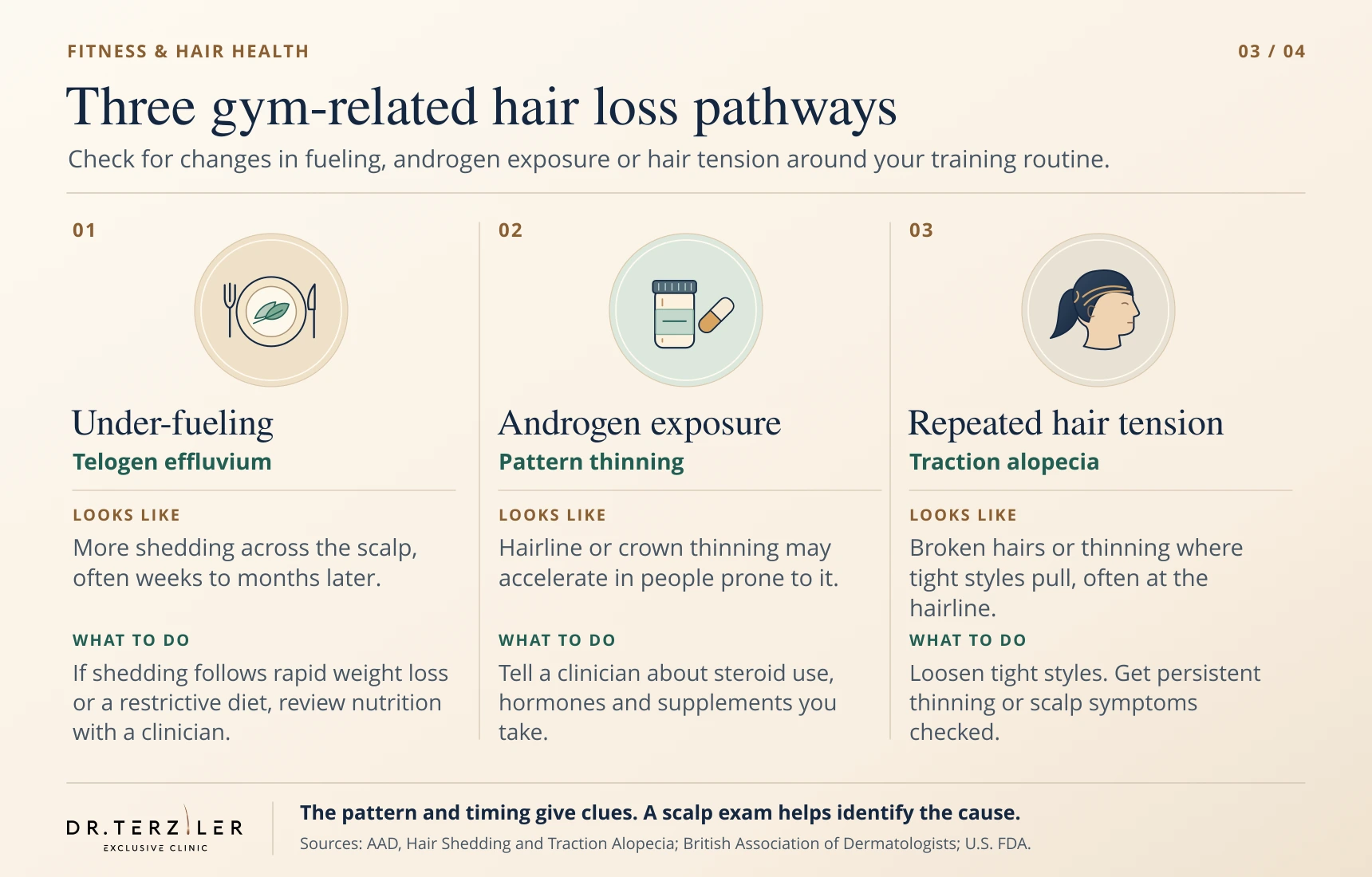
Exercise can lead to hair loss indirectly in three situations. Each has a different look, timing and fix.
| Mechanism | How it happens | What it looks like | Reversible? |
|---|---|---|---|
| 1. Telogen effluvium (stress shedding) | Crash dieting, very low energy intake, rapid weight loss, overtraining, illness | Diffuse shedding all over, more hair in the shower and on the pillow | Yes, usually within 6 to 9 months once the trigger stops |
| 2. Androgen exposure | Anabolic steroids, prohormones, “test boosters”, hidden steroids in tainted supplements | Faster recession at temples and crown in men; thinning on top in women | Partly; pattern loss can become permanent |
| 3. Traction and friction | Tight ponytails, buns, braids, helmets, headbands worn daily | Thinning along the hairline or under straps | Yes if caught early; permanent if it continues for years |
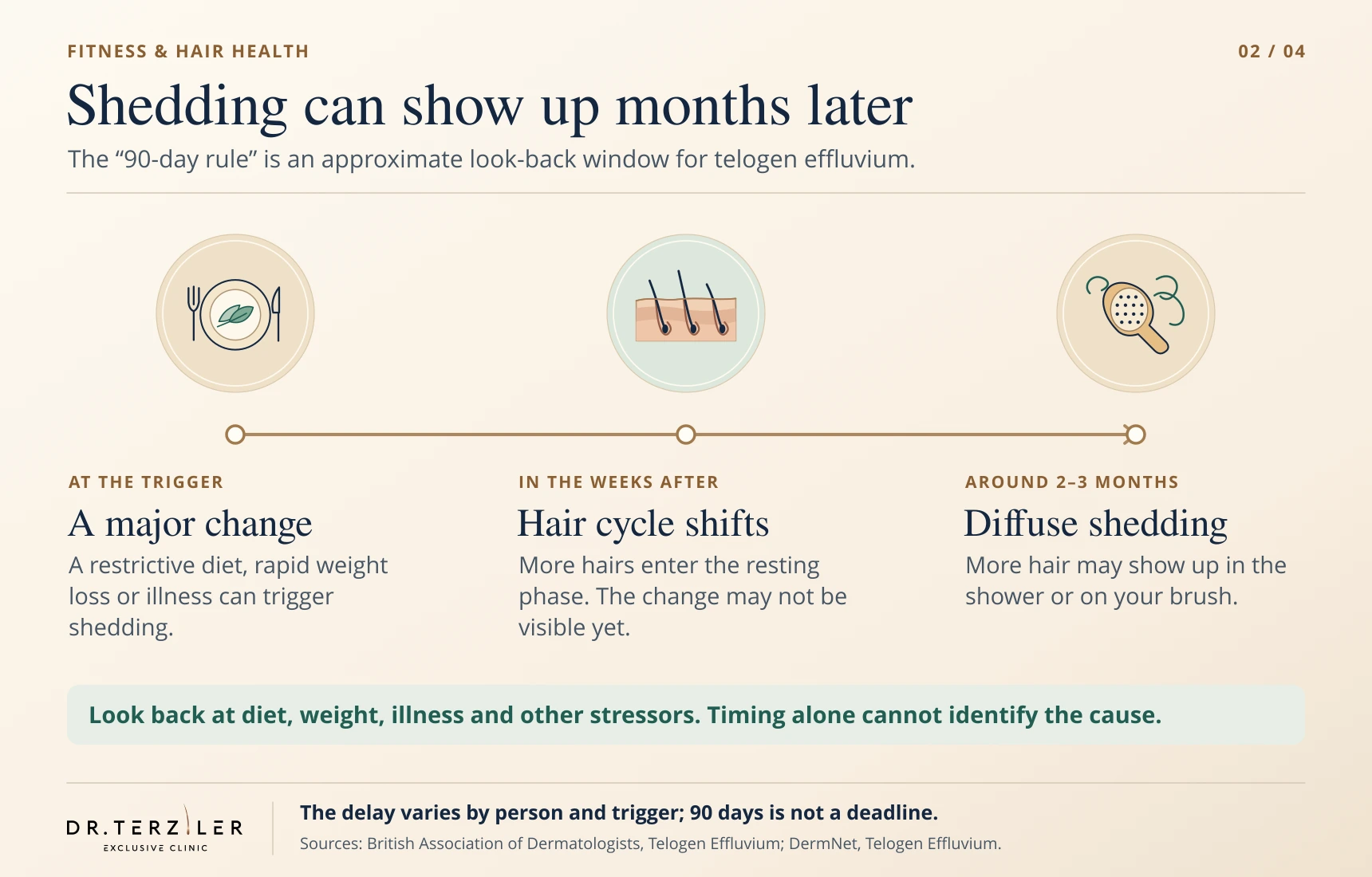
Telogen effluvium: the 90-day rule
Shedding from stress, dieting or overtraining usually starts 2 to 3 months after the trigger, not the week it happens. If your hair started falling out in March, look at your training and diet in December and January. A cutting phase, a sudden jump in training volume or a period of illness is the most likely trigger.
Normal shedding is 50 to 100 hairs a day, according to the American Academy of Dermatology. Telogen effluvium can push that higher for several months. It does not cause bald patches and it does not change your hairline shape. Hair grows back once the trigger stops, although full density can take 6 to 12 months.
Overtraining and too much exercise
Too much exercise can contribute to hair shedding when it combines with low energy intake, poor sleep and high stress. Sports medicine calls this pattern relative energy deficiency in sport (RED-S). The body protects vital functions first and hair growth last. The fix is fuel and recovery, not quitting exercise.
Can Gym Supplements Cause Hair Loss?
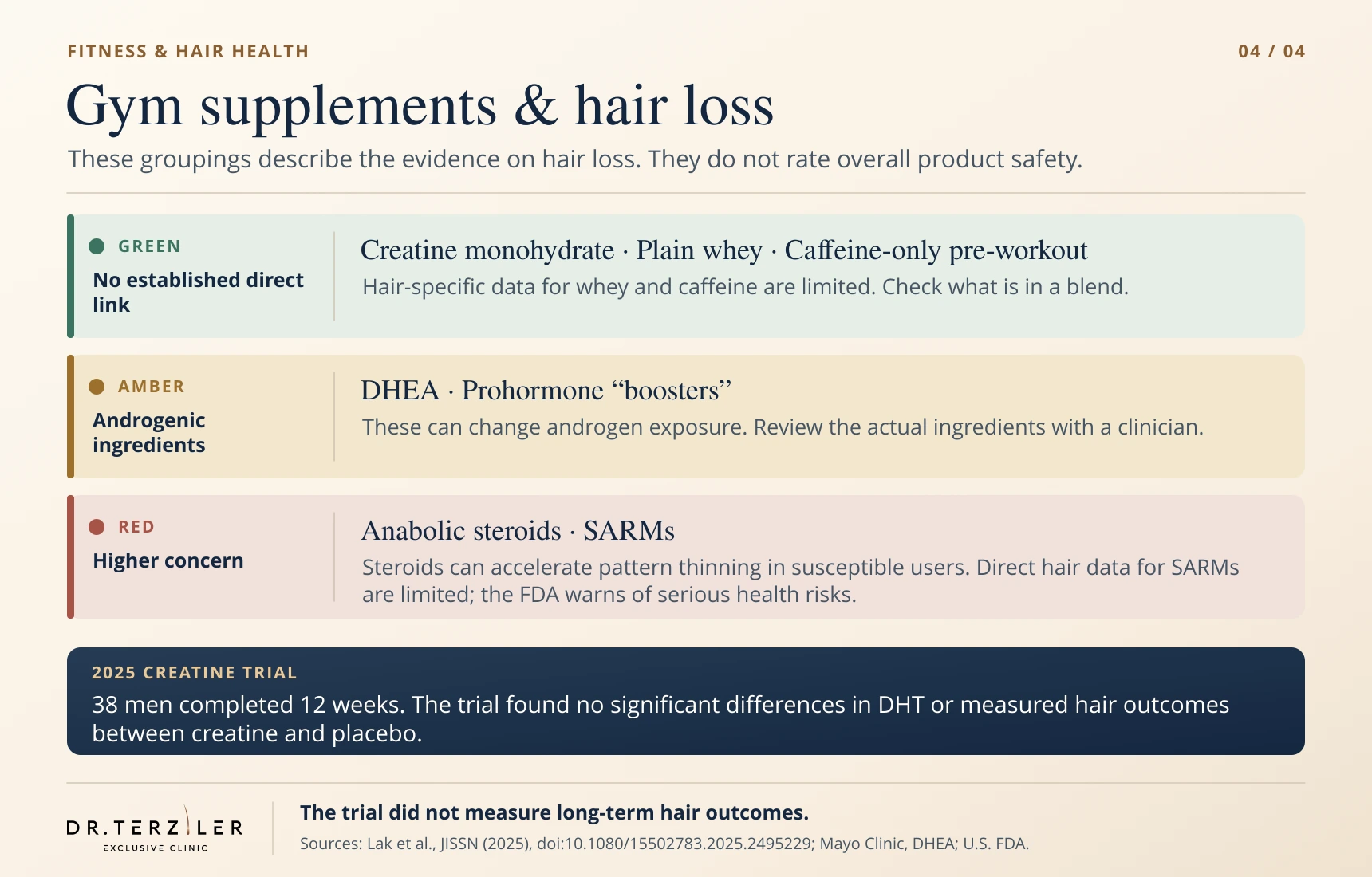
Most mainstream gym supplements do not cause hair loss. The real risks are anabolic steroids, prohormones and products with hidden steroids.
Does creatine cause hair loss?
Creatine does not cause hair loss based on current evidence. A 2025 randomized controlled trial gave 5 grams of creatine a day for 12 weeks to resistance-trained men and found no change in DHT, hair density, follicle count or hair thickness compared with placebo. The fear comes from a 2009 study in 20 rugby players, in which DHT rose 56 percent after a week of creatine loading, but that study never measured hair.
If you have strong family history of baldness and want to be cautious, skip high-dose loading phases and stick to the standard 3 to 5 grams a day. That is a reasonable middle ground while more research comes in.
| Study | What it measured | What it tells us |
|---|---|---|
| 2009 rugby player study [3] | Blood hormones. The study reported a 56% rise in DHT from baseline after seven days of creatine loading. | It did not measure shedding, hair density or hair loss. |
| 2025 12-week trial [2] | Blood hormones and hair assessments, including density and thickness. | No significant difference between creatine and placebo in the measured DHT or hair outcomes. Long-term effects were outside the trial. |
Can pre-workout cause hair loss?
Pre-workout does not cause hair loss through caffeine, beta-alanine or citrulline. The risk comes from blends that include DHEA, “prohormone” ingredients or undeclared steroids. The US Food and Drug Administration has repeatedly warned about bodybuilding products that contain hidden anabolic steroids. Check the label, avoid anything sold as a “test booster” with hormone ingredients, and choose products with third-party testing.
Do anabolic steroids cause hair loss?
Yes. Anabolic steroids can speed up male pattern baldness because they raise androgen levels far above normal. The US National Institute on Drug Abuse lists baldness among the effects of steroid misuse in men, and women can develop thinning on top and male-pattern hair growth on the face and body. For men with the baldness genes, a single cycle can bring forward years of loss.
Gym supplement checklist
Creatine monohydrate: no hair effect in the 2025 RCT.
Whey protein: no link to hair loss.
Caffeine-based pre-workout: no link to hair loss.
DHEA, prohormones, “natural test boosters” with hormone ingredients: possible risk.
Anabolic steroids, SARMs: clear risk for men with pattern hair loss genes.
Does Exercise Help Hair Growth?
Exercise does not directly make hair grow, and no study shows that working out regrows lost hair. Regular exercise can support hair indirectly by improving circulation, sleep, insulin sensitivity and stress, which are all linked to hair health. A 2025 study of 7,993 adults found that people with fatty liver disease and low physical activity had higher odds of androgenetic alopecia, but this shows an association, not proof.
One related finding is real but narrow. A 2016 Japanese study gave 9 men a 4-minute standardized scalp massage every day for 24 weeks. Hair thickness rose from 0.085 mm to 0.092 mm, about 8 percent. The number of hairs did not change. Scalp massage is not a workout, and it does not treat baldness, but it is a cheap habit with some evidence behind it.
If you want to grow or protect hair, use the treatments with evidence: medical therapy from your doctor, Hair PRP, exosome therapy, copper peptides or, for established baldness, a hair transplant in Turkey.
Can lack of exercise cause hair loss?
Lack of exercise does not cause hair loss directly. A sedentary lifestyle is linked to insulin resistance, fatty liver and higher stress, which are associated with more hair loss in large studies. Moving more is good for your hair the same way it is good for your heart: indirectly.
Can Excessive Exercise Cause Hair Loss in Women?
Excessive exercise can contribute to hair loss in women, mainly through low energy intake, iron deficiency and tight hairstyles. Female athletes are at higher risk of low iron because of menstrual losses and high training loads. A 2025 review in the Journal of Drugs in Dermatology lists iron, vitamin D and other nutrient deficiencies as major contributors to female hair loss.
- Missed periods + shedding: a warning sign of low energy availability. See a doctor.
- Low ferritin: ask for a ferritin test, not only hemoglobin.
- Thinning at the edges: tight ponytails and buns cause traction alopecia. Rotate styles and loosen them.
- Hair loss with acne or new facial hair: check for PCOS or androgen exposure.
Read about female hair transplant options if thinning is established, and our hair loss in women guide for the full list of causes.
Why Do Bodybuilders Lose Hair?
Bodybuilders lose hair mainly because of anabolic steroid use in men with a genetic tendency to baldness, and sometimes because of extreme cutting diets before competitions. Natural lifting at normal energy intake is not a cause. Steroid-driven loss follows the male pattern: temples and crown first.
How to Protect Your Hair at the Gym
- Eat enough. Avoid cutting more than about 0.5 to 1 percent of body weight a week. Keep protein adequate.
- Track the 90-day rule. Note big diet or training changes; shedding shows up 2 to 3 months later.
- Skip hormone boosters and steroids. Read labels; choose third-party tested products.
- Loosen your hairstyle. Change the ponytail position, use soft bands, avoid tight caps all day.
- Wash after heavy sweat. Sweat does not cause hair loss, but buildup can irritate the scalp and worsen dandruff.
- Swimmers: rinse before and after the pool. Chlorine damages the hair shaft, not the follicle. See can chlorine cause hair loss.
- Check your hairline every 3 months with photos in the same light. Early pattern loss responds best to treatment.
The 3-Question Gym Hair Loss Test
Answer these three questions to see what is most likely behind your hair loss.
| Question | If yes | Next step |
|---|---|---|
| 1. Did your shedding start 2 to 3 months after a cut, a big training jump or an illness, and is it all over the scalp? | Likely telogen effluvium | Fix fuel and recovery; check ferritin, vitamin D, thyroid. Expect regrowth. |
| 2. Is the loss at the temples or crown, and do you have balding relatives? | Likely male or female pattern hair loss | See a doctor early; medical therapy works best in early stages. Compare with the Norwood scale. |
| 3. Did you start steroids, SARMs, prohormones or a “test booster”? | Likely androgen-accelerated loss | Stop the product and see a doctor; check hormone levels. |
If your hairline is already receding, read our receding hairline guide.
Frequently Asked Questions
Can going to the gym cause hair loss?
No. The gym does not cause hair loss. Under-eating, steroids, some supplements and tight hairstyles can.
Does working out regrow hair?
No. Exercise does not regrow lost hair. It supports overall health, which helps hair indirectly.
Does the gym decrease DHT?
No. Exercise does not lower DHT in a meaningful way. Medical treatments that block DHT do.
Can lifting weights cause hair thinning?
Not on its own. Lifting raises testosterone briefly; thinning comes from genes, steroids or under-eating.
Does creatine cause hair loss?
A 2025 randomized trial found no change in DHT or hair after 12 weeks of 5 g/day creatine.
Can pre-workout cause hair loss?
Standard ingredients do not. Blends with DHEA, prohormones or hidden steroids can.
Why do bodybuilders lose hair?
Mostly steroid use in men with baldness genes, plus extreme cutting diets.
Can excessive exercise cause hair loss in females?
Yes, indirectly: low energy intake, low iron and tight hairstyles are the usual causes.
Can thinning hair grow back?
Shedding from stress or diet usually grows back in 6 to 12 months. Pattern loss needs treatment to stop or slow.
What is the number one cause of hair loss?
Androgenetic alopecia (male or female pattern hair loss) is the most common cause. What is the “big 3” for hair loss?
Online forums use it for finasteride, minoxidil and ketoconazole shampoo. Discuss any treatment with your doctor first.
How do I protect my hair at the gym?
Eat enough, skip hormone boosters, loosen tight styles and wash after heavy sweating.
Sources
Clinical guidance and original research referenced in this article.
- Choi J, et al. The Association between Exercise and Androgenetic Alopecia: A Survey-Based Study. Ann Dermatol. 2017;29(4):513-516. doi:10.5021/ad.2017.29.4.513
- Lak M, et al. Does creatine cause hair loss? A 12-week randomized controlled trial. J Int Soc Sports Nutr. 2025. doi:10.1080/15502783.2025.2495229
- van der Merwe J, et al. Three weeks of creatine monohydrate supplementation affects dihydrotestosterone to testosterone ratio in college-aged rugby players. Clin J Sport Med. 2009. doi:10.1097/JSM.0b013e3181b8b52f
- Tu Q, et al. Effect of acute exercise on the dynamics of testosterone levels: a systematic review of randomized controlled trials. PeerJ. 2026;14:e20615. doi:10.7717/peerj.20615
- Bazmi S, et al. Metabolic dysfunction-associated steatotic liver disease is associated with androgenetic alopecia in adults. Sci Rep. 2025. doi:10.1038/s41598-025-26483-2
- Koyama T, et al. Standardized Scalp Massage Results in Increased Hair Thickness. Eplasty. 2016;16:e8. PMC4740347
- Leavitt A, et al. Addressing the Root Causes of Female Hair Loss and Non-Pharmaceutical Interventions. J Drugs Dermatol. 2025;24(7):659-662. doi:10.36849/JDD.8763
- American Academy of Dermatology. Hair shedding (telogen effluvium). aad.org
- National Institute on Drug Abuse. Anabolic Steroids DrugFacts. nida.nih.gov
- US Food and Drug Administration. Tainted bodybuilding products warnings. fda.gov
- American Hair Loss Association. Men’s hair loss statistics. americanhairloss.org