




When you look in the mirror and notice your scalp peeking through under bright lights, your first instinct might be to consider a hair transplant. However, many patients hesitate because they aren’t completely bald yet—their hair is simply thinning out.
Naturally, this brings up two massive concerns: Is a hair transplant even possible when there is still hair on top? And will the surgical blades slice into my remaining native hair roots, destroying them permanently?
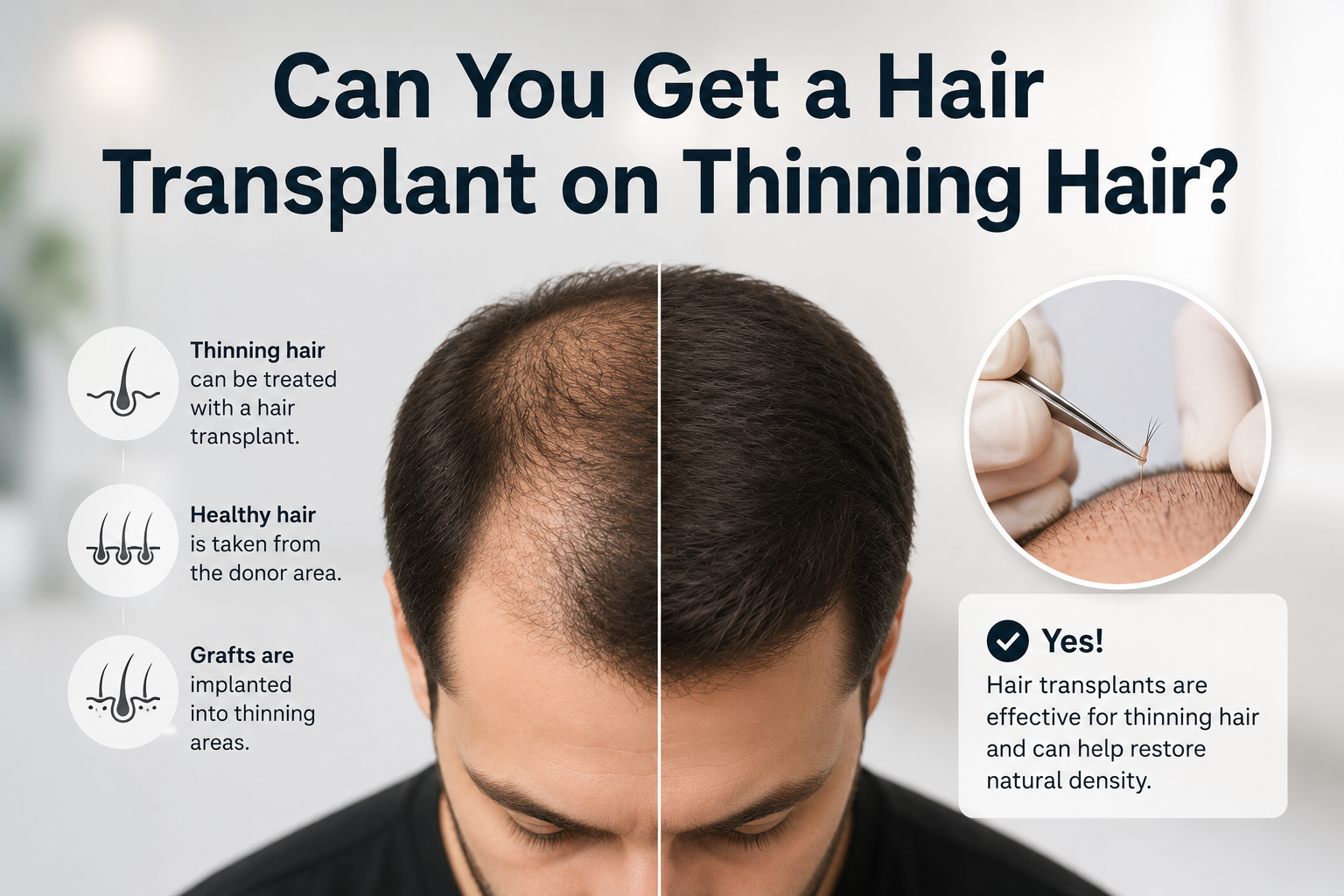
The short answer is yes, you can absolutely get a hair transplant on thinning hair. In fact, intervening during the thinning phase often yields some of the most natural, undetectable transformations.
However, performing surgery between active, living hairs requires an entirely different level of medical precision compared to operating on a completely bald scalp. Understanding the clinical risks and the advanced technologies used to protect your native hair is critical to making an informed decision.
The Concept of Diffuse Thinning vs. Baldness
In traditional hair loss, the hairline recedes backward cleanly, leaving completely bare skin behind. With diffuse thinning, the hair follicles don’t disappear right away. Instead, they undergo a process called miniaturization.
[Healthy Follicle] -> [Thinning / Miniaturized] -> [Dormant / Bare Skin]
(Thick) (Fine/Wiry) (No Hair)
Under the influence of the hormone DHT, the blood supply to the follicle slowly constricts. The hair shaft grows back thinner, shorter, and more translucent with every growth cycle until it eventually stops producing hair altogether.
If a surgeon operates when a zone is merely thinning, their goal is to perform an interstitial transplantation—planting new, robust grafts between your existing native hairs to cross-multiply your overall visual density.
The Risk of Shock Loss: Will Existing Hair Be Damaged?
The most common fear among patients with thinning hair is transection (the physical slicing of an existing root by a surgical instrument) and shock loss.
Shock loss is a physiological phenomenon where existing native hairs temporarily shed following surgery. It happens because the localized trauma of the injections, anesthesia, and microscopic incisions temporarily shocks the surrounding blood vessels, pushing nearby native hairs into a premature resting phase.
Temporary vs. Permanent Shock Loss
- Temporary Shock Loss (Common & Safe): If your existing thinning hairs are reasonably healthy, they will shed within the first month alongside your transplanted grafts. By month 4, once the scalp tissue heals, those native hairs will wake up and grow back normally right alongside your new hair.
- Permanent Shock Loss (The Real Threat): If a native hair follicle is already at the very end of its biological lifespan (miniaturized to the point of being invisible peach fuzz), the trauma of surgery may cause it to shed permanently. Furthermore, if a low-skill clinic uses wide, unrefined tools, they can physically slice into healthy neighboring roots, causing permanent blind spots.
How Elite Clinics Protect Your Existing Hair
To completely eliminate the risk of permanent native hair damage, advanced clinics abandon standard, aggressive protocols and deploy specialized protective techniques:
1. High-Magnification Micro-Mapping
Before a single incision is made, the surgeon analyzes your scalp under high-magnification trichological lenses. They map out the exact exit angles and exit directions of your native hairs. When it comes time to create channels, the surgeon aligns their micro-blade perfectly parallel to your existing roots, completely avoiding physical contact.
2. Sapphire FUE & Micro-Blades
Traditional hair transplants used wide steel blades that created rough, circular wounds. Modern elite clinics utilize Sapphire FUE blades, which are crafted from synthetic gemstones. These blades are incredibly sharp and microscopic (often 0.8mm to 1.0mm wide), allowing the surgeon to slide cleanly between existing hair shafts without disrupting the surrounding tissue matrix.
3. Direct Hair Implantation (DHI) with Choi Pens
For patients with widespread diffuse thinning, DHI is the undisputed gold standard.
With DHI, the surgeon does not open pre-cut channels across your scalp. Instead, the extracted grafts are loaded into a specialized, pen-like device called a Choi Implanter. The surgeon uses the needle tip to gently push past your active native hairs and implant the graft directly into the skin in a single, fluid motion. This offers unmatched accuracy and reduces local tissue trauma by up to 50%.
Technical Comparison for Thinning Hair
When evaluating options for multi-multiplying density inside thin zones, look at how the primary surgical modalities compare clinically:
| Surgical Variable | Standard Sapphire FUE | Direct Hair Implantation (DHI) |
| Pre-Op Shaving Requirement | Requires a completely shaved head. | Can often be performed without shaving the recipient zone. |
| Implantation Method | Incisions are cut first; grafts are inserted manually. | Grafts are guided between native hairs using a Choi Pen. |
| Risk of Native Root Damage | Low (When executed by a master surgeon). | Extremely Low (The needle pushes past existing shafts). |
| Ideal For | Large, completely bare bald zones (Norwood 4–7). | High-density packing inside active thinning zones. |
Final Thoughts: Timing Your Transformation
You do not need to wait until you are completely bald to reclaim your confidence. Catching hair loss during the thinning phase allows you to maintain a continuous, natural appearance without anyone ever realizing you underwent a medical procedure. The key to a successful outcome lies entirely in choosing a clinic that treats your thinning scalp with microscopic respect.
At Dr. Terziler Clinic, we treat thinning hair with advanced diagnostic and technological care. We recognize that your remaining native hair is incredibly precious. Our expert surgeons specialize in high-density DHI Choi Pen procedures, meticulously weaving new, robust grafts between your existing hair strands without disturbing their natural roots. Backed by our elite 12-month postoperative tracking and customized cellular aftercare therapies, we protect your native hair while multiplying your overall density—delivering thick, seamless, and completely permanent lifetime results.
Frequently Asked Questions (FAQ)
Can a hair transplant fix hair that is thinning due to stress or nutritional deficiencies?
No. A hair transplant is exclusively designed to treat permanent genetic hair loss (Androgenetic Alopecia). If your hair is thinning uniformly due to chronic stress, thyroid imbalances, or extreme vitamin deficiencies (telogen effluvium), a transplant will not help. These conditions cause temporary shedding, and the root cause must be treated medically to allow the hair to grow back naturally.
Do I have to shave my whole head if I get a transplant on thinning hair?
Not necessarily. If you choose the Direct Hair Implantation (DHI) technique, elite clinics can execute an Unshaved Hair Transplant (U-FUE/DHI). The donor area at the back of your head will be trimmed in a small, hidden strip to harvest the grafts, but the thinning recipient area on top can remain completely long, allowing you to hide the signs of surgery easily.
Q3: How do I know if my hair is too thin for a transplant, or not thin enough?
As a general clinical rule, if you have lost more than 30% to 50% of your native hair density in a specific zone, it is safe to proceed with a transplant. If your hair is only micro-thinning and your density is still mostly intact, an honest surgeon will advise you to delay surgery and start stabilizing medications like Finasteride or PRP therapy first to prevent over-packing.
Will taking hair loss medications like Finasteride protect my native hair after surgery?
Yes, heavily. While transplanted hair grafts are genetically immune to DHT and will never fall out, your surrounding native hair remains vulnerable to ongoing genetic thinning. Continuing or starting doctor-approved medical therapies post-surgery is highly recommended to protect your native hair from thinning further over the next decade.
When will temporary shock loss hairs grow back after the procedure?
If you experience temporary shock loss, the shed native hairs will remain in a resting state for roughly 2 to 3 months. Around Month 4, these native roots will wake up alongside your new, transplanted hair sprouts. By month 6 to 9, you will notice a massive surge in combined density as both your native and new hair shafts thicken up simultaneously.