





When you look at a poorly executed hair transplant, you can usually spot it from a mile away. It is rarely because the hair failed to grow; rather, it is because the front line looks like a straight, sharp line painted on with a sharpie, or it sits unnaturally low like a artificial doll’s hair.
The ultimate metric of a successful hair transplant is discretion. If a stranger looks at you and cannot tell you have had surgery, your transplant is a success.
Achieving that perfect invisibility doesn’t happen by accident. It is entirely dependent on hairline design. Creating a hairline is a delicate blend of precise facial architecture and fine-art portrait painting.
If you are planning a hair restoration journey, understanding the secrets behind how an elite surgeon builds a frame for your face will help you look for the right expertise and secure a result that ages beautifully.
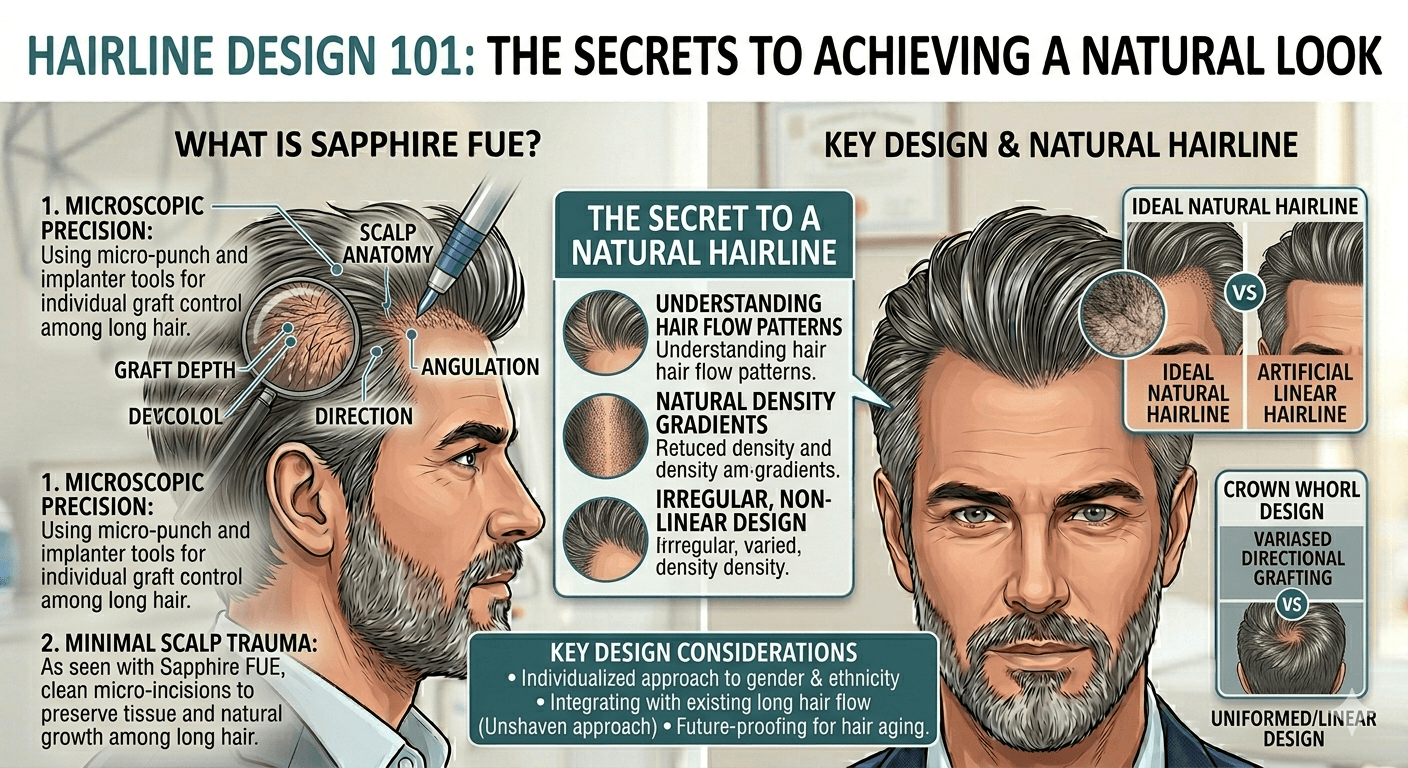
Secret 1: Nature Refuses Straight Lines (The Macro-Irregularity)
The absolute biggest mistake an inexperienced technician can make is using a ruler to draw a perfectly straight line across a patient’s forehead.
If you look closely at anyone who has never lost a single strand of hair, you will notice that their hairline is naturally chaotic. It is full of tiny, microscopic waves, subtle zig-zags, and soft indentations.
An expert surgeon meticulously designs macro-irregularities and micro-irregularities along the border. They intentionally plant grafts in an uneven, staggered pattern. This mimics the organic random scattering of nature, ensuring the eye glides over the hair naturally without catching on an artificial, harsh edge.
Secret 2: The Age-Appropriate Rule (Facial Proportions)
We all want our 18-year-old hairline back. However, dropping a hairline too low on a 35 or 45-year-old patient is a massive medical mistake. Your face shape, skull structure, and forehead tissues change as you age. A teenage hairline on a middle-aged face looks deeply out of place.
To find the perfect, natural placement, surgeons follow classical artistic proportions, specifically the Rule of Thirds:
- The face is ideally split into three perfectly equal vertical segments.
- The lower third spans from the bottom of the chin to the base of the nose.
- The middle third spans from the base of the nose to the point between your eyebrows (the glabella).
- The upper third spans from between your eyebrows to the exact starting point of your new hairline.
By measuring these proportions, the doctor finds the exact sweet spot where your hairline should sit to bring symmetry back to your entire facial structure, rather than just guessing.
Secret 3: Grading the Density (The Transition Zone)
A natural hairline does not start at 100% thickness immediately. It is a gradient.
The frontmost border of your hair—known as the transition zone—is made up of incredibly fine, soft, single-hair follicles. Behind this soft border sits the “defined zone,” where the hair naturally progresses into thick, strong clusters of 2, 3, or 4 hairs per follicle (follicular units).
During an elite transplant, the surgical team meticulously sorts the harvested grafts under a high-powered microscope. They separate the single-hair grafts from the multi-hair grafts.
- The Single Hairs: Placed strictly at the absolute front row to create a soft, feather-like, natural border.
- The Multi Hairs: Packed tightly right behind the single hairs to establish deep, rich visual density and volume.
If a clinic accidentally plants thick, triple-hair grafts on the front line, it creates the dreaded, unnatural “pluggy” look.
Secret 4: The Angle and Direction of Growth
Hair does not grow straight up out of the scalp like blades of grass, nor does it point directly forward.
Depending on where it sits on your head, hair grows at highly specific, varying angles. Near the front hairline, hair emerges at a sharp, forward-leaning angle of roughly 45 degrees, which slowly tilts sideways as it reaches the temples. At the crown, it spirals into a natural swirl (the whorl).
When opening the microscopic channels in your scalp, the surgeon must manually tilt their blade to match the exact natural exit angle of your existing native hairs. If the angle is off by even a few degrees, the transplanted hair will stick straight up or clash with your original hair, making styling an absolute nightmare.
Final Thoughts: The Signature of an Artist
At the end of the day, a high-tech extraction tool or a premium gemstone blade means very little if the person holding it lacks an artistic eye. Hairline design is where true master surgeons separate themselves from standard clinics. Your hairline is your calling card to the world—it deserves long-term planning, surgical reverence, and absolute precision.
At Dr. Terziler Clinic, we do not believe in one-size-fits-all treatments or artificial-looking templates. We treat your hairline design as a highly bespoke masterclass in facial harmony, utilizing advanced anatomical calculations and feathering techniques to deliver a lush, dense frame that matches your age, enhances your features, and remains completely undetectable for the rest of your life.
Frequently Asked Questions (FAQ)
Can I choose exactly where my new hairline will be drawn?
The design process is a close collaboration between you and your surgeon. While you can certainly express your personal styling goals, your surgeon will guide you using precise facial measurements and long-term hair loss projections. The ultimate goal is to build a hairline that you will love not just today, but when you are 50, 60, and 70 years old.
What are “temple recessions” and should they be completely filled in?
The temple recessions are the diagonal corners of your hairline above your eyebrows. In adult men, a slight, natural V-shape or a soft recession in these corners is completely normal and masculine. Trying to completely flatten or fill these temples into a square box shape often looks highly artificial and fails to age gracefully.
Why do some hair transplants look like “doll hair”?
The unnatural “doll hair” or “plug” appearance occurs due to poor graft sorting and placement. It happens when a clinic plants thick, multi-hair follicles (grafts containing 3 to 4 hairs) directly onto the front line instead of using fine, soft single-hair grafts, or when the hair is planted in a perfectly straight, unnatural grid pattern.
How long does it take for the newly designed hairline to look completely natural?
Patience is key. For the first few months, the hair goes through a shedding phase. Fresh hair begins to sprout around months 3 and 4, but it initially emerges thin, fine, and sometimes slightly wiry. As the months progress, the hair shafts mature, soften, and thicken. The final, perfectly integrated, and natural look is fully realized between 12 to 15 months post-surgery.
If I lose more hair behind my new hairline, will it ruin the design?
If your native hair continues to recede behind the permanent transplanted zone, it can create an unnatural gap. This is why ethical surgeons emphasize stabilizing your active hair loss with medical treatments like Finasteride or Minoxidil before surgery, or strategically conserving your donor hair supply in case a minor touch-up is needed years down the road.