
Quick answer
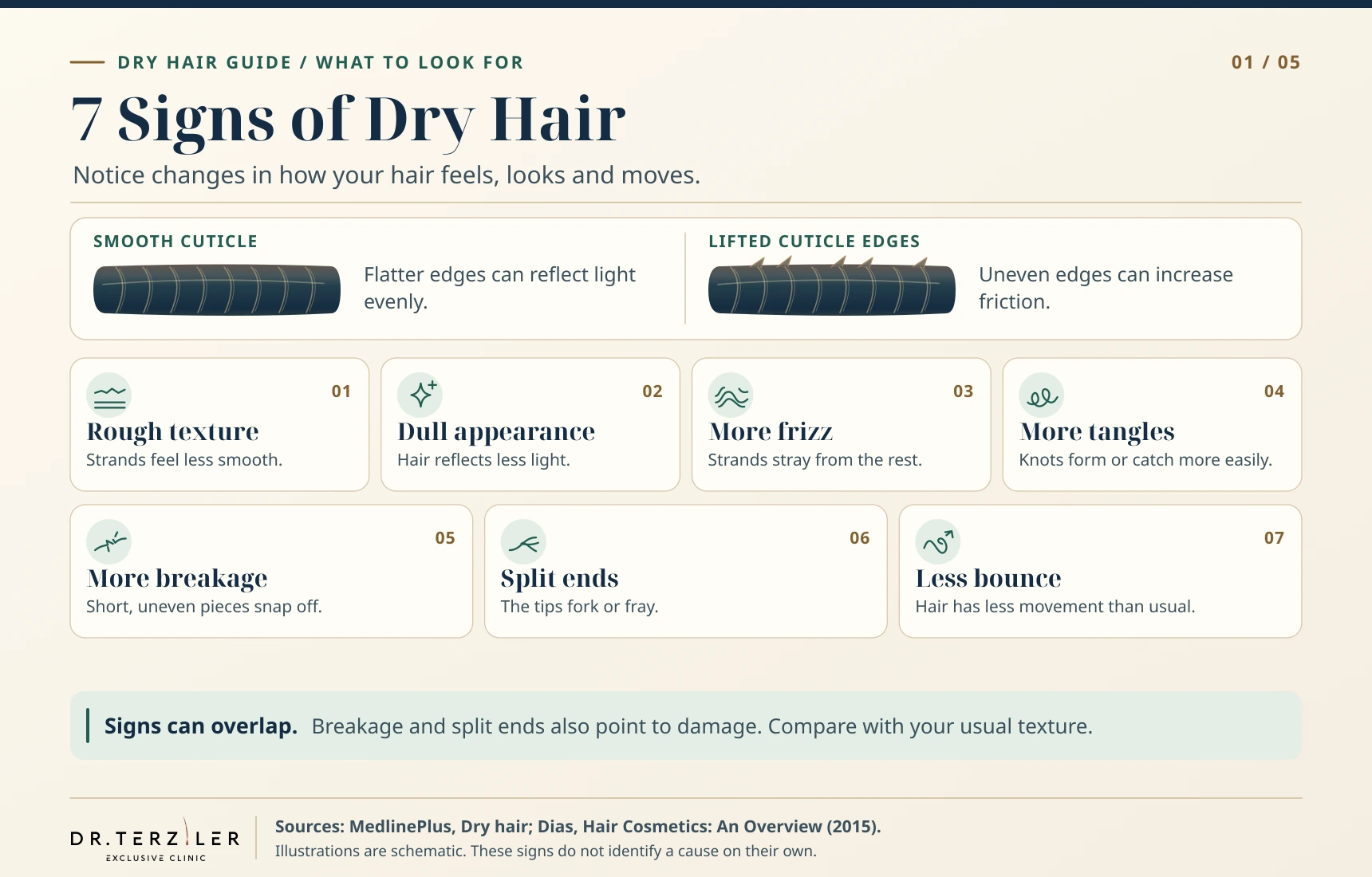
Dry hair often feels rough or straw-like, looks dull and frizzes or tangles more than usual. Split ends and short broken pieces suggest damage to the hair shaft. A longer shed hair may have a small pale bulb. That bulb can be normal. Start with gentler shampooing, conditioner and less heat. If your part is widening or shedding has increased, check the scalp as well as the lengths.
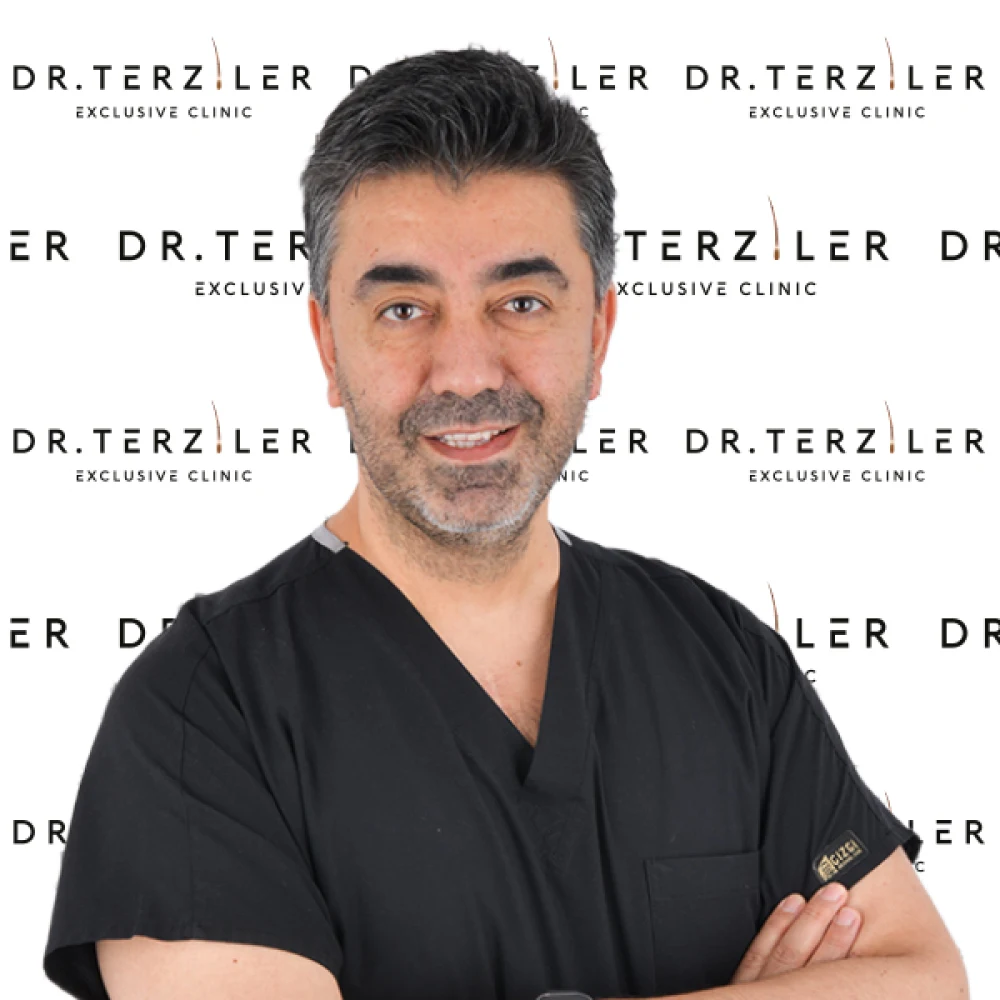
Medical aesthetics doctor · Dr. Terziler Exclusive Clinic
Your hair should not sound like a bowl of cereal when you run your fingers through it. If it does, something has changed. The useful question is whether the lengths feel dry, the shafts are breaking, or more hair is shedding from the scalp.
At a glance: A wider part tells you more about coverage than a single hair on the brush. A small pale bulb can be part of normal shedding. A lower-pH shampoo may help with static, but 5.5 is a study cutoff, not a requirement for every scalp.
What Does Dry Hair Look Like?
Dry hair can look dull, frizzy or flat. The ends may tangle and curls may lose shape. A rough surface scatters light, so the same hair may look less shiny than usual. Split ends and short broken pieces also point to damage and can occur alongside dryness.
What does dry hair feel like?
Dry hair may feel rough, stiff or straw-like, especially from mid-length to ends. The same feel can come from heat or chemical damage. Compare the lengths with hair closer to the scalp and with how your own hair usually feels.
The 7 signs of dry hair
- Rough texture that feels like straw, especially at the ends.
- No shine. Hair looks matte even right after washing.
- Frizz and static, worse in humid weather or in winter heating.
- Tangles and knots after a normal wash.
- Short broken pieces on your pillow, brush or shoulders.
- Split ends (one strand dividing into two or more).
- Lost curl or bounce; waves fall flat and hold no shape.
Dryness often shows up in the hair shaft and can respond to gentler care. If the hair is also thinning or shedding more than usual, start with a scalp assessment before considering non-surgical hair treatments.
How Do I Test If My Hair Is Dry? 3 At-Home Checks
Use three short observations on clean hair: compare the feel of the ends, notice whether an already loose wet strand feels unusually fragile, and see how water wets a small section. They may help guide care. They cannot determine porosity, diagnose damage or rule out a scalp condition.
Source: [2]
1. The touch test (10 seconds)
Slide your fingers gently along one detached strand, then compare the side that was nearer the scalp with the tip. Rough ends can be a clue to dryness or wear; a smooth feel cannot rule out damage. Our Tricho Test is a separate clinic assessment, not a version of this touch check.
2. The stretch test: is my hair dry or damaged?
| What the wet strand does | What you can infer | What to try |
|---|---|---|
| Stretches a little and springs back | The strand recovered; it does not diagnose dryness or healthy cuticles. | Keep handling gentle. Condition where lengths feel dry. |
| Snaps with little stretch | A strand may be fragile. This does not identify the cause. | Reduce heat and friction. Consider an exam if breaking persists. |
| Feels gummy or stays stretched | This can accompany severe weathering, especially after chemical treatment. | Pause bleach and high heat. A trim removes split ends. |
What did the loose strand do?
Stretches a little and springs back
The strand recovered; it does not diagnose dryness or healthy cuticles. Keep handling gentle. Condition where lengths feel dry.
Snaps with little stretch
A strand may be fragile. This does not identify the cause. Reduce heat and friction. Consider an exam if breaking persists.
Feels gummy or stays stretched
This can accompany severe weathering, especially after chemical treatment. Pause bleach and high heat. A trim removes split ends.
3. The water-bead check: what it can tell you
Mist a small section and notice whether the water beads or wets the surface. An oil or styling product can change what you see. Hair thickness, density, humidity and airflow affect drying time, so neither a bead nor a fast-drying section measures porosity on its own.
Does the hair float test work?
The popular hair float test is not a reliable way to determine porosity. Surface tension, products left on the hair and the shape of the strand can affect whether it floats. There is no household cutoff that can diagnose cuticle damage from this test.Source: [2]
On the limits of the strand float test
“Touch and stretch tell you far more.”
Seven quick choices
The 60-Second Dry Hair Test
A short self-check for how your lengths feel and look. It gives routine suggestions, not a diagnosis. Answers stay on this page and are not sent to the clinic.
How do your lengths feel when dry?
What does the shine look like?
How much frizz do you notice?
How quickly does your hair seem to dry?
How often do you use hot tools?
Have you bleached or colored it in the past year?
Have you noticed more shedding or a change in scalp coverage?
Dry vs Damaged vs Dehydrated vs Dead Hair: What Is the Difference?
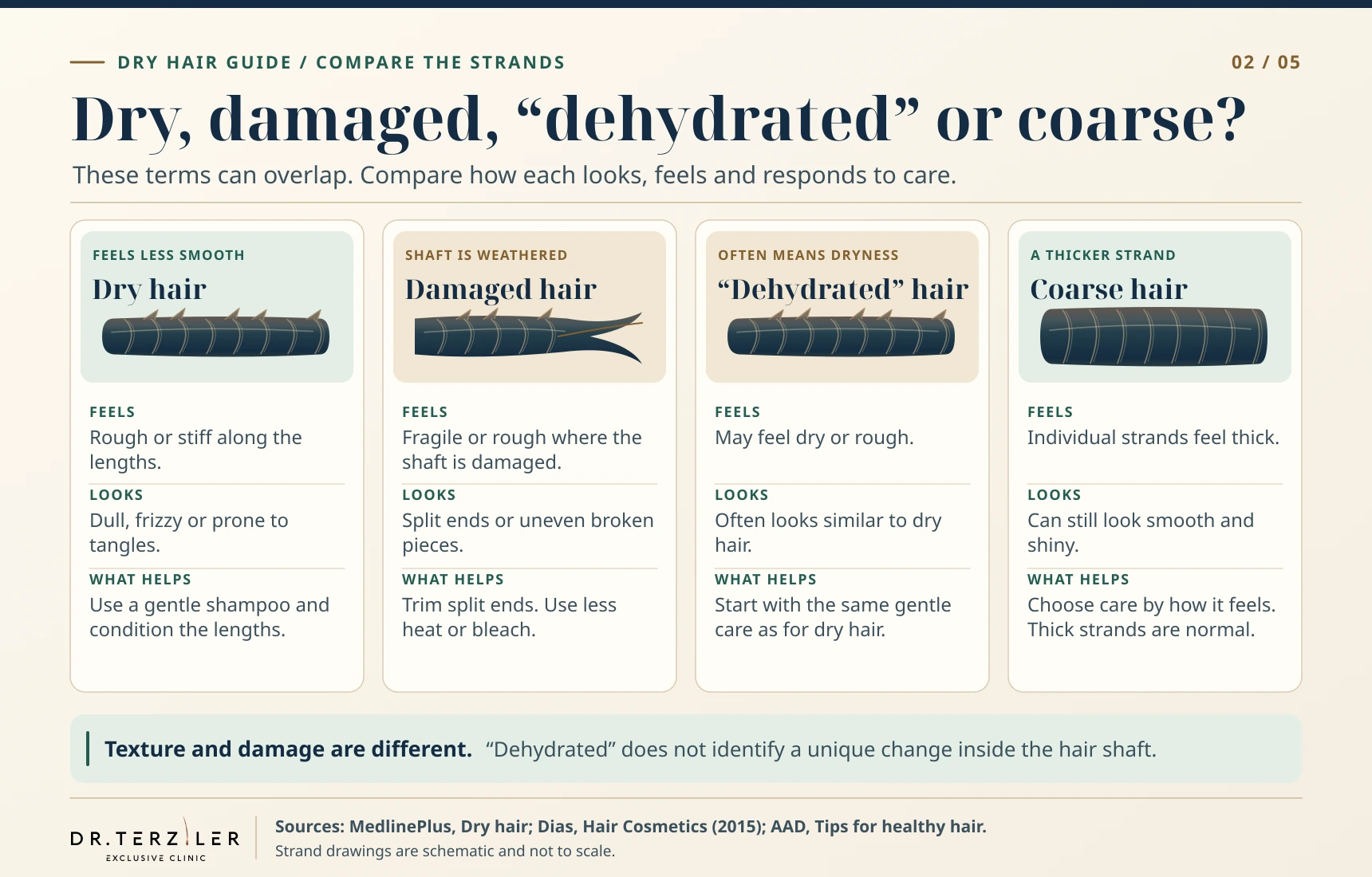
Dry hair describes how a strand feels and looks. Damaged hair has physical wear, such as a split end or a fraying shaft. “Dehydrated” usually describes a dry feel and is not a separate diagnosis. Coarse hair means thicker individual strands. All hair above the scalp is non-living, so “dead” hair is usually a way of describing severe damage.
| Clue | Dry hair | “Dehydrated” hair | Damaged hair | Coarse hair |
|---|---|---|---|---|
| What it is | A dry feel or dull appearance | An informal description that often overlaps dryness | Physical wear to the cuticle or shaft | Thicker individual strands |
| Feels | Rough or stiff | Often dry or rough | Fragile or rough; may feel gummy when wet | Thick or firm; can also be soft |
| Looks | Dull, frizzy or tangled | May look like dry hair | Split ends, fraying, uneven lengths or white nodes | Can be smooth and shiny; appearance varies |
| Common contributors | Harsh washing, friction or weathering | Often the same factors as dry lengths | Bleach, chemical processing, repeated heat or friction | Natural diameter; dryness can coexist |
| What helps | Condition and reduce friction | Start with gentle care as for dry hair | Reduce further wear and trim split ends | Care for condition; thickness itself does not need fixing |
How do I know if my hair needs moisture or hydration?
Brittleness and drying time cannot tell you which ingredient your hair needs. Start with a conditioner that improves slip and how the ends feel. Ingredients such as glycerin can attract water, while some oils and other conditioning ingredients coat the shaft and reduce friction. A leave-in or a light oil is optional.
How do you tell if your hair is dead?
All hair above the scalp is made of non-living keratin. People usually mean severely weathered lengths when they say “dead hair.” Ends may split, snap when combed or feel gummy when wet. Conditioner may improve feel, but trimming removes the part that has split. The clinic discusses growth factor therapy separately for selected scalp or thinning concerns.
Is Coarse Hair the Same as Dry Hair?
No. Coarse hair means the individual strands are thick in diameter. It is a natural hair characteristic, and thick strands can look smooth and shiny or can also be dry. Feel one strand between your fingers to get a rough sense of its thickness; use changes in feel and manageability to guide your routine.
Why Is My Hair Dry? The Main Causes
Heat, bleach, sun exposure and friction can wear the shaft. Frequent or harsh washing can leave the lengths feeling dry, and natural oils may have a harder time coating curly lengths. Thyroid problems and nutrition can also affect hair, especially when you notice other symptoms or more shedding.
| Cause or contributor | What the evidence shows |
|---|---|
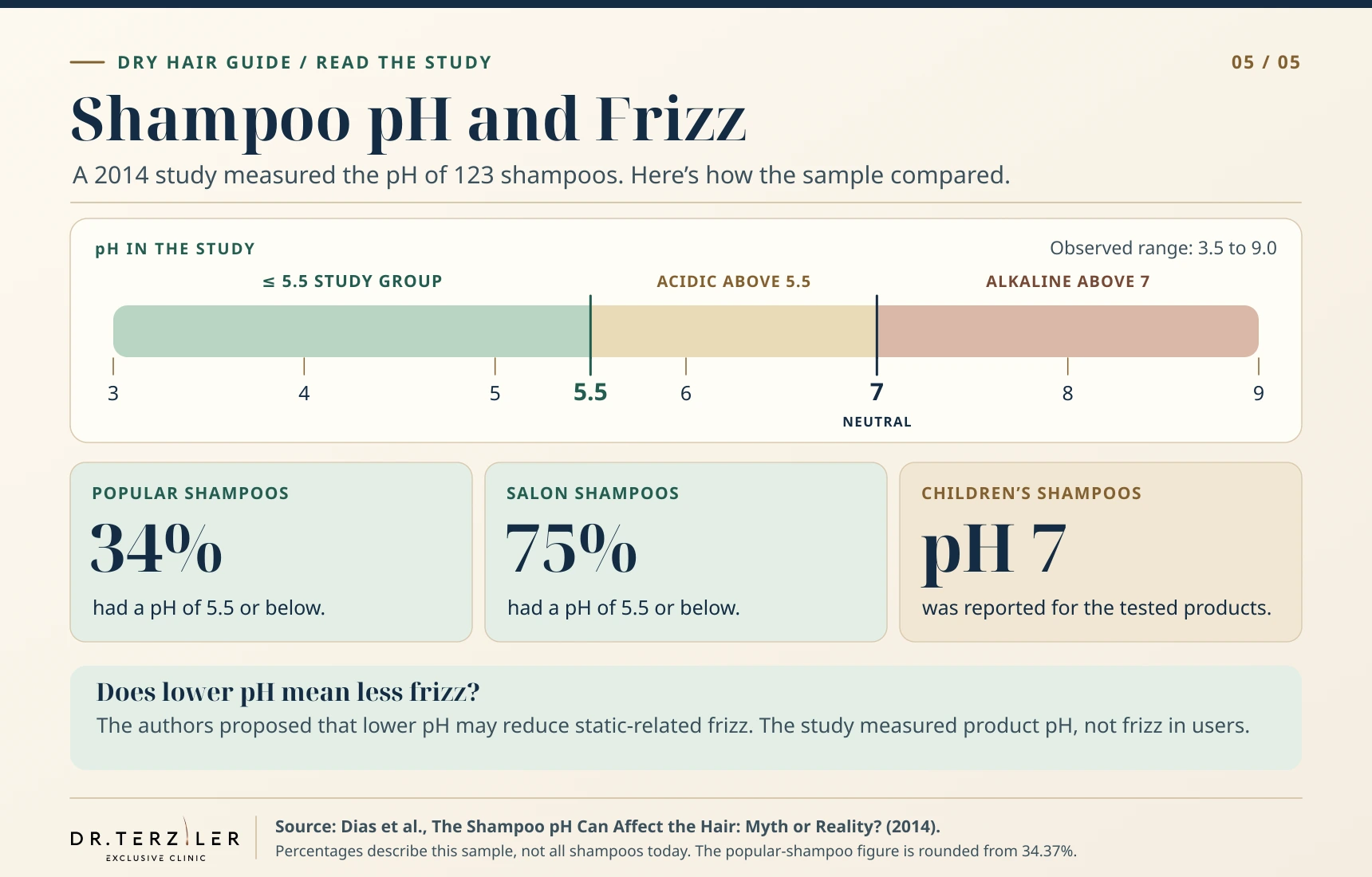
| Shampoo pH | In a 2014 study of 123 products, 38.21% had pH 5.5 or lower. The paper reported 34.37% among popular shampoos and 75% among salon shampoos. A higher pH may increase static and friction; the study did not measure frizz on people. [7] |
| Hard water | In a lab study using hair from 70 men, hard-water-treated strands measured about 8% lower in tensile strength than deionized-water-treated strands. Another study found no significant difference with its methods. Neither tests whether a household filter solves breakage. [10] [12] |
| Heat | Repeated tests on hair tresses found more shaft surface damage at higher dryer temperatures. Distance, movement and how often you use heat matter. [8] |
| Bleach and color | Chemical processing can alter the cuticle and internal structure, making the lengths more prone to wear. [2] |
| Sun and chlorine | UV exposure and pool water can wear the lengths and fade color. See whether chlorine can cause hair loss for the distinction. [4] |
| Curly or coily hair | Scalp oils may spread less easily along a curved shaft, leaving the ends feeling drier. [3] |
| Thyroid, iron and diet | Texture changes or shedding alongside other symptoms can warrant a medical assessment. Dry ends alone do not diagnose a deficiency or thyroid disease. [1] [14] |
Why is my hair dry and frizzy?
Dry and frizzy hair often has more friction between the strands. Humid air can also change how strands swell and lie. Start with conditioner and gently blot with a soft towel; a lighter styling product may help with flyaways. Compare our hair care products if you want to see the clinic’s options, and check the label for information about the actual formulation.Sources: [2] [3]
Is my hair oily or dry?
Check your scalp and ends separately once your hair has dried. The roots can look shiny or feel greasy while the ends feel rough. An oily scalp and dry ends can occur together. Cleanse the scalp as needed and condition the lengths.
Can being dehydrated make your hair dry?
Drinking more water alone is unlikely to change how the hair already growing out of your scalp feels. Illness, major weight loss or a restrictive diet can trigger temporary shedding, often after a delay. The guide to whether working out causes hair loss explains why those triggers differ from exercise itself.Source: [6]
Is It Breakage or Hair Loss? The Root Test
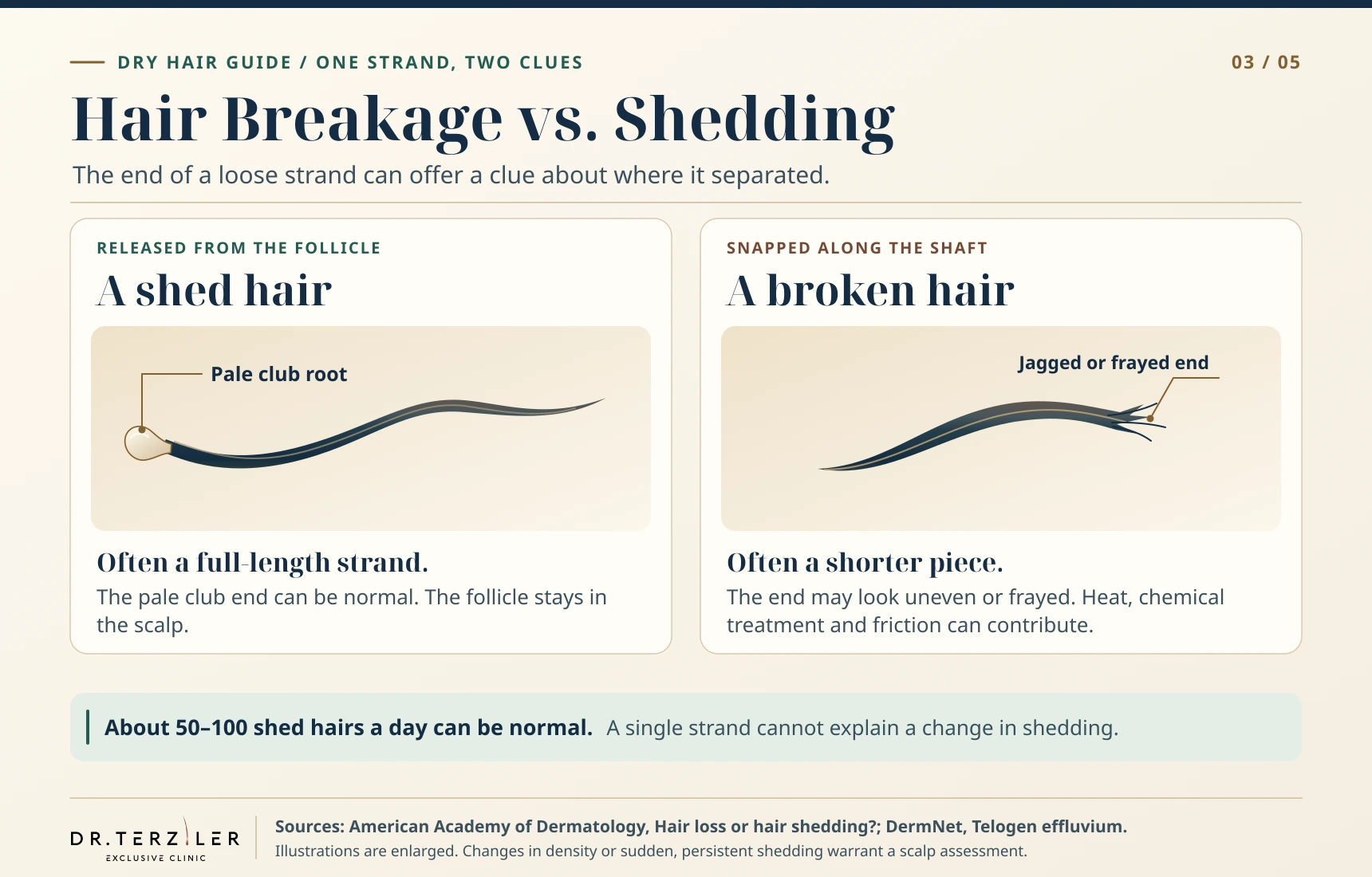
A shed resting hair can be full length with a small pale club at one end. A broken hair often looks shorter and may have a frayed or jagged end. The bulb does not mean the follicle came out. A strand check gives a clue, while a change in coverage or persistent shedding needs a scalp assessment.
What sheds from the scalp and what breaks along the shaft need different next steps. The American Academy of Dermatology says shedding about 50 to 100 hairs a day can be normal, but a daily count is not a home cutoff for a diagnosis. See our hair loss guide for the main patterns. A widening part or changing hairline can merit an exam.Source: [5]
- Look at a few loose strands from a brush or after washing. Do not pull attached hairs for this check.
- Lay them on a contrasting surface and use good light.
- Look for a rounded, pale club end or a shorter piece with a jagged or frayed end. Length alone does not tell you where a hair separated.
- If shedding is clearly above your usual pattern or coverage is changing, start with the signs in our Am I Balding? guide.
On why an assessment checks both the scalp and shafts
“Many patients who book a hair loss consultation actually have breakage, and many who blame dry hair actually have early pattern loss.”
Clinic-reported patient survey
What doctors found when patients came in worried about breakage
Of 186 patients surveyed at the clinic, 58 came in mainly worried about dry, breaking hair. Trichoscopy findings for those 58 patients are shown below.
| Finding | Patients | Share of 58 |
|---|---|---|
| Early pattern hair loss only | 21 of 58 | 36% |
| Breakage only | 23 of 58 | 40% |
| Both early pattern loss and breakage | 14 of 58 | 24% |
Does Dry Hair Cause Hair Loss?
Dry lengths can break and make hair look shorter or thinner. That does not explain hair shedding from the scalp or a change in the way follicles grow. Dryness and thinning can coexist; a clinician can check for causes such as dietary changes, thyroid disease or pattern hair loss. Our guide to DHT and hair loss explains the hormone’s role in male pattern loss.Sources: [16] [5]
Does dry hair cause dandruff?
Dry hair lengths do not cause dandruff. Dandruff involves flaking on the scalp and can overlap with conditions such as seborrheic dermatitis. Flake size and color alone are not enough to tell the cause. Apply an appropriate dandruff shampoo to the scalp as directed and condition the lengths if they feel dry.Source: [13]
How to Fix Dry Hair: What Actually Works
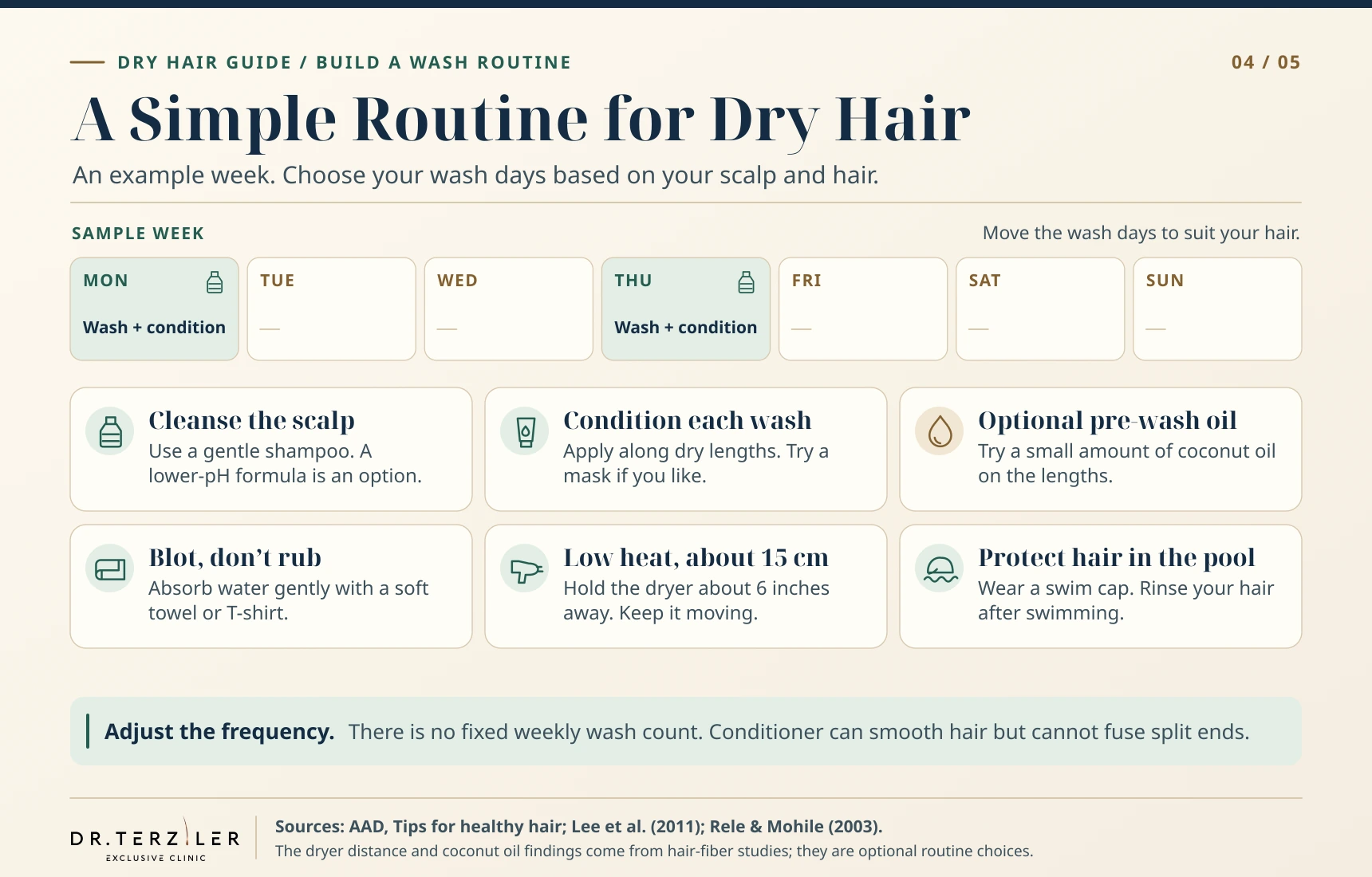
Use a gentle shampoo, condition the lengths after washing and reduce heat and friction. Protect hair in the sun and at the pool. A lower-pH shampoo or a pre-wash oil is optional. In one comparison of three oils, coconut oil reduced protein loss from hair fibers; sunflower and mineral oil did not show the same effect.
- Set your wash frequency by your scalp and hair. Apply shampoo to the scalp rather than scrubbing it into the lengths.
- Choose a gentle shampoo your scalp tolerates. Lower pH is an option if reliably stated, but pH is only one part of the formulation.
- Condition after each wash. Apply it where the hair feels dry; a richer mask is optional.
- If it suits your hair, try a little coconut oil on the lengths before washing. A lab comparison looked at protein loss from fibers, rather than a particular treatment time for people.
- Blot with a soft towel or T-shirt instead of rubbing. If you blow-dry, use low heat and keep the dryer moving. A hair-fiber study tested a distance of about 15 cm (6 inches).
- Use hot tools less often and at the lowest setting that works. Heat protectant cannot prevent all damage.
- Protect your hair from sun and chlorine. Try a hat outdoors or a swim cap at the pool, and rinse after swimming.
- If your water leaves mineral deposits, take note of when texture or manageability changed. Lab studies of hard water and hair strength disagree, and an ordinary shower filter may not soften hard water.
- Trim split ends when needed. A product can smooth the feel of the end without permanently joining the split.
- Eat enough protein and get iron and zinc through a balanced diet. Talk with a clinician before starting supplements for hair quality, especially if you have not been shown to have a deficiency.
Is it healthier to let your hair dry naturally?
Air-drying and blow-drying affect hair in different ways. A 2011 laboratory study found more surface damage as dryer heat increased and observed damage to the cell membrane complex in the naturally dried group. The moving dryer used about 15 cm from the tresses is one tested setup. The study did not compare hair loss. See whether hair dryers cause hair loss for the difference between heat damage and thinning.Sources: [8] [3]
How long does it take to fix dry or dehydrated hair?
Hair can feel easier to detangle after conditioning; there is no set number of weeks to reverse dryness. If the shaft is split or breaking, gentler care can reduce further wear, and trimming removes the damaged ends as they grow out.
Is it bad to go 4 days without washing your hair?
Four days may work if your scalp stays comfortable and does not feel oily. If it gets greasy, itchy or flaky sooner, adjust your wash schedule. Hair type, scalp oil and product buildup matter more than a fixed interval.
Should you put hair oil on wet or dry hair?
Try a small amount of oil on the dry ends to smooth flyaways, or on damp lengths if you like the finish. Coconut oil before washing is another option. Keep heavy oil away from the roots if it makes your scalp feel greasy.
One page to keep
Dry Hair Rescue Plan
A printable wash-day checklist, tips for handling dry lengths and a quick guide to looking at loose strands.
Use the clinic’s contact form to request an assessment and unlock the PDF here. The form asks for contact details and consent.
When Is Dry, Brittle Hair a Medical Sign?
A change in hair texture alone rarely identifies a medical cause. Arrange a scalp assessment if brittleness persists despite gentler care, or if it comes with persistent shedding, patchy loss, a change in part width or other new symptoms:
- Fatigue, feeling unusually cold, weight gain or dry skin can occur with an underactive thyroid.
- Fatigue, pale skin, breathlessness or heavy periods are worth discussing with a clinician, who may check for iron deficiency depending on your history.
- A major weight change, restrictive diet or a period of rapid weight loss during GLP-1 treatment can coincide with delayed shedding. See the guide to GLP-1 medications and hair loss.
- Small white nodes along snapping shafts can be a sign of trichorrhexis nodosa. Physical or chemical wear can contribute, and a clinician can check for other causes.
- Thinning on top, a wider part or a changing hairline may reflect pattern loss rather than dry ends. Our guide to hair loss in women covers common patterns and other explanations.
A clinician usually starts with your history and a scalp exam. Blood tests for thyroid function, iron status or another concern may be useful when your symptoms or exam suggest a reason to check. Tests are not routinely needed for dry ends alone.Sources: [16] [14] [15]
On asking about symptoms beyond the hair
“Dry hair is a hair problem. Dry hair plus fatigue, cold hands and thinning eyebrows is a thyroid question. We always look at the whole person before we look at the strand.”
Professional Treatments for Dry and Damaged Hair
Most dryness without scalp symptoms starts with home care. If breakage, shedding or thinning is ongoing, a scalp assessment helps clarify which problem needs treatment. The clinic offers the options below for different concerns. They do not all have the same evidence, and they are not interchangeable.Sources: [16] [17]
| Clinic option | What to ask about |
|---|---|
| Diamond Hair Reset | A clinic scalp and hair care session. Ask what it includes and which benefit you can realistically assess. |
| Hair & nail cocktail | Ask what is in the formulation and whether a confirmed deficiency would need separate assessment. |
| Copper peptides | Ask what evidence exists for the exact product and concern being treated. |
| Laser hair treatment | Some low-level light devices have evidence for selected types of hair loss. They do not repair split ends. [16] |
| Hair PRP | Discuss what evidence applies to your type of thinning, after an assessment. PRP is not a routine treatment for dry shafts. [16] |
| Exosome therapy | Ask about evidence, risks and regulatory status. There are no U.S. FDA-approved exosome products. [17] |
| Hair follicle stem cell therapy | Ask what is offered, what evidence supports it and whether that specific use is authorized. It is not standard care for dry lengths. [17] |
Dry hair after a hair transplant
Some people notice a dry or itchy scalp while healing after a hair transplant. Use your own team’s instructions; the first wash and what you can apply depend on the procedure. See the step-by-step washing guide after a transplant. The guide to itching after a hair transplant covers what to report to your team. If you are planning a hair transplant in Turkey, ask about the aftercare plan before you travel.
On the clinic’s own post-operative care
“After surgery we ask patients to treat their hair like silk for a month: lukewarm water, mild shampoo, pat, never rub.”
Have a question about dry, breaking or thinning hair? Talk to a hair doctor at Dr. Terziler Exclusive Clinic in Istanbul.
Keep reading in this guide
Frequently Asked Questions
What does dry hair feel like?
Dry hair often feels rough, stiff or straw-like from mid-length to ends. A change compared with your usual texture is a better clue than coarseness on its own.
How do I test if my hair is dry?
Notice how the ends feel, how an already detached wet strand behaves and how water wets the surface. These are observations and do not diagnose damage, porosity or hair loss.
What is the difference between damaged and dry hair?
Dry hair often feels rough or looks dull. Damaged hair has physical wear along the shaft and may split or break. One head of hair can show both, especially at the ends.
Can dry hair go back to normal?
A gentler routine can improve the way dry lengths feel and move. Split ends cannot be permanently rejoined, and there is no reliable timeline for every person.
How often should dry hair be washed?
Wash often enough to keep your scalp comfortable. Oiliness, texture and product buildup vary. Cleanse the scalp and condition the parts of the hair that feel dry.
Is it better to let hair dry naturally?
One lab study found different types of damage from room-temperature drying and blow-drying. If using a dryer, keep it moving on low heat rather than holding it close to one spot.
Is curly hair usually dry?
Curly hair can feel drier along the lengths because scalp oils may not spread as easily down the curves. Not all curly hair is dry or needs the same wash schedule.
Does dry hair cause hair loss?
Dry hair shafts can break and look thinner. More shedding from the scalp, or a widening part, can have other causes and may need an assessment.
Will hair grow back after dehydration?
If a temporary stressor triggered increased shedding, hair can regrow after the trigger resolves. Severe illness or major dietary change can trigger shedding, but a dry feel alone does not show that dehydration was the cause.
What makes hair feel like straw?
Heat, bleaching, friction and other wear can leave the shaft rough or stiff. Dryness can feel similar. Hard water is another possible contributor to feel, but evidence on breakage is mixed.
Does brushing make hair frizzier?
Dry brushing can separate clumps of curly hair and make frizz more visible. Try gentle detangling with conditioner and a wide-tooth comb, starting near the ends.
What is the most damaging thing for hair?
Bleaching, frequent high heat and repeated friction can damage hair. Which causes the most damage depends on the strength, frequency and condition of the hair beforehand.
Sources
- MedlinePlus: Dry hair
- Gavazzoni Dias MFR: Hair Cosmetics: An Overview. Int J Trichology, 2015
- American Academy of Dermatology: Tips for healthy hair
- American Academy of Dermatology: 10 hair care habits that can damage your hair
- American Academy of Dermatology: Do you have hair loss or hair shedding?
- DermNet: Telogen effluvium
- Gavazzoni Dias MFR et al.: The Shampoo pH Can Affect the Hair: Myth or Reality? Int J Trichology, 2014
- Lee Y et al.: Hair Shaft Damage from Heat and Drying Time of Hair Dryer. Ann Dermatol, 2011
- Rele AS and Mohile RB: Effect of mineral oil, sunflower oil, and coconut oil on prevention of hair damage. J Cosmet Sci, 2003
- Luqman MW et al.: Comparison of hair strength after treatment with deionized and hard water. Int J Trichology, 2018
- Luqman MW et al.: Effect of topical application of hard water in weakening of hair in men. J Pak Med Assoc, 2016
- Srinivasan et al.: Effects of hard water on hair. Int J Trichology, 2013
- American Academy of Dermatology: How to treat dandruff
- NHS: Underactive thyroid (hypothyroidism)
- MedlinePlus: Trichorrhexis nodosa
- American Academy of Dermatology: Hair loss: Diagnosis and treatment
- U.S. Food and Drug Administration: Consumer alert on regenerative medicine products including stem cells and exosomes