





Completing a hair transplant surgery requires a significant commitment of your time, finances, and emotional energy. Once you leave the operating room, you enter a critical 14-day window where the survival of your newly relocated grafts hangs entirely on how well your body can heal.
To achieve maximum density, your scalp must rapidly close thousands of microscopic incisions, rebuild complex capillary networks, and supply a continuous stream of oxygen to the fragile hair roots.
While it can be tempting to celebrate the completion of your surgery with a celebratory drink or return to your normal smoking routine, nicotine and alcohol are two of the most destructive forces a healing scalp can face.
Violating your clinic’s post-operative restrictions regarding smoking and drinking can directly stunt your hair growth, trigger severe bleeding, cause skin necrosis, or lead to a patchy, failed transplant. Understanding the exact biological impact of these substances will help you protect your investment during this fragile recovery phase.
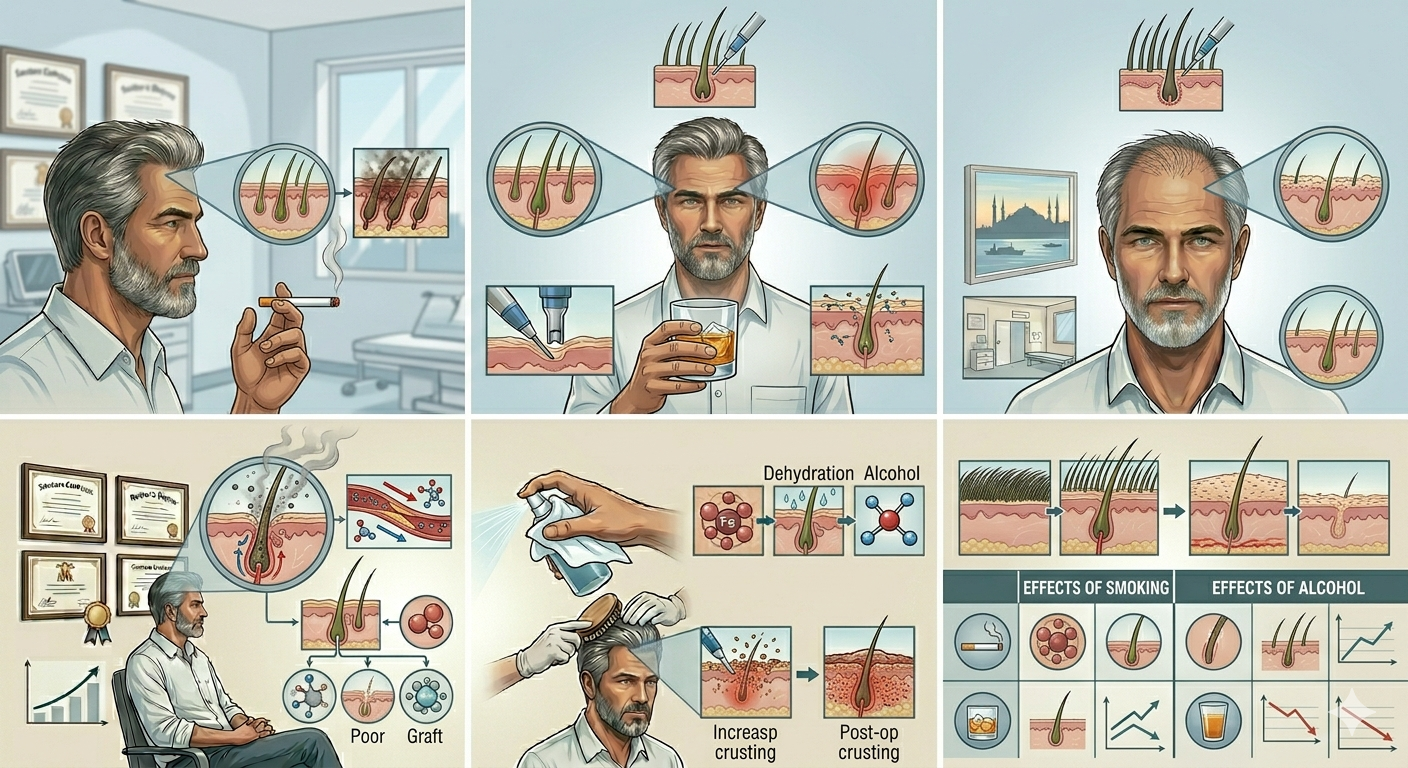
1. The Clinical Dangers of Smoking (Nicotine & Grafts)
Smoking—whether via traditional cigarettes, cigars, vapes, or shisha—introduces high levels of nicotine and carbon monoxide into your bloodstream. This combination creates a hostile environment for a healing scalp through three primary mechanisms:
Severe Vasoconstriction (Oxygen Starvation)
Nicotine is a potent natural vasoconstrictor, meaning it causes your blood vessels to instantly tighten and narrow. Newly implanted hair grafts do not have an established root system; they rely entirely on the microscopic capillaries in the surrounding skin to deliver oxygen and nutrients. When nicotine constricts these vessels, it starves the fresh grafts of oxygen, causing the roots to suffocate and die before they can anchor.
Carbon Monoxide Pollution
Cigarette smoke contains carbon monoxide, which binds to hemoglobin in your red blood cells much faster than oxygen does. This drastically reduces the overall oxygen-carrying capacity of your blood, further depriving your healing tissues of the vital oxygen required for cellular repair.
Delayed Healing and Scarring
Smoking compromises your body’s immune response and slows down skin regeneration. This leaves your micro-incisions open for a longer period, significantly increasing your risk of local bacterial infections, folliculitis, or thick, fibrotic scar tissue formation that blocks future hair growth.
2. The Clinical Dangers of Alcohol After Surgery
While smoking starves the grafts over the long term, consuming alcohol creates immediate, acute risks in the days surrounding your procedure:
Increased Risk of Post-Op Bleeding
Alcohol acts as a natural blood thinner by reducing the stickiness of blood platelets and interfering with your body’s clotting mechanisms. Drinking alcohol within the first week of surgery can trigger unexpected, active bleeding from the micro-channels, physically washing the delicate grafts right out of your scalp.
Severe Dehydration
Alcohol is a powerful diuretic that forces your kidneys to flush water out of your system rapidly. A healing scalp requires intense, deep cellular hydration to soften scabs and regenerate skin layers. Dehydration causes the scalp tissue to tighten, become brittle, and itch aggressively, which increases the risk of accidental scratching.
Dangerous Medication Interactions
During the first 3 to 5 days post-transplant, you will be prescribed a course of vital medical compounds, including antibiotics to prevent infection and anti-inflammatory medications to manage swelling. Mixing alcohol with these prescription medications can cause severe liver strain, extreme dizziness, stomach irritation, or render the antibiotics completely ineffective.
Substance Restriction Matrix
To ensure absolute safety and eliminate all chemical risks to your new hair roots, adhere strictly to this clinical timeline:
| Substance Type | Pre-Op Restriction | Post-Op Restriction | Primary Biological Risk |
| Cigarettes & Vapes | Stop 7 Days Before | Stop 14 Days After | Chronic vasoconstriction, tissue hypoxia, and graft death. |
| Alcohol (Beer, Wine, Spirits) | Stop 3 Days Before | Stop 10 Days After | Thin blood, active graft bleeding, and medication interactions. |
| Caffeine & Pre-Workout | Stop 3 Days Before | Stop 3 Days After | Spikes blood pressure, leading to intra-operative bleeding. |
What If You Accidentally Slip Up?
If you experience a moment of weakness and have a cigarette or an alcoholic drink during your restricted window, do not panic, but act immediately to mitigate the damage:
- Stop Immediately: Do not consume any more of the substance.
- Hydrate Aggressively: If you drank alcohol, drink 2 to 3 liters of water over the next few hours to flush the toxins out of your system and rehydrate your scalp tissue.
- Inspect Your Scalp: Look closely in a mirror under a bright light. Check your recipient zone for any signs of fresh, red bleeding or dark, pooling blood.
- Inform Your Clinic: Take a high-resolution photograph of your hairline and send it directly to your aftercare specialist. Being honest with your medical team allows them to give you tailored guidance or adjust your washing schedule if needed.
Final Thoughts: A Short-Term Sacrifice for a Lifetime of Hair
A hair transplant is a partnership between the artistic precision of your surgeon and the discipline of your recovery routine. Choosing to step away from smoking and drinking for just a few weeks is a remarkably small sacrifice when compared to securing a lifetime of dense, permanent, and completely natural hair growth. Protecting your scalp’s blood supply ensures that your new roots thrive flawlessly.
At Dr. Terziler Clinic, we treat your post-operative recovery phase with elite medical seriousness. We recognize that breaking daily habits can be challenging, which is why our dedicated 12-month aftercare department provides continuous, empathetic guidance throughout your journey. By pairing our advanced DHI and Sapphire FUE surgeries with comprehensive physiological tracking, we help you navigate your recovery cleanly and safely—ensuring your investment culminates in the absolute peak of dense, natural results.
Frequently Asked Questions (FAQ)
Is vaping or using nicotine patches safer than smoking traditional cigarettes?
Absolutely not. While vaping removes the tar found in tobacco smoke, the active culprit behind graft destruction is nicotine itself. Nicotine patches, nicotine gum, electronic cigarettes, and vapes all deliver a concentrated dose of nicotine directly into your bloodstream, causing the exact same narrowing of blood vessels and oxygen starvation to your fresh hair roots.
Why must I stop drinking alcohol 3 days before my hair transplant?
Consuming alcohol within 72 hours of your surgery can severely thin your blood and disrupt your body’s natural clotting abilities. This leads to excessive, continuous bleeding during the extraction and implantation phases of the surgery. Excess blood inside the operating zone makes it incredibly difficult for the surgeon to see the micro-channels clearly, which can compromise the overall accuracy and density of your hairline.
When can I safely return to heavy social drinking or smoking after my transplant?
The absolute safety milestone is Day 14 post-surgery. By this stage, the micro-incisions have completely healed, the post-op scabs have dropped off, and the relocated hair follicles have successfully established a secure, permanent connection to the scalp’s internal blood vessels—making them highly resilient to external lifestyle choices.
Can smoking cause severe skin death (necrosis) on the scalp?
Yes, in extreme cases. If a patient is a heavy, chronic smoker and continues to smoke immediately after a large-session hair transplant, the extreme lack of oxygen can cause localized skin tissue to die entirely—a condition known as cutaneous necrosis. This leads to deep scarring and ensures that no hair will ever grow in that specific zone again, requiring extensive reconstructive surgery to fix.
Can I drink non-alcoholic beer during the first week of recovery?
Yes, non-alcoholic beer (containing 0.0% alcohol) is completely safe to consume during your recovery window. Because it lacks the ethanol compound that thins the blood and causes severe dehydration, it will not interfere with your prescription medications, your body’s healing mechanisms, or the survival of your fresh grafts.