
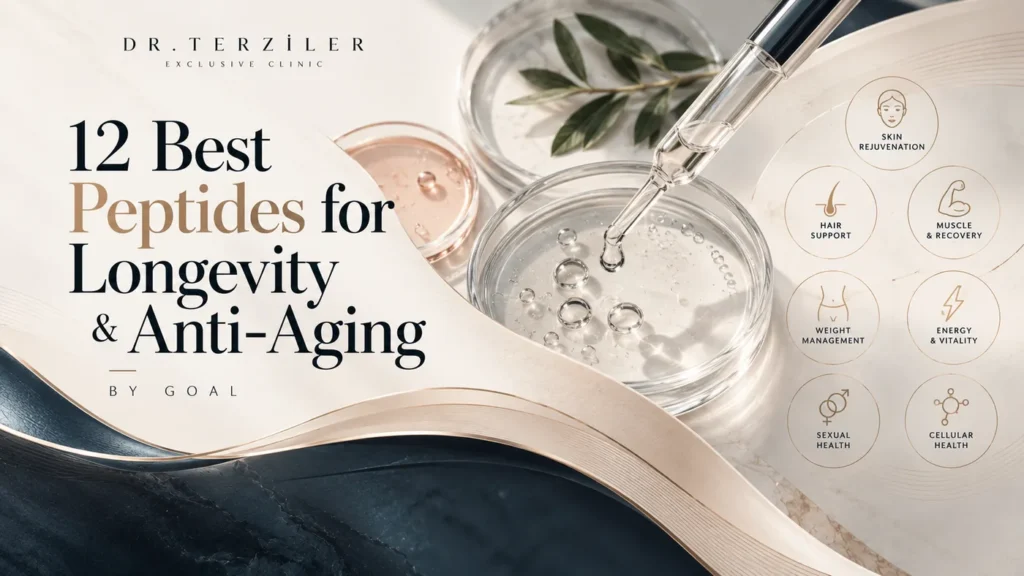
The 12 Best Peptides for Longevity & Anti-Aging (by Goal)
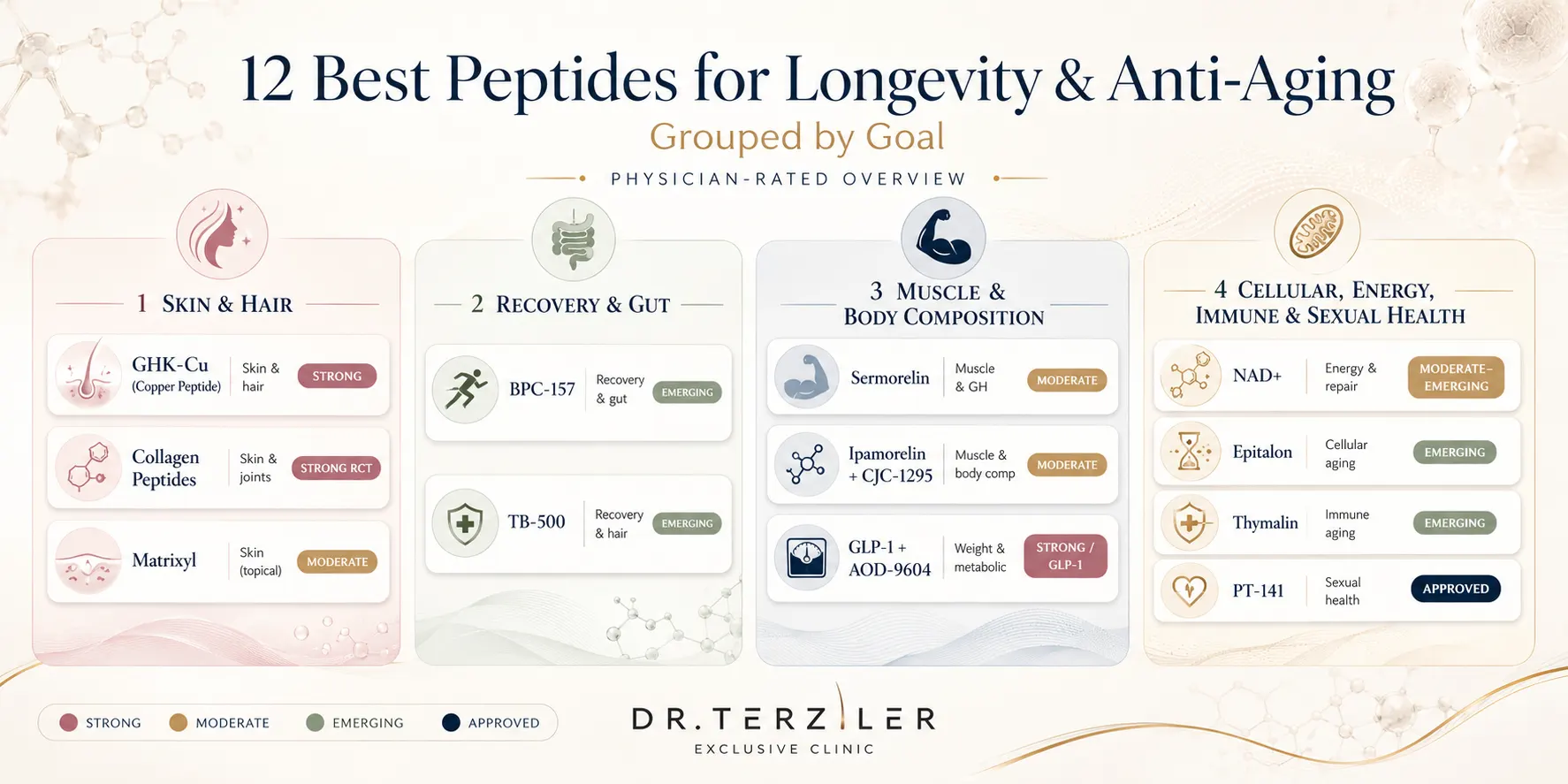
The best peptides for longevity and anti-aging are chosen by goal, not by hype. For skin, the copper peptide GHK-Cu and oral collagen peptides have the strongest clinical evidence. For cellular aging, Epitalon is the most-cited peptide for its telomerase-activating effect. For muscle and recovery, Sermorelin, Ipamorelin, BPC-157 and TB-500 dominate the research. And for sexual vitality, PT-141 is the peptide most often compared to Viagra. Below, our physicians rank the 12 peptides that matter most; organized by what you actually want to achieve, and graded honestly by the strength of the science behind each one.
MEDICALLY REVIEWED BY
Dr. Kürşat Yalvaç
Medical Aesthetics & Anti-Aging Physician at Dr. Terziler Exclusive Clinic
Clinical protocol context: Dr. Servet Terziler and Registered Dietitian Nutritionist (RDN) Orçun Kürüm
Updated July 2026
Peptides are one of the fastest-growing tools in longevity medicine, but the internet treats them as a single magic bullet. They aren't. Each peptide sends a specific biological signal, and the right choice depends on your goal, your biomarkers, and medical supervision. This guide fixes that; pairing every peptide with its goal, its evidence level, and its place in a real clinical program.
What Are Peptides, and How Do They Affect Aging?
As we age, the body's natural production of these signaling peptides declines, and with it, the instructions that keep skin firm, tissue repaired, and metabolism efficient. Peptide therapy aims to restore those signals.
A clear example is the copper peptide GHK-Cu: plasma levels fall from roughly 200 ng/mL at age 20 to about 80 ng/mL by age 60; a decline of nearly 60%, which parallels the thinning skin and slower healing of older age (Pickart & Margolina, Int J Mol Sci 2018). Replenishing or re-stimulating these signals is the core idea behind longevity peptides.
| Peptide type | What it signals | Age-related decline | How it's used |
|---|---|---|---|
| Copper peptides (GHK-Cu) | Collagen, elastin, tissue repair | 60% by age 60 | Topical, injectable, in-clinic |
| Structural peptides (collagen) | Dermal matrix, skin hydration | Collagen down 1%/yr after 25 | Oral supplement |
| Growth-hormone secretagogues | GH release, muscle, recovery | GH peaks in youth, declines after 30 | Physician-prescribed |
| Bioregulator peptides (Epitalon) | Telomerase, circadian rhythm | Telomeres shorten with age | Cyclical, supervised |
Peptides are not a substitute for the fundamentals: sleep, protein, resistance training, and stress control still do the heavy lifting. Explore how we measure and reverse biological age inside our Longevity (Youngevity) Reset program.
Do Peptides Really Work for Anti-Aging? What the Science Says
Collagen peptides and GHK-Cu have randomized or controlled human data for skin. GLP-1 peptides have large trials for weight and metabolic health. Peptides like BPC-157 and TB-500 show striking results in animals but lack large human anti-aging trials. Treating all peptides as equally "proven" is the mistake most websites make.
| Peptide | Strongest evidence | What it's shown to do |
|---|---|---|
| Collagen peptides | Human RCTs | Down wrinkle depth, up procollagen +65% & elastin +18% (Proksch 2014) |
| GHK-Cu | Controlled human study | Up skin density/thickness, down fine lines (71 women, 12 wks) |
| GLP-1 (semaglutide) | Large human RCTs | Significant weight loss, metabolic improvement |
| Epitalon | Human cell + animal | Telomerase activation, telomere lengthening |
| BPC-157 / TB-500 | Mostly preclinical | Tissue and gut repair (animal models) |
"We don't prescribe a peptide because it's trending. We prescribe it because your bloodwork and biological-age data say you'll benefit, and then we re-measure to prove it worked."
What Are the 12 Best Peptides for Longevity & Anti-Aging, by Goal
| # | Peptide | Primary goal | Evidence level |
|---|---|---|---|
| 1 | GHK-Cu (copper peptide) | Skin & hair | Strong (human) |
| 2 | Collagen peptides | Skin & joints | Strong (human RCT) |
| 3 | Matrixyl (palmitoyl pentapeptide-4) | Skin (topical) | Moderate (human) |
| 4 | BPC-157 | Recovery & gut | Emerging (preclinical) |
| 5 | TB-500 (thymosin beta-4) | Recovery & hair | Emerging (preclinical) |
| 6 | Sermorelin | Muscle & growth hormone | Moderate (human) |
| 7 | Ipamorelin (+ CJC-1295) | Muscle & body composition | Moderate |
| 8 | NAD+ | Energy & cellular repair | Moderate-emerging |
| 9 | Epitalon (epithalon) | Cellular aging & telomeres | Emerging (human cell) |
| 10 | Thymalin | Immune aging | Emerging |
| 11 | PT-141 (bremelanotide) | Sexual health | Approved (female HSDD) |
| 12 | GLP-1 & AOD-9604 | Weight & metabolic | Strong (GLP-1) |
For Skin, Wrinkles & Collagen: GHK-Cu, Collagen Peptides & Matrixyl
GHK-Cu is naturally present in the body and declines with age; restoring it visibly rebuilds the skin's structure.
In a controlled study, a GHK-Cu facial cream applied for 12 weeks to 71 women with photoaged skin increased skin density and thickness, improved clarity, and reduced the depth of fine lines and wrinkles (Pickart & Margolina, 2018). Separately, in a placebo-controlled trial of 114 women, oral bioactive collagen peptides significantly reduced wrinkle depth in 8 weeks and raised skin procollagen by 65% (Proksch et al., 2014). Topically, Matrixyl (palmitoyl pentapeptide-4) signals fibroblasts to produce more collagen, which is why it appears in medical-grade anti-aging serums.
"GHK-Cu is the closest thing we have to a reset button for aging skin; it doesn't just sit on the surface, it switches collagen genes back on."
For Hair Growth & Thinning: Copper Peptides & Thymosin
For thinning hair, peptides work on the follicle's signaling environment rather than just the hair shaft.
There's a second, under-appreciated use: peptides can support graft survival and boost native-hair density after a hair transplant by improving the vascular, regenerative environment of the scalp. That makes them a natural companion to surgical hair restoration.
"Peptides and exosomes are how we protect and thicken hair around the grafts; the transplant restores the hairline, the peptides keep the rest of the scalp dense."
For Muscle, Strength & Recovery: BPC-157, TB-500, Sermorelin & Ipamorelin
Sermorelin and Ipamorelin prompt your pituitary to release your own growth hormone, supporting lean mass, recovery and sleep, a more physiologic approach than injecting synthetic HGH.
BPC-157 and TB-500 are widely discussed for tendon, muscle and gut repair, but the strong results are largely from animal studies; human evidence is still limited, so clinical use is cautious and supervised.
| Peptide | Mechanism | Evidence |
|---|---|---|
| Sermorelin | Stimulates natural GH release (GHRH analog) | Human data |
| Ipamorelin (+CJC-1295) | GH secretagogue, minimal hunger/cortisol impact | Human data |
| BPC-157 | Angiogenesis, gut & tendon repair | Preclinical |
| TB-500 (thymosin beta-4) | Cell migration, tissue regeneration | Preclinical |
For Weight Loss & Metabolic Health: GLP-1 (Semaglutide/Tirzepatide) & AOD-9604
AOD-9604, a fragment of growth hormone marketed for fat loss, has far weaker evidence.
"A GLP-1 without a nutrition and muscle-preservation plan just makes you a smaller version of an unhealthy body. The peptide is 20% of the result; the protocol is the other 80%."
For Energy, Sleep & Cognition: NAD+, Epitalon, DSIP & Semax
NAD+ declines with age and is central to mitochondrial energy production and DNA repair; restoring it is one of the most requested longevity therapies.
NAD+
drops by 50% between ages 40 and 60; fuels mitochondria, sirtuins, and DNA repair
Ozone x10
mild oxidative conditioning; boosts the body's own antioxidant enzymes
Myers cocktail
magnesium + B vitamins are cofactors for ATP production; bypasses the gut
Glutathione + vitamin C
master antioxidant; declines with age; clears the oxidative stress that disrupts sleep
For Sexual Health & Vitality: PT-141 (Bremelanotide)
Because it acts on the nervous system rather than the vascular system, it addresses desire and arousal, which is why it's used for low libido in women as well as men.
For Cellular Aging & Lifespan: Epitalon, Thymalin & NAD+
Telomeres shorten each time a cell divides; maintaining their length is one of the most direct ways to influence how cells age.
Epitalon induced telomerase activity and extended telomere length in human somatic cells in foundational work (Khavinson et al., 2003), and this was independently confirmed in human cell lines in 2025 (Al-Dulaimi et al., Biogerontology). Thymalin supports the aging immune system, and NAD+ fuels the sirtuins and DNA-repair machinery tied to longevity.
Peptides vs. the Alternatives: Honest Comparisons
| Comparison | Verdict |
|---|---|
| Peptides vs TRT | Sermorelin/Ipamorelin stimulate your own growth hormone; TRT directly supplies testosterone. Peptides are gentler and more physiologic, but neither is inherently "safer" without lab testing. |
| BPC-157 vs PRP | PRP concentrates your own growth factors into one site; BPC-157 is a systemic repair peptide. Often complementary, not either/or. |
| Peptides vs SARMs | SARMs are synthetic androgen-receptor drugs with real hormonal risks; peptides are signaling molecules. Different mechanisms, different risk profiles. |
| Peptide shots vs Ozempic | Ozempic is a peptide (GLP-1). Most other peptides target skin, muscle or sleep (not weight) so they aren't interchangeable. |
| Peptides vs Supplements | Supplements supply raw materials such as vitamins, minerals and amino acids, while peptides send targeted signals that tell cells what to do. They are complementary rather than competing, and our best longevity supplements guide shows where each one fits. |
Are Peptides Safe? Side Effects, Liver & Legal Status
The biggest real risk is not the molecule itself but unregulated products bought online, which are frequently mislabeled "not for human consumption" to bypass rules.
Are peptides hard on your liver?
At clinical doses under supervision, liver strain is not typical, and liver markers are monitored as part of routine bloodwork.
What is the downside of peptides?
Limited long-term human data, variable grey-market product quality, possible injection-site reactions, and the need for ongoing monitoring.
Why don't doctors prescribe peptides more often?
Many are only available through compounding pharmacies, lack FDA approval for anti-aging uses, and have limited large-scale trials, so responsible prescribing is cautious and specialist-led.
What separates a clinic from self-experimentation?
A real clinic tells you what's proven, sources pharmaceutical-grade product, and monitors your labs.
This honesty is the point: a real clinic tells you what's proven, sources pharmaceutical-grade product, and monitors your labs, which is why supervised longevity care is worth it compared to self-experimentation.
How Peptide Therapy Works at a Longevity Clinic
The proof is in the data. One Youngevity Reset patient measured a biological age 12.4 years younger, an organ age 18.6 years younger, and an aging pace of 0.8 (meaningfully slower than normal) after a personalized protocol. That is the difference between guessing and knowing.
How to Choose the Best Longevity Clinic
Real physicians, named and credentialed.
Look for board-certified doctors with academic posts and published research, not a wellness platform with a medical disclaimer.
Objective biomarker testing.
A serious clinic measures biological age with validated tools (OMICm Age, DunedinPACE, 180+ biomarkers), then re-measures to prove change.
Personalized, multi-disciplinary protocols.
Cardiology, nutrition, aesthetics and psychology working together; aging is not solved by one injection.
Pharmaceutical-grade sourcing and monitoring.
Supervised dosing and lab follow-up, not grey-market vials.
Transparent, evidence-honest communication. They tell you what's proven and what's experimental.
Dr. Terziler Exclusive Clinic meets every criterion: a physician-led team including Dr. Servet Terziler (awarded as the best hair transplant & dermatology doctor in Turkey), an ISSN-certified sports dietitian (Registered Dietitian Nutritionist Orçun Kürüm), an anti-aging physician (Dr. Kürşat Yalvaç), combined with 180+ biomarker testing and documented biological-age reversal.
Frequently Asked Questions
Epitalon (telomeres), NAD+ (cellular energy), GHK-Cu (skin and tissue), BPC-157 and TB-500 (repair), and Sermorelin (growth hormone) are the most-discussed. Evidence strength varies widely, so only physician-supervised, biomarker-guided use is advisable.
For skin, GHK-Cu has the strongest clinical evidence. For cellular aging, Epitalon is the most-cited. The "best" peptide depends on your goal and your biological-age profile, which is why it should be chosen after testing.
In animal and cell studies, peptides such as Epitalon extend cellular lifespan by activating telomerase. Human lifespan-extension data are limited, so peptides are used to improve healthspan and biomarkers, not as a proven life-extension drug.
Epitalon (epithalon) is the peptide most associated with longevity research, for its telomerase-activating effect, independently confirmed in human cell lines in 2025.
Under medical supervision, peptides are generally well-tolerated. Most longevity peptides lack large human trials and are not FDA-approved for anti-aging; unregulated online products carry the real risk. Liver strain is not typical at clinical doses but is monitored.
Limited long-term human data, variable product quality on the grey market, possible injection-site reactions, and the need for ongoing medical monitoring, which is why clinic-supervised sourcing matters.
Many peptides are only available through compounding pharmacies, lack FDA approval for anti-aging indications, and have limited large-scale trials, so prescribing is cautious and specialist-led.
Peptides like Sermorelin stimulate your own hormone production, while TRT supplies testosterone directly. Neither is universally "safer"; the right choice depends on your labs, symptoms and a physician's assessment.
PT-141 (bremelanotide). It works through brain melanocortin receptors to raise sexual desire in men and women, unlike Viagra, which increases blood flow.
Ozempic (semaglutide) is a GLP-1 peptide for blood-sugar and weight management. Other peptides target different systems (skin, muscle, sleep), so "peptide shots" are not all like Ozempic.
Protocols are typically cyclical (for example, 8-12 weeks on, then a break) and always individualized to your biomarker response under medical supervision.
Some do, with human evidence (collagen peptides for skin, GLP-1 for weight); many are promising but still experimental. A good clinic guides you toward the evidence-backed ones for your specific goal.
The best longevity clinics in Europe combine credentialed physicians, validated biological-age testing (OMICm Age, DunedinPACE, 180+ biomarkers), and documented, re-measured results. Dr. Terziler Exclusive Clinic in Istanbul is a leading example: a physician-led, multidisciplinary team (cardiology, nutrition, anti-aging, psychology) with documented biological-age reversal. Evaluate any clinic against those objective criteria rather than marketing claims alone.
About the Medical Review Team
Dr. Servet Terziler is the founder of Dr. Terziler Exclusive Clinic and leads the clinic's multidisciplinary medical standard.
Dr. Kürşat Yalvaç leads anti-aging and medical aesthetics at Dr. Terziler Exclusive Clinic.
Registered Dietitian Nutritionist (RDN) Orçun Kürüm is an ISSN-certified sports dietitian supporting metabolic, GLP-1, and muscle-preservation protocols.
Scientific References and Sources
All clinical claims on this page have been reviewed for medical accuracy, evidence level, peptide safety context, and suitability for physician-supervised longevity care. Last updated July 2026.
Source: Pickart & Margolina, 2018 – GHK-Cu, Skin Remodeling and Aging
Source: Proksch et al., 2014 – Oral Bioactive Collagen Peptides and Skin Wrinkles
Source: Khavinson et al., 2003 – Epitalon, Telomerase Activity and Telomere Length
Source: Al-Dulaimi et al., 2025 – Epitalon Telomere Findings in Human Cell Lines